

Otwartoźródłowe oprogramowanie płacowe zapewnia funkcje płacowe oparte na kodzie źródłowym, który można przeglądać i, w zależności od licencji, modyfikować lub hostować samodzielnie. Dostępne opcje obejmują zarówno moduły płacowe w platformach HR i ERP, jak i narzędzia łączące wynagrodzenia z danymi o ewidencji czasu pracy lub osadzające funkcje płacowe w innym produkcie. Przed podjęciem decyzji, czy dane narzędzie pasuje do procesów HR i zasobów technicznych organizacji, porównaj jego możliwości w zakresie obsługi płac, wsparcie zgodności z lokalnymi przepisami, integracje oraz wymagania dotyczące konfiguracji.
Dlaczego warto zaufać naszym rekomendacjom oprogramowania
6,700+
Reviews
20
Industry experts
16+
Evaluation factors
14
Years reviewing software
Nasz zespół testuje i recenzuje oprogramowanie od 2012 roku. Sami jesteśmy ekspertami HR, więc wiemy, jak trudny – i jak ważny – jest wybór właściwego oprogramowania.
Na potrzeby tego przewodnika oceniliśmy narzędzia na podstawie praktycznych testów i niezależnych badań, przyznając im punkty według naszych kryteriów wyboru. Korzystamy również z wiedzy liderów opinii w branży oraz praktykujących ekspertów HR.
Nasze recenzje odzwierciedlają osąd naszej redakcji, a nie ofertę sprzedażową.
Recenzenci eksperci:
- Phil GrayCOO
 Kim BehnkeHR Tech Editor & Analyst
 Josh BarkerPeople Ops Manager

Tabela porównawcza: otwartoźródłowe oprogramowanie płacowe
Porównaj ceny i specyfikacje otwartoźródłowych programów płacowych z mojej listy wstępnej, zestawiając je obok siebie.
Score legend (out of 5)
- Excellent4.5–5
- Good4–4.4
- Average3–3.9
- Below average2–2.9
- Poor1–1.9
Sorted by: Default
| Tool | Starting Price | Website | |||||||
|---|---|---|---|---|---|---|---|---|---|
Best for linking payroll with ERP accounting | 4.0 out of 5 | 4 | 4 | 5 | 4 | 3 | 4 | Pricing upon request Free plan available | Website |
Best for salary workflows in a connected ERP | 3.2 out of 5 | 4 | 3 | 5 | 3 | 1 | 3 | Free Free open-source framework | Website |
Best for DIY payroll around a self-hosted ERP | 3.0 out of 5 | 5 | 1 | 5 | 2 | 1 | 4 | Free software Free plan + free demo available | Website |
Best for self-hosting with setup support | 3.2 out of 5 | 3 | 3 | 4 | 4 | 2 | 3 | Pricing upon request Free demo available | Website |
Best for payroll tied to wider ERP operations | 3.7 out of 5 | 5 | 3 | 5 | 3 | 2 | 4 | Free Free open-source framework | Website |
Best for workforce costs in a wider ERP | 3.2 out of 5 | 3 | 3 | 4 | 3 | 2 | 4 | Free Free plan + free demo available | Website |
Best for India-specific payroll compliance | 4.2 out of 5 | 4 | 4 | 5 | 4 | 4 | 4 | $5/month Free plan + 14-day free trial available | Website |
Best for embedding payroll in your product | 3.8 out of 5 | 4 | 4 | 4 | 4 | 3 | 4 | Free framework Free open-source framework | Website |
Best for free, unlimited-user self-hosted HR | 3.8 out of 5 | 4 | 4 | 4 | 4 | 4 | 3 | $7/user/month Free plan + 30-day free trial available | Website |
Best for payroll tied to staff schedules | 3.2 out of 5 | 3 | 4 | 1 | 3 | 4 | 4 | $50/month 30-day free trial + free demo available | Website |


Recenzje otwartoźródłowego oprogramowania płacowego
Poniżej znajdują się moje podsumowania najlepszych otwartoźródłowych programów płacowych, które trafiły na moją listę wstępną. W recenzjach omawiam możliwości każdego rozwiązania w zakresie obsługi płac, wsparcie zgodności z przepisami oraz wymagania dotyczące konfiguracji, aby pomóc Ci znaleźć najlepsze rozwiązanie.
 Best for linking payroll with ERP accounting
- Free plan available
- Pricing upon request
Visit WebsiteCustomer Rating:4.2/5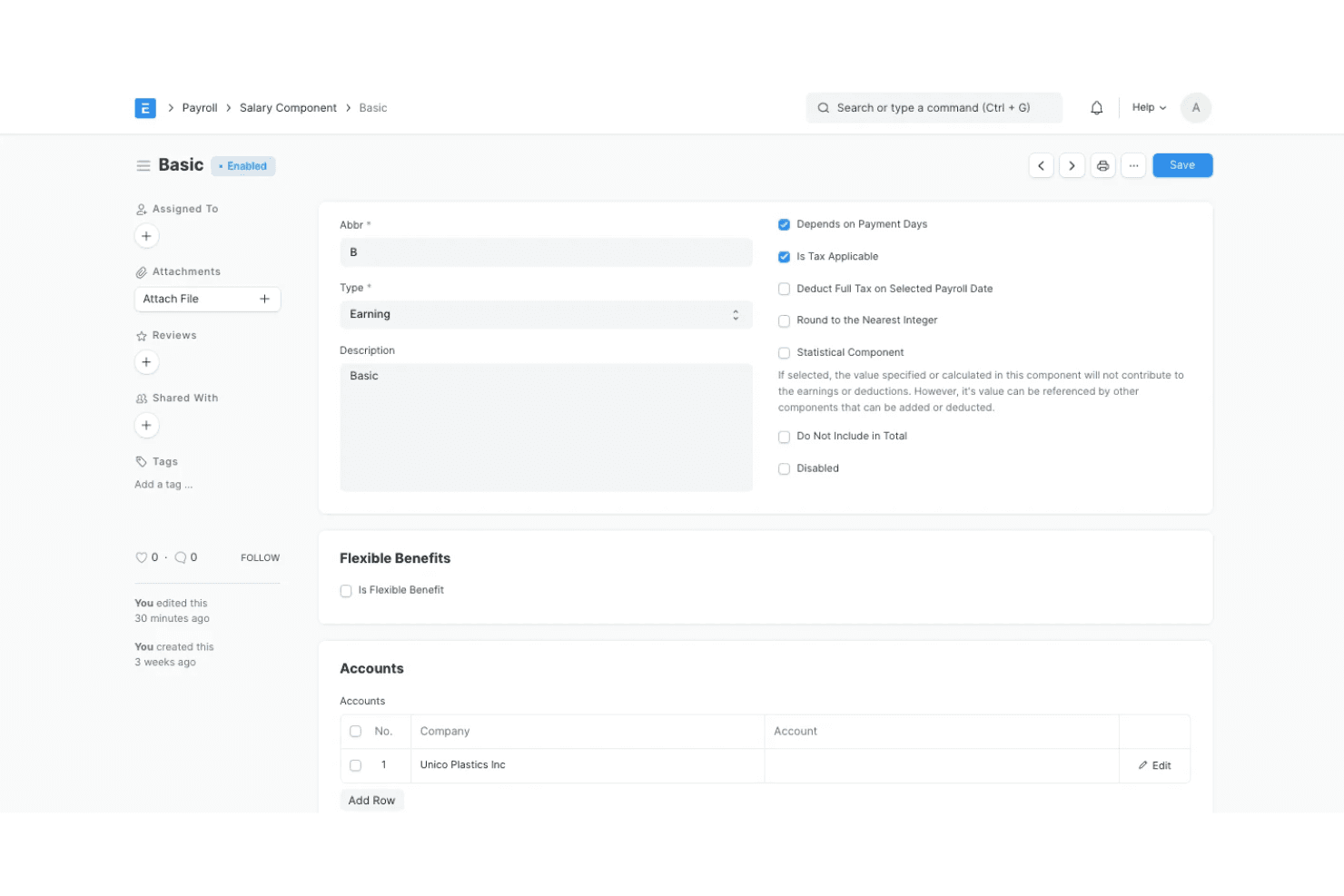
ERPNext's Payroll module lets you configure salary components such as Basic pay, including tax and account settings. ERPNext is an open-source ERP platform that, when used with the separate Frappe HR application, covers payroll processing, salary structure configuration, tax slab setup, bulk payroll processing, and direct accounting integration across HR, finance, and operations modules.
Who Is ERPNext Best For?
ERPNext is a strong fit for small businesses and IT teams that want to manage payroll, accounting, and HR within a single open-source platform they can fully control.
Why I Picked ERPNext
I picked ERPNext because it connects payroll processing directly with its accounting module. When you submit salary slips, ERPNext automatically creates the corresponding accrual journal entries, keeping payroll payable accounts up to date without manual reconciliation. I also like that you can configure salary structures with custom components and tax slabs, then process bulk payroll across branches or departments through a single payroll entry.
ERPNext Key Features
- Salary structure configuration: Define salary components, formulas, and tax slabs, then assign structures to individual employees or groups.
- Timesheet-based payroll: Calculate employee pay from submitted timesheets using the hourly rate defined in the salary structure.
- Salary slip email delivery: Automatically email password-protected salary slip PDFs to each employee's preferred email address.
- Role-based payroll access: Control who can process payroll and post accounting entries using HR Manager and Accounts User role permissions.
ERPNext Integrations
ERPNext has 398 marketplace apps, including Google Sheets Data Sync, Banking, Biostar Biometric Integration, and WhatsApp Integration. Its RESTful API supports custom integrations.
Pros and Cons
Pros:
- Supports encrypted payslip delivery
- Processes department-specific payroll batches
- Automatically posts payroll accruals
Cons:
- Non-Indian tax rules vary
- Accounting mappings need validation
Learn more about ERPNext: Best for salary workflows in a connected ERP
- Free open-source framework
- Free (self-hosted)
Visit WebsiteCustomer Rating:4.1/5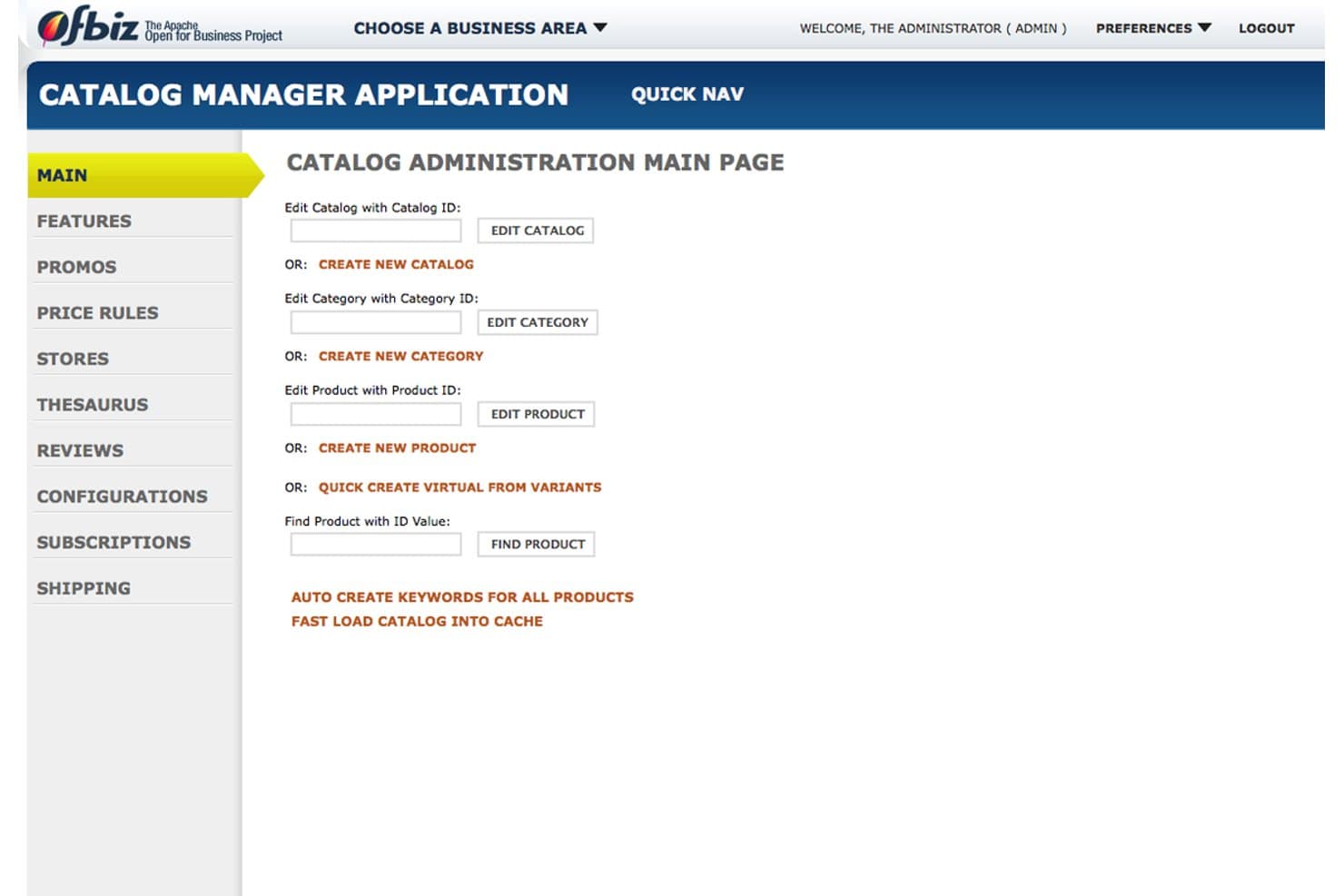
The Apache OFBiz Catalog Manager main page, for editing catalogs, categories and products. Apache OFBiz is an open-source, Java-based ERP framework with an HR module that handles salary calculations, pay grade management, payslip generation, and payroll invoice processing through an integrated accounting system.
Who Is Apache OFBiz Best For?
Apache OFBiz is a good fit for developer-led teams that need to build and maintain a self-hosted ERP with salary workflows closely connected to accounting and HR.
Why I Picked Apache OFBiz
I picked Apache OFBiz because its salary workflows operate within an integrated HR and accounting environment rather than as a separate application. You can define pay grades and salary steps linked to job position types, calculate salaries using direct amounts or grade-and-step structures, and process payroll invoices through the Accounting module's invoice lifecycle, from creation to general ledger posting and payment. I find this workflow particularly useful for teams that need payroll and general ledger records to remain synchronized without manual data transfers.
Apache OFBiz Key Features
- Pay grade and salary step configuration: Define pay grades and salary steps linked to job position types, with rates specified by year, month, week, or hour.
- HR and accounting module integration: Process payroll invoices through the Accounting module's invoice lifecycle, including creation, general ledger posting, and payment.
- Entity and service engine architecture: Build and extend custom business logic at the data model and service levels without being restricted by a fixed application structure.
- On-premises self-hosting: Deploy OFBiz on your own infrastructure across supported Windows or Unix-based environments to maintain control over payroll data.
Apache OFBiz Integrations
Apache OFBiz does not document native integrations with named external vendors. It provides APIs and connects HR salary workflows with its built-in Accounting module for custom integrations.
Pros and Cons
Pros:
- Processes integrated payroll invoices
- Supports flexible Java customization
- Configures graded salary steps
Cons:
- Payroll history uses invoices
- Statutory withholding setup undocumented
Learn more about Apache OFBiz: Best for DIY payroll around a self-hosted ERP
- Free plan + free demo available
- Free software (payroll add-on from €180)
Visit WebsiteCustomer Rating:4.5/5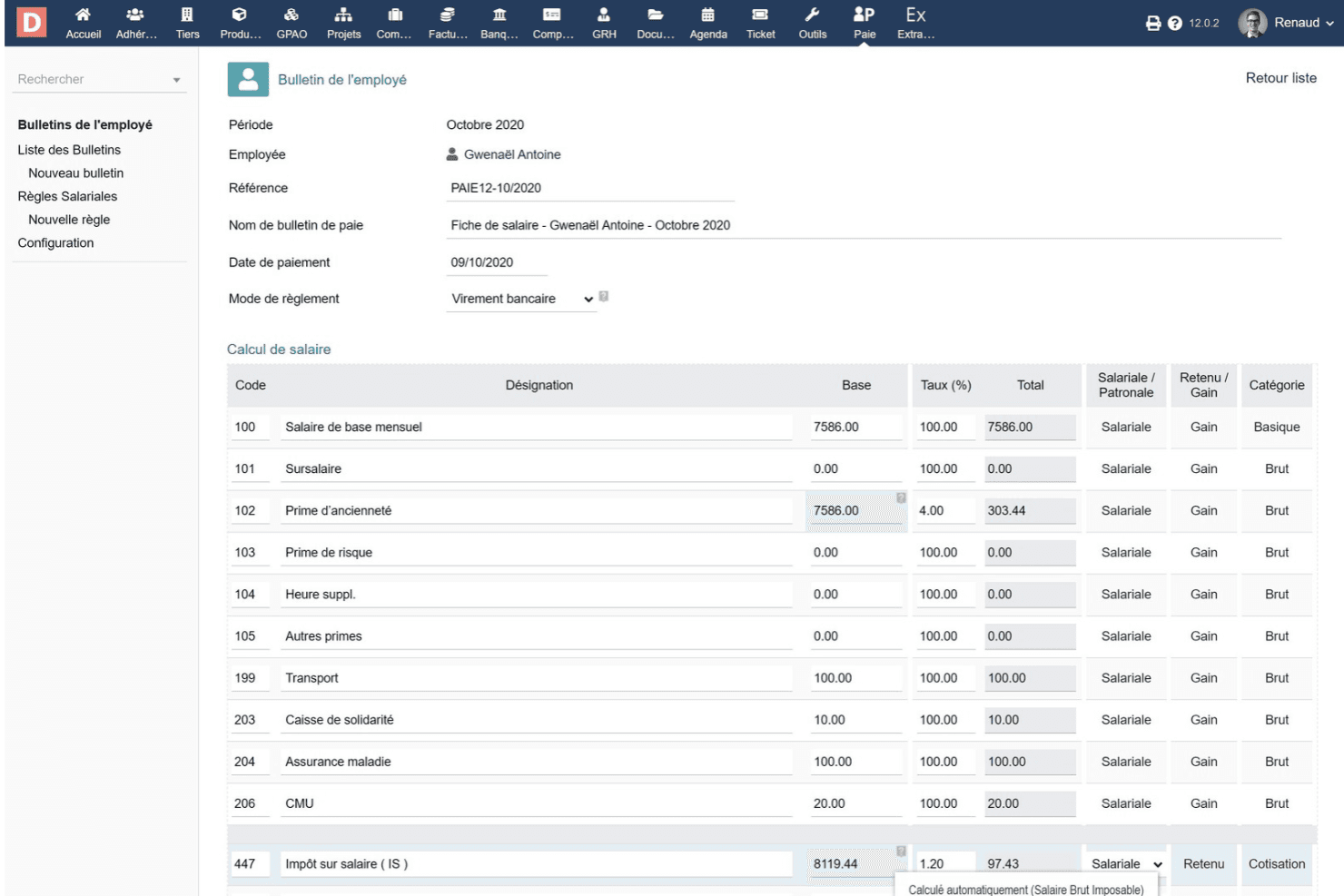
Dolibarr's payroll module generating an employee payslip with salary lines and social contributions. Dolibarr is an open-source ERP and CRM suite that covers HR, finance, billing, timesheets, and expense management. Its built-in Salaries module records salary payments, while full gross-to-net payroll calculations require a separately purchased add-on, such as Odoo Payroll for Dolibarr.
Who Is Dolibarr Best For?
Dolibarr is a good fit for technically inclined small business owners and developers who want a self-hosted, open-source ERP foundation that they can extend with custom payroll logic.
Why I Picked Dolibarr
I picked Dolibarr because it provides a self-hosted ERP environment that businesses can extend to accommodate their payroll requirements. The core Salaries module handles salary payment recording, while the separately purchased Odoo Payroll for Dolibarr add-on provides configurable gross-to-net calculations using custom salary rules, structures, and formula-based logic. This flexibility is useful for businesses with compensation arrangements that do not fit standard payroll structures, although the additional module cost and local compliance requirements must be considered.
Dolibarr Key Features
- Employee and user management: Create employee profiles, organize users into groups and hierarchies, and assign role-based permissions across the system.
- Leave request tracking: Employees submit leave requests through the platform, supervisors approve or decline them, and the system automatically updates leave balances.
- Timesheet recording: Record time by day, week, month, project, or task, and convert logged hours into monetary values using each employee's configured hourly rate.
- REST API and module builder: Access REST APIs through an embedded API explorer and use the low-code Module Builder to extend or customize the application without writing everything from scratch.
Dolibarr Integrations
Dolibarr offers native LDAP integration for user authentication and synchronization. Its REST API, triggers, hooks, and external modules support custom connections with HR, accounting, and payroll systems.
Pros and Cons
Pros:
- Extends payroll through add-ons
- Records employee salary payments
- Supports modular ERP customization
Cons:
- Add-on compliance needs validation
- Native payroll excludes calculations
Learn more about Dolibarr: Best for self-hosting with setup support
- Free demo available
- Pricing upon request
Visit WebsiteCustomer Rating:3/5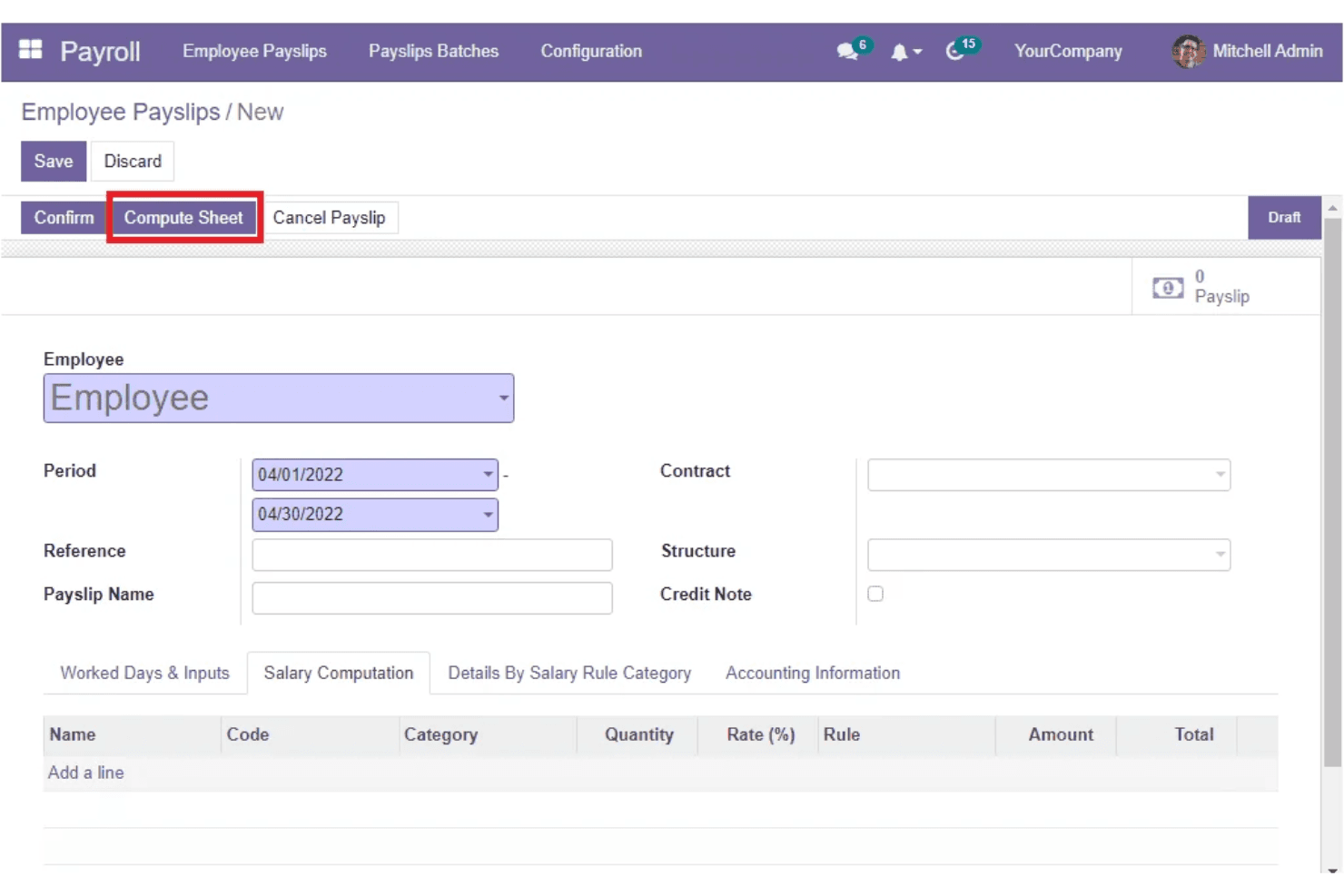
Payroll app screen for creating an employee payslip and computing the salary sheet. Open HRMS is an open-source HR and payroll management system built on Odoo that covers payroll processing, attendance, leave management, recruitment, appraisals, and employee records.
Who Is Open HRMS Best For?
Open HRMS is a strong fit for small businesses and IT teams that want a self-hosted, open-source HR and payroll system they can deploy on their own infrastructure and customize at the code level.
Why I Picked Open HRMS
I've included Open HRMS in my top picks because it's designed for teams that want to manage payroll on their own infrastructure without ongoing software licensing fees. I particularly like that it offers vendor-backed implementation packages, allowing organizations to access support when setting up Odoo. Its payroll module also handles salary structures, configurable deduction rules, and batch payslip generation, supporting gross-to-net payroll processing once an active employee contract is in place.
Open HRMS Key Features
- Payslip batch generation: Group employees under the same salary structure and generate their payslips together in a single batch.
- Biometric attendance integration: Connect fingerprint-reading and facial recognition devices to capture attendance data that feeds directly into payroll calculations.
- Employee loan management: Configure loan policies, manage approvals, and automatically deduct repayments from employee payslips.
- HR reporting suite: Generate reports covering attendance, leave, payroll, and expenses, with filtering and drill-down options for detailed analysis.
Open HRMS Integrations
Open HRMS has documented native integrations with biometric devices, including fingerprint-reading and facial recognition devices, for attendance tracking. Native third-party integrations and API availability are not clearly documented.
Pros and Cons
Pros:
- Includes vendor-backed implementation assistance
- Connects biometric attendance devices
- Generates batch employee payslips
Cons:
- Deployment guidance lacks detail
- Jurisdictional payroll modules vary
Learn more about Open HRMS: Best for payroll tied to wider ERP operations
- Free open-source framework
- Free (self-hosted)
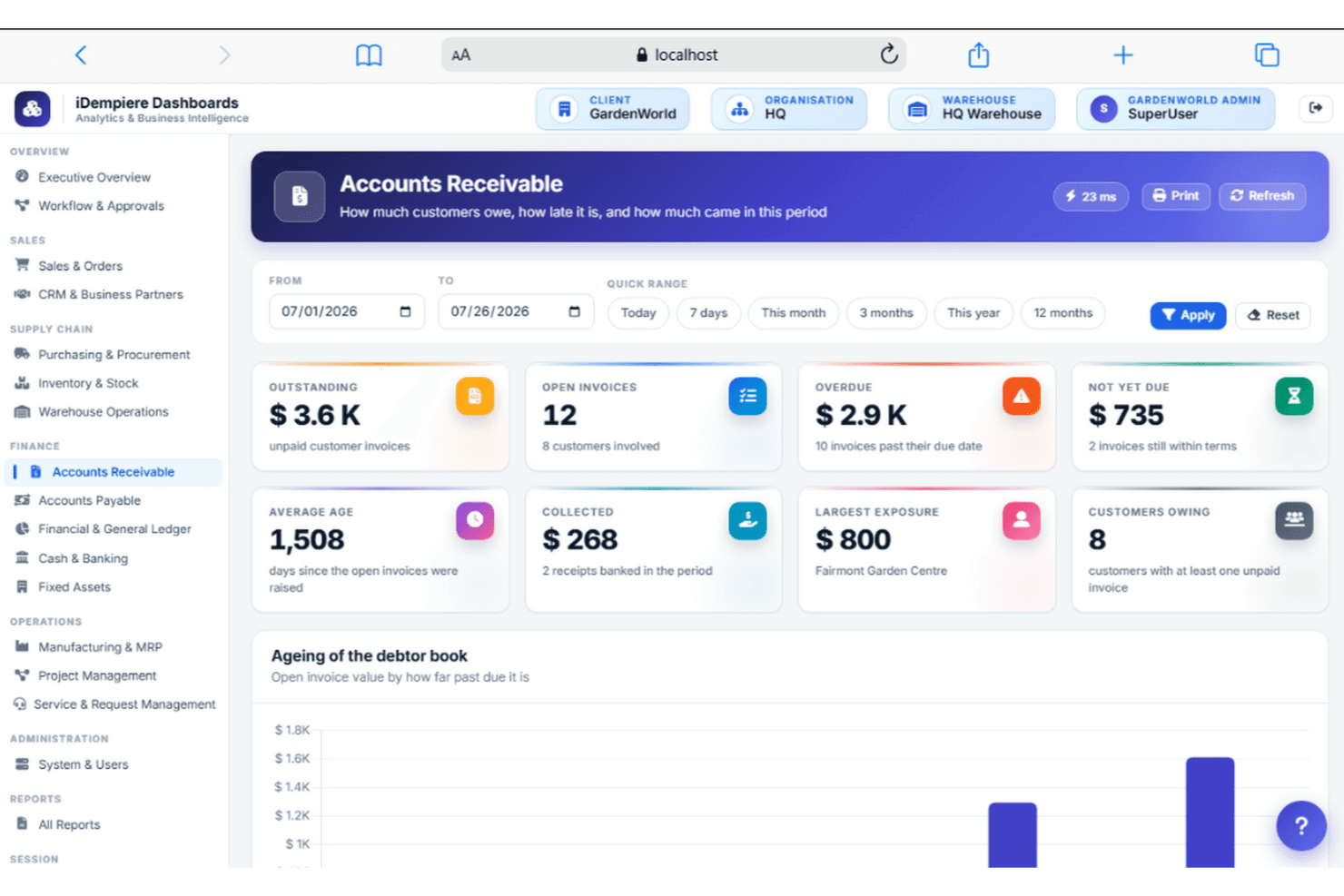
The iDempiere Accounts Receivable dashboard, showing outstanding invoices, overdue amounts and debtor ageing. iDempiere is an open-source ERP platform that connects payroll processing, HR, accounting, procurement, inventory, and manufacturing within a single self-hosted system.
Who Is iDempiere Best For?
iDempiere is a strong fit for IT teams and developers who need payroll integrated with a broader ERP system and have the technical expertise to configure and self-host it.
Why I Picked iDempiere
I picked iDempiere because its payroll functionality can operate within a comprehensive ERP platform that also handles accounting, procurement, and manufacturing. Through the CDSoftware Payroll plugin, payroll calculations connect directly with iDempiere's financial accounting system, allowing payroll and journal entries to remain synchronized without manual exports. I also like that the plugin supports multi-currency payroll attributes and employee loan management with accounting functionality, which is useful for organizations managing different compensation structures.
iDempiere Key Features
- Role-based access controls: Assign permissions at the organization, table, column, and record levels to restrict access to sensitive payroll information.
- REST and SOAP APIs: Connect iDempiere to external HR, finance, or reporting tools using built-in REST and optional SOAP/XML web services.
- Payroll report generation: Generate standard reports, including payment receipts, employee directories, work certificates, and assignment and deduction summaries.
- On-premises deployment: Self-host iDempiere on Linux, Windows, or macOS servers, maintaining control over where payroll data is stored.
iDempiere Integrations
Documented integrations include Snowflake, dbt, Tableau, 3CX, OpenEMR, Availity, and TriZetto. iDempiere also supports REST and SOAP/XML web services for custom payroll and ERP integrations.
Pros and Cons
Pros:
- Accommodates multicurrency payroll attributes
- Supports granular record permissions
- Connects payroll with accounting
Cons:
- Localization depends on extensions
- Payroll requires external plugins
Learn more about iDempiere: Best for workforce costs in a wider ERP
- Free plan + free demo available
- Free (self-hosted)
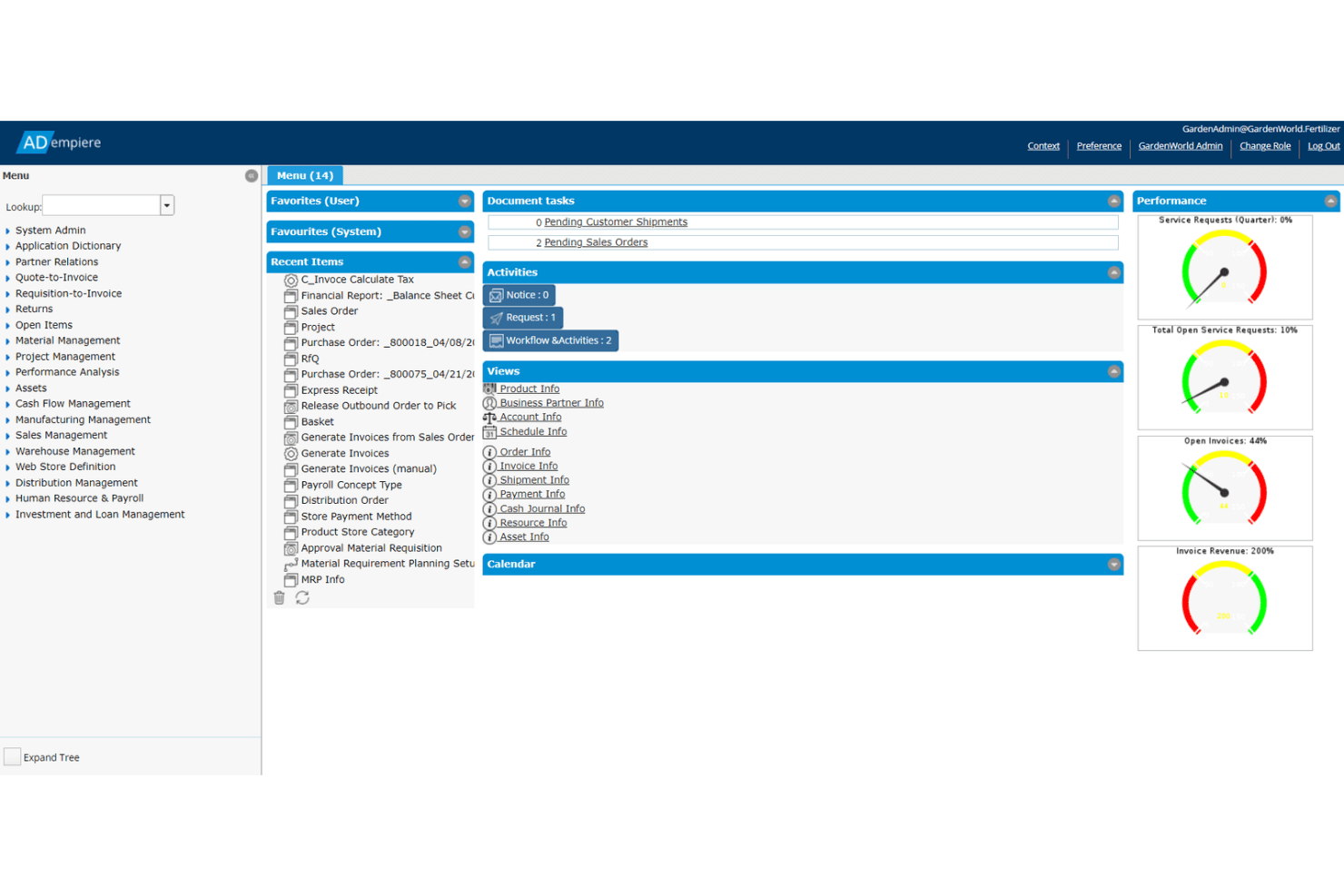
The ADempiere main dashboard with menu navigation, recent items, pending tasks and performance gauges. ADempiere is an open-source ERP with a built-in payroll module that handles payroll rules, calculations, payroll movement processing, and accounting integration through a self-hosted, GPL-2.0-licensed platform.
Who Is ADempiere Best For?
ADempiere works best for IT-led teams that need payroll integrated with a broader ERP and have the technical resources to configure and maintain a self-hosted, open-source system.
Why I Picked ADempiere
I picked ADempiere because it integrates payroll with a comprehensive ERP, allowing workforce costs to be managed alongside purchasing, accounting, and inventory in a single system. I find its payroll rules engine particularly useful because you can define custom payroll concepts, configure stop values for individual employees or payroll runs, and post final amounts through Accounts Payable without leaving the platform. The JSR 223 scripting API also allows teams to create custom calculation logic for payroll rules, which is helpful when standard deduction structures do not match an organization's pay policies.
ADempiere Key Features
- Payroll report generation: Generate salary-change, employee-dependent, employee-detail, and bank-account-detail reports directly from the payroll module.
- Payroll process selection criteria: Filter payroll runs by department, job type, employee status, salary structure, shift group, and more than a dozen other criteria.
- Accounts Payable posting: Post final payroll amounts through the built-in Accounts Payable model using ADempiere's standard accounting framework.
- JasperReports integration: Build and generate custom payroll report templates using JasperReports, which is embedded in ADempiere's reporting engine.
ADempiere Integrations
ADempiere does not clearly document native third-party integrations. Its payroll module connects internally with Accounts Payable, commission calculations, and payment selection within the ERP.
Pros and Cons
Pros:
- Customizes JasperReports payroll templates
- Filters detailed payroll runs
- Executes scripted payroll calculations
Cons:
- Payroll scripting needs maintenance
- Prebuilt compliance rules sparse
Learn more about ADempiere: Best for India-specific payroll compliance
- Free plan + 14-day free trial available
- From $5/month (hosting; software free)
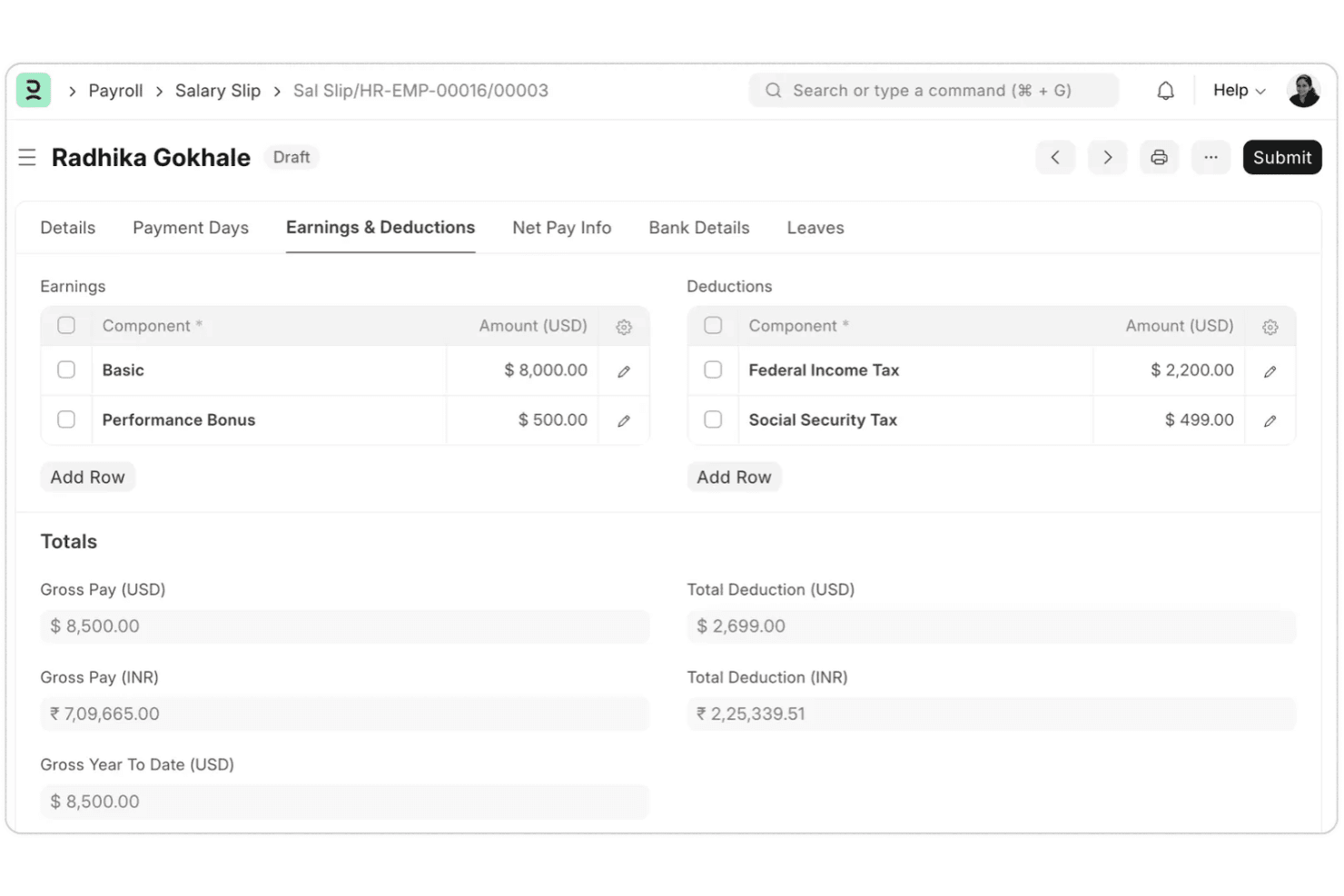
Frappe HR's salary slip screen lists earnings, deductions, and totals for an employee in draft status. Frappe HR is an open-source HR and payroll platform with dedicated modules for salary structures, statutory deductions, attendance, leave, expense claims, and employee lifecycle management.
Who Is Frappe HR Best For?
Frappe HR is a strong fit for India-based HR and payroll teams that need built-in statutory compliance support covering Provident Fund (PF), Employees' State Insurance (ESI), Professional Tax, and Labour Welfare Fund requirements across multiple states.
Why I Picked Frappe HR
I've included Frappe HR in my top picks because it offers built-in statutory compliance support for India's complex payroll deductions. The India Payroll module covers Professional Tax across more than 15 states, Labour Welfare Fund requirements across 14 states, ESI wage ceilings, and PF configuration, including voluntary contributions. I also like that employees can compare the old and new tax regimes, declare exemptions, and save their selected regime to their salary structure assignments.
Frappe HR Key Features
- Salary structure builder: Create rule-based salary structures with earnings, deductions, conditions, and formulas for different employee groups.
- Multi-currency payroll: Process payroll in a foreign currency and view gross and net totals in both that currency and your company's base currency.
- Timesheet-based payroll: Set hourly rates linked to project or task timesheets and process separate payroll entries for time-based compensation.
- Income tax declarations and proofs: Collect employee exemption declarations and supporting documents to incorporate into payroll tax calculations.
Frappe HR Integrations
Frappe HR has native integrations with ERPNext and Frappe Lending, along with REST API and webhook support for custom integrations.
Pros and Cons
Pros:
- Compares employee taxation regimes
- Configures voluntary PF contributions
- Supports Indian statutory deductions
Cons:
- Conditional formulas require configuration
- International tax localization limited
Learn more about Frappe HR: Best for embedding payroll in your product
- Free open-source framework
- Free framework (commercial regulations priced separately)
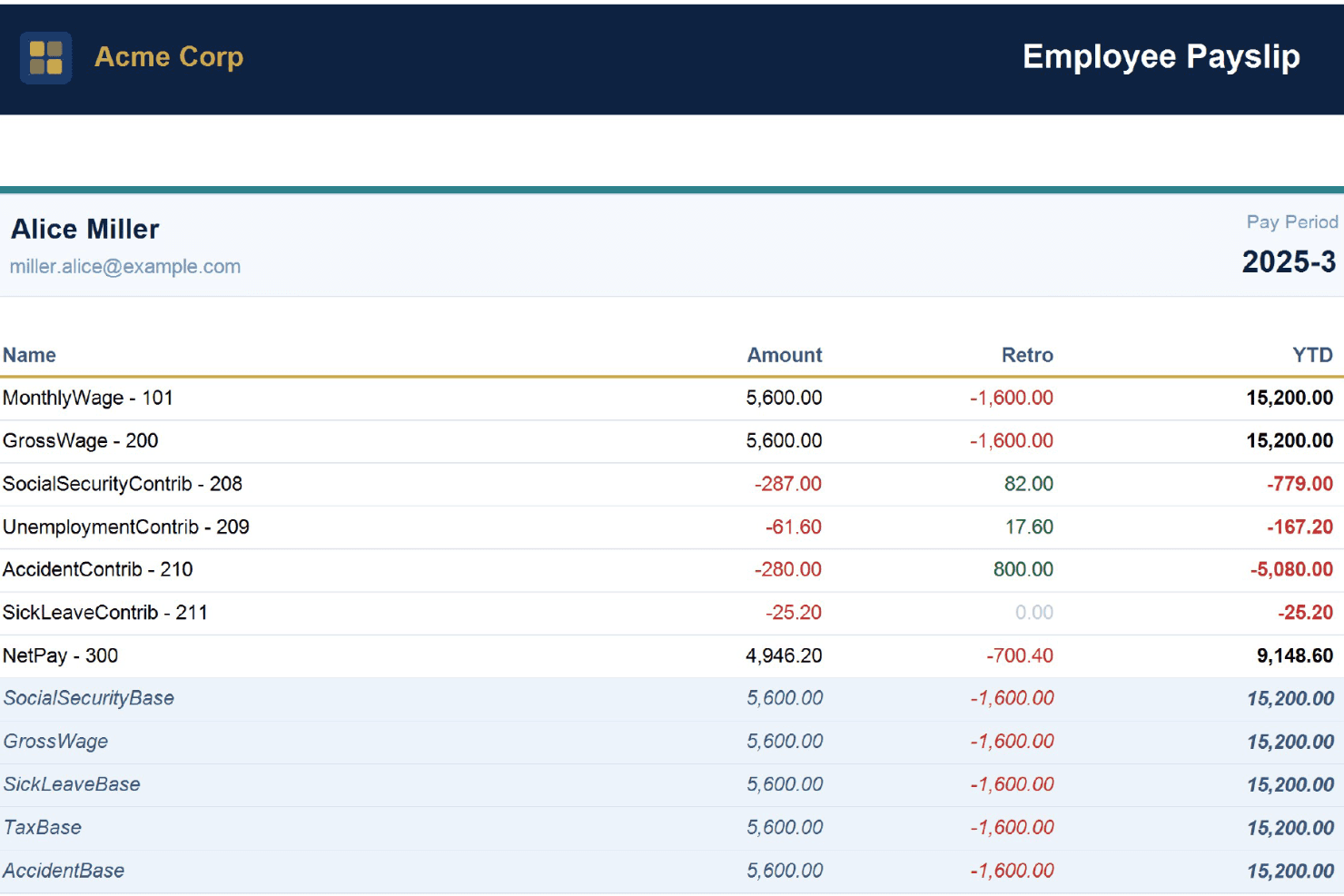
Sample employee payslip showing wages, statutory contributions, net pay and year-to-date totals. Payroll Engine is an open-source, self-hosted payroll framework built on .NET that handles gross-to-net calculations, retroactive payroll processing, multi-tenant regulation layers, forecasting, and report generation through a REST API and C# scripting model.
Who Is Payroll Engine Best For?
Payroll Engine is designed for developers and software teams that need to embed payroll processing logic directly into a custom application or platform.
Why I Picked Payroll Engine
I picked Payroll Engine because it's purpose-built for embedding payroll logic into custom products rather than operating as a standalone payroll application. I find its composable regulation layer model particularly useful because teams can combine country, company, and tenant-level rules, version them, and extend them with C# scripts or no-code actions to accommodate different pay structures. The retroactive payroll engine also handles past-dated corrections without requiring manual workarounds, which is valuable for product teams building payroll functionality into their platforms.
Payroll Engine Key Features
- Composable regulation layers: Combine country, company, and tenant-level payroll rules that can be versioned, inherited, and shared across tenants.
- Payroll forecasting: Run named what-if payroll scenarios against live regulations and employee data without affecting production results.
- Lifecycle test framework: Define JSON-based tests covering case input, payroll processing, and report output, with CI/CD pipeline support.
- Multi-format report output: Generate payslips and summaries using culture-specific templates and export them as XML, Excel, or PDF files.
Payroll Engine Integrations
Payroll Engine does not provide native integrations. It supports custom connectivity through its OpenAPI 3.1 REST API, webhooks, and .NET Client SDK.
Pros and Cons
Pros:
- Versions complex regulatory layers
- Handles retroactive payroll corrections
- Embeds payroll into applications
Cons:
- Compliance packs require licensing
- Requires custom application development
Learn more about Payroll Engine: Best for free, unlimited-user self-hosted HR
- Free plan + 30-day free trial available
- From $7/user/month
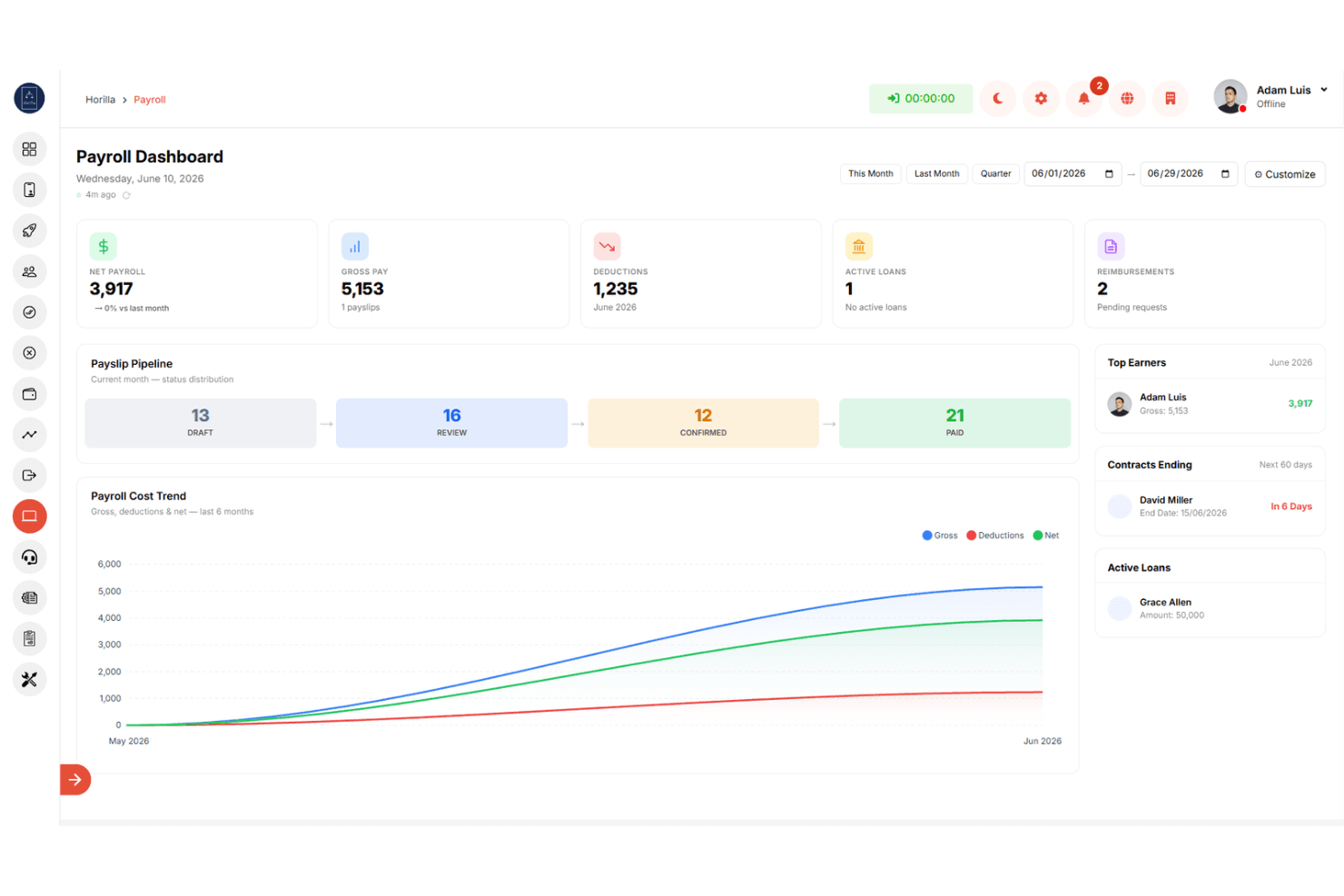
Horilla's payroll dashboard tracks net pay, deductions, payslip status and six-month cost trends in one view. Horilla is an open-source HR and payroll platform that covers the employee lifecycle, including payroll calculations, attendance tracking, leave management, recruitment, and onboarding, through a single self-hosted or cloud-deployed system.
Who Is Horilla Best For?
Horilla is a strong fit for small businesses and technical teams that want a comprehensive HR and payroll system without paying per-user licensing fees for its self-hosted open-source edition.
Why I Picked Horilla
I picked Horilla because it allows organizations to self-host an HR and payroll system for an unlimited number of users without ongoing software licensing fees. The payroll module handles gross-to-net calculations, statutory components such as PF and TDS, configurable tax brackets, and automatic loan recovery across pay cycles. I also like that attendance data flows directly into payroll, reducing the need for manual reconciliation when overtime or mid-month starts affect employee compensation.
Horilla Key Features
- Pay structure configuration: Create multiple salary structures and assign them by grade, department, or individual employee.
- Loan and advance tracking: Record employee loans and advances with automatic repayment schedules spread across future pay cycles.
- Payslip status workflow: Move payslips through draft, review, confirmed, and paid statuses, with bulk generation and CSV or PDF exports.
- Employee self-service portal: Allow employees to view their payslips, leave balances, attendance records, and submitted documents without requiring HR assistance.
Horilla Integrations
Horilla offers native integrations with LDAP, Google Drive, and WhatsApp, along with LinkedIn and Google Meet for HR workflows. Its REST API supports custom integrations through JWT authentication and Swagger/OpenAPI documentation. No accounting or ERP connectors are documented.
Pros and Cons
Pros:
- Tracks individual payslip statuses
- Automates employee loan recovery
- Offers unlimited self-hosted users
Cons:
- Payroll trend analysis limited
- Accounting connectors remain absent
Learn more about Horilla: 10Best for payroll tied to staff schedules
TimeTrex
- 30-day free trial + free demo available
- From $50/month
Visit WebsiteCustomer Rating:4.5/5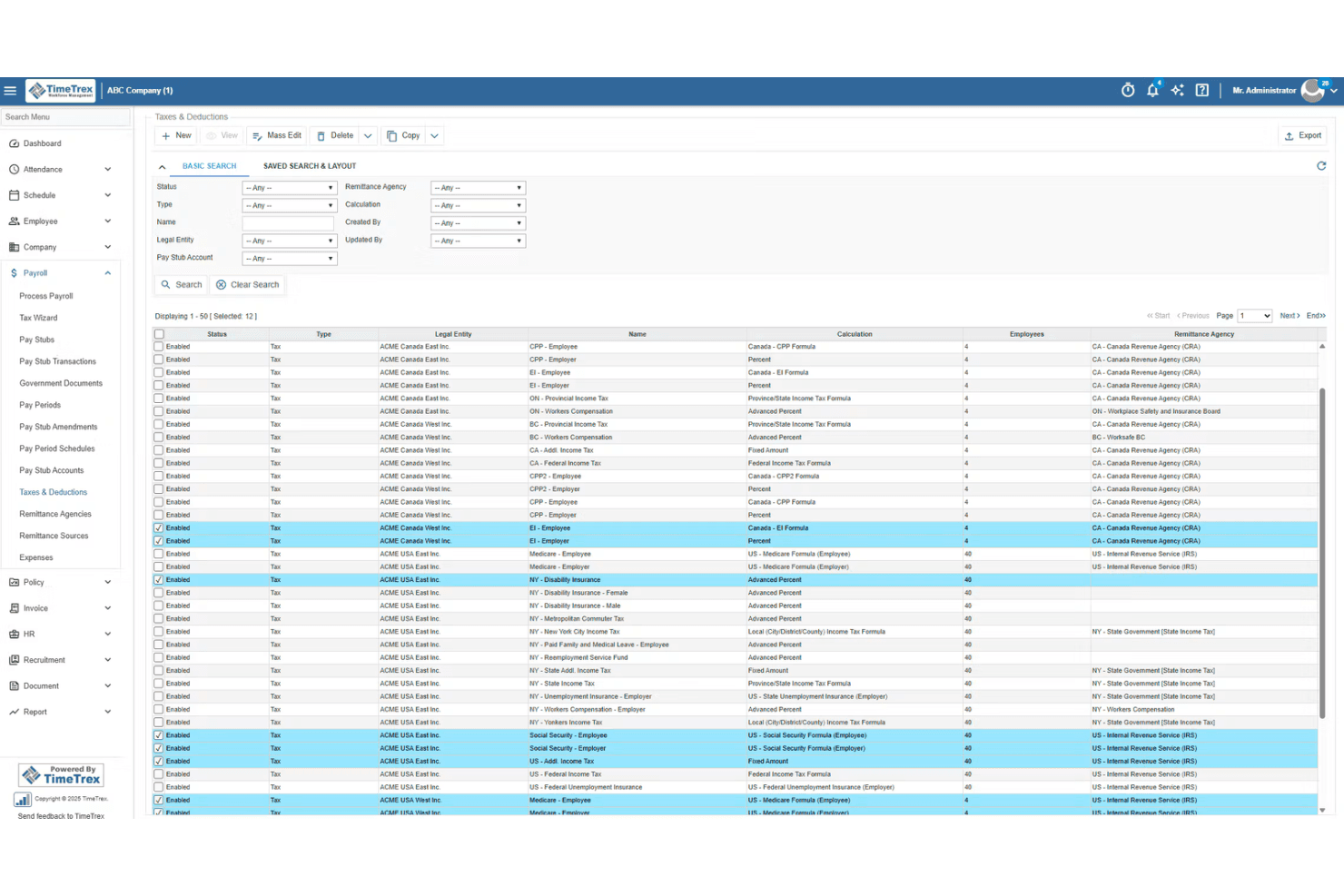
TimeTrex's Taxes & Deductions screen lists payroll tax entries by legal entity, calculation method, and remittance agency. TimeTrex is a workforce management platform with an on-premises deployment option that combines payroll processing, tax calculations, time and attendance tracking, and employee scheduling in a single system.
Who Is TimeTrex Best For?
TimeTrex is a strong fit for payroll managers who need time tracking and employee scheduling data to feed directly into payroll calculations.
Why I Picked TimeTrex
I've included TimeTrex in my top picks because its payroll engine connects directly with employee scheduling and time-tracking data. When a shift runs longer than planned or an employee clocks out early, that information feeds into payroll calculations without requiring manual data entry. I particularly like its automated scheduling capabilities and support for federal, state, and local payroll tax calculations. Its open-source Community Edition includes core scheduling and payroll functionality, although advanced features may vary by edition.
TimeTrex Key Features
- Payroll deductions management: Calculates and tracks deductions for benefits, taxes, and wage garnishments within each payroll run.
- Payroll tax calculations: Calculate federal, state, and local payroll taxes using configured tax rules, with jurisdiction-specific filing requirements needing separate verification.
- Employee self-service portal: Allows employees to access pay stubs, update personal information, and submit time-off requests directly.
- RESTful API and webhooks: Connects TimeTrex to external accounting, HR, and payroll systems through documented APIs and webhooks.
TimeTrex Integrations
TimeTrex offers integrations with Intuit QuickBooks, Sage, ADP, Paychex, Ceridian, the IRS, and the Canada Revenue Agency. It also provides a RESTful API, webhooks, and SDKs for custom connections.
Pros and Cons
Pros:
- Supports multi-state payroll calculations
- Identifies scheduling overtime risks
- Converts tracked shifts automatically
Cons:
- Deployment needs infrastructure management
- Advanced features vary by edition
Learn more about TimeTrex:
Inne otwartoźródłowe programy płacowe
Oto kilka dodatkowych opcji, które nie trafiły na moją listę wstępną, ale nadal warto je sprawdzić:
- 11PHP PayrollBest for varied pay types and local rules
- 12webERPBest for ERP users adding employee records
- 13PayrollBest for India-specific compliance outputs
- 14OCA PayrollBest for date-based tax rule changes
- 15Coati PayrollBest for payroll-linked vacation accruals
- 16JantaHRBest for legally cited payroll rule changes
- 17CworkBest for accountant-assisted Thai payroll
- 18AccountedBest for Swedish bureau pay runs via API
- 19DeduktoBest for South African tax in AI workflows
- 20Euron Open HRMSBest for managing payroll within HR workflows
How I Evaluate Open Source Payroll Software
I split my evaluation into three parts. Core functionality carries the most weight—I look for tools that can calculate gross-to-net pay and support configurable tax and compliance rules. I also check for standout features like multi-country localization, then consider total cost of ownership beyond the software itself.
Core Functionality (Table Stakes for This List)
When I'm selecting tools for my list, I score each one on a scale from 0 (does not offer the functionality) to 5 (excels in this area) for each core functionality listed below. I then convert the total into a percentage to help assess each tool's overall fit, with extra weight on any functionalities I've deemed essential.
- Open-Source Codebase (Essential): I check whether the source code is published under a recognized open-source license and whether the project has active maintainers and contribution channels.
- Payroll Calculation Engine (Essential): Each tool needs to compute gross-to-net pay across deductions, withholdings, and varied pay types like overtime, bonuses, and multiple pay schedules.
- Tax and Compliance Configuration: I look for configurable tax rules and statutory contributions that HR teams can adapt to their jurisdictions without waiting on a vendor update.
- Payslip and Report Generation: Tools should produce formatted payslips and summary reports that payroll managers can share with employees or use during audits.
- Self-Hosting Capability: I evaluate how well-documented the deployment process is, whether the project offers containers or install scripts, and how much technical effort setup requires.
- Integration and Extensibility: APIs, modules, or plugins that connect payroll to time-tracking, HR, or accounting systems matter here, since payroll rarely operates in isolation.
Once I have a list of tools that meet the criteria, I consider what sets each platform apart.
Differentiating Factors (What Sets Vendors Apart)
Here's how I compare and contrast different vendors:
Standout Features
I look for a modular plugin architecture that lets you add country-specific tax packs without touching the core code. For example, ERPNext and iDempiere both use module systems, but I check how easy it is to swap in a new localization pack when you expand to another region. Audit trail and versioning capabilities also matter—detailed logs of every payroll change help during internal reviews and regulatory checks. I evaluate whether employee self-service portals give staff direct access to payslips and tax documents, which reduces routine requests for HR teams.
Beyond Features
I check how often a project's GitHub repository receives commits and how active its forums are, since a stagnant codebase means you'll wait longer for compliance patches. Total cost of ownership matters too—hosting, developer hours for customization, and paid support tiers can quickly offset the savings of a free license. I also evaluate how clearly each tool documents deployment, because a platform like ERPNext with detailed install guides gets teams running far faster than one with sparse documentation. Finally, open-source payroll shifts regulatory responsibility to you, so I look for projects where community-maintained tax updates are released and reviewed promptly.
Jak wybrać otwartoźródłowe oprogramowanie płacowe
Wybierz system, dopasowując jurysdykcję, możliwości techniczne oraz odpowiedzialność za zmiany w przepisach płacowych do zakresu, który dokumentuje i obsługuje dany projekt.
| Jeśli Twoim priorytetem jest… | Szukaj… |
|---|---|
| Jeśli Twoim priorytetem jest…Lokalna zgodność z przepisami | Szukaj…Opublikowana lista obsługiwanych jurysdykcji i aktualizacje przepisów z podanymi datami |
| Jeśli Twoim priorytetem jest…Kontrola nad kodem i danymi | Szukaj…Uznana licencja i udokumentowane wymagania dotyczące samodzielnego hostingu |
| Jeśli Twoim priorytetem jest…Możliwość prześledzenia zmian w płacach | Szukaj…Przechowywane rejestry zmian i jasny proces przeglądu korekt |
| Jeśli Twoim priorytetem jest…Przewidywalne koszty utrzymania | Szukaj…Szacunki kosztów hostingu, konserwacji, dostosowywania i prac związanych ze zgodnością z przepisami |
Jak zweryfikować swoją listę wstępną
- Poproś o dowody zgodności: Poproś o dokument z datą, zawierający listę obsługiwanych jurysdykcji, objętych przepisami ustawowymi oraz informacje o osobach odpowiedzialnych za aktualizacje.
- Przeprowadź trzy przypadki testowe: Użyj zanonimizowanych danych dotyczących regularnego wynagrodzenia, nadgodzin i jednorazowej premii; porównaj wyniki obliczeń od brutto do netto z obliczeniami zweryfikowanymi przez specjalistę ds. płac.
- Sprawdź licencję: Zachowaj treść licencji projektu i potwierdź, czy planowane modyfikacje, hosting oraz dystrybucja są z nią zgodne.
- Przetestuj nakład pracy związany z wdrożeniem: Postępuj zgodnie z instrukcją instalacji w środowisku testowym, rejestruj liczbę godzin konfiguracji i zanotuj wszelkie zależności wymagające płatnego wsparcia lub pracy specjalisty.
- Ustal kryterium decyzyjne: Wybierz kontrolę nad kodem i możliwość dostosowywania tylko wtedy, gdy możesz wyznaczyć osobę odpowiedzialną za przegląd zmian w przepisach płacowych co najmniej raz na kwartał; w przeciwnym razie wybierz projekt z jasno udokumentowaną odpowiedzialnością za aktualizacje.
Czym jest otwartoźródłowe oprogramowanie płacowe?
Otwartoźródłowe oprogramowanie płacowe to oprogramowanie, którego kod źródłowy jest publicznie dostępny na podstawie licencji otwartego oprogramowania. W zależności od licencji i systemu można go przeglądać, modyfikować lub hostować samodzielnie. Funkcje płacowe różnią się między narzędziami, dlatego sprawdź, czy dane rozwiązanie obsługuje obliczenia wynagrodzeń, zasady zgodności z przepisami oraz raportowanie wymagane przez Twoją organizację.
Funkcje
Oto najważniejsze funkcje, których szukam w otwartoźródłowym oprogramowaniu płacowym:
- Obliczenia wynagrodzeń: Oblicza wynagrodzenie brutto i netto, uwzględniając zarobki, potrącenia i zaliczki. Zapewnia to zespołom płacowym spójny sposób realizacji każdej listy płac.
- Przepisy podatkowe i ustawowe: Stosuje konfigurowalne stawki podatkowe i wymagane składki dla obsługiwanych jurysdykcji. Sprawdź, jak aktualizowane są przepisy i kto odpowiada za weryfikowanie zmian.
- Harmonogramy wypłat i typy wynagrodzeń: Obsługuje cykliczne okresy wypłat oraz składniki wynagrodzenia, takie jak nadgodziny, premie i wynagrodzenie godzinowe lub stałe. Opcje te pomagają uwzględnić różne formy zatrudnienia.
- Dokumentacja płacowa pracowników: Przechowuje informacje, takie jak wynagrodzenie, dane podatkowe, preferencje dotyczące płatności i potrącenia. Dokładne dane zapewniają informacje potrzebne do obliczania wynagrodzeń.
- Paski wynagrodzeń i dostęp pracowników: Generuje szczegółowe paski wynagrodzeń przedstawiające zarobki, potrącenia i wynagrodzenie netto. Portal pracownika może umożliwiać pracownikom wyświetlanie lub pobieranie dokumentów.
- Raporty płacowe: Podsumowuje koszty wynagrodzeń, potrącenia i łączne kwoty płatności na potrzeby weryfikacji lub prowadzenia dokumentacji. Raporty mogą pomóc zespołom uzgadniać listy płac i przygotowywać się do audytów.
- Dane dotyczące czasu pracy i obecności: Importuje lub rejestruje godziny pracy, nadgodziny i nieobecności wykorzystywane przy obliczaniu wynagrodzeń. Sprawdź, czy system łączy się z używanymi narzędziami do ewidencji czasu pracy, czy wymaga ręcznego wprowadzania danych.
- Integracje i możliwość rozbudowy: Łączy system płacowy z systemami HR, księgowymi lub do ewidencji czasu pracy za pośrednictwem interfejsów API, modułów lub wtyczek. Pomaga to zespołom ograniczyć wielokrotne wprowadzanie tych samych danych w różnych systemach.
- Historia zmian: Rejestruje modyfikacje danych płacowych i obliczeń, w tym informacje o tym, kto wprowadził każdą zmianę, jeśli system obsługuje taką funkcję. Zachowana historia pomaga zespołom weryfikować korekty i badać rozbieżności.
Korzyści
Oto kilka typowych korzyści, których można oczekiwać od otwartoźródłowego oprogramowania płacowego:
- Kontrola nad kodem i danymi: Uznana licencja otwartoźródłowa może umożliwić zespołowi przeglądanie lub modyfikowanie kodu oraz samodzielne hostowanie danych płacowych.
- Elastyczność reguł płacowych: Konfigurowalne potrącenia, zaliczki i typy wynagrodzeń mogą pomóc dostosować obliczenia do potrzeb płacowych organizacji.
- Konfiguracja właściwa dla jurysdykcji: Moduły lokalizacyjne lub konfigurowalne reguły mogą obsługiwać lokalne wymagania, pod warunkiem że zespół zweryfikuje zakres obsługi i będzie aktualizować system.
- Elastyczność kosztów: Bezpłatna licencja może obniżyć koszty oprogramowania, pozwalając jednocześnie zdecydować, ile przeznaczyć na hosting, dostosowanie i wsparcie.
- Identyfikowalność procesów płacowych: Jeśli system obsługuje historię zmian, dzienniki modyfikacji mogą pomóc zespołowi weryfikować korekty i przygotowywać się do audytów.
- Połączone procesy pracy: Interfejsy API, moduły lub wtyczki mogą łączyć system płacowy z systemami HR, księgowymi lub do ewidencji czasu pracy, jeśli oprogramowanie obsługuje takie integracje.
Cennik
Otwartoźródłowe oprogramowanie płacowe może być bezpłatne do pobrania i samodzielnego hostowania, ale wdrożenie, hosting, utrzymanie i wsparcie mogą wiązać się z dodatkowymi kosztami. Ceny zależą od metody wdrożenia, wymagań technicznych oraz wszelkich płatnych modułów lub usług, których potrzebujesz.
Tabela porównawcza planów otwartoźródłowego oprogramowania płacowego
| Typ planu | Typowy cennik | Typowe funkcje |
|---|---|---|
| Typ planuPlan bezpłatny | Typowy cennik$0 za licencję na oprogramowanie | Typowe funkcjePodstawowe funkcje, samodzielny hosting i wsparcie społeczności. Konfiguracja i utrzymanie są zazwyczaj realizowane wewnętrznie. |
| Typ planuPlan hostowany | Typowy cennikRóżni się w zależności od dostawcy | Typowe funkcjeZarządzany hosting, kopie zapasowe, aktualizacje oprogramowania i podstawowe wsparcie, zależnie od dostawcy. |
| Typ planuPlan biznesowy | Typowy cennikSubskrypcja lub indywidualna wycena | Typowe funkcjeDodatkowe wsparcie, integracje, konfiguracja płac i opcjonalne moduły zapewniania zgodności. |
| Typ planuPlan dla przedsiębiorstw | Typowy cennikIndywidualna wycena | Typowe funkcjeZaawansowane dostosowanie, pomoc we wdrożeniu, dedykowane wsparcie i obsługa wielu podmiotów, jeśli jest dostępna. |
Najczęściej zadawane pytania
Oto odpowiedzi na często zadawane pytania dotyczące otwartego oprogramowania płacowego:
Czy otwarte oprogramowanie płacowe może obsługiwać wiele krajów?
Niektóre otwarte systemy płacowe obsługują wiele krajów, ale zakres obsługi zależy od oprogramowania i jego modułów lokalizacyjnych. Sprawdź, czy podatki dochodowe, obowiązkowe składki, formaty raportów i zasady naliczania wynagrodzeń obowiązujące w każdym kraju są udokumentowane i aktualizowane. System obsługujący obliczenia płac w jednym kraju nie będzie automatycznie uwzględniał wymagań innego kraju. Przed dokonaniem wyboru przetestuj przykładowe obliczenia dla każdej jurysdykcji, w której zatrudniasz pracowników. Ustal, kto aktualizuje zasady, jak weryfikowane są aktualizacje i co dzieje się w przypadku zmiany zasady między zaplanowanymi wydaniami.
Czy potrzebuję programisty, aby uruchomić otwarte oprogramowanie płacowe?
Nie zawsze, ale potrzebna będzie osoba mająca umiejętności niezbędne do zainstalowania, skonfigurowania i utrzymywania wybranego systemu. Niektóre projekty udostępniają instrukcje instalacji lub opcje wdrażania oparte na kontenerach, podczas gdy inne wymagają bardziej zaawansowanych prac technicznych. W zespole musi również znajdować się osoba odpowiedzialna za zasady naliczania płac, aktualizacje oprogramowania, kopie zapasowe i uprawnienia dostępu. Przetestuj instalację w środowisku testowym i odnotuj czas oraz zakres potrzebnej pomocy specjalistycznej. Taki test daje wyraźniejszy obraz bieżącego nakładu pracy niż sama cena licencji.
Czy otwarte oprogramowanie płacowe automatycznie składa deklaracje podatkowe i opłaca podatki?
Czasami, ale funkcje obliczania wynagrodzeń nie gwarantują automatycznego składania deklaracji podatkowych ani dokonywania płatności. Sprawdź w dokumentacji produktu konkretne formaty deklaracji, obsługiwane procesy przesyłania oraz funkcje płatności dostępne w Twojej jurysdykcji. Twój zespół może być zmuszony do eksportowania raportów, przesyłania formularzy przez portal rządowy lub osobnego organizowania płatności. Przed przetworzeniem rzeczywistej listy płac porównaj obliczenia oprogramowania z wartościami zweryfikowanymi przez specjalistę ds. płac. Ustal również, kto monitoruje zmiany przepisów i weryfikuje aktualizacje, zanim wpłyną one na wynagrodzenia pracowników.
Jak chronić dane pracowników podczas hostowania oprogramowania płacowego na własnej infrastrukturze?
Chroń dane płacowe za pomocą kontrolowanego dostępu, bezpiecznych kopii zapasowych i udokumentowanego procesu aktualizacji oprogramowania. Ogranicz dostęp do pracowników, którzy potrzebują informacji płacowych, i weryfikuj uprawnienia, gdy ktoś zmienia stanowisko lub odchodzi z firmy. Szyfruj dane podczas przesyłania i przechowywania, jeśli pozwala na to Twoja infrastruktura, oraz regularnie sprawdzaj, czy kopie zapasowe można przywrócić. Jeśli system to umożliwia, przechowuj rejestry dostępu i zmian. Twoja organizacja nadal odpowiada za spełnienie obowiązujących wymagań dotyczących prywatności i bezpieczeństwa, dlatego przed wdrożeniem zaangażuj zespoły IT i ds. zgodności.