

O recrutamento para as equipas de RH atuais exige rapidez, precisão e a capacidade de analisar muito mais dados de candidatos do que nunca. As ferramentas de pesquisa de candidatos com IA ajudam as equipas a trabalhar mais rapidamente, identificando talentos qualificados, melhorando a precisão das correspondências e reduzindo as horas despendidas em pesquisas e triagens manuais.
Com base na minha experiência a testar estas plataformas, as capacidades de IA alteram significativamente o processo de pesquisa de candidatos. Automatizam tarefas rotineiras, identificam candidatos que, de outro modo, poderiam passar despercebidos e fornecem informações que ajudam os recrutadores a dar prioridade aos contactos e a melhorar a qualidade geral do conjunto de candidatos. Neste artigo, apresento-lhe as melhores ferramentas de pesquisa de candidatos com IA atualmente disponíveis, com foco nas funcionalidades que melhoram verdadeiramente os resultados do recrutamento.
Verá como cada ferramenta responde a diferentes necessidades das equipas, em que aspetos se destaca e como pode simplificar o seu fluxo de trabalho de recrutamento. No final, terá uma noção mais clara de qual a solução que melhor se adequa aos seus objetivos e pode reforçar a sua abordagem à aquisição de talentos.
Why Trust Our Software Recommendations
6,700+
Reviews
20
Industry experts
16+
Evaluation factors
14
Years
Our team has been testing and reviewing software since 2012. As HR experts ourselves, we know how difficult—and important—it is to choose the right software.
For this guide, we evaluated tools using hands-on testing and independent research, scoring tools using our selection criteria. We also draw on insights from industry thought leaders and practicing HR experts.
Our reviews reflect our human editorial judgment, not a sales pitch.
Expert reviewers:
- Phil GrayCOO
 Kim BehnkeHR Tech Editor & Analyst
 Josh BarkerPeople Ops Manager

Tabela comparativa de ferramentas de pesquisa de candidatos com IA
Esta tabela comparativa resume os detalhes de preços das minhas principais escolhas de ferramentas de pesquisa de candidatos com IA:
| Tool | Best For | Trial Info | Price | ||
|---|---|---|---|---|---|
| 1 | Best with built-in worker misclassification checks | Free demo available | From $599/employee/month | Website | |
| 2 | Best for sourcing licensed healthcare clinicians | Free demo available | Pricing upon request | Website | |
| 3 | Best with multilingual and RTL language support | 14-day free trial + free demo available | From $15/user/month (billed annually) | Website | |
| 4 | Best for interview intelligence | Free plan available | From $100/user/month | Website | |
| 5 | Best for automated outreach | Free demo available | From $115/month (billed annually) | Website | |
| 6 | Best for global compliance | Free demo available | From $599/user/month (billed annually) | Website | |
| 7 | Best for AI-enhanced diversity hiring | 14-day free trial + demo available | From $179/user/month | Website | |
| 8 | Best for small businesses | Free demo available | From $299/month | Website | |
| 9 | Best for data-driven insights | Free demo available | From $270/10 users/per month | Website | |
| 10 | Best for AI resume screening | Free trial available | From $86/user/month (billed annually) | Website |


Avaliações das melhores ferramentas de pesquisa de candidatos com IA
Seguem-se os meus resumos detalhados das melhores ferramentas de pesquisa de candidatos com IA que entraram na minha lista restrita. As minhas avaliações oferecem uma análise detalhada das principais funcionalidades, vantagens & desvantagens, integrações e casos de utilização ideais de cada ferramenta, para o ajudar a encontrar a melhor opção para si.
 Best with built-in worker misclassification checks
- Free demo available
- From $599/employee/month
Visit WebsiteCustomer Rating:4.9/5
Deel Hire dashboard showing employee onboarding, payroll, and task management tools in a centralized workspace. Deel Hire makes my shortlist because I rarely see other platforms surface misclassification risk inside their AI sourcing and hiring flow. This is where Deel Hire stands out—its built-in compliance engine automatically assesses every sourced role for worker classification.
What I appreciate is the instant feedback on employment status, which means you don’t need to cross-reference with legal or external services. When teams scale global sourcing or mix contractors and employees, I think Deel Hire saves time and mitigates risk before onboarding even starts.
Deel Hire’s Best For
- Global hiring teams needing built-in misclassification checks
- Organizations balancing contractors and full-time employees across borders
Deel Hire’s Not Great For
- Companies focusing only on traditional in-country hiring
- Teams wanting basic sourcing tools without advanced compliance
What sets Deel Hire apart
Deel Hire takes a compliance-first approach that’s hard to find in other sourcing platforms. Instead of treating compliance as a separate step or checklist, Deel Hire bakes worker classification analysis into the AI sourcing flow itself. Unlike platforms like LinkedIn Recruiter, which focus on finding candidates, Deel Hire expects you to consider legal employment status at the very start.
This works best when you’re expanding across borders or mixing employee types and need to surface misclassification risks while sourcing, not just after making a hire.
Tradeoffs with Deel Hire
Deel Hire optimizes for built-in compliance but gives up feature depth in sourcing tactics or customization. If you want advanced talent pooling, analytics, or highly flexible sourcing workflows, you’ll probably feel boxed in.
Pros and Cons
Pros:
- Multiple payment methods including crypto and Wise
- Automated global payroll and tax compliance
- Localized contract generation for each region
Cons:
- Advanced features require higher-tier subscriptions
- Occasional issues with document verification accuracy
Learn more about Deel Hire: Best for sourcing licensed healthcare clinicians
- Free demo available
- Pricing upon request
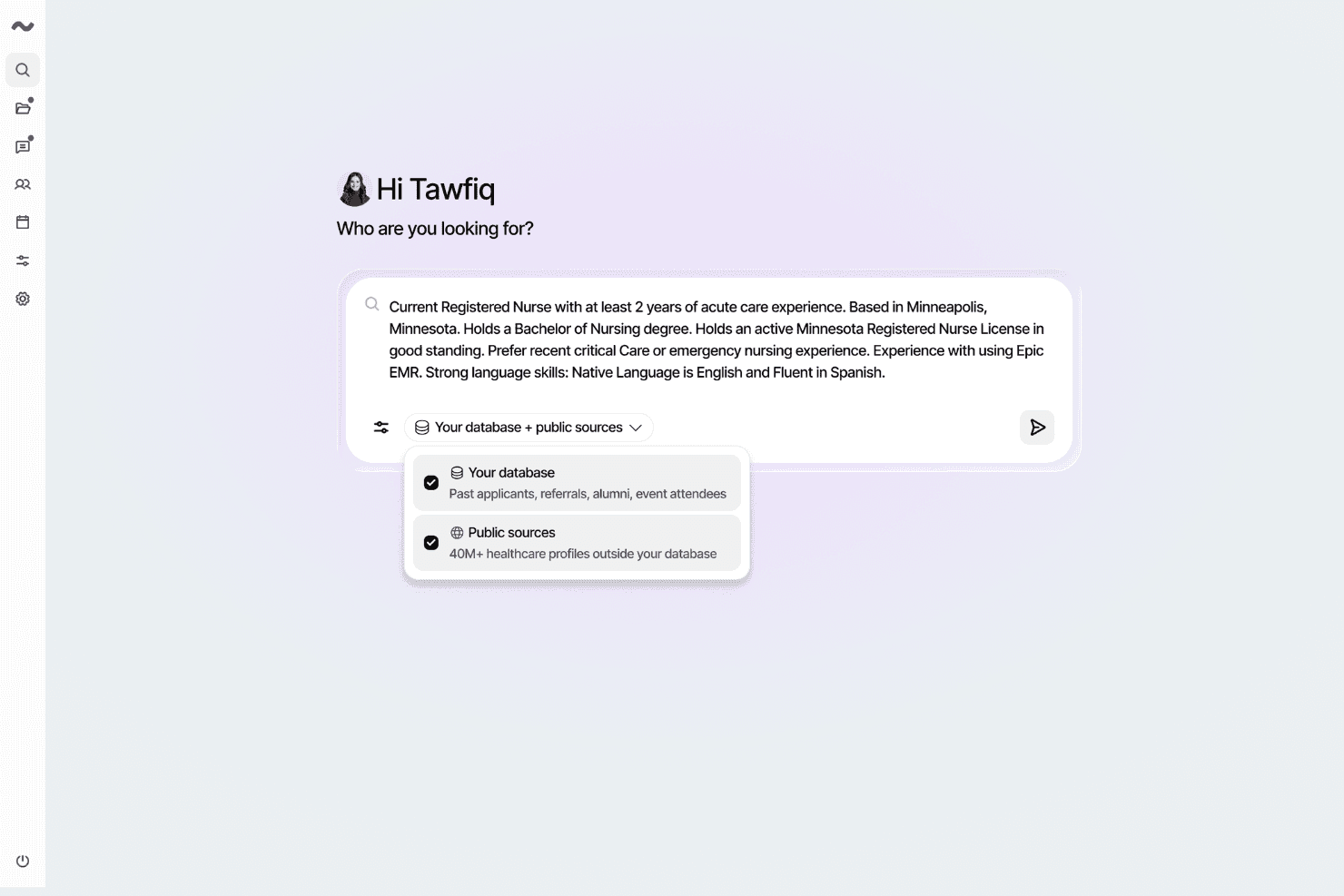
Hellora lets recruiters search their own candidate database and 40M+ public healthcare profiles using natural-language criteria. Hellora is an AI sourcing platform built for healthcare hiring. It aggregates state and federal licensing records into 40M+ contactable U.S. clinician profiles and searches them alongside a health system’s own ATS database using natural language rather than Boolean strings.
Who Is Hellora Best For?
Hellora is a strong fit for U.S. healthcare organizations that need to proactively source licensed clinicians beyond the candidates already in their ATS.
Why I Picked Hellora
Hellora earns its spot because it solves a sourcing problem specific to healthcare: every licensed clinician in the country is a matter of public record, but that data is fragmented across state and federal sources without the contact details and work history recruiters need. Hellora aggregates it into 40M+ searchable, contactable profiles. I like that recruiters can describe what they need in plain English, such as an ICU-certified RN in a specific metro with Epic experience, and get results from both the public pool and their own ATS database, labeled by source.
Hellora Key Features
- Natural language search: Describe a role in plain English and get ranked results across public licensing data and your existing ATS database.
- Candidate pipeline tracking: A built-in pipeline view lets you monitor where each candidate stands across sourcing, outreach, and engagement stages.
- Continuous enrichment: Keep licenses, certifications, and contact details updated automatically as public records change.
- Public license sourcing: Aggregates state and federal licensing records into 40M+ contactable U.S. clinician profiles.
Hellora Integrations
Hellora offers native integrations across ATS, HRIS, and recruiting platforms, including UKG, Workday, Workable, JazzHR, BambooHR, and more.
Pros and Cons
Pros:
- Searches public and ATS data
- Natural-language clinician sourcing
- 40M+ contactable clinician profiles
Cons:
- Limited to U.S. healthcare organizations
- No free trial option available
Learn more about Hellora: Best with multilingual and RTL language support
- 14-day free trial + free demo available
- From $15/user/month (billed annually)
Visit WebsiteCustomer Rating:4.8/5
Manatal candidate pipeline view showing applicants organized by hiring stage, with profile details and status indicators displayed in a dashboard layout. Manatal makes my shortlist because it’s one of the few AI sourcing tools that consistently handles multilingual and right-to-left languages. I recommend it when you’re hiring for roles spanning global regions or local teams working in non-Latin scripts, since its parsing and candidate search work reliably across a wide range of languages.
What I appreciate most is how Manatal keeps its search, pipelines, and analytics accessible in Arabic, Hebrew, and dozens of other languages.
Manatal’s Best For
- Recruiters sourcing across multilingual or RTL language regions
- Organizations needing AI-powered, language-flexible candidate search
Manatal’s Not Great For
- Teams focused on highly technical talent sourcing
- Companies needing deep customization of sourcing workflows
What sets Manatal apart
Manatal carves out space for recruiters who need consistent sourcing and management of candidates in multiple languages. Unlike Breezy HR, which sticks to a narrower set of language options, Manatal expects you to manage candidate pipelines in Arabic, Hebrew, or any language needed without having to patch around language barriers.
It’s designed so multilingual teams can collaborate or hand off searches without workflows breaking down mid-process.
Tradeoffs with Manatal
Manatal optimizes for language flexibility and broad accessibility, but the tradeoff is limited depth for highly technical or specialized sourcing workflows. You might need a more configurable tool if you require heavy process customization or deep analytics.
Pros and Cons
Pros:
- Social media enrichment for candidate profiles
- Bulk job board posting from one dashboard
- Branded resume formatting with custom templates
Cons:
- Mobile app lacks full desktop functionality
- No built-in video interviewing feature
 Best for interview intelligence
- Free plan available
- From $100/user/month
Visit WebsiteCustomer Rating:4.8/5
Metaview delivers AI interview insights with transcription and analysis for hiring teams. Metaview is my top pick for teams who need interview intelligence built into their AI sourcing stack. When I tested it, I found its automated note-taking and detailed interview insights transformed how recruiters review and learn from conversations. I especially like how it generates accurate summaries and highlights key candidate responses, making debriefs much easier. Teams seem to get the most out of it when they run lots of structured interviews and want real evidence for shortlist decisions.
Metaview’s Best For
- Recruitment teams running frequent structured interviews
- Organizations needing real-time interview summaries and highlights
Metaview’s Not Great For
- Small teams with low interview volume
- Those who prefer manual note-taking and feedback
What sets Metaview apart
Metaview is built around automating and elevating interview capture. Instead of relying on distracted notetaking or memory, you get structured insights and transcripts right after each interview. Compared to something like Google Meet’s recording features, Metaview expects hiring teams to review interviews quickly and base shortlist decisions on specific evidence, not gut feeling.
This tends to fit organizations that run lots of structured interviews and want transparency around the hiring process.
Tradeoffs with Metaview
Metaview optimizes for interview analysis and documentation, but that focus means you give up broader sourcing features or pipeline management that full ATS platforms provide. You’ll need another tool for end-to-end candidate tracking.
Pros and Cons
Pros:
- Offers feedback aggregation
- Strong ATS integrations and compliance
- Structured notes and summaries for video interviews
Cons:
- Templates lack customization options
- Limited multilingual capabilities
Learn more about Metaview: Best for automated outreach
- Free demo available
- From $115/month (billed annually)
Visit WebsiteCustomer Rating:4.6/5
Fetcher automates candidate sourcing and outreach with AI to simplify hiring. Fetcher stands out for automating sourcing and outreach in a way that actually saves time for recruiters. I like that the platform scrapes contact details and relevant candidate info, then customizes sequences based on your search. Teams tend to see the biggest gains here when outbound campaigns get tricky or too manual to manage at scale.
What I appreciate most is how Fetcher lets you skip repetitive outreach tasks and focus on qualifying responses.
Fetcher’s Best For
- Recruiters running high-volume, automated outbound sourcing campaigns
- Teams who want candidate outreach handled with minimal manual effort
Fetcher’s Not Great For
- Hiring for niche or highly specialized technical roles
- Recruiters who want full control over every message and search parameter
What sets Fetcher apart
Fetcher flips the traditional sourcing process by automating both candidate discovery and the first touch of outreach rather than expecting you to manually build lists. Unlike LinkedIn Recruiter, which gives you control and visibility over each search, Fetcher puts automation in front. This tends to work best when you want rapid outreach at scale, and you’re less concerned about fine-tuning every message.
Tradeoffs with Fetcher
Fetcher optimizes for speed and automation, but you lose visibility and precision in targeting, so you have less control over niche hard-to-fill roles.
Pros and Cons
Pros:
- Built-in DE&I insights
- Structured feedback loops
- Smart sourcing includes ongoing recruiter feedback
Cons:
- Rigid and uncustomizable email templates
- Limited built-in screening/assessment
Learn more about Fetcher: Best for global compliance
- Free demo available
- From $599/user/month (billed annually)
Visit WebsiteCustomer Rating:2.9/5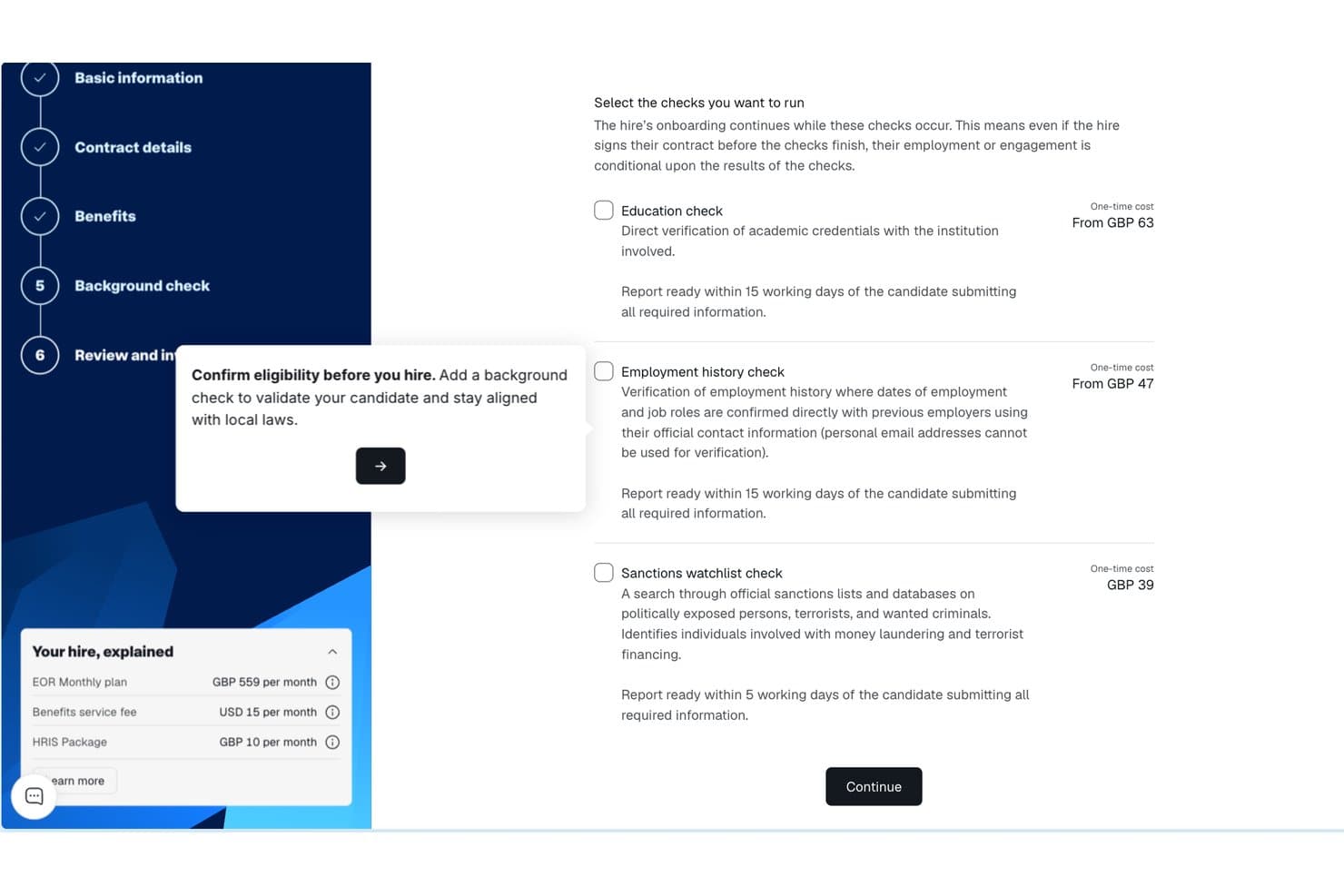
Remote background check selection screen with education, employment, and sanctions options. Remote makes my list because it solves global compliance problems that come up when hiring internationally or building distributed sourcing teams. I see organizations using Remote to legally hire and pay talent in over 170 countries, while handling local taxes and labor laws automatically.
What I appreciate is how Remote centralizes country-specific legal documents and payroll, which removes most of the complexity of cross-border AI sourcing.
Remote’s Best For
- Global organizations hiring and paying across many countries
- Teams needing airtight compliance for international AI sourcing
Remote’s Not Great For
- Companies that only hire within one country
- Teams needing advanced talent analytics or AI-based candidate scoring
What sets Remote apart
Remote takes a fundamentally compliance-first approach for global hiring and payments. Instead of layering international capabilities onto a payroll system like Deel or Oyster, Remote is designed for organizations that start with distributed teams and want to avoid local legal risks. In practice, this works best for companies that prioritize risk reduction over customization.
Tradeoffs with Remote
Remote optimizes for compliance and coverage across many countries, but sacrifice flexibility over contract terms and custom payroll schemes. This can slow you down if you need to adapt for unique, local hiring exceptions.
Pros and Cons
Pros:
- Secure and compliant Mobile Device Management
- User-friendly and responsive UX
- Includes country misclassification risk generator
Cons:
- Limited features for non-global teams
- Scale may not be suitable for small companies
 Best for AI-enhanced diversity hiring
- 14-day free trial + demo available
- From $179/user/month
Visit WebsiteCustomer Rating:4.6/5
SeekOut helps teams source diverse talent with AI for more inclusive hiring. SeekOut makes my shortlist because of its focus on diversity hiring, powered by AI-driven talent discovery. I rely on it when teams want to move beyond catch-all search filters and prioritize inclusive pipelines. What impresses me is how SeekOut’s AI finds underrepresented talent others miss, plus its in-depth diversity analytics give you real-time insights into representation gaps. I like how practical the data is for auditing and adjusting sourcing strategies.
SeekOut’s Best For
- Talent teams focused on increasing diversity in hiring
- Sourcing underrepresented candidates in technical and specialized roles
SeekOut’s Not Great For
- Organizations with no diversity sourcing targets
- Recruiters who want broad, generic candidate pools
What sets SeekOut apart
SeekOut is built for sourcing teams who want AI to help surface candidates who might not show up using standard filters. Unlike LinkedIn Recruiter, SeekOut expects you to focus on the quality and diversity of your searches rather than just quantity. It’s really designed for recruiters who want transparency into candidate pools and actionable data for improving representation.
Tradeoffs with SeekOut
SeekOut optimizes for targeted, data-driven searches, but you give up broader-market reach and simple bulk outreach. If you need high volume rather than precision, it can feel limiting.
Pros and Cons
Pros:
- Talent insights for workforce planning
- Automated outreach with real-time engagement tracking
- Offers bias mitigation tools
Cons:
- Limited ATS and CRM integration capabilities
- Limited contact credits with no rollover


Workable simplifies hiring with AI features for sourcing, scoring, and evaluation. Workable lands high on my list for small businesses that need modern AI candidate sourcing without heavy complexity or overhead. The AI-powered sourcing tool identifies and suggests candidates you’d likely overlook if you searched manually, and I appreciate the automated job posting to over 200 boards with smart screening. What usually happens is a hiring manager needs to fill roles fast but doesn’t have time for hours of manual resume review—Workable’s automated candidate ranking brings the best fits up front, keeping hiring momentum up for teams that can’t afford to fall behind.
Workable’s Best For
- Small businesses needing automated candidate sourcing and screening
- Hiring managers with broad role requirements and limited recruiting resources
Workable’s Not Great For
- Enterprises with complex, multi-stage hiring workflows
- Teams seeking deep candidate assessment and custom evaluation tools
What sets Workable apart
Workable stands out because it expects you to handle the entire sourcing and evaluation process in one place, without leaning on outside solutions or separate recruiter tools. Unlike Greenhouse, which is built for larger teams and custom process design, Workable bets on guided workflows and built-in sourcing so hiring managers don’t need to configure much. You get candidate suggestions and job board posting in a single flow. This tends to suit orgs that want to move quickly on hiring without extra setup.
Tradeoffs with Workable
Workable optimizes for self-service simplicity, but you give up depth in custom assessment and advanced workflow automations. In practice, specialized hiring processes or complex interviewing setups push the tool past its comfort zone.
Pros and Cons
Pros:
- Customizable job templates
- Easy to use and intuitive UI
- AI-powered candidate recommendations
Cons:
- Advanced reporting requires a subscription
- Costs expand as headcount grows
Learn more about Workable:

Gem supports recruiting with AI-driven sourcing, analytics, and scheduling. Gem cracks my list because it’s built around surfacing actionable insights from talent pipelines. What stands out in real usage is the way analytics help you spot sourcing bottlenecks with data on response rates, diversity efforts, and recruiter activity. I appreciate how granular you can get with reporting—this is where I see teams who care about talent metrics leaning in.
Gem’s Best For
- TA teams measuring and optimizing sourcing funnel performance
- Organizations tracking DEI, outreach, and recruiter productivity metrics
Gem’s Not Great For
- Teams prioritizing manual, small-scale candidate searches
- Organizations that don’t need deep sourcing analytics
What Sets Gem Apart
Gem expects you to drive sourcing off real data rather than gut feeling. It approaches sourcing like a funnel, surfacing analytics at every stage instead of just tracking candidate lists like Loxo or Hiretual. I see this working best when recruiting teams treat sourcing as measurable and want to find where drop-off happens, not just pool candidates. Instead of manual tracking in spreadsheets, Gem makes it easy to benchmark and pinpoint sourcing gaps.
Tradeoffs with Gem
Gem optimizes for insight from sourcing metrics, but this depth adds complexity if you want simple, one-off outreach without tracking every stage. For teams just looking to find and message a few candidates, it feels like too much machine for the job.
Pros and Cons
Pros:
- Centralizes candidate history across campaigns
- Provides both sourcing and sequenced outreach for passive talent
- Strong pipeline visibility and reporting
Cons:
- Clunky and slow interface
- Limited workflows and reports customization
Learn more about Gem: Best for AI resume screening
- Free trial available
- From $86/user/month (billed annually)

recruitRyte simplifies hiring with AI resume screening and smart candidate search. recruitRyte stands out for AI resume screening that actually helps you prioritize quality sourcing over manual sorting. When I tested its screening automations, I saw how its algorithms quickly ranked and flagged top matches, catching keywords and context I usually see missed by more basic filters.
What I like is how you can customize screening rules to focus on success criteria unique to each role. Teams who process high volumes of applicants will find these customizable automations free up sourcing hours for outreach and relationship-building.
recruitRyte’s Best For
- Companies screening large volumes of resumes with AI
- Talent acquisition teams that want automated candidate ranking
recruitRyte’s Not Great For
- Roles needing high-touch, personalized candidate review
- Organizations with minimal resume inflow or sourcing needs
What sets recruitRyte apart
recruitRyte approaches sourcing by having AI handle initial screening using criteria you define, not just keyword matching. Unlike applicant tracking systems like Greenhouse, it expects you to fine-tune automations and filters instead of relying on strict rule-based workflows. In practice, this makes it good for teams who want to delegate first-round resume review while maintaining control of screening logic.
Tradeoffs with recruitRyte
recruitRyte optimizes for automated resume assessment, but it loses the nuanced, context-driven insights you get from hands-on review. That means it isn’t ideal if you treat every resume as a unique story needing human context from the start.
Pros and Cons
Pros:
- Global candidate access
- Chat-powered search refinement
- Candidate-based contextual ranking
Cons:
- Limited advanced reporting features
- Limits on users apply across all subscription levels
Learn more about recruitRyte:
Outras ferramentas de pesquisa de candidatos com IA
Eis algumas opções adicionais de ferramentas de pesquisa de candidatos com IA que não entraram na minha lista restrita, mas que ainda vale a pena consultar:
How I Evaluate AI Sourcing Tools
Every tool on this list needs to deliver real AI value—not just keyword search with an "AI" label slapped on. I split my evaluation into core functionality that a tool must have to qualify (like AI candidate discovery and intelligent matching) and differentiating factors that separate good options from great ones for specific teams.
Core Functionality (Table Stakes For This List)
When I'm selecting tools for my list, I rank each one on a scale from 0 (does not offer the functionality) to 5 (excels in this area) for each core functionality listed below. Then, I calculate the tool's total score into a percentage. Each tool needs to achieve a minimum total score of 65% to be considered for inclusion.
- AI-Driven Candidate Discovery: I check how many sources a tool indexes—LinkedIn, GitHub, niche communities—and whether AI surfaces relevant profiles beyond basic filters.
- Intelligent Candidate Matching: Strong tools score and rank candidates against a job description using ML or NLP, not just keyword overlap in resumes.
- AI-Powered Outreach Automation: I look for generative AI that drafts personalized sequences, not just mail-merge templates with a first-name token swapped in.
- Contact Data Enrichment: Tools should auto-retrieve verified emails and phone numbers so sourcers can reach candidates directly rather than waiting on InMail.
- Boolean & Natural Language Search: I evaluate whether the tool translates plain-language prompts into accurate results or helps build Boolean strings automatically.
- ATS/CRM Integration: Sourced candidates need to flow into systems like Greenhouse, Lever, or Bullhorn without manual re-entry or broken data mapping.
Once I have a list of tools that meet this criteria, I consider what sets each platform apart.
Differentiating Factors (What Sets Vendors Apart)
Here's how I compare and contrast different vendors:
Standout Features
Candidate intent signals are a big differentiator. Tools that flag when someone is likely open to a move help sourcers prioritize warm outreach over cold blasts. I also evaluate diversity sourcing filters, which let teams build inclusive pipelines using built-in DEI signals rather than manual workarounds. A strong chrome extension matters too, since most sourcing happens on LinkedIn or GitHub. Being able to enrich and save profiles without switching tabs saves real time.
Beyond Features
Compliance and ethical AI practices weigh heavily in my evaluation. I look for tools with clear bias auditing, GDPR and CCPA readiness, and transparent matching logic—especially since AI sourcing decisions can carry legal risk. Data source coverage also matters. A tool indexing only one or two platforms limits your reach, so I check the breadth and freshness of each vendor's candidate database. Finally, I consider pricing structure, since credit-based models can get expensive fast for high-volume sourcing teams at agencies or enterprise TA functions.
Como escolher ferramentas de pesquisa de candidatos com IA
É fácil perder-se em listas extensas de funcionalidades e estruturas de preços complexas. Para o ajudar a manter o foco enquanto analisa o seu processo específico de seleção de software, eis uma lista de verificação dos fatores a ter em conta:
| Fator | O que deve considerar |
|---|---|
| FatorEscalabilidade | O que deve considerarA ferramenta consegue acompanhar o crescimento da sua equipa? Considere se suporta um aumento do número de ofertas de emprego e utilizadores sem custos adicionais ou perdas de desempenho. |
| FatorIntegrações | O que deve considerarFunciona com os seus sistemas atuais? Verifique a compatibilidade com o seu ATS, CRM e ferramentas de comunicação para evitar interrupções no fluxo de trabalho. |
| FatorPersonalização | O que deve considerarPode adaptá-la aos seus processos? Procure opções para ajustar fluxos de trabalho, modelos e notificações de acordo com as suas necessidades específicas. |
| FatorFacilidade de utilização | O que deve considerarA sua equipa considerá-la-á intuitiva? Uma curva de aprendizagem acentuada pode atrasar a adoção, por isso opte por interfaces fáceis de navegar e compreender. |
| FatorImplementação e integração inicial | O que deve considerarCom que rapidez pode começar? Avalie o tempo e os recursos necessários para a configuração, incluindo a formação e a migração de dados. |
| FatorCusto | O que deve considerarEstá dentro do seu orçamento? Compare os planos de preços, incluindo taxas ocultas, e considere o valor que cada plano oferece em relação às suas necessidades. |
| FatorMedidas de segurança | O que deve considerarComo protege os seus dados? Certifique-se de que dispõe de medidas de segurança robustas, como encriptação e auditorias regulares, para proteger informações sensíveis. |
| FatorTransparência do fornecedor | O que deve considerarO fornecedor é transparente relativamente às suas práticas? Procure uma comunicação clara sobre atualizações, períodos de indisponibilidade e utilização de dados, para garantir uma parceria de confiança. |
O que são ferramentas de pesquisa de candidatos com IA?
As ferramentas de pesquisa de candidatos com IA são soluções de software que utilizam inteligência artificial para encontrar e contactar potenciais candidatos a emprego de forma eficiente. Os recrutadores, especialistas em aquisição de talento e profissionais de recursos humanos utilizam normalmente estas ferramentas para melhorar os processos de recrutamento e tomar decisões baseadas em dados. As funcionalidades de pesquisa automatizada de candidatos, análise de currículos e análise preditiva ajudam a identificar os melhores talentos, a poupar tempo e a melhorar as estratégias de recrutamento. De um modo geral, estas ferramentas proporcionam um valor significativo ao otimizar o processo de aquisição de talento e reduzir o tempo necessário para contratar.
Funcionalidades
Ao selecionar ferramentas de pesquisa de candidatos com IA, tenha em atenção as seguintes funcionalidades principais:
- Pesquisa automatizada de candidatos: Utiliza a IA para encontrar e classificar potenciais candidatos, poupando tempo em pesquisas manuais.
- Análise de currículos: Extrai e organiza informações dos candidatos a partir dos currículos, facilitando a avaliação das qualificações.
- Análise preditiva: Analisa dados para prever os resultados do recrutamento e melhorar a tomada de decisões.
- Contacto com candidatos: Automatiza a comunicação personalizada com os candidatos para manter o interesse e melhorar as taxas de resposta.
- Pesquisa orientada para a diversidade: Identifica grupos diversificados de candidatos para apoiar práticas de contratação inclusivas.
- Inteligência para entrevistas: Fornece informações e comentários sobre as entrevistas para melhorar o processo de recrutamento.
- Ferramentas de pesquisa de mercado: Fornecem informações sobre as tendências do setor e a disponibilidade de candidatos para aperfeiçoar as estratégias de recrutamento.
- Personalização dos painéis: Permite aos utilizadores adaptar as vistas e os relatórios às necessidades específicas de recrutamento.
- Capacidades de integração: Garantem uma ligação fácil aos sistemas de RH existentes, melhorando a eficiência dos fluxos de trabalho.
- Medidas de segurança: Protegem os dados sensíveis dos candidatos através de encriptação e auditorias regulares.
Benefícios
A implementação de ferramentas de pesquisa de candidatos com IA proporciona vários benefícios à sua equipa e à sua empresa. Eis alguns dos benefícios que pode esperar:
- Poupança de tempo: A pesquisa automatizada de candidatos e a análise de currículos reduzem o tempo despendido em tarefas manuais de recrutamento.
- Melhoria da qualidade dos candidatos: A análise preditiva ajuda a identificar os melhores talentos, garantindo uma melhor correspondência entre candidatos e funções.
- Maior diversidade: A pesquisa orientada para a diversidade apoia a contratação inclusiva através da identificação de grupos diversificados de candidatos.
- Melhor tomada de decisões: As ferramentas de pesquisa de mercado fornecem informações sobre as tendências do setor, apoiando decisões estratégicas de recrutamento.
- Maior envolvimento: O contacto automatizado com os candidatos mantém o interesse e melhora as taxas de resposta.
- Segurança dos dados: As medidas de segurança protegem as informações sensíveis dos candidatos, garantindo a conformidade com as normas de proteção de dados.
- Melhoria das entrevistas: A inteligência para entrevistas fornece informações e comentários para melhorar a qualidade e a consistência das entrevistas.
Custos e preços
A seleção de ferramentas de pesquisa de candidatos com IA exige uma compreensão dos vários modelos de preços e planos disponíveis. Os custos variam consoante as funcionalidades, a dimensão da equipa, os complementos e outros fatores. A tabela abaixo resume os planos comuns, os respetivos preços médios e as funcionalidades normalmente incluídas nas soluções de ferramentas de pesquisa de candidatos com IA:
Tabela de comparação de planos para ferramentas de pesquisa de candidatos com IA
| Tipo de plano | Preço médio | Funcionalidades comuns |
|---|---|---|
| Tipo de planoPlano gratuito | Preço médio$0 | Funcionalidades comunsPesquisa básica de candidatos, análise de currículos e análise limitada. |
| Tipo de planoPlano pessoal | Preço médio$50-$379/utilizador/mês | Funcionalidades comunsPesquisa automatizada, análise básica, contacto com candidatos e apoio por e-mail. |
| Tipo de planoPlano empresarial | Preço médio$179-$599/utilizador/mês | Funcionalidades comunsAnálise avançada, pesquisa orientada para a diversidade, inteligência para entrevistas e apoio prioritário ao cliente. |
| Tipo de planoPlano empresarial de grande dimensão | Preço médio$649-$2390/utilizador/mês | Funcionalidades comunsPainéis personalizáveis, capacidades completas de integração, segurança reforçada e gestão dedicada da conta. |
Perguntas frequentes sobre ferramentas de pesquisa de candidatos com IA
Aqui encontrará algumas respostas a perguntas comuns sobre ferramentas de pesquisa de candidatos com IA:
Como é que as ferramentas de pesquisa de candidatos com IA se integram nos sistemas de RH existentes?
As ferramentas de pesquisa de candidatos com IA disponibilizam normalmente capacidades de integração com sistemas de RH populares, como plataformas ATS e CRM. Pode ligar ferramentas como a Greenhouse, a Workday ou a BambooHR para sincronizar dados dos candidatos e simplificar o seu fluxo de trabalho. Verifique se a ferramenta de pesquisa de candidatos com IA disponibiliza acesso à API ou conectores pré-configurados para facilitar a integração. Isto permitirá à sua equipa manter a consistência entre plataformas e evitar silos de dados.
As ferramentas de pesquisa de candidatos com IA podem melhorar a contratação diversificada?
Sim, as ferramentas de pesquisa de candidatos com IA podem melhorar a contratação diversificada ao identificarem grupos diversificados de candidatos e reduzirem os preconceitos no processo de recrutamento. Estas ferramentas utilizam algoritmos de IA para procurar candidatos de diferentes origens e fornecem informações sobre métricas de diversidade. Para reforçar os seus esforços de diversidade, certifique-se de que a ferramenta disponibiliza funcionalidades como o recrutamento cego e a análise da diversidade.
O que devo ter em conta ao avaliar a escalabilidade das ferramentas de pesquisa de candidatos com IA?
Ao avaliar a escalabilidade, considere a capacidade da ferramenta para gerir um aumento do número de ofertas de emprego, utilizadores e dados sem perda de desempenho. Procure planos de preços flexíveis que acompanhem o crescimento das equipas e funcionalidades que apoiem esforços de recrutamento em grande escala. Avalie se a ferramenta pode integrar-se com outros sistemas e adaptar-se às suas necessidades em evolução.
Como é que as ferramentas de pesquisa de candidatos com IA lidam com a segurança dos dados?
As ferramentas de pesquisa de candidatos com IA implementam normalmente medidas de segurança dos dados, como encriptação, auditorias regulares e conformidade com os regulamentos de proteção de dados (por exemplo, o GDPR). Ao escolher uma ferramenta, verifique as respetivas certificações de segurança e informe-se sobre as práticas de armazenamento de dados. Certifique-se de que o fornecedor é transparente relativamente aos seus protocolos de segurança para proteger as informações sensíveis dos candidatos.
As ferramentas de pesquisa de candidatos com IA disponibilizam opções de personalização?
Sim, muitas ferramentas de pesquisa de candidatos com IA disponibilizam opções de personalização para adaptar fluxos de trabalho, painéis e modelos de comunicação às necessidades da sua equipa. A personalização pode melhorar a experiência do utilizador e a eficiência, alinhando a ferramenta com os seus processos de recrutamento específicos. Verifique se a ferramenta permite modificar os critérios de pesquisa, os formatos de relatórios e as estratégias de envolvimento dos candidatos.
O que se segue:
Se está a pesquisar ferramentas de pesquisa de candidatos com IA, contacte gratuitamente um consultor da SoftwareSelect para obter recomendações.
Preenche um formulário e tem uma breve conversa na qual são analisadas em detalhe as suas necessidades. Depois, receberá uma lista restrita de soluções de software para avaliar. Também terá apoio durante todo o processo de compra, incluindo as negociações de preços.