

10 Best Remote Alternatives in 2026

Best Remote Alternatives Shortlist


Strong Remote alternatives are global employment platforms with the EOR coverage, local compliance support, and payroll services your hiring plans require. If Remote’s coverage, entity model, or service setup doesn’t fit, compare how each provider employs workers and supports your HR team. I evaluated 19 options for country coverage and compliance support to help you find the right fit.
What Is Remote?
Remote is a global employment platform that helps companies hire and pay workers across borders. It offers employer-of-record services, global payroll, and employment through its own local entities. HR teams can use it to manage international employment, payroll, and related workforce processes.
Comparison Table: Remote Alternatives
Compare pricing and specs side by side for the Remote alternatives that made it onto my shortlist.
| Tool | Best For | Trial Info | Price | ||
|---|---|---|---|---|---|
| 1 | Best for AI-driven global hiring without an entity | Free demo available | From $29/month | Website | |
| 2 | Best for flat-rate global hiring without entities | Free demo available | From $499/user/month | Website | |
| 3 | Best for expanding into 187 countries via EOR | Free demo available | Pricing upon request | Website | |
| 4 | Best for switching from pricier EOR providers | Free demo available | From $199/user/month | Website | |
| 5 | Best for merging HR, IT, and payroll in one record | Free demo available | Pricing upon request | Website | |
| 6 | Best for hiring across 180+ owned-entity countries | Free demo available | From $599/user/month | Website | |
| 7 | Best for enterprise payroll with owned-entity coverage | Free demo available | From $499/user/month | Website | |
| 8 | Best for service-led global hiring across 164 countries | Not available | Pricing upon request | Website | |
| 9 | Best for hiring via owned global entities | Free demo available | From $599/user/month | Website | |
| 10 | Best for hiring globally without local entities | Free demo available | From $459/user/month (billed annually) | Website |

Why Trust Our Software Recommendations
Our team has been testing and reviewing software since 2012. As HR experts ourselves, we know how difficult—and important—it is to choose the right software.
For this guide, we evaluated tools using hands-on testing and independent research, scoring tools using our selection criteria. We also draw on insights from industry thought leaders and practicing HR experts.
Our reviews reflect our human editorial judgment, not a sales pitch.
Expert reviewers:
Remote Alternatives Reviews
Below are summaries of the best Remote alternatives on my shortlist. My reviews cover each global employment platform’s features, country coverage, and pricing to help you find the right fit.

Best for AI-driven global hiring without an entity
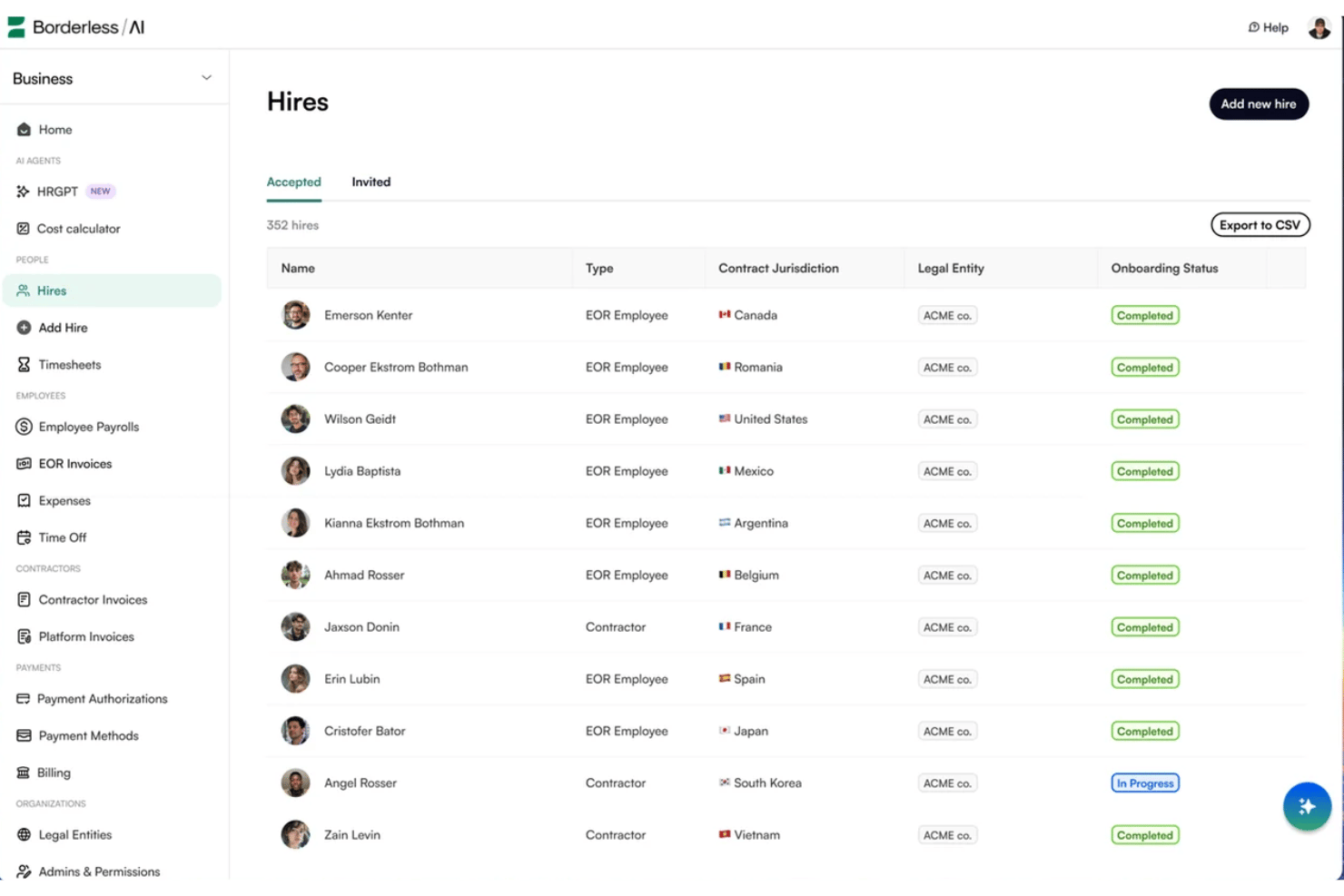
Borderless AI is an employer of record and global payroll platform for HR teams hiring internationally, managing local employment, onboarding, payroll, and compliance across countries.
Who Is Borderless AI Best For?
Borderless AI suits HR and talent teams at companies hiring internationally without setting up local legal entities.
Why I Picked Borderless AI
I picked Borderless AI for AI-driven global hiring without an entity because it combines employer of record services with AI tools for international HR. HRGPT answers HR questions, while Alberni supports global entity and legal operations. I also like its AI-powered alerts for regulatory changes and its handling of local contracts, benefits, and payroll for employees abroad.
Borderless AI Key Features
- Contractor management: Onboard and pay international contractors through a dedicated service.
- Global mobility: Access global mobility services for your workforce.
- Background checks: Request background checks as part of hiring.
- HR and finance integrations: Connect Borderless AI with systems such as Workday and ADP.
Borderless AI Integrations
Borderless AI integrates with ADP Workforce Now through ADP Marketplace to sync employee data. The company also lists Workday as a supported system but doesn’t specify its integration details.
Pros and Cons
Pros:
- Local contracts and payroll handled
- Responsive payroll and compliance support
- Fast international employee onboarding
Cons:
- Fewer in-depth country-specific HR resources
- Limited advanced reporting and analytics
New Product Updates from Borderless AI
Borderless AI Enhances Nium Onboarding and Payroll Workflows
Borderless AI enhances Nium onboarding, payroll adjustment requests, Cayman Islands payroll support, and actionable document workflows to simplify onboarding and payroll management. For more information, visit Borderless AI's official site.
 .
.
Plane
Best for flat-rate global hiring without entities
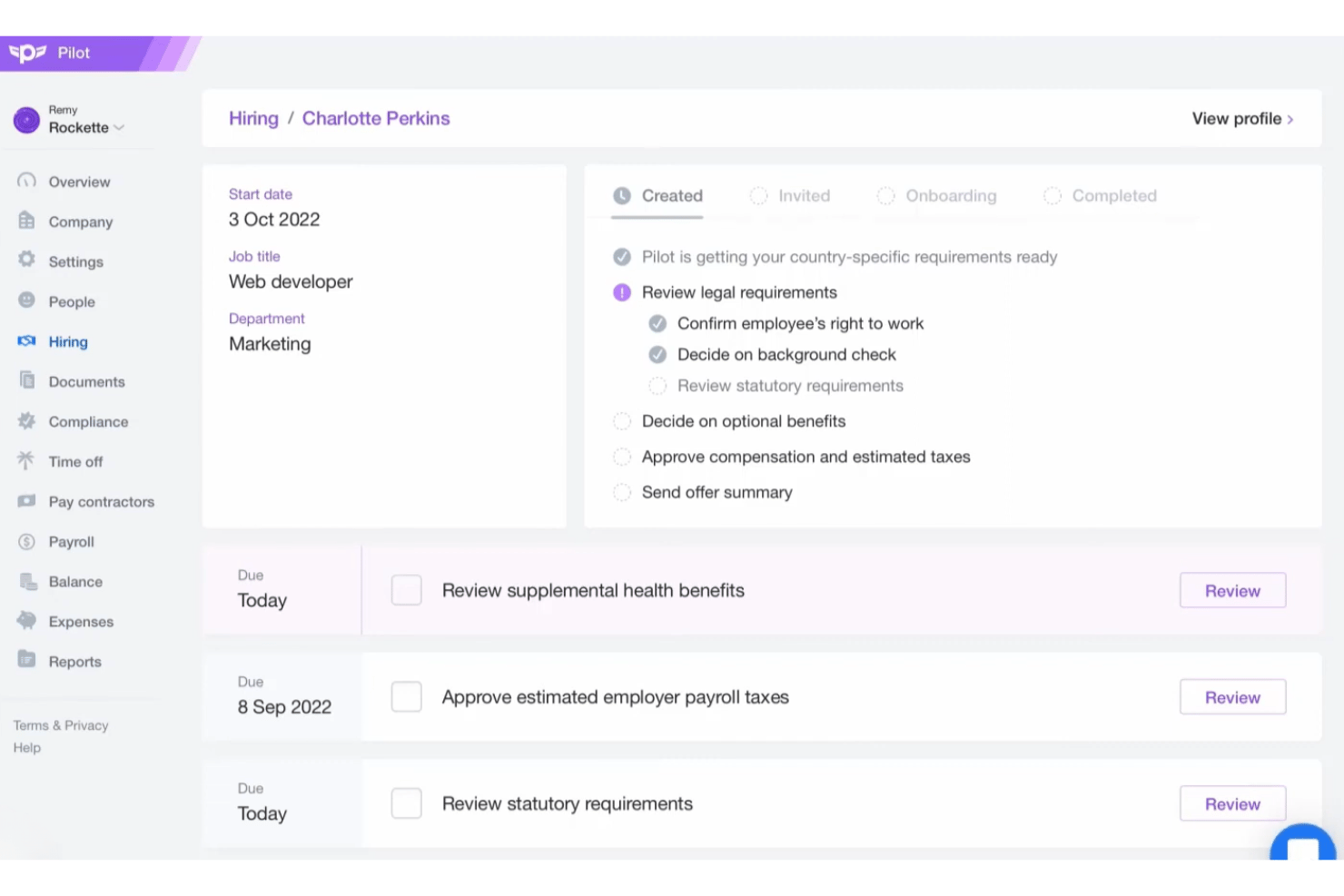
Plane is a payroll and HR platform for distributed businesses that need to manage employees, contractors, and employer-of-record hires across countries, with onboarding and payments handled in one system.
Who Is Plane Best For?
Plane is a good fit for HR and finance teams at growing companies that hire internationally without setting up local entities.
Why I Picked Plane
I picked Plane as a remote alternative because it’s Best for flat-rate global hiring without entities. I like that one payroll run can cover EOR hires, employees, and contractors, while location-specific onboarding and locally compliant contracts support hiring abroad without opening a local entity.
Plane Key Features
- Payroll approval controls: Set payroll runs to auto-approve or require manual signoff.
- QuickBooks journal entries: Plane prepares journal entries after each payroll run.
- HRIS tools: View PTO and create custom reports for different worker types.
- Payment error handling: Plane retries failed payments and may contact workers to resolve issues.
Plane Integrations
Plane offers an integration with QuickBooks Online for exporting payroll and payment journal entries. It also provides an open API for custom integrations.
Pros and Cons
Pros:
- Direct contractor payments across 240+ countries
- Responsive human support for payroll questions
- One payroll run covers employees, contractors, and EOR hires
Cons:
- No mobile app for employee self-service
- Cross-border payment arrival dates can be unclear

Best for expanding into 187 countries via EOR
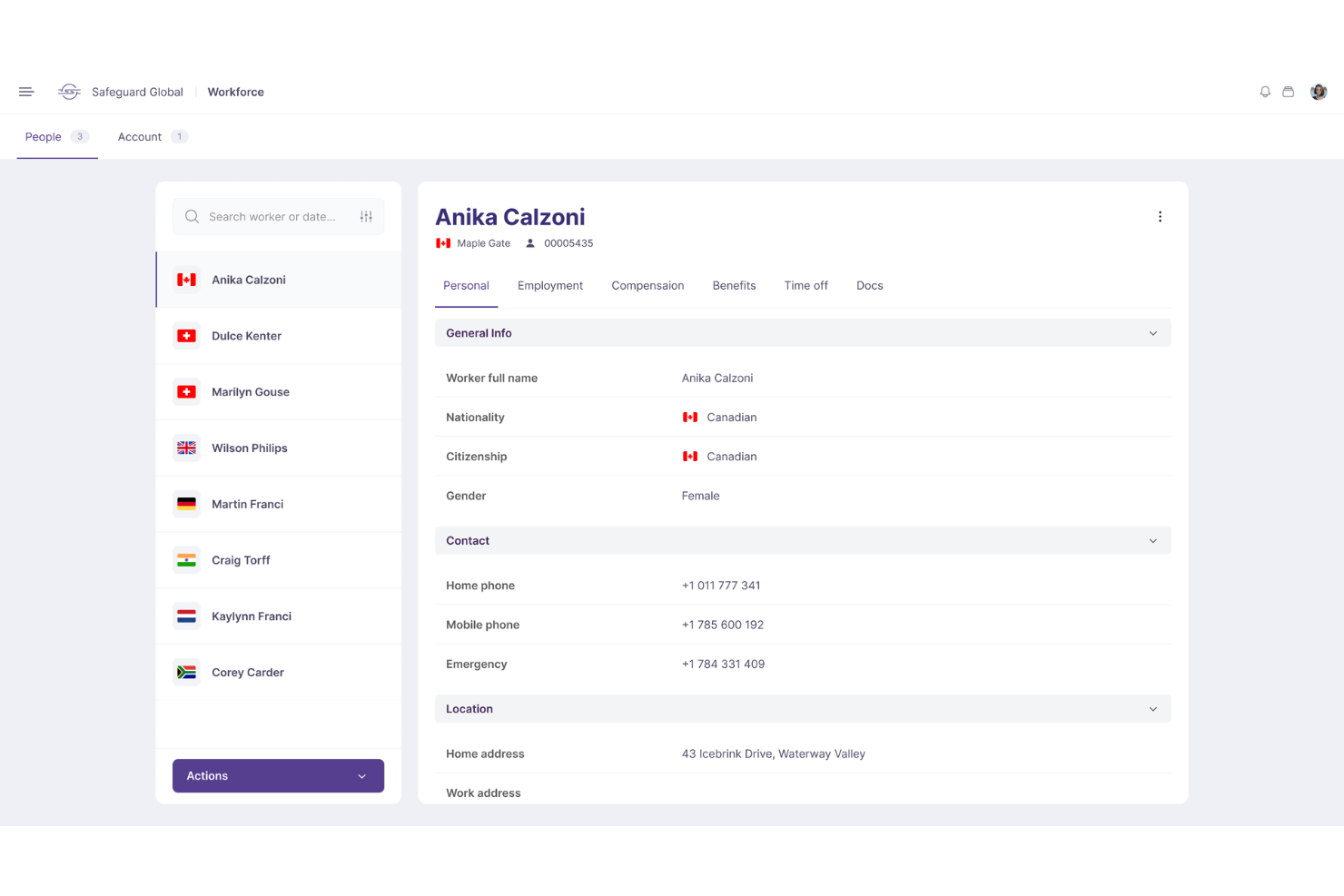
Safeguard Global is an employer of record and global workforce services provider for HR teams that need to hire, onboard, pay, and support employees abroad without establishing local entities.
Who Is Safeguard Global Best For?
Safeguard Global suits HR teams coordinating cross-border employment and workforce support across multiple markets.
Why I Picked Safeguard Global
I picked Safeguard Global as Best for expanding into 187 countries via EOR because its service covers hiring, onboarding, and payroll without setting up local entities. I appreciate that 400+ in-country experts support local employment and compliance requirements, giving me a clear option when hiring across multiple markets.
Safeguard Global Key Features
- Contractor management: Manage and pay global contractors through one platform.
- Benefits administration: Administer employee benefits as part of its HR services.
- Performance management: Manage employee performance through its HR services.
- Workforce analytics: Use dashboards to compare hiring markets, estimate costs, and plan hiring.
Safeguard Global Integrations
Safeguard Global offers certified, bidirectional Workday integrations for global payroll, including payslips, accounting journals, and time tracking. Its Workday Global Payroll Connect uses API-driven integrations to exchange payroll and HR data.
Pros and Cons
Pros:
- Combines onboarding, payroll, and local HR
- Reviewers praise responsive, personalized support
- EOR coverage spans 187 countries
Cons:
- Leave and expense request status lacks clarity
- Ticket-only support can slow quick questions

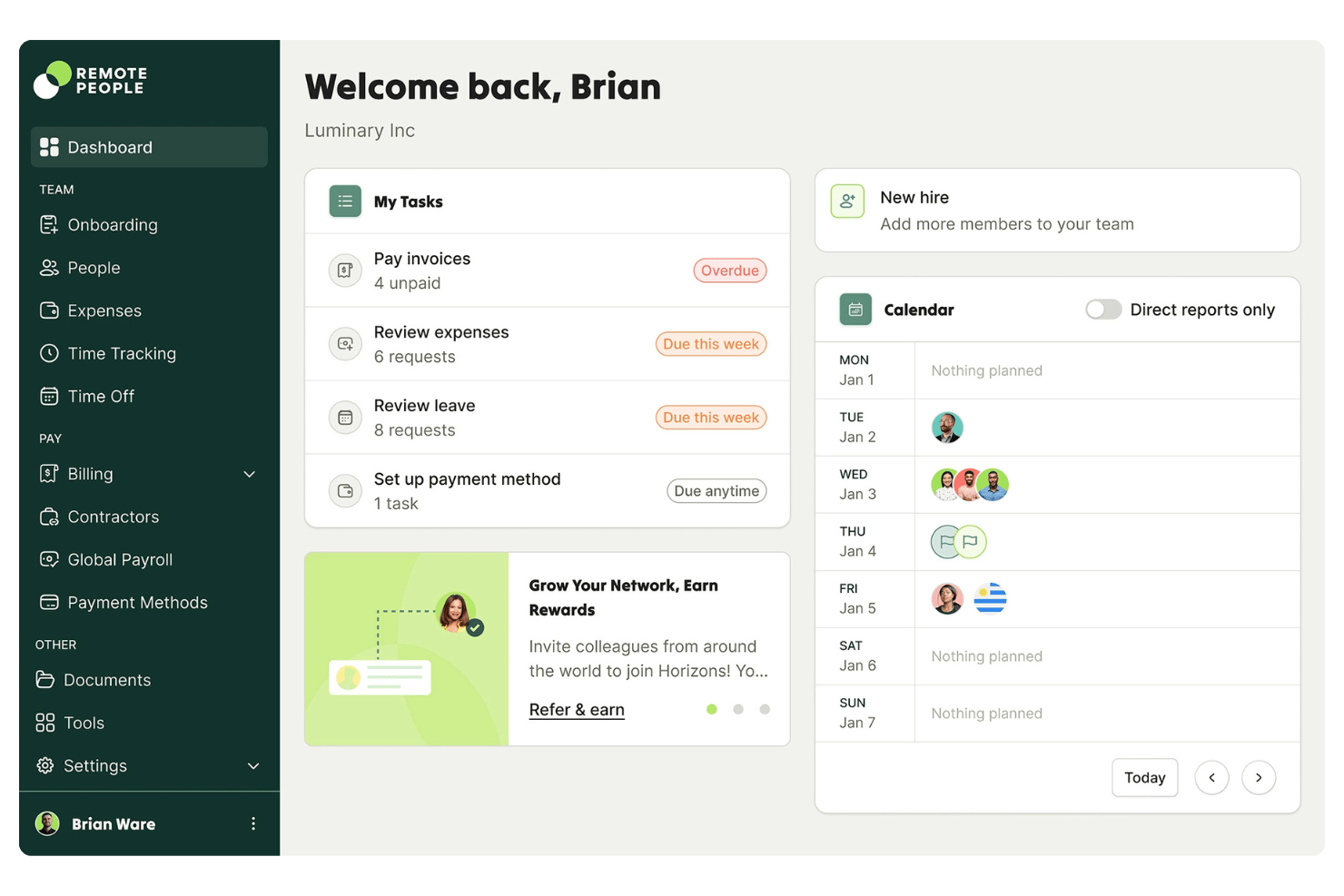
Remote People is an employer of record platform for HR teams hiring internationally, managing local employment, payroll, and compliance without requiring a business to establish entities in every market.
Who Is Remote People Best For?
Remote People suits HR teams at growing companies seeking a more budget-conscious way to manage international employment.
Why I Picked Remote People
I picked Remote People for teams switching from pricier EOR providers because it manages local employment, payroll, and compliance without requiring an entity in every market. That lets HR handle international employment through an EOR rather than maintaining local entities for each hire.
Remote People Key Features
- Command Center: Submit requests for leave, expenses, onboarding, offboarding, and employee changes in plain language.
- Audit trail: Review and export timestamped records of completed actions.
- Expert review: HR or legal specialists check high-impact changes before completion.
- Account management: Work with a dedicated account manager and HR and legal specialists, available 24/5.
RemotePeople Integrations
RemotePeople lists native integrations with Workday, SAP SuccessFactors, Oracle HCM, BambooHR, Personio, HiBob, Rippling, Gusto, Okta, and Microsoft Entra ID, plus 70+ other enterprise systems. It also offers an open API for custom integrations.
Pros and Cons
Pros:
- Expert-reviewed changes create auditable HR records
- Quick onboarding eases international provider transitions
- Responsive account managers help resolve payroll questions
Cons:
- Reporting may lack detail for finance teams
- Payment delays can create financial stress

Rippling
Best for merging HR, IT, and payroll in one record
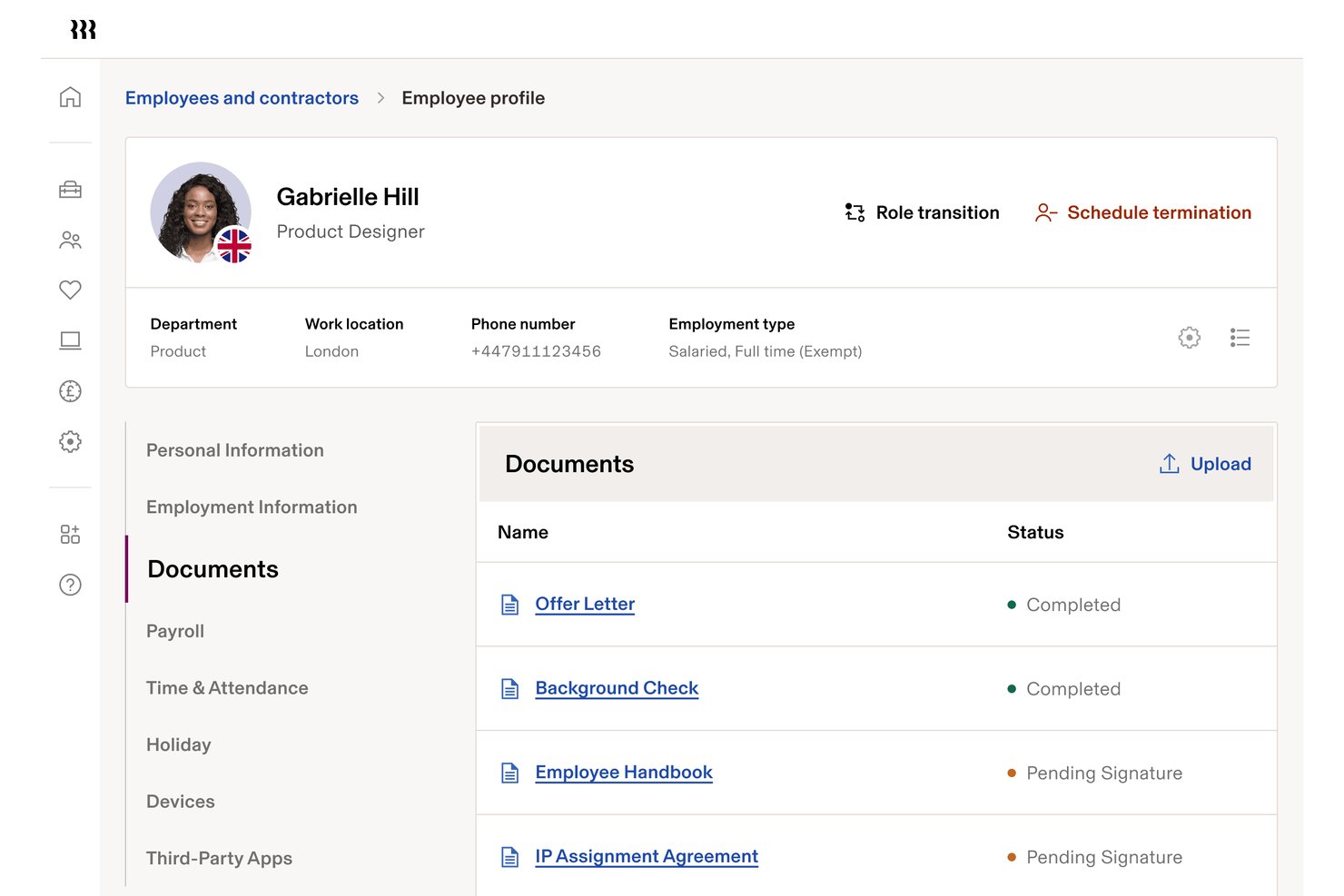
Rippling is a global HR platform with employer of record services for companies hiring international employees without local entities, giving HR teams tools to manage onboarding, payroll, and compliance across countries.
Who Is Rippling Best For?
Rippling is a good fit for growing companies that want HR and IT teams to manage employee operations in a shared system.
Why I Picked Rippling
I picked Rippling because it fits “Best for merging HR, IT, and payroll in one record.” Its global HRIS centralizes employee data across countries, while its EOR service lets you hire and pay international employees without a local entity. During onboarding, you can also set up devices and training alongside payroll and HR tasks.
Rippling Key Features
- Locally compliant benefits: EOR employees receive locally competitive benefits coverage.
- Compliance checks: Flags risks related to minimum wage, overtime, leave, and compliance training.
- Country-specific HR advice: HR advisors answer employment questions for specific countries.
- Localized workplace rules: Supports local rules for leave, working hours, breaks, and holidays.
Rippling Integrations
Rippling offers 600+ out-of-the-box integrations, including Slack and Zendesk. You can also build custom integrations with Rippling extensions and developer kits, then publish apps in the Rippling App Shop.
Pros and Cons
Pros:
- Country-specific rules flag wage, leave, overtime risks
- Localized onboarding includes devices and training
- Shared HR, IT, and payroll employee records
Cons:
- Users report inconsistent access to live support
- Complex navigation across its many modules
New Product Updates from Rippling

Rippling AI Adds Plugins, Skills, and Automations
Rippling AI now supports plugins, skills, and automations so employees can connect approved third-party tools, package repeatable work into reusable AI instructions, and run recurring workflows under existing Rippling policies and permissions. For more information, visit Rippling's official site.

G-P
Best for hiring across 180+ owned-entity countries
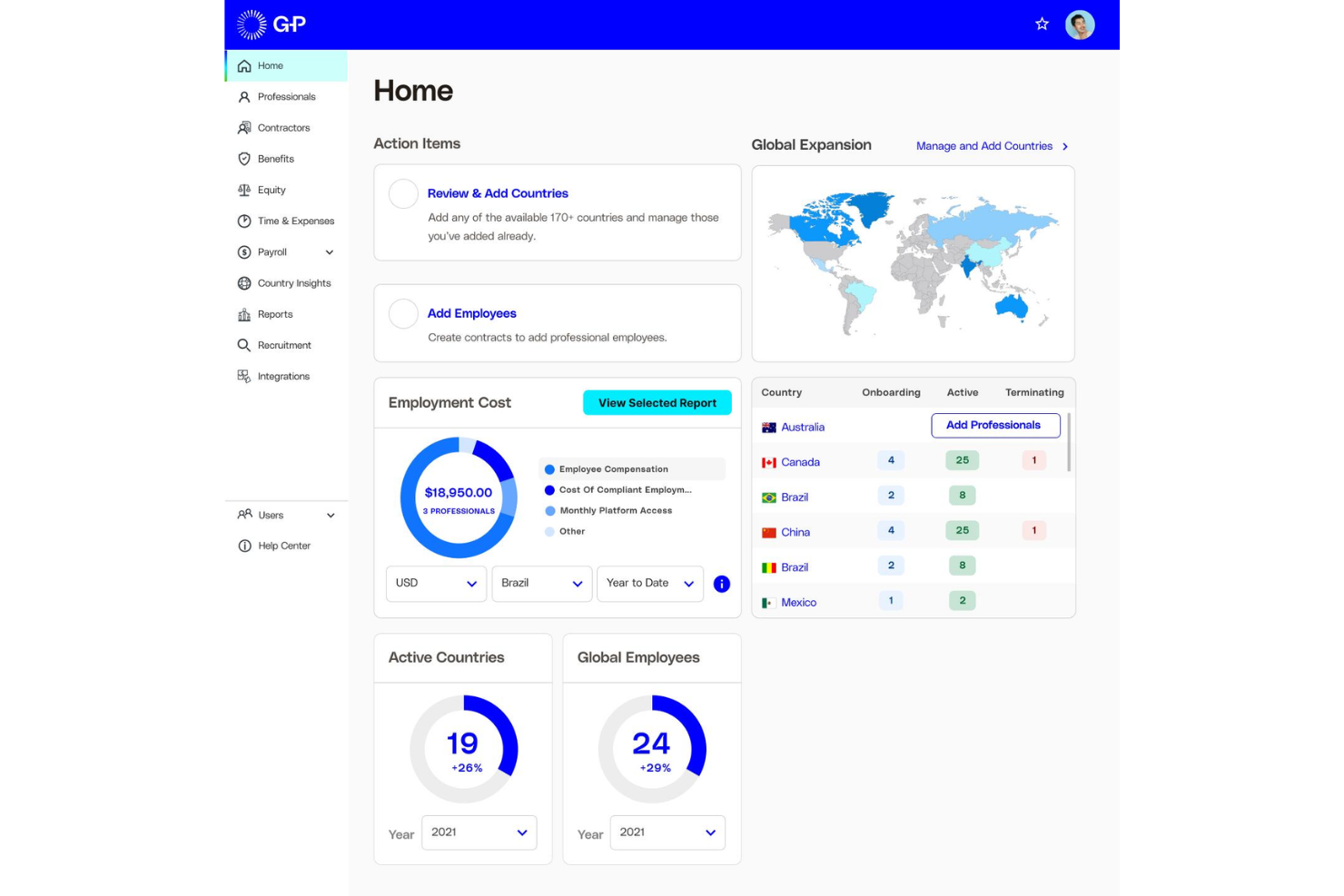
G-P is an employer of record platform for HR teams that want to hire internationally without setting up local entities or managing local payroll, contracts, and employment compliance themselves.
Who Is G-P Best For?
G-P suits HR teams coordinating hiring across multiple markets through its owned entities in 180+ countries.
Why I Picked G-P
I picked G-P for my remote shortlist because its owned-entity coverage reaches 180+ countries. Its USP is Best for hiring across 180+ owned-entity countries. I like that its EOR handles local contracts, payroll, taxes, and labor-law compliance, so I can hire a remote employee in a new market without setting up an entity first.
G-P Key Features
- AI compliance guidance: G-P Gia provides HR guidance based on vetted content.
- HR document generation: G-P Gia creates HR documents and offer letters.
- Contractor classification: G-P Contractor provides guidance on worker classification.
- HCM data synchronization: G-P’s API connects employee data with HCM and payroll tools.
G-P Integrations
G-P documents integrations with Workday, ADP Workforce Now, Paylocity, BambooHR, HiBob, Personio, SAP SuccessFactors, UKG Pro, UKG Ready, and Microsoft Entra ID. Its API supports custom integrations.
Pros and Cons
Pros:
- Account managers earn praise for responsiveness
- Local HR specialists provide country-specific guidance
- One EOR relationship spans 180+ countries
Cons:
- Repeated forms and signature delays frustrate onboarding
- Onboarding progress can be hard to track

Best for enterprise payroll with owned-entity coverage
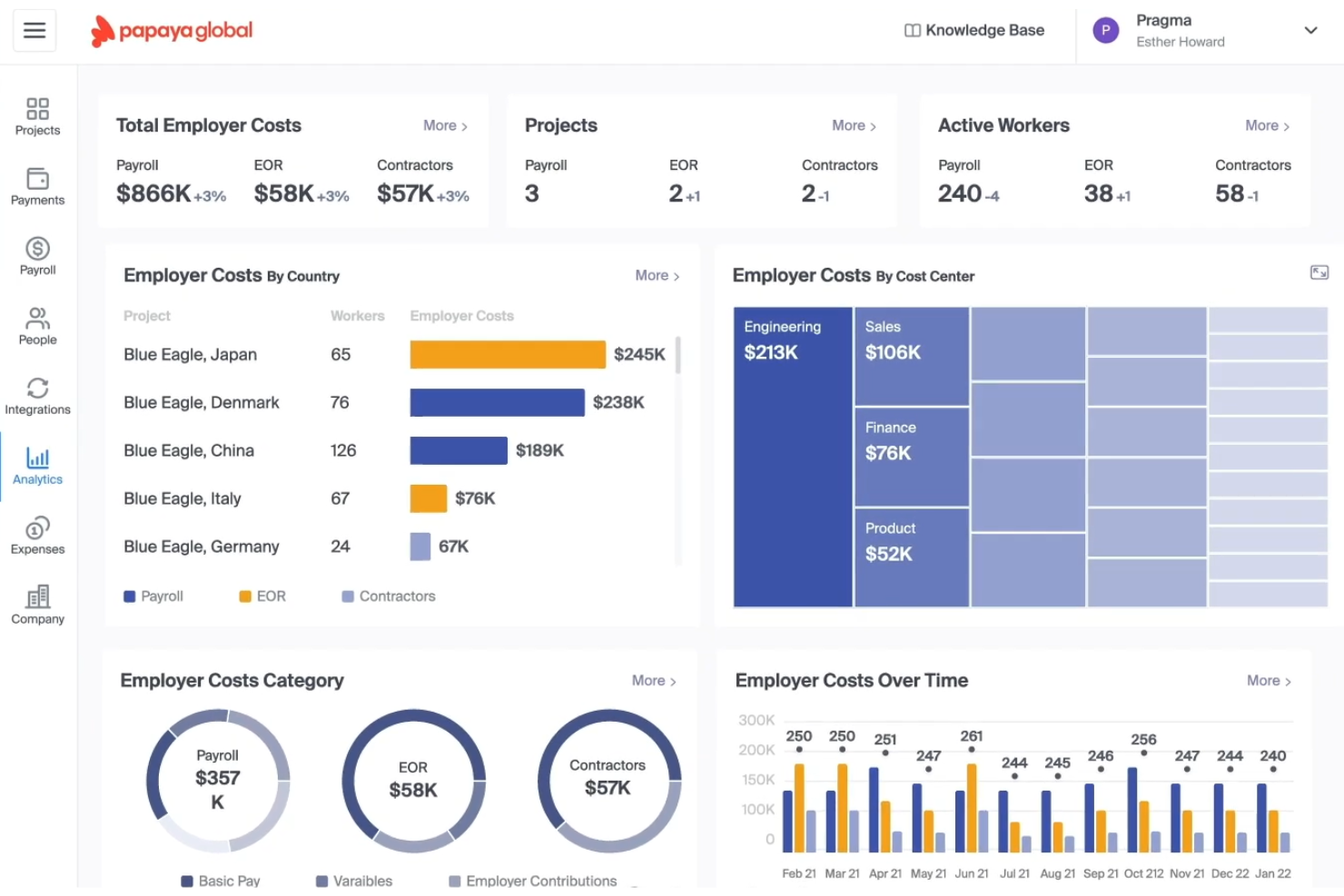
Papaya Global gives multinational HR and finance teams one platform for EOR hiring, global payroll, and payments across worker types, helping manage local employment requirements as they expand internationally.
Who Is Papaya Global Best For?
Papaya Global suits enterprise HR and finance teams managing payroll across multiple countries through their own legal entities.
Why I Picked Papaya Global
I picked Papaya Global for enterprise payroll with owned-entity coverage, especially when you need a remote alternative to hiring through an EOR. Direct payroll and EOR employees share one system, with consistent approvals and compliance monitoring across countries. You can also manage employee, authority, and vendor payments through the same platform.
Papaya Global Key Features
- Country coverage: Hire through EOR services in more than 180 countries.
- Employment contracts: Manage contracts that reflect local employment requirements.
- Termination management: Handle termination rules and validate country-specific severance.
- HRIS and ERP integrations: Use prebuilt integrations or API access for custom data flows.
Papaya Global Integrations
Papaya Global lists native integrations with Workday, SAP, Oracle, BambooHR, and NetSuite. It also offers a REST API for custom integrations.
Pros and Cons
Pros:
- Centralized reporting spans countries and worker types
- Reviewers praise timely international payroll payments
- Owned-entity payroll and EOR share one platform
Cons:
- Invoice detail and expense-tax notices need follow-up
- Partner-led jurisdictions complicate unusual employment cases

Best for service-led global hiring across 164 countries
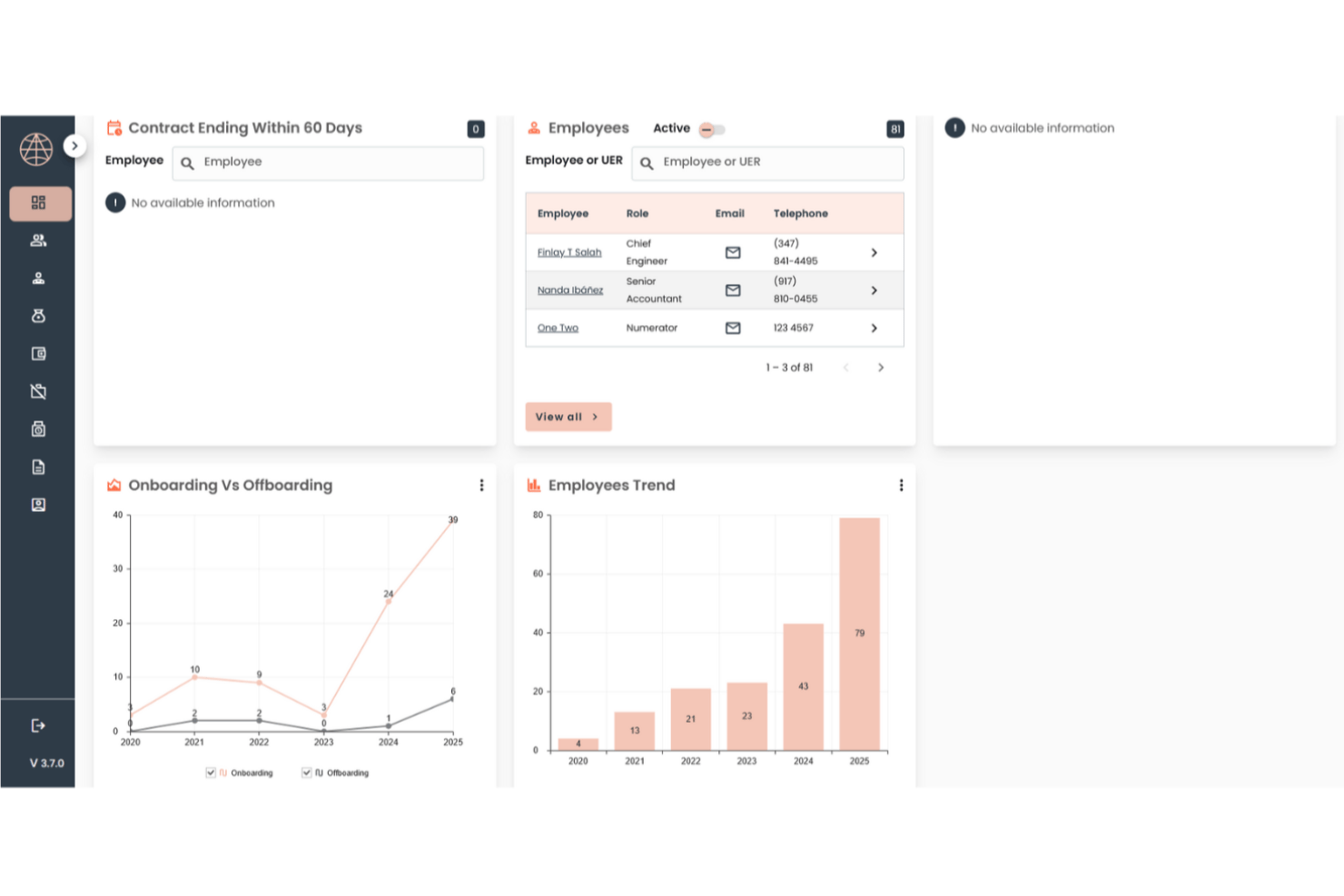
TopSource combines employer of record services with global employment and HR guidance for companies hiring internationally, helping HR teams address local compliance, payroll, and benefits without setting up entities in every market.
Who Is TopSource Best For?
TopSource suits HR teams that want hands-on support hiring and managing employees across 164 countries.
Why I Picked TopSource
I picked TopSource as a remote alternative for its “Best for service-led global hiring across 164 countries” focus. Its EOR service supports hiring without a local entity, and country experts advise on local compliance, payroll, and benefits. I also like that its Global Employment Platform supports managing international teams.
TopSource Key Features
- Contractor management: Manage contractors and their payments across markets.
- Global mobility and immigration: Access support for employee mobility and immigration processes.
- Quarterly workforce audits: Review your global talent estate for compliance risks and profitability opportunities.
- Workforce intelligence: Access salary, talent-market, and benefits benchmarking.
TopSource Integrations
TopSource lists integrations with Workday, SAP SuccessFactors, UKG, BambooHR, HiBob, Personio, Greenhouse, Lever, Workable, and SmartRecruiters. Its Portico API supports custom connections with HR, finance, and workforce systems.
Pros and Cons
Pros:
- Local payroll and compliance expertise
- Named advisors guide onboarding through offboarding
- In-country experts support hiring across 164 countries
Cons:
- Service consistency can vary by market
- Limited platform self-service and reporting

Best for hiring via owned global entities
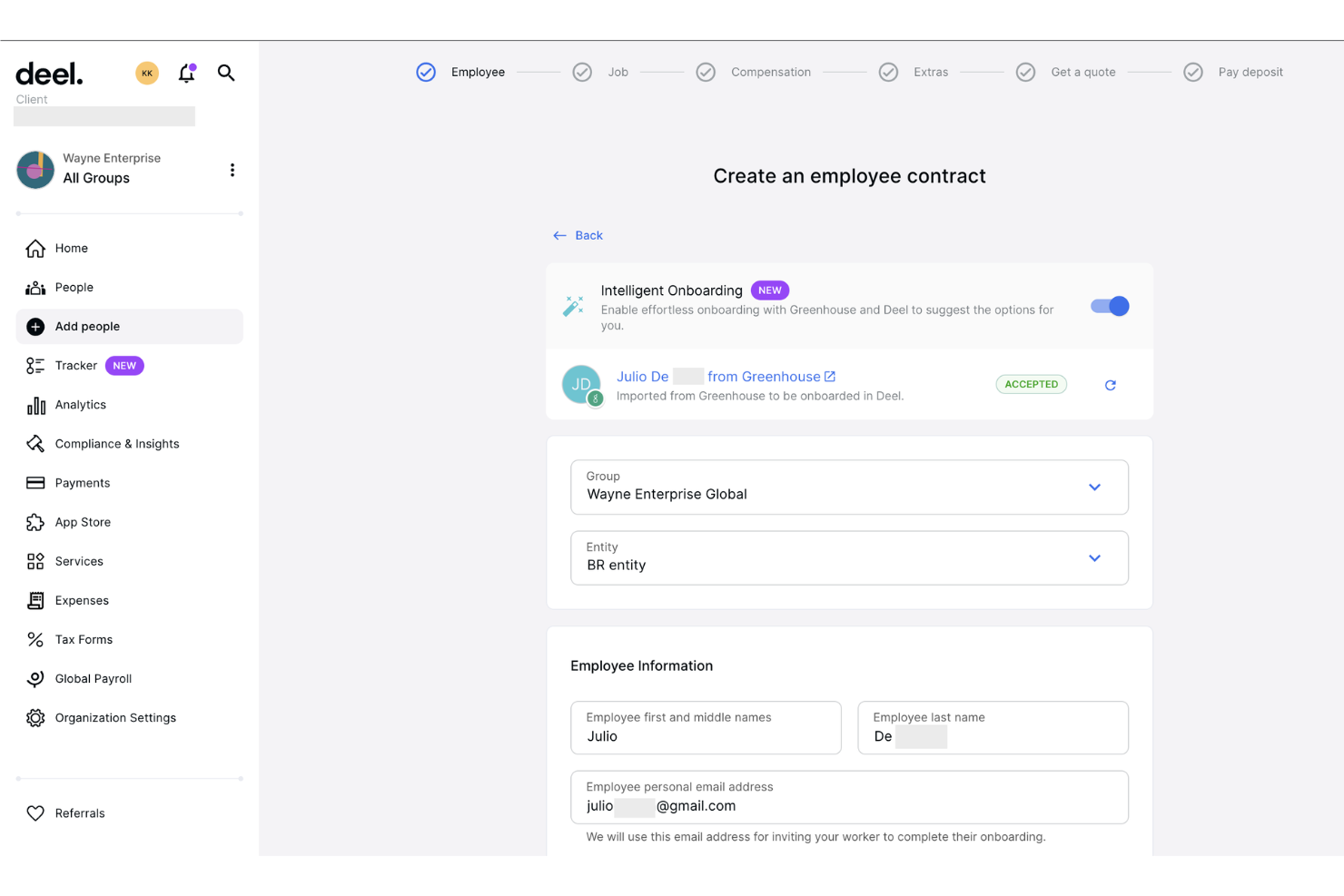
Deel combines employer of record services with global payroll and HR tools, helping growing businesses hire internationally and manage employment, pay, and compliance through one platform.
Who Is Deel Hire Best For?
Deel Hire suits HR teams at growing companies that want to recruit and employ international talent through their own legal entities.
Why I Picked Deel Hire
I picked Deel Hire for “Best for hiring via owned global entities” because its global payroll supports employees hired through your own entities. I like that it handles country-specific tax filings and statutory reporting, while onboarding collects documents and connects hires to payroll. Compliance monitoring and alerts help me track requirements as the team grows.
Deel Hire Key Features
- Employer of record service: Deel employs workers in 130+ countries without requiring your business to open a local entity.
- Locally compliant contracts: Deel provides employment agreements tailored to local requirements.
- Employee benefits: Deel administers benefits such as healthcare, dental, vision, and mental health coverage.
- Immigration support: Deel provides support for employee immigration needs.
Deel Hire Integrations
Deel’s marketplace lists 200+ integrations, including hiring connections with Greenhouse, Ashby, and JobAdder that sync candidate or placement details into Deel for onboarding. Deel also provides a REST API and webhooks for custom integrations.
Pros and Cons
Pros:
- Connects onboarding documents with payroll
- Handles local tax filings and reporting
- Supports hiring through your own entities
Cons:
- Complex cases may receive conflicting guidance
- Support can slow at month-end

Multiplier
Best for hiring globally without local entities
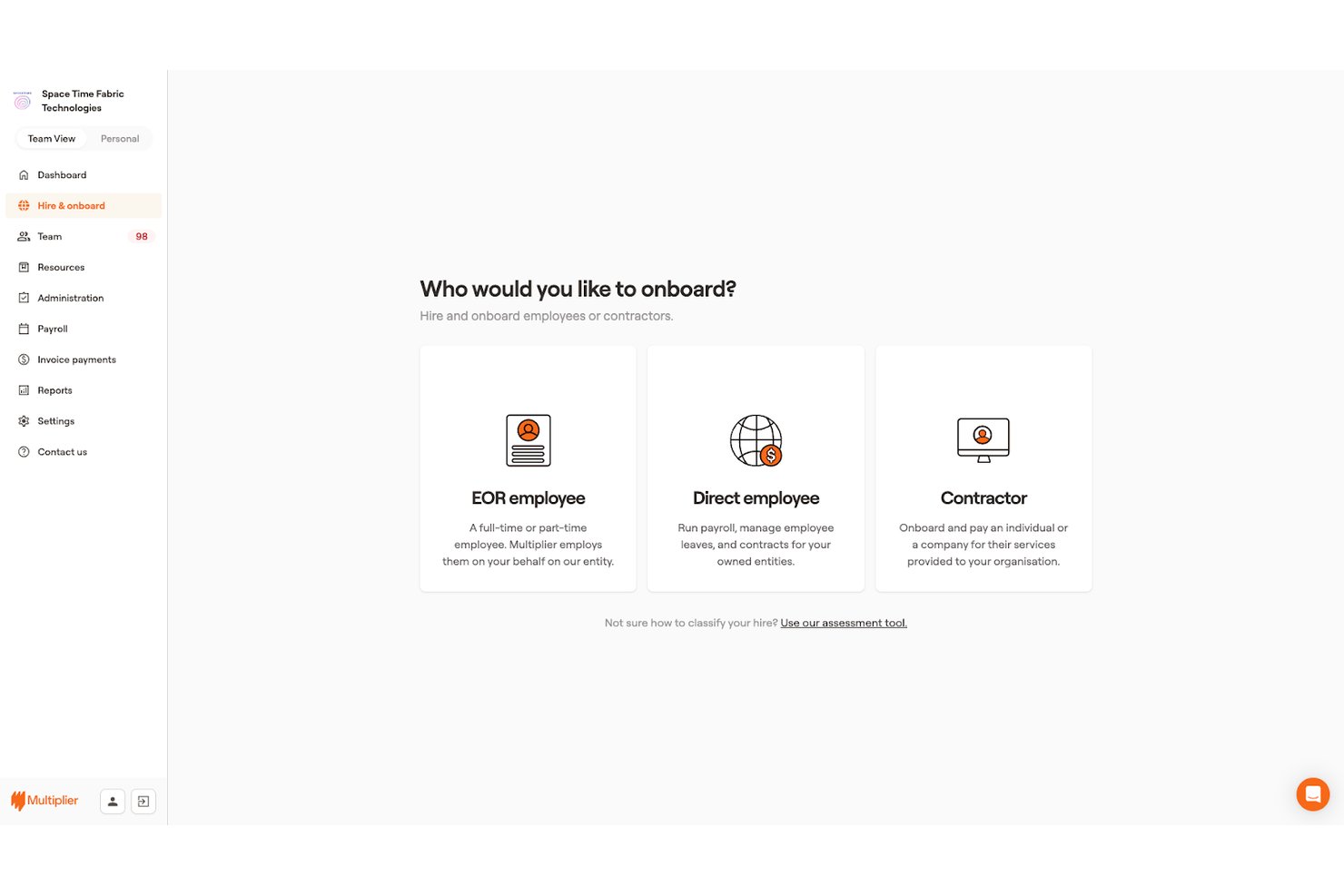
Multiplier combines employer of record services and global payroll for HR teams hiring internationally, with local employment contracts, payroll, benefits, and compliance managed through one platform.
Who Is Multiplier Best For?
Multiplier is a good fit for HR teams hiring employees across borders that need local employment contracts and payroll without setting up entities in each market.
Why I Picked Multiplier
I picked Multiplier for its “Best for hiring globally without local entities” fit: its EOR services cover 150+ countries and include locally compliant employment contracts. I like that it also handles multi-country payroll, tax withholding, and benefits administration for remote hires.
Multiplier Key Features
- Employee onboarding: Start employee setup from the Hire & Onboard workflow.
- Time-off management: Approve employee time off through the platform.
- Expense management: Manage employee expenses from the administration area.
- Timesheet review: Review employee timesheets in the platform.
Multiplier Integrations
Multiplier documents API-based HRIS integrations with Workday, BambooHR, HiBob, Personio, and UKG. It also offers open APIs for custom integrations.
Pros and Cons
Pros:
- Reviewers praise responsive onboarding support
- Payroll and benefits span 150+ countries
- Local contracts support entity-free hiring
Cons:
- Reviewers report occasional payroll corrections
- Complex support tickets can take longer
Other Remote Alternatives
Here are a few additional options that didn’t make my shortlist but are still worth checking out:
- WorkMotion
For EU compliance-first global hiring
- Pebl
For Baker McKenzie-vetted global compliance
- Rivermate
For startups hiring without local entities
- Atlas HXM
For hiring via owned entities in 160+ countries
- Boundless
For transparent EOR pricing across Europe
- Oyster
For hiring globally without a local entity
- Teamed
For transparent flat-fee global hiring
- Playroll
For flat-fee EOR across 180 countries


How I Evaluate Remote Alternatives
I split my evaluation into three parts. First, I check that each tool can legally employ workers on a client's behalf and run compliant payroll across multiple countries—these carry the most weight. Then I look for owned local entities and price transparency. Finally, I consider support quality and onboarding speed.
Core Functionality (Table Stakes For This List)
When I'm selecting tools for my list, I score each one on a scale from 0 (does not offer the functionality) to 5 (excels in this area) for each core functionality listed below. I then convert the total into a percentage to help assess each tool's overall fit, with extra weight on any functionalities I’ve deemed essential.
- Employer of Record (Essential): I assess where a provider legally employs workers on your behalf and supports onboarding, employment changes, and offboarding in countries where you lack an entity.
- Global Payroll (Essential): I look for accurate multi-country payroll, local tax handling, and consolidated reporting, including clear processes for resolving payroll changes across markets.
- Contractor Management: I check whether you can onboard, collect invoices, assess worker classification, and pay contractors in their local currencies.
- Local Compliance: I evaluate localized contracts, statutory benefits, and termination guidance, especially when hiring employees under different labor rules.
- Benefits Administration: I consider how providers arrange and administer locally compliant benefits, such as leave, health coverage, and retirement plans.
- Multi-Currency Payments: I check which currencies employees and contractors can receive, how exchange rates and fees are disclosed, and how payments are managed.
Once I have a list of tools that meet the criteria, I consider what sets each platform apart.
Differentiating Factors (What Sets Vendors Apart)
Here's how I compare and contrast different vendors:
Standout Features
I look for whether a provider operates owned local entities or relies on third-party partners. Owned entities mean faster onboarding and a single point of accountability when issues arise. I also check for a unified HRIS that combines EOR, payroll, and core HR data like time off and org charts—this cuts down on juggling multiple systems. Published flat-rate pricing matters too, since it lets you budget as headcount grows without waiting on custom quotes.
Beyond Features
I check whether a provider owns its local entities or subcontracts to in-country partners, since that affects onboarding speed and who's accountable when a payroll issue or termination dispute arises. I also evaluate how quickly you can go from signing a service agreement to running a first payroll—some vendors like Deel and G-P publish onboarding SLAs in days, while others take weeks. Support quality matters just as much: during a complex offboarding or audit, having a dedicated account manager with local labor law expertise beats a generic help desk every time.
Why Look for Remote Alternatives?
While Remote is a good choice for employer of record services, some teams need a different fit. You might be looking for a Remote alternative because…
- Your next hire is in a country outside Remote’s 150+ supported markets
- You need an entity model that fits your legal and risk requirements
- Your finance team needs pricing that fits a tighter per-hire budget
- You need support or onboarding tailored to a specific market
- You’re transferring an employee mid-contract and need a provider that supports it
If any of these sound like you, you’ve come to the right place. My list includes several employer of record service options better suited to teams facing these challenges with Remote and looking for alternatives.
Remote Key Features
Here are Remote’s key features to help you compare it with alternative options:
- Employer of record employment: Remote becomes the legal employer in countries where your company doesn’t have an entity. Your team directs the employee’s day-to-day work, while Remote handles the local employment relationship.
- Owned local entities: Remote says it employs workers through its own local entities rather than third-party partners. This gives your team one provider to contact about employment matters in supported countries.
- Localized contracts: Remote prepares employment contracts that reflect local requirements. Your team can use them to formalize a hire without drafting country-specific terms from scratch.
- Payroll and tax administration: Remote runs local payroll and handles related tax requirements for EOR employees. This gives your finance and HR teams a process for pay runs across different markets.
- Benefits administration: Remote arranges locally compliant employee benefits. Your team can manage benefits alongside employment and payroll rather than coordinating them separately in each country.
- Local compliance support: Remote’s in-house local experts support employment compliance. They can help your team address country-specific requirements as it hires and manages employees.
- Termination support: Remote guides the termination process under local rules, including notice, severance, and accrued benefit payouts. This helps your team coordinate required documentation and final pay with local requirements in mind.
- Employment records and reporting: Remote provides document management and audit-ready reporting through its platform. HR and finance teams can refer to employment records and payroll information in one system.
Costs and Pricing
Costs vary by service, team size, country, and add-ons. Here are typical price ranges for the services offered by Remote alternatives.
Plan Comparison Table for Remote Alternatives
Remote alternatives don’t use a standard plan structure, so these labels represent common service tiers. Enterprise pricing is often customized, and actual costs depend on the countries and services you need.
| Plan Type | Average Price | Common Features |
|---|---|---|
| Free Plan | $0/month | Global payments, invoice processing, worker wallets, and payment tracking. |
| Personal Plan | $29-$99/contractor/month | Contractor onboarding, localized contracts, invoice approvals, and contractor payments. |
| Business Plan | $499-$699/employee/month | EOR employment, localized payroll, benefits administration, and compliance support. |
| Enterprise Plan | $500-$1,000/employee/month | Multi-country employment, consolidated payroll, dedicated support, and customized service terms. |