

10 Best Employer of Record in Japan: Reviewed in 2026

10 Best Japanese Employer of Record Service Shortlist


The best Employer of Record (EOR) services in Japan help you hire local talent quickly and compliantly—without the need to establish a local legal entity.
Navigating Japan’s complex labor laws, social insurance requirements, and payroll regulations on your own can be a major barrier to expansion. The right EOR partner becomes the legal employer on paper, handling payroll, taxes, benefits, employment contracts, and compliance with local regulations.
Based on my experience researching global HR solutions, I’ve curated a list of the top EOR providers for Japan. In this guide, you’ll find trusted services that simplify hiring, reduce risk, and enable you to grow without the administrative burden of setting up a Japanese subsidiary.
Why Trust Our Software Recommendations
Our team has been testing and reviewing software since 2012. As HR experts ourselves, we know how difficult—and important—it is to choose the right software.
For this guide, we evaluated tools using hands-on testing and independent research, scoring tools using our selection criteria. We also draw on insights from industry thought leaders and practicing HR experts.
Our reviews reflect our human editorial judgment, not a sales pitch.
Expert reviewers:
Employer of Record in Japan Comparison Table
This comparison table summarizes pricing details for my top Employer of Record selections for hiring staff in Japan:
| Tool | Best For | Trial Info | Price | ||
|---|---|---|---|---|---|
| 1 | Best for managing global payroll and benefits | Free demo available | From $199/user/month | Website | |
| 2 | Best for navigating complex Japanese labor rules | Free demo available | From $599/user/month | Website | |
| 3 | Best for flexible global payment options | Free demo available | From $599/user/month | Website | |
| 4 | Best for quick employee onboarding | Free demo available | From $459/user/month (billed annually) | Website | |
| 5 | Best for direct hiring in Japan | Free demo available | From $99/user/month | Website | |
| 6 | Best for 24/5 dedicated support | Free demo available | Pricing upon request | Website | |
| 7 | Best for direct-entity hiring in Japan | Free demo available | From $599/user/month | Website | |
| 8 | Best for direct-entity payroll in Japan | Free demo available | From $299/user/month | Website | |
| 9 | Best for bilingual employment contracts in Japan | Free demo available | From $49/contractor/month | Website | |
| 10 | Best EOR service for small businesses or startups | Free demo available | From $199/user/month | Website |

Reviews of the Best Employer of Record Services in Japan
To help you find the best EOR service for hiring employees in Japan, I’ve described my top 10 selections in detail, including the specific services each provider offers and how HR teams can use them effectively. I’ve also included 10 more EOR service providers for Japan below in case you’d like more options to consider.

Best for managing global payroll and benefits
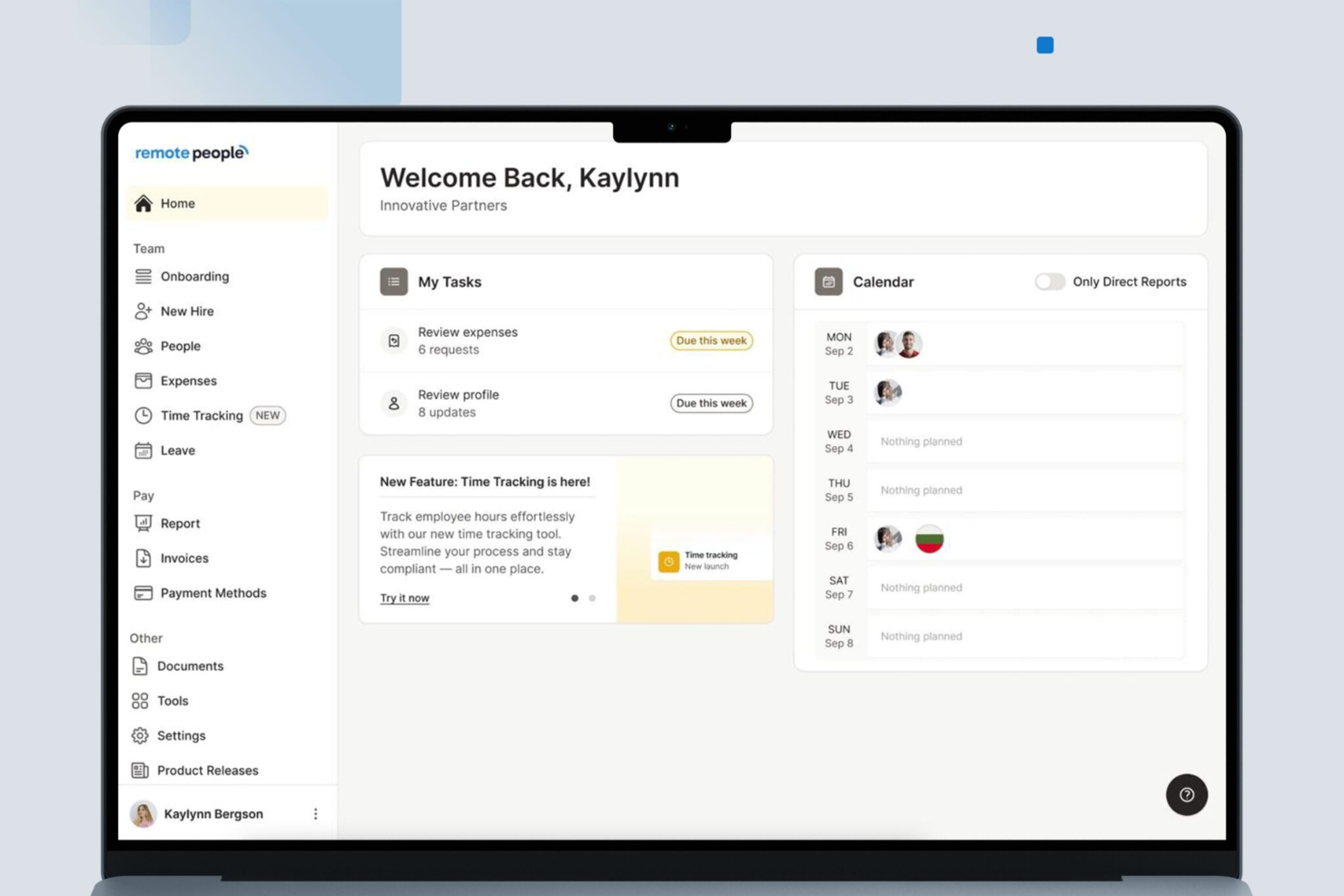
RemotePeople is a global employer of record platform that handles legal employment, payroll, statutory benefits enrollment, visa sponsorship, and compliance in Japan and 150+ other countries.
Who Is RemotePeople Best For?
RemotePeople is a strong fit for founders and HR teams hiring across multiple countries who want transparent, flat-fee pricing without setting up local entities.
Why I Picked RemotePeople
I've included RemotePeople in my top picks because it publishes more Japan-specific payroll and benefits detail than most EOR platforms I've reviewed. I particularly like that all mandatory social insurance programs, including shakai hoken and rodo hoken, are enrolled during onboarding with contribution rates published upfront. The platform also handles nenmatsu chosei (year-end tax adjustment) and produces bilingual employment contracts that satisfy Japan's Labor Standards Act.
RemotePeople Key Features
- AI Command Center: A plain-English interface where you type payroll or compliance requests, human experts review them, and every action is logged for audit.
- EOR-to-entity transfer: Once you're ready to set up your own Japan entity, RemotePeople transitions your employees from EOR to your local structure.
- Contractor of Record with conversion pathway: RemotePeople monitors misclassification risk and moves engagements that don't qualify as contracting directly to EOR status.
- Multi-currency consolidated invoicing: One invoice covers all employees across 150+ countries, with payroll processed in 120+ currencies including JPY.
RemotePeople Integrations
RemotePeople reports integrations with 100+ HRIS and accounting systems, including Workday, SAP SuccessFactors, BambooHR, HiBob, NetSuite, and QuickBooks. API availability is inconsistent across sources, so confirm custom integration support during evaluation.
Pros and Cons
Pros:
- Responsive account managers aid onboarding
- Bilingual contracts support local hiring
- Detailed Japan-specific labor law guidance
Cons:
- Day-to-day support can be slow
- Japan entity ownership remains unclear

Best for navigating complex Japanese labor rules
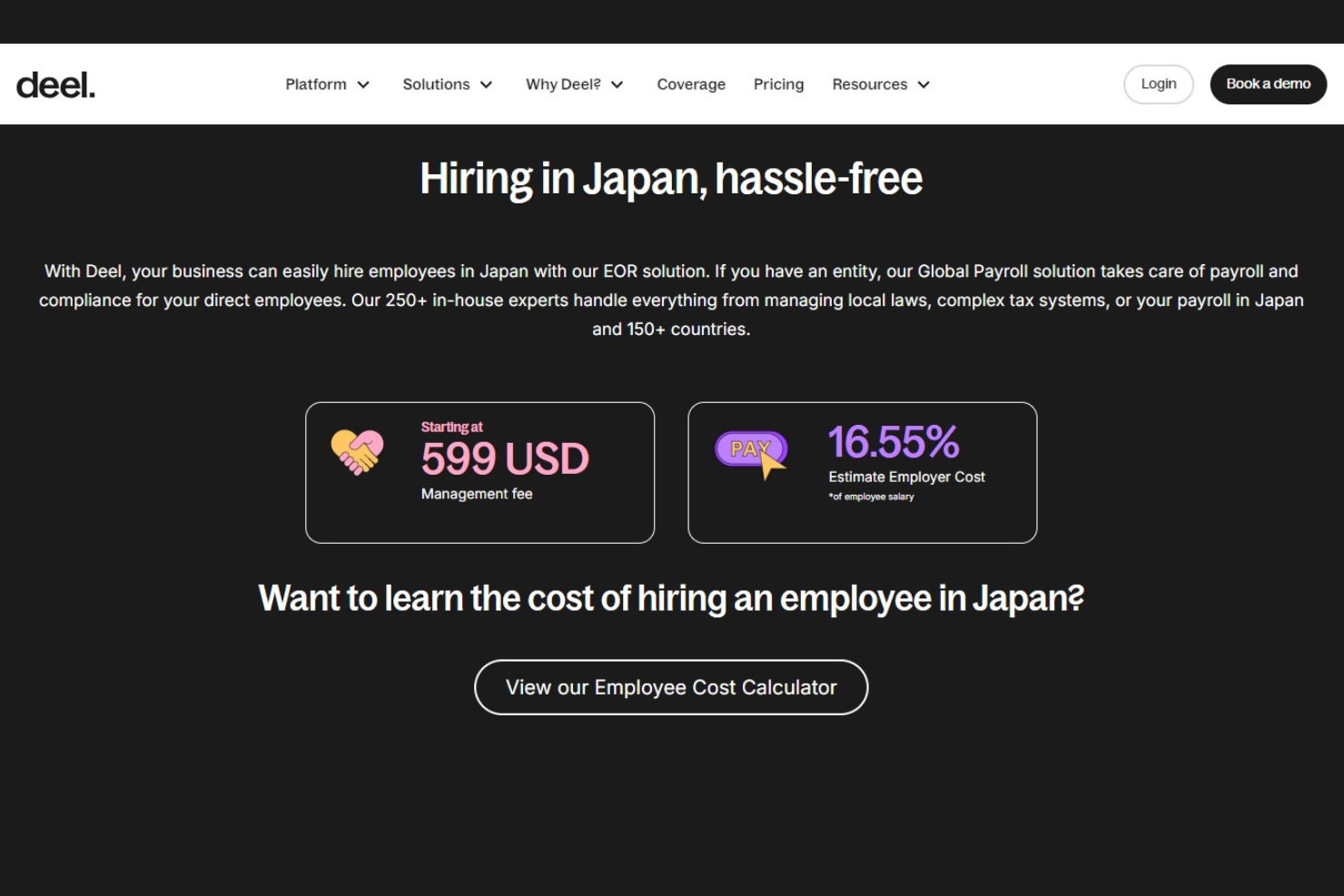
Deel is a global employer of record platform that lets you hire workers in Japan through its wholly-owned Japanese entity, handling payroll, tax withholding, statutory benefits, and labor law compliance across 130+ countries.
Who Is Deel Hire Best For?
Deel Hire is a strong fit for companies hiring across multiple countries who need Japan-specific compliance—think bilingual contracts, My Number handling, and statutory benefit enrollment—without setting up a local entity.
Why I Picked Deel Hire
I've included Deel Hire in my top picks because it owns its Japan entity outright, a wholly-owned Kabushiki Kaisha (K.K.), which means it takes on full compliance and audit liability so you don't have to. What I find especially useful is how it handles the details that trip companies up in Japan: bilingual contracts, My Number collection with APPI-compliant consent built into onboarding, and automatic day-one enrollment in health insurance, pension, employment insurance, and workers' compensation.
Deel Hire Key Features
- Contractor-to-employee conversion: Deel's platform lets you convert existing contractors to EOR employees using a built-in conversion playbook and an AI-powered misclassification tool.
- Time and attendance tracking: All Japan-based employees log hours directly in Deel's Time & Attendance tool to support overtime compliance and accurate payroll calculations.
- Visa sponsorship and COE filing: Deel Immigration handles Certificate of Eligibility filings, Immigration Bureau updates, residence card scanning, and renewal alerts for Japan-based hires.
- Multi-country unified platform: One platform manages EOR, contractors, direct payroll, and HR across 130+ countries, keeping Japan employees in the same system as your global workforce.
Deel Hire Integrations
Deel Hire offers integrations with Workday, SAP SuccessFactors, BambooHR, HiBob, Personio, Greenhouse, Ashby, QuickBooks, Xero, Slack, and Microsoft. Its directory also lists NetSuite, Sage, JumpCloud, Hubstaff, Time Doctor, Spendesk, Moss, and Pave.
Pros and Cons
Pros:
- Contractor conversion supports misclassification risk management
- Automatic day-one enrollment covers Japan’s statutory benefits
- Wholly owned Japanese entity assumes compliance liability
Cons:
- Onboarding timelines vary across Deel materials
- Reviewers report payment and withdrawal delays

G-P
Best for flexible global payment options
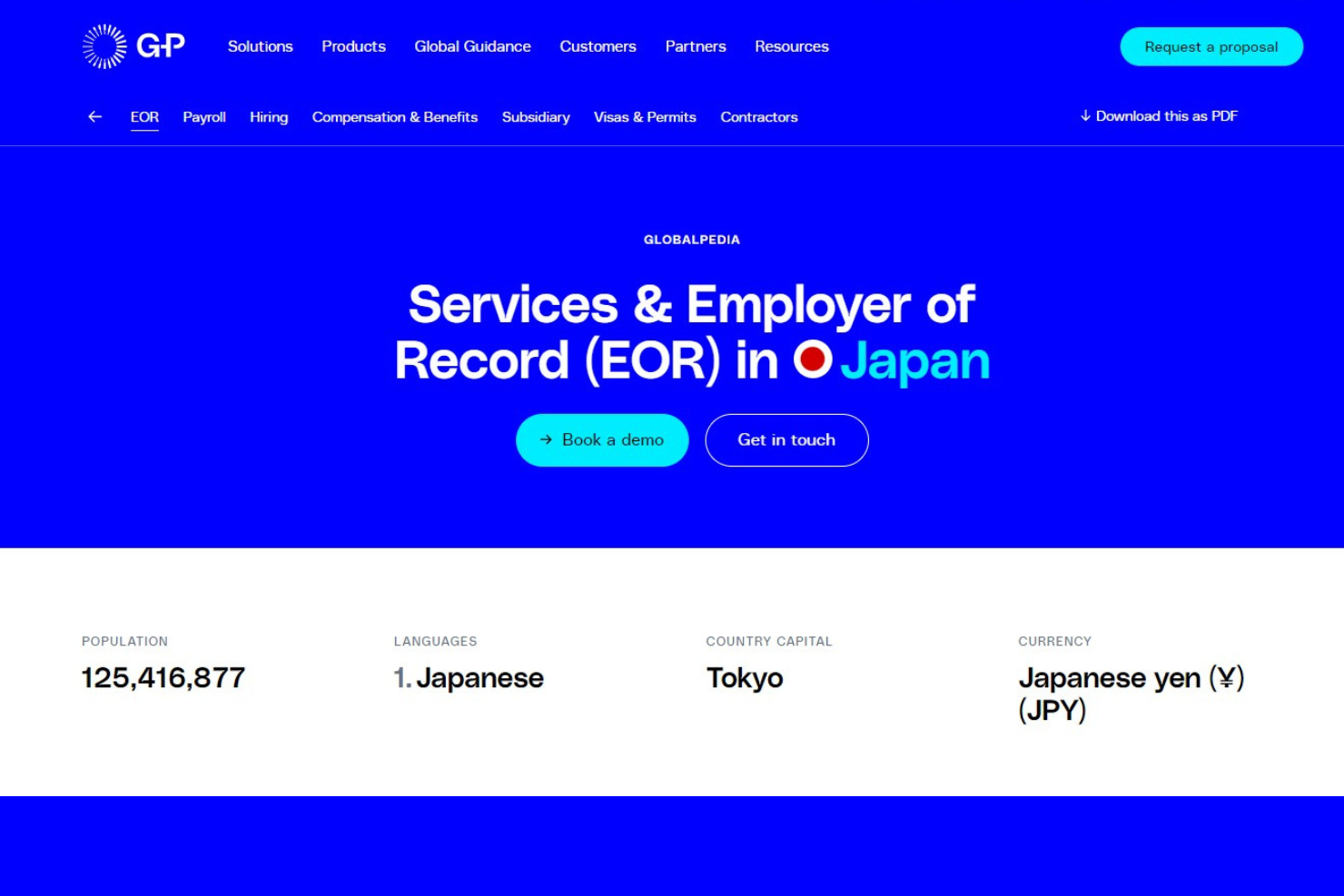
G-P is an employer of record platform that lets you hire in Japan through its own locally registered entity, handling payroll, statutory benefits, labor-compliant contracts, and multi-country workforce management across 180+ countries.
Who Is G-P Best For?
G-P is a strong fit for HR and global mobility teams managing employees across multiple countries who need flexible, multi-currency payment options alongside a fully owned-entity EOR model.
Why I Picked G-P
G-P earns its spot on my shortlist because its payment flexibility goes well beyond standard multi-currency payroll. I like that it runs EOR payroll across 150+ currencies and supports multiple funding methods, including ACH, wire transfer, and digital wallet, so paying Japan-based employees alongside a distributed global team doesn't require juggling separate invoices or accounts. Its built-in Wise integration for contractor payments also handles FX at scale, with batch payments and live tracking across 130+ currencies.
G-P Key Features
- Owned-entity employment in Japan: G-P acts as the legal employer through its own locally registered Japan GK entity, which has been operating since 2017.
- Global compliance engine: G-P auto-generates locally compliant contracts and flags legal risks, covering Japan's four main employment contract types under the Labor Standards Act.
- Contractor-to-EOR conversion: G-P's unified platform lets you convert Japan-based contractors to full-time employees directly, reducing misclassification risk with AI-assisted onboarding tools.
- HCM integrations and API access: Native integrations with BambooHR, Workday, SAP SuccessFactors, HiBob, and others sync payroll and workforce data across your existing HR stack.
G-P Integrations
G-P offers documented integrations with BambooHR, Workday, SAP SuccessFactors, HiBob, UKG Pro, Google Workspace, Microsoft Entra ID, Okta/Auth0, and Wise. Its API supports custom integrations.
Pros and Cons
Pros:
- Responsive support earns favorable user reviews
- Flexible multi-currency payroll suits global teams
- Owned Japanese entity supports local compliance
Cons:
- Invoice workflows can feel unintuitive
- Visa assistance costs extra and varies

Best for quick employee onboarding
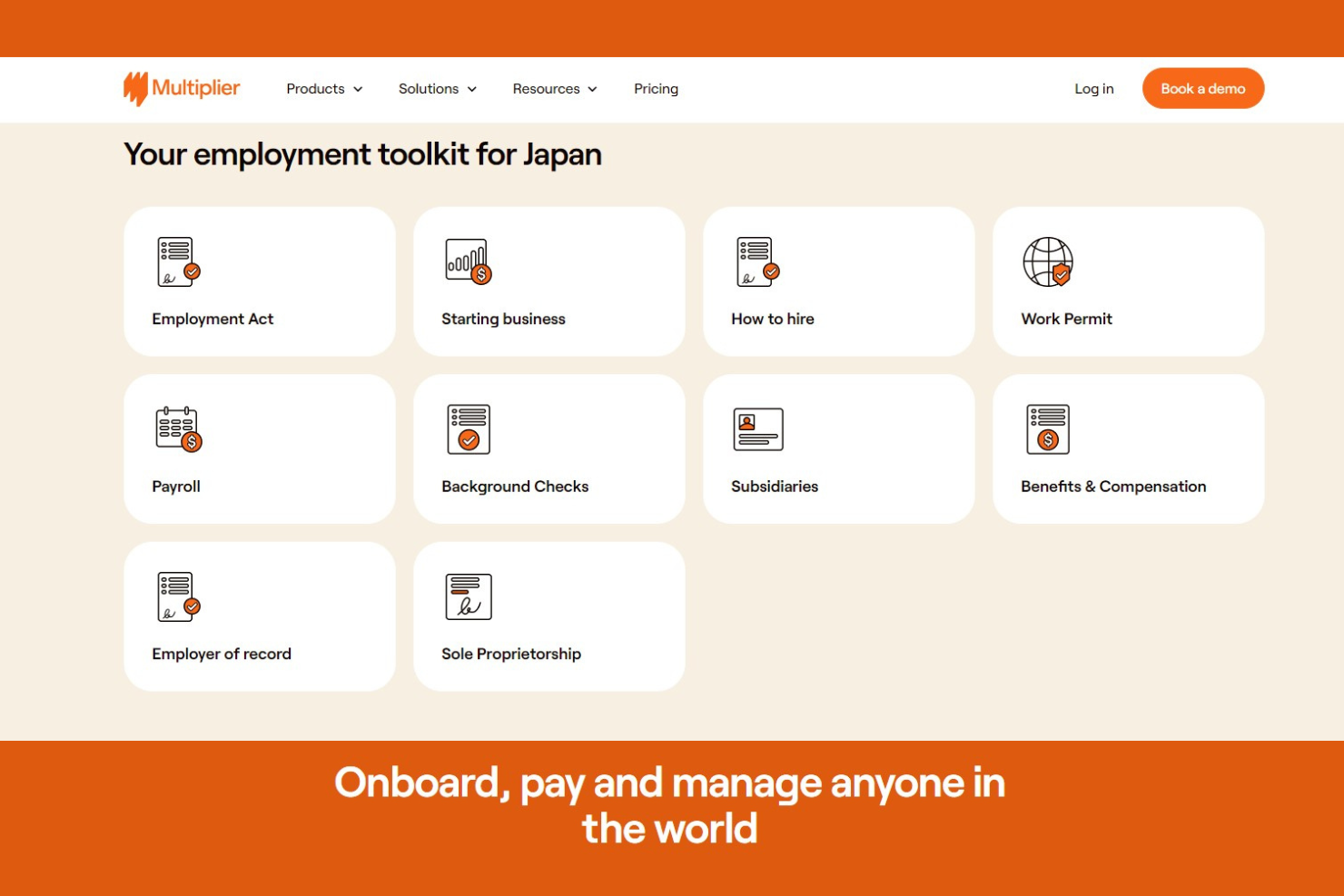
Multiplier is a global employer of record platform that lets you hire in Japan without a local entity, handling employment contracts in Japanese, payroll in JPY, statutory insurance enrollment, and labor law compliance across the full employment lifecycle.
Who Is Multiplier Best For?
Multiplier is a strong fit for HR teams and founders who need to get employees hired and working in Japan quickly, without spending weeks on legal setup.
Why I Picked Multiplier
I picked Multiplier as one of the best because it generates employment contracts in Japanese in under five minutes and completes full social insurance enrollment within 48 hours of a hire starting. I love that it automatically tracks the five-year fixed-term conversion rule under the Labour Contract Act, so you're never caught off guard by a compliance deadline. Bilingual contracts (Japanese with English translations) remove a step that typically slows hiring teams down.
Multiplier Key Features
- Statutory insurance enrollment: Multiplier enrolls employees in all four mandatory Japanese insurance programs—health, pension, employment, and workers' accident—on their first day, with direct filings to the Japan Pension Service and public employment office.
- 36 Agreement management: The platform documents and tracks overtime agreements (三六協定) required under Japanese law, including monthly and annual hour caps and applicable overtime pay rates.
- Multi-currency payroll dashboard: A single dashboard runs monthly JPY payroll alongside payroll in other currencies across 160+ countries, with electronic payslips and five-year record retention.
- HRIS integrations: Multiplier connects with 15+ HR and payroll systems, including Workday, BambooHR, SAP SuccessFactors, and ADP Workforce Now, syncing employee data across your existing tools.
Multiplier Integrations
Multiplier documents 15+ integrations, including Workday, BambooHR, SAP SuccessFactors, ADP Workforce Now, Personio, HiBob, Oracle HCM, and Zoho People. It also supports API and custom integrations, SSO, audit logs, and role-based access.
Pros and Cons
Pros:
- Tracks five-year conversion deadlines
- Day-one statutory insurance enrollment
- Japanese-English contracts support faster hiring
Cons:
- Japan dispute and visa ownership unclear
- Onboarding timelines contradict each other

Best for direct hiring in Japan
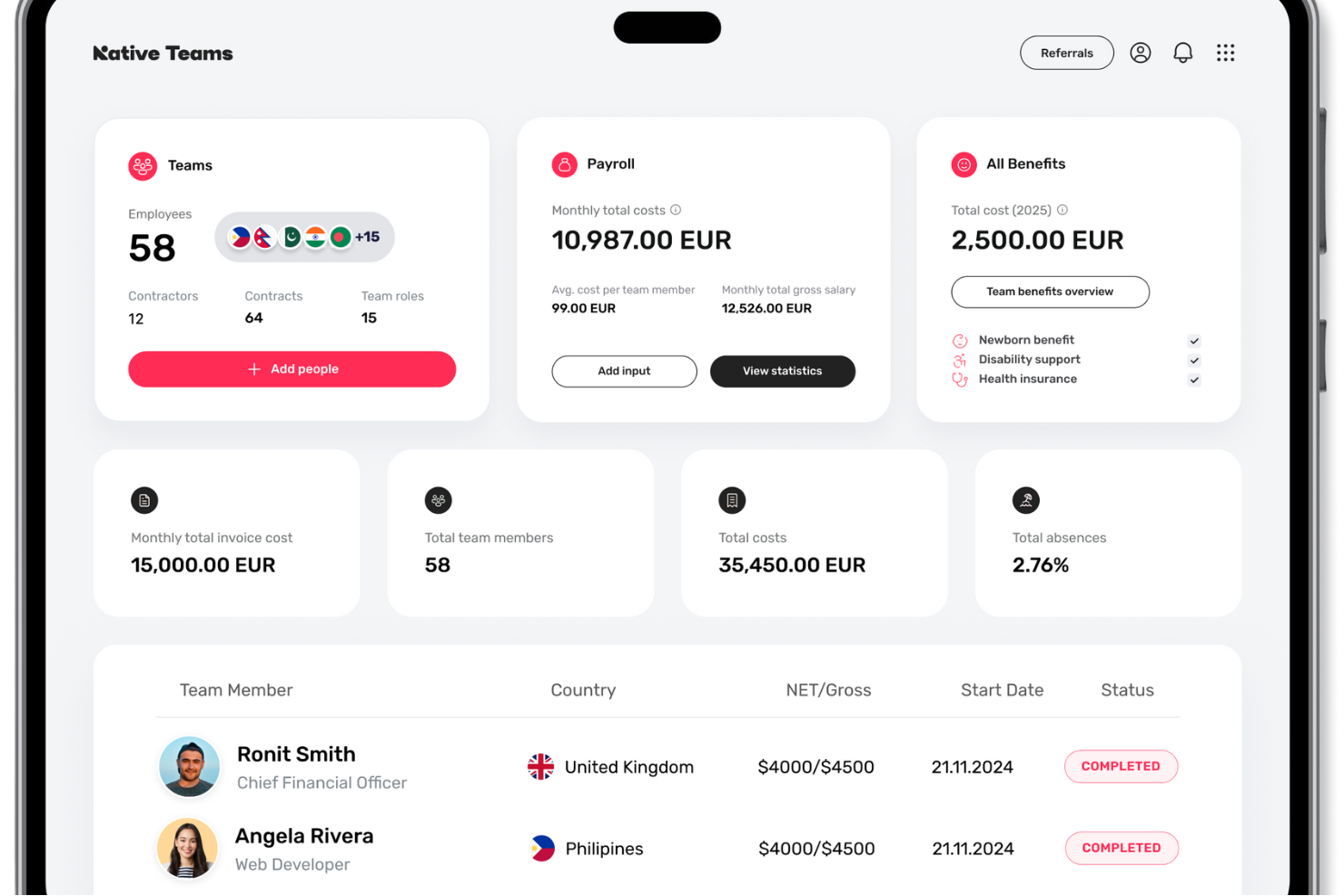
Native Teams is an employer of record platform that lets you hire in Japan through its own legal entities, handling contracts, payroll, statutory benefits enrollment, and compliance with Japanese labor law across a unified multi-country dashboard.
Who Is Native Teams Best For?
Native Teams works well for founders and global mobility leads who need to hire in Japan quickly, without setting up a local entity.
Why I Picked Native Teams
I've included Native Teams in my top picks because it lets you hire in Japan directly through its own legal entities, with no resellers or third parties involved. I particularly like that its Japan documentation covers the specifics that actually matter at hire time: statutory contribution rates for pension, health, and employment insurance, plus termination rules and the 5-year fixed-term conversion requirement. If you're a founder or global mobility lead who needs to get someone under contract in Japan within days, the 2–3 business day onboarding timeline makes that realistic.
Native Teams Key Features
- Statutory contribution management: Native Teams publishes employer contribution rates for Japan's pension, health, employment, and workers' accident insurance directly within the platform's country documentation.
- Multi-currency payroll wallet: Employees access earnings through a built-in multi-currency wallet, with JPY payroll support and optional expense cards.
- Contractor-to-EOR conversion: The platform lets you move contractors into full EOR employment without switching tools or vendors.
- Unified multi-worker dashboard: A single dashboard manages employees, contractors, and gig workers across countries, including onboarding, contracts, and payroll approvals.
Native Teams Integrations
Native integrations are not clearly documented. Third-party listings mention Slack, Microsoft Teams, QuickBooks, BambooHR, Google Workspace, and Zapier, but Native Teams describes its ecosystem as limited and doesn’t publish API documentation.
Pros and Cons
Pros:
- Reviewers praise responsive account managers
- Detailed Japanese labor law guidance
- Direct entity employment in Japan
Cons:
- Users report occasional payment errors
- Japan-specific visa support remains unclear

Best for 24/5 dedicated support
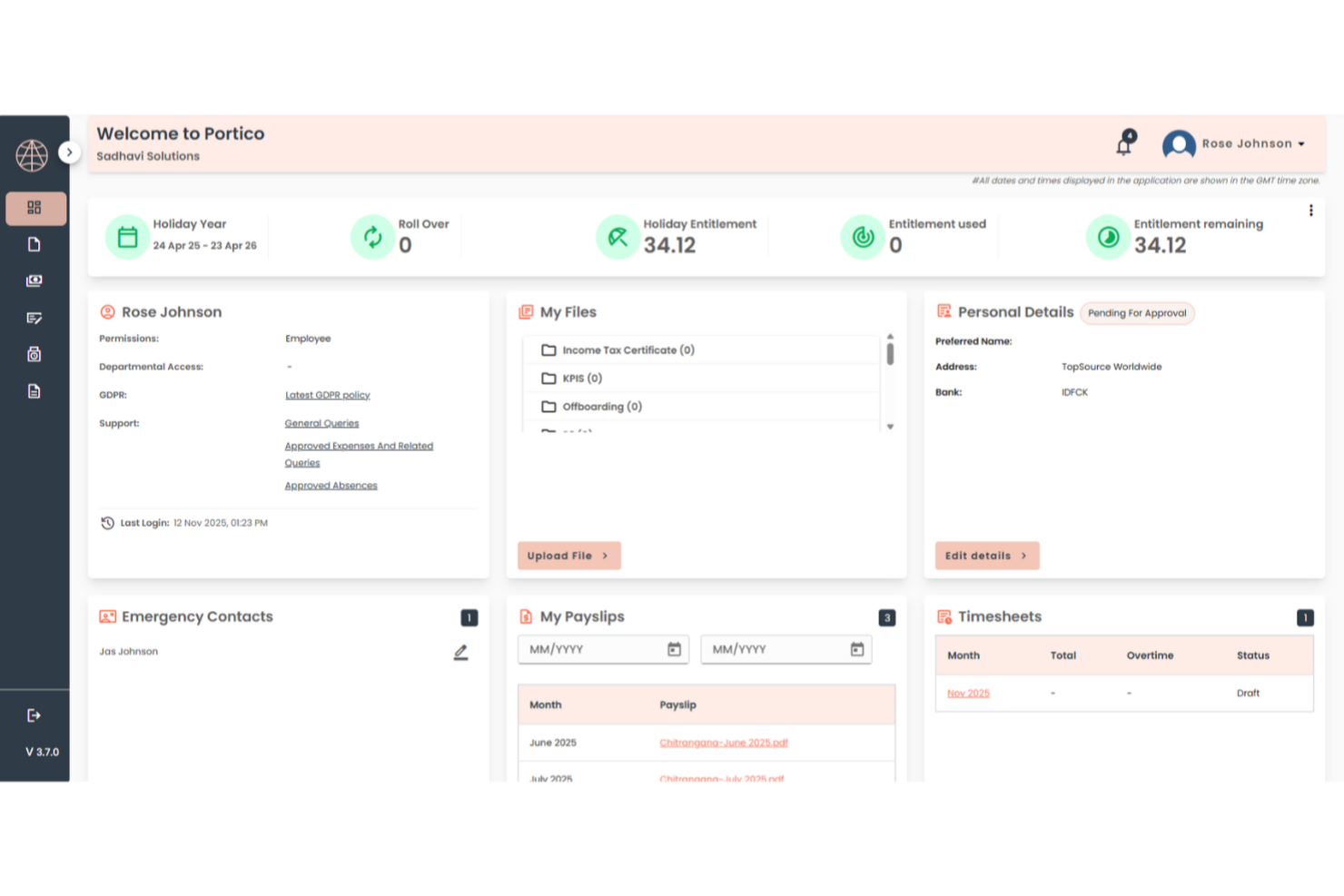
TopSource Worldwide is a global employer of record service that handles Japanese payroll, statutory benefits enrollment, tax withholding, and labor law compliance on behalf of companies hiring in Japan without a local entity.
Who Is TopSource Best For?
TopSource is a strong fit for HR directors and global mobility leads who need hands-on, account-managed support for Japan compliance rather than a self-serve platform.
Why I Picked TopSource
I've included TopSource in my top picks because its 24/5 phone access to a named account manager is genuinely useful when you're navigating Japan's payroll complexity across time zones. I like that each client gets a dedicated contact who handles everything from year-end tax adjustments (年末調整) to resident tax filings across multiple municipalities. When a compliance question comes up mid-quarter, you're not submitting a ticket and waiting.
TopSource Key Features
- Flat monthly fee structure: TopSource charges one fixed fee per employee that doesn't increase with salary, and passes statutory costs through at no markup.
- Portico global dashboard: A unified platform gives you real-time visibility across your entire workforce in all 164 supported countries from one interface.
- Quarterly compliance reviews: TopSource runs scheduled compliance reviews and provides in-country HR advice for contract changes, performance issues, and offboarding.
- HRIS and ATS integrations: Native connections to tools like Workday, BambooHR, Greenhouse, and Lever keep onboarding, offboarding, and pay changes in sync automatically.
TopSource Integrations
TopSource offers integrations with Workday, SAP SuccessFactors, UKG, BambooHR, Greenhouse, Lever, and other HRIS and ATS platforms. It also provides an API for custom connections involving attendance, leave, onboarding, and benefits data.
Pros and Cons
Pros:
- Quarterly reviews support ongoing legal compliance
- Detailed Japanese payroll compliance guidance
- Dedicated 24/5 account manager support
Cons:
- Portico workflows can feel manual
- Japan legal employer remains undisclosed

Best for direct-entity hiring in Japan
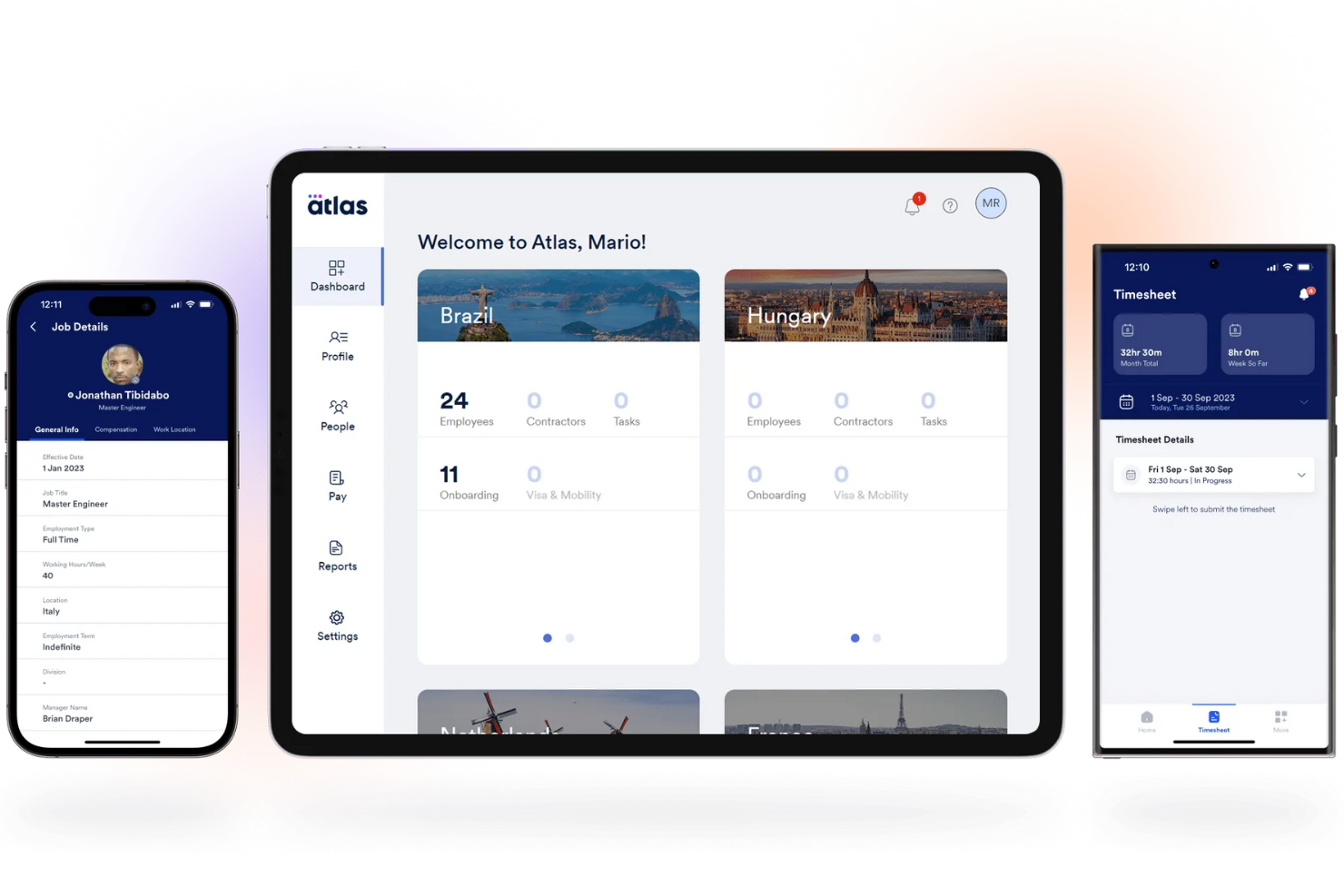
Atlas HXM is a direct-entity employer of record that lets you hire employees in Japan through its own locally owned legal entity, handling employment contracts, payroll, statutory benefits, and visa sponsorship without third-party intermediaries.
Who Is Atlas HXM Best For?
Atlas HXM is a strong fit for companies that need to hire in Japan through a direct-entity EOR and want to avoid third-party intermediaries in the employment chain.
Why I Picked Atlas HXM
I picked Atlas HXM as one of the best because it operates its own legal entity in Japan, meaning your employees are hired directly through Atlas with no third-party intermediaries in the chain. I find this especially valuable when hiring in Japan, where employment contracts must align precisely with the Labor Contracts Act and statutory contributions spanning health insurance, pension, and workers' compensation need accurate employer-side management. Atlas also supports HSP and Engineer/Specialist visa sponsorship in Japan through dedicated mobility specialists, which matters when you're relocating talent rather than just hiring locally.
Atlas HXM Key Features
- Statutory benefits enrollment: Atlas automatically enrolls employees in Japan's mandatory social insurance programs, including health, pension, employment insurance, and workers' compensation.
- Visa sponsorship case management: A dedicated Global Mobility Specialist manages each visa application end-to-end, covering HSP, Engineer/Specialist, and Business Manager visa categories in Japan.
- Employee self-service app: Employees access payslips, tax documents, time-off requests, timesheets, and expenses through iOS and Android apps.
- Regulatory change alerts: The platform monitors Japanese labor law updates and sends automated alerts to keep employment terms and HR practices current.
Atlas HXM Integrations
Atlas HXM lists integrations with Workday, BambooHR, Sage, Ashby, Paycor, UKG, Ceridian Dayforce, ExactHire, Okta, Microsoft, and Google Workspace. It also supports Udemy Business through SSO and provides centralized employee and payroll data syncing.
Pros and Cons
Pros:
- Dedicated account managers provide responsive guidance
- Supports HSP and Engineer visas
- Direct-entity employment avoids third-party intermediaries
Cons:
- Reviewers report complex interfaces and payroll errors
- Japan-specific My Number handling remains undocumented
Mercans
Best for direct-entity payroll in Japan
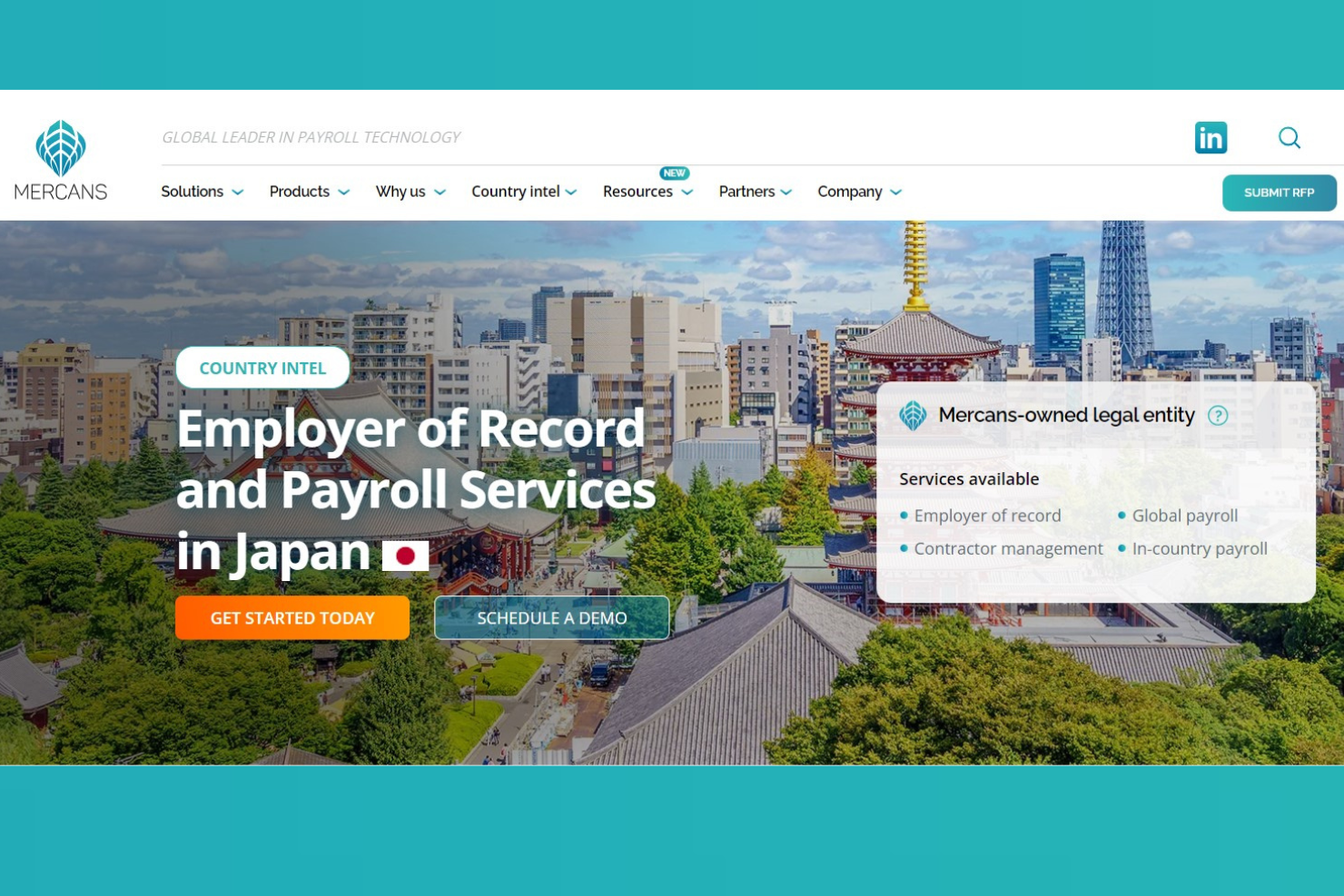
Mercans is an employer of record platform with its own legal entity in Japan that handles local payroll, statutory benefits administration, tax filings, and work visa support across 160+ countries through its HR Blizz platform.
Who Is Mercans Best For?
Mercans is a strong fit for HR directors and founders who need direct-entity payroll in Japan without setting up a local company.
Why I Picked Mercans
I've included Mercans in my top picks because it owns its Japan legal entity outright and employs local staff directly, with no third-party aggregators involved. In practice, that means your payroll runs on Mercans' own infrastructure, covering nenmatsu chosei automation, resident tax withholding, and Zengin-format bank transfers without a middleman adding risk or delay. I also like that it manages My Number collection, encryption, and disposal in-house, which removes a compliance headache that trips up a lot of foreign companies entering Japan.
Mercans Key Features
- Statutory benefits administration: Mercans calculates and files contributions across all mandatory Japanese schemes, including health insurance, pension, employment insurance, and the April 2026 child-rearing support contribution.
- HR Blizz self-service portal: Employees and managers access payslips, leave requests, time and attendance, and expense submissions through a single cloud platform.
- Zengin-format payroll transfers: Payroll is disbursed via Zengin-compatible bank transfer files, meeting Japanese banking standards for domestic salary payments.
- Dynamic Statutory Radar: Mercans' compliance monitoring tool tracks Japanese regulatory changes and updates payroll calculations automatically to reflect new rates or rules.
Mercans Integrations
Mercans HR Blizz integrates with Workday, SAP SuccessFactors, Oracle, SAP, and HiBob, with a REST API available for custom two-way integrations.
Pros and Cons
Pros:
- Reviewers praise local-law support
- Deep resident-tax and year-end payroll coverage
- Direct Japan entity avoids aggregators
Cons:
- Japan contractor conversion process remains unclear
- Visa renewal guidance remains limited


RemotePeople (formerly Horizons) is a global employer of record service that lets you hire in Japan without a local entity, handling bilingual employment contracts, JPY payroll, statutory benefits enrollment, and visa sponsorship across 150+ countries.
Who Is Horizons Best For?
Horizons is a strong fit for global mobility teams and HR professionals navigating Japan's complex labor law requirements, particularly when bilingual contracts and visa sponsorship are non-negotiable.
Why I Picked Horizons
I've included Horizons in my top picks because bilingual Japanese/English employment contracts are built directly into the onboarding process, not treated as an add-on. When you're hiring in Japan, that matters: contracts must comply with both the Labor Standards Act and the Labor Contract Act, and having them drafted in both languages from day one removes a significant legal risk. I also like that Horizons covers visa sponsorship for multiple work authorization types, including the Highly Skilled Professional and Engineer/Specialist categories, with a dedicated immigration manager handling the Certificate of Eligibility process end to end.
Horizons Key Features
- Statutory benefits enrollment: Horizons registers employees in Shakai Hoken (health insurance and pension) and Rodo Hoken (unemployment and workers' accident insurance), including the annual September standard remuneration recalculation.
- Contractor-to-employee conversion: The platform converts existing contractors in Japan into compliant full-time employees, with a compliance review built into the process.
- Year-end tax adjustment: Horizons handles nenmatsu chosei as part of the standard EOR fee, covering Japan's annual income tax reconciliation process.
- AI-assisted compliance actions: The Command Center feature lets you submit HR and payroll requests in plain language, with each action checked against local law and reviewed by an expert before execution.
Horizons Integrations
Horizons doesn’t have clearly documented native integrations. Its pricing page documents payroll exports to QuickBooks and Xero, while no public API or HRIS/ATS integrations are listed.
Pros and Cons
Pros:
- Handles year-end tax adjustments and benefits enrollment
- Visa sponsorship includes dedicated immigration support
- Bilingual contracts support Japanese compliance
Cons:
- Japan-specific data handling remains unclear
- Users report slow payroll responses

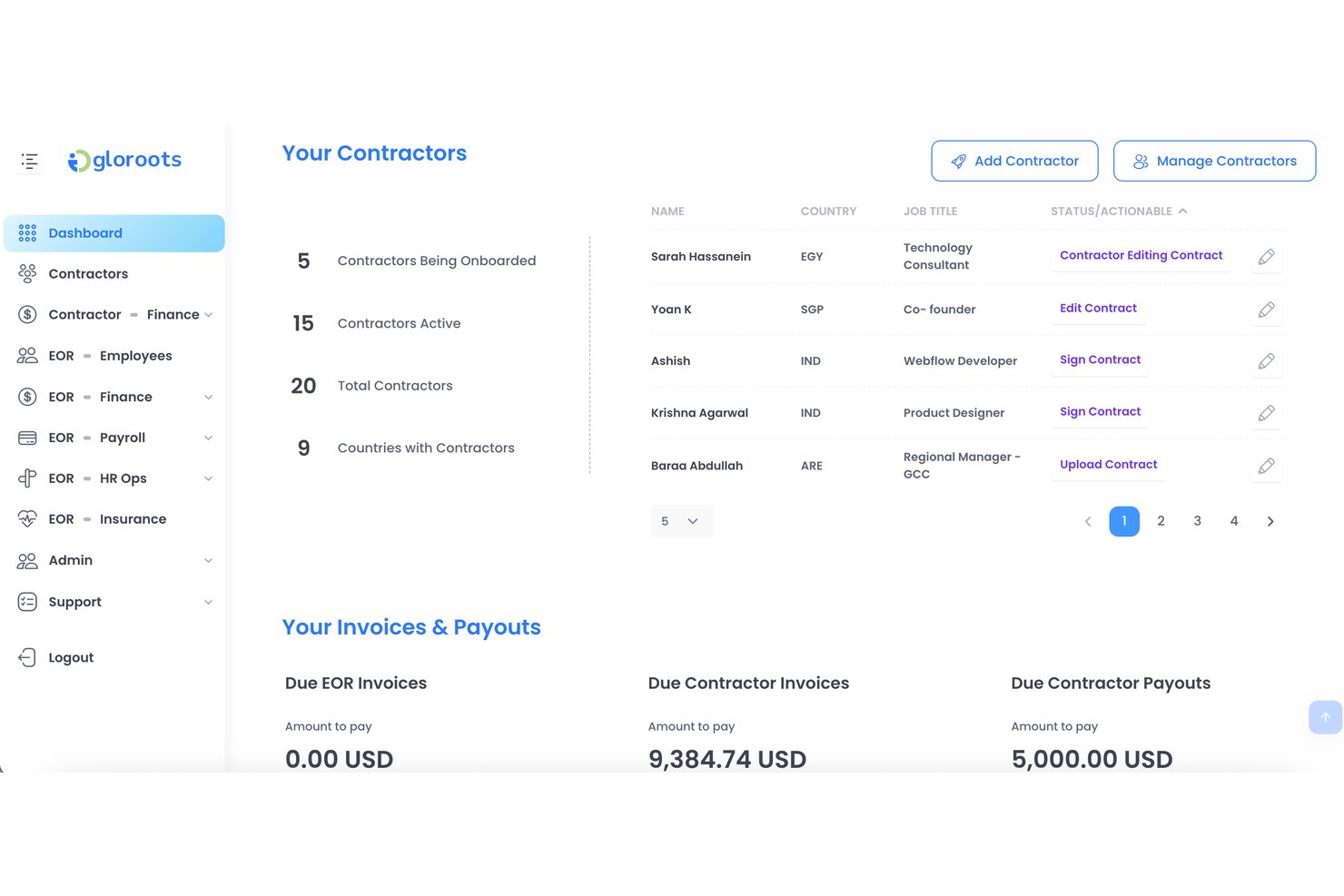
Gloroots is an employer of record platform that lets you hire, onboard, and pay employees in Japan without a local entity, covering payroll, tax withholding, statutory benefits, My Number compliance, and visa sponsorship across 150+ countries.
Who Is Gloroots Best For?
Gloroots is a strong fit for founders and early-stage teams who need to hire in Japan without the overhead of a dedicated HR or legal function.
Why I Picked Gloroots
I picked Gloroots as one of the best because it's built for founders and early-stage teams who need to hire in Japan without a legal or HR function behind them. I love that it owns its Japan KK entity directly, which means your employee is covered under Japan's Labor Standards Act from day one. It also handles Japan-specific requirements like My Number collection, Article 36 filings, and the 5-year fixed-term rule automatically, without you needing to flag them.
Gloroots Key Features
- My Number compliance: Gloroots collects and stores My Number data in an access-controlled environment that meets APPI requirements, with consent required before any data leaves Japan.
- Article 36 filing: Gloroots files the mandatory Article 36 Agreement on your behalf before employees work any overtime hours.
- Statutory benefits enrollment: Employees are enrolled from day one in Japan's health insurance, pension, employment insurance, and workers' compensation programs.
- Contractor-to-EOR conversion: The platform lets you convert existing contractors into compliant full-time employees, with updated contracts and statutory benefits, without switching tools.
Gloroots Integrations
Gloroots lists integrations with Workday, SAP SuccessFactors, Oracle, and BambooHR. Enterprise APIs, SSO, and SCIM support custom HR and identity connectivity.
Pros and Cons
Pros:
- Reviewers praise responsive payroll support
- Local Japanese entity supports employment and visas
- Japan compliance covers My Number and overtime
Cons:
- Japan claims lack independent verification
- Onboarding timelines vary across company pages
Other Japanese Employer of Record Services
Here are some other EOR service providers in Japan that didn’t make it into my top 10 shortlist, but are still worth considering:
- Payoneer Workforce Management
For IP protection when hiring in Japan
- Papaya Global
For AI-validated payroll runs in Japan
- Rivermate
For European teams hiring in Japan
- Rippling
For one platform across all global markets
- Playroll
For flat-rate Japan payroll and tax filing
- GoGlobal
For Tokyo-based entity ownership and support
- Teamed
For flat-fee Japan EOR with named HR advisors
- AYP Group
For contractor-to-employee conversion in Japan


Market Details for Hiring in Japan
- Capital City: Tokyo
- Currency: Japanese Yen (JPY)
- Payroll Frequency: Monthly
- Official Language: Japanese
- Approx. Population: 125 Million
- Public Holidays: 16 days
Why Hire Employees in Japan?
Japan's workforce is well-educated and the country is regarded as a global leader in industries such as technology, engineering, and manufacturing. It’s known for its expertise in advanced manufacturing, precision engineering, and cutting-edge technology, making it a prime destination for businesses seeking top-tier talent in these fields.
In addition, Japan's focus on innovation, commitment to quality, and strategic location in the Asia-Pacific region also make the market an attractive location for hiring remote talent. For all these reasons, Japan presents a compelling opportunity to hire world-class talent for specialized roles such as software developers, engineers, and R&D specialists.
How I Evaluate Employer of Record Japan
I split my evaluation into three parts, with core functionality carrying the most weight: legally employ workers in Japan and run local payroll, tax, and statutory benefits. Next, I look for My Number handling and bilingual contracts. Finally, I consider local HR support, onboarding speed, and transparent pricing.
Core Functionality (Table Stakes For This List)
When I'm selecting tools for my list, I score each one on a scale from 0 (does not offer the functionality) to 5 (excels in this area) for each core functionality listed below. I then convert the total into a percentage to help assess each tool's overall fit, with extra weight on any functionalities I’ve deemed essential.
- Legal Entity Employment (Essential): I check whether the provider legally employs workers in Japan through its own or clearly disclosed local entity.
- Japanese Labor Law Compliance (Essential): I assess Japan-specific contracts, termination guidance, statutory protections, and support for sensitive employee relations cases.
- Payroll And Tax Administration: I look for local-currency payroll, income-tax withholding, remittance, payslips, and clear reconciliation records.
- Statutory Benefits Administration: I check enrollment and ongoing administration for Japan’s health insurance, pension, social insurance, and labor insurance.
- Visa And Work Permit Support: I assess hands-on support for visa sponsorship, work permits, renewals, and onboarding foreign employees in Japan.
- Multi-Country Platform Access: I look for one dashboard covering Japan and other countries, with consistent employee records, workflows, and reporting.
Once I have a list of tools that meet the criteria, I consider what sets each platform apart.
Differentiating Factors (What Sets Vendors Apart)
Here's how I compare and contrast different vendors:
Standout Features
I look for built-in year-end tax adjustment (nenmatsu chōsei) automation, since manual reconciliation across dozens of employees creates real compliance risk every December. Contractor-to-EOR conversion is another differentiator—I check whether a provider can move existing Japan-based contractors to full-time status without gaps in coverage or benefits enrollment. I also evaluate My Number handling protocols, because mismanaging this sensitive data can trigger penalties under Japan's privacy laws.
Beyond Features
I check whether each provider owns its Japan entity or subcontracts to a local partner, since partner-based models can create gaps in data handling and employee experience. Termination expertise matters just as much—Japan's labor law makes most at-will dismissals unenforceable, so I evaluate how each vendor guides severance negotiations and exit documentation. I also look at realistic onboarding timelines for contract issuance, social insurance enrollment, and visa processing specific to Japan.
How to Choose an Employer of Record in Japan
An EOR service can solve many different challenges and simplify the process of hiring and managing staff in Japan. To help you figure out which EOR service best fits your business needs, you need to document your specific challenges first.

As you work through your own unique selection process, keep the following points in mind:
- What problem are you trying to solve? Start by identifying the challenges you're trying to overcome, whether that's managing compliance with Japan’s employment laws and tax regulations, offering health benefits that are compliant with Japanese government requirements, or sourcing staff within a specific Japanese region or prefecture, such as the Tokyo prefecture (Kanto region), the Osaka prefecture (Kansai region), or others.
- Who will benefit from the service? Consider who will manage the EOR relationship (i.e., who will your main contact people be in-house?) and how having an employer of record will improve their day-to-day work tasks.
- What is your budget? To evaluate cost, estimate how many employees you anticipate hiring in Japan. Since EOR providers typically charge a monthly fee for each new hire, this will help you anticipate your monthly costs.
- What outcomes are important? Review the capabilities you want to gain or improve, and how you will measure success. Being clear on your desired outcomes upfront is crucial to avoid wasting valuable time.
- Would the EOR platform work with your technical requirements? Consider how the service provider's software ecosystem would work alongside your existing workflows and systems. Does their software framework integrate with your existing HR software, or would you face data management roadblocks?
Remember, every business is different — don’t assume that a Japanese employer of record service will work for your organization just because it's popular.
What is an Employer of Record in Japan?
An Employer of Record (EOR) in Japan is a third-party organization that hires employees on your behalf, handling all the legal and administrative responsibilities, while you retain control over day-to-day work.
As the legal employer, the EOR manages payroll, tax deductions, benefits, and compliance with Japan’s labor laws, including regulations set by the Ministry of Health, Labour and Welfare.
It’s a smart solution for companies looking to hire local or foreign talent in Japan without the complexity of setting up a legal entity. By partnering with a Japanese EOR, you offload regulatory burdens and ensure compliant, hassle-free hiring.
Why Use an Employer of Record Service in Japan?
Using an employer of record (EOR) in Japan allows you to hire employees without establishing a local entity or navigating Japan’s highly regulated employment and payroll system. To hire directly, employers must register for payroll tax, social insurance, labor insurance, and pension obligations while complying with the Japanese Labor Standards Act and related employment laws.
Japan also has strict rules around working hours, overtime, social insurance enrollment, and termination protections. An EOR helps manage these requirements, reduces administrative burden, and allows you to hire employees quickly while staying compliant with local labor laws.
Deciding Between an EOR and a Legal Entity in Japan
If you’re unsure whether to use an EOR or establish a legal entity in Japan, it helps to understand what each option entails. While setting up a legal entity gives you full control, using an EOR is a faster, simpler way to hire in Japan without taking on the regulatory and administrative burden.
Here’s a side-by-side comparison of what each option typically involves:
| Setup time | A few days to a week | Several weeks to months |
| Need to register with authorities | No – the EOR handles it | Yes – includes Legal Affairs Bureau, tax office, etc. |
| Payroll and tax management | Managed by the EOR | Must be set up and maintained internally |
| Employment contracts | Drafted and signed via EOR in compliance with local law | Fully your responsibility, including legal review |
| Social insurance & benefits | Administered by EOR per Japanese law | Must manage enrollment and payments directly |
| Compliance risk | Mitigated by EOR expertise | Fully your responsibility |
| Control over HR operations | Shared – day-to-day managed by you, legal by EOR | Full control |
| Cost of entry | Lower (monthly service fee) | Higher (setup + ongoing admin & compliance costs) |
As this table indicates, using an EOR is ideal for companies that want to hire quickly, test the market, or avoid the overhead of establishing a local entity. For longer-term operations with larger teams, setting up a legal entity may eventually make sense, but an EOR can be a valuable first step.
EOR vs Permanent Establishment in Japan
When hiring in Japan, one key consideration is whether your activities create a Permanent Establishment (PE), which could subject your company to Japanese corporate taxation.
A PE may arise if your company maintains a fixed place of business in Japan or conducts business through employees or agents who act on your behalf. If a PE is established, your company may become liable for Japanese corporate tax on income attributable to local operations.
PE risk increases if you:
- Employ staff directly in Japan
- Maintain a local office or physical infrastructure
- Allow employees to negotiate or conclude contracts on behalf of your company
How EORs Protect From Permanent Establishment Risk
An EOR helps reduce PE risk by creating a legal separation between your company and your workforce in Japan.
- Legal employer structure. The EOR is the official employer, not your company
- No local entity required. You avoid establishing a fixed place of business
- Local payroll and compliance handled by the EOR. All filings are made under the EOR’s registrations
- Service-based relationship. Your agreement with the EOR is structured as a B2B service contract
- Reduced authority risk. Employees are less likely to be viewed as representatives who can bind your company commercially
While an EOR significantly reduces PE exposure, risk can still depend on the employee’s activities and authority level in Japan.
Hiring in Japan: Important Details
Here are some key details to note if this is your first time hiring staff located in Japan. Your EOR provider will manage these compliance details on your behalf. However, proactively informing yourself of these details is always recommended before you invest your resources into sourcing staff based in Japan.
In Japan:
- Employment laws in Japan are set by the Ministry of Health, Labour and Welfare (MHLW). In addition, Japan’s Labour Standards Act also specifies labor standards, including working conditions, employment contracts, and hourly wages.
- You can hire employees (full-time, part-time, temporary, or seasonal) or contractors. Your Japanese EOR provider can help you determine the best employee classification option depending on your situation while preventing misclassification errors.
- Japan has both mandatory payroll deductions and other employment or social security contributions that must be collected, including the following:
- Employee’s pension insurance
- Health insurance
- Unemployment insurance
- Long-term care insurance
- National income tax, and the
- Municipal income tax.
- Japanese is the official language in Japan. However, other languages are spoken, including Korean, Mandarin Chinese, and English, particularly in urban areas and among expatriate communities.
- The standard working week in Japan is 40 hours per week for a 5-day work week.
- Overtime is allowed under the Labour Standards Act and is calculated at a premium rate of 125% for overtime, 135% for work on public holidays, and 150% for late-night work between 10 PM and 5 AM. However, employees cannot be asked to work more than six consecutive days without a rest day.
- In Japan, employees are paid monthly, typically around the 25th of each month. Japan also has a 13th-month payment system, usually paid in December as a bonus, with some companies offering a 14th-month payment during the summer.
- Paid vacation in Japan starts at 10 days of paid annual leave per year for employees who have been with a company for at least 6 months.
- There are 16 national public holidays that are celebrated in Japan which employees are paid for, plus several regional holidays and festivals. Understanding and complying with employment norms and legal requirements surrounding Japanese public holidays is one area where your EOR service will shine, managing these occurrences hassle-free on your behalf.
- National public holidays in Japan include:
- New Year's Day (January 1)
- Coming of Age Day (2nd Monday in January)
- National Foundation Day (February 11)
- Emperor’s Birthday (February 23)
- Vernal Equinox Day (variable, around March 20 or 21)
- Shōwa Day (April 29)
- Constitution Memorial Day (May 3)
- Greenery Day (May 4)
- Children’s Day (May 5)
- Marine Day (3rd Monday in July)
- Mountain Day (August 11)
- Respect for the Aged Day (3rd Monday in September)
- Autumnal Equinox Day (variable, around September 23)
- Health and Sports Day (2nd Monday in October)
- Culture Day (November 3)
- Labour Thanksgiving Day (November 23)
- Japan offers maternity leave and paternity leave.
- The maternity leave entitlement is 14 weeks, beginning 6 weeks before the child’s birth.
- The paternity leave entitlement for fathers is 4 weeks, which can be taken within 8 weeks after the child’s birth.
- During these leaves, employees receive 67% of their regular salary from Japan’s Social Security Fund.
- Paid sick leave in Japan is not mandated by law. However, most companies offer between 5 to 10 days of paid sick leave per year.
- The probationary period in Japan is typically 3 to 6 months, during which an employer can terminate the employee with shorter notice or no severance.
- The termination terms in Japan are mandated by the Labour Standards Act. The required notice period is 30 days, though this can be extended based on the length of service and the terms of the employment contract. (This is another area where a local Japanese EOR can provide assistance to ensure the probation period and related severance are handled correctly.)
- Severance pay is not legally required in Japan. However, it is still customary for many companies to offer severance pay based on the employee's length of service and salary.
Tax Overview for Employers in Japan
Japan has a structured payroll tax and social insurance system with mandatory employer contributions.
- Employers act as withholding agents. Employers must withhold income tax from employee salaries.
- Income tax is progressive. Rates vary based on income level.
- Social insurance contributions are mandatory. Employers contribute to:
- Health insurance
- Pension insurance
- Employment insurance
- Workers’ compensation insurance
- Employer and employee contributions are generally shared. Employer-side social insurance costs are substantial and vary depending on salary and region.
- Resident tax applies. Local inhabitant taxes are typically withheld through payroll.
- Payroll reporting and filings are required regularly. Employers must comply with annual and monthly filing obligations.
- Strict labor and payroll compliance applies. Authorities closely monitor overtime, insurance enrollment, and payroll practices.
Trends in Employer of Record Services
As global hiring continues to accelerate, businesses need faster, more reliable ways to manage payroll, compliance, benefits, and onboarding across borders. EOR providers are rising to the challenge with tech-forward solutions that prioritize flexibility, automation, and all-in-one support to simplify international expansion.
Here are the latest trends shaping EOR services and the HR platforms that power them:
- Immigration Support: There is a growing demand for assistance with immigration services like visa and work permit sponsorships, simplifying global talent acquisition processes for client companies immensely.
- Specialized Services for Diverse Needs: Several EOR providers have begun to offer IP and invention rights protection and equity incentive planning services, to cater to the specific needs of their client companies.
- Enhanced Employee Benefits Packages: There's a growing trend in EOR providers going beyond standard healthcare coverage to offer a full spread of enterprise-level medical and health benefits, stock options, and even one-time benefits like moving bonuses. This trend demonstrates an understanding of the importance of attracting and retaining top talent globally.
- AI-Backed Knowledge Bases: Some EOR providers (including Deel) are beginning to offer legally vetted knowledge bases or information wikis that use artificial intelligence to surface answers to common questions quickly. This helps customers source details on hiring within a specific country fast, without relying on human-run support systems.
As the market continues to evolve, these trends are likely to shape the future of international employment, making it easier for businesses to navigate the challenges of global expansion.
For a closer look at specific EOR providers that are capitalizing on these trends, I recommend reading our in-depth reviews of Omnipresent, Payoneer, and Oyster HR.
Key Employer of Record Services And Features
An Employer of Record (EOR) simplifies hiring and compliance in Japan by managing payroll, tax obligations, and labor laws. Key services include:
- Payroll in JPY: Your EOR ensures accurate salary payments in Japanese yen, fully compliant with Japan’s Labor Standards Act. This includes wage calculations, overtime rules, allowances, and detailed record-keeping to prevent penalties from the Ministry of Health, Labour, and Welfare (MHLW).
- Tax compliance and social contributions: EOR providers handle all required tax withholdings such as income tax and residence tax (jūminzei). They also manage mandatory social insurance contributions—including health insurance, pension (Kōsei Nenkin), long-term care insurance, and employment insurance (Koyō Hoken)—to ensure compliance with the National Tax Agency (NTA) and Japan’s social security system.
- Labor law compliance: Japan’s labor laws outline strict regulations around working hours, paid leave, break times, contract requirements, and termination procedures. EOR partners provide deep expertise in these areas, reducing legal risk and ensuring compliance with national and international labor standards.
- Talent acquisition and background checks: Many EOR providers assist with local hiring by verifying credentials, conducting background checks, and ensuring new hires meet Japanese legal and professional certification requirements before employment begins.
- Visa and work permits: For foreign talent, the EOR manages visa applications, renewals, and work permit processes in accordance with the Immigration Services Agency of Japan and Ministry of Justice standards—ensuring full legal compliance for expatriate employees.
- Onboarding and offboarding: EORs manage compliant onboarding setups and legally sound terminations under Japanese labor law. This includes notice period management, severance pay calculations, and the documentation required to avoid disputes or claims of unfair dismissal.
- Benefits administration: Employers can offer competitive benefits tailored to the Japanese job market—including social insurance enrollment, pension contributions, meal allowances, transportation stipends, and private health coverage—administered directly by the EOR.
- HR support: EOR specialists provide ongoing guidance on regulations, workplace safety, required employee documentation, compliance obligations, and best practices for managing HR in Japan’s structured labor environment.
- Risk management and insurance: EORs oversee workers' compensation (Rōdōsha Saigai Hoshō Hoken) and ensure appropriate insurance coverage is in place to reduce legal and financial liabilities tied to workplace injuries or disputes.
- Multi-language support: With Japan’s increasingly international workforce, EOR providers often offer translation and localization of employment contracts, company policies, and HR materials in English and Japanese to ensure clarity for all employees.
Common Employer Of Record Japan AI Features
Many EOR platforms operating in Japan now integrate AI capabilities to improve accuracy, compliance, and overall efficiency, for example:
- Automated payroll anomaly detection: AI reviews payroll data for issues such as incorrect tax withholdings, misapplied overtime rates, or missing social insurance contributions—flagging discrepancies before payroll is processed.
- Automated document verification: AI validates documents including residence cards, passports, tax forms, and employment certificates to speed up onboarding and reduce verification errors.
- Smart compliance monitoring: AI tracks updates to Japan’s labor laws, social insurance requirements, NTA tax regulations, and immigration guidelines—alerting HR teams when changes require action.
- Predictive workforce analytics: AI forecasts turnover risks, hiring needs, salary trends, and productivity patterns within the Japanese workforce to support more informed HR planning and budgeting.
- AI-powered employee support: Chatbots provide employees with real-time answers about payroll, insurance, taxes, leave entitlements, onboarding steps, and documentation—available in English or Japanese.
- Automated visa and renewal tracking: AI monitors visa expiration dates, renewal deadlines, and required documentation for foreign employees—helping employers remain compliant with Japanese immigration law.
- AI-enhanced onboarding workflows: AI recommends role-specific onboarding tasks, compliance steps, and required training modules based on job level, industry, and Japanese labor standards.
- Fraud and risk detection: AI identifies suspicious activity such as duplicate employee records, inconsistent identification details, or unusual payroll patterns—reducing compliance risk.
Benefits
Expanding globally doesn’t have to mean getting tangled in complex employment laws. Partnering with an EOR lets you hire across borders without setting up a legal entity, which saves time, reduces risk, and simplifies compliance.
Here are some key benefits you can expect from using an EOR:
- Quick Market Entry: For organizations aiming to test new markets or hire talent in new countries where they have no legal presence, an EOR offers a swift and efficient solution to initiate operations, saving time and resources.
- Simplified Global Payroll: Using an EOR service simplifies the complex process of managing international payroll, including tax deductions, withholdings, and currency conversions for your employees worldwide.
- Global Compliance & Risk Mitigation: By managing compliance, an EOR service provides expertise in navigating the intricacies of employment laws, tax regulations, and insurance requirements in multiple jurisdictions, helping businesses safeguard their operations against compliance-related risks.
- Enhanced Benefits Negotiation: By leveraging their extensive networks and purchasing power, EORs can negotiate better international insurance rates and secure competitive benefit packages on your behalf, enhancing your ability to attract and retain top talent worldwide.
- Improved Cost Effectiveness: Using an EOR service is a cost-effective way for businesses to enter new markets, compared to the significant costs of establishing a new foreign entity. The latter option involves significant upfront legal fees, plus other costs related to office infrastructure, staffing, and local benefits and insurance coverage.
Understanding the benefits of an EOR service is crucial for strategic planning and operational efficiency. As businesses look towards international markets for growth opportunities, partnering with an EOR provider offers a streamlined, cost-effective, and compliant pathway to global expansion.
Need a bit more firepower to convince your upper management to partner with an EOR service? Focusing on the costs of hiring a foreign employee and how an EOR can simplify the hiring process might just be the winning strategy you need.
Evaluate EORs based on cost, reputation, and whether you’ll actually use their bells and whistles. Some are expensive because they white-label services through local partners.
Costs and Pricing
Typically, the cost of an EOR service follows a fee per-employee, per-month pricing model, which can vary widely depending on a range of factors. This model allows for scalability and predictability in budgeting for international expansion efforts.
In general, EOR services in Japan cost between $300 to $1,700 per employee, per month.
Key factors that can influence the pricing of an employer of record service include:
- Geographic Location: Costs can vary significantly based on the country or countries you're hiring in. This is due to local economic conditions, labor laws, and the complexity of compliance requirements.
- Employee Seniority and Role Complexity: The level and nature of the roles being filled can also impact the monthly cost. Senior positions or roles requiring special qualifications may increase the price due to higher benefits and compensation management costs.
- Number of Employees: The total number of employees being managed can also impact the cost. In some cases, higher volumes may lead to volume discounts, making per-employee costs more economical.
- Custom Requirements: Any specific needs beyond the standard service offering may also contribute to the monthly cost. This may include customized solutions for recruitment, specialized employee onboarding, or unique compliance requirements, all of which can affect pricing.
Some EORs also operate under different pricing models, including a percentage of employee salary model, a fixed pricing model, and custom pricing models. If you'd like to delve deeper into the different factors that influence prices, my article explaining the intricacies of different types of EOR pricing structures is a natural next step.
When considering an EOR service, it is crucial to understand how these factors impact the overall cost to ensure that the service aligns with your business's needs and budget constraints. Anticipating the specific requirements of your international expansion strategy will help you choose the most cost-effective and efficient EOR solution for your needs.
FAQs
If you’ve got specific questions about the requirements to hire Japanese employees or how EOR services work, these answers to frequently asked questions are a good place to start:
How does an EOR handle IP transfer upon termination in Japan?
In Japan, intellectual property (IP) created by employees is governed by the Patent Act and Copyright Act. Certain work-created IP can belong to the employer if it is developed within the scope of employment, but the rules differ depending on the type of IP involved. When using an EOR, the EOR is the legal employer, so IP rights would initially vest with them unless otherwise assigned.
To ensure your company retains ownership, EOR providers use contractual IP assignment clauses in both the employment agreement and the service agreement. These agreements create a clear transfer path from the employee to the EOR, and then from the EOR to your company. The provisions remain enforceable after termination, ensuring all work created during employment continues to belong to your business, while also including confidentiality protections and post-termination obligations where permitted under Japanese law.
What does an Employer of Record do?
An Employer of Record (EOR) service provider is a third-party entity that can help an organization hire a new employee in a country where it has no physical presence. It’s a useful service for businesses that are expanding internationally but don’t have physical offices established yet, or don’t ever plan to establish them. In these situations, the EOR provider becomes the legal employer of your remote staff on your behalf.
In this type of partnership, the EOR service provider deals with local employee-related matters such as managing payroll, deducting taxes, and administering the onboarding process for new employees. This allows organizations to access global talent while reducing their legal liabilities and compliance risks. This is because the EOR company assumes the legal responsibility for your international new hires on your behalf.
What are the minimum wage requirements in Japan?
In Japan, the minimum wage requirements are determined by both national and regional standards. The national minimum wage serves as a baseline, but each prefecture can set its own rate, which typically exceeds the national minimum.
The national minimum wage in Japan as of 2024 is set at ¥961 per hour. This rate is applicable nationwide, but local prefectures usually have higher minimum wages depending on the cost of living and economic conditions in the area. Some examples include:
- Tokyo has the highest minimum wage, currently set at ¥1,072 per hour.
- Osaka follows with a minimum wage of ¥1,023 per hour.
- Other regions, such as Okinawa and Tottori, have lower minimum wages, around ¥853 to ¥893 per hour, respectively.
Employers in Japan are legally required to comply with these minimum wage standards, and failure to do so can result in penalties. Managing these requirements is another benefit of working with an employer of record in Japan.
Do EOR providers offer other types of global HR services?
Yes, most of the time they do. Many service providers in this space also offer professional employer organization services (also known as PEO services), as well as international payroll services.
PEO services are a type of HR outsourcing that can help you support your international teams. PEO companies can help you with international compliance issues, benefits administration, workers’ compensation, and other HR administrative tasks.
What are some of the consequences of non-compliance?
As an organization, you never want to be deemed as non-compliant in the eyes of any government body. The exact rules and regulations will vary according to the jurisdiction you’re operating in, which is one of the main benefits of using an EOR service provider.
If you don’t use an EOR and you do hire international workers, you may quickly find yourself in non-compliance. The consequences of doing so will depend on the severity of the violation, but they could include all of the following:
- Fines and penalties
- Legal actions such as lawsuits or other litigation proceedings
- Corrective measures and compliance orders
- Revocation of business licenses or operating permits
- Reputational damage if the news becomes public (loss of public trust and loss of internal employee respect)
- Increased monitoring and additional government scrutiny
Companies who fail to follow international labor laws cannot simply say they were unaware of the legalities, and hence, didn’t follow them. That’s where an EOR service can really remove a lot of potential risk and liability from the international hiring process.
Are there any risks to using an Employer of Record service?
Like any business partnership, using an EOR isn’t completely risk-free. While these services offer clear advantages, it’s important to be aware of potential pitfalls as you evaluate your options:
Financial risks:
-
Hidden fees: Some EORs may tack on extra charges for onboarding, offboarding, or ad-hoc HR support.
-
Mandatory benefits: In countries like Japan, legally required benefits are added on top of salaries and service fees—costs that can stack up quickly.
-
Currency fluctuations: Exchange rate swings can affect your payroll totals and international transaction costs.
Operational risks:
- Data security concerns: You’re trusting your EOR with sensitive employee data, so look for providers with strong protections (i.e., think ISO 27001 certification, penetration testing, and clear incident response plans).
Strategic risks:
-
Reduced control: Delegating HR processes means giving up some oversight, which could affect how you manage your team.
-
Reputation impact: Your EOR’s actions reflect on your brand, meaning any missteps on their part can affect employee experience and public perception.
What is a nearshore vs offshore employee?
A nearshore employee is based in a country closer to the company’s location, typically within the same or a nearby time zone, making collaboration and communication easier due to the smaller time difference.
For North American companies, nearshore remote workers may reside in Canada, the Caribbean, or Central or South America.
An offshore employee is located in a country far from the hiring company’s home base, often in a different time zone, to capitalize on cost savings and increase access to a broader talent pool.
For North American companies, offshore remote workers may reside in Asia, Africa, or Europe.
How are employee benefits handled differently in Japan compared to other countries?
Japan’s culture is rich in traditions, including cultural expectations surrounding employee benefits for Japanese employees. While employers must offer statutory benefits like health insurance and pensions, it’s also common (and expected) to provide perks like commuting allowances, seasonal bonuses, and housing support. These extras aren’t just nice-to-haves—they’re seen as a sign of employer reliability and long-term commitment.
Speaking on this subject, Andrew Lokenauth, author of TheFinanceNewsletter, stated:
“While Western companies might see these [employee benefits] as “optional,” they’re basically mandatory in Japan. I learned this the hard way when we tried to move away from them. Our turnover rate jumped from 5% to nearly 25% in just a few months. …The thing is, trying to force Western benefits structures in Japan just leads to retention issues. After implementing a hybrid [benefits] approach, our retention rate improved by 35% and employee satisfaction scores jumped significantly.“
Understanding these cultural nuances of operating within Japan is another benefit of working with a local, in-country EOR partner.
This content is provided for general informational purposes only and does not constitute legal, tax, or other professional advice. It may not be complete, accurate, or current, and laws and practices may change without notice and vary by jurisdiction. You should not act on this information without obtaining advice from qualified legal or tax counsel in the relevant jurisdiction regarding your specific circumstances.