

Contractor and contingent workforce programs can easily grow past 1,000 workers, but you don’t need to massively add to your own in-house team to run it efficiently. With the right platforms and know-how, your admin time nor your management costs don’t have to scale with your program.
Aspia grew its contractor network from about 180 people to more than 5,000 in just four years. And over the same stretch, the in-house team only grew from 5 to 12. That means Aspia built its contractor pool by 2,677% while only building the in-house team by 140%.
Aspia isn’t the only one, though. There are other businesses who’ve successfully scaled their contingent workforce programs, and we can learn a lot by looking at the partners behind the case studies.
Below, we look at nine Worksuite customer programs across professional services, media production, education, advertising, live events, travel, and distribution. Most manage well over 1,000 contractors, and some even manage 5,000+. The industries might have little in common, but the way they run their programs does.
1. They Run Every Contractor Through Worksuite
Before they scaled, almost every program on this list was spread across tools that didn't talk to each other. It was a messy mix of spreadsheets, PDFs, emails, and Slack messages without a single source of truth.
- Springboard paid more than 2,300 mentors in 30+ countries through PayPal, Transferwise, Gusto, and local bank wires, sorting mentors by payment channel every month. "It was really awful," said Eva-Marie Costello, Team Lead for Mentor Operations. "We paid mentors through 6 different vendors. It was difficult to operationally manage and there was no way we could have scaled with the system in place." Springboard now pays every mentor from a single platform: Worksuite. One system of record for every freelancer, every invoice, every month.
- FloSports, which has worked with somewhere between 20,000 and 30,000 contractors over five years, ran its database in Google Sheets. "We had probably two thousand W9s in emails that we had to shuffle to accounting," said Cyon Williams, Senior Director of Operations. "Now it's all in one place [Worksuite], with independent work contracts."
- At Jack Morton, one office tracked freelancers in Google Sheets and another in monday.com, while deal memos lived in Word documents (and insurance certificates were managed separately). The agency now engages, onboards, signs deal memos, and reviews insurance for 1,500+ freelancers in Worksuite. As an operations leader at Jack Morton put it in a Worksuite customer interview, "[Worksuite] has made it so easy to manage this at scale because we only have to be doing all of this in one place."
- Publicis Prodigious had 3,000 employees across 37 locations and more than 4,000 external partners. Each office kept its own black book of freelancers. A production manager in Paris who needed talent would call a contact in London and ask for a referral. Now, with Worksuite, every office works from one shared freelancer network, so producers in any location can find and manage the right talent on a single platform.
Tool sprawl costs more than license fees. Every handoff between systems is a place where a document goes missing or a payment goes out before a contract is signed.
2. Their Contractor Count Grows Faster Than Their Team
The clearest sign a program has scaled well is a widening gap between contractor headcount and internal headcount. Programs that get there stop treating admin as a function of worker count. It’s not.
Aspia is the extreme case. Its team of 12 now manages more than 5,000 contractors across Sweden, 27x the network it started with. Before Worksuite, time reporting meant consolidating emailed timesheets into spreadsheets every month.
"I was managing three different spreadsheets manually every month," said Linnea Hellman Hanna, Service Management Leader. "Now it's one click, and everything flows directly into our invoice system."
Jack Morton managed up to 300 freelancers in spreadsheets before moving to Worksuite. It now runs a network of more than 1,500. Before the switch, each new onboarding "would normally require eight hours of sourcing and messaging," said Allen Larson, VP of Talent Acquisition and Resource Director. Automated onboarding prompts and personalized group messages in Worksuite took most of that work off the team's plate. With a single office onboarding eight to 12 freelancers in a busy week, Larson puts the savings at about 80 hours a week.
You don’t need 1,000+ workers for this pattern to show up, either. The Motley Fool grew its freelance network from about 450 to 600 and avoided hiring an additional finance team member to keep up.
When administrative burden stays flat as headcount grows, cost per contractor drops with every worker added.
3. Compliance Happens Before (Not After)
Scaled workforce programs don't treat compliance as an audit fire drill. They build it into contractor onboarding, so a worker can't start until the paperwork, checks, and contract are in place.
Ferguson, the largest U.S. distributor of plumbing supplies, works with around 1,500 installation partners who go into customers' homes. Its previous process worked like a posting board, with no checks and no central record showing that each job was legally covered. Ferguson now runs a background check on every installation partner through a third-party integration in Worksuite.
"Whether they're our own in-house employee or a third party, they're all treated the same," said Scott King, National Install Manager. "We don't want to put a customer at risk."
- Worksuite onboarding workflows collect tax information and banking details, and stores insurance documents for review before a freelancer is engaged. These onboarding stages can be configured to business needs and HR policies.
- The Motley Fool runs contractor compliance for multiple entities around the world through a single entry point, with entity-specific and local rules segmented underneath.
- FloSports keeps independent contractor agreements and tax forms such as the IRS Form W-9 attached to each contractor's profile.
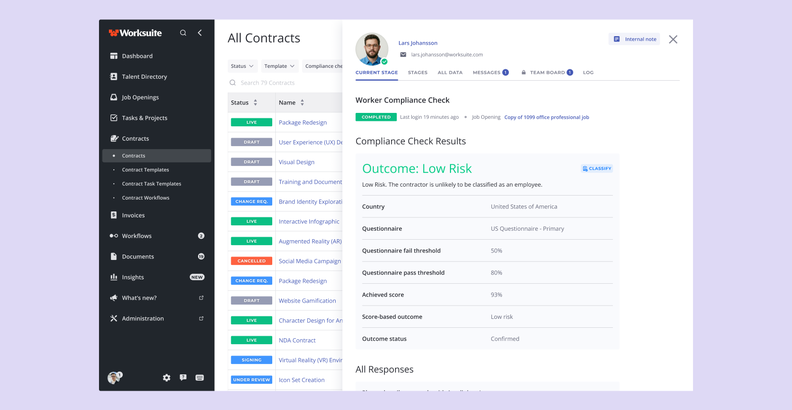
Compliance problems are always cheaper to catch before the signature. A missing certificate or an unreviewed engagement costs minutes at onboarding but far more once work has started.
4. Payment Runs on a Predictable Schedule
At scale, manual payment processing is where programs break first. Contractors always notice late payments (whether they mention it or not), and finance notices the hours it takes to get payments out.
BetterUp was paying hundreds of professional coaches in 35+ countries. Its operations team used to build an activity report for every coach each month, send it out to confirm accuracy, wait for it to come back, and then pay each coach individually through PayPal. Then, they switched to Worksuite.
"It's super smooth, super quick, and takes about three hours now whereas it used to take about three days," said Anisha Suterwala, Strategic Ops Senior Analyst.
The Motley Fool's international contractors used to invoice directly and get paid by wire transfer, which the team described as "a really archaic system." Worksuite built custom API payment integrations into The Motley Fool's content management system and rolled the platform out one country at a time, so automated payments kept running with no downtime during the switch. Invoices now move through Worksuite's invoice management instead of individual inboxes.
Springboard gets an email trigger when a mentor finishes onboarding, so the team knows the mentor is payable. Safeguards stop anyone other than the manager from triggering a payment.
Predictable payment keeps good contractors coming back. It also takes the end-of-month payment crunch off your finance team’s calendar.
5. Their Talent Pool Is Searchable, Rated, and Shared
The programs on this list treat their contractor list as a searchable private talent pool, with skills, ratings, certifications, portfolios and work history attached to every profile.
- Aspia's clients sometimes ask for five pre-vetted candidates within 30 minutes. That used to take days of searching LinkedIn and spreadsheets. Aspia built custom skill taxonomies and a tiered rating system in Worksuite, and it now fills those requests from about 600 pre-qualified subcontractors in roughly 30 minutes.
- FloSports used to screen as many as 400 contractors over a weekend to staff a single event production. It now filters its network by region, state, and zip code.
- Jack Morton's teams can see past project assignments and manager notes for every freelancer, which makes it easier to share talent across the company. It also gives the agency room to negotiate. "There is a cost saving because if we can offer a freelancer six months of solid work, we might get a better rate," Larson said.
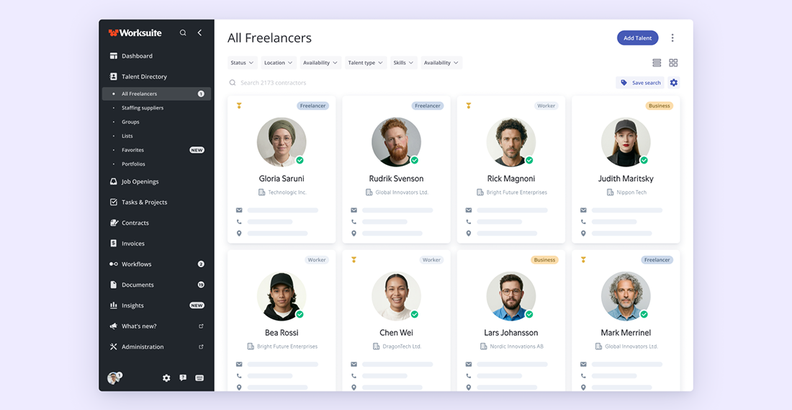
A centralized, searchable talent pool means fewer cold searches, less reliance on agency markups, and faster rehiring when you need to put the best people on the project fast.
6. Finance Sees Real-Time Spend
When contractor data lives in one place, budget owners can see what they're spending while there's still time to change it.
"Our hiring managers need to approve spending on a weekly or monthly basis," said Michael McCoy, Contingent Workforce Program Manager at The Motley Fool. "Now they can see in real time how much money they're spending with the Insights Modules. That's been really key."
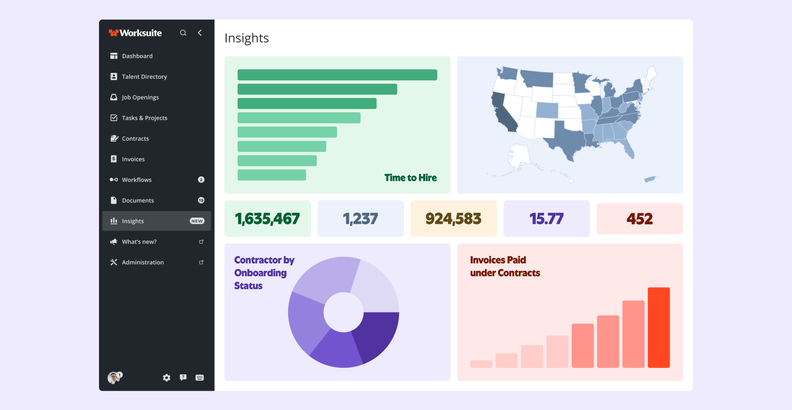
At Skyscanner, moving freelancer payment administration into Worksuite gave the finance team a more accurate picture of freelance spend and a better basis for forecasting it. "We saved tens of thousands of pounds a year," said Alex Jordan, Editorial Lead. "And in terms of people hours, between us all, hundreds if not thousands of hours a year."
7. They Configure Worksuite Around the Program
None of these programs bent their operations around a fixed product. They configured the platform to match how their business runs (not the other way around), and that's what got other teams to adopt it.
- Ferguson spoke with twelve vendors, narrowed the list to four, and picked Worksuite because the team would configure the platform to its requirements. "We gave our dedicated account manager at Worksuite our list of what we needed, and they made everything look and feel how we wanted," King said.
- Jack Morton built its onboarding workflow step by step, cutting steps it didn't need and adding custom ones. It also branded the freelancer experience. "Everything coming from us now has our voice and our branding on it," Larson said.
- At Skyscanner, Worksuite started with the editorial team. Once the results showed up, the social, design, translation, and localization teams adopted the platform too, each customizing it without changing the original structure.
Custom configuration is what turns a tool into the entire program's system of record. When each business unit can set up its own workflows and compliance routing architecture, with the help of Worksuite’s Business Solutions Architects (BSAs) embedded within their team, the system scales with the program.
How Worksuite Supports Contractor Programs at This Scale
All nine programs we looked at run on Worksuite, a contingent workforce management platform built for blended worker programs at growing enterprises. Each program gets one system of record for onboarding, contracts, compliance, payment, and spend reporting. The platform also supports multi-entity setups for organizations running several brands, agencies, subsidiaries or business units.
For programs at this scale, Worksuite combines global payments, contractor classification, and employment support in one system. Global Pay supports payments across 200+ countries and 120+ currencies, while Smart Classification checks engagements against local requirements and routes flagged cases to compliance experts. For more complex arrangements, Worksuite also offers AoR, CoR, and Contingent EOR options to help manage classification risk and workers who require employment.
Configuration explains a lot of how these programs scaled. Worksuite’s Business Solutions Architects set up entities, approval chains, onboarding workflows, and integrations during implementation, so the platform fits the program from the start.
If you’re running a program with 1,000 contractors, or planning for growth, you can book a live demo and get a free CW program design roadmap, to see how Worksuite can support your needs.