

Engagement surveys show how employees feel at one point in time. Between survey cycles, HR teams often have little visibility into which teams are starting to drift. Recognition activity helps fill that gap, because it's logged every day.
WorkTango Recognition & Rewards (R&R) records every Recognition employees send and receive, from peer and manager Recognition to Milestones and Incentives. Read alongside survey results from WorkTango Surveys & Insights (S&I), that activity gives HR teams a daily signal to watch between surveys.
Drawing on WorkTango’s research report, How and (Why) Recognition Activity Predicts Engagement, this guide walks through how to use recognition activity in WorkTango to find teams at risk of disengagement and help managers act before the next survey.
Summary
- Recognition activity is logged daily in WorkTango, so HR teams can spot changes in engagement between survey cycles.
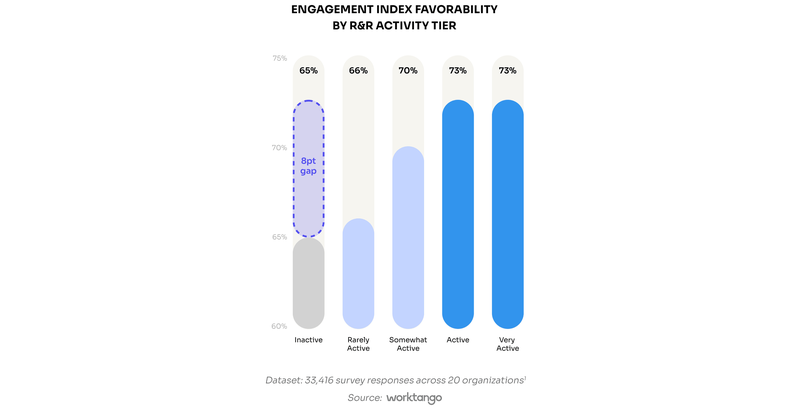
- In WorkTango research across 33,416 employee survey responses from 20 organizations, 73% of Active and Very Active recognition users scored favorably on engagement, compared with 65% of Inactive users.
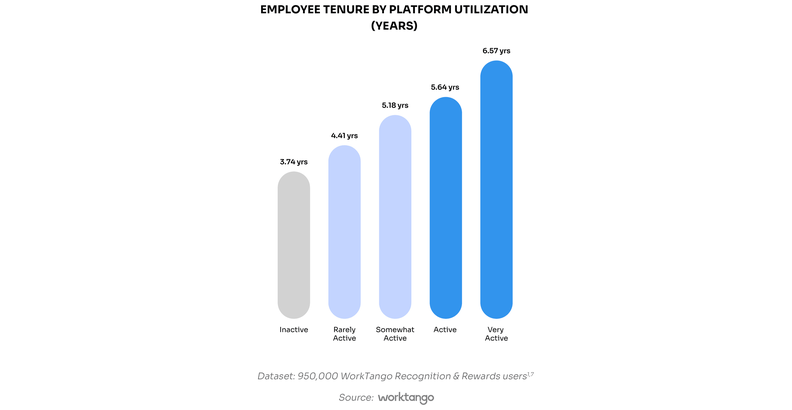
- Across 950,000 WorkTango R&R users, Very Active users averaged 6.57 years of tenure, compared with 3.74 years for Inactive users.
- Managers set the pattern for their teams. When managers were Inactive, 91% of their direct reports were Rarely Active or Inactive.
- Recognition data shows HR teams where to look. Pulse surveys in WorkTango S&I help explain why.
Step 1. Group employees by recognition activity
WorkTango’s research used that activity to group employees into five tiers, counting Recognition sent and received, comments, Incentives claimed and rewards redeemed.
- Very Active employees are in the top 25% for recognition activity.
- Active employees are in the 51st to 75th percentile.
- Somewhat Active employees are in the 26th to 50th percentile.
- Rarely Active employees are in the bottom 25% of those with any activity.
- Inactive employees have no recognition activity at all.
You can use the same approach. Set aside employees with no activity as Inactive, then split everyone else into four equal groups by how active they are. Track both directions of recognition. An employee who receives Recognition but never sends it is having a different experience from one who is never recognized at all.
In WorkTango research, engagement scores rose at each tier. That steady climb makes tiers a practical way to see who may need attention.
Step 2. Compare recognition activity with survey results by team
Every team in WorkTango has two signals to compare. Recognition activity comes from R&R, and engagement results come from S&I. Placed side by side, they usually fall into one of four patterns.
- High recognition, high engagement. This is a healthy team with habits worth sharing. Ask the manager what works and share it with peers.
- High recognition, low engagement. Recognition is happening, but something else is wearing on people, such as workload, tools or process. Send a short pulse survey to find the specific issue.
- Low recognition, high engagement. People feel engaged today, but the recognition habit is missing. Give the manager a simple weekly routine.
- Low recognition, low engagement. This team is the most likely to need support. Meet with the manager this month.
Because recognition activity updates daily, a team that slips from Active to Rarely Active over a few weeks is a reason to check in long before the next survey goes out.
Step 3. Start with managers
In WorkTango, a team’s recognition habits tend to follow its manager. In WorkTango research, when managers were Inactive, 91% of their direct reports were Rarely Active or Inactive. When managers were Very Active, their direct reports ranked in the top 50% for recognition activity.
Start by finding managers with low recognition activity, and approach the conversation as support. Most of these managers care about their people. They're simply stretched thin.
Give them a routine that takes about 10 minutes a week.
- Check who on the team hasn't been recognized in the last 30 days.
- Recognize one of those people by name for something specific they did.
- Tie the Recognition to a company value so it carries more meaning.
Once managers build the habit, their teams have a model to follow. From there, the goal is to get employees recognizing each other, so recognition keeps going even on the weeks a manager is busy.
Step 4. Bring quiet employees into peer recognition
Every employee in WorkTango can send Recognition to a peer and attach Points the recipient later redeems for a reward they choose. Peer Recognition spreads the work beyond managers and helps employees feel seen by the people they work with every day.
From Step 1, focus on employees who rarely send Recognition and employees who rarely receive it.
- Make it easy to take part. With the WorkTango mobile app and integrations for tools like Slack and Microsoft Teams, employees can send Recognition without leaving the flow of work.
- Let Milestones do some of the work. Birthdays and work anniversaries are celebrated automatically, which gives teammates a natural reason to join in.
- Use Incentives to build the habit. A short Incentive that rewards sending peer Recognition gives quieter teams a reason to try it.
- Make Recognition visible. Ask team leads to call out one peer Recognition in team meetings.
Building these habits takes time from managers and HR teams. To keep leadership behind the effort, it helps to show what’s at stake in dollars.
Step 5. Put a cost on the tenure gap
Every HR team needs a way to show leaders what disengagement costs. Tenure is a good place to start. Across 950,000 WorkTango R&R users, Very Active users stayed about 2.8 years longer than Inactive users (6.57 years vs. 3.74 years). Gallup estimates that replacing an employee can cost one-half to two times their annual salary.
Here's a simple way to build your own estimate.
- Find your average annual salary. This example uses $50,000.
- Apply Gallup's low-end replacement cost of one-half that salary, or $25,000 per departure.
- Estimate how many departures stronger recognition habits could help you avoid in a year. Keep it conservative. This example uses 10.
- Multiply. 10 departures × $25,000 = $250,000 a year.
Swap in your own numbers and stay on the low end. A modest, defensible figure builds more trust with finance than a big one.
Follow up with a pulse survey
Before planning a fix for the teams flagged in Steps 2 and 3, HR teams need to know what’s causing the drop. Recognition activity shows that a team has gone quiet. It can't show whether the cause is a staffing gap, a new manager or work that goes unnoticed.
WorkTango Surveys & Insights lets HR teams send a short pulse survey to the teams they flagged and see results as they come in. Action Plans then help managers turn that feedback into steps they follow through on.
Why recognition and survey data work better together for HR teams stretched thin
WorkTango brings recognition and employee listening into one platform. For HR teams that can't wait a full survey cycle to find a struggling team, that means a daily signal from R&R and a way to ask why through S&I, without stitching data together from separate tools.
Find the teams that need support before the next survey. See how it works at worktango.com.