Payworks Review: Pros, Cons, Features and Pricing Explained



Payworks is a Canadian payroll software for small and mid-sized businesses that need to run payroll, manage employee time, and stay compliant with federal and provincial tax rules across Canada. I'd consider it if you want a Canada-focused platform with dedicated payroll specialists and built-in CRA and Revenu Québec tax remittances, rather than a global platform that can feel oversized for a Canadian SMB.
Payworks Evaluation Summary
- From $44/employee/month
- Free demo available
Why Trust Our Software Reviews
Our team has been testing and reviewing software since 2012. As HR experts ourselves, we know how difficult—and important—it is to choose the right software.
For this guide, we evaluated tools using hands-on testing and independent research, scoring tools using our selection criteria. We also draw on insights from industry thought leaders and practicing HR experts.
Our reviews reflect our human editorial judgment, not a sales pitch.
Expert reviewers:
Payworks Overview
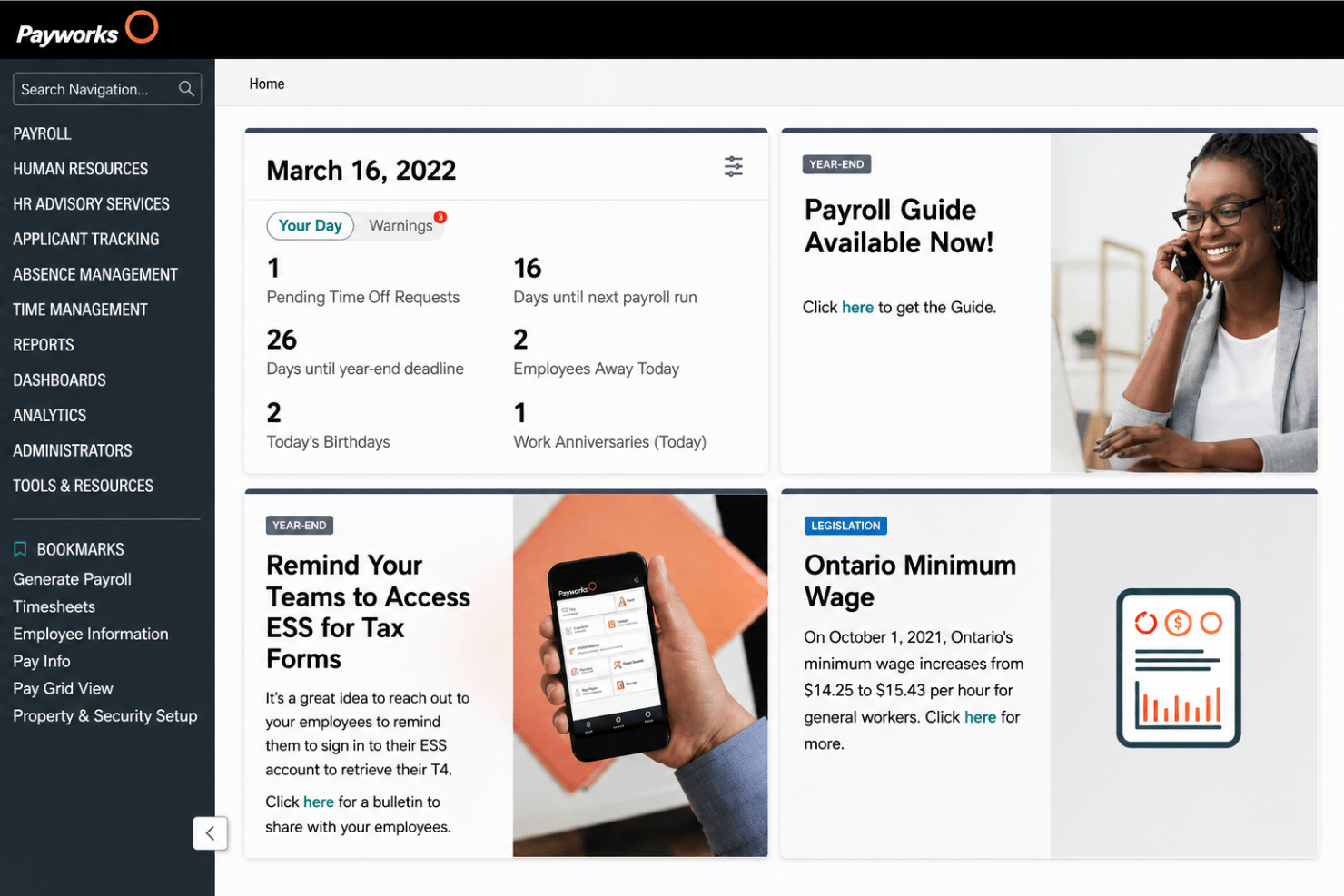
I think Payworks stands out for Canadian payroll because its interface is easy to learn, onboarding support is personal and fast, and its CRA integration keeps year-end work simple. If you’re choosing based on price transparency and local payroll expertise, Payworks is a strong contender. Across user reviews the overall rating leans heavily on support quality, which matches what I’d expect from a payroll administrator’s day-to-day. Larger companies needing deep integrations or advanced analytics might find it limited compared to global alternatives, but I’d pick Payworks for a Canadian business where local compliance and hands-on support matter most. I’ve seen owner-operators and HR teams get up to speed in just a few days.
pros
-
CRA and Revenu Québec tax remittances handled automatically
-
Direct access to Canadian payroll specialists for support
-
Built-in attendance, absence management, and vacation tracking for compliance
cons
-
Lacks advanced reporting and analytics options
-
Limited to Canadian businesses only
-
Mobile app feature set is basic compared to competitors
-

Justworks
Visit WebsiteThis rating combines scores from multiple user review sites to reflect overall customer sentiment about the product.4.6 -
Small Improvements
Visit WebsiteThis rating combines scores from multiple user review sites to reflect overall customer sentiment about the product.4.3 -
HiBob
Visit WebsiteThis rating combines scores from multiple user review sites to reflect overall customer sentiment about the product.4.5




How We Test & Score Our Tools
We’ve spent years building, refining, and improving our software testing and scoring system. The rubric is designed to capture the nuances of software selection and what makes a tool effective, focusing on critical aspects of the decision-making process.
Below, you can see exactly how our testing and scoring works across seven criteria. It allows us to provide an unbiased evaluation of the software based on core functionality, standout features, ease of use, onboarding, customer support, integrations, customer reviews, and value for money.
Core Functionality (25% of final score)
The starting point of our evaluation is always the core functionality of the tool. Does it have the basic features and functions that a user would expect to see? Are any of those core features locked to higher-tiered pricing plans? At its core, we expect a tool to stand up against the baseline capabilities of its competitors.
Standout Features (25% of final score)
Next, we evaluate uncommon standout features that go above and beyond the core functionality typically found in tools of its kind. A high score reflects specialized or unique features that make the product faster, more efficient, or offer additional value to the user.
We also evaluate how easy it is to integrate with other tools typically found in the tech stack to expand the functionality and utility of the software. Tools offering plentiful native integrations, 3rd party connections, and API access to build custom integrations score best.
Ease of Use (10% of final score)
We consider how quick and easy it is to execute the tasks defined in the core functionality using the tool. High scoring software is well designed, intuitive to use, offers mobile apps, provides templates, and makes relatively complex tasks seem simple.
Onboarding (10% of final score)
We know how important rapid team adoption is for a new platform, so we evaluate how easy it is to learn and use a tool with minimal training. We evaluate how quickly a team member can get set up and start using the tool with no experience. High scoring solutions indicate little or no support is required.
Customer Support (10% of final score)
We review how quick and easy it is to get unstuck and find help by phone, live chat, or knowledge base. Tools and companies that provide real-time support score best, while chatbots score worst.
Customer Reviews (10% of final score)
Beyond our own testing and evaluation, we consider the net promoter score from current and past customers. We review their likelihood, given the option, to choose the tool again for the core functionality. A high scoring software reflects a high net promoter score from current or past customers.
Value for Money (10% of final score)
Lastly, in consideration of all the other criteria, we review the average price of entry level plans against the core features and consider the value of the other evaluation criteria. Software that delivers more, for less, will score higher.
Core Features
Payroll Processing
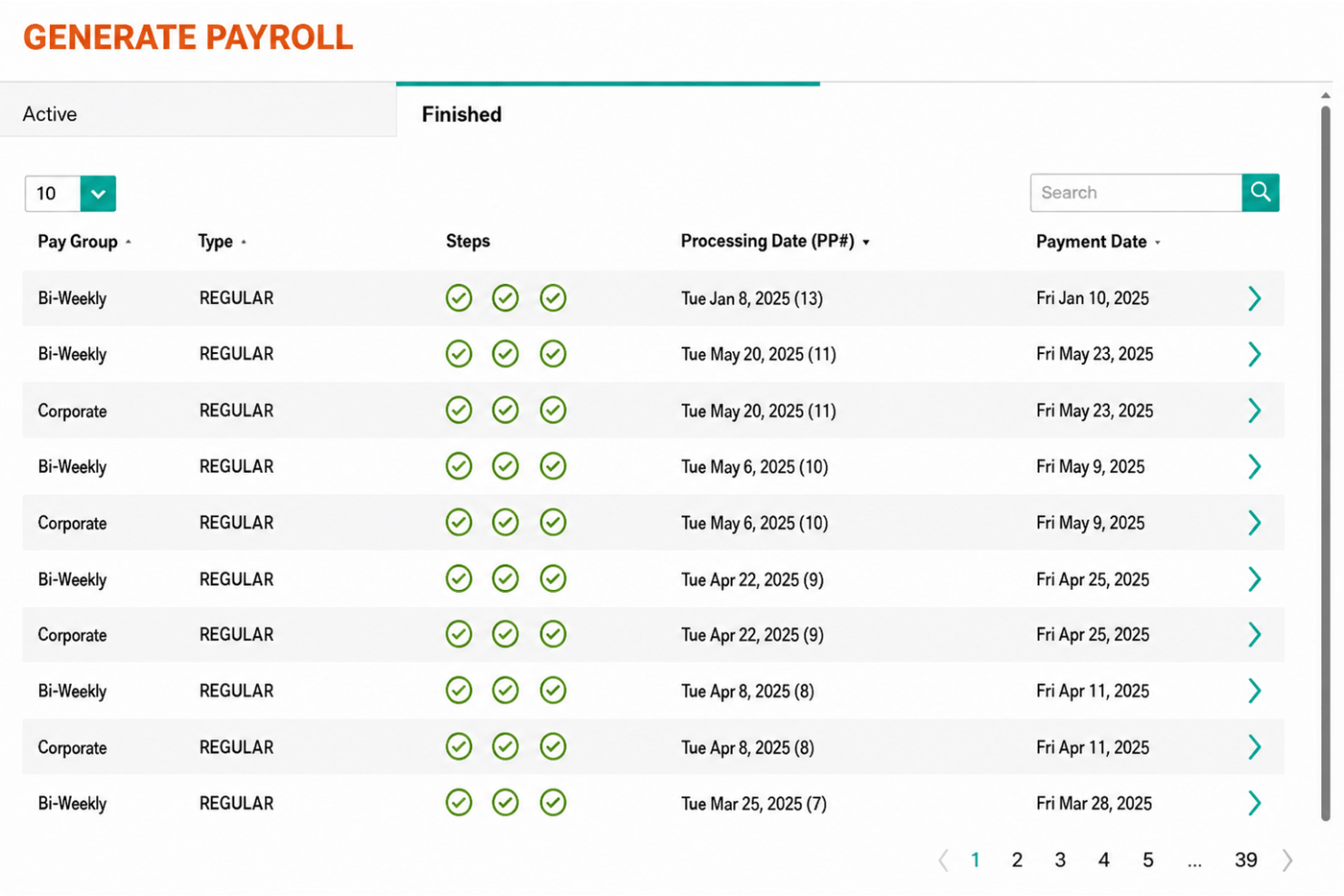
Run payroll for hourly and salaried staff with automatic CRA and Revenu Québec remittances. Quickly review, edit, and approve detailed pay runs in one dashboard.
Year-End Tax Filing
Generate T4s, T4As, and Relevé 1 slips with a few clicks. Automatic calculations help reduce errors and keep filings compliant.
Employee Self-Service
Let employees access pay statements, tax forms, and time-off balances online. Staff submit changes and requests without needing to go through HR every time.
Time and Attendance Tracking
Track employee hours, clock in/out records, and absences with automatic overtime calculations. Hours flow directly into payroll so nothing gets missed on payday.
Vacation and Leave Management
Set custom vacation policies, track accruals, and approve time off requests in one place. Employees see real-time balances before requesting leave.
Direct Deposit
Pay staff directly into their bank accounts on payday. Schedule payments in advance and support multiple accounts per employee.
Ease of Use
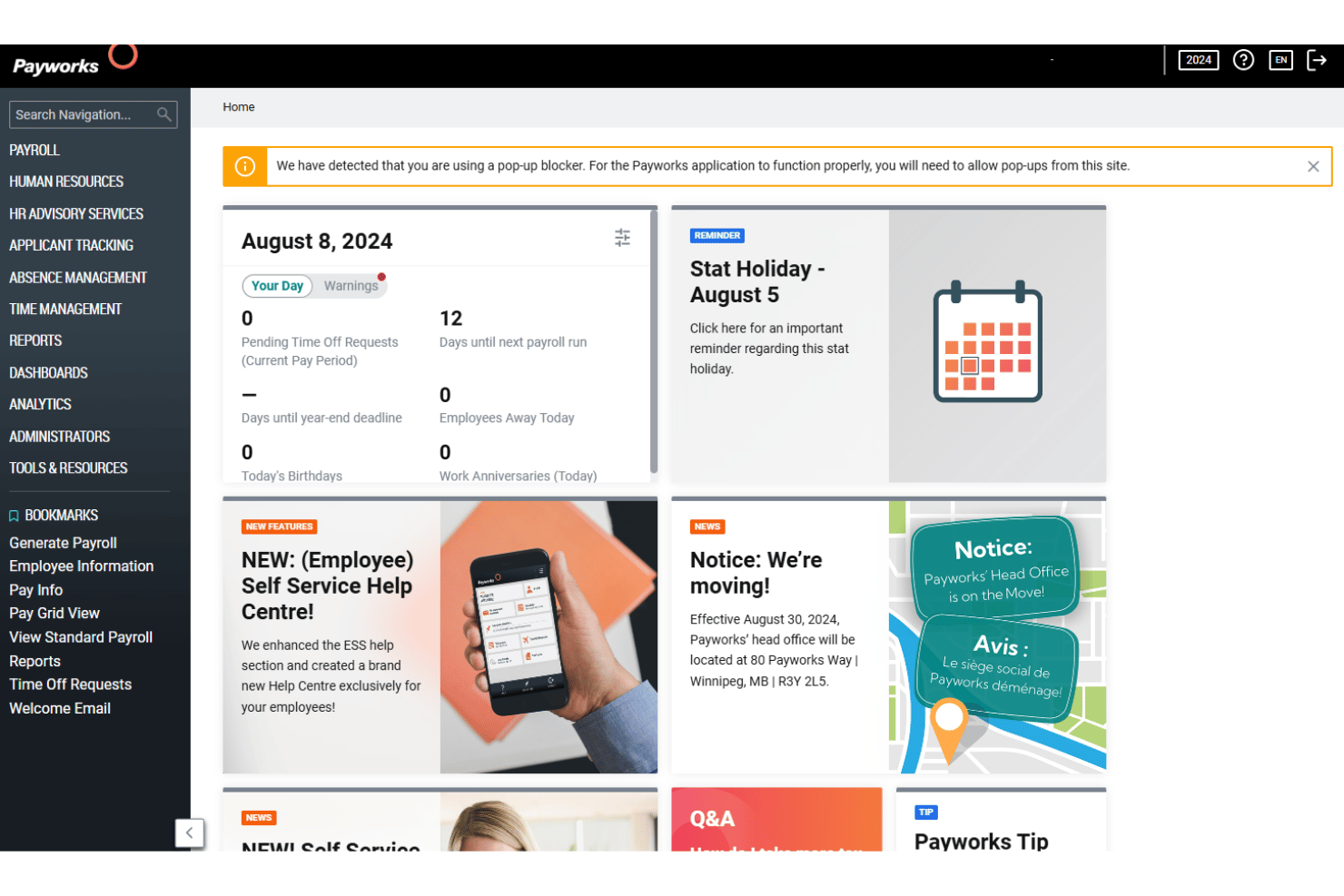
Payworks is easy to navigate even for first-timers, with step-by-step payroll workflows and clear year-end checklists. I think users appreciate how it centralizes pay, leave, and government filings in one dashboard. For a human resources team without a dedicated payroll person, that consolidation matters more than a long feature list. Frequent feedback highlights that the help chat and resource center actually resolve issues fast, making the platform feel supportive rather than overwhelming for busy HR or payroll admins.
Integrations
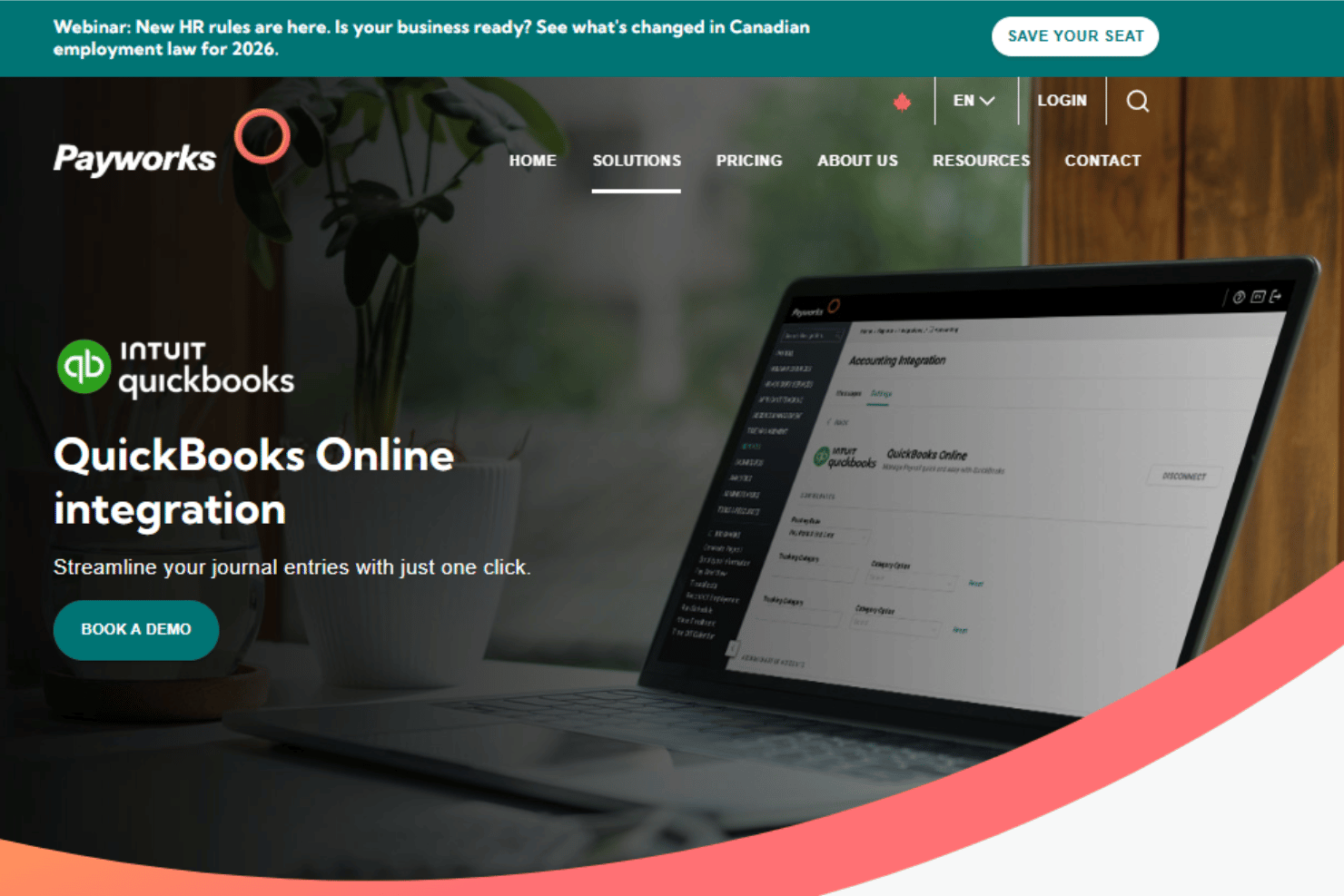
Payworks integrates with QuickBooks Online, Xero, Sage 50, AccountingSuite, Netsuite, EasyBooks, Dayforce, BambooHR, UKG Ready, and Employment Hero, among others. Payworks also provides an open API for custom integrations and connects with some third-party integration tools.
Payworks Specs
- 2-Factor Authentication
- 360 Degree Feedback
- API
- Application Tracking
- Attendance Tracking
- Batch Permissions & Access
- Compliance Tracking
- Dashboard
- Data Export
- Data Import
- Data Visualization
- Employee Database
- Employee Engagement
- Employee Incentive Management
- Employee Onboarding
- Employee Training
- Expense Tracking
- External Integrations
- Feedback Management
- Multi-User
- Notifications
- Payroll
- Performance Appraisal
- Scheduling
- Time Management
- Timesheets
- Travel Management
- Vacation & Absence Calendar