


Spring Health Review: Pros, Cons, Features and Pricing Explained



Spring Health is a workplace mental health platform for employers who want to offer mental health benefits that go beyond a basic EAP. It uses a clinically validated assessment to match each employee with the right type of care—therapy, coaching, or medication management—rather than leaving them to figure that out on their own. I'd consider it over Lyra Health if faster access to care and a broader range of clinical services are priorities for your benefits program.
Spring Health Evaluation Summary
- Pricing upon request
- Free demo available
Why Trust Our Software Reviews
Our team has been testing and reviewing software since 2012. As HR experts ourselves, we know how difficult—and important—it is to choose the right software.
For this guide, we evaluated tools using hands-on testing and independent research, scoring tools using our selection criteria. We also draw on insights from industry thought leaders and and practicing HR experts.
Our reviews reflect our human editorial judgment, not a sales pitch.
Spring Health Overview
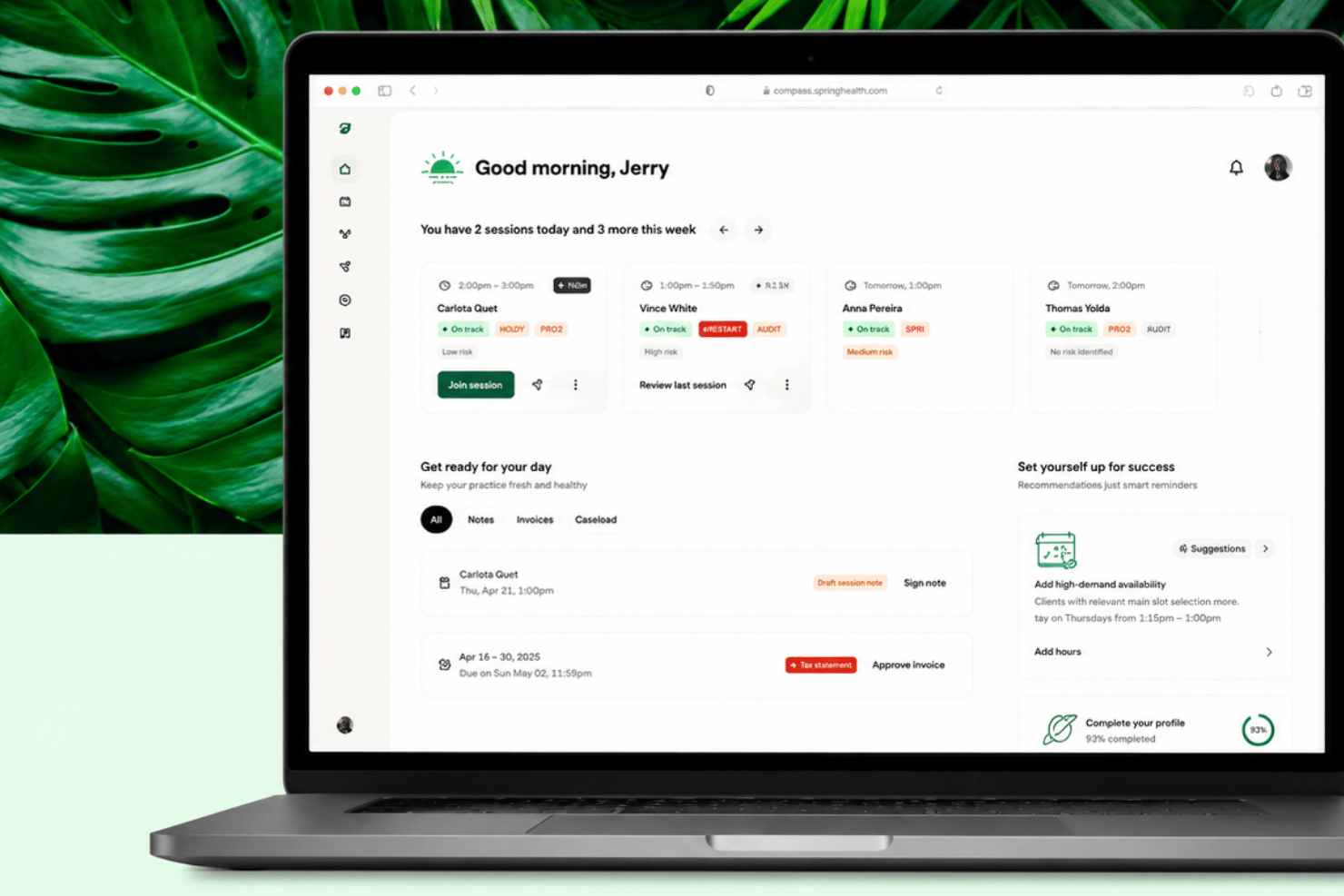
In my experience, Spring Health stands out for its personalized care matching, fast appointment access, and strong clinical navigation support. It combines therapy, coaching, medication management, self-guided tools, and employer analytics in one connected platform, which makes the experience feel more comprehensive than a traditional EAP.
I also think its evidence-based approach and measurable outcomes reporting are major strengths, though pricing transparency and plan-by-plan feature differences may frustrate some buyers. Spring Health is best suited for organizations that want a high-touch mental health benefit with guided care and strong employee support.
pros
-
Delivers personalized care recommendations through clinically guided assessments.
-
Offers fast access to therapy, coaching, and psychiatric support.
-
Combines mental healthcare, EAP services, and analytics in one platform.
cons
-
Limited in-person care options in some regions.
-
Employer pricing is not publicly transparent or standardized.
-
Some users report billing, notification, and video-session frustrations.
Is Spring Health Right For Your Needs?
Who Would be a Good Fit for Spring Health?
Spring Health is best suited for organizations that want a clinically managed mental health benefit rather than a lightweight wellness app or traditional EAP. In my view, it works especially well for employers that need fast access to care, guided support through Care Navigators, measurable outcomes reporting, and broad support for employees and their families. The platform is also a strong fit for distributed and global workforces thanks to its multilingual resources, virtual care options, and centralized employer analytics.
-
Organizations Replacing Traditional EAPs
Spring Health works especially well for employers that want more than a basic employee assistance program. Its combination of therapy, coaching, work-life services, and measurable outcomes makes it feel far more comprehensive than many legacy EAP offerings.
-
Global and Distributed Workforces
The platform’s virtual care model, multilingual resources, and broad geographic coverage make it a strong fit for remote, hybrid, and international teams that need consistent access to mental health support.
-
Healthcare Organizations
Healthcare employers can use Spring Health to support staff dealing with burnout, compassion fatigue, and high-stress work environments through fast access to care and ongoing clinical support.
-
Large Enterprise Employers
Enterprise organizations benefit from Spring Health’s analytics dashboards, implementation support, employer reporting, and ability to coordinate care across large employee populations.
-
Manufacturing and Shift-Based Workforces
Spring Health is a good fit for employees working nontraditional schedules because users can access digital resources, virtual appointments, and care support outside standard business hours.
-
Family-Focused Benefits Programs
Organizations that want to support employees beyond individual therapy will benefit from Spring Health’s Family Care features, including support for spouses, dependents, children, and teens.
Who Would be a Bad Fit for Spring Health?
Spring Health is probably not the best fit for organizations looking for a low-cost, lightweight wellness app or a simple self-serve EAP replacement. I think the platform delivers the most value for employers that want clinically guided care, analytics, and high-touch support, which can feel excessive for smaller teams with minimal mental health benefit needs. It may also be frustrating for organizations that require highly flexible reimbursement models, extensive in-person care availability, or fully transparent public pricing before purchase.
-
Small Startups With Tight Budgets
Spring Health’s enterprise-focused pricing and broad feature set may be difficult to justify for very small companies that only need basic wellness resources.
-
Organizations Wanting Simple Wellness Apps
Teams looking primarily for meditation content or lightweight wellbeing perks may find Spring Health more robust and operationally complex than necessary.
-
Companies Requiring Fully Transparent Pricing
Because Spring Health uses custom quote-based pricing, it may not fit buyers who prefer publicly listed plans and predictable self-serve SaaS purchasing.
-
Members Wanting Reimbursement for Outside Therapists
Spring Health works best within its own provider ecosystem, so employees hoping to continue care with external therapists may find the platform limiting.
-
Rural or Low-Connectivity Workforces
Organizations operating in areas with limited internet access or fewer available providers may not get the full benefit of Spring Health’s virtual-first care model.
-
Organizations Requiring Primarily In-Person Mental Healthcare
While Spring Health does support some in-person care, the platform is heavily optimized around virtual access, digital tools, and remote care coordination.
How We Test & Score Our Tools
We’ve spent years building, refining, and improving our software testing and scoring system. The rubric is designed to capture the nuances of software selection and what makes a tool effective, focusing on critical aspects of the decision-making process.
Below, you can see exactly how our testing and scoring works across seven criteria. It allows us to provide an unbiased evaluation of the software based on core functionality, standout features, ease of use, onboarding, customer support, integrations, customer reviews, and value for money.
Core Functionality (25% of final score)
The starting point of our evaluation is always the core functionality of the tool. Does it have the basic features and functions that a user would expect to see? Are any of those core features locked to higher-tiered pricing plans? At its core, we expect a tool to stand up against the baseline capabilities of its competitors.
Standout Features (25% of final score)
Next, we evaluate uncommon standout features that go above and beyond the core functionality typically found in tools of its kind. A high score reflects specialized or unique features that make the product faster, more efficient, or offer additional value to the user.
We also evaluate how easy it is to integrate with other tools typically found in the tech stack to expand the functionality and utility of the software. Tools offering plentiful native integrations, 3rd party connections, and API access to build custom integrations score best.
Ease of Use (10% of final score)
We consider how quick and easy it is to execute the tasks defined in the core functionality using the tool. High scoring software is well designed, intuitive to use, offers mobile apps, provides templates, and makes relatively complex tasks seem simple.
Onboarding (10% of final score)
We know how important rapid team adoption is for a new platform, so we evaluate how easy it is to learn and use a tool with minimal training. We evaluate how quickly a team member can get set up and start using the tool with no experience. High scoring solutions indicate little or no support is required.
Customer Support (10% of final score)
We review how quick and easy it is to get unstuck and find help by phone, live chat, or knowledge base. Tools and companies that provide real-time support score best, while chatbots score worst.
Customer Reviews (10% of final score)
Beyond our own testing and evaluation, we consider the net promoter score from current and past customers. We review their likelihood, given the option, to choose the tool again for the core functionality. A high scoring software reflects a high net promoter score from current or past customers.
Value for Money (10% of final score)
Lastly, in consideration of all the other criteria, we review the average price of entry level plans against the core features and consider the value of the other evaluation criteria. Software that delivers more, for less, will score higher.
Core Features
Personalized Mental Health Assessments
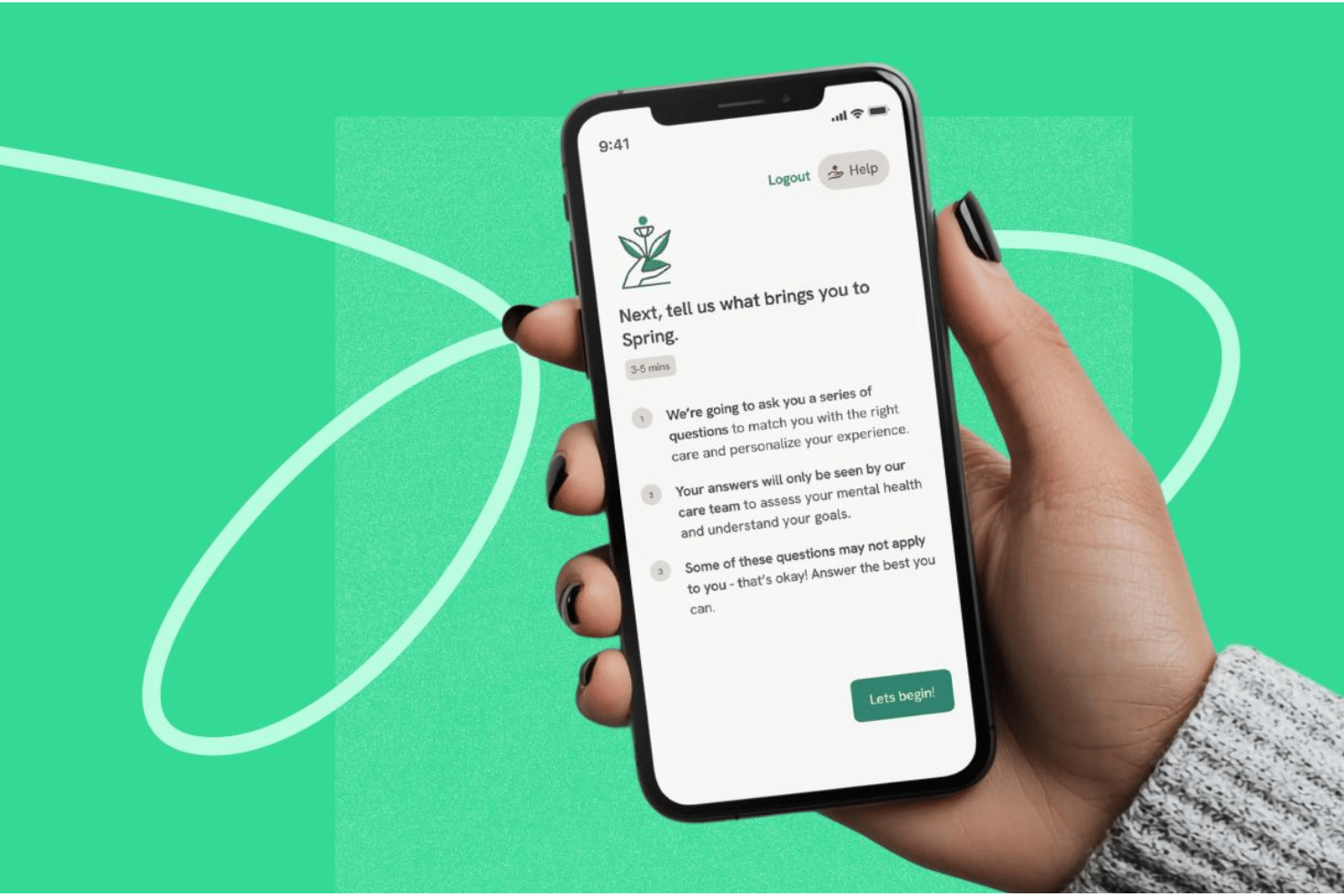
Spring Health uses a short, clinically validated assessment to identify care needs and recommend the most appropriate support path. The platform screens for multiple mental health conditions and helps reduce the trial-and-error process of finding care.
Therapy, Coaching, and Medication Management
Employees can access virtual or in-person therapy, mental health coaching, and psychiatric medication management through Spring Health’s provider network. Care options are personalized based on individual goals, symptoms, and preferences.
Self-Guided Mental Wellness Tools
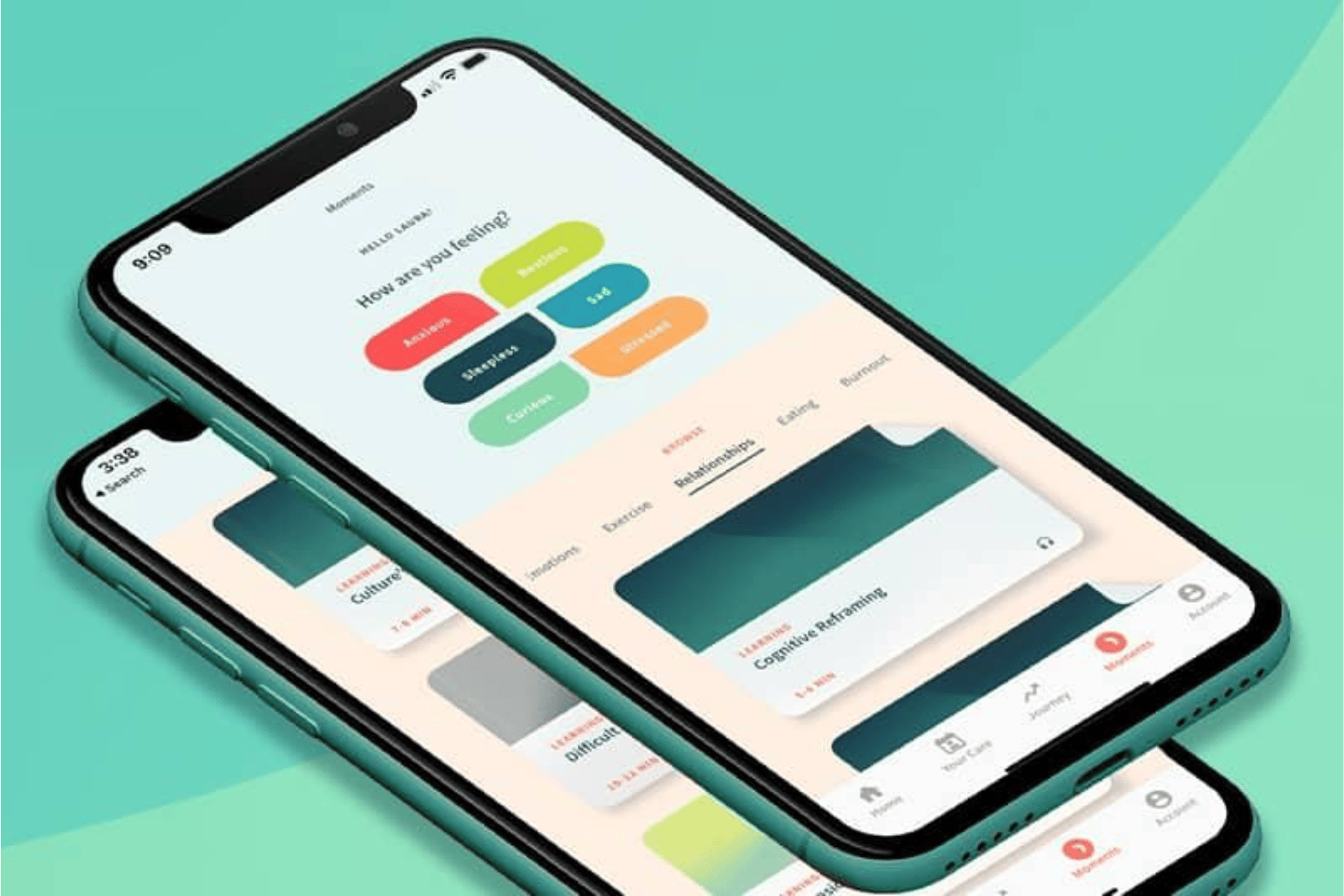
The platform includes on-demand exercises, mindfulness content, CBT-based activities, and stress-management resources that employees can use between sessions. These tools are available through Spring Health’s mobile and web apps.
Family and Dependent Support
Spring Health extends mental health support to eligible family members, including children and teens. Family Care features shared support resources, guided care options, and multilingual access for global teams.
Employer Analytics and Outcomes Reporting
HR leaders get access to dashboards showing utilization, engagement, clinical improvement, and ROI metrics. These reporting tools help organizations measure the impact of their mental health benefits programs.
Workplace Support and EAP Services
Spring Health combines mental healthcare with workplace wellbeing services like manager consultations, critical incident response, legal and financial resources, and employee support programs designed to improve organizational health.
Standout Features
Care Navigation With Licensed Clinicians
One of the things that most impressed me about Spring Health is its Care Navigator model. Members can connect with licensed clinicians who help guide care decisions, answer questions, coordinate support, and reduce the stress of navigating mental healthcare alone.
AI-Powered Precision Matching and Continuous Care
Spring Health stands out for its AI-driven matching and continuity tools, including its newer Guide experience that helps members stay engaged between sessions. The platform uses machine learning, provider data, and ongoing assessments to personalize care recommendations and improve long-term outcomes.
Ease of Use
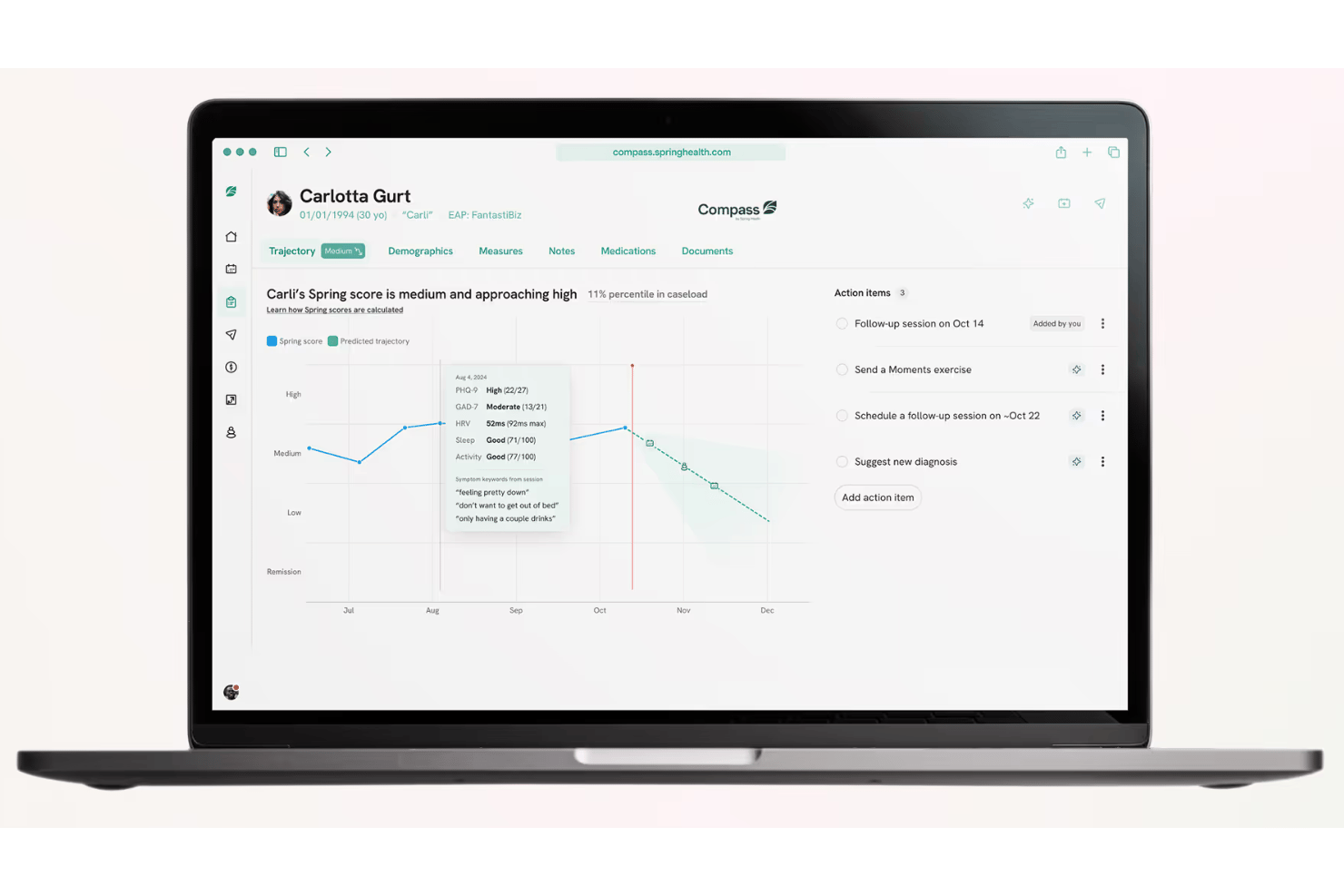
Spring Health is easy for both employees and admins to navigate, with clear dashboards, fast appointment booking, and a minimal learning curve. I’ve noticed users often mention how quickly they can access therapy or self-guided tools, and admins appreciate the detailed reporting. The onboarding process stands out as smooth, thanks to built-in education and Care Navigator support, making it approachable for teams of any size.
Onboarding
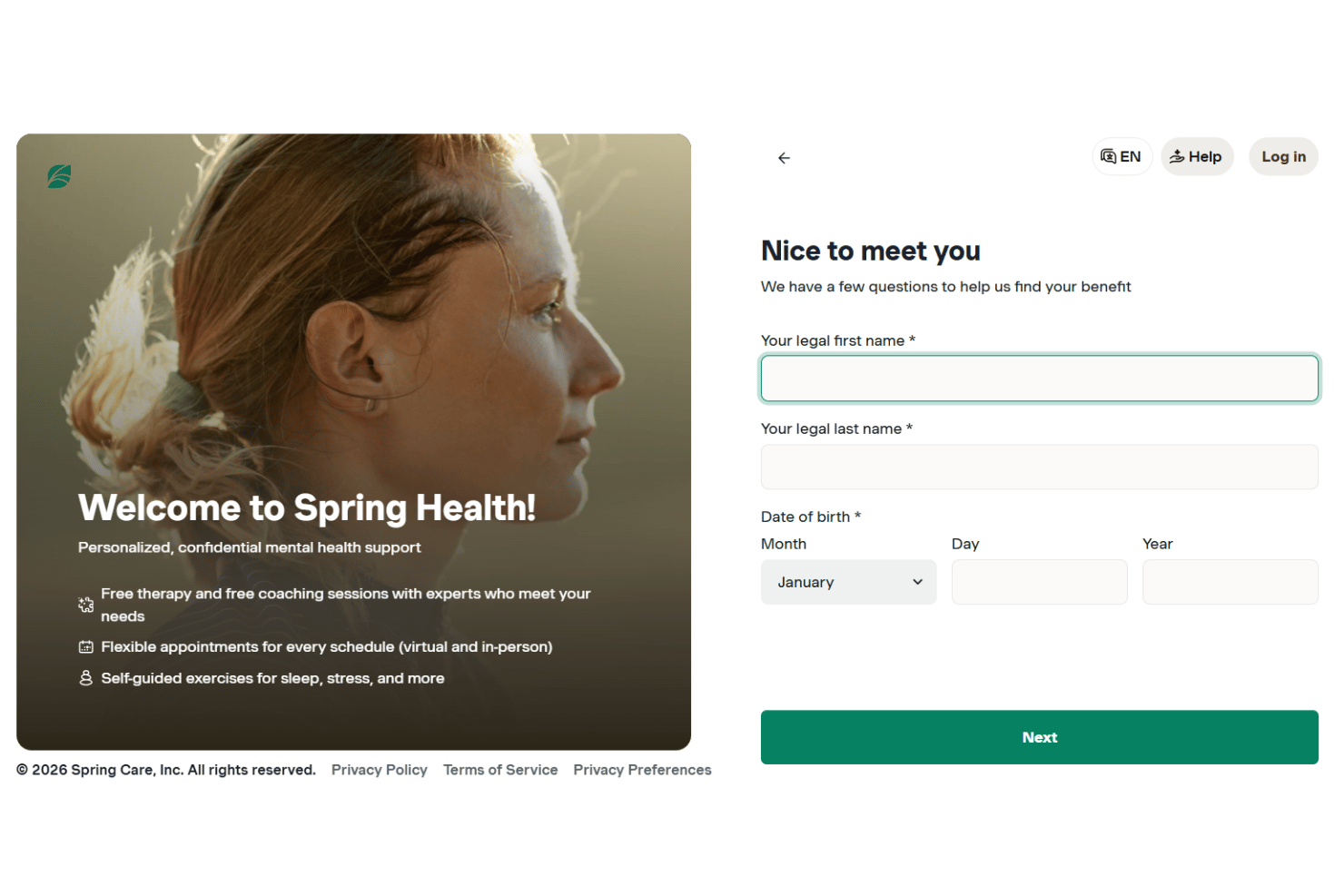
Spring Health’s onboarding is fast and personalized, with users reporting that dedicated Care Navigators make a big difference from the start. The platform guides employees step by step, includes resource libraries, and offers responsive support, which speeds up adoption and delivers value within days. I think this makes it one of the more approachable options for new users seeking immediate and ongoing help.
Customer Support
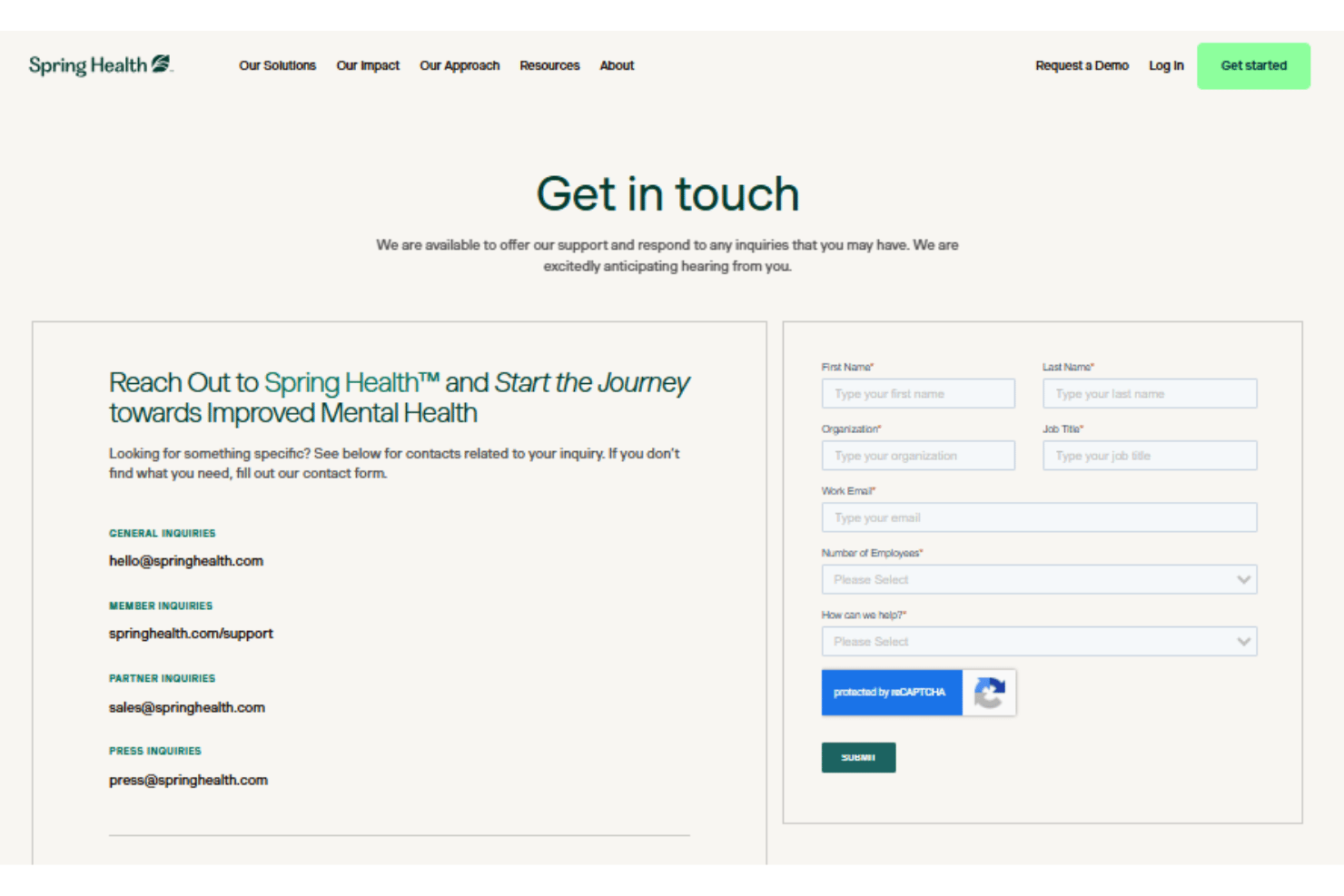
Spring Health offers a fairly high-touch support experience, with help available through its knowledge base, web messaging, phone support, and Care Navigator guidance. Members can also securely message providers after beginning care, which helps maintain continuity between sessions. From my perspective, the combination of clinical navigation, responsive support channels, and crisis-support availability makes the platform feel more comprehensive than many lighter mental health benefits tools.
Integrations
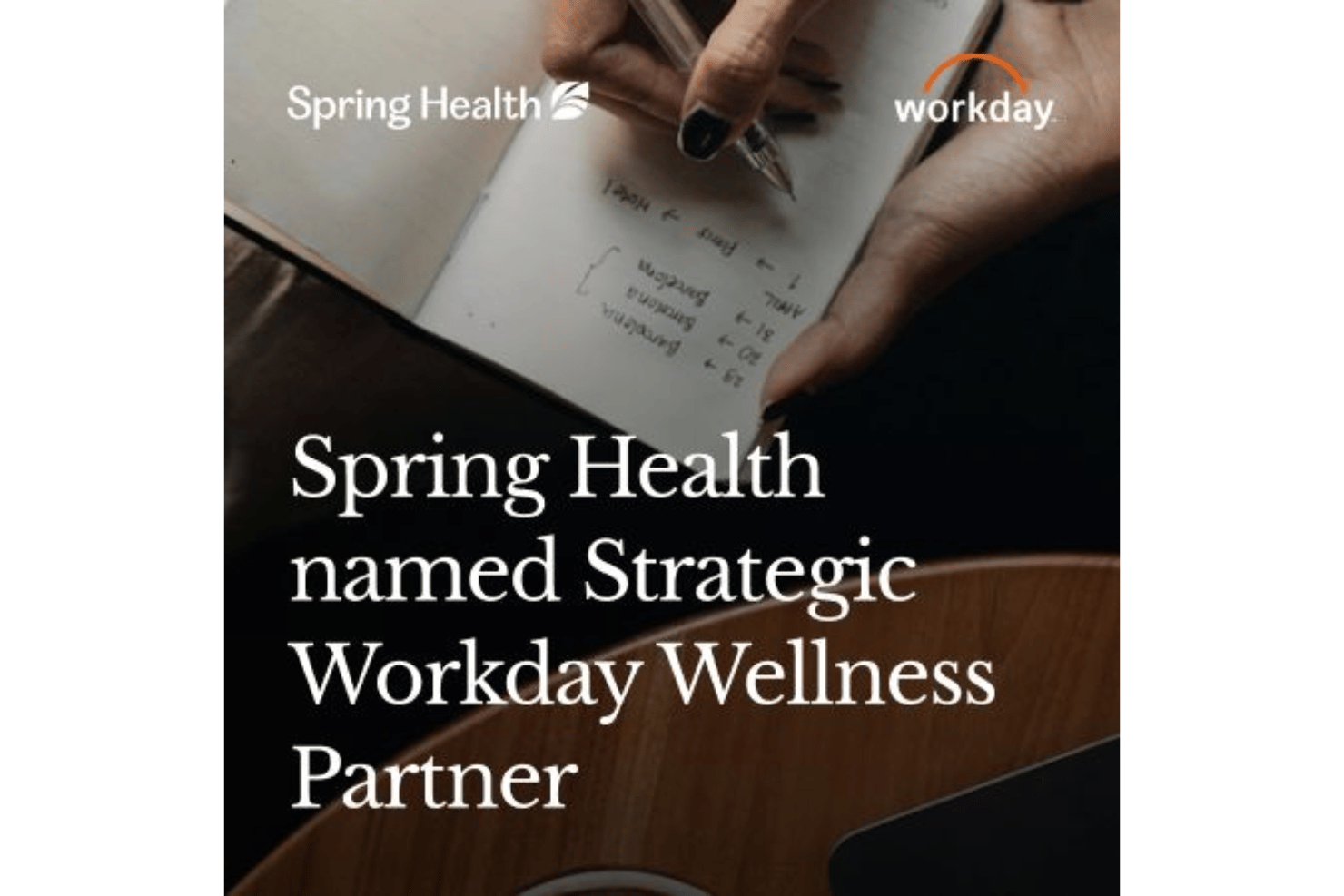
Spring Health integrates with platforms like Workday Wellness, Castlight Health, Virgin Pulse, and select health-plan systems through customized implementation partnerships. The platform also supports SSO and OAuth setup, eligibility-file syncing, referral workflows, and other HR or benefits integrations for enterprise customers. Spring Health offers API access for some clients, but does not currently connect to third-party automation tools like Zapier.
Value for Money
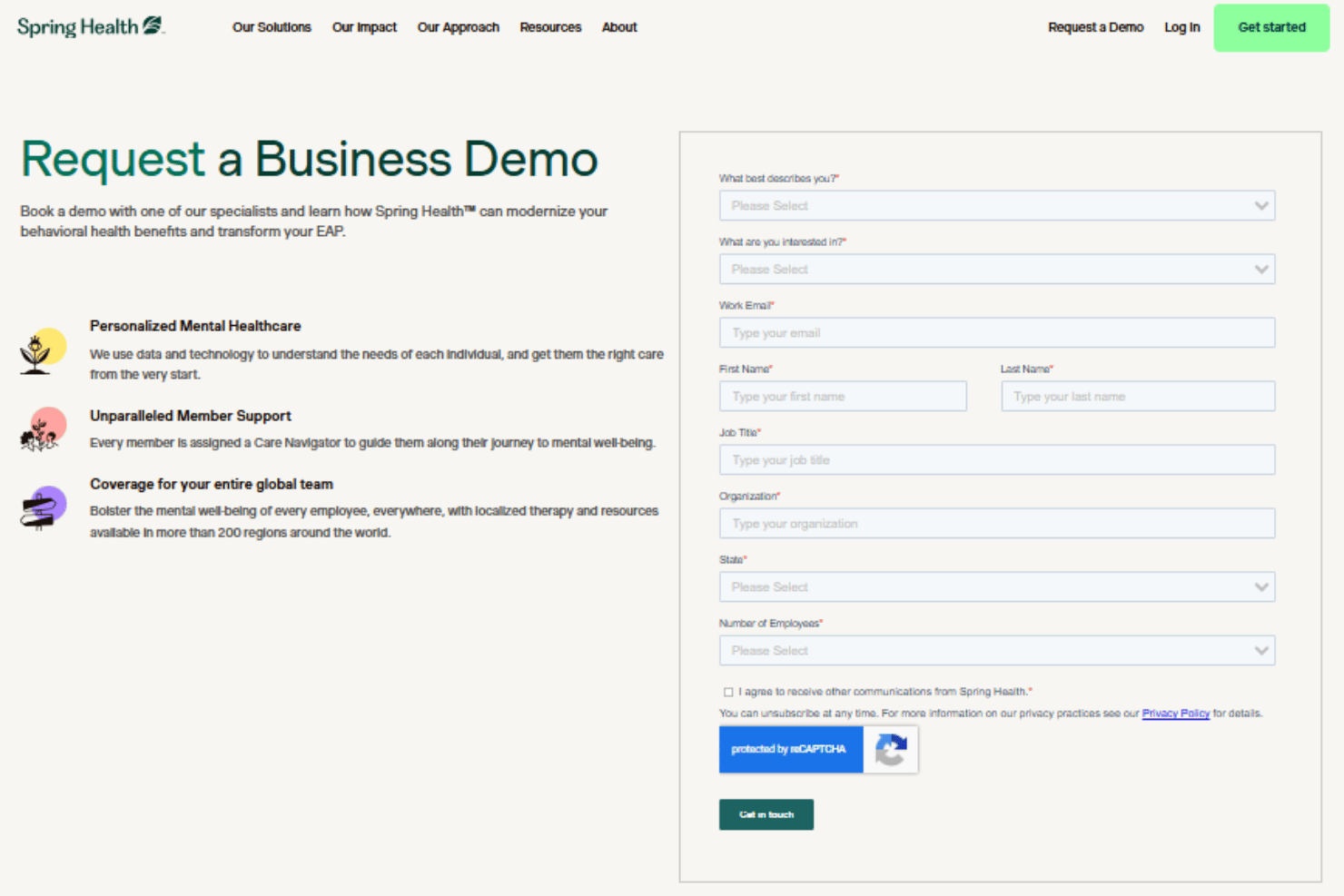
Spring Health offers strong value for organizations that want a more comprehensive mental health benefit than a traditional EAP. The platform combines therapy, coaching, medication management, self-guided resources, family support, workplace services, and outcomes reporting in one system, which helps justify the higher-touch enterprise approach. However, the biggest drawback I notice is the lack of pricing transparency, since Spring Health uses custom quote-based pricing rather than publicly listed plans.
Because pricing is customized, costs can vary based on organization size, coverage structure, sponsored sessions, and included services. Most employees access Spring Health through employer or health-plan sponsorship, which can significantly reduce out-of-pocket costs for care.
Spring Health Specs
- API
- Batch Permissions & Access
- Behavioral Tracking
- Budgeting
- Calendar Management
- Compliance Tracking
- Custom Data Forms
- Custom Reports
- Dashboard
- Data Export
- Data Import
- Data Visualization
- Employee Database
- Employee Engagement
- Employee Incentive Management
- Employee Training
- Expense Tracking
- External Integrations
- Feedback Management
- Health Management
- Multi-User
- Notifications
- Online Surveys
- Risk Assessment
- Safety Management
- Social-Media Integration
- Vacation & Absence Calendar
- Workflow Management
Spring Health FAQs
How quickly can employees access care after enrollment?
What is the process for matching employees to providers?
Does Spring Health support dependent and family coverage?
How are usage and outcomes tracked for reporting to HR?
What level of data security and regulatory compliance does Spring Health maintain?
Can Spring Health be customized for specific organizational needs?
What ongoing support is available for employees after they start using the platform?
How does Spring Health’s pricing model work for different company sizes?
Spring Health Company Overview & History
Spring Health is a mental health platform based in New York City, serving employers and their workforces globally. Founded by April Koh and Adam Chekroud, the company focuses on providing personalized mental health care through technology and clinical navigation. Spring Health has scaled to serve millions of members and employs hundreds of team members. Notable clients include General Mills, Whole Foods, and PepsiCo, and Spring Health is recognized for its inclusive, mission-driven work culture and rapid growth in the mental health benefits space.
Spring Health Major Milestones
- 2016: Spring Health was founded by April Koh and Adam Chekroud in New York City.
- 2018: Secured Series A funding and launched its personalized mental health benefit for employers.
- 2021: Raised $190 million in Series C funding, achieving unicorn status with a $2 billion valuation.
- 2022: Named to Forbes’ Next Billion-Dollar Startups list, expanding its customer base significantly.
- 2023: Launched new family support and global offerings to reach more employees worldwide.