

Coaching skills are increasingly expected of HR professionals and people leaders. I rounded up the best coaching courses by format, cost, and focus so you can compare options and find training that fits your goals and your schedule.
The 16 Best Coaching Courses
Below are my summaries of the best coaching courses. My reviews offer a look at each course's learning objectives, best fits, cost, and more.
1. Coaching for Engagement & Performance (CEP) Certification - Human Capital Institute (HCI)
Best for: HR leaders building an organization-wide coaching culture
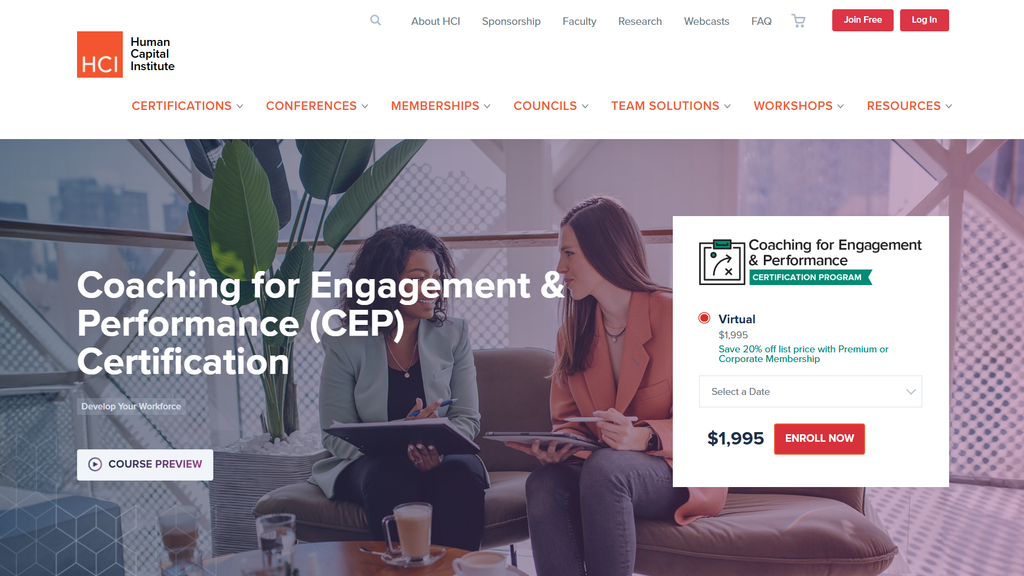
HCI's CEP Certification is a two-day virtual program that teaches coaching skills through an inside-out model—starting with your own practice, then scaling to others and the broader organization.
What you'll learn: Refine your personal coaching skills, apply the Coaching Impact Model to know when to coach, design peer coaching programs, assess organizational readiness, and measure coaching ROI.
Course details:
- Format: Live virtual (instructor-led via Zoom)
- Duration: 2 days (9:00 AM–5:00 PM EST each day)
- Level/prerequisites: Intermediate; no prior coaching certification required
- Price: $1,995 USD per learner; 20% discount available with HCI Premium or Corporate Membership
- Certificate/credits: HCI CEP Certification (renewable every 3 years with 60 credits); 13 HCI, 13 HRCI, 13 SHRM, and 12 ATD recertification credits
Considerations: The two-day consecutive format requires blocking your full schedule for both days, which can be a constraint for HR professionals managing active workloads.
2. Coaching Certificate Program - AMA (American Management Association)
Best for: Managers who want practical, hands-on coaching skills fast

AMA's Coaching Certificate Program teaches managers and team leaders to use coaching as a leadership skill, built around AMA's proprietary GUIDE to Coaching Model and hands-on practice through role plays and live coaching sessions.
What you'll learn: Diagnose performance issues, deliver constructive feedback, apply the GUIDE to Coaching Model, use facilitative questioning techniques, and facilitate team coaching sessions.
Course details:
- Format: In-person (multiple U.S. cities), live online (instructor-led), or private on-site at your organization
- Duration: 2 days; one live-online cohort runs as 4 half-days spread across two weeks
- Level/prerequisites: Basic; a foundation in leadership is listed as a prerequisite
- Price: $2,895 USD per learner (non-members); $2,595 USD (AMA members); $2,567 USD (GSA rate)
- Certificate/credits: AMA Certificate of Completion; 1.2 IACET CEUs, 12 SHRM PDCs, 14 CPE credits, 12 CAE credits, 12 CLP credits, and 12 PMU credits
Considerations: The AMA Certificate of Completion is not a formal coaching credential or professional coaching license. It may not satisfy requirements for roles that ask for an accredited coaching certification.
3. Coaching Skills for Managers Specialization - University of California, Davis (via Coursera)
Best for: People managers who need a flexible, budget-friendly option
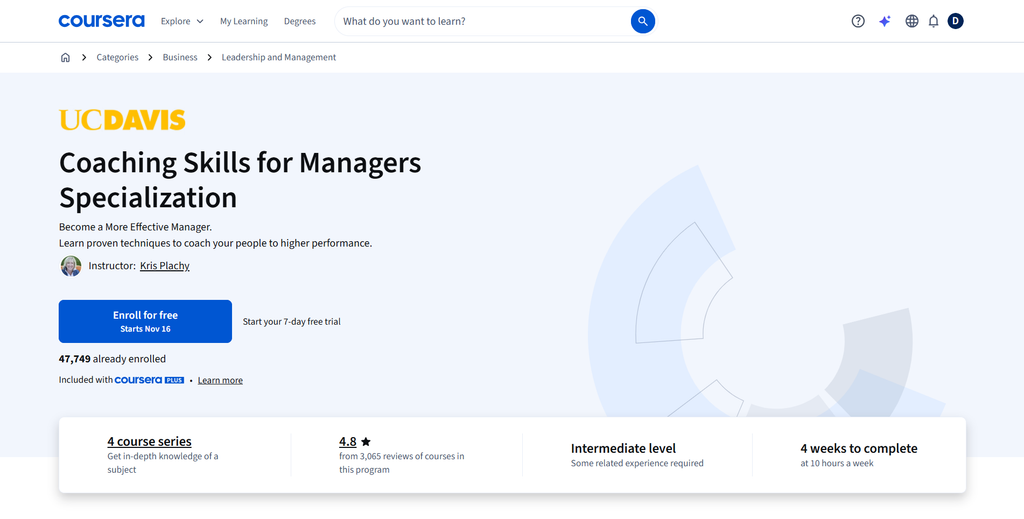
UC Davis's Coursera specialization gives managers two proprietary frameworks—the Thought Model and Coaching Algebra—to diagnose performance issues and coach employees through them. It's one of the most affordable structured options on this list.
What you'll learn: Diagnose why expectations aren't being met using Coaching Algebra, apply the Thought Model to shift employee thinking, set collaborative expectations, and conduct structured one-on-one coaching conversations.
Course details:
- Format: Fully online, self-paced (video lectures, readings, assignments, and peer-reviewed work)
- Duration: Approximately 41 hours across four courses; learners set their own pace
- Level/prerequisites: Intermediate; no prior coaching experience or certification required
- Price: Included with Coursera Plus at $239 USD/year; individual course enrollment also available
- Assessment: Peer-reviewed assignments throughout, including a capstone coaching conversation
- Certificate/credits: Shareable UC Davis career certificate issued via Coursera; not an ICF-accredited credential
Considerations: Because this is a Coursera completion certificate rather than a professional coaching credential. It won't satisfy employer or role requirements that specify an accredited coaching certification.
Have an account? Log In
4. Emory Executive Coaching Program - Emory University (Goizueta Business School)
Best for: Leaders pursuing an ICF ACC certification pathway
Emory's Goizueta Business School runs this two-certificate program, drawing faculty from business, neuroscience, psychiatry, and psychoanalysis. That depth—paired with a dedicated ICF-credentialed mentor coach per small group—makes it one of the more rigorous ICF ACC pathways available.
What you'll learn: Apply foundational coaching techniques, brain-based coaching principles, and family systems frameworks, then integrate all three in real-world coaching conversations with structured mentor-coach feedback throughout.
Course details:
- Format: Live online (Fridays and Saturdays) or in-person in Atlanta (Thursdays and Fridays); sessions are not recorded, and attendance is required
- Duration: 80 hours total (40 per certificate); approximately 6 months for the full program, plus 7–10 hours of interim work per module
- Level/prerequisites: Intermediate to advanced; no prior coaching certification required for Foundations; Advanced requires 30 ICF training hours earned within two years
- Price: Foundations: $5,500 (online) / $6,000 (on campus); Advanced: $6,500 (online) / $7,000 (on campus); full program: $12,000–$13,000 USD per learner
- Certificate/credits: Emory Executive Coaching Certificate (stackable); 80 ICF CCE credits (66 Core + 14 Resource Development); digital badge; pathway to ICF ACC credential
Considerations: Because sessions are not recorded and attendance is required, missing a session means missing that content permanently. It is a real commitment for working professionals with unpredictable schedules.
5. Executive Leadership Coaching - Harvard Division of Continuing Education
Best for: Experienced coaches advancing with science-backed frameworks
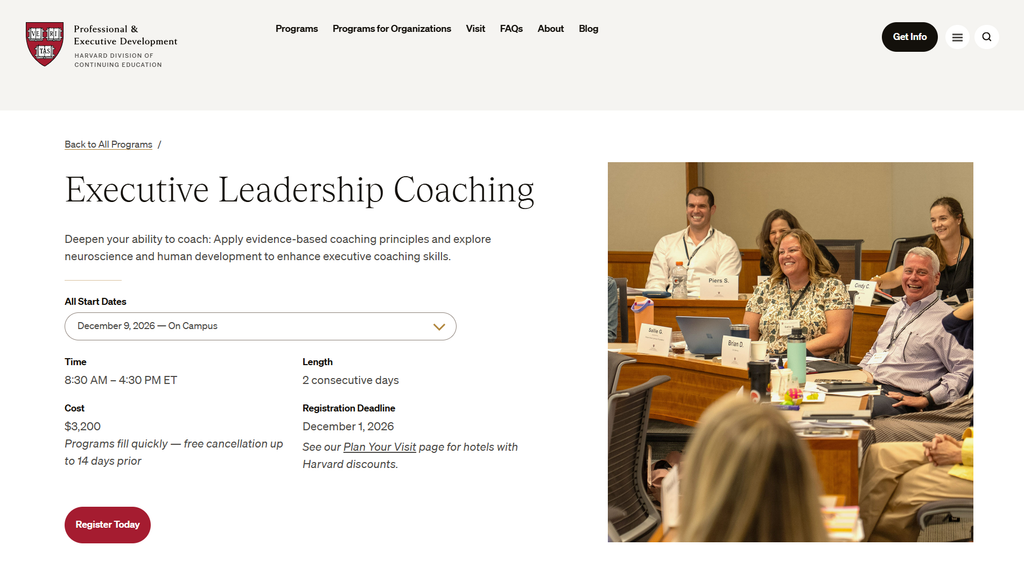
Harvard DCE's Executive Leadership Coaching is an advanced program for coaches ready to go deeper. It integrates neuroscience, somatic coaching, and AI ethics into a compact live format with peer coaching practice and master coaching demonstrations.
What you'll learn: Apply neuroscience and adult development frameworks, somatic coaching techniques, and Conversational Intelligence assessments, then design and evaluate outcomes-based coaching engagements with ethical AI applications.
Course details:
- Format: Live on campus (Cambridge, MA) or live online; instructor-led; not self-paced
- Duration: 2–3 consecutive days (on campus) or 5 weekly 4-hour sessions (online)
- Level/prerequisites: Advanced; provider recommends a minimum of 3 years or 100 hours of coaching experience
- Price: $3,200–$4,200 USD per learner (on campus); $3,500 USD per learner (online); varies by cohort
- Certificate/credits: Certificate of Completion from Harvard DCE; counts toward Harvard's Certificate of Leadership Excellence
Considerations: This program does not appear to offer ICF CCE credits or professional coaching certification. It won't satisfy requirements for coaches specifically building toward an ICF credential.
6. Executive Certificate in Leadership Coaching - Georgetown University (School of Continuing Studies)
Best for: Experienced coaches targeting ICF PCC certification

Georgetown's eight-course certificate, delivered through its Institute for Transformational Leadership, is one of the few university-affiliated programs with ICF Level 2 accreditation
What you'll learn: Coach leaders at the ICF PCC level using adult development theory, systems thinking, and identity and culture frameworks, then integrate them in a capstone skills assessment.
Course details:
- Format: Live online (Zoom) or in-person at Georgetown University in Washington, D.C.; cohort-based, full attendance required
- Duration: 8 months; eight sequential courses totaling 148.5 contact hours (14.85 CEUs); classes meet monthly in multi-day blocks
- Level/prerequisites: Intermediate to advanced; requires a bachelor's degree and a minimum of 5 years of experience in coaching, HR, leadership, or organization development
- Price: $13,995 USD per learner, including course materials; interest-free payment plan available; 10% discount for Georgetown alumni
- Assessment: Final skills assessment required as part of program completion
- Certificate/credits: Georgetown Executive Certificate in Leadership Coaching; 14.85 CEUs; ICF Level 2 accreditation—graduates are eligible to apply for ICF PCC certification after completing required client hours and passing the ICF knowledge exam
Considerations: At $13,995 and eight months of required monthly multi-day attendance, this is a significant commitment—both financially and logistically. It suits coaches who are serious about pursuing ICF PCC certification rather than a lighter credential.
7. Certificate in Executive Coaching - NYU School of Professional Studies (SPS)
Best for: Aspiring coaches who want ICF hours and real client work

NYU SPS's Certificate in Executive Coaching delivers 200 ICF-accredited contact hours across four sequential courses, including two 12-week real-client engagements—more hands-on practice than most comparable programs at this price point.
What you'll learn: Apply evidence-based coaching theory using the ICF Core Competency Model, practice skills through live coaching conversations, and lead two 12-week client engagements from contracting to completion.
Course details:
- Format: Online; live synchronous sessions via NYU Zoom with asynchronous components; courses taken sequentially, one per semester
- Duration: Approximately 2 academic years; four sequential courses totaling 200 ICF contact hours (36 synchronous + 14 asynchronous per course)
- Level/prerequisites: Foundational to intermediate; no prior coaching certification or minimum experience listed as prerequisites
- Price: Approximately $12,800 USD per learner ($3,200 per course × 4 courses); based on AY 2026–27 pricing; subject to change
- Certificate/credits: NYU SPS Certificate in Executive Coaching; 200 ICF contact hours from an ICF Level 2 Accredited Provider; qualifies for ICF ACC credentialing; optional Mentor Coaching add-on opens the ICF PCC path
Considerations: Completing the certificate takes roughly two years since you can only take one course per semester. This pacing suits working professionals but isn't ideal if you need credentials quickly.
8. Better Conversations Every Day™ - Center for Creative Leadership (CCL)
Best for: Managers building coaching habits into daily conversations

Better Conversations Every Day™ is a live online program from CCL built around four evidence-based conversation skills. With a 1:4 coach-to-participant ratio, you practice applying new skills to real challenges with direct coaching support.
What you'll learn: Listen to understand, ask powerful questions, challenge thinking, establish next steps in coaching conversations, and give feedback with greater confidence and psychological safety.
Course details:
- Format: Live online, instructor-led; 1:4 coach-to-participant ratio; also licensable for organization-wide delivery
- Duration: 8-hour intensive delivered over one week; required pre-course online coursework and assessments included
- Level/prerequisites: Designed for leaders at all levels; prerequisites not specified
- Price: $1,350 USD per person (2026 rate); increasing to $1,586 USD from January 1, 2027
- Certificate/credits: Not published on the course page
Considerations: Because the program awards no formal certificate or continuing education credits, it's suited for building practical coaching habits rather than accumulating credentials toward an ICF application or professional designation.
9. Coaching for HR - AIHR
Best for: HR professionals building an internal coaching program
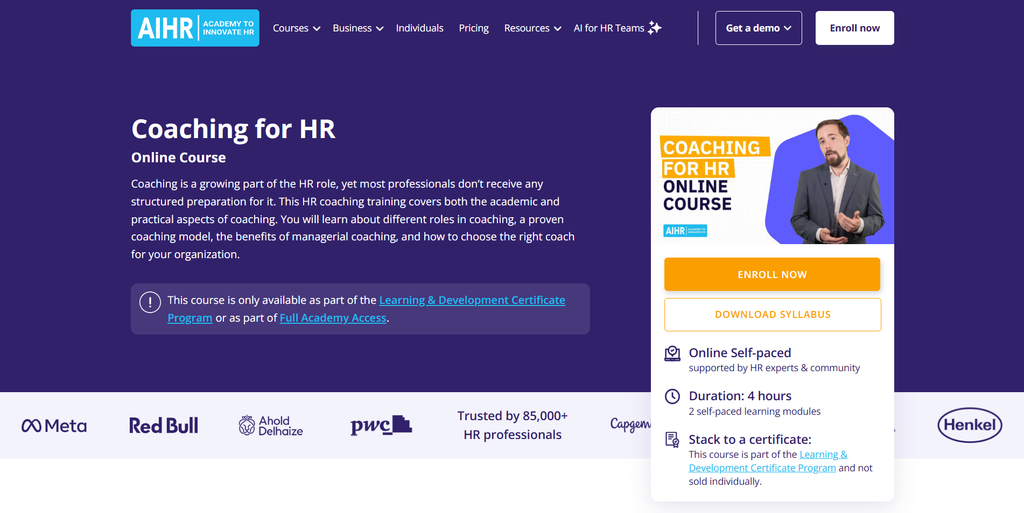
AIHR's Coaching for HR is a short, self-paced course designed for HR professionals who need to understand and implement coaching as an organizational strategy. Taught by an executive coaching psychologist, it covers evidence-based coaching and the GROW model in roughly 4 hours.
What you'll learn: Apply the GROW model, support managers in adopting coaching behaviors, select and manage internal and external coaches, and integrate coaching into your L&D strategy.
Course details:
- Format: Self-paced online; video lessons, reading materials, quizzes, and a downloadable GROW Guidebook; accessible via desktop and mobile app
- Duration: Approximately 4 hours of instruction; 12-month access from enrollment date
- Level/prerequisites: Foundational; no prior coaching experience required
- Price: Not sold individually; included in the L&D Certificate Program ($1,125 USD) or Full Academy Access ($9,750 USD/year)
- Assessment: Quizzes included across the two modules
- Certificate/credits: Digital completion certificate shareable on LinkedIn; eligible for SHRM PDCs and recognized for HRCI, HRPA, CPHR, and CIPD recertification; no ICF credits awarded
Considerations: Because this course is only accessible as part of the L&D Certificate Program or Full Academy Access, your actual cost depends on whether the broader bundle aligns with your learning goals.
10. Executive Coach Certification - Center for Executive Coaching (CEC)
Best for: Professionals launching a paid executive coaching practice

CEC is a nearly 30-year-old ICF Level 1 and Level 2 accredited provider with multiple certification pathways. Format flexibility—self-paced, virtual seminar, or in-person—plus 20+ hours of built-in business development training sets it apart from most programs.
What you'll learn: Apply ICF Core Competencies, coach executives using evidence-based frameworks, price and market a coaching practice, and pursue ICF ACC/PCC or BCC credentials.
Course details:
- Format: Self-paced on-demand, live virtual seminar (2–3 days), in-person seminar, or hybrid; all include coaching labs and faculty access
- Duration: 3–6 months for most pathways; up to 24 months to complete; ongoing member site access included post-certification
- Level/prerequisites: Designed for professionals with leadership, HR, consulting, or related experience; no prior coaching certification required for most programs
- Price: $3,990–$12,900 USD per person depending on pathway; individual continuing education workshops from $150 USD
- Certificate/credits: CEC Executive Coach Certification; up to 3 certifications (Executive, Career, Business Coach) in one enrollment; ICF ACC/PCC eligible (ICF Level 1 and Level 2 accredited); BCC-approved by CCE; university credential available via the university-backed pathway; ICF CCE hours available through workshop series
Considerations: CEC offers 10+ distinct programs at varying price points, so I'd recommend mapping your credentialing goal (CEC-only, ICF ACC/PCC, BCC, or university-backed) before choosing a pathway.
11. Conversations That Inspire: Coaching Learning, Leadership and Change - Case Western Reserve University
Best for: Leaders who want the science behind effective coaching
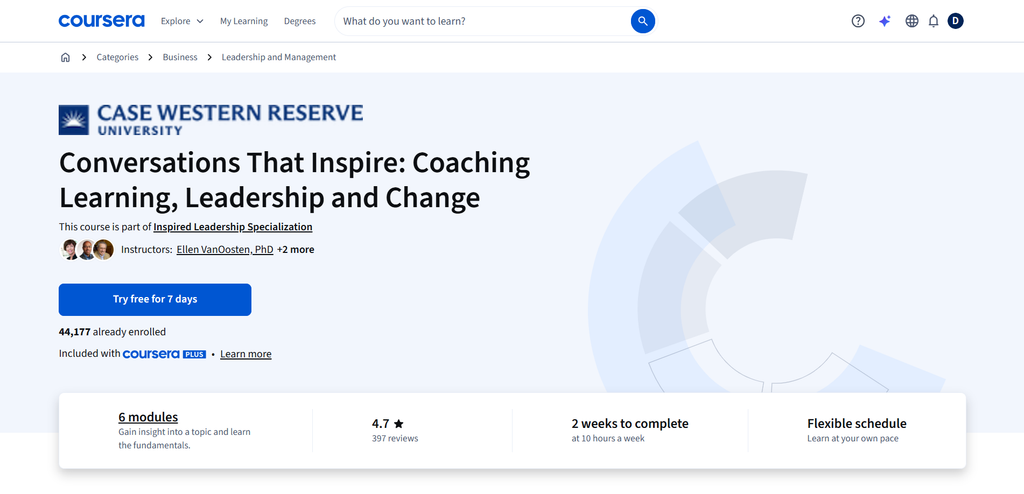
Conversations That Inspire is a Coursera course from Case Western Reserve University. Richard Boyatzis and colleagues teach the neuroscience of coaching with compassion, grounded in their own peer-reviewed research on Intentional Change Theory.
What you'll learn: Apply Intentional Change Theory and the neuroscience of coaching to build compassionate coaching conversations, support sustained behavior change, and establish a coaching culture in your organization.
Course details:
- Format: Self-paced online on Coursera; video lectures, readings, peer-reviewed assignments, and discussion prompts; accessible on desktop and mobile
- Duration: Approximately 16 hours across 6 modules; self-paced with no fixed schedule
- Level/prerequisites: Intermediate; some related experience recommended by the provider, but no prior coaching training required
- Price: Free to audit without a certificate; certificate requires paid access via Coursera Plus ($239 USD/year) or individual course purchase
- Assessment: Peer-reviewed assignments and discussion prompts across 6 modules
- Certificate/credits: Shareable completion certificate (paid enrollment required); specialization certificate available upon completing all 5 Inspired Leadership courses; no ICF or HR recertification credits awarded
Considerations: This course doesn't award ICF credits, SHRM PDCs, or other professional coaching credentials, so it won't meet formal credentialing or recertification hour requirements.
12. Coach Training Program - iPEC
Best for: Coaches who want a proprietary methodology and assessment
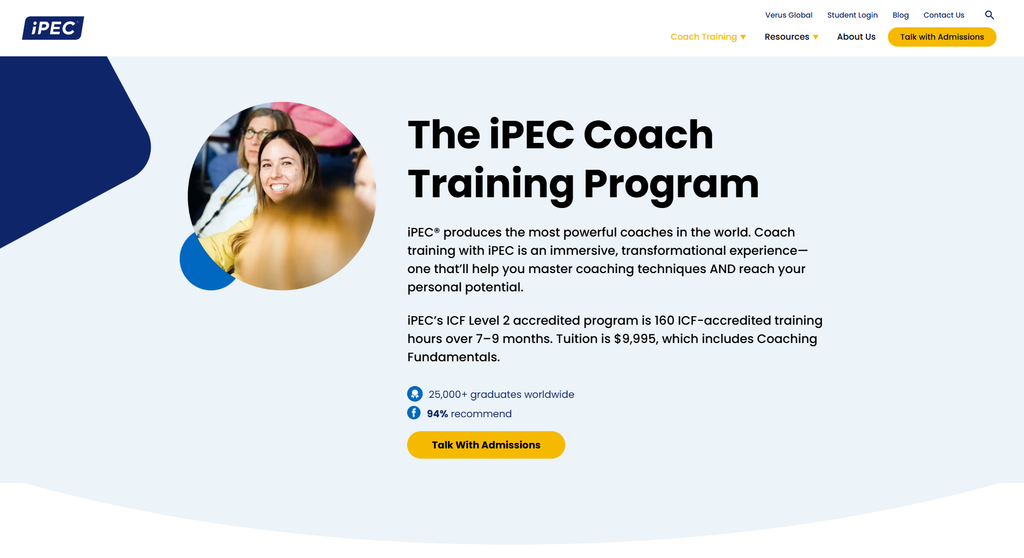
iPEC has trained 25,000+ coaches since 1999 using its proprietary Core Energy Coaching™ methodology. The ICF Level 2 accreditation and dual certifications—including the ELI assessment—give graduates a concrete, differentiated toolkit from day one.
What you'll learn: Apply Core Energy Coaching™ to identify limiting beliefs, administer and debrief the Energy Leadership Index® assessment, and coach clients through sustained behavioral change.
Course details:
- Format: Three live 3-day modules (in-person or live virtual), plus weekly webinars, peer coaching, and mentor coaching between modules
- Duration: 7–9 months part-time; 160 ICF-accredited training hours total
- Level/prerequisites: Foundational; no prior coaching experience required; must be 18+ with a high school diploma or equivalent
- Price: $9,995 USD per person for the full program; Module I only available at $1,995 USD (credited toward full enrollment); 0% interest payment plans available
- Assessment: Final exams required after Module III to complete the program
- Certificate/credits: Certified Professional Coach (CPC) and Energy Leadership Index® Master Practitioner (ELI-MP); 160 ICF Level 2 accredited hours (ACC/PCC eligible); 67 SHRM PDCs; 70 HRCI credit hours; 120 BCC training hours toward the CCE Board Certified Coach credential
Considerations: At $9,995, this is one of the pricier options in this roundup—and the proprietary ELI assessment and Core Energy Coaching™ methodology are iPEC-specific, so they won't transfer directly to other credentialing frameworks.
13. HR as Coach & Mediator - The TCM Group
Best for: HR professionals managing workplace conflict daily

HR as Coach & Mediator™ is a 2-day course from The TCM Group that teaches HR professionals coaching and mediation skills to resolve workplace conflict without formal processes.
What you'll learn: Structure coaching conversations, apply active listening and emotional intelligence, use positive psychology to set goals, and run facilitated dialogue sessions with managers and employees.
Course details:
- Format: Instructor-led; in person at TCM Academy in London or live online via Zoom; also available as in-house delivery for groups of four or more
- Duration: 2 days
- Level/prerequisites: Designed for HR advisers and HR managers; no prior coaching or mediation certification required
- Price: £595 + VAT per person for open-access courses; in-house group pricing available on request
- Certificate/credits: CPD certification awarded by The CPD Certification Service; access to TCM Delegate Zone™ resources; free Refresh, Review and Reassure session 3–6 months post-training
Considerations: This course doesn't award ICF credits, CIPD credits, SHRM PDCs, or other internationally recognized coaching credentials, so it won't count toward formal coaching credentialing or recertification requirements.
14. Executive and Management Coaching - University of Cape Town
Best for: Coaches who want hands-on practice with a UCT certificate

Executive and Management Coaching is an online short course from the University of Cape Town, delivered via GetSmarter. It pairs coaching theory with live practice—observing five coaching meetings and running your own sessions with an assigned partner.
What you'll learn: Apply coaching models and philosophies, contract and facilitate a coaching process from initial through closure, build a personalized toolkit, navigate coaching ethics, and develop a professional coaching brand.
Course details:
- Format: Cohort-based online; self-paced weekly modules with incremental deadlines; partner coaching sessions included
- Duration: 12 weeks (excluding orientation); 8–12 hours per week
- Level/prerequisites: Prerequisites not specified
- Price: $980 USD per course; interest-free three-part payment plan available
- Assessment: Continuous assessment through practical assignments; certificate requires meeting conditions outlined in the course handbook
- Certificate/credits: Digital certificate of completion from the University of Cape Town (UCT); included coaching sessions count toward coaching credential hours, per the provider
Considerations: UCT notes that certificate issuance can be delayed by several weeks or months due to administrative requirements, so factor that in if you need the credential by a specific date.
15. Coaching and Developing Employees (2024) - LinkedIn Learning
Best for: Managers who want coaching frameworks they can apply today
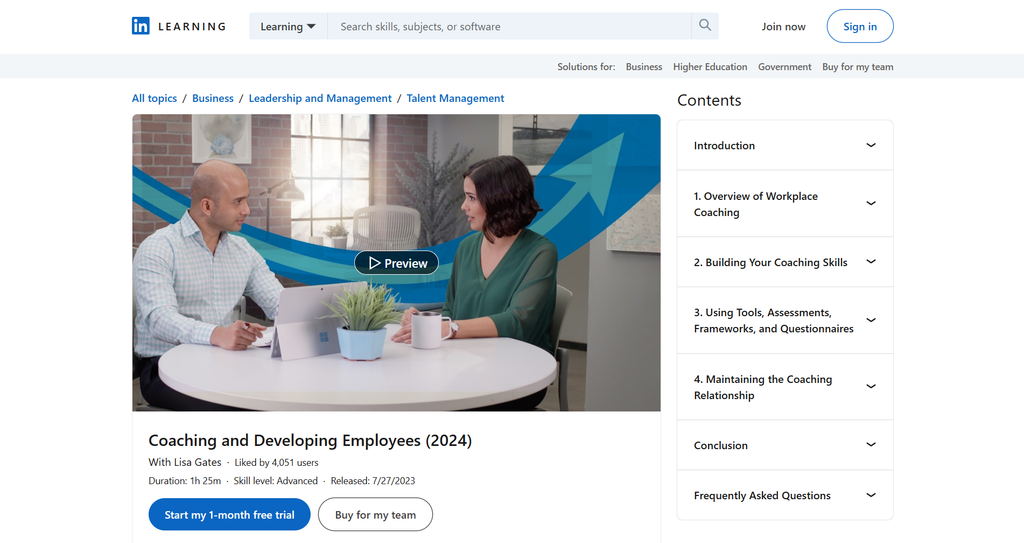
Coaching and Developing Employees (2024) is a LinkedIn Learning course taught by Lisa Gates. It's a compact option for managers who want practical coaching frameworks—like GROW and ORID—without committing to a multi-week program.
What you'll learn: Ask powerful open-ended questions, apply the GROW model and ORID framework, give future-focused feedback, manage accountability, and coach remote employees.
Course details:
- Format: Self-paced online; video lessons with quizzes, an exercise file, and AI-powered role-play practice
- Duration: 1 hour 25 minutes
- Level/prerequisites: Listed as Advanced on LinkedIn Learning; no prior coaching training required
- Price: Included with a LinkedIn Learning subscription at $39.99/month or $239.88/year; a one-month free trial is available for eligible new users
- Assessment: 4 quizzes
- Certificate/credits: LinkedIn Learning certificate of completion, shareable directly to your LinkedIn profile; continuing education units (CEUs) included
Considerations: Access requires an active LinkedIn Learning subscription, so you lose the certificate and course materials if you don't renew.
More Articles
16. Management Coaching: Coaching Employees for High Performance - Udemy
Best for: Managers who want structured role-play practice on a budget
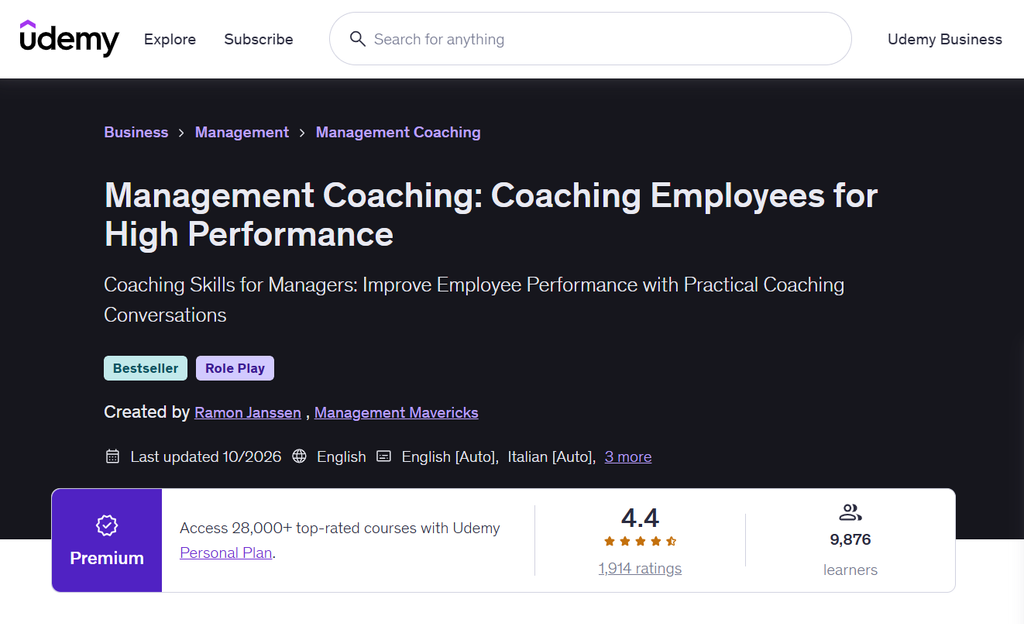
Management Coaching: Coaching Employees for High Performance is a Udemy course by Ramon Janssen built around a 10-step Performance Coaching Model and eight role plays—giving managers a structured, practice-based approach to coaching conversations.
What you'll learn: Apply the Skill–Will Coaching Matrix, run structured coaching conversations using the 10-step Performance Coaching Model, give feedback in difficult situations, and coach for high-performance team culture.
Course details:
- Format: Self-paced online; on-demand video with role plays, case studies, worksheets, and downloadable resources, including a full coursebook
- Duration: 9 hours 33 minutes of video content; lifetime access included
- Level/prerequisites: Basic understanding of business, management, or leadership required; no prior coaching training needed
- Price: $79.99 USD per course; frequently discounted; also available via Udemy Personal Plan from $12.99/month
- Assessment: Exercises and role plays throughout; no formal exam required for completion
- Certificate/credits: Udemy certificate of completion, downloadable and shareable
Considerations: The certificate carries no ICF accreditation, SHRM PDCs, or other recognized credential hours, so it won't support formal coaching certification pathways.
How to Choose a Coaching Course
Start by getting clear on the professional problem you're trying to solve. Are you building toward a formal coaching credential, or do you need practical skills to use in everyday management conversations?
- Match the curriculum to your actual role. A course built around manager-employee conversations (like a performance coaching model) will serve team leaders differently than one structured around professional coaching engagements with contracting, closure, and ethics. Look at the section-by-section curriculum, not just the headline description.
- Check whether the credential counts toward anything. Completion certificates and professional certifications aren't the same thing. If you're working toward an ICF credential, SHRM recertification, or BCC designation, verify that the course explicitly publishes accredited training hours before you enroll.
- Assess how much practice the course builds in. There's a meaningful difference between watching coaching demonstrations and actually running coaching sessions. Some courses include AI role-play or peer coaching programs; others are primarily video-based. Think about how you learn best.
- Be honest about your time and schedule. A 90-minute self-paced course and a 12-week cohort-based program both have trade-offs. The shorter option gets you frameworks faster; the longer one forces you to apply them over time with structured feedback.
- Calculate the full cost before committing. Some courses require an active subscription to retain your certificate or access materials. Factor in renewal costs alongside the upfront price, especially if you plan to reference the course after completing it.
- Consider your current experience level realistically. Some courses are designed for aspiring coaches with no background; others assume you already manage people. Starting at the wrong level wastes time in both directions.
Coaching FAQ
How can you tell whether a course will give you useful feedback?
Check who actually reviews your practice work and how often. There’s a real difference between a course that includes exercises and one where a trained coach reviews your performance and tells you what to adjust. Look for specifics in the course description—details on feedback frequency, who provides it (instructor, trained coach, or peer), and whether you can apply that feedback in later practice sessions.
If the course page is vague about feedback, that’s usually a sign it’s lighter on direct assessment than it looks.
Is completing a coaching course enough to start coaching clients professionally?
No—a course builds foundational skills, but it’s rarely enough on its own to start coaching clients professionally. Professional coaching also requires ongoing practice, clear ethical boundaries, and usually some form of recognized training or credential, depending on what your clients expect.
If you’re aiming to coach professionally, map out the requirements of the credential body you’re pursuing—ICF, BCC, or another—before choosing a course, so your training hours actually count toward your goal rather than just your learning.
What should you do after a coaching course to keep developing?
Keep practicing with willing partners, ideally people who’ll give you honest feedback. Reflection matters too—after each coaching conversation, note what landed and what didn’t. If you’re working toward a credential, check whether you need supervised coaching hours or mentor coaching as a next step.
Many credentialing bodies, including ICF, require documented hours before you can apply, so the sooner you start logging real conversations, the better positioned you’ll be when you’re ready to pursue formal recognition.
How can you assess whether a course's teaching will transfer to your work?
Look for realistic scenarios that match your actual context—manager-employee conversations, client coaching, team dynamics, or whatever applies to your role. A course that walks you through how to adapt its frameworks is more transferable than one that presents a single model as universal. Pay attention to whether the tools and templates are designed for your setting, not just generic coaching.
I’d also check whether the course addresses common complications, like resistance, difficult conversations, or virtual coaching—those are where most people get stuck in practice.
What’s Next?
To stay up to date on people management, subscribe to our newsletter for leaders and managers. Get insights and offerings for leaders and HR professionals straight to your inbox.


