

Remote work courses help you build the skills distributed teams actually need—async communication, digital collaboration, and focus. I rounded up the best options so you can find training that fits your role and the gaps you're working to close.
The 14 Best Remote Work Courses
Below are my summaries of the best remote work courses. My reviews offer a look at each course’s learning objectives, best fits, cost, and more.
1. How to Manage a Remote Team - GitLab (via Coursera)
Best for: Leaders planning a team's shift to remote work
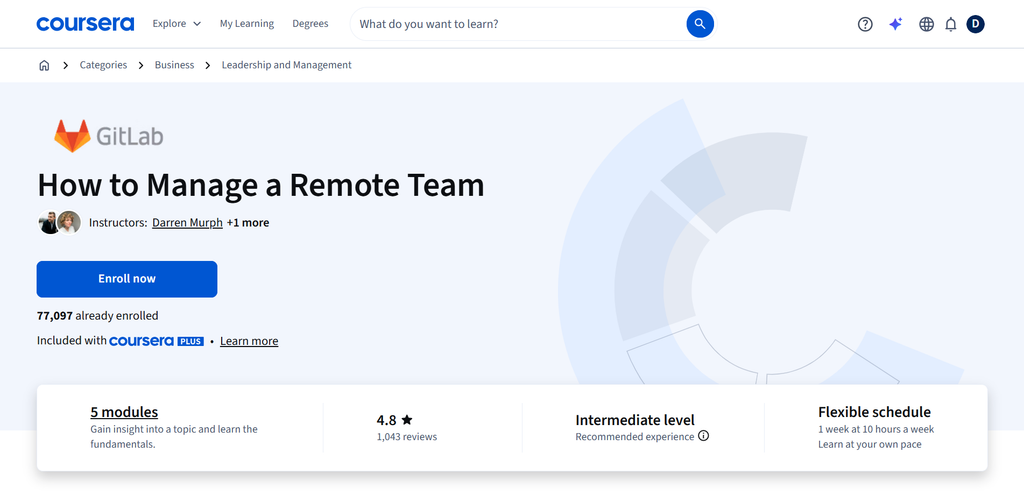
GitLab built this course from its experience running a fully remote company of 1,300+ people across 68 countries. It covers remote team management end-to-end, and the final project has you draft a real transition plan for your own team.
What you'll learn: Assess team readiness for remote work, manage performance and morale in distributed teams, develop remote culture and values, and build a structured remote-transition strategy.
Course details:
- Format: Self-paced online via Coursera; includes video lessons, readings, assignments, and discussion prompts
- Duration: Approximately 10 hours across 5 modules
- Level/prerequisites: Intermediate; provider recommends at least 1 year of management experience
- Price: Included with Coursera Plus ($239/year); no standalone course price listed
- Assessment: Peer-reviewed final project (remote transition plan)
- Certificate/credits: Shareable completion certificate issued through Coursera
Considerations: Access to the course requires a Coursera Plus subscription, so if you only plan to take this one course, the annual fee may be a significant factor in your decision.
2. Leading Remote Teams - eCornell
Best for: HR leaders who need SHRM or HRCI recertification credits
eCornell's Leading Remote Teams certificate is built on Cornell SC Johnson College of Business research. It covers the full arc of virtual team leadership, from forming and launching distributed teams to navigating cross-cultural dynamics and improving decision quality.
What you'll learn: Build trust and psychological safety in virtual teams, manage remote conflict and negotiation, strengthen cross-cultural collaboration, and create team charters and communication plans.
Course details:
- Format: Online with structured start dates; 5 sequential courses with facilitated discussions, graded assignments, and facilitator feedback
- Duration: Approximately 3 months; each of the 5 courses runs 2 weeks at 3–5 hours per week
- Level/prerequisites: No prior management experience required; suited to current and aspiring virtual team leaders
- Price: $3,750 (one-time) or 5 monthly payments of $800 ($4,000 total), per learner
- Certificate/credits: Leading Remote Teams Certificate from Cornell SC Johnson College of Business; 50 PDHs (5 CEUs); 50 PDCs toward SHRM-CP/SHRM-SCP recertification; 50 credit hours toward HRCI recertification
Considerations: At $3,750 or more, this is one of the most expensive options in this roundup — the SHRM and HRCI recertification credits make it easier to justify for credentialed HR professionals. Still, it's a significant investment for individual contributors.
3. Professional Certificate in Leading in a Remote Environment - Harvard Online
Best for: Leaders who want a Harvard credential at an accessible price
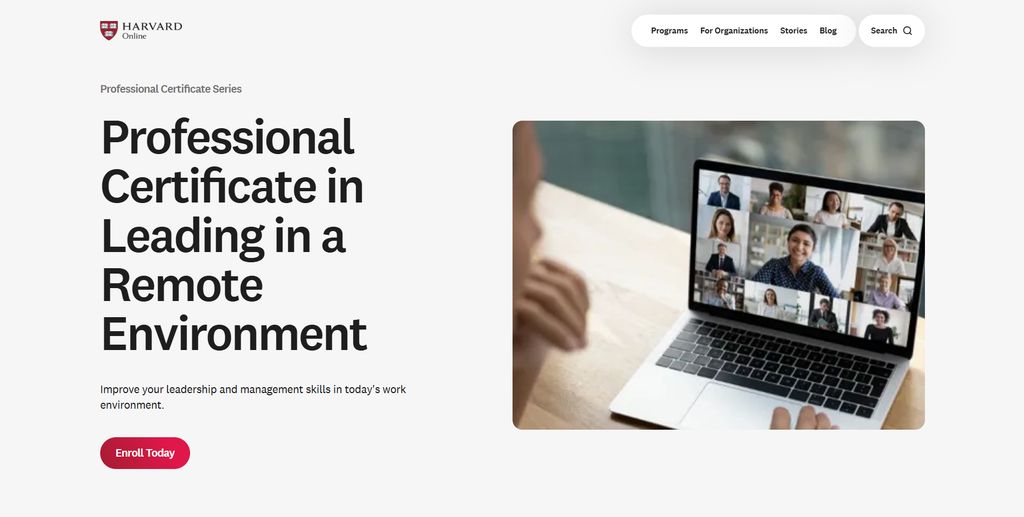
Harvard Online pairs two courses taught by Ronald Heifetz and Tsedal Neeley—combining adaptive leadership theory with practical remote team management. With over 1.15 million learners enrolled, it's one of the most widely taken programs of its kind.
What you'll learn: Build trust in remote teams, improve productivity and communication in distributed settings, select digital tools that support collaboration, and lead through organizational change and adaptive challenges.
Course details:
- Format: Self-paced online via edX; includes video lessons, activities, tests, and discussion forums
- Duration: Approximately 2 months at 2–3 hours per week; Course 1 runs 4 weeks, Course 2 runs 3 weeks
- Level/prerequisites: Introductory; no prior experience required
- Price: $322.20 per learner for the full certificate; individual courses can be audited for free
- Assessment: Tests and activities within each course
- Certificate/credits: Professional Certificate in Leading in a Remote Environment from Harvard University (HarvardX), issued through edX
Considerations: Auditing individual courses is free, but you'll need to pay for the certificate to earn the credential—so factor that in if the Harvard certification is your primary goal.
Have an account? Log In
4. Remote Work Revolution for Everyone - Harvard Online
Best for: Professionals who want free Harvard remote work training
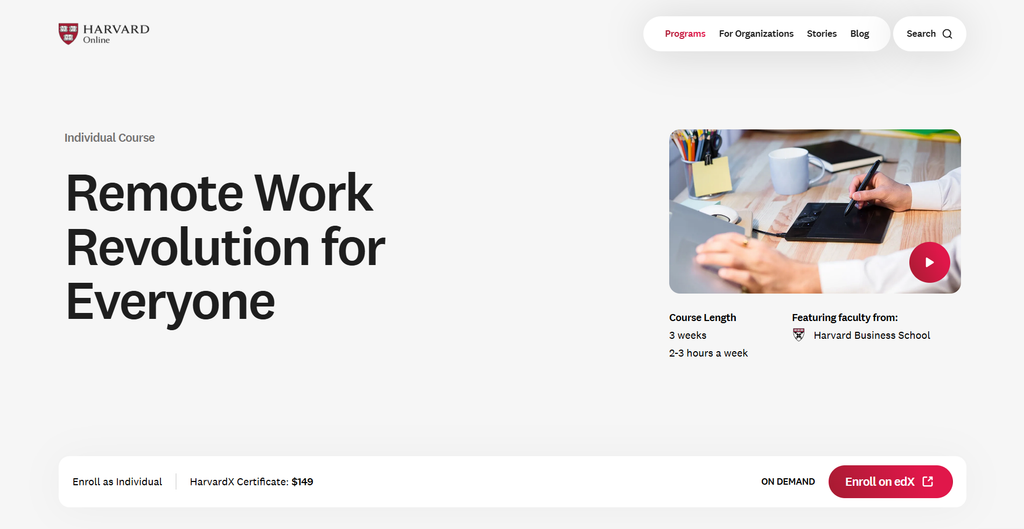
Taught by Harvard Business School's Tsedal Neeley, this standalone HarvardX course uses real-world case studies to teach practical remote work strategies. The free audit option makes it one of the most accessible Ivy League courses available.
What you'll learn: Build trust in remote teams, select digital tools that support team access and productivity, improve communication and collaboration, and create a plan to relaunch your team as remote contributors.
Course details:
- Format: Self-paced online via edX; video lessons using the Harvard Business School case method, activities, tests, and discussion forums
- Duration: 3 weeks at 2–3 hours per week (approximately 6–9 hours total)
- Level/prerequisites: Introductory; no prior experience required
- Price: $149 per learner for the verified certificate; free audit available with access to select materials (no certificate awarded)
- Assessment: Activities and tests within the course
- Certificate/credits: HarvardX verified certificate issued through edX
Considerations: If you want a broader credential that includes adaptive leadership training, item #3 in this roundup bundles this course with a second course for $322.20 — the standalone $149 certificate covers only the remote work content.
5. Remote Leadership for Managers Specialization - University of California, Irvine (via Coursera)
Best for: New managers stepping into remote team leadership
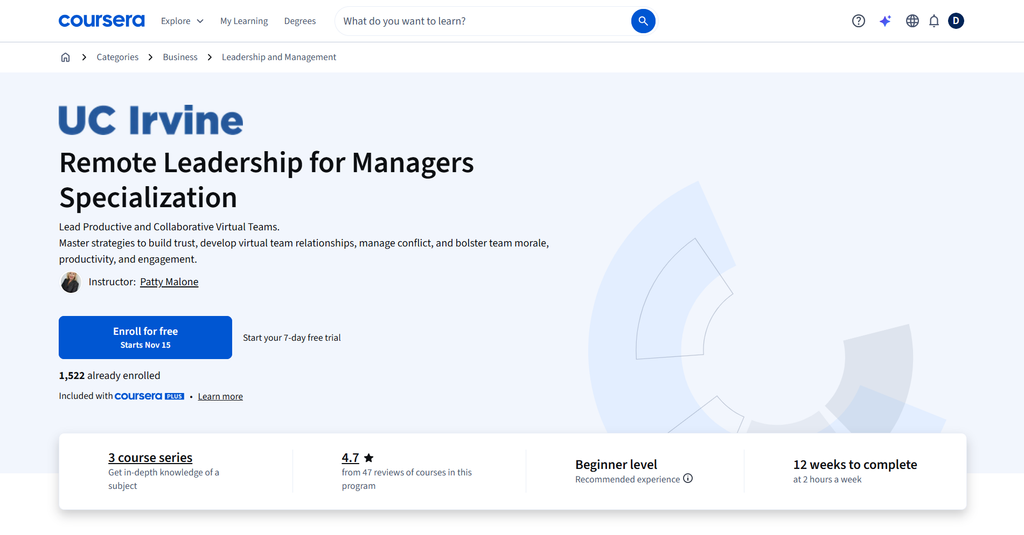
UC Irvine's three-course Coursera specialization covers remote communication, leadership, and productivity in one structured program. Instructor Patty Malone ties it together with a scenario-based final exam that applies concepts across all three courses.
What you'll learn: Build trust in virtual teams, adapt leadership styles to remote settings, manage conflict and burnout, select digital tools for distributed collaboration, and boost team productivity.
Course details:
- Format: Self-paced online via Coursera; video lessons, readings, graded assignments, and discussion prompts across three courses
- Duration: Approximately 19 hours total (Course 1: 5 hrs, Course 2: 6 hrs, Course 3: 8 hrs); flexible, self-paced schedule
- Level/prerequisites: Beginner; no prior experience required
- Price: Included with Coursera Plus ($239/year); no standalone one-time purchase price is listed
- Assessment: Graded assignments and knowledge checks per course; cumulative scenario-based final exam in Course 3
- Certificate/credits: Shareable completion certificate from the University of California, Irvine; no university credit awarded
Considerations: Access to graded assignments and the certificate requires a paid Coursera subscription, so a free audit won't earn you the UC Irvine credential.
6. Leadplaceless® Virtual Leadership Training - Workplaceless
Best for: Managers who want SHRM credit for remote leadership training
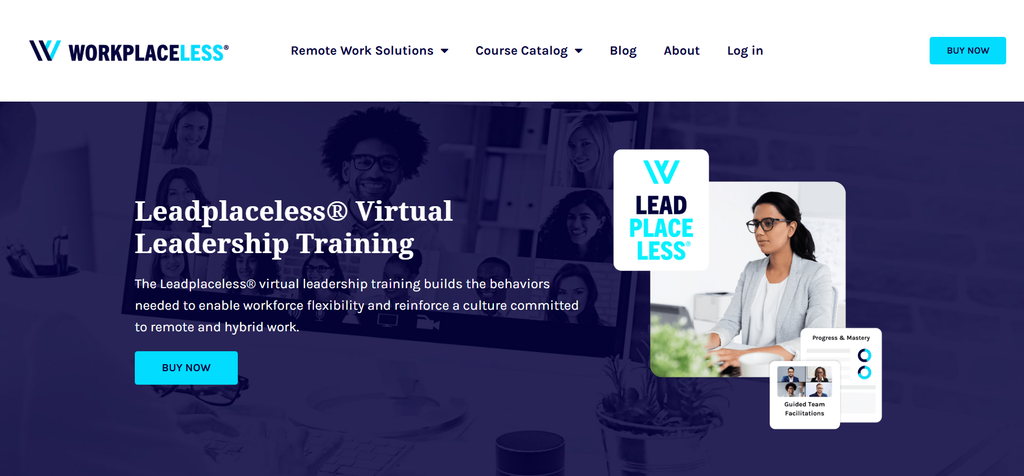
Workplaceless built Leadplaceless specifically for remote and hybrid managers — not adapted from general leadership content. Seven modules pair short lessons with real-team projects and a behavioral audit to move you from learning concepts to changing actual habits.
What you'll learn: Run inclusive virtual meetings, build trust across distance, manage performance by outcomes, reduce burnout through boundary-setting, and select the right communication tools for distributed teams.
Course details:
- Format: Self-paced online; fully asynchronous; video modules, quizzes, a behavioral audit, seven team projects, and a template toolkit
- Duration: 2–3 hours of core content; recommended 4–6 weeks to complete projects with your team; one year of access
- Level/prerequisites: Prerequisites not specified; suited to managers of remote or hybrid teams at any experience level
- Price: $195 per learner; a Leadplaceless + Toolkit Group Bundle is $245 per seat; custom bulk pricing for 50+ seats
- Assessment: Module quizzes and a Remote Leader Behavior Audit; seven self-guided team projects applied with your direct reports
- Certificate/credits: Completion certificate from Workplaceless; SHRM Professional Development Credits (PDCs) for SHRM-CP® or SHRM-SCP® recertification
Considerations: The seven team projects require your direct reports to participate, so if you're not currently leading a remote team, you won't be able to complete the applied portion of the course.
7. Workplaceless Remote Work Certification - Workplaceless
Best for: Individual contributors new to remote or hybrid work
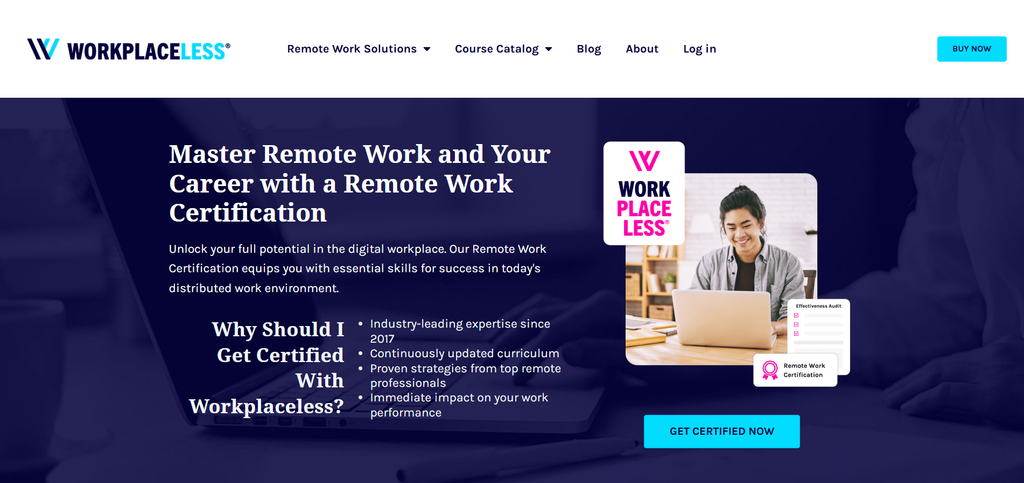
Workplaceless built this certification specifically for individual contributors navigating remote or hybrid roles — not managers. Seven modules address practical skills remote workers need, from workday structure to async communication, anchored by a personal effectiveness audit.
What you'll learn: Manage your remote workday structure, secure your digital infrastructure, communicate asynchronously, track workflow with project management tools, and build collaboration habits that keep you productive on distributed teams.
Course details:
- Format: Self-paced online; fully asynchronous; video modules, knowledge checks, case studies, exercises, and downloadable job aids
- Duration: 4–5 hours of core content; access period not specified by provider
- Level/prerequisites: Prerequisites not specified; designed for individual contributors new to or seeking remote work
- Price: $195 per learner; group pricing available for organizations; custom enterprise pricing for 50+ seats
- Assessment: Knowledge checks, module assessments, and a Remote Worker Effectiveness Audit with a personalized development plan
- Certificate/credits: Completion certificate from Workplaceless; SHRM Professional Development Credits (PDCs) for SHRM-CP® or SHRM-SCP® recertification
Considerations: Workplaceless doesn't publish the number of SHRM PDCs this course awards, so if you need a specific credit total for recertification, confirm the PDC count with Workplaceless before enrolling.
8. Leading a Remote Workforce Training - Six Sigma Global Institute (SSGI)
Best for: Managers who need both PMI PDUs and SHRM PDCs
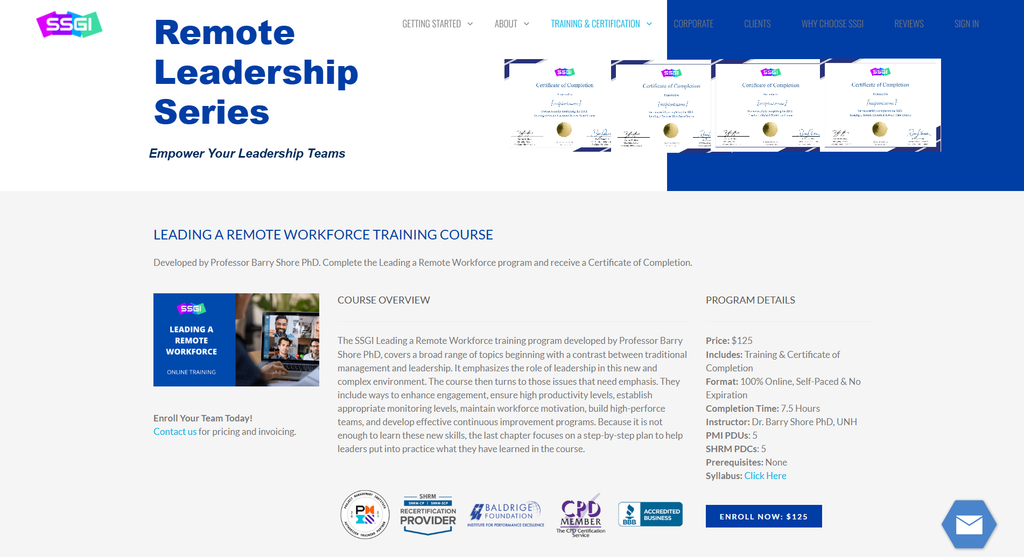
SSGI's Leading a Remote Workforce Training is a 12-module course developed by Dr. Barry Shore of the University of New Hampshire. At $125, it's one of the few remote leadership courses that awards both PMI PDUs and SHRM PDCs.
What you'll learn: Engage and motivate remote employees, coach individuals and teams at a distance, run productive virtual meetings, and build a step-by-step plan to apply new leadership skills.
Course details:
- Format: Self-paced online; fully asynchronous; includes lessons, supplementary video content, per-module quizzes, and a final exam
- Duration: Approximately 7.5 hours; one year of access from purchase
- Level/prerequisites: Prerequisites not required; suited to team leads, supervisors, and managers leading or preparing to lead remote teams
- Price: $125 per learner; team enrollment pricing available by contacting SSGI directly
- Assessment: Quiz after each of the 12 modules; final exam with a 75% passing score required for certification
- Certificate/credits: Certificate of completion from SSGI; 5 PMI Professional Development Units (PDUs); 5 SHRM Professional Development Credits (PDCs) for SHRM-CP® or SHRM-SCP® recertification
Considerations: SSGI is known primarily for Lean Six Sigma training, so if brand recognition in remote work circles matters to you, this course carries less name recognition than providers like Workplaceless.
9. Managing Remote Teams - ed2go
Best for: Managers who want instructor support and weekly pacing
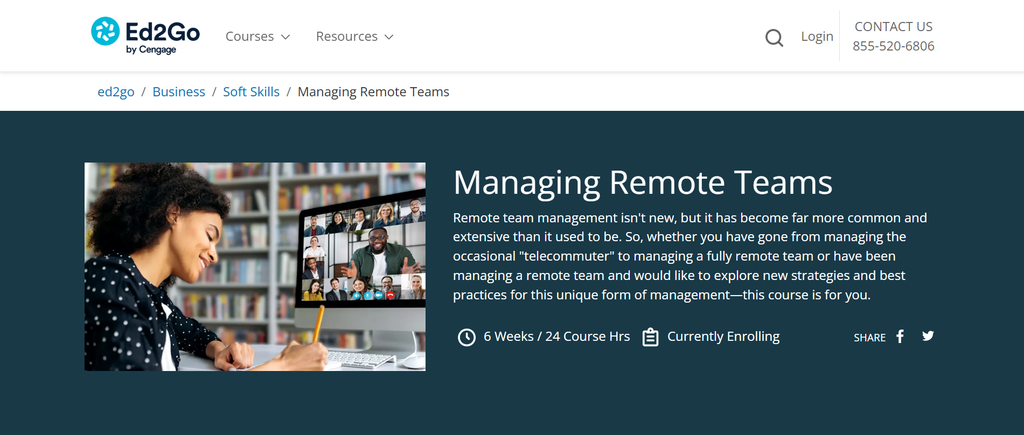
ed2go's Managing Remote Teams covers the full lifecycle of managing distributed teams. The instructor-moderated format releases lessons on a weekly schedule with discussion boards—useful if you want structure and instructor access rather than pure self-pacing.
What you'll learn: Adapt your management style for distributed teams, align remote employees with company culture, recruit and onboard remotely, monitor productivity without micromanaging, and resolve conflict in remote settings.
Course details:
- Format: Online; two options—instructor-moderated (two lessons per week over six weeks, with discussion boards) or self-guided; fully asynchronous
- Duration: 24 course hours; instructor-moderated runs 6 weeks; self-guided provides three months of access
- Level/prerequisites: Managerial experience recommended; foundational management concepts are not covered
- Price: $200 (instructor-moderated) or $215 (self-guided) per learner on the main ed2go site; pricing varies by partner institution
- Certificate/credits: No certificate of completion or professional development credits confirmed
Considerations: This course awards no confirmed credentials or professional development credits, so it's not the right fit if you need PDU or PDCs for recertification.
10. Managing Remote Employees - MindEdge Learning
Best for: HR professionals needing HRCI recertification credits
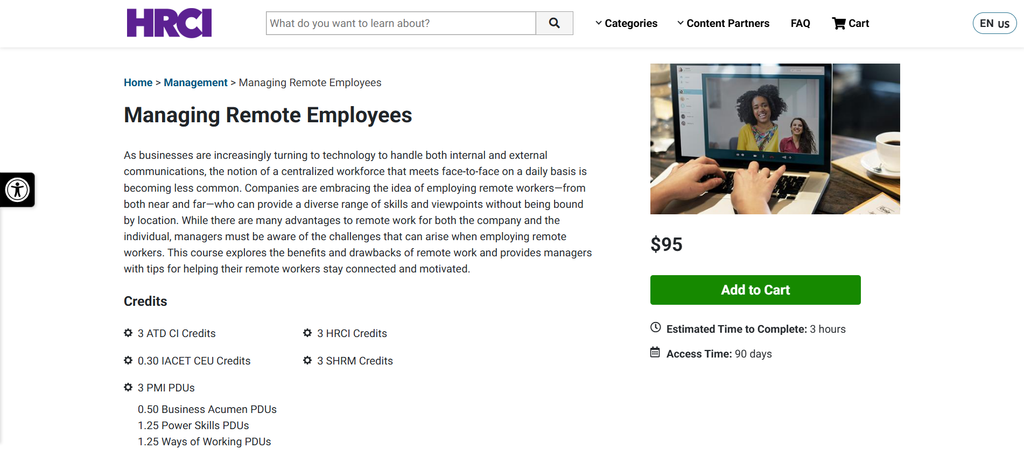
MindEdge's Managing Remote Employees is hosted on the HRCI catalog and covers remote management fundamentals in 3 hours. At $95, it awards credits from four major professional bodies, making it the most credit-efficient option in this roundup.
What you'll learn: Identify the benefits and challenges of remote work, apply best practices for hiring and onboarding remote staff, communicate and provide feedback remotely, and develop strategies to motivate distributed teams.
Course details:
- Format: Self-paced online; fully asynchronous; includes interactive activities, real-world case studies, and assessments; WCAG AA accessible
- Duration: 3 hours of content; 90 days of access from purchase
- Level/prerequisites: Foundation level; no prerequisites required
- Price: $95 per learner on the HRCI/MindEdge catalog; pricing varies by partner institution
- Assessment: Minimum passing score of 70% required on assessments
- Certificate/credits: 3 HRCI credits, 3 SHRM PDCs, 3 PMI PDUs, 3 ATD CI credits, and 0.30 IACET CEUs upon completion
Considerations: At 3 hours, the course offers a focused introduction to remote management rather than the depth of longer options, so it works best as a primer or a credit-earning supplement to a more in-depth course.
11. Build Essential Skills to Manage Remote and Hybrid Teams - LinkedIn Learning
Best for: Managers overseeing both remote and in-office employees
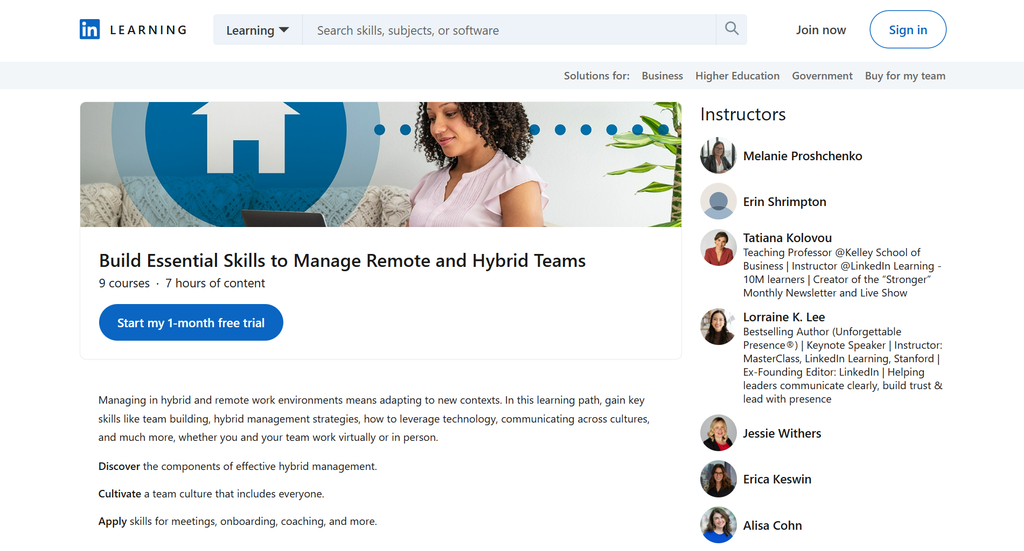
LinkedIn Learning's Build Essential Skills to Manage Remote and Hybrid Teams bundles nine expert-led courses into a single learning path. At roughly 7 hours total, it's the only option here that explicitly covers hybrid work—useful if your team splits time between office and remote.
What you'll learn: Build connection in hybrid and virtual teams, facilitate remote and hybrid meetings, apply OKRs to align distributed teams, onboard remote employees, and deliver virtual performance reviews and coaching.
Course details:
- Format: Self-paced online; fully asynchronous; on-demand video with supplementary materials; mobile-compatible via the LinkedIn Learning app
- Duration: ~7 hours of video content across 9 courses; access continues while your subscription is active
- Level/prerequisites: No level stated by provider; no prerequisites required
- Price: Included with LinkedIn Premium at $39.99/month or $239.88/year; a one-month free trial is available for new subscribers
- Certificate/credits: A badge of completion for the full path and individual completion certificates for each course, all shareable on LinkedIn; credit eligibility for PDUs or PDCs varies by individual course
Considerations: Access to the learning path depends on an active LinkedIn Premium subscription, so your coursework and certificates are tied to maintaining that subscription.
12. Managing Remote Teams - Udemy
Best for: Budget-conscious managers who want tactical remote tools
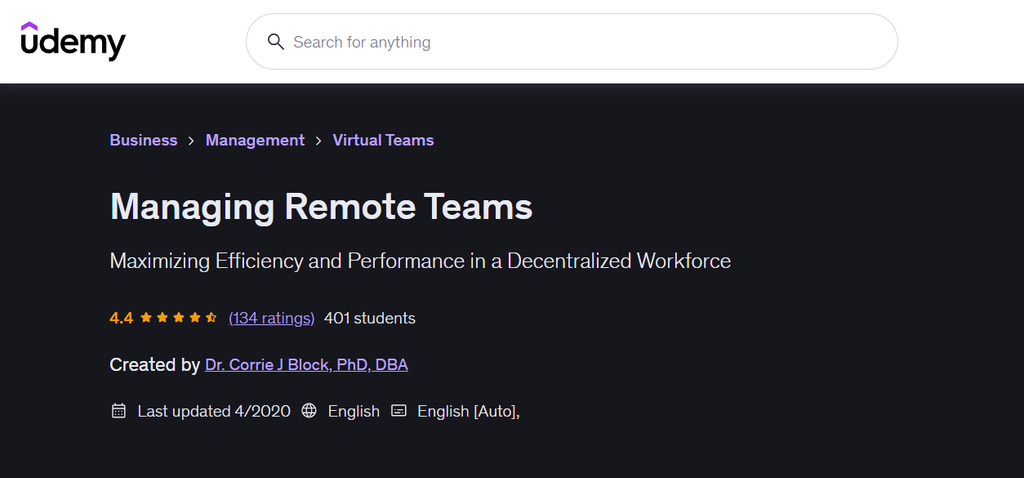
Managing Remote Teams is taught by Dr. Corrie J Block, a professor with 20+ years of experience across 100+ companies globally. It focuses on practical protocols and specific tools, making it one of the most operationally grounded options in this roundup.
What you'll learn: Set up meeting protocols before, during, and after sessions, select tools for communication and progress tracking, map workflows digitally, monitor deliverables, and conduct mental health check-ins with isolated team members.
Course details:
- Format: Self-paced online; fully asynchronous; on-demand video with downloadable resources; mobile and TV accessible
- Duration: ~3 hours of video content across 20 lectures; lifetime access with no expiration
- Level/prerequisites: No level stated by provider; no prerequisites required
- Price: $49.99 USD per learner; also available via Udemy subscription from $12.99/month; 30-day money-back guarantee
- Certificate/credits: Udemy certificate of completion; no professional development credits (PDUs, PDCs, or CEUs) awarded
Considerations: The course was last updated in April 2020, so some tool-specific guidance may not reflect the latest remote work practices or platform updates.
13. Certified Remote Work Leader - Utah State University Extension
Best for: Leaders managing both in-office and remote employees
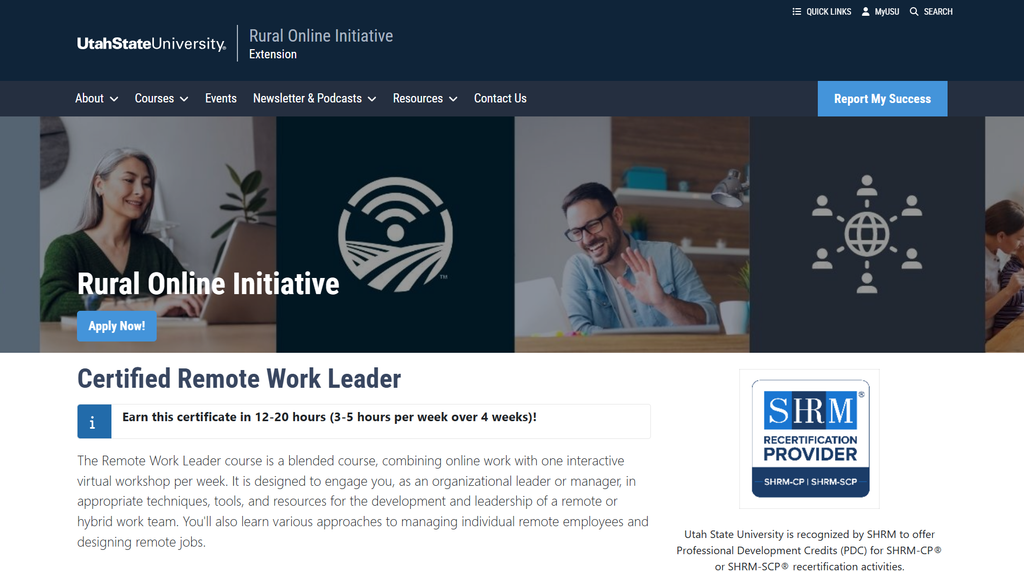
Utah State University Extension's Certified Remote Work Leader course blends self-paced modules with four live Zoom workshops in a cohort format. That structure builds accountability and peer learning that fully self-paced courses can't replicate.
What you'll learn: Build a remote work vision, assess and digitize company culture, develop virtual communication agreements, manage remote performance and conflict, and design individual learning plans for distributed teams.
Course details:
- Format: Blended; self-paced online modules via Canvas plus four mandatory live virtual workshops via Zoom; cohort-based
- Duration: 12–20 hours over 4 weeks (3–5 hours/week); 2026 cohort dates listed as TBD
- Level/prerequisites: No level stated by provider; no prerequisites required
- Price: $149 USD per learner; optional 3 USU CEUs cost an additional $90
- Assessment: Minimum 80% score required on each module assessment to earn the certificate
- Certificate/credits: Certificate of completion; 12 SHRM PDCs; optional 3 USU continuing education units (CEUs) for an additional $90, recorded on an official university transcript
Considerations: The four live workshops run on Wednesdays at 12 p.m. Mountain Time, so your schedule needs to accommodate that fixed commitment—and the course doesn't support tablets or smartphones, requiring a laptop or desktop with a webcam.
More Articles
14. Certificate in Remote Work Success - NYU SPS
Best for: Remote workers and managers who want an NYU credential
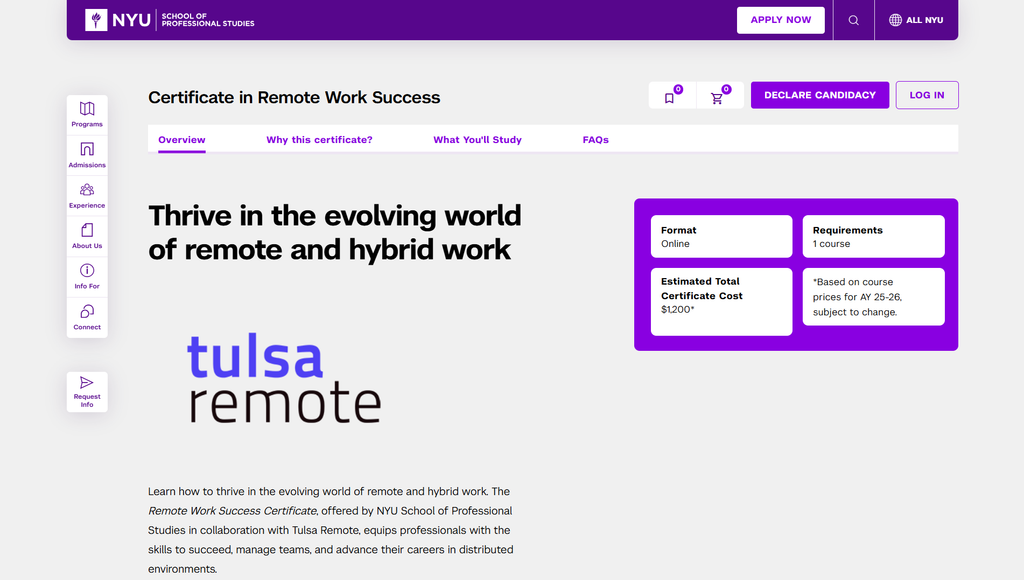
NYU SPS developed this certificate with Tulsa Remote, the country's largest remote worker relocation program. Nine live Zoom sessions across three modules cover both individual contributors and managers, with an optional in-person Tulsa visit included in the tuition.
What you'll learn: Set up a productive remote workspace, lead distributed teams across time zones, manage remote performance, and develop career strategies around pay equity and AI.
Course details:
- Format: Hybrid; nine live virtual sessions via Zoom plus an optional three-day in-person visit to Tulsa; cohort-based
- Duration: Approximately 25 contact hours over six weeks; optional three-day in-person component follows the cohort
- Level/prerequisites: No level stated by provider; no prerequisites required; open enrollment
- Price: $1,200 USD per learner; travel and accommodation for the optional Tulsa visit are included; NYU alumni and other eligible groups receive discounts
- Assessment: Minimum grade of B required across all three modules to earn the certificate
- Certificate/credits: NYU SPS Remote Work Success Certificate; digital credential/badge via credentials.sps.nyu.edu; 2.5 NYU SPS CEUs
Considerations: The program launched its inaugural cohort in February 2026, so there's limited student feedback or track record to draw on when evaluating the experience.
How to Choose a Remote Work Course
Start by naming the problem you're trying to solve. Are you a manager struggling with performance conversations across time zones, or a solo contributor trying to build better focus habits at home? That answer should drive every other decision.
- Match the curriculum to your role. Some courses focus on individual productivity and workspace setup; others go deep on leading distributed teams, managing conflict, or building remote culture. If you're a manager, skip courses that don't cover performance management and team accountability.
- Decide how much structure you need. Self-paced video courses give you flexibility but no accountability. Cohort-based programs with live sessions create scheduled touchpoints that push you to apply the material. If you've started and abandoned self-paced courses before, a cohort format is worth the scheduling constraints.
- Think honestly about time. Course lengths in this roundup range from roughly three hours to 20+ hours spread across several weeks. A three-hour course fits around a busy week; a four-week cohort with live workshops requires a real recurring commitment.
- Check whether the credential serves a purpose. A certificate of completion signals effort but carries no formal standing. If you need SHRM PDCs to maintain your credential, verify the exact credit count before enrolling. If you need university credit on a transcript, only one option here offers that.
- Factor in total cost, not just list price. Some courses discount frequently, some include employer reimbursement pathways, and some bundle live instruction or travel into their price. Compare what you're actually getting at the price you'll actually pay.
Remote Work Course FAQ
Do you need to work remotely to benefit from a course?
No. You can take a remote work course to prepare for a remote role before you’re in one, or to build skills for managing a distributed team you’re being promoted into. That said, some course material assumes you have workplace or leadership experience, so check the description for the intended audience.
If you’re brand new to professional work altogether, start with foundational courses on communication or productivity before moving into leadership-focused programs.
Can a remote work course guarantee you a remote job?
No. A course builds relevant skills, but hiring depends on your overall experience, the role’s requirements, and how you present your qualifications. Treat training as one useful part of your job search strategy—not a substitute for it.
That said, completing a course does give you something concrete to point to in applications and interviews, especially if you can speak to specific skills or frameworks you applied.
How can you tell whether a course's content is current?
Check when it was last updated and whether its examples and tool guidance reflect how remote work actually operates now. This matters most for courses that teach specific software features, which can change frequently.
Look for mentions of asynchronous communication norms, AI tools, or hybrid work considerations—if the course treats remote work as a temporary workaround rather than a standard operating model, that’s a signal the material may be dated.
Will a course certificate make your resume stand out?
It may help, but a certificate alone is unlikely to determine whether you get an interview. Consider how relevant the skills are to the roles you’re targeting, whether employers in your field recognize the credential, and whether you can speak to what you actually learned.
University-backed certificates and those tied to recognized credentials like SHRM PDCs carry more weight than marketplace completion badges, so the issuing institution matters more than the certificate itself.
What’s Next?
To stay current on people management, subscribe to our newsletter for leaders and managers. Get insights and offerings for leaders and HR professionals delivered straight to your inbox.


