


Atlas-Test: Vorteile, Nachteile, Funktionen und Preise erklärt



Agency recruitment gets messy real fast when the detail that matters lives in calls, inboxes, and message threads nobody has time to write up. The right platform should hold that context for you and give leaders a clear view of the desk without creating another admin job.
Atlas is an AI-native recruitment platform built for staffing, recruitment, and executive search firms that want a CRM which records itself. I’d look at it if your team loses hours to data entry and candidate write-ups, and you want conversations, pipeline, and business development tracked automatically, rather than a legacy system with AI features fitted on top years after the fact.
Atlas Evaluation Summary
- From £105/user/month
- 14-day free trial
Warum Sie unseren Software-Bewertungen vertrauen können
Unser Team testet und bewertet Software seit 2012. Als HR-Experten wissen wir selbst, wie schwierig – und wichtig – es ist, die richtige Software auszuwählen.
Für diesen Leitfaden haben wir Tools mithilfe von praktischen Tests und unabhängiger Recherche bewertet und dabei unsere Bewertungskriterien angewendet. Zudem greifen wir auf Erkenntnisse von Branchenvordenkern und praktizierenden HR-Experten zurück.
Unsere Bewertungen spiegeln unser menschliches redaktionelles Urteilsvermögen wider, keine Verkaufsstrategie.
Expertenprüfer:
Atlas Overview
If you’re judging Atlas as a recruitment platform, I think the automatic capture of calls, emails, and messages is what separates it from tools that still depend on recruiters typing their notes up. Plain-language search across your own database, a built-in copilot, and client-ready candidate reports all draw on that same record. Pricing is quote based, and onboarding is guided rather than something you work through alone. Atlas underperforms if you need a long list of native connections to older tools, or if you’re an in-house talent team shopping for a general ATS. I’d select Atlas for agencies running permanent and contract desks, where recording the relationship matters as much as closing the placement.
pros
-
Calls, emails, and messages are logged and made searchable without manual entry
-
Plain-language search pulls answers from past conversations, not just CV fields
-
Client-ready candidate reports are produced from data already in the platform
cons
-
Fewer native integrations than vendors that have been building them for a decade
-
Smaller pool of public reviews and reference customers than incumbent platforms
-
Workflows are tailored to agencies, not in-house talent acquisition teams
Is Atlas Right For Your Needs?
Who Would be a Good Fit for Atlas?
Atlas makes sense for agencies and search firms where the sheer volume of client and candidate conversation is the real workload. It works best when a team runs permanent and contract desks together, needs business development tracked without someone maintaining it by hand, and wants leaders to see pipeline and performance without pulling reports together. If your team values fast onboarding and wants the admin to disappear rather than be reorganized, Atlas fits the bill.
-
Enterprise HR Teams
Large staffing and search organizations get a shared record across desks and offices, plus the reporting leaders need to run the business.
-
Regulated Industries
Automatic capture leaves a dated trail of every conversation, backed by ISO 27001 certification and GDPR compliance, which helps in sectors with tighter record-keeping expectations.
-
Multi-location Companies
Centralized dashboards let you manage activity across regions, standardize how work gets recorded, and maintain visibility into distributed desks.
-
Staffing Agencies
Permanent and contract desks, automatic context capture, opportunity tracking, and contractor management sit in one platform, which is precisely the buyer Atlas is built for.
-
Tech Scaleups
Agencies placing into fast-moving markets can connect Atlas to the rest of their stack through its open API and Claude MCP connector as their tooling changes.
-
Growth-focused Startups
Newer and smaller agencies can get productive quickly, since onboarding is guided and the platform builds the candidate record for them from day one.
Who Would be a Bad Fit for Atlas?
Atlas isn’t the right choice outside staffing, recruitment, and executive search, because that is the only market it serves. In-house talent teams looking for a general ATS will find some workflows tuned to agency work instead of theirs, and buyers who want a long list of connections to older tools, or a deep archive of public reviews, will notice the gaps.
-
Microbusinesses Hiring
A business hiring for its own vacancies isn’t the buyer here. Atlas is sold to agencies and search firms, so internal hiring on a small scale sits outside what it’s designed to do.
-
Boutique Creative Firms
Firms filling the occasional role for themselves rather than placing candidates for clients won’t get much from a platform organized around client work and billing.
-
Manual-Only HR Departments
If you’d rather keep hiring in spreadsheets and inboxes, Atlas won’t deliver value, because the payoff comes from it capturing conversations for you.
-
Nonprofit Volunteer Recruiting
Volunteer and other non-employee recruitment falls outside the agency and executive search use cases Atlas commits to serving.
-
Standalone Freelance Recruiters
Solo recruiters can use Atlas, but a one-person desk is unlikely to need the dashboards, opportunity tracking, and contractor management that much of the platform is built around.
-
Companies Using Single HR Platform
Teams standardized on a single internal HR system for their own hiring don’t need Atlas, which replaces an agency CRM rather than sitting next to an HRIS.
Wie wir unsere Tools testen und bewerten
Wir haben jahrelang unser System zur Überprüfung und Bewertung von Software aufgebaut, verfeinert und verbessert. Das Bewertungsschema ist darauf ausgelegt, die Nuancen der Softwareauswahl und die Wirksamkeit eines Tools abzubilden, wobei der Fokus auf wesentlichen Aspekten des Entscheidungsprozesses liegt. Unten sehen Sie genau, wie unsere Tests und Bewertungen anhand von sieben Kriterien funktionieren. Damit können wir eine unvoreingenommene Bewertung der Software hinsichtlich zentraler Funktionen, herausragender Merkmale, Benutzerfreundlichkeit, Onboarding, Kundensupport, Integrationen, Kundenrezensionen und Preis-Leistungs-Verhältnis bieten.
Kernfunktionen (25% der Endnote)
Der Ausgangspunkt unserer Beurteilung ist immer die Kernfunktionalität des Tools. Verfügt es über die grundlegenden Funktionen, die ein Benutzer erwarten würde? Sind einige dieser Funktionen in teureren Tarifen eingeschlossen? Im Kern erwarten wir, dass ein Tool den grundlegenden Fähigkeiten seiner Mitbewerber standhält.
Herausragende Funktionen (25% der Endnote)
Danach bewerten wir außergewöhnliche Funktionen, die über das Übliche hinausgehen, das normalerweise in ähnlicher Software zu finden ist. Eine hohe Punktzahl spiegelt spezialisierte oder einzigartige Funktionen wider, die das Produkt schneller, effizienter oder für den Benutzer wertvoller machen. Wir bewerten auch, wie einfach es ist, sich mit anderen im technischen Ökosystem üblichen Tools zu integrieren, um die Funktionalität und Nützlichkeit der Software zu erweitern. Tools mit vielen nativen Integrationen, Drittanbieter-Anbindungen und API-Zugängen für individuelle Integrationen erhalten die beste Bewertung.
Benutzerfreundlichkeit (10% der Endnote)
Wir betrachten, wie schnell und einfach die Aufgaben im Bereich der Kernfunktionen mit dem Tool erledigt werden können. Hoch bewertete Software ist gut designt, intuitiv zu bedienen, bietet mobile Apps, Vorlagen und macht komplexe Aufgaben einfach.
Onboarding (10% der Endnote)
Uns ist bewusst, wie wichtig eine schnelle Einführung eines neuen Systems im Team ist. Deshalb bewerten wir, wie leicht ein Tool mit minimalem Training erlernt und genutzt werden kann. Wir prüfen, wie schnell ein Teammitglied ohne Vorerfahrung mit dem Tool starten kann. Lösungen mit hoher Bewertung erfordern wenig bis keine Unterstützung.
Kundensupport (10% der Endnote)
Wir überprüfen, wie schnell und einfach Hilfe telefonisch, per Live-Chat oder Wissensdatenbank erhalten werden kann. Tools und Unternehmen, die Echtzeit-Support bieten, schneiden am besten ab – Chatbots am schlechtesten.
Kundenrezensionen (10% der Endnote)
Zusätzlich zu unseren eigenen Tests berücksichtigen wir den Net Promoter Score aktueller und ehemaliger Kunden. Wir prüfen, wie wahrscheinlich sie, falls es zur Wahl käme, das Tool für die Kernfunktionen erneut wählen würden. Eine hohe Bewertung der Software spiegelt einen hohen Net Promoter Score wider.
Preis-Leistungs-Verhältnis (10% der Endnote)
Abschließend berücksichtigen wir unter Einbeziehung aller anderen Kriterien den durchschnittlichen Preis der Einstiegstarife im Vergleich zu den Kernfunktionen und zum Wert der anderen Bewertungskriterien. Software, die mehr für weniger bietet, erhält höhere Bewertungen.
Core Features
Advanced Workflow Customization
Set up pipelines and stages that match how your desk actually runs, then let AI agents handle the repetitive steps in between. Tagging, syncing, and follow-ups happen in the background, so work moves forward without anyone stopping to update a field.
Centralized Reporting and Analytics
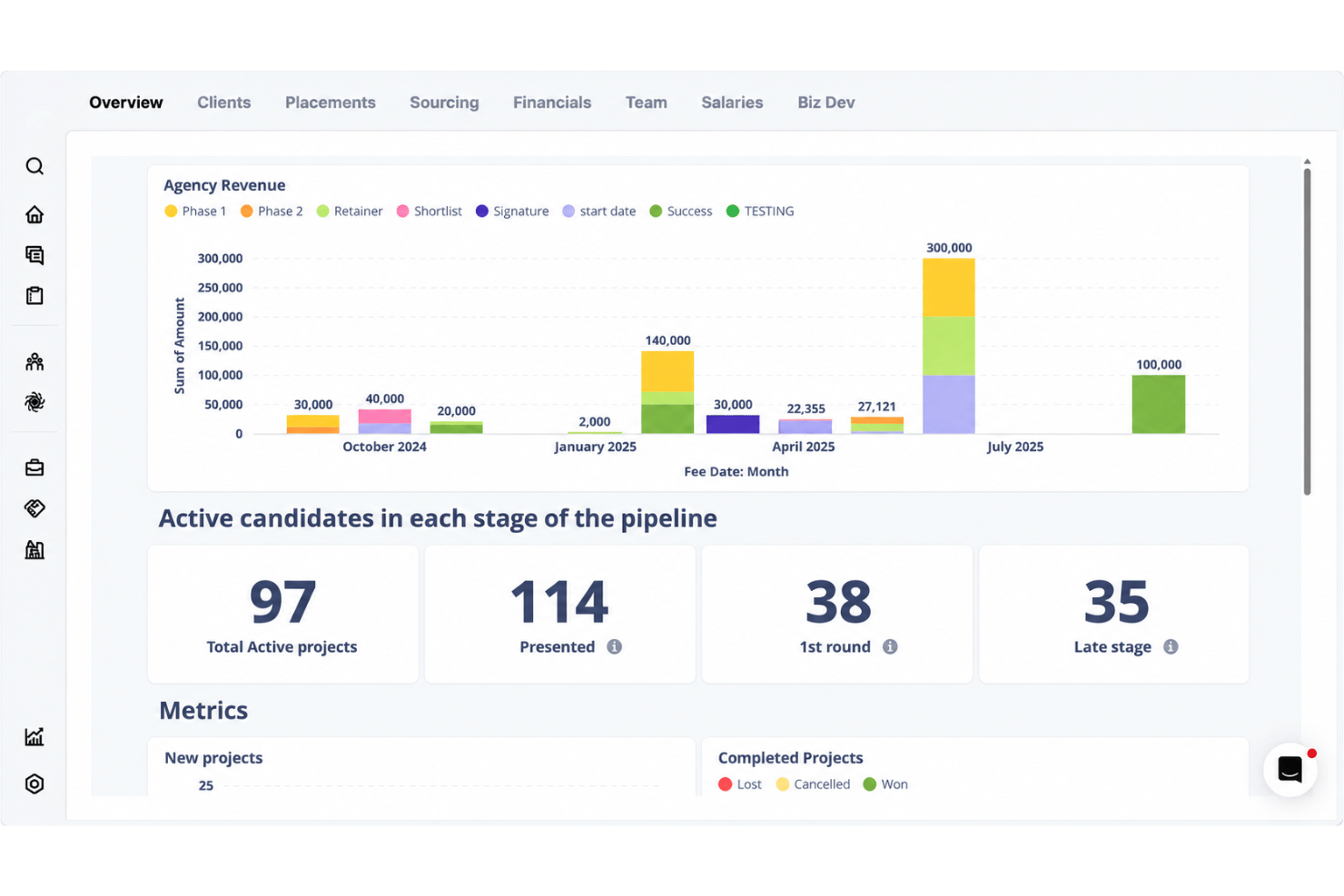
Dashboards pull live activity, pipeline, and performance into a single view across desks and offices. Leaders can watch revenue, placements, and time-to-fill without stitching reports together by hand.
Global Sourcing Tools
People Search runs across your own database and returns matches with the evidence behind them, drawn from real conversations rather than CV keywords alone. Multi-touch outreach then works across email, phone, and social channels to reach candidates wherever they actually reply.
Bulk Candidate Management
Tag, update, and contact large groups of candidates at once, with AI agents applying changes as records move. Outreach sequences and follow-ups can be triggered for a whole talent pool rather than one profile at a time.
Magic Search
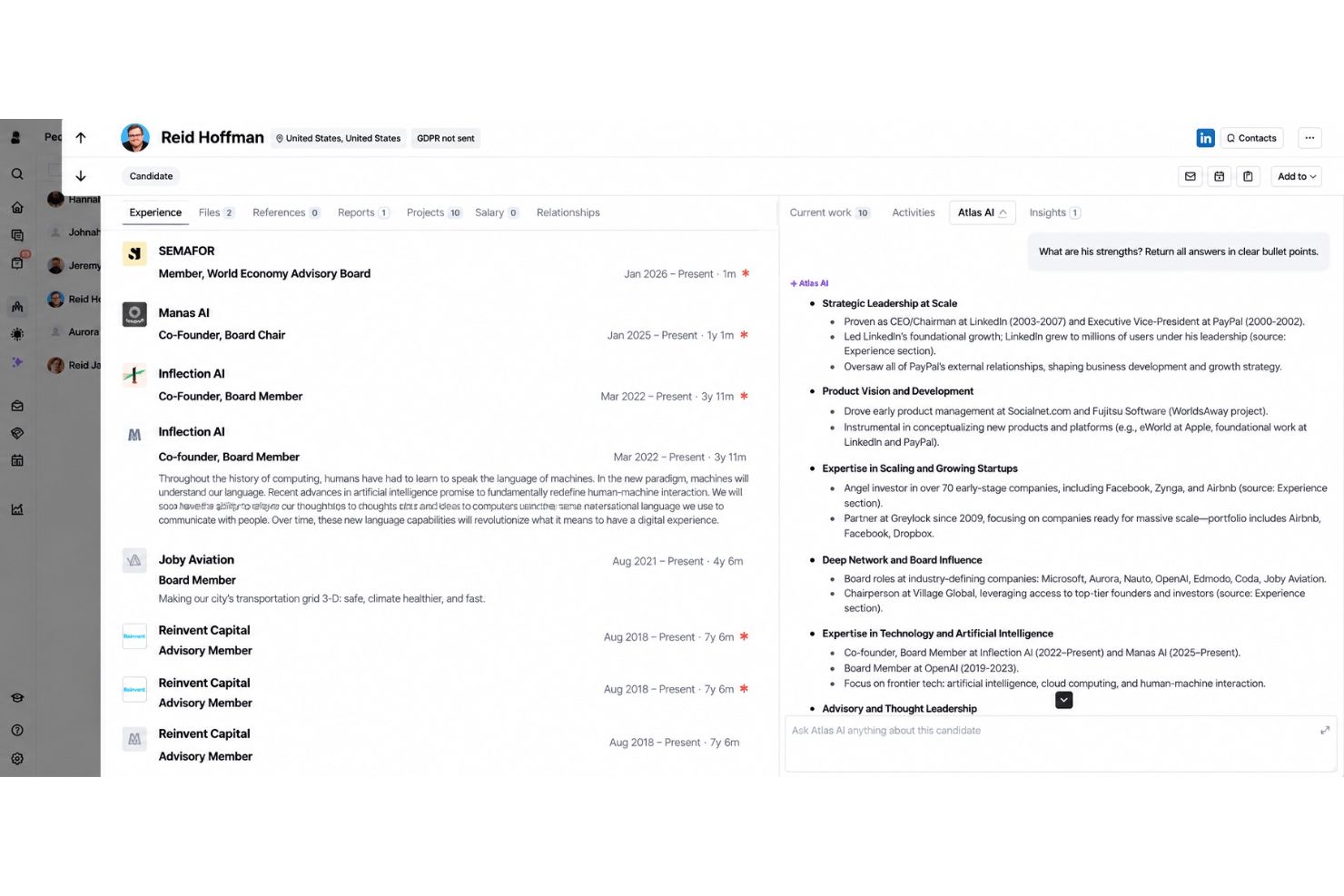
Describe your ideal candidate in plain language or by voice, and Atlas searches your existing database plus context from resumes, notes, calls, messages, and research. It returns a ranked shortlist with match scores and evidence explaining why each person fits, so recruiters can refine searches without relying on Boolean strings or manual filtering.
Automated Candidate Communications
Outreach, interview scheduling, and follow-up messages run from templates and connected calendars. The built-in note taker writes up calls and interviews on its own, so the record of every conversation stays attached to the candidate.
Standout Features
Total Memory
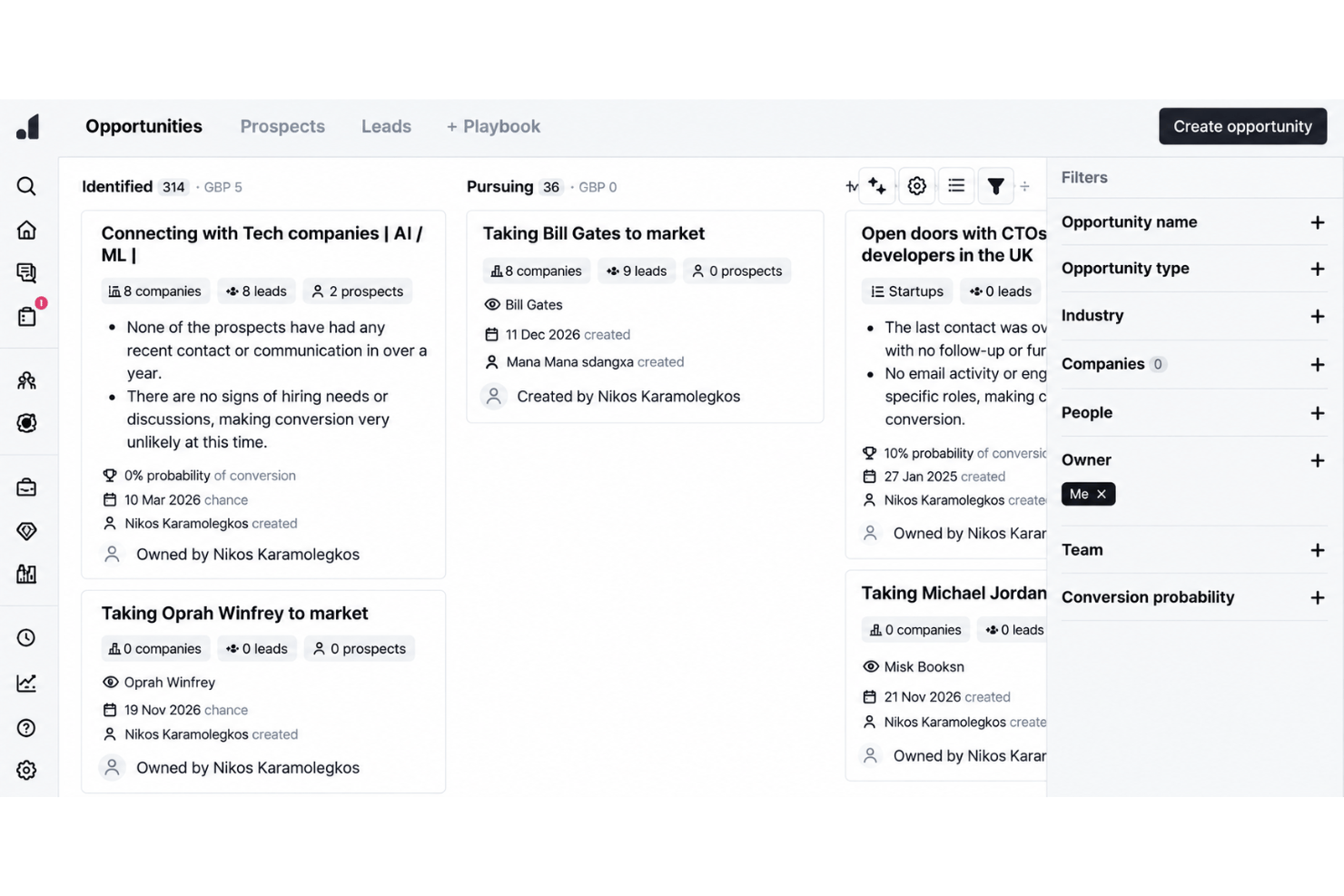
Because Atlas keeps the full context of every conversation, you can group and compare candidates by what they have actually told you: who is open to moving, who wants shorter weeks, who is quietly unhappy where they are. This helps teams spot the right person for a role they haven’t opened yet, not just the one in front of them.
Compliance-Ready Audit Trails
Every call, email, and message is captured as it happens, which leaves a dated record of how a placement progressed without anyone writing it up afterwards. Atlas is certified to ISO 27001 and operates within GDPR, with SOC 2 accreditation in progress and expected in early 2027.
Ease of Use
Atlas strikes a practical balance between depth and ease-of-use for agency teams. The interface is organized around how a desk works, and because the record builds itself from calls and messages, there is less to configure and far less to keep updated. Public feedback from agency founders keeps landing on the same point: it behaves the way recruiters already think, rather than asking them to adapt. The platform doesn’t overwhelm with feature sprawl, but gives enough control and visibility for busy firms running several desks at once.
Onboarding
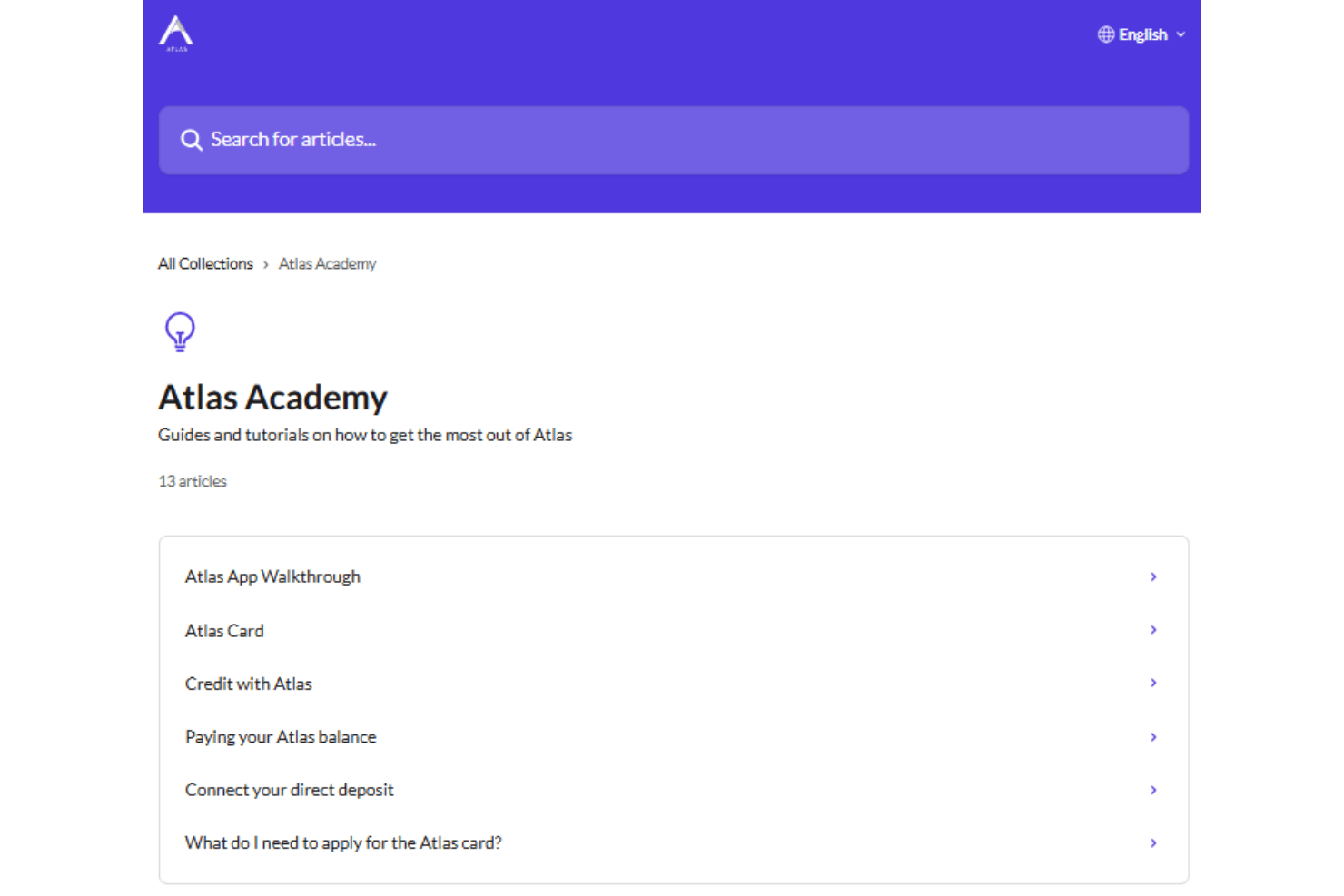
Onboarding is led by the Atlas team rather than left to you. Every new customer is paired with a dedicated onboarding group from the first day, with daily sessions that work through the platform until the whole desk is confident using it. Support sits alongside that process, so anything that comes up gets handled straight away instead of waiting until training wraps. Atlas also takes on the migration of data from your previous system, and will help cover the tail end of an existing vendor contract on longer commitments.
Customer Support
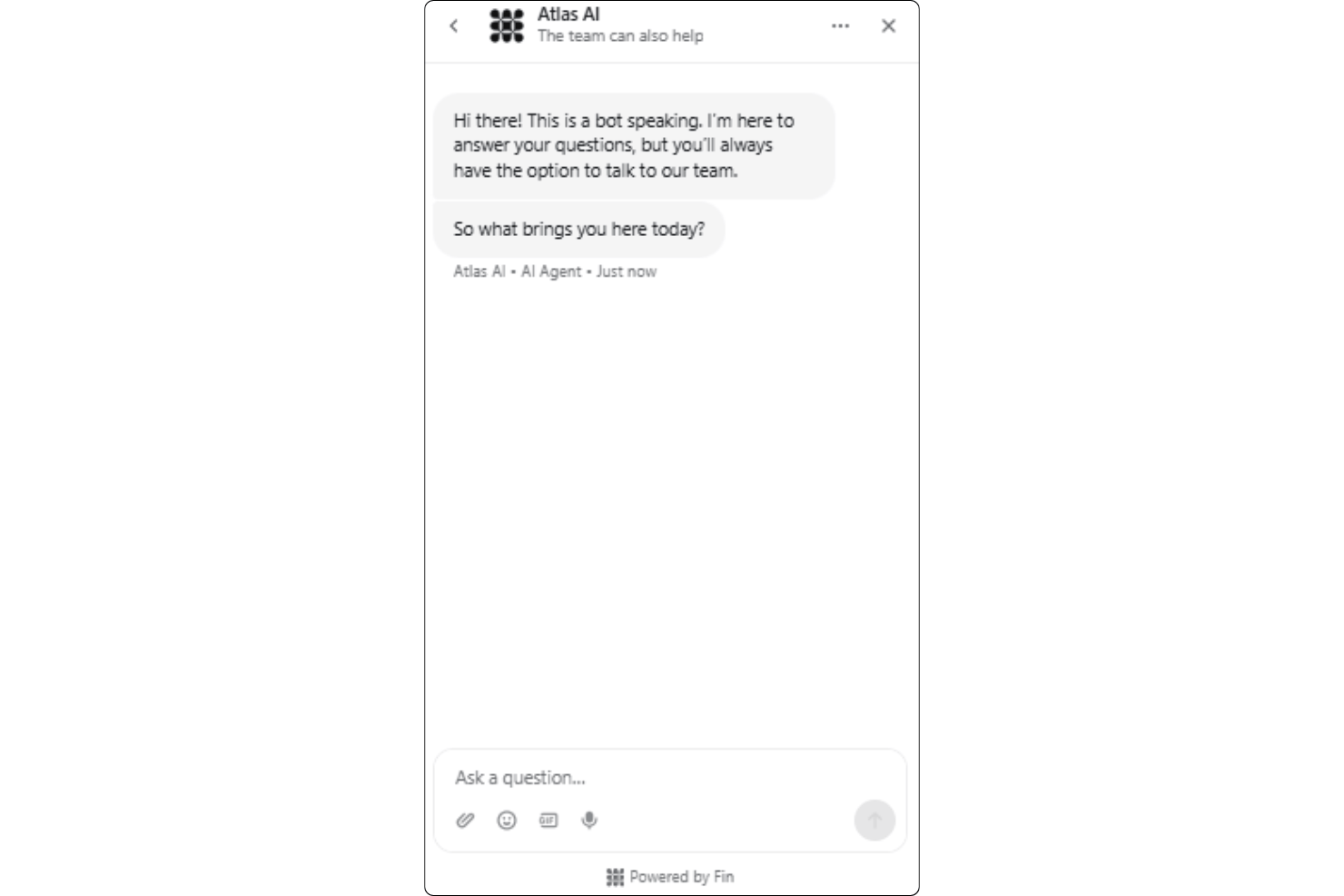
Atlas offers helpful customer support that runs through the app itself and typically answers within minutes. The people replying come from recruitment backgrounds, so you don’t spend the first message explaining how an agency works, and the founding team is known to step into customer issues directly. Compared with other agency platforms, what stands out is how closely support works with onboarding through the ramp-up period, which is when most teams need it.
Integrations
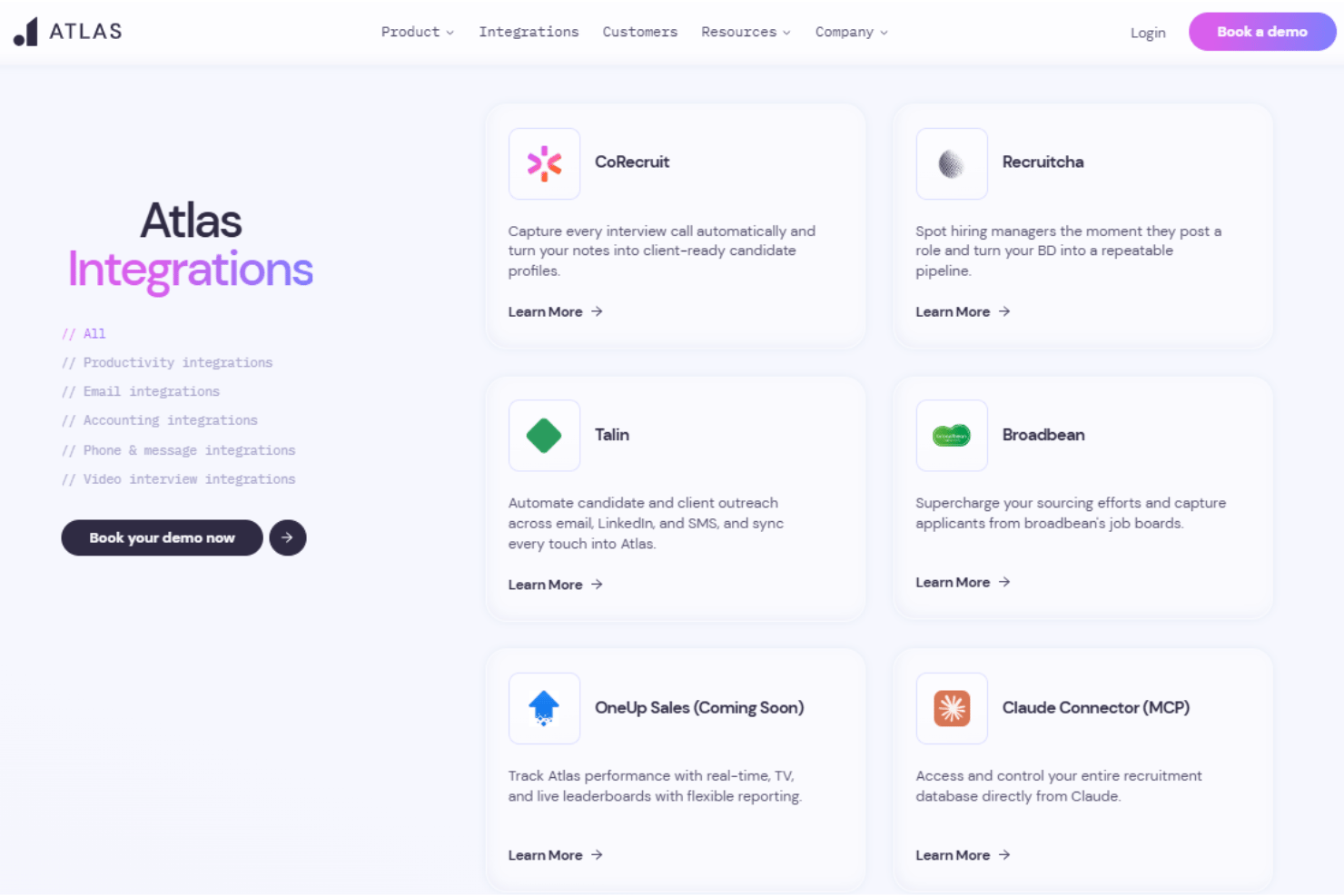
Atlas integrates with CoRecruit Broadbean, Talin, Claude MCP, Xero, RingCentral, Zoom, Microsoft Teams, and Microsoft Outlook among others.
Atlas also has an open API and connects with third-party integration tools.
Value for Money
Atlas uses quote-based pricing and does not publish standard rates, so you’ll need to contact the company for a package tailored to your hiring needs. While costs are not transparent upfront, teams with complex recruitment requirements may find value in its guided onboarding, advanced workflows, compliance-ready audit trails, and in-depth integration options.
Atlas Specs
- 360 Degree Feedback
- API
- Application Tracking
- Batch Permissions & Access
- Behavioral Testing
- Budgeting
- Calendar Management
- Candidate Database
- Cognitive Testing
- Compliance Tracking
- Dashboard
- Data Export
- Data Import
- Data Visualization
- Email Integration
- Employee Database
- Employee Engagement
- Employee Incentive Management
- Employee Onboarding
- External Integrations
- Feedback Management
- Forecasting
- Interview Scheduling
- Multi-User
- Notifications
- Onboarding
- Personality Testing
- Psychometric Testing
- Referral Tracking
- Scheduling
- Soft Skill Testing
- Softphone
- Status Notifications
- Travel Management
Atlas FAQs
Can Atlas handle complex hiring processes across multiple departments?
What integrations does Atlas offer out of the box?
How does Atlas support data security and compliance?
What’s the onboarding experience like with Atlas?
How responsive is Atlas customer support?
Is Atlas suitable for small businesses or solo recruiters?
How does Atlas help HR teams working across multiple locations?
What kind of organizations get the most value from Atlas?
Atlas Company Overview & History
Atlas is an AI-native recruitment software built for agencies and search firms that want the admin side of the job handled for them. It trades as Atlas Recruitment Technology Ltd, a UK-based company led by founder and CEO Jordan Sholsberg, and positions itself as the only recruitment CRM designed after generative AI arrived rather than updated later to accommodate it. Details such as workforce size, ownership, funding, and revenue are not published on its site. Customer outcomes are shared publicly through named case studies with agencies including Executive Integrity, Attis, and Ocean Red Partners.
Atlas Major Milestones
- 2022: Founded as an AI-native recruitment platform, built after generative AI made automatic context capture possible
- 2026: AI agents and digital workers introduced, alongside a Claude connector built on MCP and a widening integration lineup
Atlas Partner Spotlight

So verwenden Sie Atlas für Vertragsbesetzungen


Wie Atlas die Verwaltungsarbeit von Recruitern beseitigt

Atlas’ gesamter Speicher, erklärt