


Spott ATS vs. Recruiterflow: Vergleich und Bewertungen für 2026



Manual work can slow recruiting teams down long before the candidate pipeline looks full. Between sourcing, outreach, client updates, and follow-ups, agencies need a system that keeps recruiting activity organized without adding more admin.
Spott ATS and Recruiterflow are applicant tracking systems built for executive search, recruiting, and staffing agencies, but they differ in how they handle AI, automation, CRM, and day-to-day recruiter workflows. Spott is built around AI-native agency workflows, while Recruiterflow offers a recruiting platform for managing candidates, clients, outreach, and placements.
In this comparison, I’ll evaluate Spott ATS and Recruiterflow across features, pricing, ease of use, onboarding, customer support, security, integrations, and ideal use cases to help you determine which ATS is the better fit for your team's hiring needs.
Spott ATS vs. Recruiterflow: An Overview
Spott ATS


Recruiterflow



Warum Sie unseren Software-Bewertungen vertrauen können
Unser Team testet und bewertet Software seit 2012. Als HR-Experten wissen wir selbst, wie schwierig – und wichtig – es ist, die richtige Software auszuwählen.
Für diesen Leitfaden haben wir Tools mithilfe von praktischen Tests und unabhängiger Recherche bewertet und dabei unsere Bewertungskriterien angewendet. Zudem greifen wir auf Erkenntnisse von Branchenvordenkern und praktizierenden HR-Experten zurück.
Unsere Bewertungen spiegeln unser menschliches redaktionelles Urteilsvermögen wider, keine Verkaufsstrategie.
Expertenprüfer:
Spott ATS vs. Recruiterflow Pricing Comparison
| Spott ATS | Recruiterflow | |
|---|---|---|
| Free Trial | Free trial available | Free demo available |
| Pricing | From $139/user/month (billed annually) | From $119/user/month (billed annually) |
Spott vs. Recruiterflow Preise & Versteckte Kosten
Spott verwendet ein transparentes, stufenbasiertes Preismodell mit Core-, Pro- und Enterprise-Plänen, das es Agenturen erleichtert, die Kosten im Voraus abzuschätzen. Die Unterschiede zwischen den Paketen liegen hauptsächlich beim Zugang zu Automatisierung, Datenanreicherung, Prioritätssupport, Berechtigungen und Vertragsbedingungen für Unternehmen. Potenzielle versteckte Kosten können entstehen, wenn zusätzliche Nutzer hinzugefügt werden oder ein Upgrade nötig ist, wenn Ihr Team fortschrittlichere Workflow-Unterstützung benötigt. Recruiterflow hingegen bietet einen veröffentlichten Platform-Plan sowie einen individuell bepreisten AIRA-Plan, wobei die höheren Tarifkosten an KI-Agenten, Kommunikations-Synchronisierung, individuelle BI-Dashboards und erweiterte Automatisierung gekoppelt sind.
Die Wahl zwischen den beiden hängt im Wesentlichen von der Kostenplanbarkeit und den aktuell bzw. zukünftig benötigten Funktionen Ihrer Agentur ab. Spott ist eventuell leichter zu budgetieren, wenn Sie Wert auf ein klares, paketbasiertes Preismodell legen. Recruiterflow ist interessant, wenn Sie einen niedrigeren Einstiegspreis bevorzugen, aber bereit sind, genau zu prüfen, welche KI-, Reporting- und Automatisierungsfunktionen in den individuell bepreisten Plan fallen.
Spott ATS vs. Recruiterflow Feature Comparison
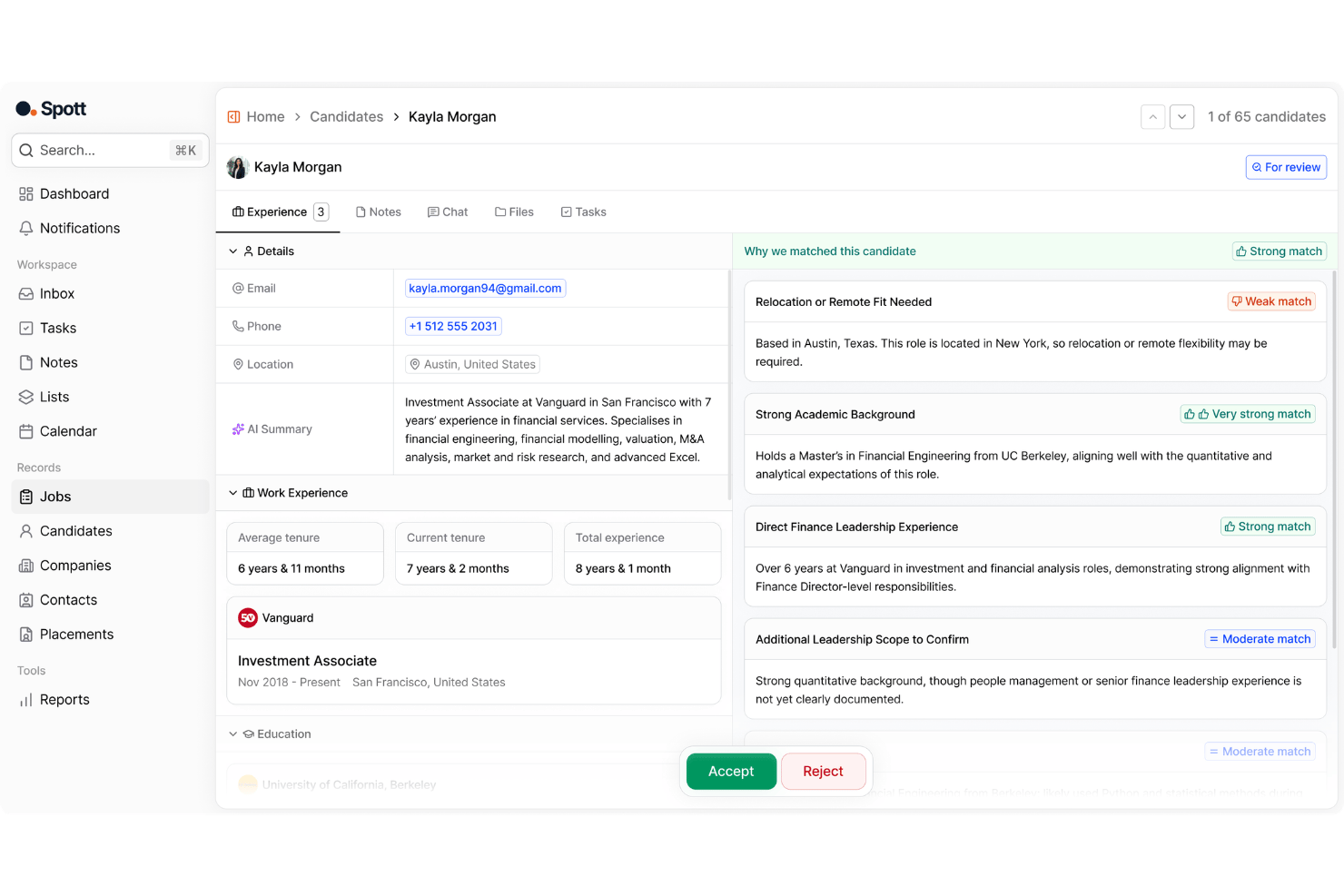
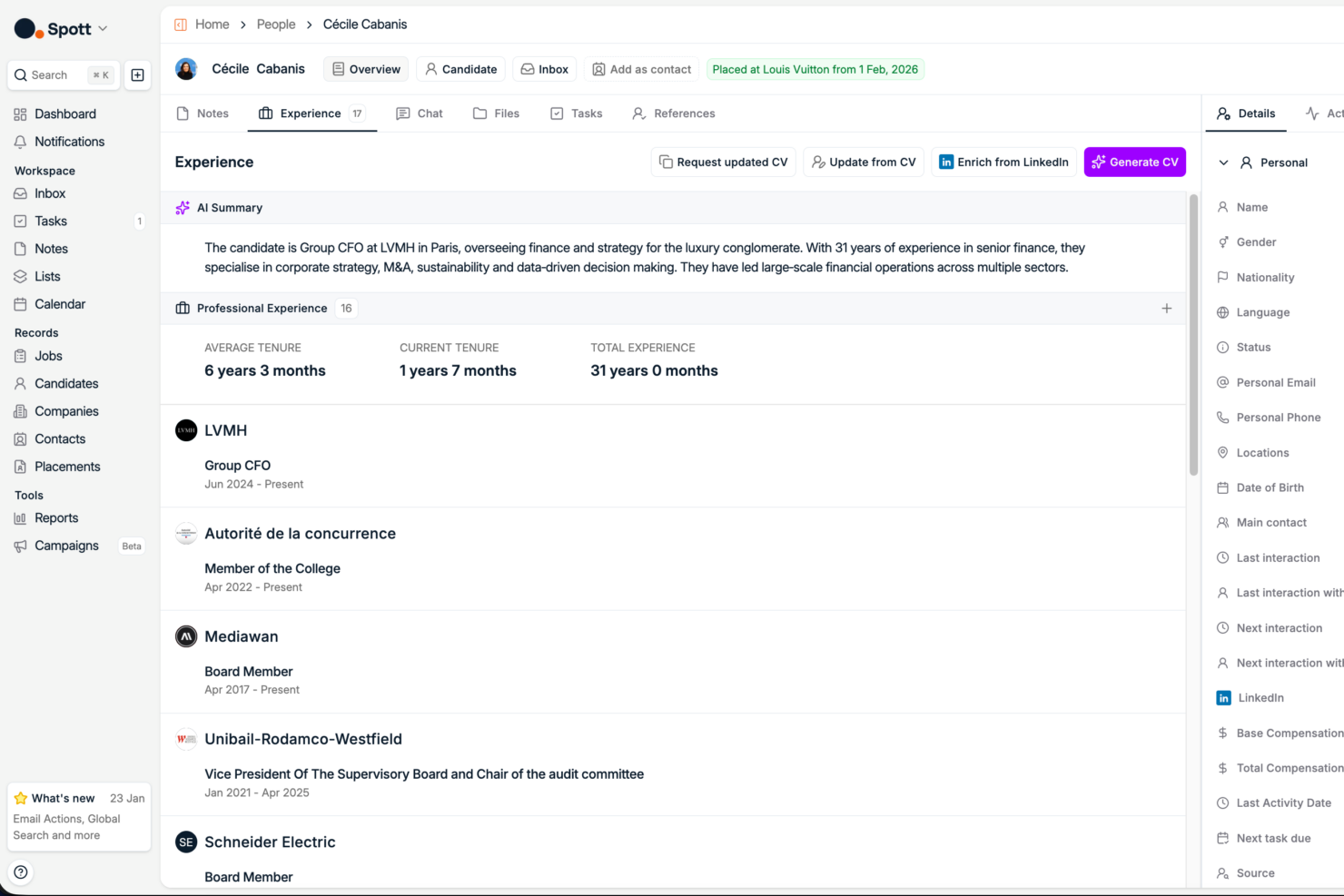
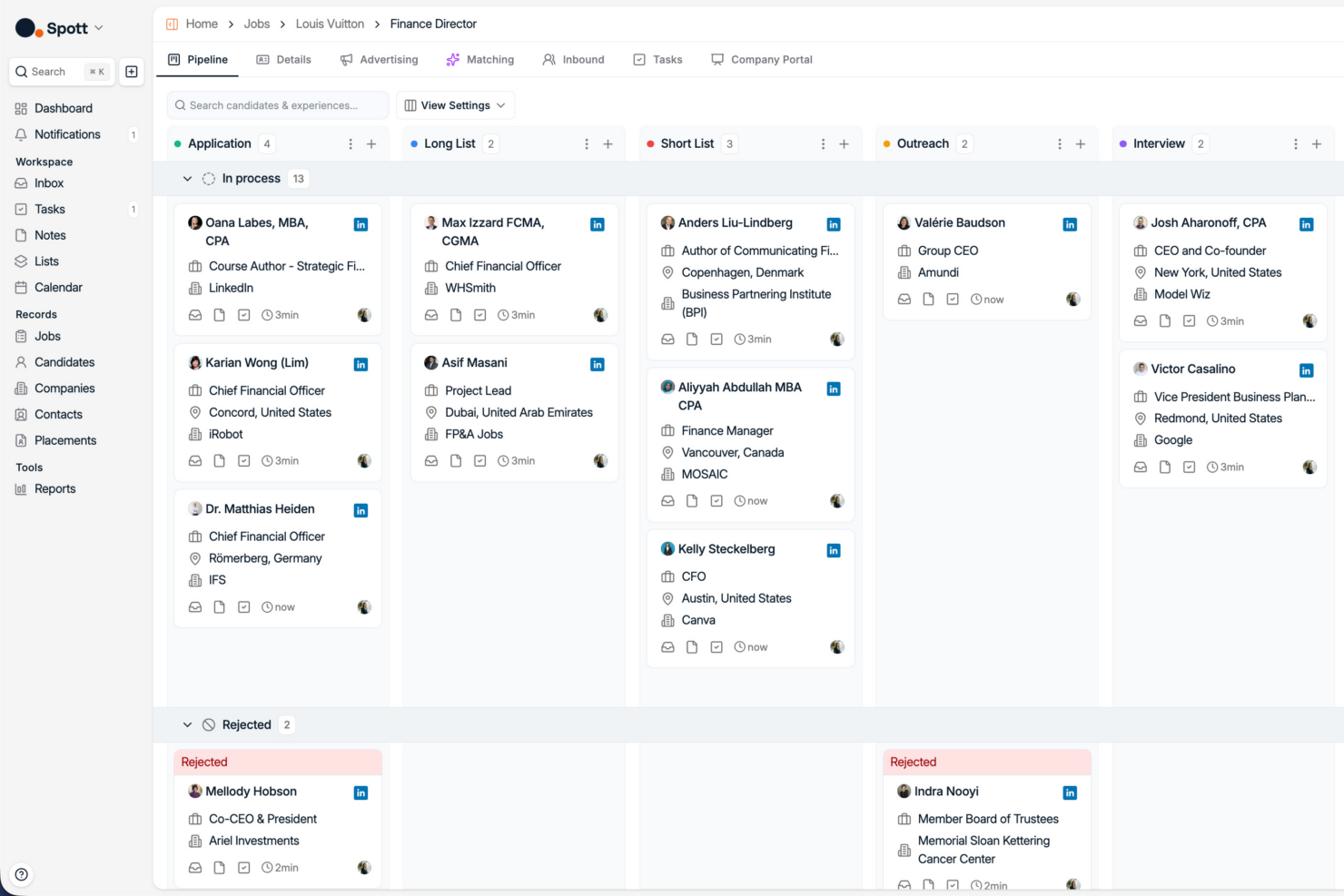
Spott und Recruiterflow unterstützen beide grundlegende Workflows zur Bewerberverwaltung, darunter Kandidatenmanagement, Pipeline-Tracking, Kandidatenansprache, Reporting und Recruiting-CRM-Funktionen. Spott ist jedoch stärker auf KI-native Workflows für Agenturen ausgerichtet, mit semantischer Zuordnung, Conversation Memory, Unibox, Decision Intelligence und einer KI-gestützten Recruiting-Datenbank, die Aktivitäten von Kandidaten und Kunden während des gesamten Rekrutierungsprozesses verknüpft. Die Suchfunktion von Spott geht über Standardfelder hinaus und analysiert Lebensläufe, Notizen, Gespräche und vorherige Interaktionen, bewertet anschließend Kandidaten rollenspezifisch und erklärt nachvollziehbar, weshalb sie geeignet sind.
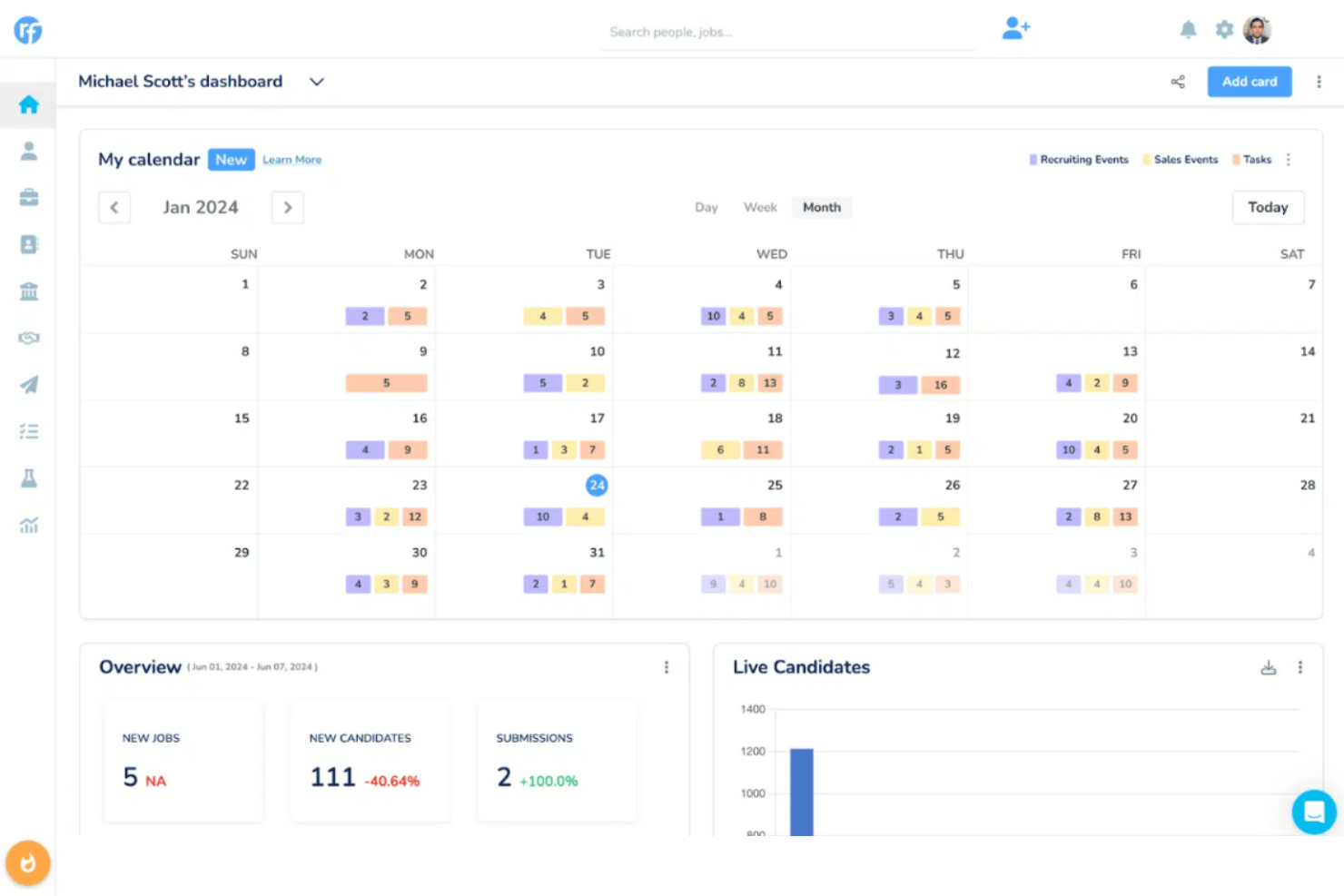
Recruiterflow hingegen konzentriert sich auf praktische Recruiting-Prozesse mit visueller Pipeline-Verwaltung, automatisierten E-Mail-Sequenzen, kollaborativen Recruiting-Tools, Lebenslauf-Parsing, Jobanzeigen-Management und Aufgaben-Tracking. Die Sucherfahrung ist dabei stärker von Schlagworten und Filtern abhängig, was bei komplexen oder kontextreichen Kandidatensuchen weniger effektiv sein kann. Für Agenturen bedeutet das: Spott ist ideal für Teams, die eine verknüpfte Kommunikationshistorie und aussagekräftiges, KI-basiertes Matching wünschen, während Recruiterflow besser geeignet ist, wenn strukturierte Pipelines, E-Mail-Automation und das Management täglicher Recruiting-Aufgaben im Vordergrund stehen.
| Spott ATS | Recruiterflow | |
|---|---|---|
| API | ||
| Application Tracking | ||
| Behavioral Testing | ||
| Budgeting | ||
| Calendar Management | ||
| Candidate Database | ||
| Cognitive Testing | ||
| Contact Management | ||
| Custom Assessments | ||
| Dashboard | ||
| Dashboards | ||
| Data Export | ||
| Data Import | ||
| Data Visualization | ||
| Email Integration | ||
| Employee Database | ||
| Employee Onboarding | ||
| External Integrations | ||
| Feedback Management | ||
| Forecasting | ||
| Interview Scheduling | ||
| Multi-Source Feedback | ||
| Multi-User | ||
| Notifications | ||
| Personality Testing | ||
| Psychometric Testing | ||
| Scheduling | ||
| Status Notifications | ||
| Travel Management |
Spott vs. Recruiterflow Integrationen
| Integration | Spott | Recruiterflow |
|---|---|---|
| ✅ | ❌ | |
| Microsoft | ✅ | ✅ |
| Ringover | ✅ | ✅ |
| Indeed | ❌ | ✅ |
| ❌ | ✅ | |
| Zoom | ✅ | ✅ |
| RingCentral | ✅ | ✅ |
| Juicebox | ✅ | ✅ |
| Devyce | ✅ | ❌ |
| ✅ | ✅ | |
| ChatGPT | ✅ | ❌ |
| Zapier | ❌ | ✅ |
| API | ✅ | ✅ |
Sowohl Spott als auch Recruiterflow decken grundlegende Integrationen für Sourcing, Kommunikation, Produktivität und Workflow-Tools ab. Recruiterflow bietet aktuell eine größere Auswahl und ist deshalb stärker für Teams, die auf viele Sourcing-Kanäle, Automatisierungs-Tools und die Anbindung von Drittanbieter-Apps angewiesen sind. Spott konzentriert sich auf engere Direktanbindungen, die das KI-native ATS- und CRM-Erlebnis unterstützen, wobei weitere Integrationen sich noch in der Entwicklung befinden. Insgesamt führt Recruiterflow aktuell in der Breite der Integrationen, während Spott für Agenturen optimal ist, die Wert auf eine enge Verzahnung der wichtigsten Tools in einer vernetzten Recruiting-Plattform legen.
Spott vs. Recruiterflow Sicherheit, Compliance & Zuverlässigkeit
| Faktor | Spott | Recruiterflow |
|---|---|---|
| Compliance | GDPR-konform, ISO 27001 zertifiziert und KI-Sicherheitskonform, mit einem öffentlichen Trust Center, das Ressourcen zu Sicherheit, Datenschutz und Compliance bereitstellt. | Unterstützt GDPR-bezogene Anforderungen durch Kandidateneinwilligung, Aufbewahrungseinstellungen und eine Vereinbarung zur Datenverarbeitung. |
| Datenschutz | Verwendet in der EU gehostete Infrastruktur, Verschlüsselung bei Speicherung und Übertragung sowie Richtlinien zum Schutz von Kandidaten- und Kundendaten. | Nutzt vertragliche Sicherheitsmaßnahmen für die Verarbeitung personenbezogener Daten, darunter Zugriffssteuerungen, Übertragungskontrollen, Protokollierungen und Maßnahmen zur Sicherstellung der Verfügbarkeit. |
| Zugriffskontrolle | Unterstützt kontrollierten Zugriff über Berechtigungen, Authentifizierung und Funktionen zum Zugriffsmanagement. | Bietet von Admins verwalteten Benutzerzugriff und Kontrollen zur Datenverarbeitung, wobei die Sicherheitsmaßnahmen in der Vereinbarung zur Datenverarbeitung festgelegt sind. |
| Überwachung & Vorfallreaktion | Sorgt für kontinuierliche Überwachung und Prozesse zur Reaktion auf Vorfälle, um Sicherheitsrisiken zu erkennen und zu adressieren. | Stellt Support- und Eskalationsprozesse für Serviceprobleme bereit, einschließlich Reaktionszeiten bei kritischen und schwerwiegenden Vorfällen. |
| Zuverlässigkeit & Kontinuität | Nutzt EU-gehostete Infrastruktur und Trust Center-Dokumentation zu Sicherheitskontrollen, Datenaufbewahrung, Transparenz von Dienstleistern und Governance. | Bietet Servicegutschriften, wenn die monatliche Verfügbarkeit unter die definierten SLA-Schwellen fällt, mit geplanter Ausfallzeit und Serviceausschlüssen, die in der SLA beschrieben sind. |
Insgesamt legt Spott Wert auf Transparenz in Sachen Sicherheit, EU-gehostete Infrastruktur, dokumentierte Governance sowie KI-basierte Datenschutzkontrollen, einschließlich einer klaren Richtlinie, dass Kundendaten nicht zur Schulung von Grundmodellen verwendet werden. Recruiterflow konzentriert sich hingegen auf die Unterstützung der DSGVO, Schutzmaßnahmen bei der Datenverarbeitung, Zugriffskontrolle und service-gestützte Zusagen durch SLAs. Beide Produkte decken wichtige Sicherheits- und Compliance-Anforderungen für Recruiting-Teams ab, aber Spott ist stärker im Bereich der öffentlichen Sicherheitstransparenz sowie bei KI-/Datengovernance, während Recruiterflow stärker auf praxisnahe DSGVO-Kontrollen und Service-Level-Support für Agenturen ausgerichtet ist.
Spott vs. Recruiterflow Benutzerfreundlichkeit
| Faktor | Spott | Recruiterflow |
|---|---|---|
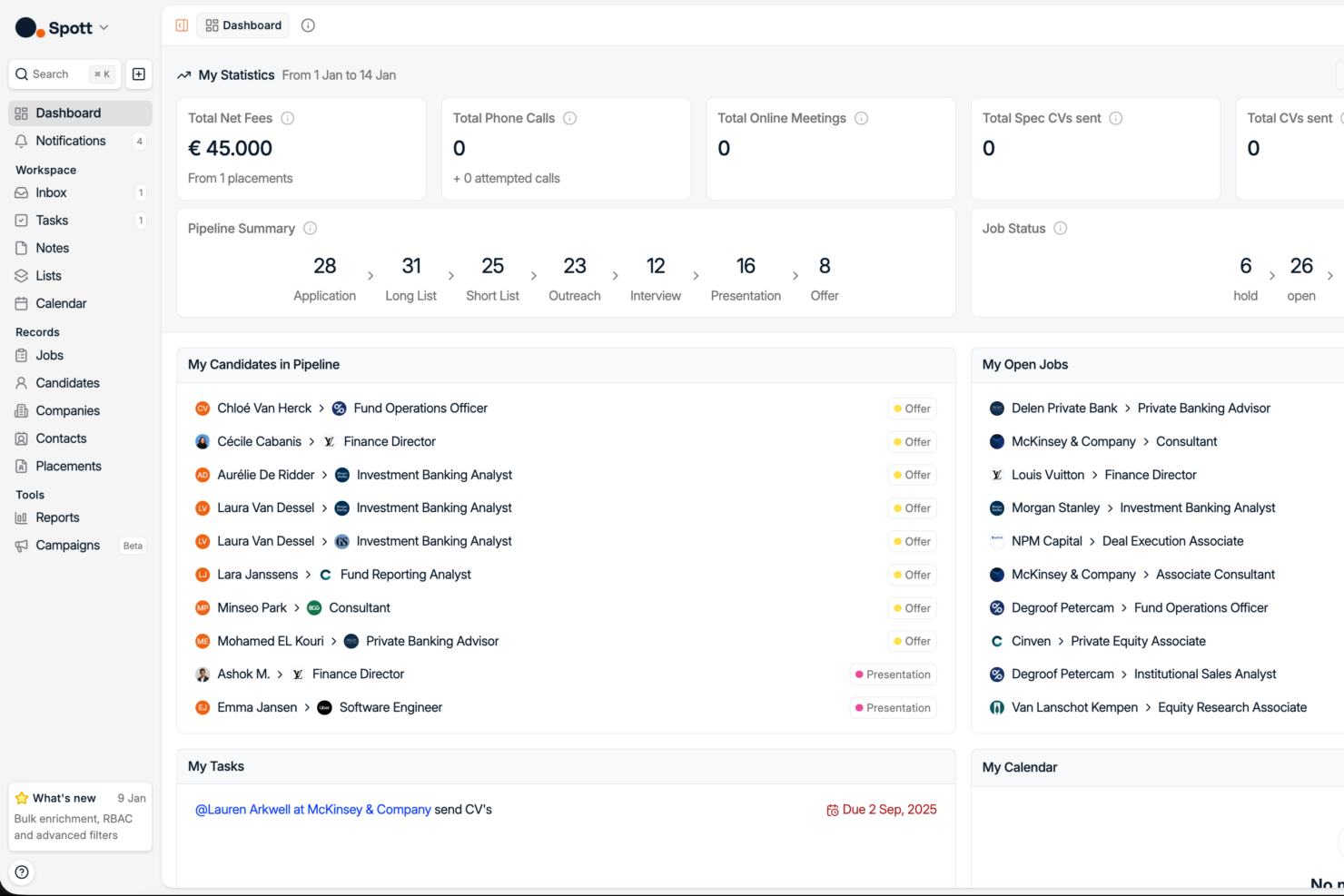
| Benutzeroberfläche | Bietet einen modernen Recruiting-Arbeitsbereich mit klarer Navigation, gut platzierten Buttons und klickarmen Workflows. | Nutzt eine praxisorientierte Recruiting-Oberfläche, die auf Pipeline-Ansichten, Kandidatenprofilen, Outreach und Agenturaktivitäten basiert. |
| Onboarding | Bietet dedizierte Einführung, White-Glove-Migration und Live-Support von echten Personen über den In-App-Chat. | Bietet Unterstützung bei der Einrichtung, Hilfecenter-Ressourcen und Chat-basierte Hilfe für Teams beim Start. |
| Anpassbarkeit | Unterstützt benutzerdefinierte Objekte, eigene Attribute, KI-gestützte Spalten, Drag-and-Drop-Ansichten, Kanban-Ansichten und Workflow-Automatisierungen. | Erlaubt Teams, Pipelines, Felder, Automatisierungen, Vorlagen und Workflows individuell nach ihrem Recruiting-Prozess zu gestalten. |
| Support-Zugang | Enthält 24/7 Live-Chat, Hilfecenter-Ressourcen, KI-gestützte Dokumentationsantworten, Onboarding und Masterclasses. | Bietet Hilfecenter-Ressourcen sowie Support via Chat und E-Mail für Produktfragen und Problemlösungen. |
| Mobiler Zugriff | Verfügt über begrenzte mobile App-Funktionalität, was ein Nachteil für mobile-orientierte Recruiter sein kann. | Bietet mobilen Zugriff über eine Progressive Web App, um Kandidaten und Kontakte auch unterwegs zu verwalten. |
In puncto Benutzerfreundlichkeit ist Spott besonders für Agenturen geeignet, die einen aufgeräumten Recruiting-Arbeitsbereich, eine geführte Migration und klickarme Workflows mit Live-Support wünschen. Recruiterflow ist hingegen praktisch für Teams, die flexible Pipeline-Ansichten, konfigurierbare Recruiting-Prozesse und mobilen Zugriff für das grundlegende Kandidaten- und Kontaktmanagement benötigen. Spott ist besonders nutzerfreundlich für Agenturen, die von Altsystemen umsteigen, während Recruiterflow jene anspricht, die mehr eigenen Einfluss auf die täglichen Recruiting-Abläufe wünschen.
Spott ATS vs Recruiterflow: Pros & Cons
Spott ATS
- AI-powered candidate matching based on context, not just keywords
- Unified platform for recruiting, CRM, outreach, and automation
- Flexible workflows with extensive customization options
- Contracting features are still being rolled out
- Mobile app offers limited functionality
- External candidate sourcing relies on third-party integrations
Recruiterflow
- Automated email outreach and follow-up streamline candidate communication
- Collaboration tools simplify team notes and hiring feedback
- Visual pipeline management provides clear overview of open roles
- Reporting features offer limited customization and export options
- Mobile app is missing core functionalities many recruiters expect
- No in-platform video interviewing or assessment integrations
Best Use Cases for Spott ATS and Recruiterflow
Spott ATS
- Recruitment Agencies Spott helps recruitment agencies manage candidates, clients, pipelines, outreach, and placements from one system built for agency operations.
- Staffing Firms Staffing firms can use Spott to support candidate management, client communication, business development, and placement workflows across multiple open roles.
- Executive Search Firms Spott’s AI matching, conversation memory, and candidate presentation tools can help executive search teams manage high-touch relationships with candidates and clients.
- Permanent Placement Firms Permanent placement firms can use Spott to track candidate pipelines, manage client submissions, and keep recruitment activity connected to revenue outcomes.
- RPO and Consulting Teams RPO providers and recruitment consultants can use Spott to manage client-facing workflows, outreach campaigns, reporting, and candidate communication.
- Temp Staffing Teams Temp staffing teams can benefit from Spott’s recruiting workflows, communication tracking, and reporting tools when managing ongoing candidate and client activity.
Recruiterflow
- Staffing Agencies Staffing agencies will love the drag-and-drop pipelines and bulk email sequences for keeping high-volume searches organized.
- In-House Talent Teams In-house talent teams get an easy way to manage multiple roles, assign tasks, and keep leadership in the loop through real-time updates.
- Executive Search Firms Executive search firms can automate outreach, track progress visually, and build a customized database of hard-to-find candidates.
- Tech Startups Tech startups benefit from the fast onboarding and unlimited jobs, which helps keep up with rapid growth and shifting hiring priorities.
- Remote-First Companies Remote-first companies use the collaborative tools and centralized communication history to keep distributed teams aligned.
- High Growth SMEs High growth SMEs can use automated candidate sourcing and robust pipeline tracking to reduce manual work as they scale recruitment.
Für wen ist Spott geeignet und für wen Recruiterflow?
Wenn Sie eine Personalagentur oder ein Personaldienstleister sind und ein KI-basiertes ATS und CRM für das Management von Kandidaten, Kunden, Outreach, Vermittlungen und Geschäftsentwicklung benötigen, ist Spott wahrscheinlich die bessere Wahl. Es eignet sich besonders gut für Personalagenturen, Zeitarbeitsfirmen, Executive-Search-Teams, Vermittlungsunternehmen, RPO- und Beratungs-Teams sowie Zeitarbeitsunternehmen, die semantisches Matching, Conversation Memory, Unibox, Decision Intelligence und agenturorientierte Workflows wünschen.
Im Gegensatz dazu eignet sich Recruiterflow besser für Personalagenturen, Zeitarbeitsfirmen, HR-Teams und schnell wachsende Unternehmen, die strukturierte Pipelines, Massen-E-Mail-Automatisierung, Kollaborationstools und Unterstützung bei der Kandidatensuche benötigen. Es ist eine starke Lösung für Personaldienstleister, interne Talentteams, Headhunter, Tech-Startups, Remote-First-Unternehmen und wachstumsstarke KMU, die Kommunikation zentralisieren, das Bewerberaufkommen steuern und in aktiven Rekrutierungsprozessen schnell agieren möchten.
Differences Between Spott ATS and Recruiterflow
| Spott ATS | Recruiterflow | |
|---|---|---|
| AI Workflow Approach | Built around AI-native recruiting workflows, including semantic matching, Conversation Memory, Decision Intelligence, and connected candidate-client context. | Offers AI features through its AIRA plan, including notetaking, matchmaker, job change alerts, field updates, and task agents. |
| Implementation Support | Provides dedicated onboarding, white-glove migration, and live human support for agencies moving from legacy systems. | Offers setup support and product guidance, but is more focused on quick adoption and configurable workflows. |
| Integration Breadth | Covers key productivity, communication, and AI-related integrations, with more integrations still in development. | Currently offers the wider integration selection, especially for sourcing, job boards, automation, and third-party workflow connections. |
| Mobile Experience | Has limited mobile app functionality, which may be a drawback for mobile-first recruiters. | Offers mobile access through a Progressive Web App for managing candidates and contacts on the go. |
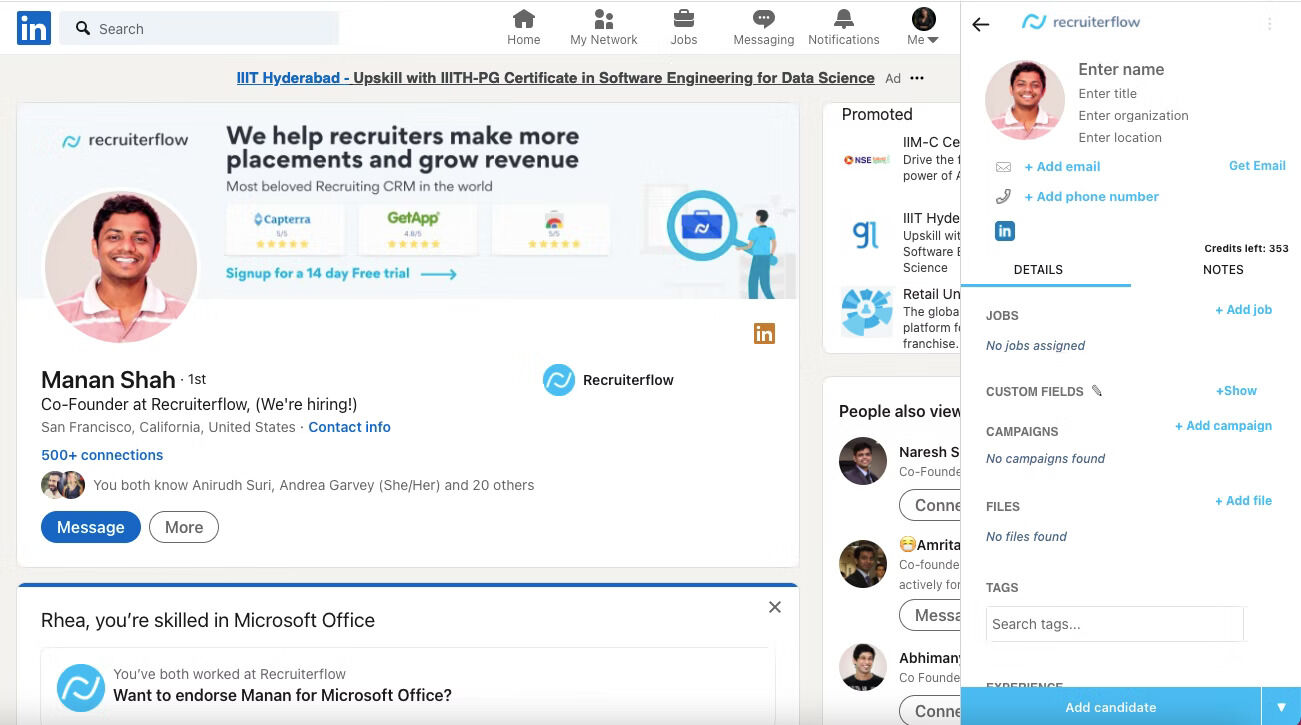
| Sourcing Coverage | Supports sourcing workflows, but some external database sourcing capabilities are still handled through integrations or roadmap development. | Stronger for built-in sourcing workflows, including Chrome sourcing, LinkedIn imports, job posting, and candidate database growth. |
| Visit Spott ATSOpens new window | Read Recruiterflow ReviewOpens new window |
Similarities Between Spott ATS and Recruiterflow
| Applicant Tracking | Both platforms help recruiting teams manage jobs, candidates, applications, and placement workflows from early-stage screening through later hiring stages. |
|---|---|
| Outreach Workflows | Both support outreach and follow-up workflows, helping teams engage candidates and clients without relying only on manual communication tracking. |
| Pipeline Management | Both provide pipeline views that help recruiters monitor candidate progress, update stages, and keep active roles organized across the hiring process. |
| Recruiting CRM | Both include CRM capabilities for managing candidate and client relationships, making them useful for agencies that need to track communication, context, and follow-ups. |
| Reporting | Both offer reporting features that help recruiting teams review activity, monitor pipeline health, and understand performance across jobs, candidates, and team workflows. |
| Visit Spott ATSOpens new window Read Recruiterflow ReviewOpens new window | |