


Reseña de monday.com: Pros, Contras, Características y Precios



monday AI Workspace is a workforce management software that combines AI-assisted planning, task automation, and cross-team workflow building in one flexible platform. It's worth a close look if your team manages multiple projects at once and wants AI tools embedded directly into daily work—not bolted on separately. I'd choose it over Asana if AI-native features matter to you, since monday AI Workspace weaves AI into planning, updates, and automation in ways that Asana's more traditional project tracking approach doesn't match.
monday AI Workspace Evaluation Summary
- From $9/user/month (billed annually)
- Free plan + 14-day free trial available
Por qué confiar en nuestras reseñas de software
Nuestro equipo lleva probando y evaluando software desde 2012. Como expertos en RR. HH., sabemos lo difícil —y lo importante— que es elegir el software adecuado.
Para esta guía, evaluamos las herramientas mediante pruebas prácticas e investigación independiente, puntuando las herramientas según nuestros criterios de selección. También nos basamos en la experiencia de líderes de opinión del sector y de profesionales de RR. HH. en activo.
Nuestras reseñas reflejan nuestro criterio editorial humano, no un discurso de ventas.
Revisores expertos:
monday AI Workspace Overview
In my opinion, monday.com gives you a strong mix of flexibility, speed, and clarity for workforce management, especially if you’re handling shifting workloads across multiple teams. When I compare it to other tools, it stands out with its visual boards and automations that actually reduce daily admin instead of adding more steps. It does fall short if you need extremely advanced scheduling or deep HR-specific modules, but for most teams it’s easy to judge it as a reliable, scalable choice. If you want something that adapts to how your team works—and not the other way around—it’s a solid pick.
pros
-
You can automate routine steps so your daily work runs with fewer manual updates.
-
You get clear visibility into workloads, timelines, and task owners across your team.
-
You can set up workflows fast with simple boards, columns, and drag-and-drop tools.
cons
-
You may run into limits when handling advanced workforce needs like detailed labor rules.
-
You’ll need time to build and maintain boards if your team manages complex processes.
-
You may find the flexible setup overwhelming if you want strict, structured workflows.
Is monday AI Workspace Right For Your Needs?
Who Would be a Good Fit for monday AI Workspace?
monday.com works well for teams that need a flexible workforce management software to organize people, schedules, and daily operations in one place. It’s especially helpful if you run cross-team work, handle shifting priorities, or manage a mix of employees and contractors because its boards and automations adapt quickly. You’ll get the most value if you want clear visibility into workloads and need a simple way to standardize processes across your team.
-
HR Teams
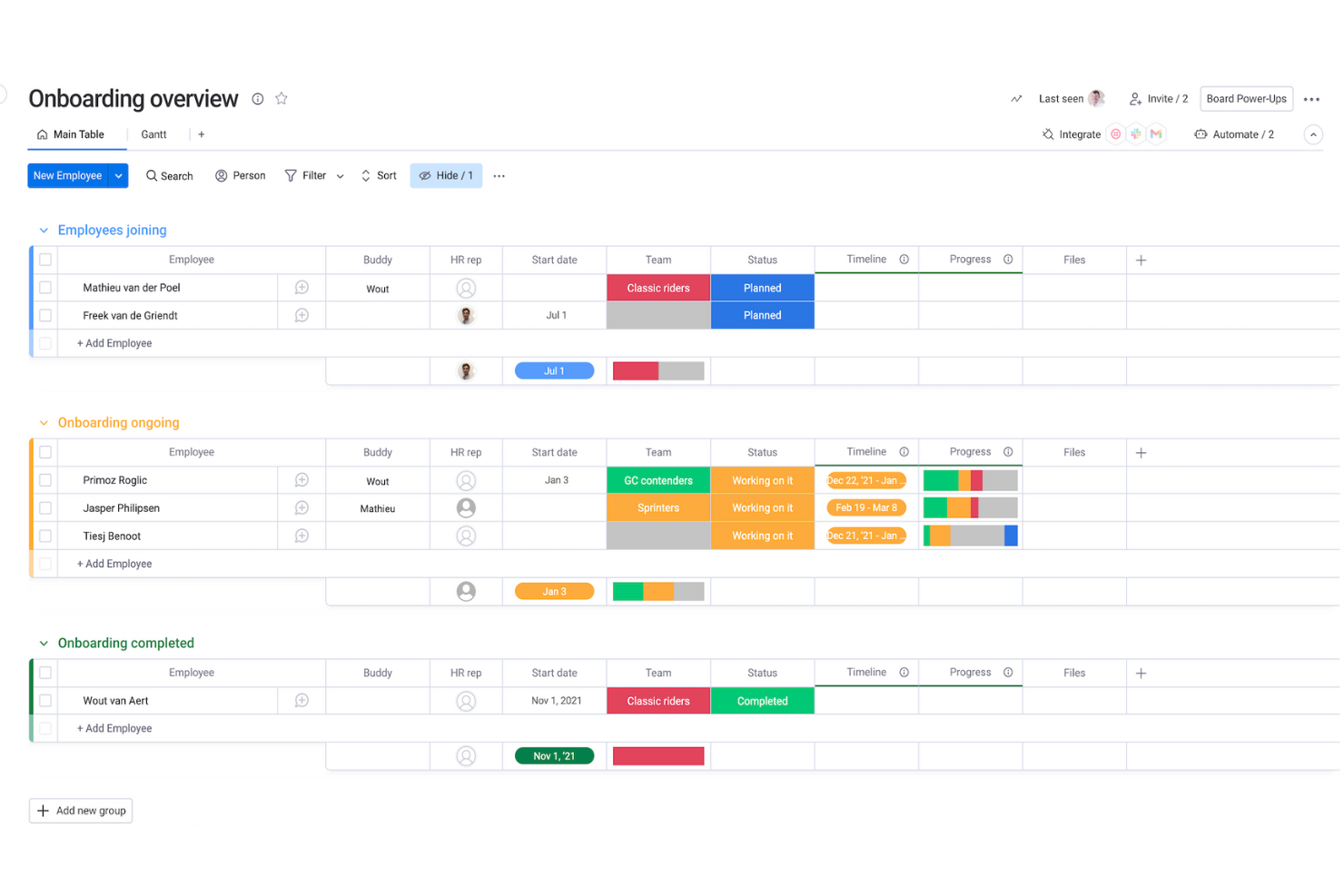
It helps you track onboarding, schedules, and employee requests with customizable boards that match your workflows.
-
Operations Teams
You can map processes, set automations, and keep everyone aligned without messy manual steps.
-
Retail Staff Scheduling
Drag-and-drop scheduling and real-time updates make it easy to plan shifts and avoid coverage gaps.
-
Project Managers
Timelines, owners, and status boards give you clear visibility into progress so your team always knows what’s next.
-
Agencies
It makes it simple to balance workloads, track client deliverables, and keep your team from being overloaded.
-
Small Businesses
You get an easy, visual way to coordinate people and tasks without needing technical setup or heavy processes.
Who Would be a Bad Fit for monday AI Workspace?
monday.com isn’t ideal if your work requires deep, specialized workforce systems like advanced payroll, complex compliance tracking, or industry-specific labor rules. You may struggle if you need highly rigid reporting standards because monday.com is built to be flexible rather than strict. It also won’t be a strong match if your team prefers traditional, spreadsheet-style tools and doesn’t want to maintain visual boards.
-
Unionized Labor
Complex contract rules and auto-enforced scheduling policies aren’t supported natively.
-
Healthcare Staffing
Strict compliance, credentialing, and shift-swap rules require more specialized systems than monday.com provides.
-
Large Call Centers
It lacks the deep forecasting and real-time staffing tools these environments depend on.
-
Manufacturing Plants
Highly detailed labor tracking and machine-level scheduling aren’t built into its core workflows.
-
Heavy Payroll
It doesn’t offer the complex calculations and regulation-specific rules you’d need for payroll-driven teams.
-
Finance Departments
If you need rigid audit-ready structures, monday.com’s flexible boards may feel too loose for your requirements.
Cómo probamos y puntuamos nuestras herramientas
Hemos pasado años construyendo, refinando y mejorando nuestro sistema de pruebas y puntuación de software. La rúbrica está diseñada para capturar los matices de la selección de software y lo que hace que una herramienta sea efectiva, centrándose en los aspectos críticos del proceso de toma de decisiones. A continuación, puedes ver exactamente cómo funcionan nuestras pruebas y puntuaciones a través de siete criterios. Esto nos permite ofrecer una evaluación imparcial del software basada en la funcionalidad principal, características destacadas, facilidad de uso, incorporación, soporte al cliente, integraciones, reseñas de clientes y relación calidad-precio.
Funcionalidad principal (25% de la puntuación final)
El punto de partida de nuestra evaluación siempre es la funcionalidad principal de la herramienta. ¿Tiene las funciones básicas que se espera encontrar? ¿Alguna de esas funciones básicas está restringida a planes de precio superiores? En esencia, esperamos que una herramienta se compare favorablemente con las capacidades básicas de sus competidores.
Características destacadas (25% de la puntuación final)
Luego, evaluamos características poco comunes que van más allá de la funcionalidad principal que normalmente se encuentra en herramientas de su tipo. Una puntuación alta refleja funciones especializadas o únicas que hacen que el producto sea más rápido, eficiente o que ofrezca un valor adicional al usuario. También evaluamos lo fácil que es integrar con otras herramientas comúnmente usadas en el entorno tecnológico para ampliar la funcionalidad y utilidad del software. Las herramientas que ofrecen muchas integraciones nativas, conexiones de terceros y acceso a API para construir integraciones personalizadas obtienen las mejores puntuaciones.
Facilidad de uso (10% de la puntuación final)
Consideramos qué tan rápido y fácil es ejecutar las tareas definidas en la funcionalidad principal utilizando la herramienta. El software que obtiene una puntuación alta está bien diseñado, es intuitivo, ofrece aplicaciones móviles, proporciona plantillas y hace que tareas relativamente complejas parezcan simples.
Incorporación (10% de la puntuación final)
Sabemos lo importante que es la rápida adopción del equipo para una nueva plataforma, por eso evaluamos qué tan fácil es aprender y usar una herramienta con una capacitación mínima. Evaluamos cuán rápido un miembro del equipo puede configurarse y comenzar a usar la herramienta sin experiencia. Las soluciones con mejores puntuaciones requieren poco o ningún soporte.
Soporte al cliente (10% de la puntuación final)
Revisamos cuán rápido y fácil es obtener ayuda mediante teléfono, chat en vivo o base de conocimientos. Las herramientas y empresas que ofrecen soporte en tiempo real obtienen las mejores puntuaciones, mientras que los chatbots obtienen las peores.
Reseñas de clientes (10% de la puntuación final)
Además de nuestras propias pruebas y evaluaciones, consideramos el puntaje neto de promotores de clientes presentes y pasados. Revisamos su probabilidad, dada la opción, de elegir nuevamente la herramienta por su funcionalidad principal. El software con una puntuación alta refleja un alto puntaje neto de promotores por parte de clientes actuales o anteriores.
Relación calidad-precio (10% de la puntuación final)
Por último, considerando todos los demás criterios, revisamos el precio promedio de los planes de entrada frente a las funciones principales y valoramos el resto de los criterios de evaluación. El software que ofrece más por menos tendrá una mejor puntuación.
New Product Updates from monday AI Workspace
monday AI Workspace Adds Human Approval Routing
monday AI Workspace adds a human-in-the-loop approval block that sends approval requests and branches AI Workflows based on the response. The update lets teams incorporate human decisions into automated workflows before determining which path the workflow should follow. Highlights include:
- Human Approval Block: Adds a human approval step directly within AI Workflows.
- Approval Requests: Sends requests to users when human input is required.
- Conditional Routing: Routes the workflow to different paths based on the approval response.
Visit monday AI Workspace’s official site for more details.
 for more details.
monday.com Adds Managed Columns Across Boards
monday.com adds Managed Column to help teams create reusable status, dropdown, and label columns with predefined labels across boards. The update helps organizations standardize workflows and sync column updates automatically from one central source. Highlights include:
- Reusable Managed Columns: Teams can reuse standardized status, dropdown, priority, and label columns across multiple boards.
- Centralized Label Syncing: Updates made to Managed Columns automatically sync across connected boards for more consistent workflows.
Visit monday.com's official site for more details.

monday.com Adds Clearer AI Result Feedback in Cells
monday.com adds clearer feedback for AI-generated cell results to help users review and improve AI outputs more easily. The update helps teams adjust prompts and inputs for more accurate and useful results. Highlights include:
- Clearer AI Feedback: Users can better understand AI-generated results directly within cells.
- Prompt Refinement Support: Teams can adjust prompts and inputs more effectively to improve AI outcomes.
Visit monday.com’s official site for more details.
monday.com Enhances List View With Column Mapping
monday.com adds column mapping to List View, allowing users to include board-specific columns for better visibility. This update helps teams view and manage data across multiple boards more efficiently. Highlights include:
- Add Board-Specific Columns: Users can now add unique board-specific columns to the List View, allowing for a more personalized data organization.
- Map Columns Across Boards: This feature enables users to map columns across different boards, ensuring that all data is accurately represented and easily accessible.
- Complete Visibility: By mapping columns, users can achieve complete visibility of their workflow, enhancing decision-making and productivity.
Visit monday.com's official site for more details.
monday AI Workspace Specs
- API
- Batch Permissions & Access
- Budgeting
- Calendar Management
- Collaboration Support
- Contact Management
- Contact Sharing
- Customer Management
- Dashboard
- Dashboards
- Data Export
- Data Import
- Data Visualization
- Dependency Tracking
- Document Sharing
- Expense Tracking
- External Integrations
- File Sharing
- Gantt Charts
- Kanban Boards
- Multi-User
- Notifications
- Project Management
- Resource Management
- Scheduling
- Task Scheduling/Tracking
- Third-Party Plugins/Add-Ons
- Time Management
- Travel Management
- Workflow Management
monday AI Workspace FAQs
Can monday.com support complex HR workflows as my team grows?
How well does monday.com handle sensitive employee data?
Can my team collaborate in real time on HR tasks and updates?
Will monday.com help me keep track of workloads across multiple departments?
Can monday.com support hiring and applicant tracking needs?
Does monday.com support documentation for HR audits or compliance?
Can monday.com help me streamline onboarding for new hires?
Will monday.com work for HR teams that manage remote or hybrid employees?
monday AI Workspace Company Overview & History
monday.com Ltd. is a publicly traded software company headquartered in Tel Aviv, Israel, and has grown to more than 2,500 employees while supporting thousands of teams globally. It began as daPulse in 2012 and changed its name to monday.com in 2017, and now serves clients including over 60% of the Fortune 500. The company went public on Nasdaq in June 2021 and reported revenue of around $730 million in 2023.
monday.com Major Milestones
- 2012: Incorporated as daPulse Labs Ltd. in Israel.
- 2017: Rebranded to monday.com.
- 2019: Raised $150 million in Series D at a valuation of $1.9 billion.
- 2021: Completed an IPO on Nasdaq under ticker MNDY.
- 2023: Achieved positive free cash flow of $212.7 million.
- 2024: Reported revenue of roughly $729.7 million for fiscal year.
¿Qué sigue?
Para mantenerte al día con lo último en gestión de personas, suscríbete a nuestro boletín para líderes y gerentes. Recibirás ideas y ofertas personalizadas para líderes y profesionales de RR. HH. directamente en tu bandeja de entrada.