Mentorship vs Sponsorship: Why You Should Utilize Both

Mentorship and sponsorship are both key relationships for career growth, but they offer very different value. Mentors guide, advise, and support your development, while sponsors advocate for you, use their influence to create real opportunities, and help you advance.
If you want to accelerate your career and make a bigger impact, you need both: mentorship to build your skills, and sponsorship to open doors and champion your potential. Here’s how each role shapes your success.
What is mentorship?
Mentorship is an organized approach to matching more experienced employees to more junior ones. The more seasoned individuals act as trusted coaches or advisers to support the junior employee’s growth and professional development.

Mentor/mentee relationships can vary in their level of formality. When done well, organizations create strategically built mentoring programs that align individuals with the right competencies, skills, and knowledge to help develop the next wave of talent within their organization.
Successful mentorship gives mentees space to focus on their career development, career vision, and the creation of a plan to build the skillset they need to realize their aspirations.
Benefits of mentorship
Drive Colleague Development
Mentorship is a critical component of any formal employee learning and development program, providing mentees with social learning in addition to the formal learning they get through coursework and experiential learning they gain on the job.
Mentorship relationships allow mentees to gain new skills, perspectives, and relationships in a safe space outside of a formal hierarchical/managerial relationship.
This is essential in helping mentees gain the knowledge, skills, and abilities needed to be successful in the role they are in today or aspirational roles they hope to grow into within your organization.
Internal Mobility
Developing your employee's capabilities opens the door for internal mobility and personal growth within your organization, both of which are critical from an employee retention and engagement perspective.
Mentorship can help expose your mentees to other parts of the organization and build out their professional network at your company. This, combined with helping ensure they have the right critical skills, can be a catalyst to help them ascend to new roles as they emerge.
In the end, mentorship has a business impact through talent retention and development, both of which drive down your overall talent costs.

What is sponsorship?
Sponsorship, in a way, transcends mentorship. Mentorship is certainly a component of the relationship and perhaps how it begins, but successful sponsorship takes the relationship to a whole new level.
An easy way to think about sponsorship is mentorship with action—it’s an active effort on the part of the sponsor to use their network, connections, and potentially even their authority to help influence the career growth and advancement of the individual they are sponsoring.
Let me be clear—this is not about favoritism. This is about individuals in leadership roles (often C-suite) taking a highly intentional approach to put the right individuals, or proteges, into the right opportunities to shine within your organization.
Those opportunities could be their next project, a promotion opportunity, or a new role within the organization. The sponsor is staking their own credibility and potentially their own success on the individual whom they are championing.
Sponsorship is therefore predicated, not just upon a high level of trust, but a deep-seated belief in the sponsee’s ability to be successful in the opportunities they get recommended for.
Benefits of sponsorship
Drive organizational success and business growth
Ultimately the largest benefit is the success and growth of your business. Your talent is your greatest asset and your ability to deploy that talent in the most impactful way is paramount.
Sponsorship can help ensure you have the right people in the right roles at the right times to support your organizational needs.
Retain high-potential talent
Today’s war for talent is highly competitive and it’s more cost-effective to retain talent. One of the best ways we can retain top talent is to give them the right space to grow and develop within our organization.
We often find unique talent within our teams who have the ability to grow above and beyond their roles, even if that means moving to other parts of our organization.
Taking a strategic approach to these high-potential employees, and sponsoring their ability to find internal mobility opportunities, is one of the strongest ways we can keep our best talent working for us.
Impact organization DEI efforts
Being intentional about sponsoring employees in underrepresented demographics is a great way to drive diversity, equity, and inclusion at your company.
Women and people of color, in particular, can benefit from sponsorship, especially in the tech space and other industries where these groups are woefully underrepresented.
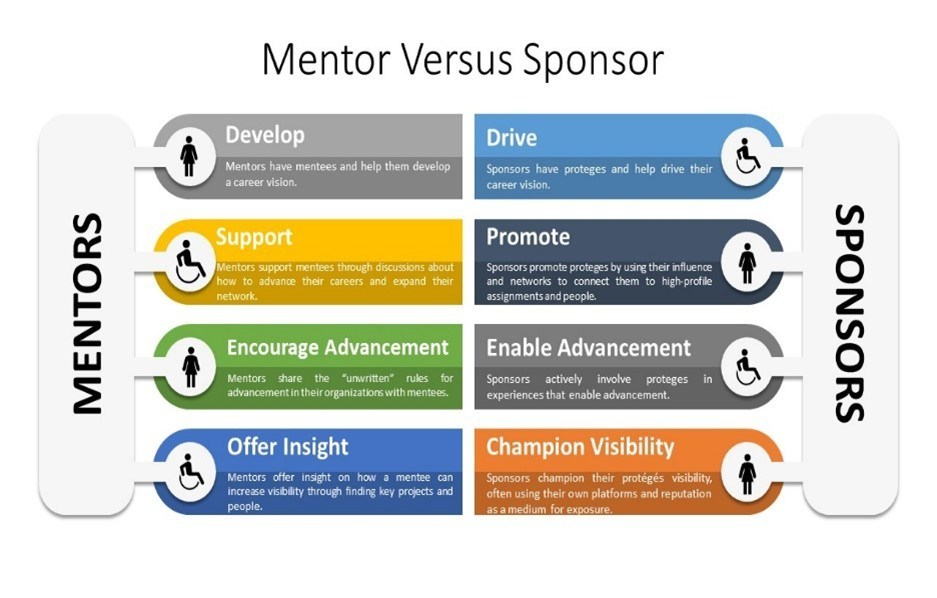
Mentorship vs Sponsorship
Here’s a quick side-by-side view to help see the subtle shift in thinking when moving from mentor or sponsor.
How to foster mentorship and sponsorship in your organization?
So how do you get started with fostering mentorship and/or sponsorship at your company?
The extent to which you invest in both mentorship and sponsorship is going to depend greatly upon the maturity of your talent processes and the unique needs of your organization.
Like all HR processes, mentorship and sponsorship efforts needs to map back to your organization's needs and talent strategy.
Identify your needs
Start by asking yourself questions like:
- What critical business needs do we need to drive? Does our talent strategy contribute to our business needs?
- What components of our culture are we trying to influence? What behaviors do we want our employees to emulate across the organization?
- What critical skills do we have today? What critical skills do we need for tomorrow? Do we have employees across the organization who can coach others on these skills?
- Do we have a diverse pipeline of high-potential talent ready to fill critical roles?
- Which high-potential individuals do we want to invest in to build critical capabilities for tomorrow?
- Are there pockets of employees who would benefit most from mentorship or sponsorship?
Once you’ve isolated the needs you are trying to address through mentorship and sponsorship you can begin to build out a program designed to meet those needs.
Fostering mentorship
Mentorship is generally driven through formal mentoring programs. I would encourage you to check out our “How To Start An Effective Mentoring Program In 6 Steps” article for a detailed overview of how to build out a program at your organization.
You might also want to consider enrolling leaders in one of these mentorship courses to help them get familiar with the concepts.
Fostering sponsorship
Sponsorship, meanwhile, isn’t often accomplished through a formal program. However, it does benefit from structure and agreement across your leadership team.
Ultimately, successfully utilizing sponsorship comes down to three key things:
- A culture of learning, development, and internal growth and mobility
- A strong commitment from senior leaders across your organization to make time and space to build sponsorship relationships and invest in key talent
- Clear alignment by leaders across the organization regarding how they’ll leverage sponsorship to contribute to the business
A best practice is for your leadership team to leverage your organizational talent review processes, or other formal talent discussions, as an opportunity to talk about your approach as well as the key talent that you are investing in through sponsorship.
Conclusion: mentorship and sponsorship—why it’s good to utilize both in an organization
It’s abundantly clear that both mentorship and sponsorship have a role in nurturing and retaining talent.
It certainly shouldn’t be an “either/or,” but rather an “and” as both play a distinct role in how you grow and develop talent within your organization.
Mentorship without sponsorship doesn’t allow you to invest specifically in the career success of your highest potential talent.
On the other hand, sponsorship without true mentorship leaves a significant portion of your population undiscovered and unsupported in their personal growth and development.
However, together, mentorship and sponsorship can help you grow, develop, retain and deploy all talent across your organization.
Interested in learning more? I’d highly recommend Sylvia Ann Hewlett’s “Forget a Mentor, Find a Sponsor” (a fascinating read).
You can also utilise mentoring software to help you launch and run your mentoring program and match mentors with mentees.