

NEO versus Remote: Vergelijking & Deskundige beoordelingen voor 2026


Wereldwijde werkgelegenheid beheren betekent dat je te maken krijgt met lokale arbeidswetgeving, salarisadministratie en naleving van regelgeving in meerdere landen. Als je NEO en Remote vergelijkt, beoordeel je waarschijnlijk verschillende benaderingen van ondersteuning door een werkgever van registratie (EOR) voor internationale werving.
Hoewel beide platforms bedrijven helpen personeel aan te nemen zonder lokale entiteiten op te zetten, werken ze volgens verschillende modellen. Remote volgt een traditionele EOR-aanpak met één leverancier, terwijl NEO werkt als een marktplaats die bedrijven rechtstreeks in contact brengt met lokale EOR-aanbieders. Inzicht in deze verschillen is essentieel om de juiste optie te kiezen.
In dit artikel leg ik uit hoe elk platform omgaat met wereldwijde werkgelegenheid, zodat je een beter onderbouwde keuze kunt maken.
NEO vs. Remote: An Overview
NEO

Remote
Waarom u onze softwarebeoordelingen kunt vertrouwen
Ons team test en beoordeelt software sinds 2012. Als HR-experts weten we zelf hoe moeilijk — en belangrijk — het is om de juiste software te kiezen.
Voor deze gids hebben we tools geëvalueerd met behulp van praktijktests en onafhankelijk onderzoek, waarbij we tools beoordeelden aan de hand van onze selectiecriteria. We putten ook uit inzichten van vooraanstaande experts uit de branche en van praktiserende HR-professionals.
Onze reviews weerspiegelen ons menselijke redactionele oordeel, geen verkooppraatje.
Deskundige beoordelaars:
NEO vs. Remote Pricing Comparison
| NEO | Remote | |
|---|---|---|
| Free Trial | Free plan available | Free demo available |
| Pricing | From $49/user/month | From $699/user/month |
NEO versus Remote: prijzen en verborgen kosten
NEO en Remote hanteren verschillende prijsstructuren die van invloed zijn op hoe de kosten zich in verschillende landen ontwikkelen. NEO brengt platformkosten in rekening en houdt de lokale EOR-servicekosten apart. Deze worden betaald aan gecontroleerde aanbieders in het betreffende land tegen lokale tarieven. Kosten voor valutaconversie worden ook afzonderlijk vermeld. Dat biedt meer inzicht in de oorsprong van de kosten, maar vereist wel vergelijkingen per land.
Remote gebruikt een gebundeld prijsmodel per werknemer waarin EOR-diensten, platformtoegang en naleving van regelgeving worden gecombineerd in één maandelijkse vergoeding. Dit kan budgettering en prognoses vereenvoudigen, maar biedt per land minder flexibiliteit. Bij de keuze tussen beide moeten teams afwegen of ze de voorkeur geven aan transparante lokale prijzen of voorspelbare gebundelde kosten.
NEO vs. Remote Feature Comparison
NEO is een wereldwijd platform voor werkgelegenheidsmarktplaatsen dat is ontworpen om salarisgegevens, contracten, onboarding en naleving van regelgeving te centraliseren zonder zelf als werkgever op te treden. In plaats daarvan coördineert het de tewerkstelling via gecontroleerde lokale EOR-aanbieders, terwijl teams één platform krijgen om werkgelegenheidsprocessen en inzicht op landenniveau te beheren. Deze aanpak werkt goed voor organisaties die flexibiliteit, het vermijden van leveranciersafhankelijkheid en kostentransparantie belangrijker vinden dan ingebouwde HR-automatisering.
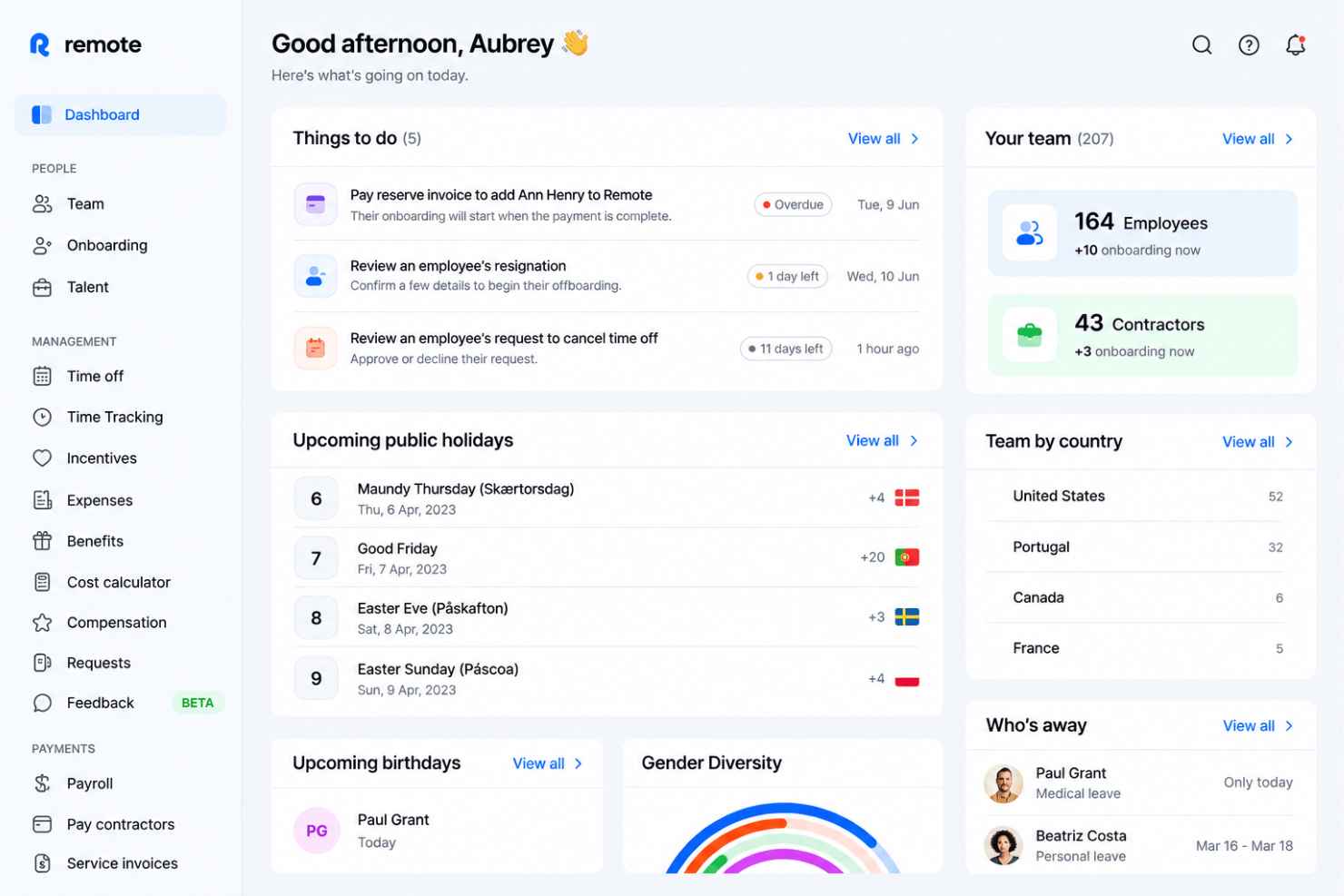
Remote werkt als een traditioneel EOR-platform met één leverancier en levert werkgelegenheid, salarisadministratie, naleving van regelgeving, secundaire arbeidsvoorwaarden en HR-ondersteuning via één geïntegreerd systeem. In de meeste ondersteunde landen treedt Remote op als werkgever van registratie via entiteiten die het bezit of beheert, met de nadruk op consistentie, automatisering en gestandaardiseerde processen. Dit model is geschikt voor teams die de voorkeur geven aan een meer voorgeschreven, alles-in-één aanpak voor het beheren van werknemers wereldwijd.
| NEO | Remote | |
|---|---|---|
| API | ||
| Data Export | ||
| Data Import | ||
| Data Visualization | ||
| Employee Database | ||
| Employee Onboarding | ||
| External Integrations | ||
| Multi-Currency | ||
| Multi-User | ||
| Notifications | ||
| Payroll | ||
| Scheduling | ||
| Tax Management | ||
| Timesheets |
NEO versus Remote: integraties
| Integratie | NEO | Remote |
|---|---|---|
| BambooHR | ❌¹ | ✅ |
| Workday | ❌¹ | ✅ |
| HiBob | ❌¹ | ✅ |
| Greenhouse | ❌¹ | ✅ |
| NetSuite | ❌¹ | ✅ |
| QuickBooks | ❌¹ | ✅ |
| Xero | ❌¹ | ✅ |
| API | ✅¹ | ✅ |
| Zapier | ❌¹ | ✅ |
¹ NEO vermeldt geen native integraties in het openbaar. API-toegang en aangepaste integraties zijn mogelijk beschikbaar bij betaalde abonnementen.
Met NEO beheer je voornamelijk werkgelegenheidsgegevens binnen het platform. Als je integraties of API-toegang nodig hebt, moet je bevestigen wat er via de betaalde abonnementen beschikbaar is. Dat werkt goed als je configuratie relatief eenvoudig is. De HRIS- en ATS-integraties van Remote zijn daarentegen beter geschikt voor teams die al afhankelijk zijn van een gekoppelde technologiestack. Ze helpen je om werving, salarisadministratie en werknemersgegevens met minder handmatig werk tussen systemen gesynchroniseerd te houden.
NEO versus Remote: beveiliging, naleving en betrouwbaarheid
| Factor | NEO | Remote |
|---|---|---|
| Gegevensprivacy | Gebruikt standaardbeveiligingsmaatregelen om gevoelige personeelsgegevens te beschermen, hoewel specifieke versleutelingsstandaarden niet openbaar zijn beschreven. | Ondersteunt naleving van de AVG en past sterke versleuteling en toegangscontroles toe om personeelsgegevens te beschermen. |
| Naleving | Ondersteunt naleving via gescreende lokale EOR-partners die arbeidswetgeving per land toepassen. | Treedt in ondersteunde landen op als werkgever van record en beheert de naleving rechtstreeks. |
| Updates van regelgeving | Verwerkt wijzigingen in arbeidswetgeving en loonadministratie via lokale expertise van partners in elk land. | Past contracten en arbeidsvoorwaarden aan om wijzigingen in regelgeving in ondersteunde regio's weer te geven. |
| Risicobeheer | Centraliseert contracten, loonadministratie en nalevingsgegevens om operationele risico's te beperken. | Gebruikt gestandaardiseerde werkstromen en intern juridisch toezicht om het nalevingsrisico te beperken. |
| Systeembetrouwbaarheid | Werkt met een gecentraliseerd platform voor het beheren van wereldwijde werkstromen voor werkgevers. | Werkt op cloudgebaseerde infrastructuur die is ontworpen voor consistente prestaties en beschikbaarheid. |
Beide platforms geven prioriteit aan gegevensbeveiliging en naleving. Over het algemeen biedt Remote duidelijker gedocumenteerde interne praktijken voor naleving en beveiliging, terwijl NEO een partnergestuurde aanpak hanteert die het risicobeheer nog steeds centraliseert. Als HR-professional moet je de beveiligingsdocumentatie van elke leverancier beoordelen, verduidelijken wie in elk land de juridische verantwoordelijkheid draagt en vragen hoe updates over naleving worden gecommuniceerd voordat je een keuze maakt.
NEO versus Remote: gebruiksgemak
| Factor | NEO | Remote |
|---|---|---|
| Gebruikersinterface | Gebruikt een overzichtelijk, eenvoudig dashboard dat is gericht op kerntaken van een EOR, zoals loonadministratie en contracten. | Biedt een verzorgd dashboard met duidelijkere navigatie voor werving, loonadministratie en secundaire arbeidsvoorwaarden. |
| Installatie | Is snel toegankelijk, maar verwacht dat je werkstromen configureert met beperkte begeleiding in de app. | Biedt gestructureerde installatiestappen die je begeleiden bij het configureren van werving en loonadministratie. |
| Ervaring bij het inwerken | Biedt geen formele handleidingen voor het inwerken; ondersteuning bij het instellen wordt via accountgerichte hulp geboden bij betaalde abonnementen. | Bevat begeleide processen voor het inwerken en aanwijzingen binnen het platform voor belangrijke acties. |
| Ondersteuning | Betaalde abonnementen bieden doorgaans toegang tot toegewijde ondersteuning voor accounts of klantensucces. | Biedt accountgerichte ondersteuning en toegang tot specialisten voor doorlopende begeleiding. |
Vanuit mijn perspectief is NEO gemakkelijker te gebruiken als je een lichtgewicht systeem wilt en het waardeert om een vast aanspreekpunt te hebben dat je indien nodig begeleidt. Remote voelt gemakkelijker voor teams die de voorkeur geven aan gestructureerde werkstromen en begeleiding in het product om dagelijkse HR-taken te beheren met minder handmatige besluitvorming.
NEO vs Remote: Pros & Cons
NEO
- Lower-cost structure than bundled EOR platforms by connecting you with local providers at market rates.
- No vendor lock-in by country—NEO’s model lets you switch EOR providers any time.
- Payroll data consolidation, onboarding, contracts, and compliance are handled in one place, which keeps global hiring organized.
- Teams need to evaluate and select local EOR partners rather than relying on one default provider, which can add a small amount of upfront planning.
- Though providers in NEO’s marketplace are vetted, service quality may still vary by country.
- Not an all-in-one solution if you’re looking for more advanced HR features built in, like performance management, engagement, and learning and development.
Remote
- Owns local entities in every covered country.
- Fast onboarding and clear employment contracts.
- Transparent, flat monthly pricing structure.
- Limited on-demand support for smaller teams.
- Not built to replace a full HRIS.
- Payroll setup can face country-specific delays.
Best Use Cases for NEO and Remote
NEO
- Global Employers Well-suited for companies hiring employees across multiple countries that want compliant employment without opening local entities or paying bundled EOR platform premiums. By connecting employers directly with vetted local providers, NEO offers clearer cost visibility and more flexibility than traditional single-vendor EOR platforms.
- EOR Providers EOR providers can use NEO as an underlying infrastructure to manage employment operations, payroll coordination, and compliance across regions. Rather than building proprietary systems, providers can rely on NEO’s platform to standardize workflows while maintaining direct relationships with their clients.
- Managed Service Providers Managed Service Providers (MSPs) benefit from NEO’s marketplace model when supporting distributed workforces across multiple countries. The platform helps MSPs centralize payroll and compliance oversight while working with local employment partners instead of maintaining in-house expertise in every jurisdiction.
- Staffing Teams Staffing and recruitment firms can place international hires more efficiently by leveraging local EOR partners through NEO. Contracts, payroll coordination, and compliance are managed centrally, reducing friction when expanding placements across new countries or clients.
- Finance & Procurement Teams Finance and procurement teams benefit from NEO’s transparent cost structure, where local employment fees, FX conversion costs, and platform fees are clearly separated. This makes it easier to forecast global payroll spend, compare providers by country, and avoid the opaque pricing common with bundled EOR platforms.
- Scaling Organizations (Small to Large) NEO works well for smaller teams getting started with international hiring, thanks to its free platform access for up to three employees. This makes it possible to access global employment at local rates and smaller FX fees without upfront platform costs. As headcount grows, larger organizations can benefit from the same marketplace model at scale with a modest platform fee, where pricing transparency, provider flexibility, and custom integrations support more complex global hiring needs.
Remote
- Global Tech Startups Remote makes it easy to hire and onboard talent in multiple countries, reducing the legal and payroll barriers that fast-growing tech startups face.
- Small HR Teams With automated workflows and a self-serve portal, HR teams with limited resources can manage contracts, payroll, and compliance without manual oversight.
- Remote-First Companies Remote’s international payroll, contract setup, and benefits administration all support a fully distributed workforce needing reliable local compliance.
- VC-Backed Scaleups The flat pricing, transparent cost calculator, and bulk action API let VC-backed growth companies budget and expand into new markets confidently.
- Professional Services Firms Companies hiring contractors and employees across regions can centralize document management and payments for smooth cross-border operations.
- Product-Led SaaS SaaS companies expanding overseas need strong HR integrations and fast onboarding, which Remote’s API and partner connectors deliver.
Wie zou NEO moeten gebruiken en wie Remote?
Vanuit mijn perspectief is NEO het beste als je een leveranciersneutrale EOR-oplossing wilt die je flexibiliteit biedt in plaats van je vast te leggen aan één wereldwijde aanbieder. Je gebruikt één platform om loonadministratie, contracten en naleving te coördineren, terwijl je per land met gescreende lokale EOR-partners werkt. Dat zorgt voor meer transparantie over kosten en stelt je in staat van aanbieder te veranderen wanneer je behoeften veranderen. Dankzij een gratis versie en een modulaire inrichting past NEO bij teams die controle, duidelijkheid over kosten en een lichter systeem voor het beheren van wereldwijde werkgelegenheid willen.
Remote past beter bij HR-teams van groeiende bedrijven die een volledig geïntegreerd platform voor wereldwijde werkgelegenheid willen. Het werkt goed voor teams die volledig op afstand werken, technologische start-ups, adviesbureaus en e-commercebedrijven die ingebouwde werkstromen nodig hebben voor werving, loonadministratie en naleving in veel landen. Als je team meer automatisering en minder handmatige coördinatie wil naarmate je wereldwijd uitbreidt, is Remote waarschijnlijk de betere optie.
Differences Between NEO and Remote
| NEO | Remote | |
|---|---|---|
| Approach | Connects you with vetted local EOR partners who handle employment by country, while providing you with the platform to maintain payroll and compliance visibility. | Acts as the direct EOR in supported countries through its own entities. |
| Integrations & API | Doesn’t publicly list native integrations and requires confirmation for API access on paid plans. | Provides multiple prebuilt integrations with HR, finance, and ATS tools. |
| Platform Scope | Focuses on core EOR needs such as payroll, contracts, compliance, and employee records. | Covers a wider range of workflows, including hiring, payroll, benefits, and ongoing HR support. |
| Pricing Model | Separates platform fees, local provider fees, and FX costs for country-level visibility. Connecting you directly with local EOR providers and using mid-market FX fees keeps costs lower in many markets around the world compared to paying a bundled, marked-up price with a single vendor. | Uses bundled per-employee pricing that combines EOR services and platform access, and generally has more expensive per-employee-per-month pricing. |
| Workflow Automation | Keeps workflows lighter and more flexible, with support assisting where needed. | Uses more guided and automated workflows across hiring, payroll, and compliance. |
| Visit NEOOpens new window | Visit RemoteOpens new window |
Similarities Between NEO and Remote
| Contract Management | Both support legally compliant employment contracts aligned with local labor laws to reduce risk when hiring globally. |
|---|---|
| Hiring Model | Both let you hire employees in countries where you don’t have local entities, avoiding the need to set up subsidiaries to employ talent (but they offer different approaches: NEO is a global marketplace while Remote is a traditional single-vendor EOR). |
| Payroll | Both support paying international employees while accounting for local payroll rules, currencies, and statutory deductions. |
| Scalability | Both are built to support growing international teams, making it easier to add new hires and expand into new regions over time. |
| Visibility | Both provide a single platform to view and manage employee records, contracts, and employment status across countries. |
| Visit NEOOpens new window Visit RemoteOpens new window | |