

Um empregador legal no Líbano é uma entidade terceira que emprega legalmente os seus trabalhadores locais e gere a administração laboral em seu nome. O fornecedor adequado pode ajudar a sua equipa de RH a tratar das obrigações relativas à NSSF e aos impostos, integrar trabalhadores e pagar-lhes em libras libanesas ou dólares americanos, apesar das limitações bancárias.
Esta comparação abrange opções de empregadores legais e os aspetos a avaliar em matéria de conformidade, fiabilidade salarial, apoio aos trabalhadores e futuras alterações à força de trabalho.
Porque pode confiar nas nossas recomendações de software
6,700+
Reviews
20
Industry experts
16+
Evaluation factors
14
Years
A nossa equipa testa e analisa software desde 2012. Como especialistas em RH, sabemos o quão difícil — e importante — é escolher o software certo.
Para este guia, avaliámos as ferramentas através de testes práticos e pesquisa independente, pontuando-as de acordo com os nossos critérios de seleção. Recorremos também a contributos de líderes de opinião do setor e de especialistas em RH no ativo.
As nossas análises refletem o juízo da nossa equipa editorial, e não um discurso de vendas.
Revisores especialistas:
- Phil GrayCOO
 Kim BehnkeHR Tech Editor & Analyst
 Josh BarkerPeople Ops Manager

Tabela comparativa: empregadores legais no Líbano
Compare lado a lado os preços e as especificações dos empregadores legais no Líbano que entraram na minha lista restrita:
Score legend (out of 5)
- Excellent4.5–5
- Good4–4.4
- Average3–3.9
- Below average2–2.9
- Poor1–1.9
Sorted by: Default
| Tool | Starting Price | Website | |||||||
|---|---|---|---|---|---|---|---|---|---|
Best for planning pay across LBP and USD | 3.2 out of 5 | 2 | 3 | 3 | 4 | 4 | 3 | $349/user/month Free demo available | Website |
Best for detailed Lebanon compliance guidance | 3.2 out of 5 | 3 | 3 | 3 | 4 | 3 | 3 | $599/user/month Free demo available | Website |
Best for tracking Lebanon's NSSF changes | 3.5 out of 5 | 5 | 3 | 4 | 4 | 3 | 2 | $299/per employee/month Free demo available | Website |
Best for startups with per-hire discounts | 3.3 out of 5 | 2 | 3 | 3 | 5 | 3 | 4 | $699/user/month Free demo available | Website |
Best for moving hires from EOR to your entity | 3.7 out of 5 | 2 | 4 | 4 | 4 | 4 | 4 | $599/per employee/month Free demo available | Website |
Best for switching from another EOR | 2.7 out of 5 | 2 | 2 | 3 | 3 | 3 | 3 | $199/employee/month Free demo available | Book Demo |
Best for Lebanon-specific compliance planning | 3.0 out of 5 | 3 | 3 | 4 | 2 | 3 | 3 | $349/employee/month Free demo available | Website |
Best for audited contractor-to-employee moves | 3.3 out of 5 | 2 | 4 | 3 | 4 | 4 | 3 | $399/employee/month Free demo available | Website |
Best for planning Lebanon NSSF and tax costs | 3.0 out of 5 | 2 | 3 | 3 | 4 | 3 | 3 | $549/employee/month Free demo available | Website |
Best for guaranteed pay dates amid bank limits | 3.0 out of 5 | 2 | 2 | 3 | 4 | 3 | 4 | $29/user/month Free demo available | Website |


Avaliações de empregadores legais no Líbano
Apresento abaixo os meus resumos detalhados dos melhores empregadores legais no Líbano que entraram na minha lista restrita. As minhas avaliações abrangem os preços, o apoio à conformidade e as opções salariais de cada serviço de empregador legal, para o ajudar a encontrar a opção mais adequada.
 Best for planning pay across LBP and USD
- Free demo available
- From $349/user/month
Visit WebsiteCustomer Rating:4.9/5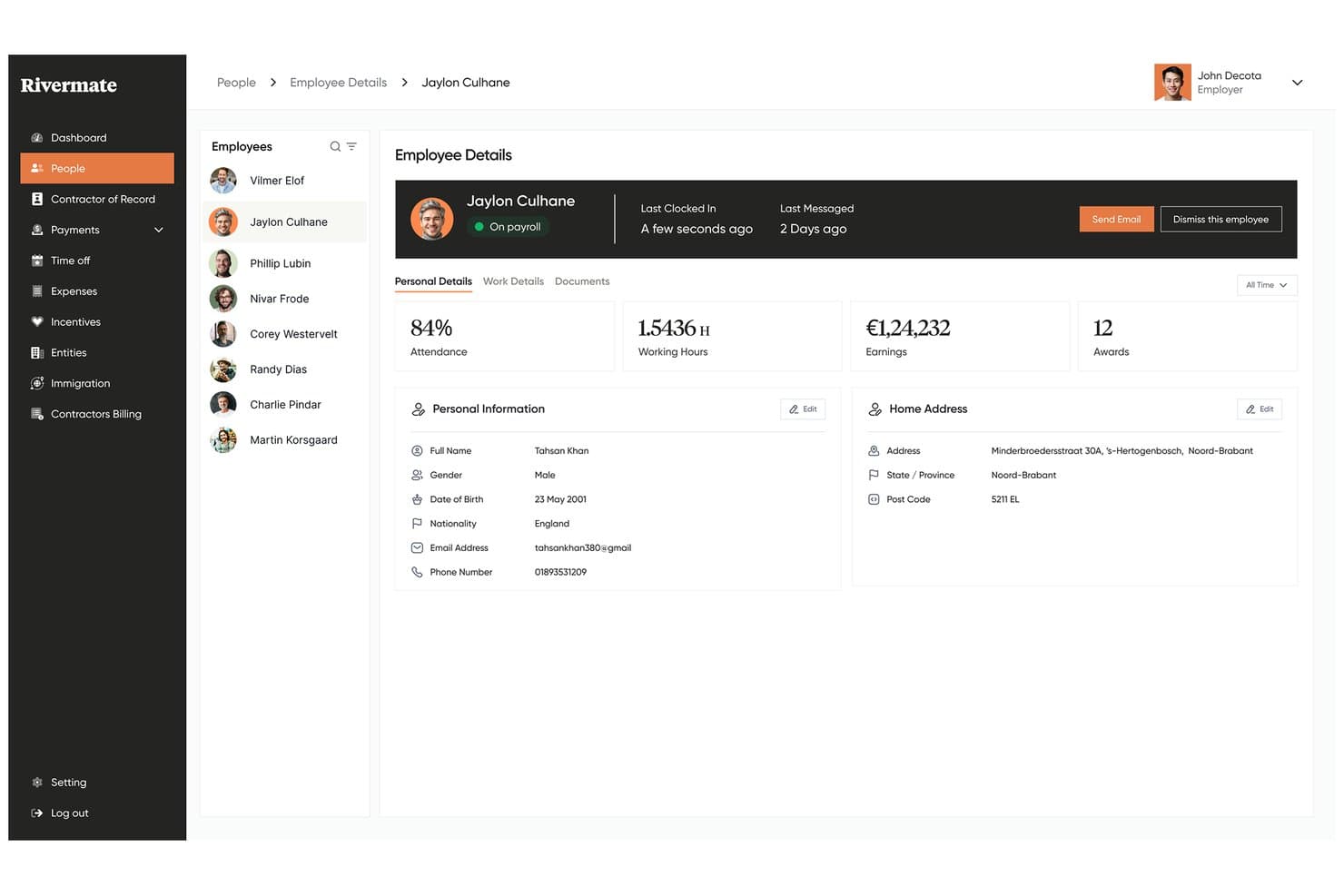
Rivermate displays full employee personal details and payroll stats. Rivermate is a global employer of record platform that covers Lebanon through local partner infrastructure, handling payroll, statutory benefits, compliant contracts, and terminations across 180+ countries from a single dashboard.
Who Is Rivermate Best For?
Rivermate is a good fit for startup founders who want a flat-fee EOR service with no onboarding costs and a demo-first process before committing.
Why I Picked Rivermate
I've included Rivermate in my top picks because it's one of the few EOR platforms with a published cost calculator that displays in Lebanese pounds, letting you model exact compensation packages in both LBP and fresh USD before you commit to a hire. Lebanon's dual-currency reality makes that genuinely useful: Rivermate's guide covers the official 89,500 LBP/USD rate and explicitly addresses structuring pay across both currencies. Its Lebanon-specific payroll handling includes employer NSSF contributions (broken down across maternity, family, and end-of-service buckets) and the transportation allowance of 450,000 LBP per working day.
Rivermate Key Features
- Dedicated account manager: Every account includes a named account manager available via Slack, WhatsApp, email, and phone around the clock.
- Contractor-to-employee conversion: Rivermate lets you move a contractor directly onto EOR payroll without restarting the hiring process.
- Multi-country compliance dashboard: A single real-time dashboard tracks payroll runs, tax filings, time off, expenses, and visa status across all your countries.
- End-of-service indemnity administration: Rivermate calculates and administers Lebanon's statutory end-of-service indemnity, including the 5% employer NSSF contribution with no cap.
Rivermate Integrations
Rivermate doesn't have any native integrations.
Pros and Cons
Pros:
- Contractor conversion supports existing Lebanon talent
- Lebanon guide details NSSF and leave obligations
- Reviewers praise responsive dedicated account support
Cons:
- Lebanon hiring timelines can reach four weeks
- Undisclosed local partner limits accountability
Learn more about Rivermate: Best for detailed Lebanon compliance guidance
- Free demo available
- From $599/user/month
Visit WebsiteCustomer Rating:4.6/5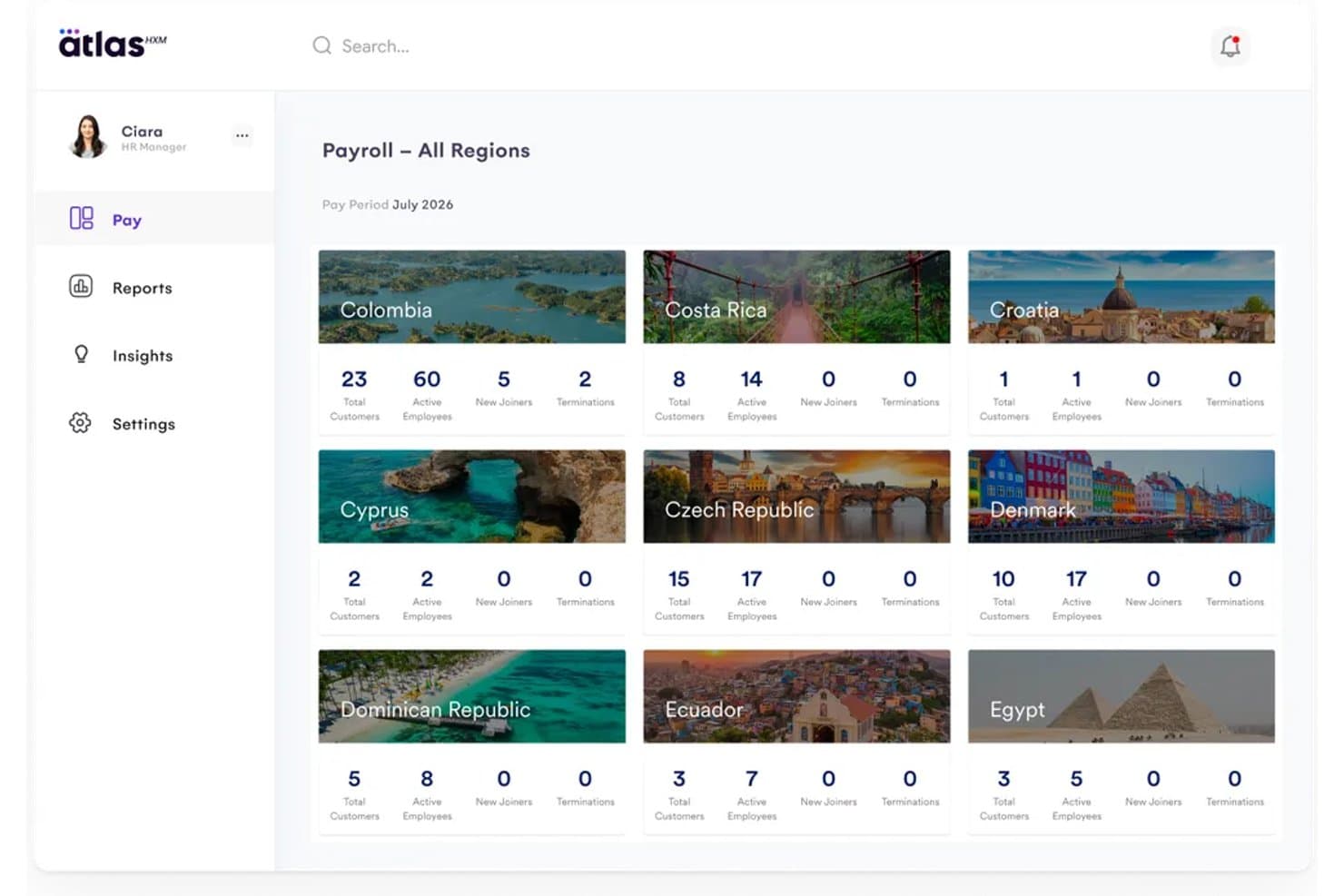
Atlas HXM displays payroll data across all global regions at once. Atlas HXM is a direct employer of record platform that manages payroll, local contracts, statutory benefits, and compliance for companies hiring in Lebanon without a legal entity.
Who Is Atlas HXM Best For?
Atlas HXM is a strong fit for global mobility managers overseeing hires across multiple countries who need a centralized platform with detailed Lebanon-specific compliance documentation.
Why I Picked Atlas HXM
Atlas HXM earns its spot on my shortlist because its Lebanon-specific compliance documentation goes deeper than most EOR providers I've reviewed. The Lebanon page spells out NSSF contribution rates, Arabic-language contract requirements, progressive tax withholding brackets, and the December 2023 pension reform, giving your HR team a real reference point rather than boilerplate coverage. I also appreciate that onboarding runs in as little as two weeks, with contracts issued and signed on day one.
Atlas HXM Key Features
- Multi-country dashboard: Track payroll progress, approvals, workforce costs, and hiring milestones across 160+ countries from a single centralized view.
- Employee self-service portal: Employees manage time off requests, timesheets, payslips, tax documents, and benefits through a web portal and iOS/Android app.
- HRIS integrations: Sync employee data directly with platforms like Workday, BambooHR, Sage, Paycor, and UKG to keep records consistent across systems.
- Payroll funding control: Fund each Lebanon payroll run 2–5 days before payday, with real-time error flagging and automatic adjustments for local holidays and leave.
Atlas HXM Integrations
Atlas HXM provides a developer platform for API-based connections, including employee onboarding and record updates. Access and permissions should be configured for the required customer workflow.
Pros and Cons
Pros:
- Two-week onboarding supports faster hiring
- Reviewers praise responsive account management
- Detailed Lebanon guidance covers NSSF and contracts
Cons:
- No published USD or banking contingencies
- Conflicting leave and severance guidance
Learn more about Atlas HXM: Best for tracking Lebanon's NSSF changes
- Free demo available
- From $299/per employee/month
Visit WebsiteCustomer Rating:4.8/5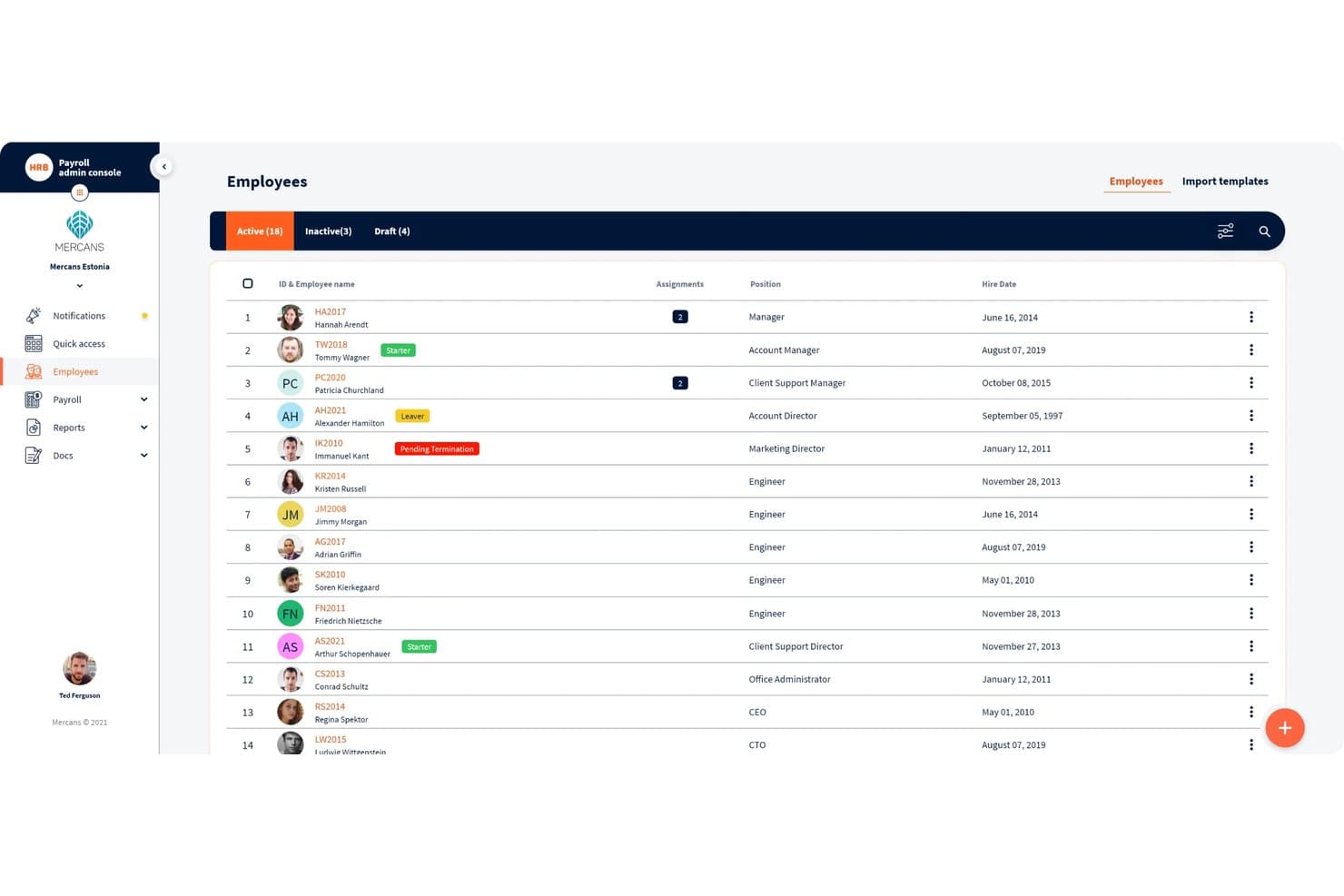
Mercans lets users manage active employees with statuses and hire dates. Mercans is an EOR platform with its own legal entity in Lebanon, covering local payroll processing, NSSF administration, end-of-service indemnity, and contractor management through its HR Blizz platform and G2N Nova payroll engine.
Who Is Mercans Best For?
Mercans is a strong fit for global mobility managers and HR teams that need to stay ahead of Lebanon's frequently shifting NSSF contribution rules and statutory payroll obligations.
Why I Picked Mercans
I've included Mercans in my top picks because it actively tracks Lebanon's NSSF contribution rule changes and publishes compliance alerts as they happen—like the May 2026 update raising the NSSF salary cap from LBP 18M to LBP 28M under Decree 2923. Its G2N Nova payroll engine processes these changes directly, so your payroll reflects current statutory rates without manual intervention. Mercans also owns its Lebanon legal entity outright, with no third-party aggregators handling compliance on its behalf.
Mercans Key Features
- G2N Nova payroll engine: Processes each payroll cycle in 72 hours or less, with automated payments across 103 currencies.
- HR Blizz self-service portal: Gives employees and managers access to time and attendance, leave tracking, expense management, and document storage in one dashboard.
- Global contract consolidation: Lets you manage all Lebanon and international employees under a single global contract with Mercans, rather than separate per-country agreements.
- End-of-service indemnity administration: Handles statutory end-of-service pay obligations under Lebanon's labor law directly through NSSF enrollment and management.
Mercans Integrations
Mercans documents payroll connectivity with Workday, SAP, and Oracle systems, alongside integration options for transferring HR and payroll data.
Pros and Cons
Pros:
- NSSF alerts track contribution cap changes
- Own Lebanese entity avoids aggregator handoffs
- Local payroll expertise earns reviewer praise
Cons:
- Lebanon payment currency handling remains unclear
- HR Blizz relies on support tickets
Learn more about Mercans: Best for startups with per-hire discounts
- Free demo available
- From $699/user/month
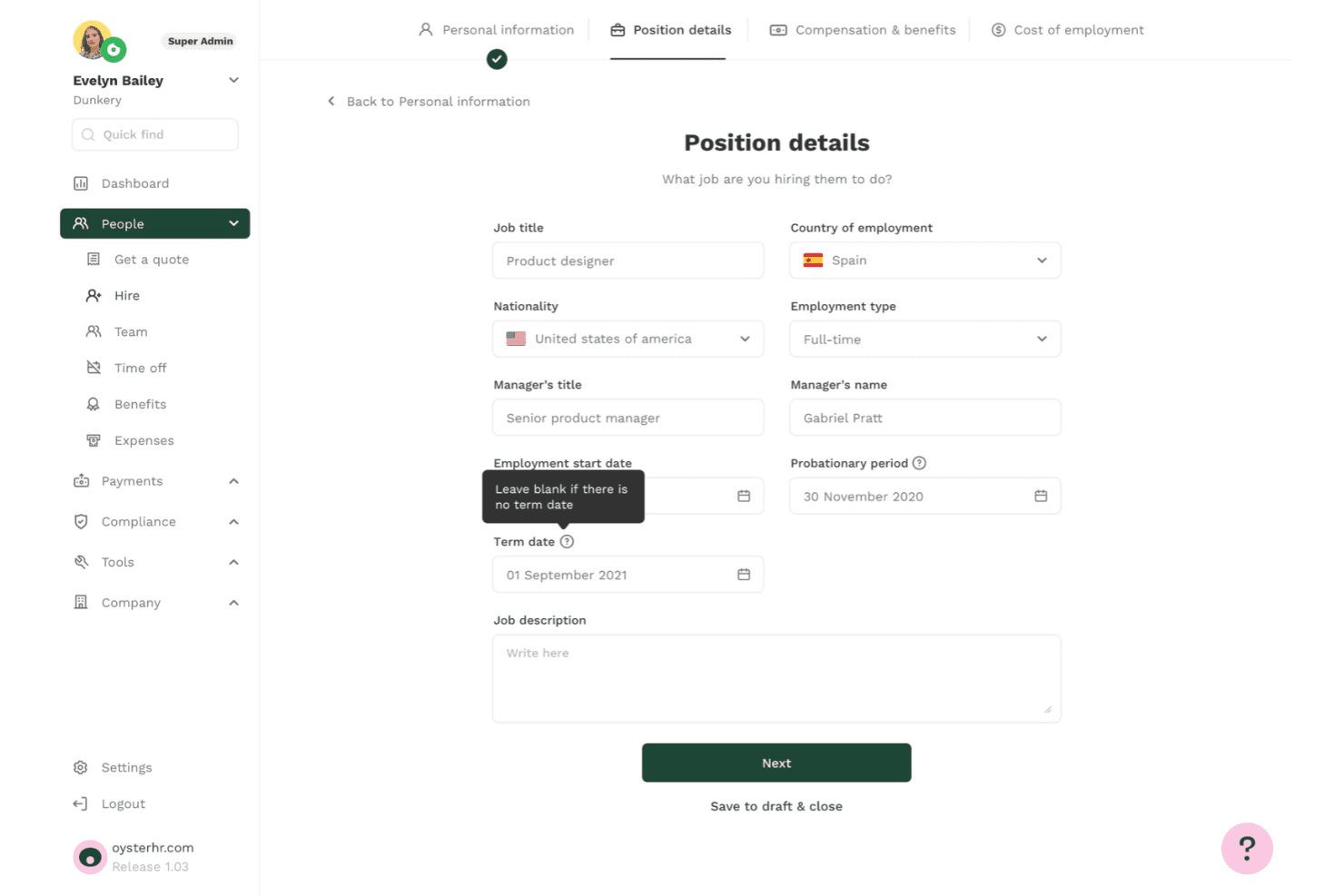
Oyster lets users define job title, nationality, and term date when hiring. Oyster is an employer of record platform that lets you hire, pay, and manage full-time employees in Lebanon without setting up a local entity, handling contracts, payroll, statutory benefits, and offboarding through a single dashboard.
Who Is Oyster Best For?
Oyster is a strong fit for early-stage startups hiring their first employees in Lebanon, thanks to per-hire discounts that reduce EOR costs by up to $1,200 per hire in the first year.
Why I Picked Oyster
I've included Oyster in my top picks because its startup discount program directly reduces EOR costs by up to $1,200 per hire in the first year, which matters when you're hiring your first employee in Lebanon and every dollar counts. I particularly like that this applies with no minimum headcount, so even a single hire qualifies. Oyster also handles Lebanon's mandatory end-of-service indemnity contributions and termination notice requirements automatically, with offboarding specialists included at no extra fee.
Oyster Key Features
- Multi-country dashboard: Manage hiring, payroll, time off, expenses, contracts, and documents for Lebanon and other countries from a single interface.
- Contractor-to-EOR conversion: A built-in misclassification analyzer and step-by-step conversion plan guides you through switching contractors to compliant employment.
- Zapier integration: Connect Oyster to 5,000+ apps via Zapier, alongside native integrations with tools like BambooHR, Greenhouse, HiBob, and ADP Workforce Now.
- Role-based access control: Assign team manager, administrator, payroll, or expenses roles to control who can view and action employee data.
Oyster Integrations
Oyster documents connections with BambooHR, Greenhouse, HiBob, Slack, Carta, Xero, and QuickBooks. API and Zapier options support additional workflows; data coverage varies by connection.
Pros and Cons
Pros:
- Offboarding specialists handle Lebanon exits
- Automated payroll covers Lebanese deductions
- Reviewers praise quick onboarding and responsive support
Cons:
- Banking disruption plans aren't documented
- Lebanon entity or partner remains undisclosed
Learn more about Oyster: Best for moving hires from EOR to your entity
- Free demo available
- From $599/per employee/month
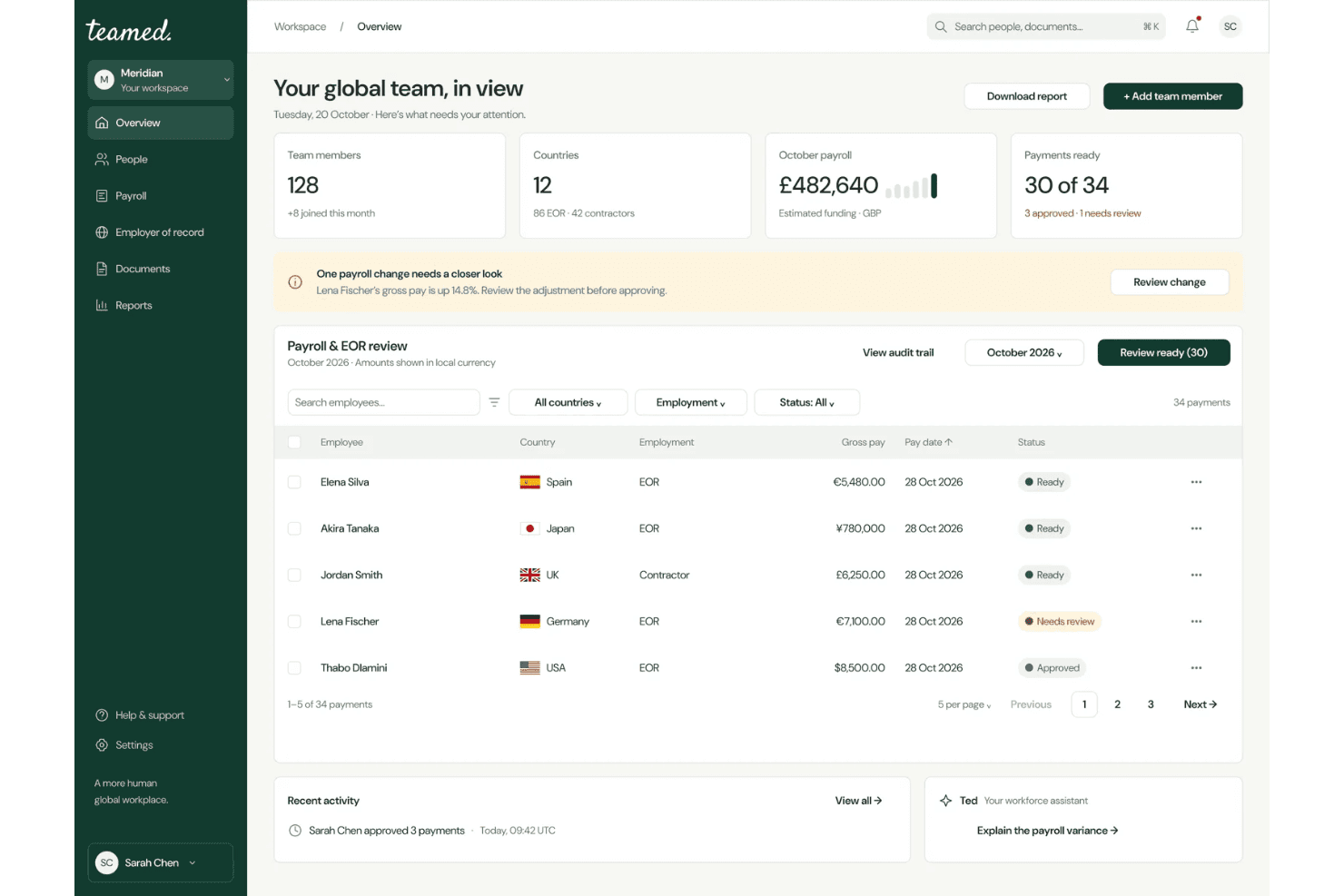
Teamed centralizes global payroll and EOR oversight in one dashboard. Teamed is an employer of record platform that handles Lebanese payroll, NSSF administration, locally compliant employment contracts, and statutory benefits across a single dashboard that also supports contractor management and own-entity payroll.
Who Is Teamed Best For?
Teamed is a good fit for companies that want to hire in Lebanon through an EOR and then move those workers onto their own entity as headcount grows.
Why I Picked Teamed
I've included Teamed in my top picks because its "Graduation Model" makes the EOR-to-entity transition genuinely smooth: workers keep their tenure and records intact, and Teamed proactively contacts you within five business days once setting up your own entity becomes cheaper than continuing on EOR. I also like that Lebanon-specific contract drafting is handled by local legal partners under the Labour Code, not pulled from a template, and that NSSF rates are confirmed per role before you sign anything.
Teamed Key Features
- NSSF rate confirmation per role: Teamed confirms current National Social Security Fund (NSSF) employer contribution rates for each role before payroll starts, since rates change by decree.
- Contractor-to-EOR conversion: Teamed converts existing contractor relationships to EOR arrangements without re-onboarding or losing prior work history.
- Misclassification cover: Teamed Guard and Teamed Protect provide financial cover if a contractor engagement is reclassified as employment under Lebanese law.
- Multi-currency payroll with zero FX markup: Teamed runs payroll in Lebanese pounds (LBP) or USD and applies the mid-market rate with no markup, itemised on every invoice.
Teamed Integrations
Teamed documents a Personio integration and lists connections with BambooHR, HiBob, Workday, Slack, Xero, QuickBooks, Greenhouse, Okta, and Zapier.
Pros and Cons
Pros:
- Publishes a zero-FX-markup policy
- Offers EOR and own-entity payroll services
- Supports EOR-to-entity planning
Cons:
- Personio leave syncing requires configured leave policies
- Requires an employment-cost deposit
Learn more about Teamed: Best for switching from another EOR
- Free demo available
- From $199/employee/month
Visit WebsiteCustomer Rating:5/5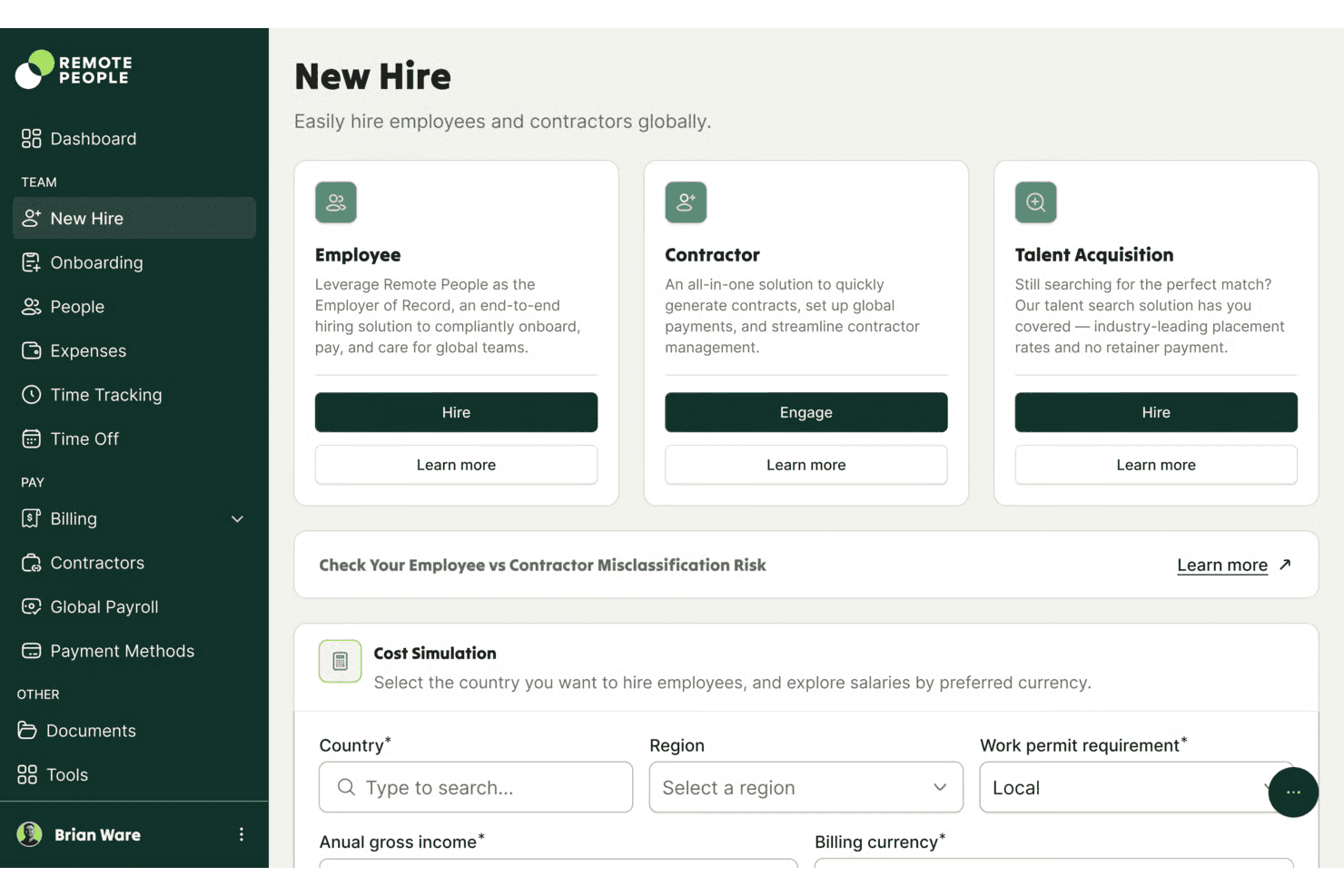
Remote People lets users hire employees, contractors, or find talent globally. RemotePeople is a global employer of record platform that handles payroll, statutory benefits, local contracts, and compliance for companies hiring in Lebanon without a local entity.
Who Is RemotePeople Best For?
RemotePeople is a good fit for companies already using another EOR that want to switch providers without losing momentum, thanks to its dedicated EOR Switch program.
Why I Picked RemotePeople
I've included RemotePeople in my top picks because its dedicated EOR Switch program makes it a practical choice if you're already locked into another provider. The program covers up to 12 months of fee payback and handles migration in roughly two weeks, so you're not stuck absorbing exit costs or losing ground on compliance continuity in Lebanon. I also like that it backs the switch with a 30-day money-back guarantee, which removes some of the risk when moving employees mid-contract.
RemotePeople Key Features
- Arabic payslip generation: RemotePeople produces Arabic-language payslips as required under Lebanese labor law, alongside monthly payroll tax declarations.
- NSSF administration: The platform handles National Social Security Fund registration and contribution calculations, covering sickness, maternity, family allowances, and end-of-service indemnity.
- Work permit support: RemotePeople manages Lebanese work permit applications and renewals for foreign nationals, priced per case.
- Multi-country dashboard: A single platform covers EOR, contractor management, and payroll across 150+ countries, with compliance records maintained in one place.
RemotePeople Integrations
RemotePeople documents HRIS connections with BambooHR, HiBob, Personio, Dayforce, and Workday. It also offers an open API for custom integrations, but no public directory lists a total integration count.
Pros and Cons
Pros:
- EOR Switch supports migration from another provider
- Reviewers praise responsive, helpful support
- Arabic payslips support local payroll administration
Cons:
- Conflicting NSSF rates weaken payroll confidence
- Lebanese entity ownership remains undisclosed
Learn more about RemotePeople: Best for Lebanon-specific compliance planning
- Free demo available
- From $349/employee/month
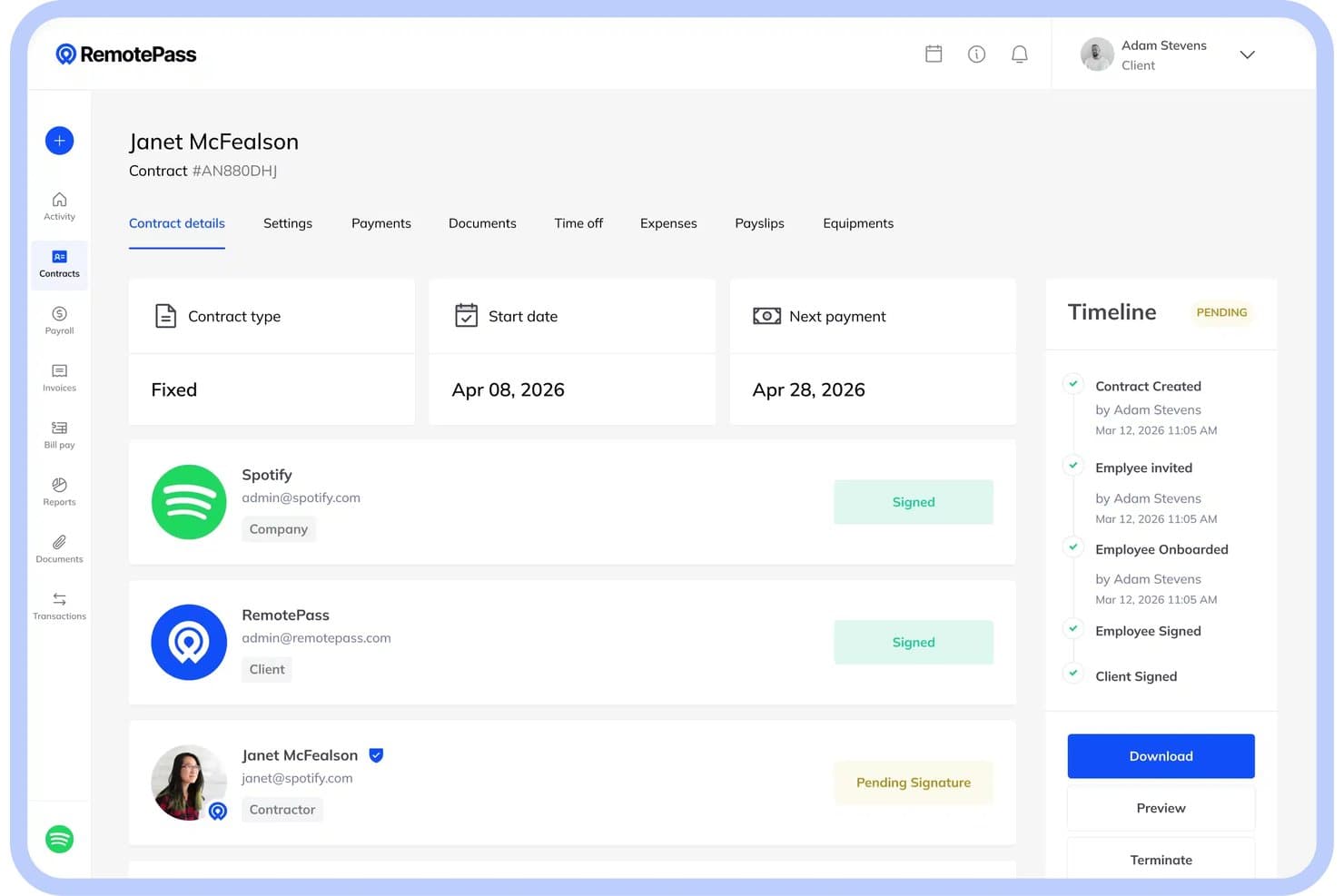
RemotePass displays contract signing status and timeline for contractors. RemotePass is an employer of record platform that handles legal employment, payroll processing, tax withholding, NSSF contributions, and contract generation for companies hiring in Lebanon without a local entity.
Who Is RemotePass Best For?
RemotePass is a strong fit for companies navigating Lebanon's layered payroll, NSSF, and tax obligations for the first time.
Why I Picked RemotePass
I picked RemotePass as one of the best because its Lebanon-specific compliance documentation goes deeper than most EOR platforms I've reviewed. It maps out the full NSSF contribution structure, including the 8.5% employer contribution for end-of-service indemnity and the 3% employee medical contribution, alongside progressive income-tax withholding and the USD-to-LBP conversion at the official rate of LBP 89,500. It also handles Arabic-language contract generation aligned with the Lebanese Labour Code, which is a requirement many platforms gloss over.
RemotePass Key Features
- One-click payroll: Submit payroll details and salary adjustments for all Lebanon-based employees through a single monthly invoice and payment.
- Visa and work-permit sponsorship: RemotePass acts as the registered Lebanese sponsor, managing the six-step Ministry of Labour approval and work-permit application process for foreign nationals.
- Background check integration: Request individual or bulk Certn SoftCheck screenings for EOR employees directly through the platform, available for Lebanon-based hires.
- Multi-entity account management: Administrators can add and switch between multiple entities under one account, with role-based contract access controls per entity.
RemotePass Integrations
RemotePass lists connections with Wafeq, NetSuite, Xero, QuickBooks, BambooHR, HiBob, Google Workspace, and Slack. It also provides REST API, webhooks, and Zapier options. Google Workspace functionality includes authentication, so it should not automatically be described as a payroll-data integration.
Pros and Cons
Pros:
- Local employer sponsorship avoids entity setup
- Reviewers report dependable payroll and responsive onboarding
- Detailed Lebanon payroll and NSSF guidance
Cons:
- Lebanese employing entity ownership remains undisclosed
- Some reviewers report delayed salary transfers
Learn more about RemotePass: Best for audited contractor-to-employee moves
- Free demo available
- From $399/employee/month
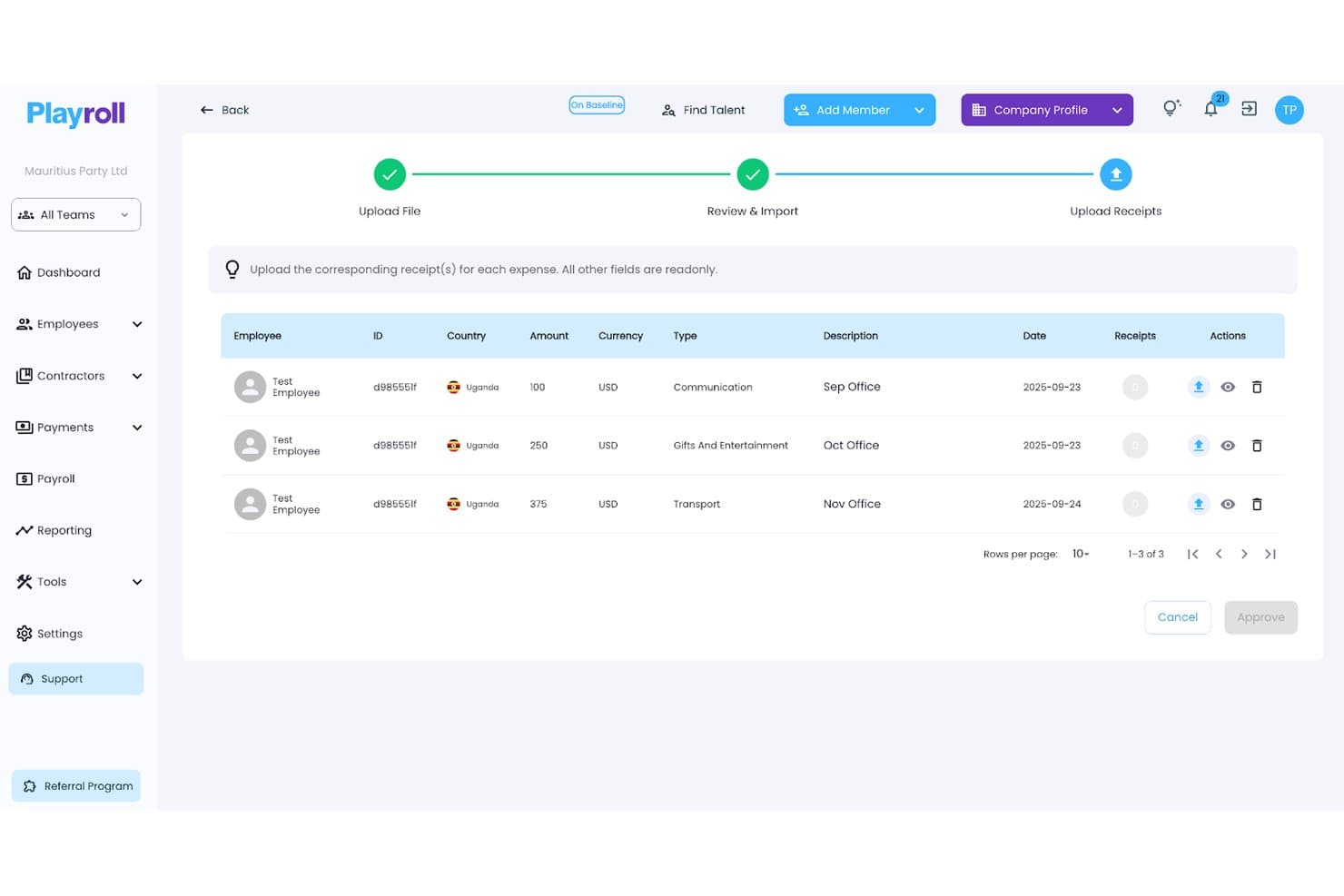
Playroll lets users upload receipts for bulk-imported expenses. Playroll is an employer of record platform covering 180+ countries—including Lebanon—that handles local contract generation, NSSF registration, payroll processing, statutory benefits administration, and contractor-to-employee conversion.
Who Is Playroll Best For?
Playroll is a strong fit for startups and small teams making their first hire in Lebanon who want flat, predictable pricing and a clear path from contractor to full employee.
Why I Picked Playroll
I've included Playroll in my top picks because it's the only platform I've seen that pairs EOR coverage in Lebanon with a built-in, audited contractor-to-employee conversion service. When you're ready to convert a Lebanese contractor to a full employee, Playroll runs a misclassification audit, handles the data migration, and manages white-glove onboarding, all in one workflow. It also generates bilingual Arabic-English contracts that cover probation, notice periods, and end-of-service indemnity from day one.
Playroll Key Features
- Bilingual contract generation: Playroll drafts Arabic-English employment contracts covering probation periods, notice terms, and end-of-service indemnity under Lebanese labor law.
- NSSF registration and remittance: Playroll handles National Social Security Fund (NSSF) registration, monthly wage declarations, and employer contribution filings on your behalf.
- Multi-country unified dashboard: A single dashboard gives you visibility into employees, contractors, and payroll across 180+ countries, with role-based access for unlimited admins.
- Dedicated customer and employee success managers: Every account includes a named Customer Success Manager and Employee Success Manager at no additional cost.
Playroll Integrations
Playroll documents integrations with BambooHR, HiBob, and Expensify. It also offers a custom or open API for connecting other HR and payroll systems.
Pros and Cons
Pros:
- Reviewers often praise responsive customer support
- Lebanon contracts cover local statutory terms
- Contractor conversions include misclassification audits
Cons:
- Published NSSF and tax figures conflict
- Lebanese employing entity remains undisclosed
Learn more about Playroll: Best for planning Lebanon NSSF and tax costs
- Free demo available
- From $549/employee/month
Visit WebsiteCustomer Rating:4.8/5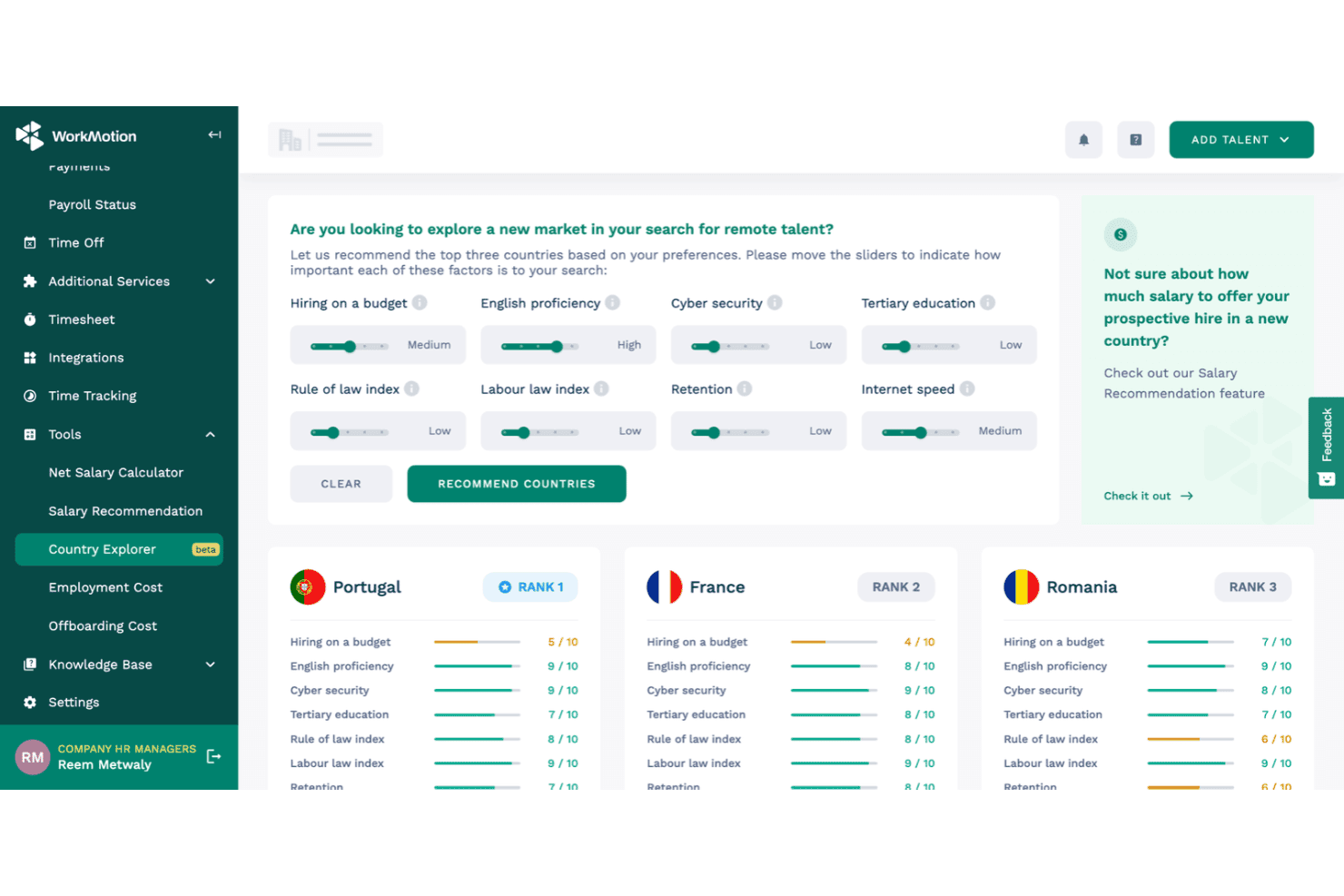
WorkMotion's Country Explorer recommends top remote hiring markets. WorkMotion is a Berlin-based employer of record platform that hires workers in Lebanon through a local partner network, handling NSSF registration, monthly LBP payroll, bilingual Arabic/English contracts, and statutory benefits administration across 160+ countries from a single dashboard.
Who Is WorkMotion Best For?
WorkMotion suits startup founders and small teams who want to hire in Lebanon fast, without entity setup, and need clear NSSF and tax cost breakdowns upfront.
Why I Picked WorkMotion
I picked WorkMotion as one of the best because its Lebanon country page gives you a genuinely detailed NSSF cost breakdown before you commit, showing exactly how the ~22.5% employer contribution splits across sickness, family benefits, and end-of-service indemnity. I also like that it documents the 2025 minimum wage update (LBP 28M per month) and flags the upcoming 2026 pension shift under Law 319, so you're not caught off guard by compliance changes mid-hire. Bilingual Arabic/English contracts generated from legally reviewed templates round out the planning picture.
WorkMotion Key Features
- Bilingual contract generation: Produces Arabic/English employment contracts built from legally reviewed Lebanese templates, covering probation terms, fixed-term rules, and overtime requirements.
- Multi-country dashboard: Manages onboarding, payroll, time off, expenses, documents, and offboarding across 160+ countries from a single platform with one monthly invoice.
- Offboarding cost calculator: Estimates severance, accrued vacation, and notice period costs for Lebanon before you initiate a termination, with a country offboarding guide included.
- HR system integrations: Connects with platforms including BambooHR, HiBob, Personio, Workday, and Factorial so your existing HR stack stays in sync with EOR activity.
WorkMotion Integrations
WorkMotion lists connections with BambooHR, HiBob, Personio, Workday, Factorial, ADP Workforce Now, and UKG Pro. The supported fields and workflows vary by integration.
Pros and Cons
Pros:
- Bilingual contracts cover Lebanese employment rules
- Reviewers praise responsive support during onboarding
- Lebanon page details NSSF rates and caps
Cons:
- LBP-only payroll leaves currency disruption exposed
- Unnamed local partner limits employer transparency
Learn more about WorkMotion: Best for guaranteed pay dates amid bank limits
- Free demo available
- From $29/user/month
Visit WebsiteCustomer Rating:4.4/5
Papaya Global tracks employer costs by country, category, and cost center. Papaya Global is an employer of record and global payroll platform that covers Lebanon-based hiring, payroll processing, statutory benefits administration, and termination compliance without requiring you to set up a local entity.
Who Is Papaya Global Best For?
Papaya Global is a strong fit for mid-market and enterprise teams managing employees across multiple countries who need a single platform to handle Lebanon payroll alongside other markets.
Why I Picked Papaya Global
I picked Papaya Global as one of the best because its licensed payment infrastructure directly addresses Lebanon's banking instability. Papaya holds its own payment rails through J.P. Morgan and Citi, and it backs every pay run with a contractual land date guarantee, so employees actually receive pay on the committed date regardless of local banking disruptions. I also find the termination liability guarantee notable: Papaya puts legal-cost caps in writing, which matters in Lebanon's complex severance environment.
Papaya Global Key Features
- Workforce OS dashboard: A unified platform that shows real-time payroll, compliance alerts, and employment status across all countries, including Lebanon, in one view.
- Automated statutory payments: The platform calculates and processes NSSF contributions and income tax withholdings according to Lebanon's published filing deadlines and rates.
- Auto-generated country-specific contracts: The platform produces employment contracts aligned to local requirements, with support for Arabic and French translations needed for work permits.
- Enterprise HRIS integrations: Native connections to Workday, SAP SuccessFactors, BambooHR, and 15+ other systems let your existing HR stack feed directly into Lebanon payroll runs.
Papaya Global Integrations
Papaya Global lists connections with enterprise HR systems including Workday, SAP SuccessFactors, Oracle HCM, BambooHR, HiBob, and UKG.
Pros and Cons
Pros:
- Contractual termination liability caps address exposure
- Lebanon filing deadlines and NSSF rules documented
- Responsive account managers support payroll questions
Cons:
- Urgent requests can receive slow responses
- Lebanon legal-employer entity remains undisclosed
Learn more about Papaya Global:
Outros empregadores legais no Líbano
Eis algumas opções adicionais que não entraram na minha lista restrita, mas que ainda vale a pena consultar:
- 11Payoneer Workforce ManagementBest for paying Lebanon hires in LBP or USD
- 12RemoteBest for USD or local-currency pay
- 13G-PBest for teams with strict access controls
- 14RemoFirstBest for hiring without long-term commitments
- 15Borderless AIBest for AI help with HR and entity operations
- 16INS GlobalBest for quick market tests with a listed fee
- 17Mauve GroupBest for hiring and planning market entry
- 18Global ExpansionBest for gauging local entity break-even
- 19Acumen InternationalBest for adviser-led HR in complex markets
- 20Newton WorkforceBest for hiring under a locally licensed employer
How I Evaluate Employers of Record in Lebanon
I split my evaluation into three parts. First, core functionality—can the provider legally employ workers in Lebanon and process compliant payroll with NSSF deductions—this carries the most weight. Second, I look for standout features like multi-currency pay support. Third, I consider pricing transparency and regulatory monitoring.
Core Functionality (Table Stakes for This List)
When I'm selecting tools for my list, I score each one on a scale from 0 (does not offer the functionality) to 5 (excels in this area) for each core functionality listed below. I then convert the total into a percentage to help assess each tool's overall fit, with extra weight on any functionalities I've deemed essential.
- Legal Entity in Lebanon (Essential): I check whether the provider owns a local entity or uses a disclosed partner, and how much visibility you get into that arrangement.
- Compliant Payroll Processing (Essential): I evaluate how each provider handles salary calculations, NSSF contributions, and tax filings, looking for automation over manual workarounds.
- Local Contract Generation: Each provider should produce Lebanon-specific employment contracts that reflect statutory terms, not just a generic template with a country name swapped in.
- Statutory Benefits Administration: I look at whether the platform tracks NSSF contributions, end-of-service indemnity, and leave entitlements together rather than requiring you to manage pieces separately.
- Multi-Country Platform Visibility: A unified dashboard matters when you're managing Lebanon hires alongside teams in other countries and need payroll and compliance data in one view.
- Termination and Offboarding Compliance: I evaluate whether the provider calculates notice periods and severance in line with Lebanese labor law or only offers general guidance.
Once I have a list of tools that meet the criteria, I consider what sets each platform apart.
Differentiating Factors (What Sets Vendors Apart)
Here's how I compare and contrast different vendors:
Standout Features
Multi-currency payment support matters a lot in Lebanon's dual-currency economy. I check whether a provider can pay in Lebanese pounds or USD and how they handle switches between the two. Contractor-to-EOR conversion is another area I evaluate closely. If you already have contractors in Lebanon, the provider should move them into compliant employment without gaps in pay or coverage. I also look at how fast a provider can onboard a new hire, since pre-built contract templates and local entity infrastructure can cut setup from weeks to days.
Beyond Features
I check how each provider handles salary disbursement when Lebanese banks delay transfers or impose withdrawal caps. A clear contingency plan for payment disruptions matters more here than in most markets. I also evaluate whether regulatory updates are proactively pushed to clients, since Lebanon's labor law and NSSF rules can shift with little warning and a missed change can expose your company to penalties.
Como escolher um empregador legal no Líbano
Escolha um fornecedor testando a forma como trata as obrigações relativas à NSSF e aos impostos no Líbano, as opções monetárias e as interrupções nos pagamentos antes de assumir um compromisso.
| Se a sua prioridade for… | Procure… |
|---|---|
| Se a sua prioridade for…Descontos salariais precisos | Procure…Um recibo de vencimento de exemplo do Líbano que mostre o vencimento bruto e líquido, as contribuições para a NSSF e o tratamento fiscal |
| Se a sua prioridade for…Clareza sobre quem emprega os seus trabalhadores | Procure…Uma declaração escrita do empregador legal e de qualquer parceiro local |
| Se a sua prioridade for…Pagamento previsível dos salários | Procure…Um plano de pagamento escrito em LBP ou USD, incluindo o que acontece se uma transferência bancária falhar |
| Se a sua prioridade for…Menos surpresas quando as regras mudam | Procure…Um exemplo datado de uma atualização regulamentar e da forma como foi comunicada aos clientes |
Como avaliar a sua lista restrita
- Analise um documento salarial: Peça um recibo de vencimento anonimizado do Líbano e as respetivas notas de cálculo; verifique como apresenta as contribuições para a NSSF e as deduções fiscais.
- Confirme o modelo de contratação: Peça por escrito o nome do empregador legal, a função de qualquer parceiro e um exemplo de contrato de trabalho do Líbano.
- Teste o plano de pagamento: Peça ao fornecedor que documente um pagamento salarial previsto em LBP ou USD, o respetivo percurso de transferência e a alternativa prevista para uma transferência atrasada ou rejeitada.
- Verifique um caso de saída: Dê ao fornecedor uma data de cessação de exemplo e peça uma explicação escrita de como avaliaria o aviso prévio, as férias e os montantes devidos no final do serviço.
- Escolha o seu modelo operacional: Utilize uma grelha de avaliação com duas colunas para ponderar o tratamento centrado no Líbano face à administração centralizada em vários países; dê prioridade ao detalhe local ou a um processo partilhado com base nas necessidades da sua equipa.
O que são os empregadores legais no Líbano?
Um empregador de registo no Líbano é um terceiro que emprega legalmente os seus trabalhadores contratados localmente e gere a administração laboral em seu nome. Pode tratar dos contratos de trabalho, dos salários e de obrigações como as contribuições para o NSSF e as retenções fiscais. A sua empresa orienta o trabalho diário dos trabalhadores, enquanto o EOR gere o seu emprego formal.
Características
Eis as principais características que procuro num empregador de registo no Líbano:
- Entidade empregadora local: O EOR deve identificar o empregador legal dos seus trabalhadores contratados e divulgar qualquer parceiro local. Isto permite saber quem assina os contratos e assume as responsabilidades formais enquanto empregador.
- Processamento salarial em conformidade: O processamento salarial deve calcular o salário, as contribuições para o NSSF e as retenções fiscais aplicáveis utilizando as regras específicas do Líbano. Os recibos de vencimento claros e os registos dos cálculos ajudam a sua equipa a verificar o valor bruto e líquido.
- Contratos de trabalho locais: O prestador deve preparar contratos que reflitam os termos legais libaneses e as condições de trabalho acordadas. Isto proporciona aos trabalhadores e à sua empresa um registo escrito claro do acordo.
- Gestão das prestações legais: O EOR deve acompanhar as contribuições para o NSSF, os direitos a férias e a indemnização por cessação do serviço, quando aplicável. Manter estas obrigações reunidas ajuda a sua equipa a monitorizar os custos e os direitos dos trabalhadores.
- Pagamentos em várias moedas: O prestador deve explicar se pode pagar os salários em libras libanesas ou dólares americanos e como são geridas as alterações cambiais. Confirme os meios de transferência e os procedimentos alternativos para pagamentos atrasados ou rejeitados.
- Integração dos trabalhadores: O EOR deve recolher as informações necessárias dos trabalhadores, preparar os documentos contratuais e configurar o processamento salarial antes da data de início. Um processo de integração definido ajuda a evitar registos em falta ou o atraso no primeiro pagamento.
- Apoio à cessação e à saída: O prestador deve explicar como avalia o aviso prévio, as férias não gozadas e os valores devidos no final do serviço ao abrigo dos requisitos libaneses. Solicite um cálculo escrito para uma data de cessação exemplificativa.
- Atualizações regulamentares: O EOR deve notificar os clientes quando as regras laborais, fiscais ou do NSSF relevantes forem alteradas e explicar o efeito prático. As notificações datadas ajudam a sua equipa de RH a manter os processos e os registos dos trabalhadores atualizados.
Vantagens
Eis algumas vantagens comuns que pode esperar ao utilizar um empregador de registo no Líbano:
- Contratação local sem uma entidade: Um EOR pode atuar como empregador legal no Líbano, permitindo que a sua empresa contrate localmente sem constituir a sua própria entidade empregadora.
- Administração salarial específica do Líbano: O apoio ao processamento salarial pode abranger os cálculos salariais, as contribuições para o NSSF e as retenções fiscais aplicáveis.
- Documentação laboral clara: Os contratos de trabalho locais podem definir os termos legais e as condições acordadas para a sua empresa e para os trabalhadores.
- Obrigações legais coordenadas: Um prestador pode acompanhar as contribuições para o NSSF, os direitos a férias e a indemnização por cessação do serviço num único local.
- Acompanhamento integrado de vários países: Os prestadores com um painel de controlo unificado podem apresentar as informações salariais e de conformidade do Líbano juntamente com os dados de outros países.
- Mais opções de pagamento: Os prestadores que aceitam pagamentos em LBP ou USD podem explicar os meios de transferência e os procedimentos alternativos para transferências bancárias atrasadas ou rejeitadas.
Preços
Os preços variam consoante o prestador, o número de trabalhadores e o âmbito dos serviços. As taxas de um empregador de registo no Líbano situam-se geralmente entre $300 e $800 por trabalhador por mês.
Tabela de comparação de planos para empregadores de registo no Líbano
Estes são intervalos indicativos das taxas mensais de serviço, não nomes de planos normalizados. Os prestadores de EOR normalmente não disponibilizam um plano gratuito.
| Tipo de plano | Preço médio | Características comuns |
|---|---|---|
| Tipo de planoPlano gratuito | Preço médio$0 (normalmente não disponibilizado) | Características comunsNão inclui serviços de emprego através de um EOR, administração salarial ou gestão das prestações legais. |
| Tipo de planoPlano pessoal | Preço médio$300–$400 por trabalhador/mês | Características comunsContratos de trabalho locais, processamento salarial e administração legal básica. |
| Tipo de planoPlano empresarial | Preço médio$400–$600 por trabalhador/mês | Características comunsProcessamento salarial, gestão das prestações legais e apoio à cessação. |
| Tipo de planoPlano empresarial de grande dimensão | Preço médio$600–$800 por trabalhador/mês | Características comunsVisibilidade da plataforma em vários países, atualizações regulamentares e apoio dedicado. |
Perguntas frequentes
Eis as respostas às perguntas mais comuns sobre empregadores de registo no Líbano:
Pode um EOR contratar cidadãos estrangeiros no Líbano?
Possivelmente, mas a nacionalidade, o estatuto de residência e a função podem afetar a elegibilidade. Peça ao prestador que confirme quais os documentos de autorização de trabalho ou de residência de que o trabalhador necessita antes de definir uma data de início. Esclareça também se o EOR trata dos pedidos de autorização ou apenas verifica os documentos fornecidos pela sua equipa. Não considere um contrato de trabalho assinado como autorização para trabalhar. Confirme o processo e os prazos por escrito, especialmente se a pessoa contratada já estiver no Líbano ou precisar de se mudar para o país. Se o prestador não conseguir explicar qual é o seu papel, procure aconselhamento em matéria de imigração antes de prometer uma data de início.
Posso utilizar um EOR para uma contratação de curta duração no Líbano?
Sim, um EOR pode ser adequado para uma contratação por tempo limitado, mas a duração do contrato e o plano de saída devem ser cuidadosamente analisados. Pergunte como o prestador documenta a duração do contrato, os termos do período experimental, o aviso prévio, as férias e os cálculos relativos ao fim do serviço. Não parta do princípio de que uma data fixa para o fim do projeto termina automaticamente a relação laboral sem outras diligências. Solicite o processo de saída por escrito do prestador e uma estimativa de custos exemplificativa antes de orçamentar a função. Isto ajuda a comparar a opção do EOR com a constituição de uma entidade local ou com a utilização de outro modelo legal de contratação.
Posso transferir posteriormente os trabalhadores de um EOR para a minha própria entidade no Líbano?
Sim, pode planear uma transição, mas não parta do princípio de que o contrato ou o historial de serviço do trabalhador são transferidos automaticamente. Pergunte ao EOR e ao advogado local como documentariam a mudança de empregador, tratariam as férias acumuladas e os direitos relativos ao fim do serviço, e coordenariam quaisquer registos da NSSF ou da folha salarial. Chegue a acordo quanto ao calendário, à comunicação com o trabalhador e à responsabilidade pelos montantes acumulados antes da transferência. Formalize o processo por escrito antes de constituir a entidade ou de definir uma data de transferência. Isto ajuda a evitar falhas no processamento salarial ou obrigações do empregador pouco claras.