

Os softwares de gestão de viagens de negócios ajudam a sua equipa a reservar viagens, acompanhar despesas e gerir as políticas de viagens da empresa num único local. Se a sua empresa está a crescer ou gere pedidos frequentes de viajantes, sabe como os voos, os hotéis e as despesas podem rapidamente ficar fora de controlo. A plataforma certa proporciona-lhe uma visão clara, desde aprovações e alertas em tempo real até relatórios automatizados, para que possa manter as viagens seguras, os orçamentos corretos e os colaboradores satisfeitos durante as deslocações. Neste guia, encontrará as principais ferramentas de que precisa para simplificar a gestão de viagens, garantir a conformidade e obter o melhor valor em cada viagem de negócios em 2026.
Why Trust Our Software Recommendations
6,700+
Reviews
20
Industry experts
16+
Evaluation factors
14
Years
Our team has been testing and reviewing software since 2012. As HR experts ourselves, we know how difficult—and important—it is to choose the right software.
For this guide, we evaluated tools using hands-on testing and independent research, scoring tools using our selection criteria. We also draw on insights from industry thought leaders and practicing HR experts.
Our reviews reflect our human editorial judgment, not a sales pitch.
Expert reviewers:
- Phil GrayCOO
 Kim BehnkeHR Tech Editor & Analyst
 Josh BarkerPeople Ops Manager

Tabela comparativa de software de gestão de viagens de negócios
A tabela abaixo compara os detalhes de preços das minhas principais seleções de software de gestão de viagens de negócios.
| Tool | Best For | Trial Info | Price | ||
|---|---|---|---|---|---|
| 1 | Best for card-based travel spend controls | Free plan available; 30-day free trial | From $15/user/month | Website | |
| 2 | Best rapid implementation for growing teams | Free plan available | From $49/month | Website | |
| 3 | Best for redeeming points on business travel | Free plan available | From $12/user/month | Website | |
| 4 | Best unified travel and expense dashboards | Free demo available | Pricing upon request | Website | |
| 5 | Best for built-in rewards and incentives | Free demo available | Pricing upon request | Website | |
| 6 | Best for real-time duty of care monitoring | Free plan available | Pricing upon request | Website | |
| 7 | Best for connected enterprise travel and expense | Free demo available | Pricing upon request | Website | |
| 8 | Best customizable policy controls | Free demo available | Pricing upon request | Website | |
| 9 | Best for broad global travel inventory | Free plan available | From $99/month | Website | |
| 10 | Best for multi-level approval workflows | Free demo available | Pricing upon request | Website |


Análises do melhor software de gestão de viagens de negócios
Abaixo encontram-se os meus resumos detalhados do melhor software de gestão de viagens de negócios que entrou na minha seleção. As minhas análises apresentam uma visão detalhada das funcionalidades, integrações e melhores casos de utilização de cada plataforma, para ajudar a encontrar a melhor opção para si.
 1Best for card-based travel spend controls
Ramp
- Free plan available; 30-day free trial
- From $15/user/month
Visit WebsiteCustomer Rating:4.8/5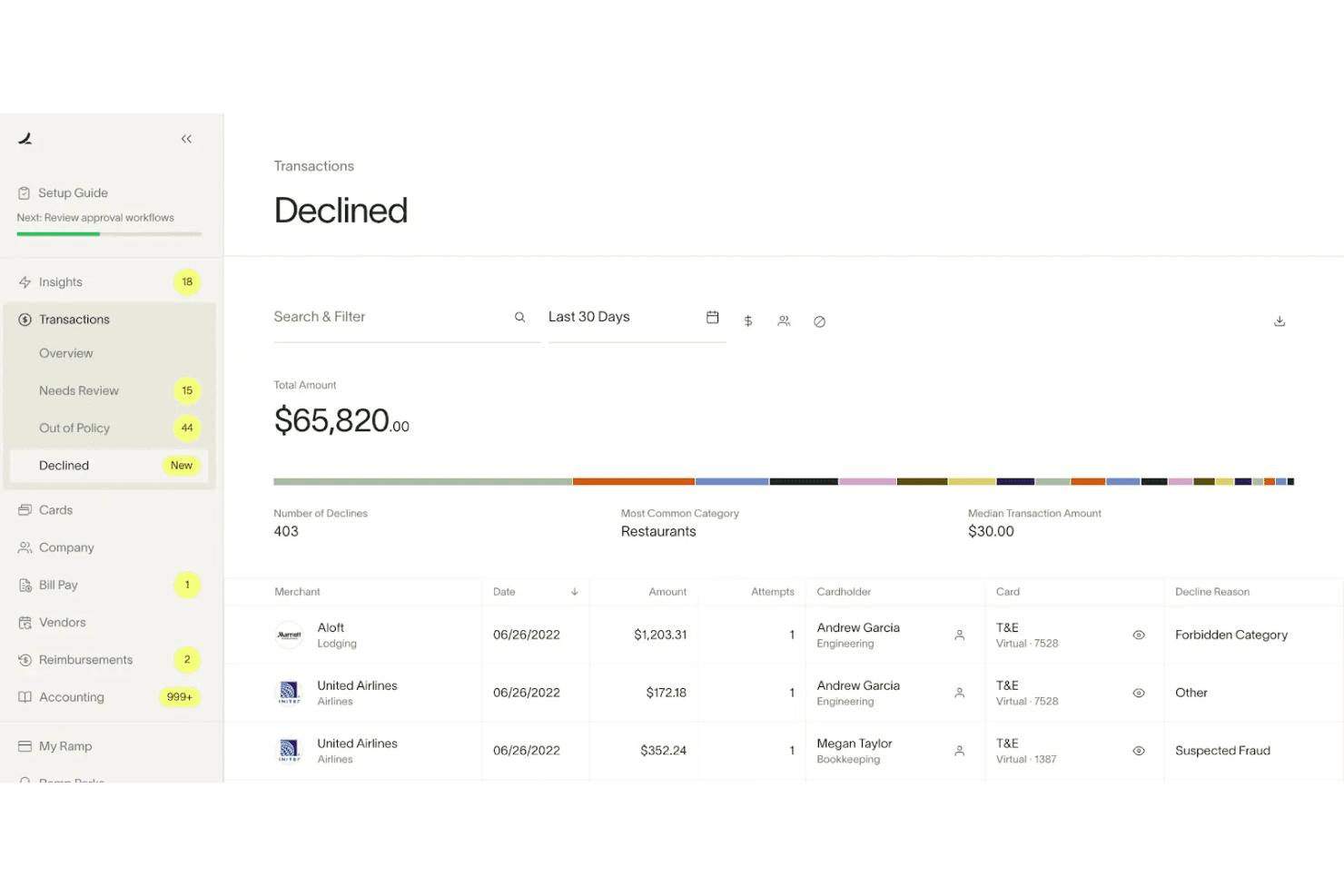
Ramp displays a Declined Transactions dashboard showing 403 declines totaling $65,820, with details on merchants, cardholders, and decline reasons. Ramp is a corporate card and expense management platform that extends into business travel booking, with integrated policy enforcement, automated receipt capture, and spend controls applied directly at the card level.
Who Is Ramp Best For?
Ramp is a strong fit for finance-led teams at SMBs and mid-market companies that want tight spend controls built into their corporate card program.
Why I Picked Ramp
Ramp earns its spot on my shortlist because of how it enforces travel policy directly at the card level. Instead of chasing violations after the fact, Ramp applies spend guardrails at the point of purchase, blocking out-of-policy transactions before they happen. I also like that the booking interface shows real-time policy status on each flight or hotel option, so travelers know what's approved without having to consult a PDF or ask a manager.
Ramp Key Features
- Integrated travel booking portal: Lets employees book flights, hotels, and car rentals within the same platform.
- Policy-compliant booking display: Shows policy status on each travel option while employees search and book.
- Automatic receipt capture: Matches receipts to transactions without manual entry or expense reports.
- HRIS and accounting integrations: Syncs with systems like Workday, NetSuite, QuickBooks, and Xero for unified data management.
Ramp Integrations
Ramp offers native integrations with QuickBooks, Xero, NetSuite, Sage Intacct, Acumatica, Workday, Microsoft Dynamics 365, and Slack, and provides an API for custom integrations.
Pros and Cons
Pros:
- Policy compliance visible while searching flights
- Receipts auto-match without manual expense reports
- Card-level controls block out-of-policy purchases
Cons:
- Travel inventory limited to Priceline content only
- No real-time traveler risk alerts available
Learn more about Ramp: Best rapid implementation for growing teams
- Free plan available
- From $49/month
Visit WebsiteCustomer Rating:4.9/5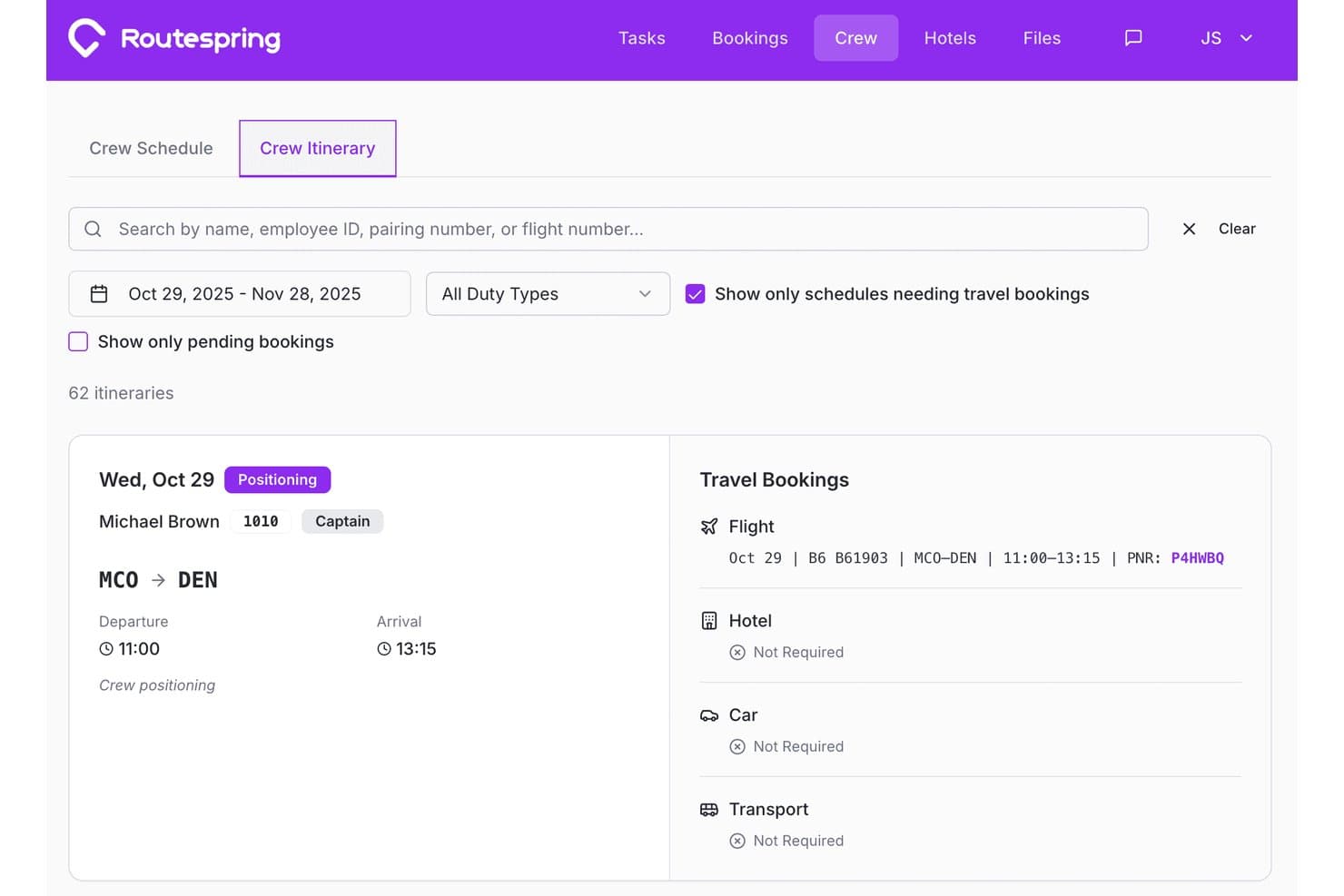
Routespring offers a Crew Itinerary management view that displays positioning schedules, flight bookings, and travel requirements for crew members. Routespring is a corporate travel management platform with self-service booking for flights, hotels, and ground transport, centralized payments, multi-level approval workflows, and travel spend analytics.
Who Is Routespring Best For?
Routespring is a strong fit for mid-market companies and growing teams that need a travel management program up and running quickly without a lengthy implementation.
Why I Picked Routespring
Routespring earns its spot on my shortlist because of how fast a team can go from sign-up to booking. I've seen policy configuration, traveler invitations, and approval workflows set up in a single session. One G2 reviewer rolled it out to 200 employees with just a 30-minute training. I also like the centralized payment model, where every traveler books on a shared corporate card with no expense reports needed.
Routespring Key Features
- Real-time inventory search: Access flights, hotels, and ground transport from a global pool of providers within one booking interface.
- Multi-level approval workflows: Set up tailored approval structures based on department, traveler role, or trip criteria.
- Centralized payments integration: Book all trips using a shared company payment method, eliminating individual card use and reimbursement.
- Live analytics dashboard: Gain instant visibility into travel spend, compliance, and booking patterns across the entire organization.
Routespring Integrations
Routespring offers native integrations with QuickBooks, NetSuite, Oracle Fusion Cloud, Zoho Books, Brex, and Ramp. An API is available for custom integrations.
Pros and Cons
Pros:
- Policy compliance rates are consistently high
- Centralized payments eliminate expense reimbursements
- Fast setup with no lengthy implementation
Cons:
- Reporting dashboard customization is limited
- Lacks real-time traveler safety tracking
Learn more about Routespring: 3Best for redeeming points on business travel
Brex
- Free plan available
- From $12/user/month
Visit WebsiteCustomer Rating:4.5/5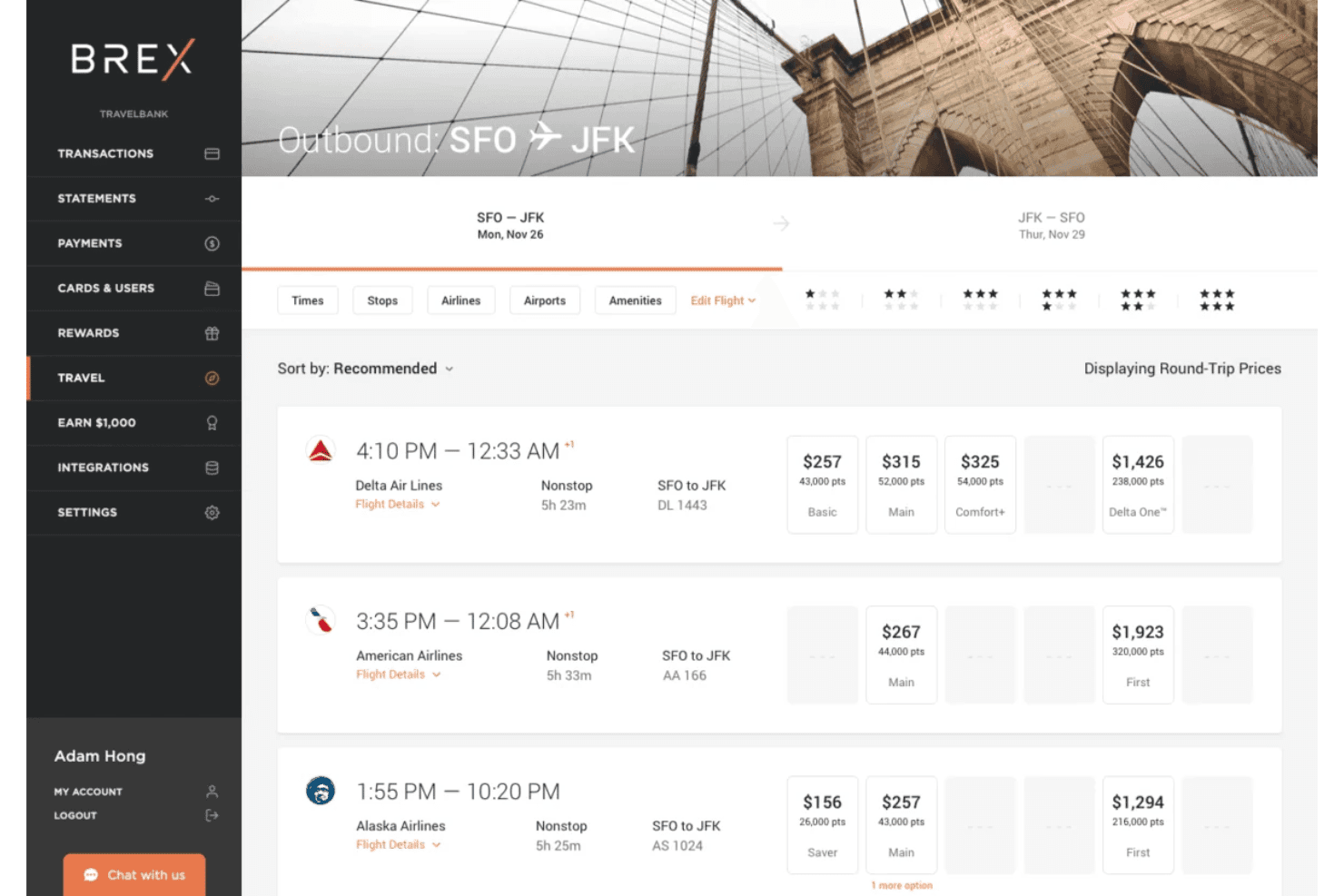
Brex TravelBank offers a flight search interface displaying outbound SFO to JFK routes with pricing tiers and reward points across multiple airlines. Brex is a unified spend platform that combines corporate card management, travel booking, expense automation, and reimbursements in a single system built for startups and mid-market companies.
Who Is Brex Best For?
Brex is a strong fit for VC-backed startups and mid-market companies that want finance-led control over travel booking and expense spending in one place.
Why I Picked Brex
I picked Brex as one of the best because the rewards structure is genuinely built around travel spending. Startups booking through Brex Travel earn 4x points per dollar, and those points redeem directly against travel costs inside the same platform. Brex also gives startups access to negotiated corporate rates typically reserved for large enterprises, so the rewards stack on top of already-reduced pricing.
Brex Key Features
- Multi-modal booking engine: Book flights, hotels, rail, and car rentals with a single search and checkout.
- Embedded policy controls: Set configurable spend limits and enforce travel policies at the point of booking.
- Integrated HRIS and ERP sync: Sync employee profiles, approval chains, and cost centers with major HR and accounting systems.
- 24/7 live travel support: Access experienced travel agents via phone, chat, or email for help with bookings and disruptions.
Brex Integrations
Brex offers native integrations with NetSuite, Sage Intacct, QuickBooks, Rillet, Campfire, Workday, Rippling, ADP, and Gusto. An API is available for custom integrations.
Pros and Cons
Pros:
- Startups access enterprise-level negotiated rates
- Travel and expense managed in one platform
- Earns 4x rewards points on travel bookings
Cons:
- Not available to traditional small businesses
- Limited duty of care tracking capabilities
Learn more about Brex: Best unified travel and expense dashboards
- Free demo available
- Pricing upon request
Visit WebsiteCustomer Rating:4.6/5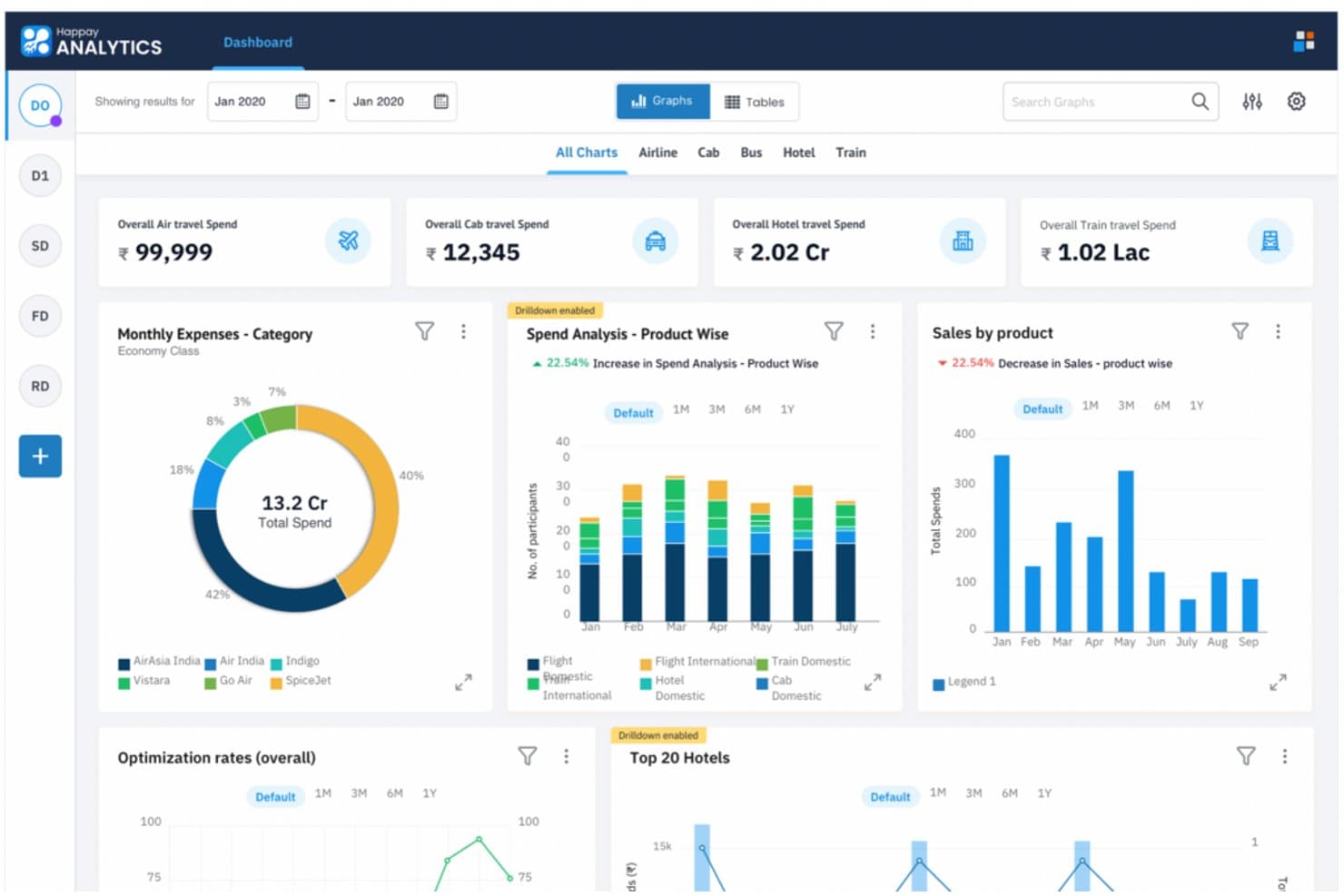
Happay provides an analytics dashboard for tracking air, cab, hotel, and train travel spends with visual charts and spend analysis tools. Happay is an enterprise travel and expense management platform that combines a self-booking tool for flights, hotels, trains, and cabs with multi-level approval workflows, automated expense capture, and real-time spend dashboards.
Who Is Happay Best For?
Happay is a strong fit for enterprise finance and T&E teams in India and APAC markets managing high-volume corporate travel across multiple departments.
Why I Picked Happay
Happay earns its spot as one of the best on my shortlist because of how tightly it connects booking data and expense data inside a single dashboard view. I love the DeepAnalyze feature, which breaks spend down by department, cost center, and booking lead time in real time. I also like that policy violation tracking and cancellation behavior are surfaced in the same view, so I'm not toggling between separate reports to understand where the budget is going.
Happay Key Features
- Self-booking tool: Lets employees book flights, hotels, cabs, trains, and buses directly from one interface.
- AI fare optimization: Uses algorithms to present lowest available fares and lock in prices to prevent surges.
- Credit card integration: Captures and reconciles business expenses automatically from card statements within the platform.
- Multi-vendor inventory: Connects with multiple TMCs and travel suppliers to consolidate travel options in a single system.
Happay Integrations
Happay offers native integrations with leading travel management companies like MakeMyTrip, Riya, Thomas Cook, and FCM Travels, as well as ERP, HRMS, and project management systems. An API is available for custom integrations.
Pros and Cons
Pros:
- Pre-trip approval workflows with fare lock-in
- Multi-modal booking across five transport types
- Unified booking and expense data in one view
Cons:
- Limited global inventory outside India and APAC
- No duty-of-care or traveler safety tracking
Learn more about Happay: Best for built-in rewards and incentives
- Free demo available
- Pricing upon request
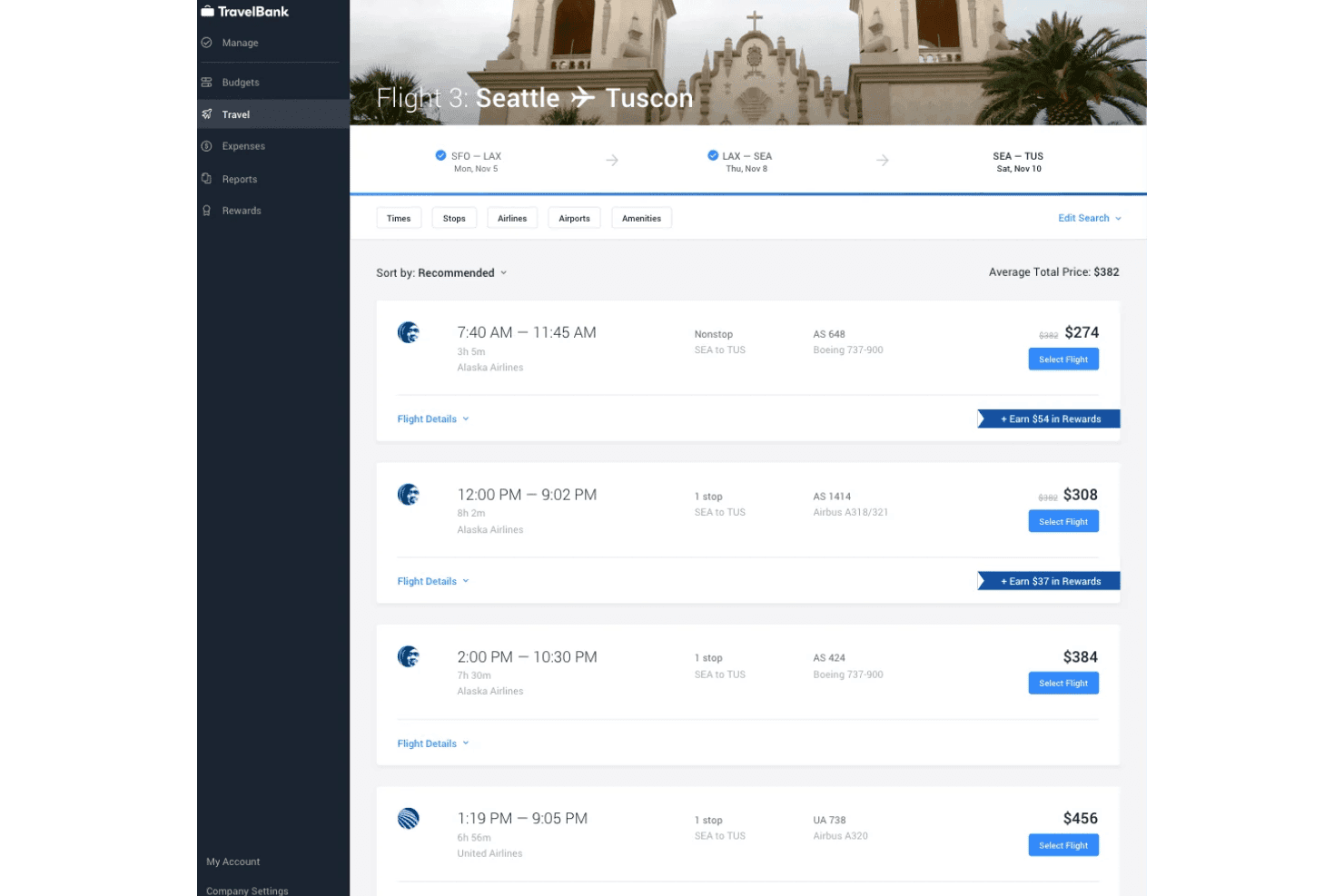
TravelBank displays flight search results for a Seattle to Tucson trip, showing multiple Alaska Airlines options with prices, rewards earnings, and booking filters. TravelBank is an all-in-one travel and expense management platform that combines self-service trip booking, corporate policy enforcement, card reconciliation, and spend reporting in a single interface.
Who Is TravelBank Best For?
TravelBank is a strong fit for mid-market finance and HR teams that manage both travel booking and expense reimbursement and want to consolidate them in one platform.
Why I Picked TravelBank
TravelBank earns its spot on my shortlist because the rewards program is genuinely built into the booking experience, not bolted on. When a traveler books below their policy cap, they earn credits, which means cost-conscious choices get reinforced by real incentives. I also like that policy rules surface at the point of search, prompting users while they're browsing flights and hotels rather than flagging violations after booking.
TravelBank Key Features
- All-in-one travel booking: Book flights, hotels, and car rentals in a unified interface with company policy built in.
- Automated expense tracking: Automatically capture receipts, reconcile card transactions, and create reports from business travel activity.
- Premium insights dashboard: Access customizable reporting on spend, policy compliance, and travel booking trends.
- ERP and accounting integrations: Sync with accounting platforms like QuickBooks Online and NetSuite for expense data transfer.
TravelBank Integrations
TravelBank offers native integrations with QuickBooks Online, QuickBooks Enterprise, NetSuite, Brex, and U.S. Bank. It also integrates with HR systems, supports single sign-on, and provides an API for custom integrations.
Pros and Cons
Pros:
- Policy enforcement at the point of booking
- Unified travel and expense in one platform
- Built-in rewards incentivize under-budget bookings
Cons:
- Named HRIS integrations not clearly documented
- Limited duty of care tracking tools
Learn more about TravelBank : Best for real-time duty of care monitoring
- Free plan available
- Pricing upon request
Visit WebsiteCustomer Rating:4.7/5
Navan displays a detailed flight itinerary page with booking management options, passenger info, and trip planning tools for business travel. Navan is an all-in-one corporate travel and expense platform that covers flight, hotel, rail, and car booking, travel policy enforcement, real-time traveler tracking, and expense reconciliation in a single system.
Who Is Navan Best For?
Navan is a strong fit for travel and expense administrators at mid-size to enterprise companies managing frequent business travel across distributed or global teams.
Why I Picked Navan
I picked Navan as one of the best because its live traveler map gives me real-time visibility into where every employee is at any given moment. When a disruption hits, I can send targeted notifications directly to affected travelers and restrict future bookings to flagged locations without leaving the platform. The native integrations with providers like International SOS and Crisis24 layer in global risk intelligence, so I'm not relying on a separate tool to know when a traveler needs help.
Navan Key Features
- AI-powered booking recommendations: Suggests policy-compliant flight, hotel, and ground transport options tailored to each traveler’s history and preferences.
- Virtual payment card issuance: Generates single-use cards for travel bookings, improving control and transaction reconciliation.
- Unused ticket management: Tracks, applies, and reports on unused airline credits and voided tickets to reduce waste.
- Carbon emissions tracking: Calculates trip-specific CO2 output and displays greener alternatives for sustainability reporting.
Navan Integrations
Navan offers 30+ native integrations with tools like Workday, BambooHR, ADP, Gusto, HiBob, Oracle NetSuite, Sage Intacct, Xero, Concur, and Slack. An API is available for custom integrations.
Pros and Cons
Pros:
- Navan Rewards incentivizes on-policy bookings
- Travel and expense managed in one system
- Built-in live traveler location tracking
Cons:
- Full expense features require a Navan card
- Hotel inventory thinner outside major markets
Learn more about Navan: Best for connected enterprise travel and expense
- Free demo available
- Pricing upon request
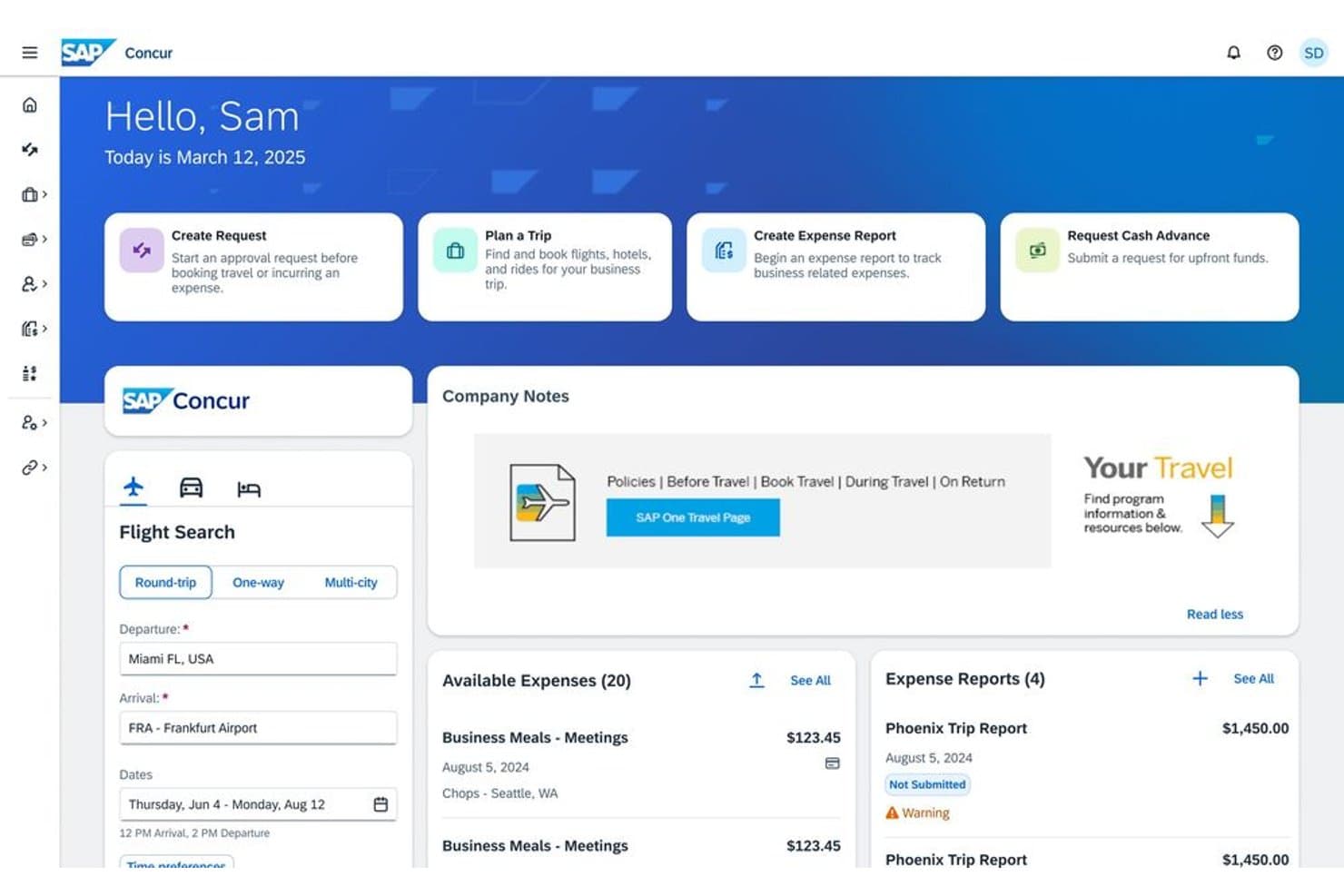
SAP Concur offers a centralized dashboard for booking flights, managing expense reports, and tracking available expenses for business travel. SAP Concur is an enterprise travel and expense management suite that connects corporate travel booking, expense reporting, invoice processing, and spend analytics into a single platform.
Who Is SAP Concur Best For?
SAP Concur is a strong fit for mid-size to large enterprises with complex, global travel programs and dedicated T&E administrators managing multi-entity spend.
Why I Picked SAP Concur
SAP Concur earns its spot on my shortlist because of how tightly it connects the full travel and expense cycle in one place. What I find genuinely useful is Concur TripLink, which pulls bookings made outside the platform (like direct hotel reservations) back into the managed travel program so nothing falls through the cracks. On the expense side, ExpenseIt with Joule AI auto-captures receipts and flags out-of-policy spend before it ever hits the approval queue.
SAP Concur Key Features
- Multi-modal booking platform: Book flights, hotels, rail, and car rentals from a single interface with real-time global inventory.
- Dynamic travel policy engine: Set rules, tiered approvals, and restrictions that are enforced during booking and expense submission.
- Traveler tracking and safety alerts: Monitor employee locations, send notifications, and support duty of care in emergencies.
- Customizable spend analytics dashboards: Visualize spend, compliance, and booking behavior with configurable data views and reporting tools.
SAP Concur Integrations
SAP Concur offers over 300 native integrations, including QuickBooks, SAP, ADP, Sage, Microsoft Teams, Workday, Xero, and Infor, with an API available for custom integrations.
Pros and Cons
Pros:
- Joule AI flags policy violations before approval
- Concur Intelligence offers deep spend visibility
- TripLink captures out-of-channel bookings automatically
Cons:
- Implementation requires significant IT and admin resources
- Dated interface frustrates frequent business travelers
Learn more about SAP Concur:
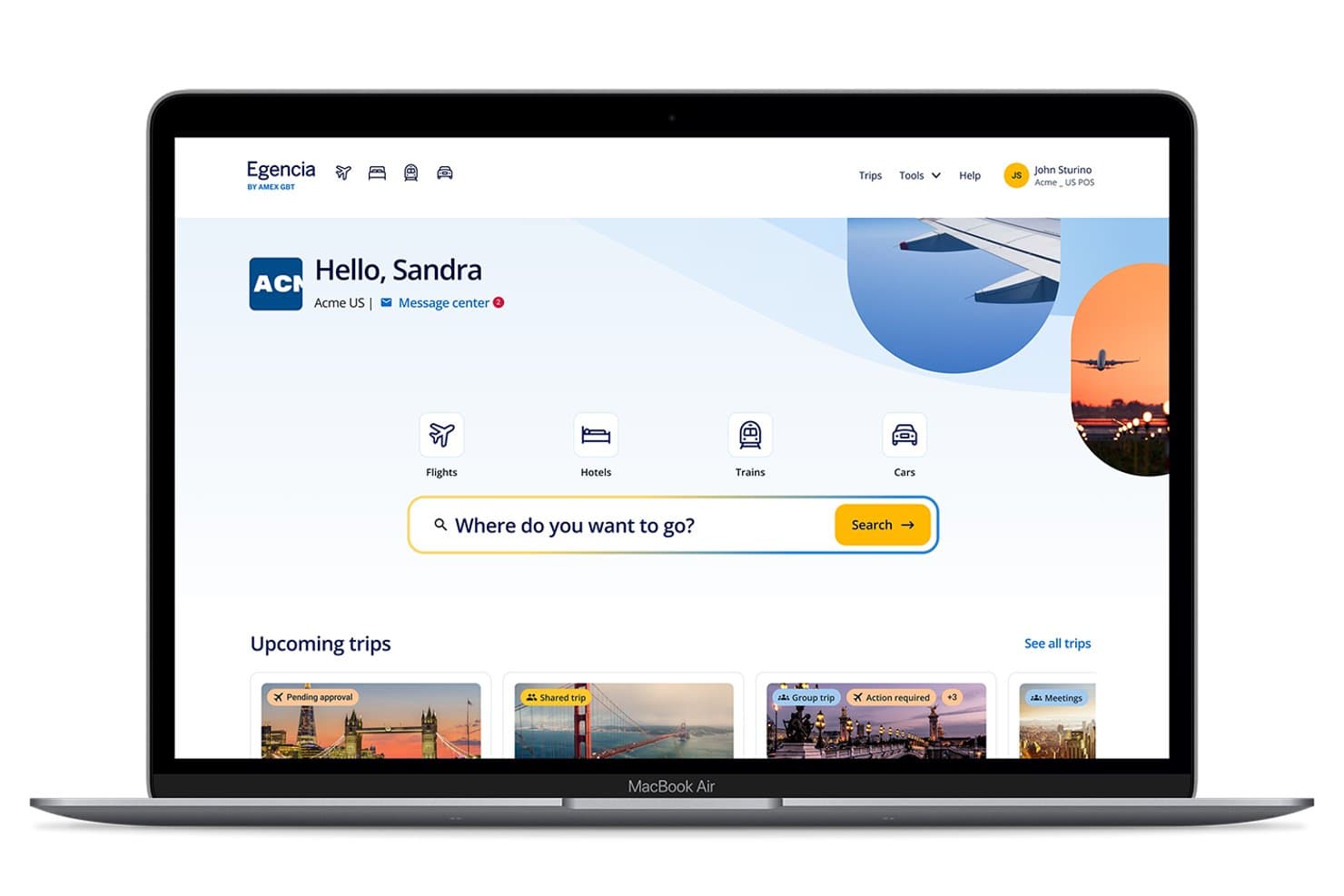
Egencia offers a centralized travel management dashboard where users can search and book flights, hotels, trains, and cars, while viewing upcoming trips with approval statuses. Egencia is a B2B business travel management platform that covers flight, hotel, rail, and car rental booking alongside travel policy enforcement, expense integration, duty of care tracking, and spend reporting.
Who Is Egencia Best For?
Egencia is a strong fit for mid-market and enterprise companies that manage high volumes of employee travel across multiple countries and need strict, auditable policy controls.
Why I Picked Egencia
I picked Egencia as one of the best because its policy controls go well beyond basic spend caps. I particularly like the dynamic hotel pricing feature, which uses AI to adjust rate caps based on local market medians rather than fixed limits. Travel managers can also mix dynamic and static caps by city, country, or traveler group, and the platform flags any out-of-policy bookings for manager approval before they're confirmed.
Egencia Key Features
- Multi-modal booking engine: Book flights, hotels, rail, and car rentals from a single platform with real-time inventory updates.
- Duty of care dashboard: Monitor traveler locations and receive safety alerts for potential disruptions worldwide.
- Automated expense sync: Integrate with SAP Concur and Payhawk for instant reconciliation of booking data and receipts.
- Custom analytics reporting: Create dashboards for travel spend, policy compliance, unused tickets, and sustainability metrics.
Egencia Integrations
Egencia offers over 50 native integrations, including SAP Concur, Payhawk, and Celigo. An open API and a developer center are available for custom integrations.
Pros and Cons
Pros:
- 24/7 live agent support for disruptions
- Real-time traveler tracking and risk alerts
- AI-driven dynamic hotel pricing caps
Cons:
- HRIS native sync requires custom API work
- Reporting dashboards can feel cluttered
Learn more about Egencia:
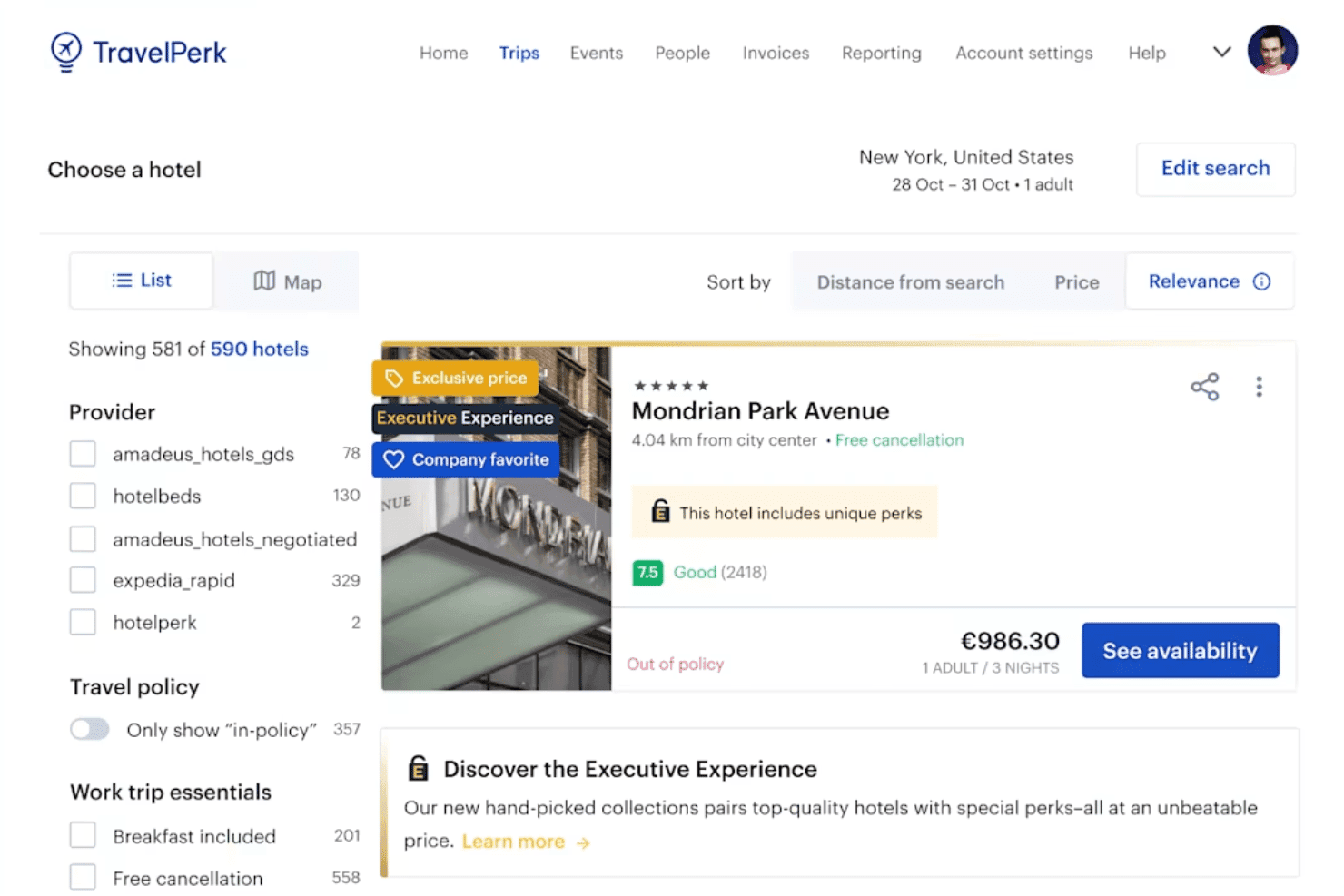
TravelPerk displays a hotel search results page with filtering options, pricing, and booking availability for New York. TravelPerk is a business travel management platform that combines multi-modal booking across flights, hotels, rail, and cars with built-in policy controls, approval workflows, duty of care tools, and an integrated spend and expense management layer.
Who Is TravelPerk Best For?
TravelPerk suits travel and expense administrators at mid-market companies managing frequent cross-border employee travel across multiple regions.
Why I Picked TravelPerk
TravelPerk earns its spot because it pulls content from Amadeus, Skyscanner, Booking.com, and Expedia into a single itinerary checkout, covering flights, hotels, trains, and rental cars in one place. I particularly like that TravelPerk layers negotiated rates on top of that aggregated inventory, so the pricing goes beyond what you'd find booking direct. Billing in seven currencies is a detail I've found genuinely useful when managing travel across multiple countries.
TravelPerk Key Features
- Duty of care center: Provides real-time traveler tracking, risk alerts, and global emergency assistance tools.
- Automated invoice processing: Uses AI to capture, process, and reconcile invoices and receipts from every trip.
- Virtual and physical Perk Cards: Issues spend-enabled Visa cards for travelers with policy controls and automated expense categorization.
- HRIS and ERP integrations: Connects natively with major HR and finance systems for automated employee sync and accounting.
TravelPerk Integrations
TravelPerk offers 60+ native integrations, including NetSuite, Xero, BambooHR, HiBob, SAP SuccessFactors, Ramp, Expensify, Spendesk, Slack, and International SOS. An API is available for custom integrations.
Pros and Cons
Pros:
- Real-time duty of care tracking for travelers
- FlexiPerk allows cancellation on nearly any booking
- Broadest inventory across flights, hotels, and rail
Cons:
- Customer support quality varies by subscription level
- Advanced reporting locked behind higher-tier plans
Learn more about TravelPerk:
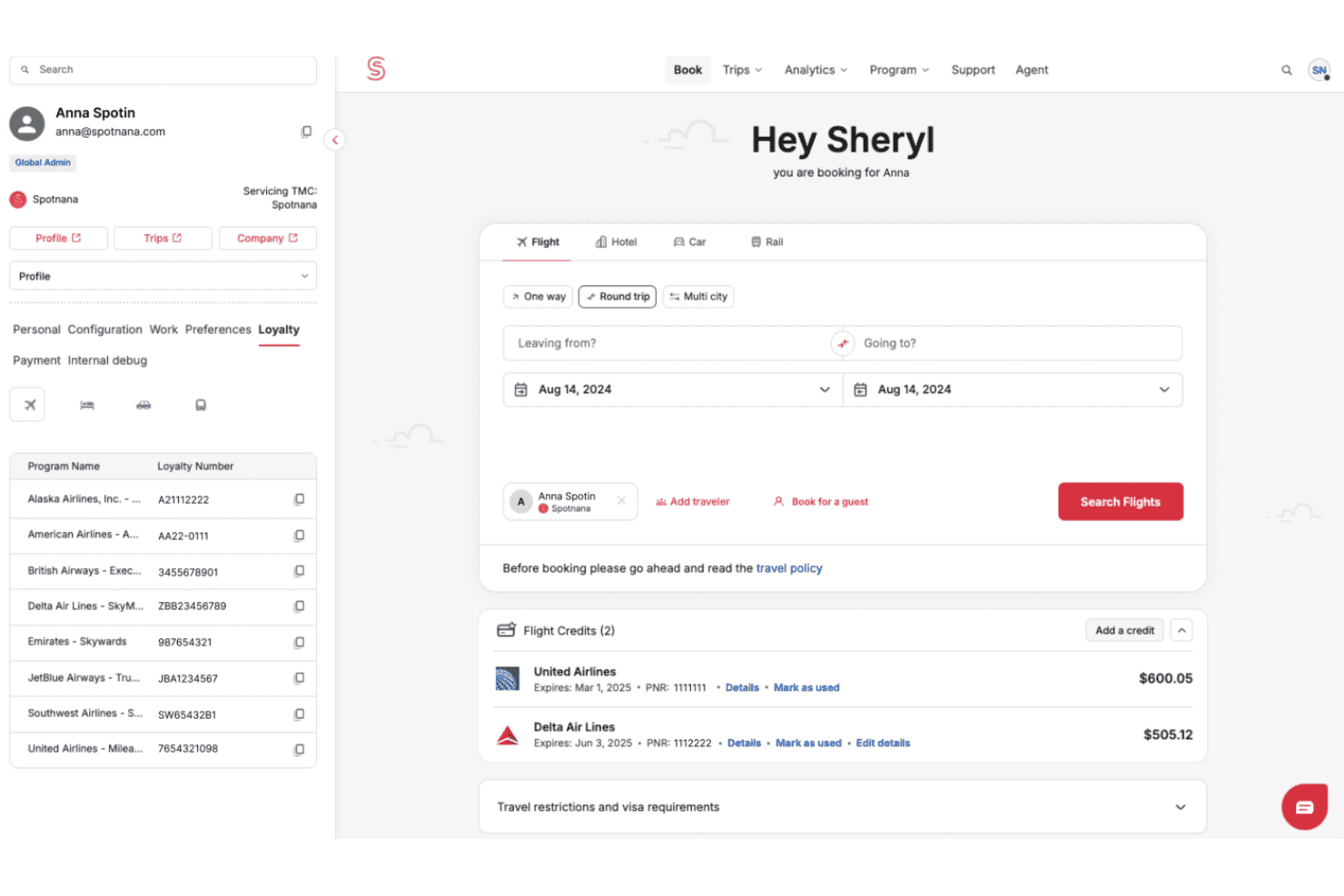
Spotnana displays a travel booking interface where agents can manage loyalty programs, flight credits, and search flights on behalf of travelers. Spotnana is a Travel-as-a-Service platform built on a single global infrastructure that connects travelers, travel managers, agents, and TMC operators across multi-modal booking, policy management, duty of care, and real-time analytics.
Who Is Spotnana Best For?
Spotnana is a strong fit for large, multinational organizations running complex global travel programs that need centralized control across multiple countries and regions.
Why I Picked Spotnana
Spotnana earns its spot on my shortlist because of how granularly its approval workflows can be configured. I like that you can set no, soft, or hard approval per trip type and assign multiple approvers in a single policy. The "show but do not allow booking" option is particularly useful when you need to block out-of-policy fares without hiding them from travelers, keeping the experience transparent while keeping spend in check.
Spotnana Key Features
- Multi-modal booking engine: Book flights, hotels, rail, and rental cars with global inventory from one unified platform.
- Duty of care integration: Track traveler locations in real time and receive security alerts through partners like International SOS and Crisis24.
- HRIS and expense integrations: Sync employee profiles, cost centers, and trip data with tools like Workday, BambooHR, Brex, and Expensify.
- Real-time analytics dashboard: Monitor travel spend, policy compliance, and booking patterns with customizable reporting and business intelligence.
Spotnana Integrations
Spotnana offers native integrations with Workday, BambooHR, ADP, Brex, Center, Expensify, AirPlus, Conferma, International SOS, and Crisis24, and provides an API for custom integrations.
Pros and Cons
Pros:
- NDC airline content with negotiated corporate rates
- Real-time traveler tracking across global trips
- Granular multi-level approval workflow configuration
Cons:
- Implementation complexity for smaller travel programs
- No built-in native expense management module
Learn more about Spotnana:
Outro software de gestão de viagens de negócios
Eis algumas opções adicionais de software de gestão de viagens de negócios que não entraram na minha seleção, mas que continuam a merecer atenção:
- 11ITILITEBest AI-driven travel recommendations
- 12Emburse Best for granular spend compliance
- 13Zoho ExpenseBest for localized per diem management
- 14EngineBest for group and crew travel
How I Evaluate Business Travel Management Software
I split my evaluation into two layers: the core booking, policy, and duty of care controls every platform needs to qualify, and the differentiators that separate the best from the rest.
Core Functionality (Table Stakes For This List)
When I'm selecting tools for my list, I rank each one on a scale from 0 (does not offer the functionality) to 5 (excels in this area) for each core functionality listed below. Then, I calculate the tool's total score into a percentage. Each tool needs to achieve a minimum total score of 65% to be considered for inclusion.
- Travel Booking Engine: I look for a self-service interface that covers flights, hotels, rail, and car rentals with real-time inventory from multiple sources.
- Policy & Approval Controls: The tool should let admins set spend limits by trip type or role and enforce multi-level approvals before booking confirms.
- Traveler Tracking & Duty of Care: I evaluate whether the platform gives admins real-time visibility into where employees are, with safety alerts during disruptions.
- Expense Integration: Each tool should capture receipts and itinerary data, then reconcile trip costs against corporate cards or reimbursement workflows.
- Reporting & Analytics: I check for dashboards that break down travel spend by department, policy compliance rates, and booking patterns across the org.
- HRIS & Employee Data Sync: The platform should sync employee profiles, cost centers, and departments from your HR system to keep traveler data current.
Once I have a list of tools that meet the criteria, I consider what sets each platform apart.
Differentiating Factors (What Sets Vendors Apart)
Here's how I compare and contrast different vendors:
Standout Features
Duty of care tools are a key differentiator. I look for platforms that offer real-time risk alerts and two-way messaging with travelers. That way, you can locate and reach employees during flight cancellations or regional emergencies. AI-powered recommendations also matter. The best platforms suggest policy-compliant options based on past booking patterns, saving travelers time and keeping spend in line. I also check for unused ticket management, since expired airline credits are easy to lose track of and can quietly drain your travel budget.
Beyond Features
Inventory breadth matters. I evaluate whether platforms pull from multiple GDS sources alongside NDC fares and low-cost carriers. Limited content pushes travelers to book outside the system. 24/7 traveler support is equally important, since a midnight flight cancellation requires live agents who can rebook on the spot.
I also check how well each tool connects to your finance and HR stack. Syncing cost centers from your HRIS or reconciling charges in your ERP keeps travel data from living in a silo.
Como escolher software de gestão de viagens de negócios
É fácil perder-se em longas listas de funcionalidades e estruturas de preços complexas. Para o ajudar a manter o foco enquanto percorre o seu processo único de seleção de software, eis uma lista de verificação dos fatores a ter em conta:
| Fator | O que considerar |
|---|---|
| FatorEscalabilidade | O que considerarEsta plataforma dará suporte à sua equipa à medida que cresce em diferentes regiões, departamentos e novos tipos de viajantes? |
| FatorIntegrações | O que considerarConsegue ligar-se facilmente ao seu HRIS e aos seus sistemas de despesas e contabilidade sem transferências manuais de dados? |
| FatorPersonalização | O que considerarOs fluxos de trabalho de políticas, os relatórios e as cadeias de aprovação podem ser adaptados aos seus controlos internos e à estrutura organizacional? |
| FatorFacilidade de utilização | O que considerarTodos os colaboradores, incluindo os viajantes ocasionais, conseguem reservar viagens, submeter despesas e gerir perfis com facilidade? |
| FatorImplementação e integração inicial | O que considerarDe que nível de orientação do fornecedor, migração de dados e apoio na configuração de políticas precisará antes do lançamento? |
| FatorCusto | O que considerarQual é a clareza do preço total — incluindo taxas de transação, suporte e integração — em comparação com o seu volume de viagens? |
| FatorMedidas de segurança | O que considerarA ferramenta disponibiliza encriptação de dados, controlos de acesso e conformidade com as normas legais e da sua empresa? |
| FatorDisponibilidade do suporte | O que considerarO suporte ao cliente em direto está disponível 24 horas por dia, 7 dias por semana, e que canais — chat, telefone ou e-mail — podem os viajantes utilizar em situações de emergência? |
O que é software de gestão de viagens de negócios?
O software de gestão de viagens de negócios é uma plataforma que ajuda as organizações a planear, reservar e supervisionar as viagens de negócios dos colaboradores de acordo com as políticas da empresa. Estas ferramentas proporcionam um espaço centralizado para reservar viagens, gerir aprovações, acompanhar despesas e monitorizar a segurança dos viajantes, simplificando simultaneamente a conformidade e os relatórios para as equipas de RH e finanças.
Funcionalidades do software de gestão de viagens de negócios
Ao selecionar software de gestão de viagens de negócios, esteja atento às seguintes funcionalidades essenciais:
- Motor de reservas de viagens: Permite aos colaboradores reservar voos, hotéis, viagens de comboio e alugueres de automóveis numa única plataforma centralizada, com inventário atualizado e tarifas negociadas.
- Aplicação da política: Aplica as regras de viagem e as aprovações da sua organização durante a reserva, ajudando a evitar viagens que não estejam em conformidade com a política e despesas não autorizadas.
- Aprovações multinível: Suporta fluxos de trabalho configuráveis para que os responsáveis, a área financeira e outras partes interessadas possam analisar e aprovar os pedidos de viagem antes da reserva.
- Integração de despesas: Capta recibos e estabelece ligação direta ao seu sistema de gestão de despesas, simplificando o reembolso e a contabilidade.
- Rastreio de viajantes: Monitoriza a localização dos colaboradores durante as viagens e fornece atualizações em tempo real, o que é essencial para a segurança durante emergências ou interrupções.
- Alertas do dever de diligência: Envia notificações de risco, avisos de viagem e mensagens de emergência para ajudar a manter os viajantes informados e apoiados.
- Relatórios e análises: Oferece painéis que acompanham as despesas, a conformidade e os padrões de viagem para fundamentar atualizações da política e decisões orçamentais.
- Sincronização com HRIS e diretórios: Integra-se com o seu sistema de RH para manter atualizados os perfis dos colaboradores, os departamentos e os centros de custo, assegurando políticas e relatórios rigorosos.
- Acesso móvel: Permite aos utilizadores gerir reservas, aprovações e despesas a partir dos seus smartphones, garantindo flexibilidade em qualquer lugar.
Benefícios do software de gestão de viagens de negócios
A implementação de software de gestão de viagens de negócios proporciona vários benefícios à sua equipa e à sua empresa. Eis alguns dos benefícios que pode esperar:
- Conformidade com a política: As regras automatizadas e os fluxos de aprovação ajudam a garantir que cada reserva está em conformidade com as políticas de viagens da empresa.
- Maior segurança: O rastreio de viajantes em tempo real e os alertas do dever de diligência facilitam a localização e a assistência aos colaboradores caso ocorram interrupções ou emergências.
- Visibilidade centralizada: Os painéis e as análises proporcionam uma visão abrangente das despesas, dos padrões de viagem e da conformidade com a política em toda a sua força de trabalho.
- Despesas simplificadas: A integração direta com os sistemas de despesas permite captar recibos facilmente e efetuar reembolsos mais rápidos e rigorosos.
- Conveniência para os colaboradores: Uma única plataforma de autosserviço para reservar e gerir viagens poupa tempo tanto aos viajantes frequentes como aos ocasionais.
- Eficiência administrativa: A sincronização automática de dados com ferramentas de HRIS e contabilidade reduz o trabalho manual associado à gestão de viagens.
- Controlo de custos: A supervisão centralizada e as tarifas negociadas ajudam a monitorizar o orçamento e a reduzir despesas de viagem desnecessárias.
Custos e preços do software de gestão de viagens de negócios
A seleção de software de gestão de viagens de negócios exige uma compreensão dos vários modelos de preços e planos disponíveis. Os custos variam consoante as funcionalidades, a dimensão da equipa, os complementos e outros fatores. A tabela abaixo resume os planos mais comuns, os respetivos preços médios e as funcionalidades normalmente incluídas nas soluções de software de gestão de viagens de negócios:
Tabela de comparação de planos de software de gestão de viagens de negócios
| Tipo de plano | Preço médio | Funcionalidades comuns |
|---|---|---|
| Tipo de planoPlano gratuito | Preço médio$0 | Funcionalidades comunsInterface básica de reserva de viagens, aplicação simples da política, relatórios limitados e exportação manual de despesas. |
| Tipo de planoPlano pessoal | Preço médio$10-$20/utilizador/mês | Funcionalidades comunsReserva em autosserviço, fluxos de aprovação básicos, definições de política, suporte limitado e relatórios padrão. |
| Tipo de planoPlano empresarial | Preço médio$25-$40/utilizador/mês | Funcionalidades comunsAprovações multinível, rastreio de viajantes em tempo real, alertas do dever de diligência, integração com HRIS e análises de despesas. |
| Tipo de planoPlano empresarial avançado | Preço médio$50-$100/utilizador/mês | Funcionalidades comunsMotores de políticas avançados, inventário proveniente de várias fontes, suporte global, integrações com ERP e análises personalizadas. |
Perguntas frequentes sobre software de gestão de viagens de negócios
Eis algumas respostas a perguntas comuns sobre software de gestão de viagens de negócios:
Como é que o software de gestão de viagens de negócios apoia a segurança dos colaboradores?
Estas ferramentas fornecem acompanhamento em tempo real e enviam alertas sobre atrasos, interrupções ou emergências. Os administradores podem localizar e comunicar com os colaboradores em viagem e ativar rapidamente o apoio necessário.
O software de gestão de viagens de negócios consegue lidar com políticas de viagens globais?
Sim, a maioria das plataformas permite definir políticas para vários países, lidar com diferentes moedas e idiomas e gerir a conformidade com os regulamentos regionais relativos a impostos e privacidade dos dados.
Que tipos de integrações devo esperar de um software de gestão de viagens?
Procure integrações com ferramentas de HRIS, gestão de despesas e contabilidade. Estas ligações asseguram um aprovisionamento simples, a sincronização dos centros de custo e a reconciliação automatizada das despesas.
É difícil migrar dados de viagens ao mudar de fornecedor?
A migração varia. Alguns fornecedores oferecem apoio na integração inicial, ferramentas de importação de dados ou podem trabalhar diretamente com os seus sistemas de RH ou financeiros para minimizar as interrupções.
Existem opções para acompanhar bilhetes ou créditos não utilizados?
Sim, muitas plataformas incluem agora funcionalidades para acompanhar automaticamente bilhetes não utilizados e aplicar créditos ou reembolsos disponíveis, ajudando a evitar a perda de valor.