


Remote: Fördjupad recension av arbetsgivarregistreringstjänsten för 2026



Building a global workforce means navigating hiring, payroll, and compliance across countries without losing control of the employee experience. As remote work expands your talent pool, the right EOR partner can make international growth far easier to manage.
Remote is an employer of record services platform for companies that need to hire, pay, and manage full-time employees or contractors in countries where they don’t have a legal entity. It also runs payroll in markets where you do have entities, so it can sit under the HR stack you already keep.
I’d mainly consider it if you want a provider that owns its local entities rather than leaning on third-party partners the way other EORs do in some regions, which matters if compliance consistency and direct IP protection are high on your list.
Remote Evaluation Summary
- From $599/employee/month (billed annually)
- Free demo available
Varför du kan lita på våra programvarurecensioner
Vårt team har testat och recenserat programvara sedan 2012. Som HR-experter själva vet vi hur svårt — och viktigt — det är att välja rätt programvara.
För den här guiden utvärderade vi verktyg genom praktisk testning och oberoende research, och betygsatte verktygen enligt våra urvalskriterier. Vi drar även nytta av insikter från branschens tankeledare och praktiserande HR-experter.
Våra recensioner speglar vårt mänskliga redaktionella omdöme, inte ett säljbudskap.
Expertgranskare:
Remote Overview
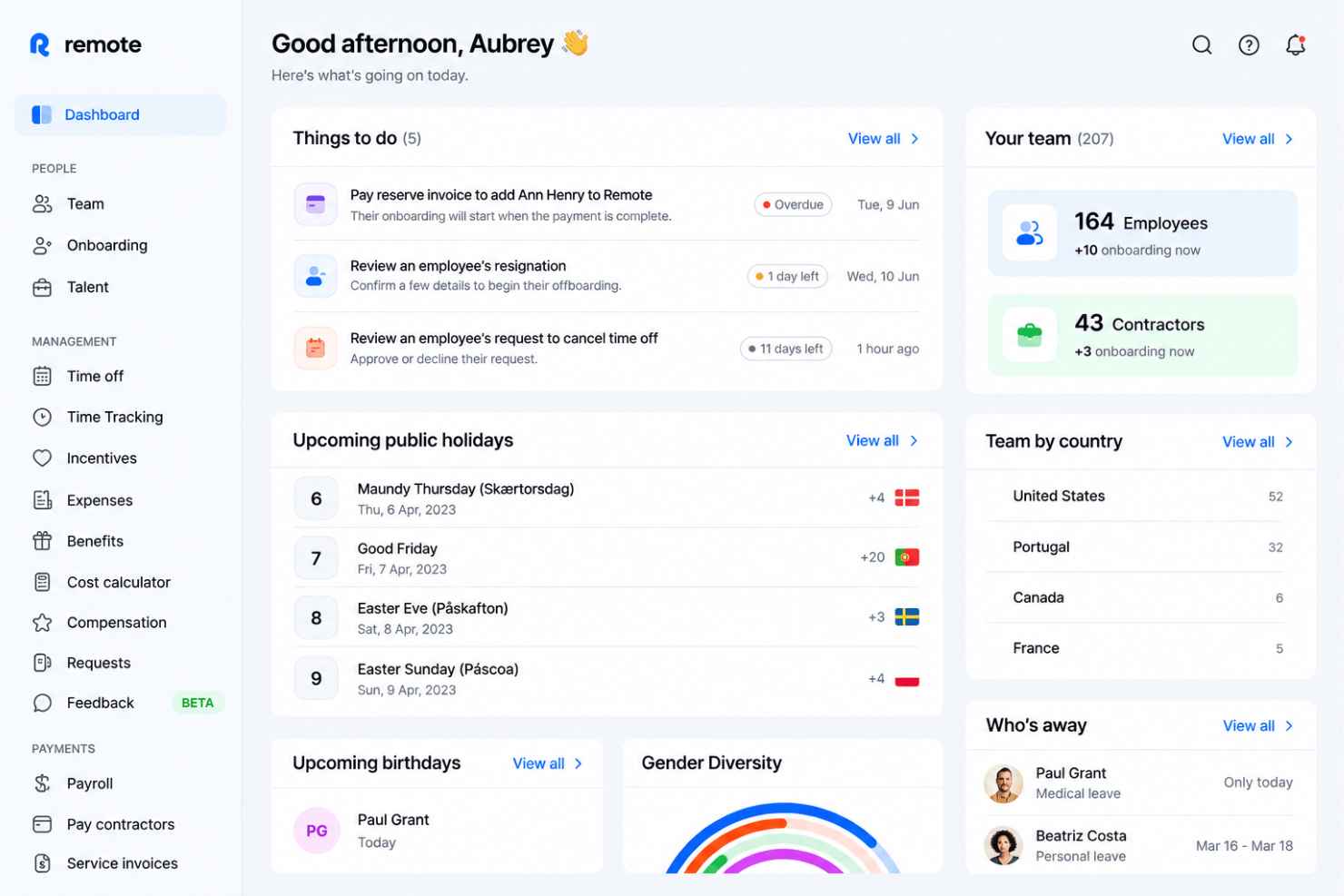
If you want direct compliance oversight, unified IP protections, and transparent contracts for global employment, I think Remote is one of the best picks. Its owned-entity model means you get more consistent legal coverage, and the interface is polished but stays practical. Pricing is predictable and onboarding is quick, but smaller teams with infrequent hires might feel it’s more than they need. It’s worth knowing this is employment and payroll infrastructure rather than a full HRIS, so it works best sitting underneath a system instead of replacing one. For distributed teams from scaleup to enterprise that care about compliance above all, I’d choose Remote over providers that lean on third-party intermediaries.
pros
-
Owns local entities in every covered country.
-
Fast onboarding and clear employment contracts.
-
Transparent, flat monthly pricing structure.
cons
-
Limited on-demand support for smaller teams.
-
Not built to replace a full HRIS.
-
Payroll setup can face country-specific delays.
Is Remote Right For Your Needs?
Who Would be a Good Fit for Remote?
Remote is a strong match for teams managing complex international hiring or those scaling distributed workforces, because it handles onboarding, payroll, and local compliance in dozens of countries with a clean interface. Fast-growing startups, HR teams with limited admin resources, and companies looking for simple cost controls will get the most value from Remote’s flat-rate pricing, automated workflows, and self-serve documentation support. The fit gets stronger rather than weaker as you move up market: mid-market and enterprise buyers hiring across many countries can keep Workday, SAP SuccessFactors, or whichever HRIS they already run, and slot Remote underneath it as the employment and payroll layer.
-
Global Tech Startups
Remote makes it easy to hire and onboard talent in multiple countries, reducing the legal and payroll barriers that fast-growing tech startups face.
-
Small HR Teams
With automated workflows and a self-serve portal, HR teams with limited resources can manage contracts, payroll, and compliance without manual oversight.
-
Remote-First Companies
Remote’s international payroll, contract setup, and benefits administration all support a fully distributed workforce needing reliable local compliance.
-
VC-Backed Scaleups
The flat pricing, transparent cost calculator, and bulk action API let VC-backed growth companies budget and expand into new markets confidently.
-
Professional Services Firms
Companies hiring contractors and employees across regions can centralize document management and payments for smooth cross-border operations.
-
Product-Led SaaS
SaaS companies expanding overseas need strong HR integrations and fast onboarding, which Remote’s API and partner connectors deliver.
Who Would be a Bad Fit for Remote?
Remote isn’t a catch-all solution for every business. Companies hiring in a single country with no international plans, teams shopping purely on lowest cost, and organizations hoping to retire their HRIS altogether will all be better served elsewhere. Deskless and shift-heavy operations such as hospitality, retail, or construction need scheduling and time-clock tooling that this simply isn’t built for, and payroll with unusual union rules or bespoke local calculations may still need a specialist local provider. If your needs are niche, require constant hand-holding, or fall outside the supported countries, Remote may not be right for you.
-
Single-Country SMBs
If your business only hires within one country, you likely don’t need Remote’s global compliance and pay-as-you-go features.
-
Domestic-Only Payroll Teams
A payroll team that runs a single country in-house already covers the ground Remote would take on, so the global tooling and document workflows would mostly sit idle.
-
Frontline & Shift-Based Teams
Restaurants, retailers, and site-based operations mostly need shift scheduling, time clocks, and labor optimization, and that frontline workforce layer isn’t what Remote is built to provide.
-
Highly Customized HR
Firms requiring deep policy customization and hands-on compliance management often find Remote’s standardized workflows limiting.
-
Niche Local Regulations
Organizations hiring in countries with unique, highly specific regulations beyond Remote’s coverage won’t get the support they require.
-
High-Touch Payroll Needs
Businesses expecting personal, immediate support during every payroll cycle should know Remote’s customer service response times can lag, especially on complex issues.
How We Test & Score Our Tools
We’ve spent years building, refining, and improving our software testing and scoring system. The rubric is designed to capture the nuances of software selection and what makes a tool effective, focusing on critical aspects of the decision-making process.
Below, you can see exactly how our testing and scoring works across seven criteria. It allows us to provide an unbiased evaluation of the software based on core functionality, standout features, ease of use, onboarding, customer support, integrations, customer reviews, and value for money.
Core Functionality (25% of final score)
The starting point of our evaluation is always the core functionality of the tool. Does it have the basic features and functions that a user would expect to see? Are any of those core features locked to higher-tiered pricing plans? At its core, we expect a tool to stand up against the baseline capabilities of its competitors.
Standout Features (25% of final score)
Next, we evaluate uncommon standout features that go above and beyond the core functionality typically found in tools of its kind. A high score reflects specialized or unique features that make the product faster, more efficient, or offer additional value to the user.
We also evaluate how easy it is to integrate with other tools typically found in the tech stack to expand the functionality and utility of the software. Tools offering plentiful native integrations, 3rd party connections, and API access to build custom integrations score best.
Ease of Use (10% of final score)
We consider how quick and easy it is to execute the tasks defined in the core functionality using the tool. High scoring software is well designed, intuitive to use, offers mobile apps, provides templates, and makes relatively complex tasks seem simple.
Onboarding (10% of final score)
We know how important rapid team adoption is for a new platform, so we evaluate how easy it is to learn and use a tool with minimal training. We evaluate how quickly a team member can get set up and start using the tool with no experience. High scoring solutions indicate little or no support is required.
Customer Support (10% of final score)
We review how quick and easy it is to get unstuck and find help by phone, live chat, or knowledge base. Tools and companies that provide real-time support score best, while chatbots score worst.
Customer Reviews (10% of final score)
Beyond our own testing and evaluation, we consider the net promoter score from current and past customers. We review their likelihood, given the option, to choose the tool again for the core functionality. A high scoring software reflects a high net promoter score from current or past customers.
Value for Money (10% of final score)
Lastly, in consideration of all the other criteria, we review the average price of entry level plans against the core features and consider the value of the other evaluation criteria. Software that delivers more, for less, will score higher.
Core Features
Owned Legal Entities
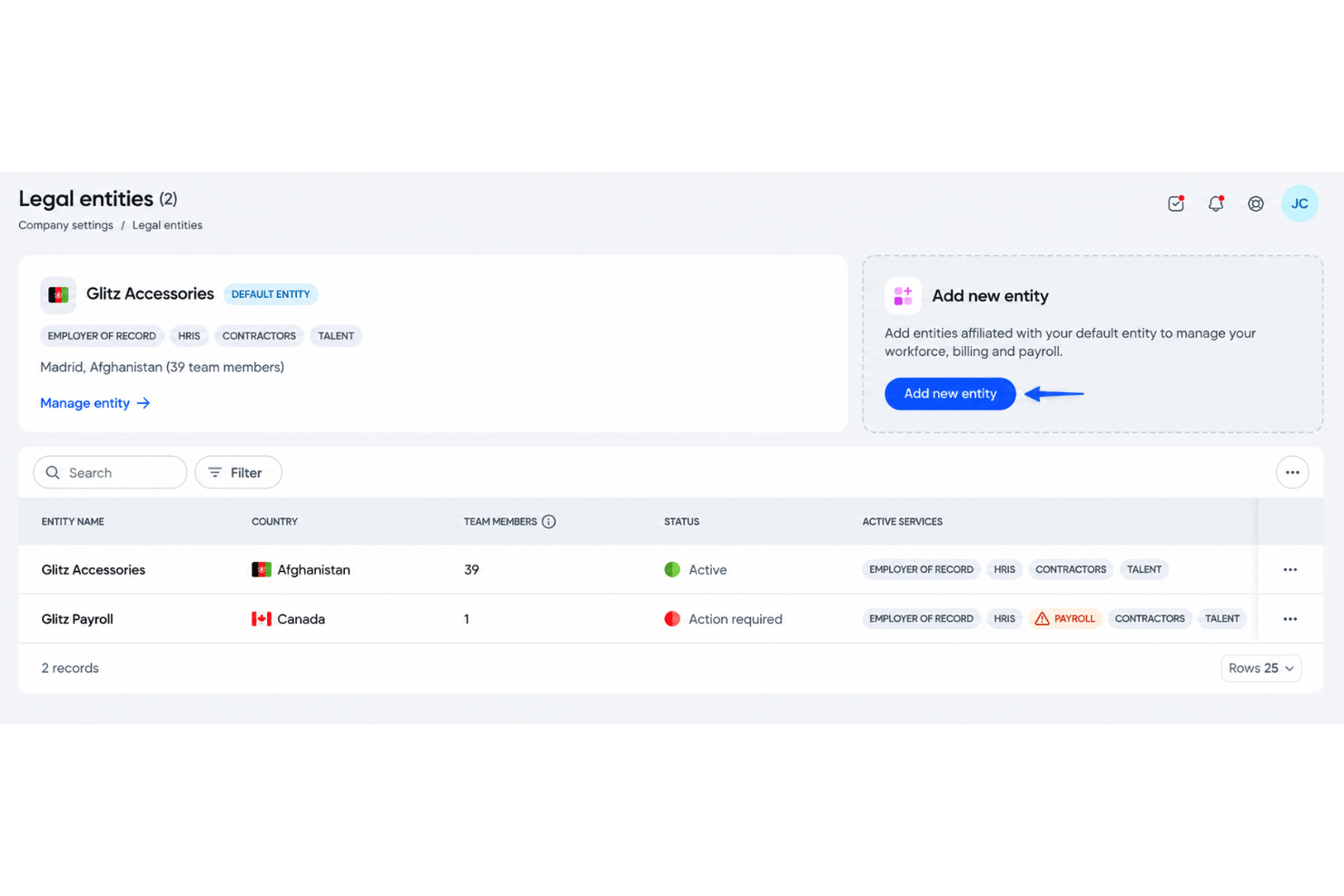
Remote owns and operates its own entities in the countries it serves, so there is no third-party provider sitting between you and the local employment relationship. That gives you direct compliance oversight, steadier service quality, and the same local protections with every hire.
Global Payroll Processing
Remote runs payroll for full-time employees and contractors across a broad list of countries, and it can also consolidate payroll in markets where you already hold your own entities. Local taxes, social contributions, and statutory benefits are calculated and filed for you.
Automated Employment Contracts
Remote generates locally compliant contracts that reflect up-to-date legal standards. Contracts come in local languages and are signed digitally, and amendments or employment letters can be issued from the same place without restarting the paperwork.
Benefits Administration
Remote manages mandatory and supplemental benefits tailored to each country, including health insurance, pension, and paid leave. This removes the complexity of local benefits setup for your team.
IP and Data Protection
Remote moves employee-created intellectual property across to your business automatically through its own local entities, so nothing routes via an outside partner. EOR relationships are also backed by uncapped indemnity, which is rare in this category and worth weighing if legal exposure keeps you up at night.
Localized Compliance Support
Remote tracks employment law changes country by country and surfaces the relevant ones inside the platform, so you are not chasing updates yourself. In-house legal, payroll, and HR specialists are available when a local rule needs interpreting rather than just flagging.
Standout Features
Instant Pre-Hire Cost Calculator
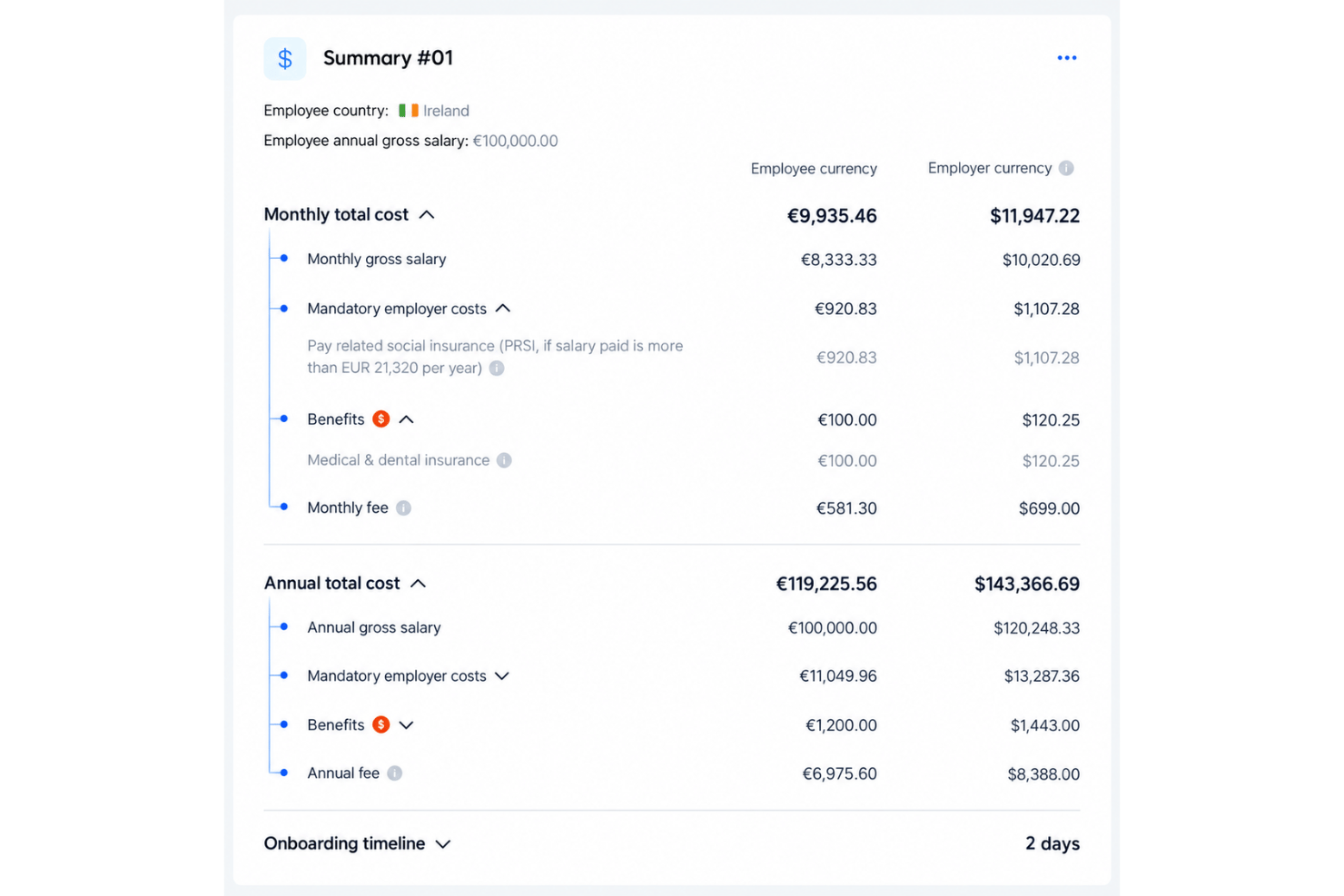
Remote gives you an instant pre-hire cost calculator that estimates total employer costs for any country before you hire. You can run country-to-country comparisons in seconds to make quick, budget-aware hiring decisions.
Self-Service Document Management
Remote provides a self-service document management portal for contracts, onboarding forms, and compliance paperwork. Your team and employees can upload, sign, and retrieve critical documents anytime without waiting for manual processing.
On-Demand Specialists And Mobility Support
You can book one-to-one time with Remote’s in-house HR, legal, and tax specialists when a country question turns thorny, instead of filing a ticket and waiting. Visas, work eligibility, and relocation cases are project-managed by an internal mobility team too, though both of these sit outside the base plan as paid add-ons.
Ease of Use
Remote is user-friendly, with a clean dashboard and logical workflows for onboarding, contracts, and payroll. The self-serve document portal and instant pre-hire cost calculator make key tasks straightforward for HR and hiring managers. User reviews highlight the intuitive interface and clear support resources, but some mention slow response times during country-specific payroll setup. I think fast-growing teams will appreciate how little hand-holding is needed once you’re set up.
Onboarding
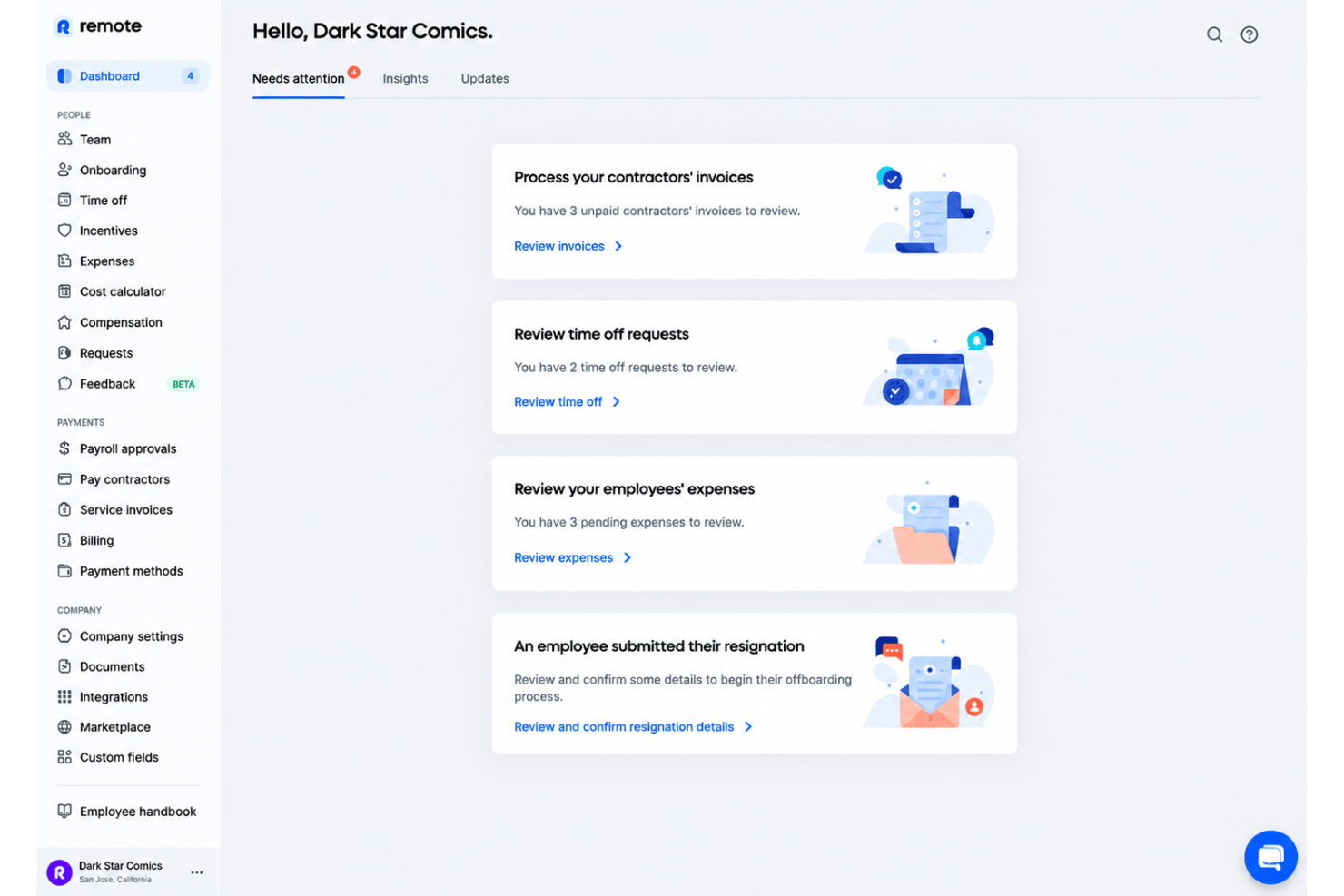
Remote makes onboarding straightforward with a clean interface, automated contract setup, and self-serve document management. Straightforward EOR and contractor hires move quickly once you hand over accurate worker and payroll details, while multi-country global payroll implementations are a guided project that runs over several weeks with an implementation or payroll specialist assigned on Remote’s side. Support channels are clear, with timely documentation and legal guidance, though response times can vary if country-specific payroll issues arise. Budget time to pull together historical payroll data if you are migrating from another provider.
Customer Support
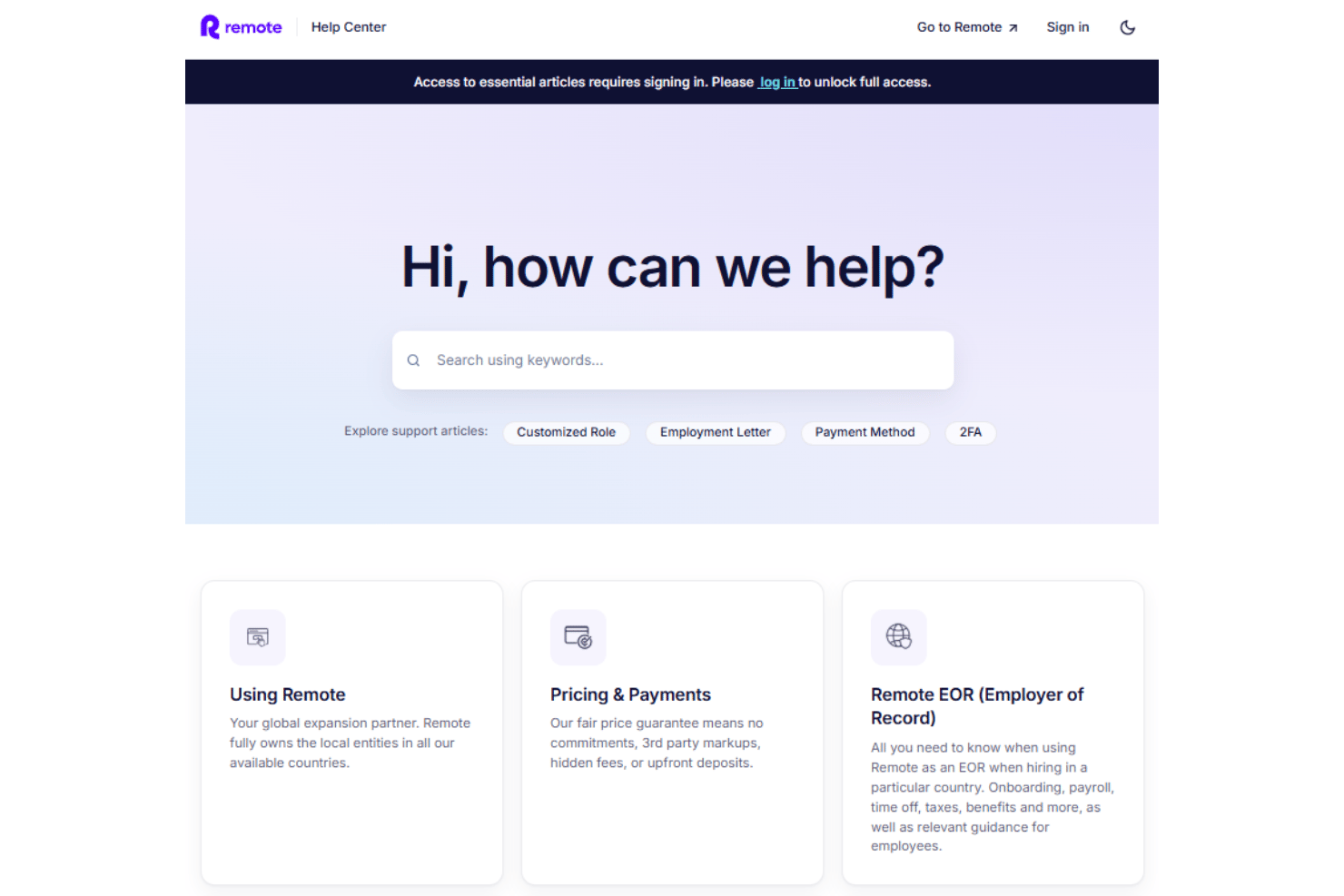
Remote’s customer support is solid for documentation and legal guidance, especially during onboarding or compliance questions. You get clear resources, a self-serve portal, and access to in-house legal, payroll, and HR people rather than an outsourced help desk, which shows when a genuine cross-border edge case comes up. Users still say response times can drag when country-specific payroll issues pop up, and support is less hands-on for smaller clients or urgent queries, so you may wait longer if your team is not a high-priority account.

Integrations
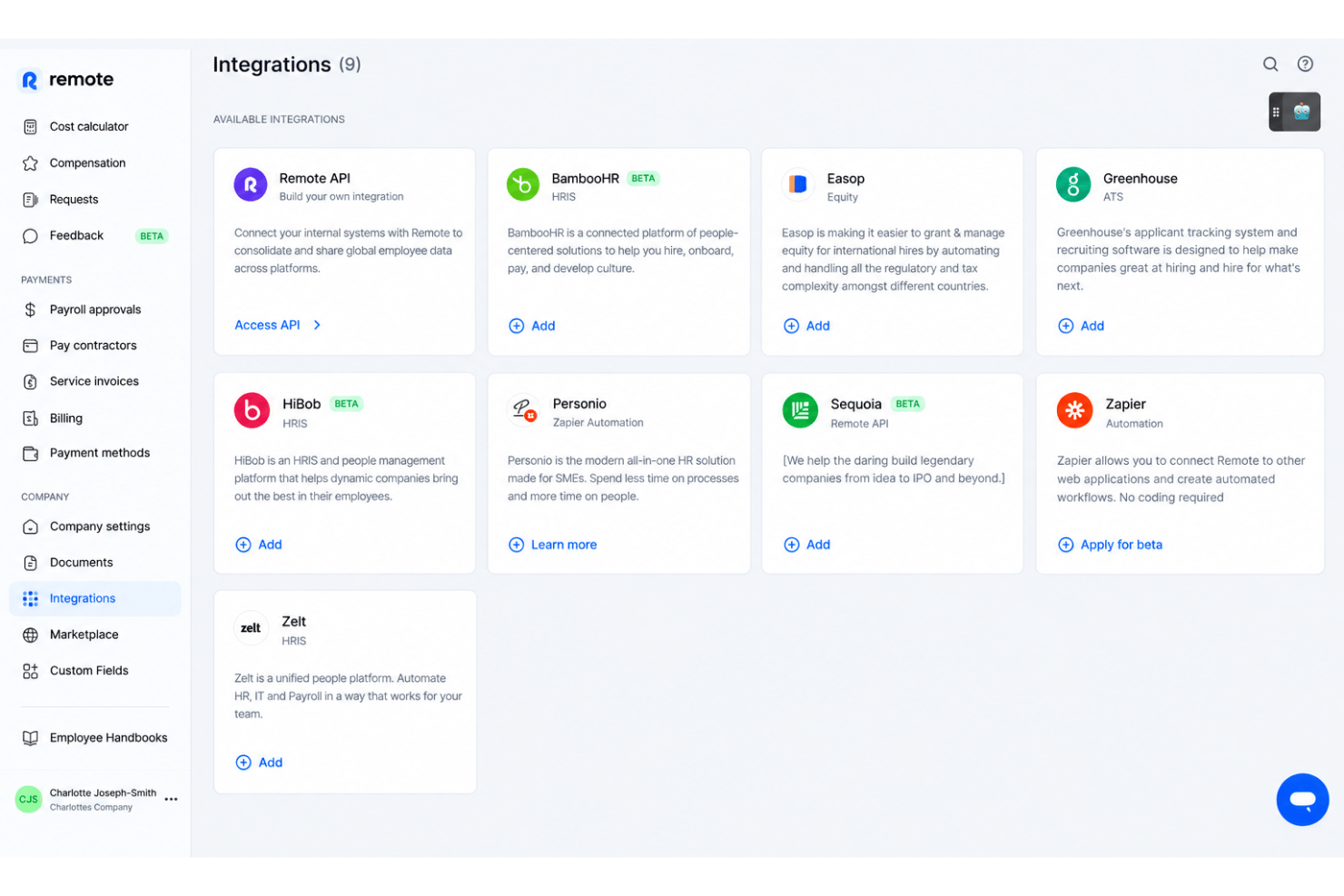
Remote integrates with BambooHR, HiBob, Greenhouse, Personio, NetSuite, Okta, Xero, and QuickBooks , among others.
Remote also offers an API and connects with popular third-party integration tools like Zapier.
Value for Money
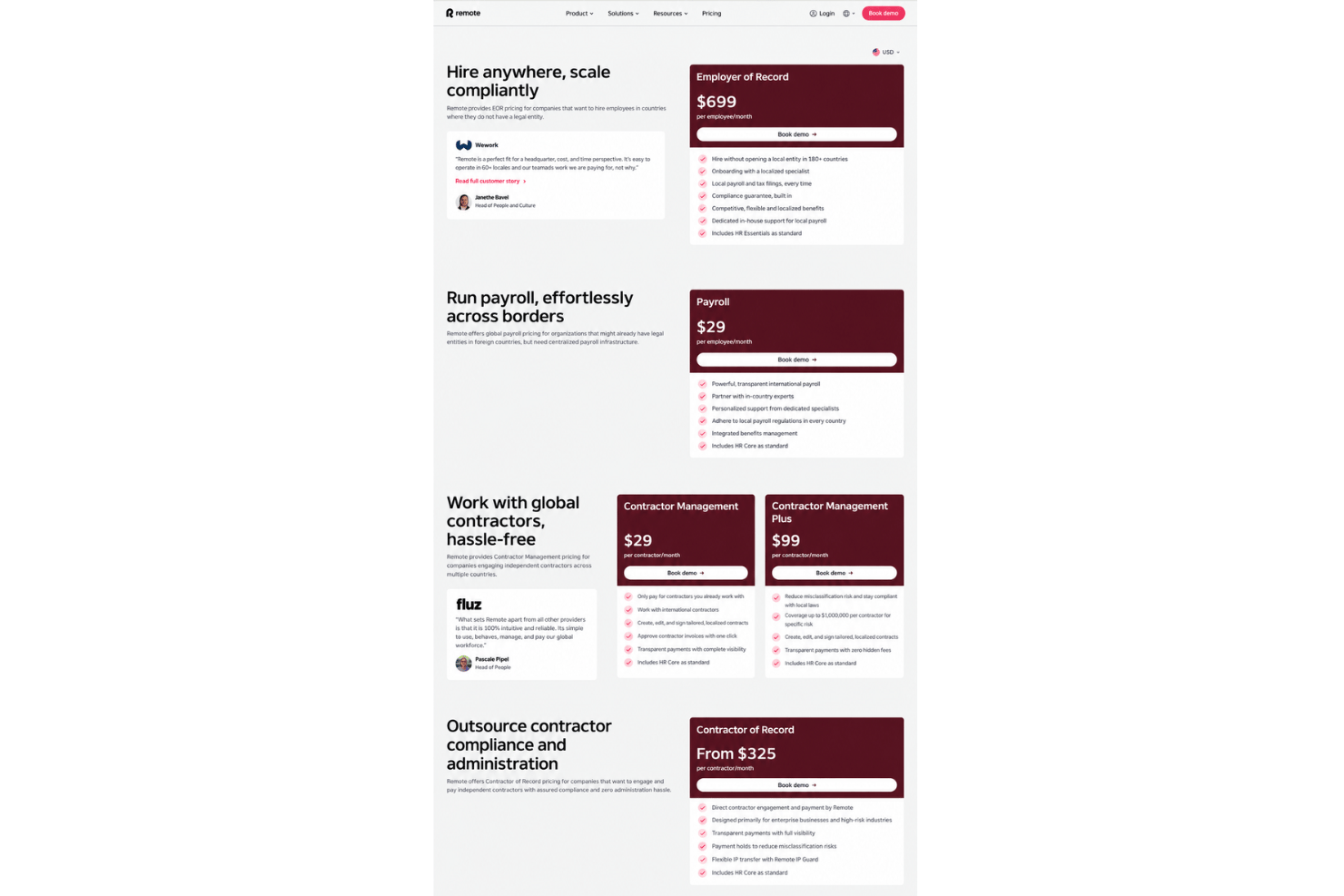
Remote’s pricing is transparent and competitive for global hiring. I think the pre-hire cost calculator and self-service workflows help teams manage international hiring costs with less overhead. Beyond EOR, Remote also offers additional modules and services for areas like payroll, contractor management, and PEO. Compared to similar employer of record services, teams say Remote’s flat fees reduce surprises and suit both startups and scaling companies.
- Employer of Record: Flat monthly fee per employee; includes onboarding, local payroll, compliance, and local benefits management.
- Payroll: Includes global payroll, self-service platform, personalized support, and integrated benefits management.
- Contractor Management: Provides localized contracts, contractor invoices, and approval workflows.
- Contractor Management Plus: Adds indemnity protection, coverage per contractor penalties, and compliant contracts.
- Professional Employer Organization: Offers PEO capabilities, dedicated HR and compliance experts, payroll processing, and guided onboarding.
- Equity: Includes transparent equity processes, tax handling, and fully compliant legal documentation.
Remote Specs
- API
- Application Tracking
- Batch Permissions & Access
- Compliance Tracking
- Contract Management
- Data Export
- Data Import
- Data Visualization
- Database Search
- Document Management
- Employee Database
- Employee Onboarding
- Employee Training
- External Integrations
- HRIS Integration
- Mobile App
- Multi-Currency
- Multi-User
- Notifications
- Password & Access Management
- Payroll
- Report & Compliance
- Risk Assessment
- Scheduling
- Tax Management
- Timesheets
Partner i rampljuset: Berättelser från Remote
Användningsfall för Remote PEO för tillväxt
Prestationsbedömningar behöver inte dra ut på tiden
Remote FAQs
How quickly can we onboard international employees with Remote?
Does Remote support payroll and compliance in every country?
What HR systems and payroll tools does Remote integrate with?
How transparent is Remote’s pricing for different hiring needs?
What happens if there’s a payroll or compliance issue in a specific country?
Can we manage both employees and contractors in Remote?
How does Remote handle data security and compliance with global regulations?
Is Remote a good choice if we already have our own legal entities in every country?
Remote Company Overview & History
Remote is a global HR technology company based in San Francisco, California, with a distributed workforce and employees across dozens of countries. The company focuses on employer of record, payroll, benefits, and compliance solutions to help businesses hire and pay international teams, and it runs its own network of local entities rather than reselling third-party providers. Remote is not known to own other products or be affiliated with other companies, and it is recognized for its emphasis on distributed work culture. Notable clients include GitLab, DoorDash, Loom, and Fountain.
Remote Major Milestones
- 2019: Company founded by Job van der Voort and Marcelo Lebre.
- 2020: Product officially launches, allowing global payroll and compliance.
- 2021: Raised $150 million in Series B funding; reached unicorn status with a $1 billion valuation.
- 2022: Raised an additional $300 million in Series C funding, increasing its valuation to nearly $3 billion.
- 2023: Broadened payroll and compliance coverage across a significantly wider set of countries.