



HireGlobal vs. Remote: Comparison & Expert Reviews For 2026



Hiring software talent across borders can quickly add complexity around payroll, worker classification, contracts, and local employment laws. For HR and finance teams, the challenge is finding an EOR platform that can support global growth without creating more admin.
HireGlobal and Remote are both EOR platforms for software companies, but they take different approaches. HireGlobal focuses on flexible engagement models, including EOR, Virtual EOR, AOR, contractor management, and payroll, while Remote positions itself as global employment infrastructure for EOR, payroll, compliance, and international workforce management.
In this comparison, I’ll evaluate HireGlobal and Remote across features, pricing, usability, compliance, and overall fit to help you decide which platform better suits your software company.
HireGlobal vs. Remote: An Overview
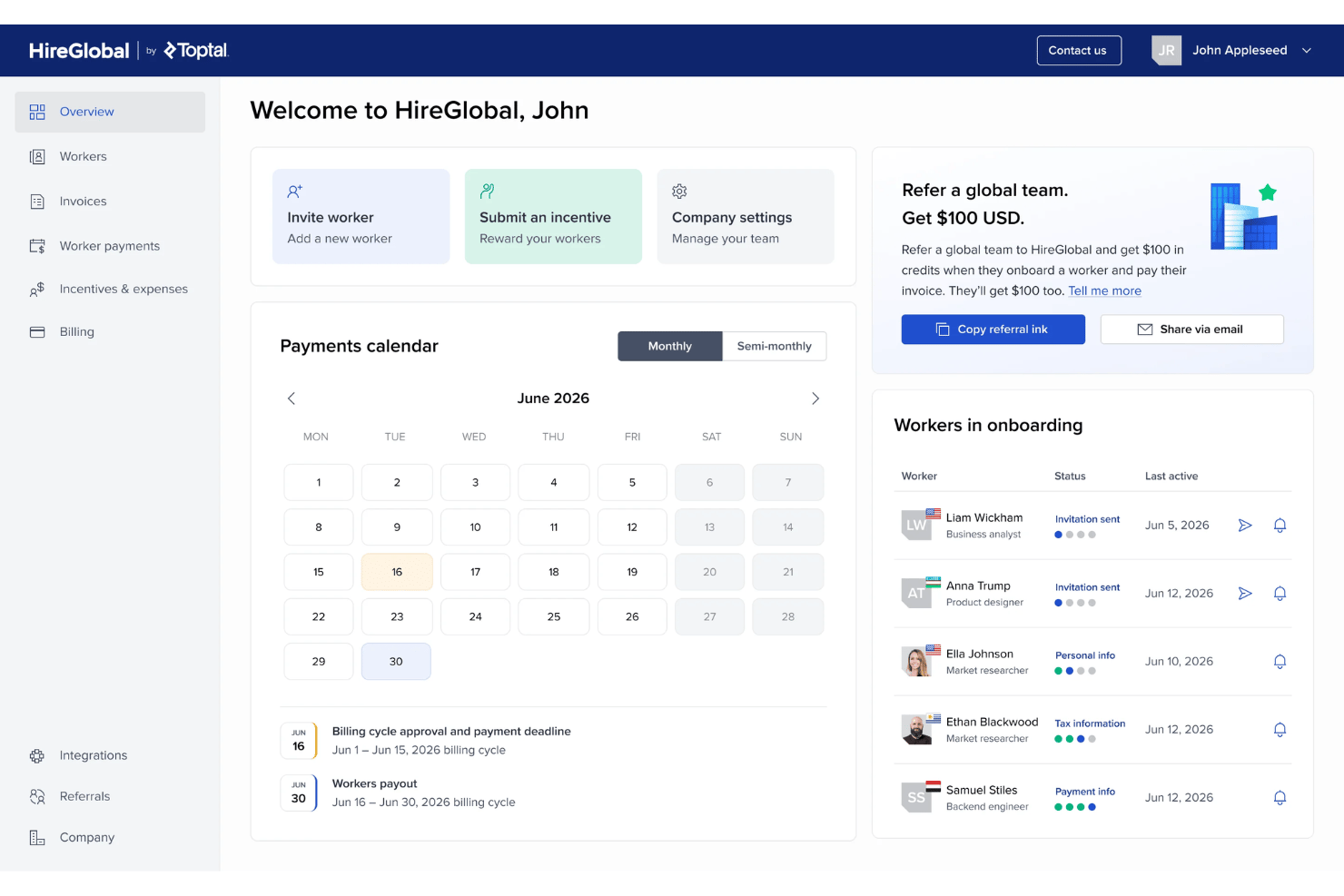
HireGlobal
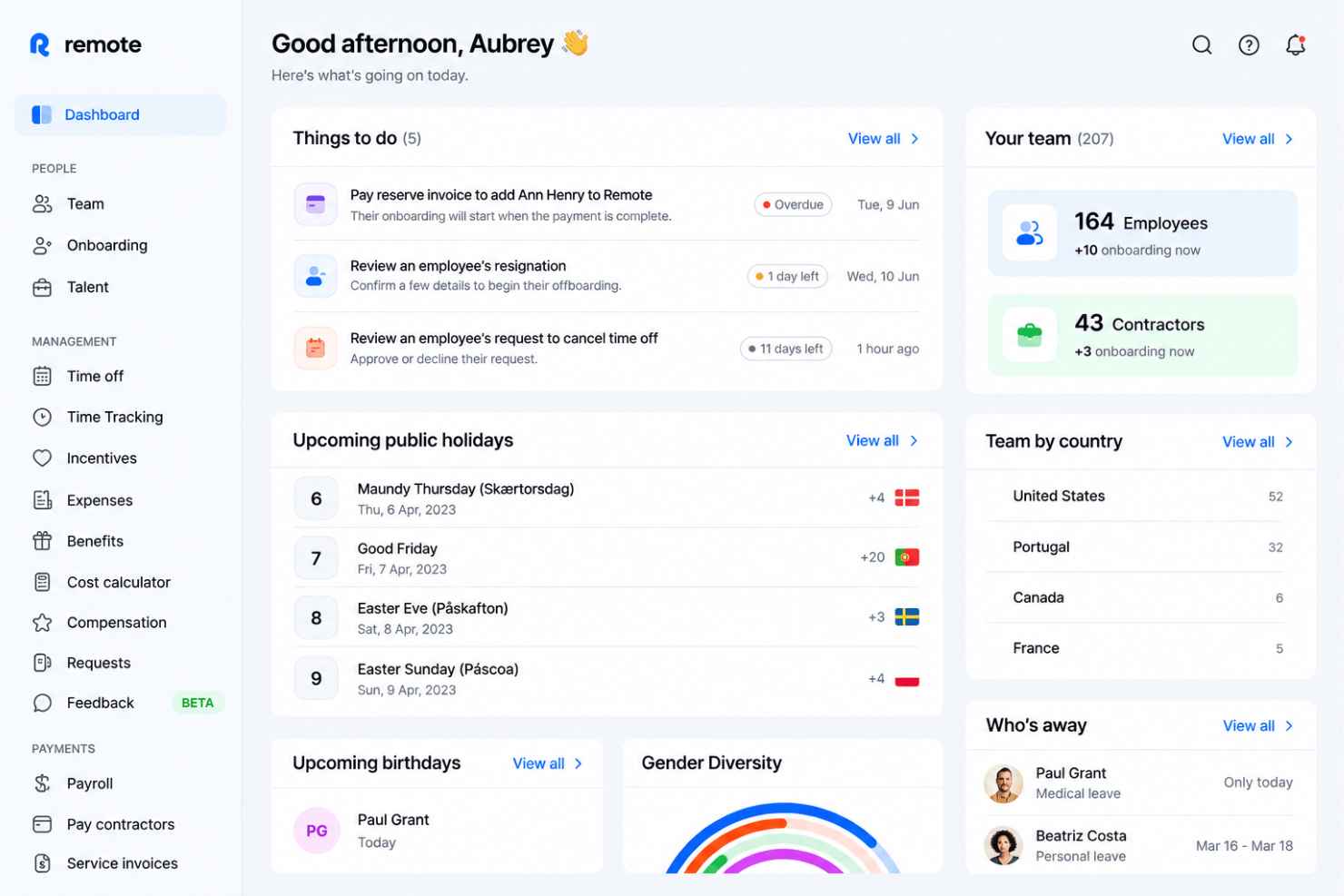
Remote
Why Trust Our Software Recommendations
Our team has been testing and reviewing software since 2012. As HR experts ourselves, we know how difficult—and important—it is to choose the right software.
For this guide, we evaluated tools using hands-on testing and independent research, scoring tools using our selection criteria. We also draw on insights from industry thought leaders and practicing HR experts.
Our reviews reflect our human editorial judgment, not a sales pitch.
Expert reviewers:
HireGlobal vs. Remote Pricing Comparison
| HireGlobal | Remote | |
|---|---|---|
| Free Trial | Free demo available | Free demo available |
| Pricing | From $199/employee/month | From $699/user/month |
HireGlobal vs. Remote Pricing & Hidden Costs
HireGlobal prices its services based on the level of compliance and employment support each worker needs, from contractor management to Virtual EOR and full EOR. It emphasizes predictable costs with no setup fees, migration fees, deposits, or annual commitments. Meanwhile, Remote uses service-based pricing across its global employment products and also promotes transparent pricing without hidden fees.
Choosing between the two largely comes down to whether you prefer HireGlobal’s flexible, risk-based model or Remote’s service-based structure. For software companies managing both employees and contractors, HireGlobal makes it easier to avoid paying for full EOR coverage when a lower-cost engagement model is enough.
HireGlobal vs. Remote Feature Comparison
| HireGlobal | Remote | |
|---|---|---|
| API | ||
| Application Tracking | ||
| Batch Permissions & Access | ||
| Compliance Tracking | ||
| Contract Management | ||
| Data Export | ||
| Data Import | ||
| Data Visualization | ||
| Database Search | ||
| Document Management | ||
| Employee Database | ||
| Employee Onboarding | ||
| Employee Training | ||
| External Integrations | ||
| HRIS Integration | ||
| Mobile App | ||
| Multi-Currency | ||
| Multi-User | ||
| Notifications | ||
| Password & Access Management | ||
| Payroll | ||
| Report & Compliance | ||
| Risk Assessment | ||
| Scheduling | ||
| Tax Management | ||
| Timesheets |
HireGlobal vs. Remote Integrations
| Integration | HireGlobal | Remote |
|---|---|---|
| Workday | ✅ | ✅ |
| BambooHR | ✅ | ✅ |
| Rippling | ✅ | ❌ |
| Jira | ✅ | ❌ |
| Slack | ✅ | ✅ |
| Gusto | ✅ | ❌ |
| Claude | ✅ | ❌ |
| ChatGPT | ✅ | ❌ |
| API | ❌¹ | ✅ |
| Zapier | ❌¹ | ✅ |
¹ HireGlobal’s integrations are still developing, with additional connections available on request.
HireGlobal’s native integration ecosystem is still under development, with several connections already supported and additional integrations available on request. Remote, meanwhile, offers a broader set of documented integrations across HRIS, accounting, recruiting, and automation tools, along with API and Zapier support. For software companies with specific integration needs, HireGlobal takes a more request-driven approach, while Remote provides a more established set of predefined connections.
HireGlobal vs. Remote Security, Compliance & Reliability
| Factor | HireGlobal | Remote |
|---|---|---|
| Data Privacy | Supports GDPR compliance, end-to-end encryption, secure document management, and single-tenant data isolation. | Supports GDPR compliance, encryption at rest and in transit, and least-privilege access to customer data. |
| Security Certifications | Meets SOC 2 Type I and II, SOC 3, and ISO 27001 standards, with regular security monitoring and vulnerability management. | Maintains SOC 2 Type 2, ISO 27001, and CSA STAR Level 1 security credentials. |
| Employment Compliance | Supports contracts, worker classification, payroll, and payments across 180+ countries, backed by a team of 40+ lawyers. | Supports local employment, payroll, tax, and regulatory compliance through its EOR and global employment services. |
| Risk Protection | Virtual EOR includes $1M indemnification and legal support per worker, with protection varying by hiring model. | Provides compliance protections across its employment models, including indemnity coverage for EOR and contractor services. |
| Reliability | Built on Toptal’s infrastructure, which brings 15+ years of global payroll experience and more than $5B processed across 180+ countries. | Uses high-availability infrastructure, daily backups, continuous monitoring, and business continuity controls, with Remote reporting 99.999% uptime. |
Overall, HireGlobal combines strong security standards with flexible compliance protection, $1M indemnification under Virtual EOR, and Toptal-backed payroll infrastructure. Remote applies established security and availability controls across its global employment services. For software companies balancing employees and contractors across markets, HireGlobal’s ability to match different worker types with different levels of compliance protection is a particularly useful advantage.
HireGlobal vs. Remote Ease of Use
| Factor | HireGlobal | Remote |
|---|---|---|
| User Experience | Centralizes employees, contractors, payroll, payments, time tracking, and compliance across different hiring models. | Brings EOR, payroll, contractor management, HR, and related workforce tools into one platform. |
| Onboarding Process | Offers self-serve setup or guided onboarding with a 30-minute consultation to help teams choose the right hiring model. | Uses country-specific onboarding flows with localized contracts and payroll setup, with a dedicated specialist for EOR hires. |
| Setup Time | Most customers can get started within minutes to a few days, depending on the country and hiring model. | Supports digital onboarding, with timing depending on the country, employment type, and required documentation. |
| Support Access | Provides dedicated customer support and white-glove compliance guidance throughout ongoing workforce operations. | Offers 24/7 AI chat, 24/5 live messaging, support tickets, and dedicated channels for some payroll and PEO questions. |
| Learning Curve | Keeps the experience focused on global hiring, payroll, and compliance across several engagement models. | Supports multiple employment and HR products, so teams using several services may have additional workflows to manage. |
From an ease-of-use perspective, HireGlobal keeps global hiring relatively focused, with both self-serve setup and hands-on guidance when teams need help choosing the right employment model. Remote uses structured, country-specific onboarding and provides several support channels across its employment services. For software companies managing a mix of international employees and contractors, HireGlobal may feel more direct because teams can choose the appropriate engagement model without defaulting every worker to full EOR.
HireGlobal vs Remote: Pros & Cons
HireGlobal
- Supports EOR, Virtual EOR, AOR, contractor management, and managed payroll for different global hiring needs
- Includes $1M indemnification per worker under its Virtual EOR model, with legal and compliance support
- Combines payroll, payments, time tracking, and workforce management in a centralized platform
- Relies on vetted local partners rather than owned entities in some countries
- Multiple hiring models and pricing options may require guidance to choose the right fit
- Onboarding timelines can vary in countries with more complex compliance requirements
Remote
- Owns local entities in every covered country.
- Fast onboarding and clear employment contracts.
- Transparent, flat monthly pricing structure.
- Limited on-demand support for smaller teams.
- Not built to replace a full HRIS.
- Payroll setup can face country-specific delays.
Best Use Cases for HireGlobal and Remote
HireGlobal
- Technology and SaaS Companies Manage international developers, product teams, and other distributed workers without setting up local entities.
- Professional Services and Consulting Firms Centralize contracts, payroll, and compliance for employees and contractors working across different markets.
- Advertising and Digital Agencies Support distributed creative, marketing, and technical teams using different employment and contractor models.
- Financial Services Companies Manage international hiring and payroll while adding compliance support across multiple jurisdictions.
- Retail and Ecommerce Companies Support distributed corporate, ecommerce, marketing, and operations teams across international markets.
- Scaling Global Businesses Expand into new countries using EOR, contractor, or payroll services without building local employment infrastructure from scratch.
Remote
- Global Tech Startups Remote makes it easy to hire and onboard talent in multiple countries, reducing the legal and payroll barriers that fast-growing tech startups face.
- Small HR Teams With automated workflows and a self-serve portal, HR teams with limited resources can manage contracts, payroll, and compliance without manual oversight.
- Remote-First Companies Remote’s international payroll, contract setup, and benefits administration all support a fully distributed workforce needing reliable local compliance.
- VC-Backed Scaleups The flat pricing, transparent cost calculator, and bulk action API let VC-backed growth companies budget and expand into new markets confidently.
- Professional Services Firms Companies hiring contractors and employees across regions can centralize document management and payments for smooth cross-border operations.
- Product-Led SaaS SaaS companies expanding overseas need strong HR integrations and fast onboarding, which Remote’s API and partner connectors deliver.
Who Should Use HireGlobal, and Who Should Use Remote?
If you’re looking for an EOR platform that gives you flexibility in how international workers are engaged, HireGlobal is likely the better fit. It’s especially useful for software companies managing a mix of employees and contractors that want to choose between EOR, Virtual EOR, AOR, contractor management, and payroll based on each role’s compliance needs.
If your company is expanding into new markets and wants EOR alongside global payroll, contractor management, and compliance support, Remote may suit your needs. It can work well for tech startups and distributed HR teams managing employees across several countries and looking for structured onboarding and local employment support.
Differences Between HireGlobal and Remote
| HireGlobal | Remote | |
|---|---|---|
| Coverage Approach | Supports payroll and payments across 180+ countries and 50+ currencies, with owned infrastructure in core markets and vetted local partners for additional EOR coverage. | Provides EOR employment in 90+ countries alongside global payroll and contractor services. |
| Engagement Model Flexibility | Offers EOR, Virtual EOR, AOR, contractor management, and managed payroll, letting companies match each worker to a different level of compliance coverage. | Offers EOR, contractor management, Contractor of Record, PEO, and global payroll as separate employment services. |
| Migration & Workforce Transition | Includes white-glove migration of worker data, compliance, and payroll, with dedicated support throughout the transition. | Provides onboarding support for EOR hires and a country-transfer service for moving employees between Remote entities. |
| Pricing Commitments | Emphasizes predictable pricing with no setup fees, migration fees, deposits, or annual commitments. | Uses service-based pricing, with separate rates for EOR, payroll, contractor services, PEO, and equity. |
| Virtual EOR & Risk Protection | Virtual EOR provides a middle ground between contractor management and full EOR, with $1M indemnification and legal support per worker. | Provides risk protection through its EOR and contractor services, including indemnity options under Contractor Management Plus and Contractor of Record. |
| Visit HireGlobalOpens new window | Visit RemoteOpens new window |
Similarities Between HireGlobal and Remote
| Benefits Administration | Both support localized employee benefits as part of their international employment services, helping companies stay competitive across markets. |
|---|---|
| Compliance & Onboarding | Both manage locally compliant contracts, worker documentation, onboarding requirements, and ongoing employment compliance across different countries. |
| Contractor Support | Both help companies onboard, manage, and pay independent contractors across multiple countries alongside full-time employees. |
| Global Employment | Both allow companies to hire international employees without setting up their own legal entity in every country, while still handling core employment requirements locally. |
| Payroll & Payments | Both support international payroll and worker payments, including local taxes, deductions, currencies, and country-specific payroll requirements. |
| Visit HireGlobalOpens new window Visit RemoteOpens new window | |