Leadr Review: Pros, Cons, Key Features and Pricing Explained



Leadr is a leadership development program built for managers who want to run better one-on-ones, deliver ongoing feedback, and coach direct reports without stitching together separate tools. I'd point you to it if your team needs a single space for meeting agendas, goal tracking, reviews, and development plans, rather than juggling docs, spreadsheets, and a performance management platform. Compared to something like 15Five, which leans heavily into engagement surveys and analytics, Leadr puts the manager-employee coaching relationship front and center, so you'll get more value here if your priority is building manager habits over collecting company-wide sentiment data.
Leadr Evaluation Summary
- Starting from $9/person/month
- Free demo available
Why Trust Our Software Recommendations
Our team has been testing and reviewing software since 2012. As HR experts ourselves, we know how difficult—and important—it is to choose the right software.
For this guide, we evaluated tools using hands-on testing and independent research, scoring tools using our selection criteria. We also draw on insights from industry thought leaders and practicing HR experts.
Our reviews reflect our human editorial judgment, not a sales pitch.
Expert reviewers:
Leadr Overview
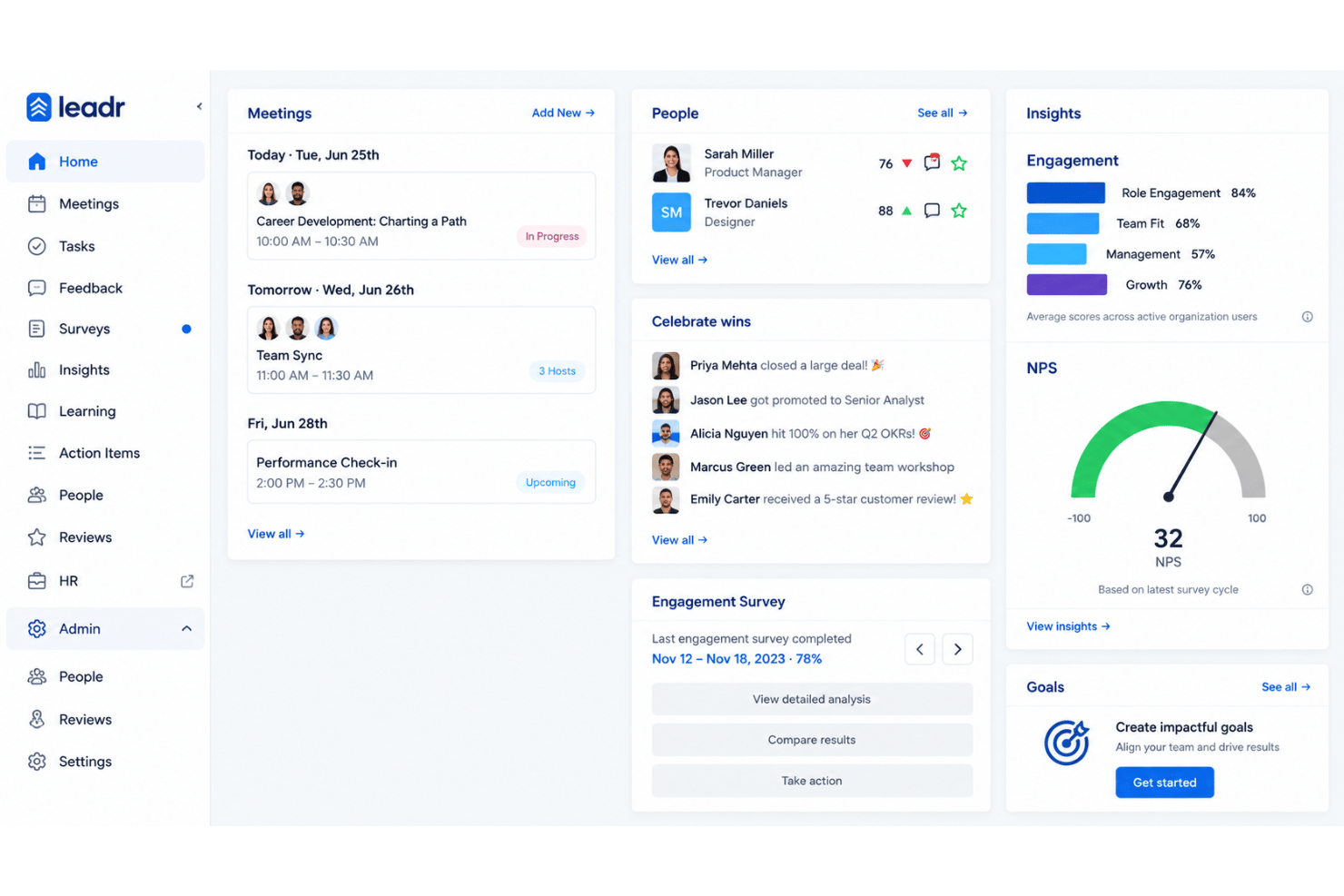
If you’re trying to choose a leadership development platform that puts manager coaching front and center, I think Leadr is a solid pick. Its combined features for one-on-ones, feedback, and goal setting simplify running better meetings and supporting direct reports. The interface is clean and easy to pick up, and onboarding doesn’t drag out. While it doesn’t offer every analytics or engagement feature you might find elsewhere, it’s strong where it matters most for teams building better manager habits. I’d suggest Leadr for organizations that prioritize hands-on manager development over company-wide analytics.
pros
-
Meeting agendas, feedback, and goals live in one place
-
Drives regular one-on-ones to build manager habits
-
Quick onboarding with clean, intuitive interface
cons
-
Limited analytics for wider organizational insights
-
Doesn’t cover engagement surveys or pulse checks
-
Lacks deeper competency frameworks or assessment tools
-

Justworks
Visit WebsiteThis rating combines scores from multiple user review sites to reflect overall customer sentiment about the product.4.6 -
Small Improvements
Visit WebsiteThis rating combines scores from multiple user review sites to reflect overall customer sentiment about the product.4.3 -
HiBob
Visit WebsiteThis rating combines scores from multiple user review sites to reflect overall customer sentiment about the product.4.5



How We Test & Score Our Tools
We’ve spent years building, refining, and improving our software testing and scoring system. The rubric is designed to capture the nuances of software selection and what makes a tool effective, focusing on critical aspects of the decision-making process.
Below, you can see exactly how our testing and scoring works across seven criteria. It allows us to provide an unbiased evaluation of the software based on core functionality, standout features, ease of use, onboarding, customer support, integrations, customer reviews, and value for money.
Core Functionality (25% of final score)
The starting point of our evaluation is always the core functionality of the tool. Does it have the basic features and functions that a user would expect to see? Are any of those core features locked to higher-tiered pricing plans? At its core, we expect a tool to stand up against the baseline capabilities of its competitors.
Standout Features (25% of final score)
Next, we evaluate uncommon standout features that go above and beyond the core functionality typically found in tools of its kind. A high score reflects specialized or unique features that make the product faster, more efficient, or offer additional value to the user.
We also evaluate how easy it is to integrate with other tools typically found in the tech stack to expand the functionality and utility of the software. Tools offering plentiful native integrations, 3rd party connections, and API access to build custom integrations score best.
Ease of Use (10% of final score)
We consider how quick and easy it is to execute the tasks defined in the core functionality using the tool. High scoring software is well designed, intuitive to use, offers mobile apps, provides templates, and makes relatively complex tasks seem simple.
Onboarding (10% of final score)
We know how important rapid team adoption is for a new platform, so we evaluate how easy it is to learn and use a tool with minimal training. We evaluate how quickly a team member can get set up and start using the tool with no experience. High scoring solutions indicate little or no support is required.
Customer Support (10% of final score)
We review how quick and easy it is to get unstuck and find help by phone, live chat, or knowledge base. Tools and companies that provide real-time support score best, while chatbots score worst.
Customer Reviews (10% of final score)
Beyond our own testing and evaluation, we consider the net promoter score from current and past customers. We review their likelihood, given the option, to choose the tool again for the core functionality. A high scoring software reflects a high net promoter score from current or past customers.
Value for Money (10% of final score)
Lastly, in consideration of all the other criteria, we review the average price of entry level plans against the core features and consider the value of the other evaluation criteria. Software that delivers more, for less, will score higher.
Core Features
One-on-One Meeting Agendas
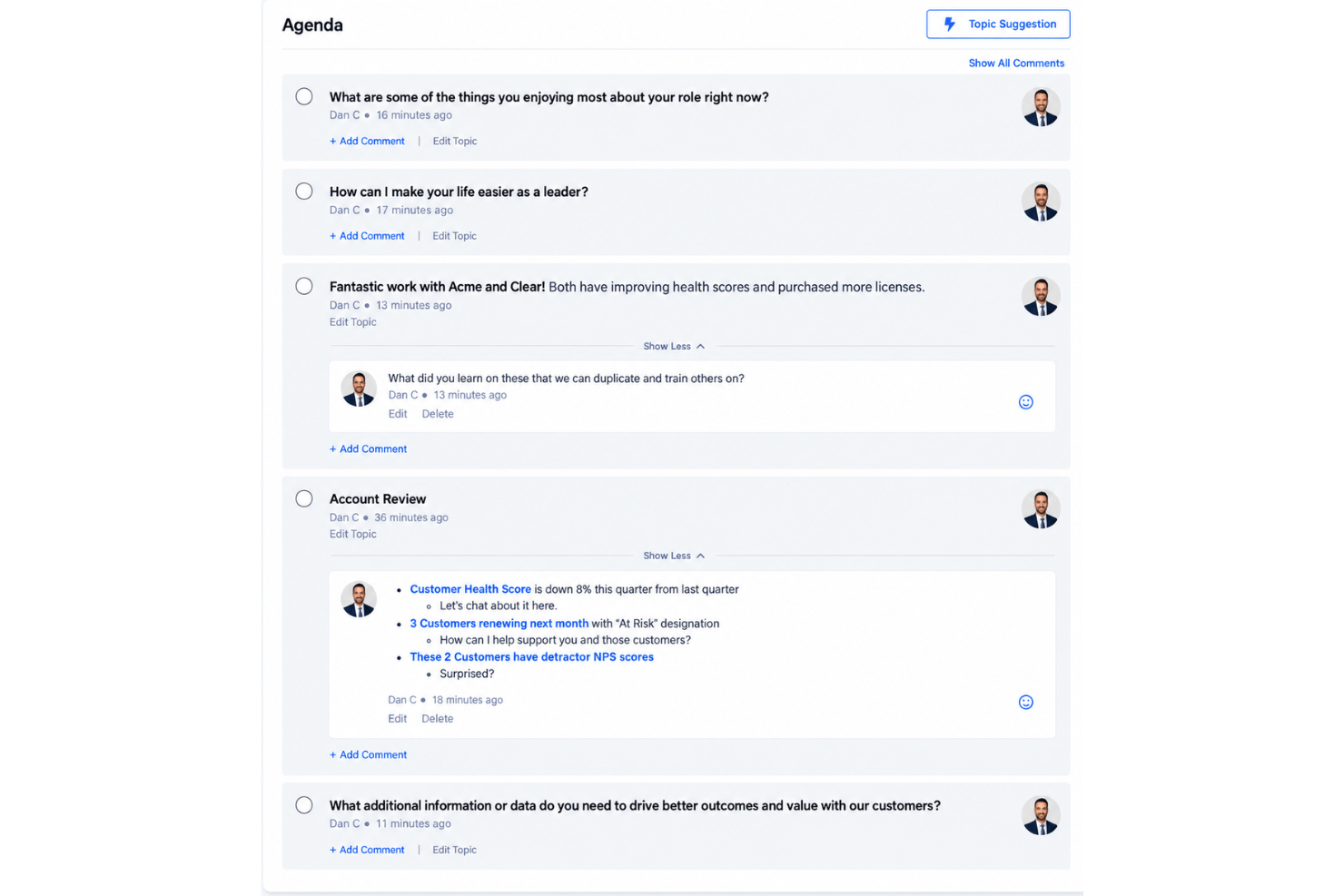
Create and track one-on-one meeting agendas for every direct report in one shared space. Add topics, action items, and notes so you and your team always know what’s coming next.
Feedback and Recognition
Request and share feedback with peers or direct reports in real time. Use templates or write custom messages to deliver recognition and foster continuous development.
Goal Setting and Tracking
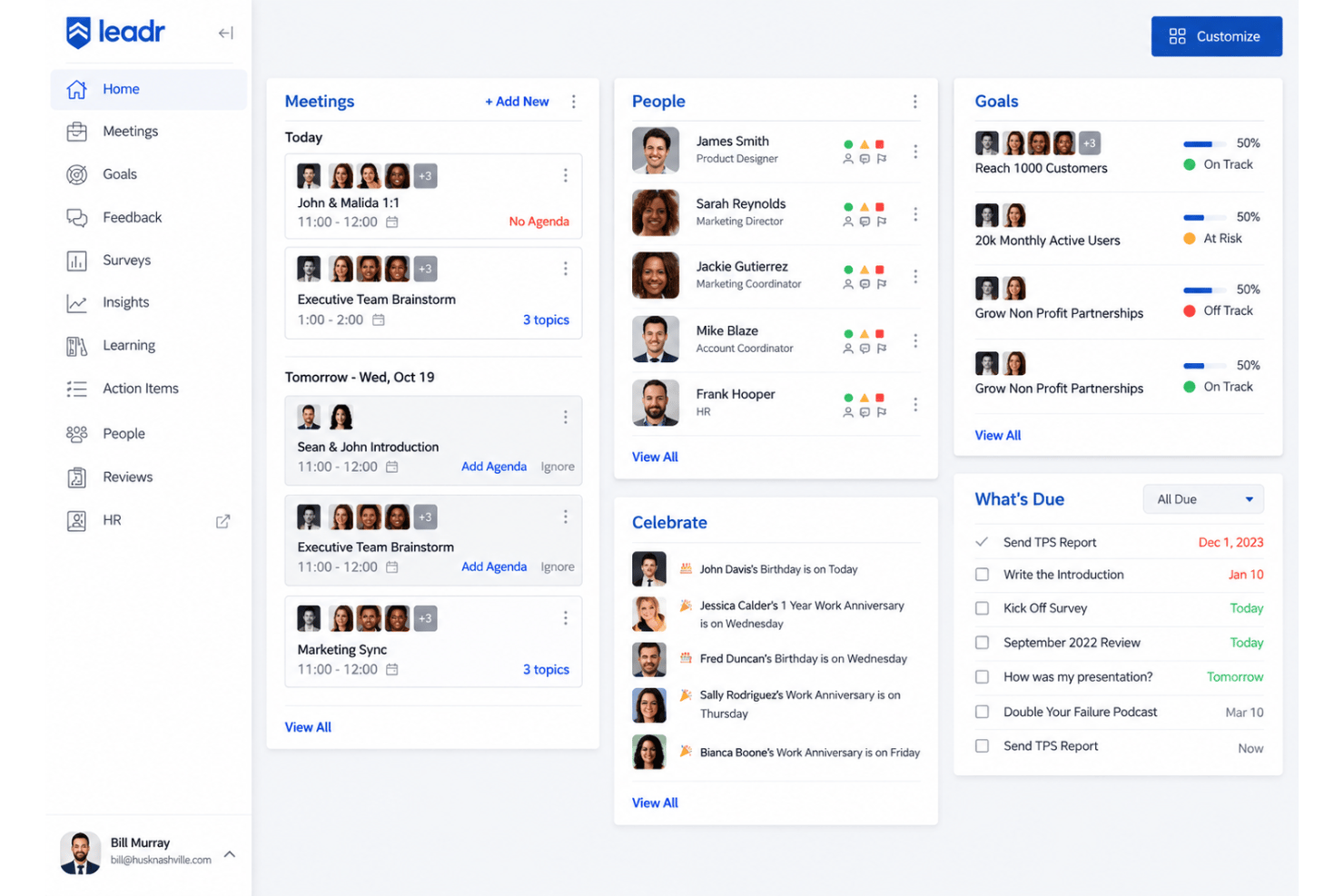
Set, assign, and monitor goals for yourself and your team, keeping progress transparent and aligned. Leadr links goals to individual development plans so priorities stay top of mind.
Performance Reviews
Run structured performance reviews with input from managers, peers, and self-assessments right inside Leadr. Keep review data connected to day-to-day coaching for clearer development conversations.
Learning and Development Plans
Build personalized growth plans with recommended skills, resources, and milestones. Managers can assign learning paths and review achievements as employees make progress.
Shared Notes and Action Items
Capture notes and assign action items during meetings, then track follow-up in one place. Everyone leaves with clear next steps, reducing miscommunication and lost tasks.
Ease of Use
Leadr is easy to pick up thanks to its clean interface and guided onboarding that walks managers through setup. Organizing one-on-ones, setting goals, and capturing feedback all happen in a single spot, which cuts down on manual tracking or switching between tools. Managers say the intuitive navigation helps them stay focused on coaching, not admin work. The platform’s in-app prompts also remind users about key actions, making habit-building feel straightforward.
Integrations
Leadr integrates with Microsoft Teams, Slack, Google Workspace, Outlook, Entra ID, Okta, and OneLogin
Leadr does not currently offer an API, nor does it support connections with third-party integration tools.
Leadr Specs
- 360 Degree Feedback
- API
- Cloud Deployment
- CRM Integration
- Data Export
- Data Import
- Data Visualization
- Database
- Employee Database
- Employee Engagement
- Employee Incentive Management
- Employee Training
- External Integrations
- Feedback Management
- Google Apps Integration
- Health Management
- Migration to Cloud
- Multi-Source Feedback
- Multi-User
- Performance Appraisal
- Process Reporting
- Resource Management
- Rewards & Recognition
- Social-Media Integration
- Software Integration
- Task Scheduling/Tracking
- Third-Party Plugins/Add-Ons
- Workflow Management