

Oyster HR vs. Remote: Comparison and Expert Reviews for 2026



Building a global team means balancing speed, compliance, and cost every time you enter a new market. The right EOR partner can make international hiring feel far more manageable instead of turning expansion into an administrative maze.
Struggling to pick between Oyster HR and Remote for your global team? If you’re wrestling with compliance worries, sticker shock, or just the headache of navigating international hiring, you’re not alone. Choosing the right employer of record services can make a world of difference, quite literally.
In this article, I’ll compare Oyster HR and Remote side by side. You’ll get my take on their pros, cons, use cases, pricing, security, and usability, helping you decide which option delivers what your business actually needs.
Oyster HR vs. Remote: An Overview
Oyster HR
Remote
Why Trust Our Software Reviews
Our team has been testing and reviewing software since 2012. As HR experts ourselves, we know how difficult—and important—it is to choose the right software.
For this guide, we evaluated tools using hands-on testing and independent research, scoring tools using our selection criteria. We also draw on insights from industry thought leaders and practicing HR experts.
Our reviews reflect our human editorial judgment, not a sales pitch.
Expert reviewers:
Oyster HR vs. Remote Pricing Comparison
| Oyster HR | Remote | |
|---|---|---|
| Free Trial | Free demo available | Free demo available |
| Pricing | From $699/user/month | From $699/user/month |
Oyster HR vs. Remote Pricing & Hidden Costs
Both vendors price per worker per month, and both knock the rate down if you commit annually. Headline employer of record rates land in much the same neighborhood, and contractor management costs a fraction of that on either side. Neither one charges for setup, onboarding, or offboarding, which removes a whole category of surprise that used to plague this market. The one structural difference is up front: Oyster HR asks for a refundable deposit before an engagement starts, while Remote holds a reserve only in cases it treats as high risk.
The real cost gap sits in the add-ons. Oyster HR bills its white-glove HR advisory by the hour and sells visa sponsorship, benefits packages, and salary benchmarking as separate lines. Remote splits its catalog by product instead, so US-only PEO hiring, contractor of record, equity administration, and a higher contractor tier with indemnity cover each carry their own rate. Ask both for an all-in quote against your current and planned headcount, confirm what happens when you scale down or end a contract early, and check which currencies you can actually be billed in. That is where the honest comparison lives.
Oyster HR vs. Remote Feature Comparison
| Oyster HR | Remote | |
|---|---|---|
| API | ||
| Application Tracking | ||
| Batch Permissions & Access | ||
| Compliance Tracking | ||
| Contract Management | ||
| Data Export | ||
| Data Import | ||
| Data Visualization | ||
| Database Search | ||
| Document Management | ||
| Employee Database | ||
| Employee Onboarding | ||
| Employee Training | ||
| External Integrations | ||
| HRIS Integration | ||
| Mobile App | ||
| Multi-Currency | ||
| Multi-User | ||
| Notifications | ||
| Password & Access Management | ||
| Payroll | ||
| Report & Compliance | ||
| Risk Assessment | ||
| Scheduling | ||
| Tax Management | ||
| Timesheets |
Oyster HR vs. Remote Integrations
| Integration | Oyster HR | Remote |
|---|---|---|
| Slack | ✅ | ✅ |
| QuickBooks | ✅ | ✅ |
| BambooHR | ✅ | ✅ |
| Greenhouse | ✅ | ✅ |
| Workday | ✅ | ✅ |
| Xero | ✅ | ✅ |
| HiBob | ✅ | ✅ |
| Netsuite | ❌ | ✅ |
| API | ✅ | ✅ |
| Zapier | ✅ | ✅ |
| Personio | ❌ | ✅ |
| Carta | ✅ | ❌ |
The overlap here is wider than either vendor lets on. Accounting, HRIS, applicant tracking, chat, and automation are all covered on both sides, and each publishes an API plus a Zapier connection that picks up the long tail. Remote goes deeper on ERP and identity providers, which matters once finance and IT get a vote in the decision. Oyster HR spreads wider across mid-market HRIS and recruiting tools and leans on a large partner directory beyond its direct connectors. Finance-led stack, Remote has the edge out of the box; recruiting-led stack, Oyster HR feels better covered.
Oyster HR vs. Remote Security, Compliance & Reliability
| Factor | Oyster HR | Remote |
|---|---|---|
| Data Privacy | GDPR compliant with a data processing addendum built into its terms, and it follows the EU to US data privacy framework for transfers. | GDPR compliant, with data encrypted in transit and a documented key management policy governing cryptographic controls. |
| Regulatory Compliance | Legal-reviewed employment agreements and localized compliance checks across the countries in its employer of record footprint. | In-house legal, payroll, and compliance teams in its operating markets, with relevant law changes surfaced inside the platform. |
| Platform Reliability | Runs on AWS with automated backups, tight recovery objectives, and a documented business continuity plan. | Built for high availability, with continuous infrastructure monitoring, automated alerting, and periodically tested disaster recovery. |
| Security Certifications | SOC 1 and SOC 2 Type 2 audited, with continuous control monitoring and regular third-party penetration testing. | ISO 27001 certified and SOC 2 Type 2 audited, with cloud security alliance accreditation on top. |
| Access Controls | Two-factor authentication, single sign-on, least-privilege access, and event and audit log management. | Single sign-on, two-factor authentication, least-privilege administrative access, and scheduled user access reviews. |
Both take security seriously and publish their controls openly, so neither should trouble a security review. Remote holds the deeper certification stack, adding an ISO information security certification and cloud security accreditation on top of the audit reports both vendors share. Oyster HR counters with continuous control monitoring, regular third-party penetration testing, and its own public trust dashboard. The detail I would push on is liability: Remote backs employer of record work with uncapped indemnity, while Oyster HR relies on a large but capped insurance policy.
Oyster HR vs. Remote Ease of Use
| Factor | Oyster HR | Remote |
|---|---|---|
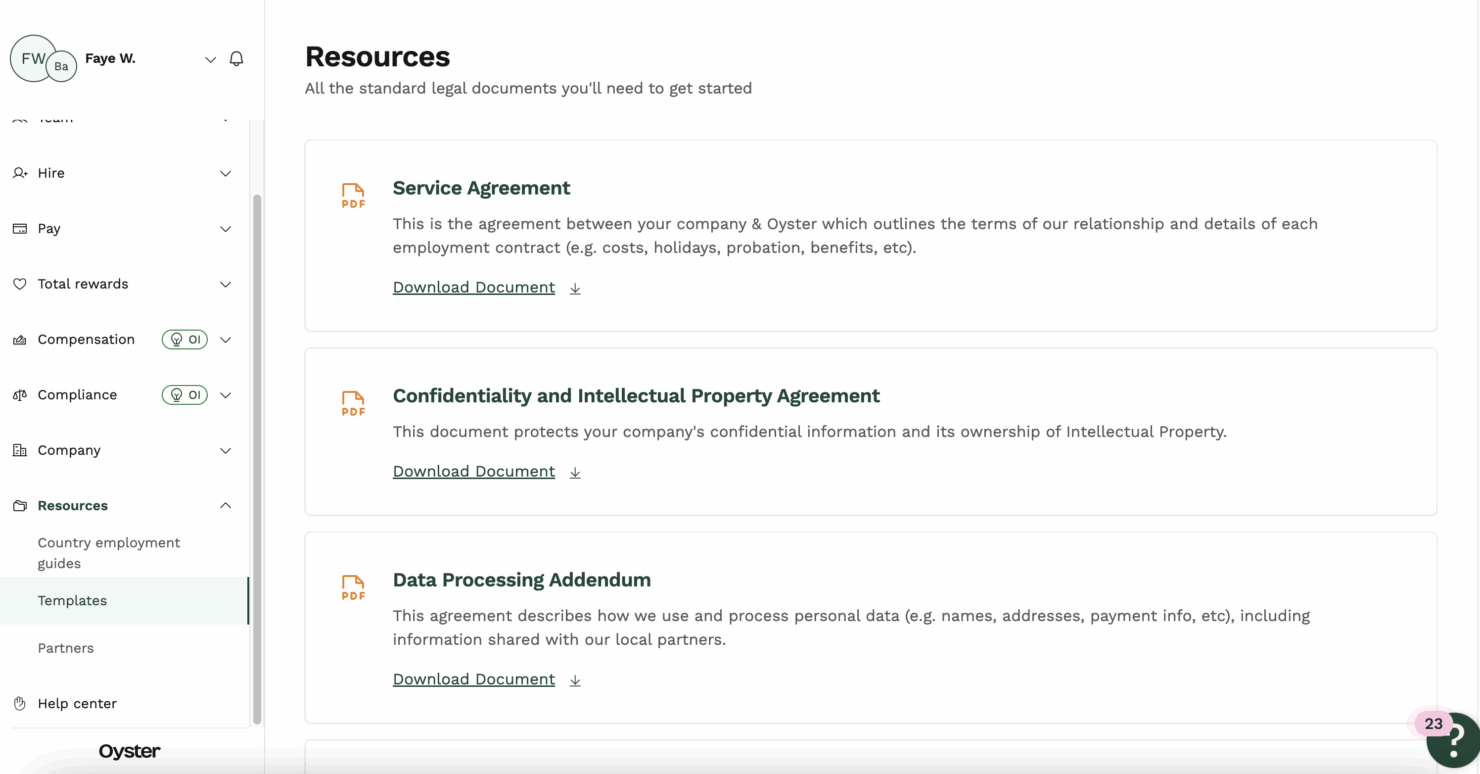
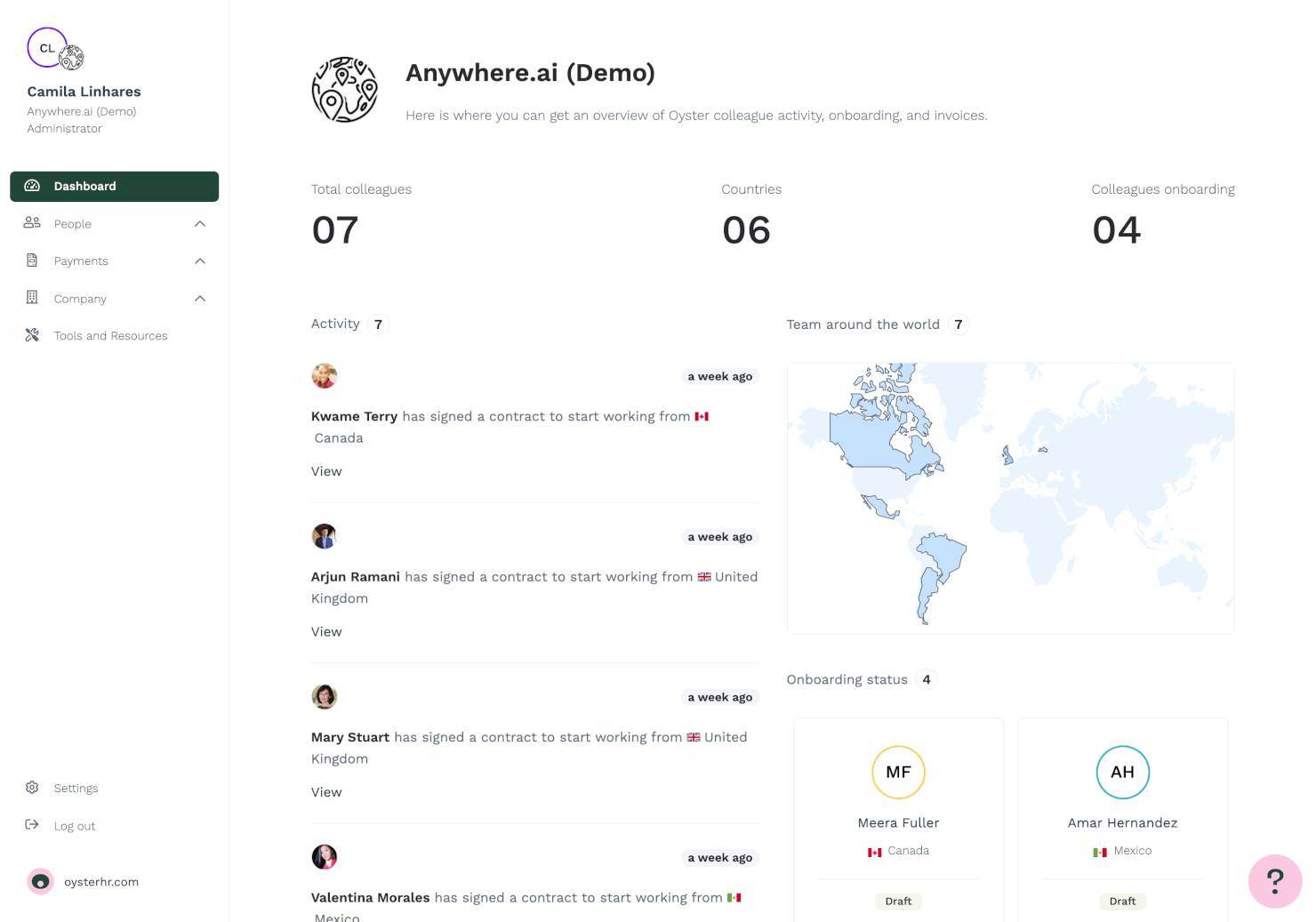
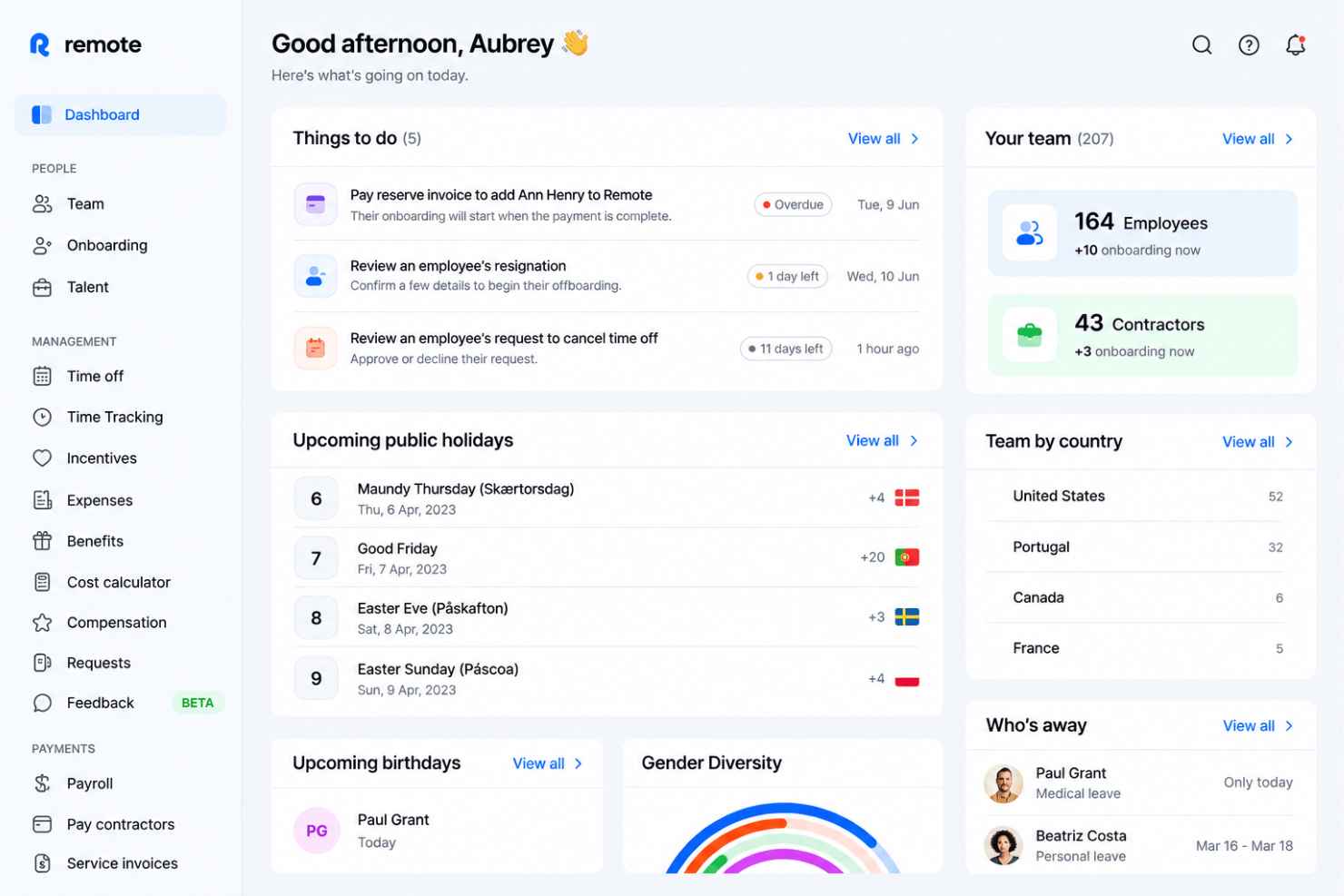
| Dashboard Design | Clean, modern dashboard keeps key actions like onboarding, payroll, and compliance front and center. | Streamlined interface prioritizes quick access to payroll, benefits, and support resources. |
| Onboarding Workflow | Guided checklists and country-specific onboarding managers help new users avoid compliance pitfalls. | Automated onboarding tools with smart forms and templates simplify contract setup and documentation. |
| Support Accessibility | Live chat, a named point of contact, and HR advisors you can bring in by the hour for genuinely tricky cases. | In-house legal, payroll, and HR specialists in its operating markets, plus a dedicated onboarding specialist on EOR plans. |
| Setup Process | Step-by-step guidance and local prompts help teams launch in new countries with minimal friction. | Fast initial setup with pre-built templates for country-specific requirements. |
Both platforms get teams live quickly, and each advertises onboarding measured in days rather than weeks. Oyster HR feels more guided, pairing country-specific onboarding managers with checklists that flag local pitfalls before you trip over them. Remote feels more self-directed, with smart forms and templates that move fast if you already know what you are doing, plus an in-house specialist bench for when you don’t. I think Oyster HR suits teams walking into unfamiliar markets, while Remote suits teams that want to move without waiting on anyone.
Oyster HR vs Remote: Pros & Cons
Oyster HR
- Onboarding: Oyster HR simplifies the onboarding of new hires with compliant employment contracts and digital signing.
- Benefits management: Oyster HR provides localized benefits packages that are customized for each employee's country.
- Payroll processing: Oyster HR handles all aspects of global payroll, including taxes, deductions, and payments made in local currencies.
- Limited countries: Oyster HR supports hiring employees in 180 countries, fewer than other global EOR providers.
- No PEO option: Oyster HR only offers employer-of-record services and does not provide a professional employer organization (PEO) co-employment model.
- Separate platform: Oyster HR is a standalone platform that does not directly integrate with some popular HR and payroll systems.
Remote
- Owns local entities in every covered country.
- Fast onboarding and clear employment contracts.
- Transparent, flat monthly pricing structure.
- Limited on-demand support for smaller teams.
- Not built to replace a full HRIS.
- Payroll setup can face country-specific delays.
Best Use Cases for Oyster HR and Remote
Oyster HR
- Remote teams Oyster HR makes hiring and paying remote workers in over 180 countries hassle-free while complying with local employment laws.
- Startups Oyster's self-service platform and transparent pricing are well-suited for fast-moving startups looking to scale their global team quickly.
- HR departments Oyster's dashboard gives HR teams visibility into their global workforce for headcount planning, payroll, and people analytics.
- Tech companies Software and tech firms with geographically distributed teams find Oyster's automated compliance, payroll, and benefits administration across 180+ countries very helpful.
- Fast Growth Companies experiencing rapid headcount growth globally can use Oyster to onboard new hires in days instead of months.
- Emerging markets Oyster HR simplifies hiring with a global network of pre-screened, market-savvy candidates.
Remote
- Global Tech Startups Remote makes it easy to hire and onboard talent in multiple countries, reducing the legal and payroll barriers that fast-growing tech startups face.
- Small HR Teams With automated workflows and a self-serve portal, HR teams with limited resources can manage contracts, payroll, and compliance without manual oversight.
- Remote-First Companies Remote’s international payroll, contract setup, and benefits administration all support a fully distributed workforce needing reliable local compliance.
- VC-Backed Scaleups The flat pricing, transparent cost calculator, and bulk action API let VC-backed growth companies budget and expand into new markets confidently.
- Professional Services Firms Companies hiring contractors and employees across regions can centralize document management and payments for smooth cross-border operations.
- Product-Led SaaS SaaS companies expanding overseas need strong HR integrations and fast onboarding, which Remote’s API and partner connectors deliver.
Who Should Use Oyster HR, and Who Should Use Remote?
Oyster HR is the better fit if you want a guide rather than a tool, with onboarding managers, pre-built benefits packages, visa sponsorship, and advisors you can pull in by the hour. Its employer of record footprint also stretches across more countries than Remote’s owned-entity network, so it is the safer bet when your next hire lands somewhere unusual. Remote is the pick when you want range and control, from US PEO hiring and contractor of record through to entity setup, backed by deeper finance and ERP connections and uncapped indemnity behind the employment relationship. If your priority is guidance and country reach, Oyster HR wins; if it is product range, integration depth, and legal cover, Remote pulls ahead. Both make global hiring easier, but your team’s needs and work style will decide the match.
Differences Between Oyster HR and Remote
| Oyster HR | Remote | |
|---|---|---|
| Benefit Packages | Pre-configured local and global benefits packages tailored for each country. | Localized benefits selected per country, with equity administration available alongside. |
| Compliance Support | In-depth, country-specific hiring guidance, alerts, and legal-reviewed agreements. | In-house legal and payroll teams in its operating markets, with law changes surfaced in-platform. |
| Country Reach | Employer of record coverage spans a noticeably longer list of countries. | Fewer employer of record countries, but contractor and payroll reach extends much further. |
| Integration Focus | Broad partner directory across HRIS, recruiting, and accounting, extended through automation tools. | Same core coverage plus ERP and identity providers, which suits finance and IT-led stacks. |
| Liability Cover | Large but capped liability insurance sitting behind the employment relationship. | Uncapped indemnity on employer of record engagements, plus automatic IP transfer. |
| Read Oyster HR ReviewOpens new window | Visit RemoteOpens new window | |
| Onboarding Style | Guided checklists and local onboarding managers make onboarding simple. | Fast automated onboarding with smart forms and templates. |
| Pricing Approach | Flat monthly rate per worker, annual seats at a reduced rate, and a refundable deposit up front. | Flat monthly rate per worker too, discounted for paying annually, with no platform or setup fees. |
| Read Oyster HR ReviewOpens new window | Visit RemoteOpens new window |
Similarities Between Oyster HR and Remote
| API & HR Integrations | Both platforms support API access and connect with popular HR and applicant tracking tools like BambooHR, Greenhouse, and Slack. This ensures you can plug each into a broader tech stack and automate routine work, even if they support some different partners. |
|---|---|
| Compliance Automation | Each solution offers automated compliance checks, alerts, and built-in employment agreement templates to make sure users meet local laws. Both notify teams about regulatory changes and support custom workflows to reduce admin time and error risk. |
| Flexible Contract Types | Both Oyster HR and Remote let you hire full-time employees and manage global contractors from the same platform, handling payroll, benefits, and contracts together, which makes them a fit for teams with diverse global resourcing needs. |
| Global Coverage | Both platforms support hiring, payroll, and compliance across a wide slice of the world, making them a fit for teams building an international presence. Each offers automated compliance tooling and country-by-country legal updates, helping global teams avoid risk no matter where they hire. |
| Read Oyster HR ReviewOpens new window Visit RemoteOpens new window | |
| No Setup Fees | Neither vendor charges for setup, onboarding, or offboarding, and both publish their per-worker rates openly rather than hiding them behind a sales call. Each also runs discount programs for nonprofits and mission-driven organizations, so it is worth asking whether you qualify before you sign. |
| Unified Dashboard | Oyster HR and Remote centralize all core employer of record functions, including payroll, benefits, compliance, onboarding, and document storage, in a single accessible dashboard. Both prioritize at-a-glance summaries and action items to keep HR teams focused. |
| Read Oyster HR ReviewOpens new window Visit RemoteOpens new window | |