Teramind Review: Pros, Cons, Features, and Pricing Explained


Teramind is a workforce analytics software built for teams that need to monitor user activity, detect insider threats, and track productivity across their workforce. I'd look at it closely if your organization needs security-focused behavioral analytics alongside productivity data. Where ActivTrak leans heavily into productivity insights, Teramind gives you deeper visibility into risky user behavior and data loss prevention—making it a better fit when compliance and data protection are just as much a priority as workforce performance.
Teramind Evaluation Summary
- Pricing upon request
- Free demo available
Why Trust Our Software Reviews
Our team has been testing and reviewing software since 2012. As HR experts ourselves, we know how difficult—and important—it is to choose the right software.
For this guide, we evaluated tools using hands-on testing and independent research, scoring tools using our selection criteria. We also draw on insights from industry thought leaders and practicing HR experts.
Our reviews reflect our human editorial judgment, not a sales pitch.
Expert reviewers:
Teramind Overview
If you're judging Teramind against other workforce analytics software, you'll notice its monitoring depth and real-time alerts set it apart, especially for organizations with strict compliance or insider threat concerns. The interface is detailed but can feel overwhelming at first, so onboarding may take some adjustment. Price is competitive for the feature set, and support is responsive. I think Teramind is best for teams that need granular tracking and customizable behavior rules—like finance or healthcare—rather than those seeking a lightweight, plug-and-play analytics tool. If you value detailed oversight, Teramind is a strong contender.
pros
-
Real-time alerts help quickly identify risky behavior
-
Detailed productivity metrics support data-driven HR decisions
-
Customizable policies fit strict compliance environments
cons
-
Monitoring features can feel invasive to employees
-
Interface complexity may overwhelm new users
-
Advanced analytics require time to configure and interpret
-

Justworks
Visit WebsiteThis rating combines scores from multiple user review sites to reflect overall customer sentiment about the product.4.6 -
Small Improvements
Visit WebsiteThis rating combines scores from multiple user review sites to reflect overall customer sentiment about the product.4.3 -
HiBob
Visit WebsiteThis rating combines scores from multiple user review sites to reflect overall customer sentiment about the product.4.5



How We Test & Score Our Tools
We’ve spent years building, refining, and improving our software testing and scoring system. The rubric is designed to capture the nuances of software selection and what makes a tool effective, focusing on critical aspects of the decision-making process.
Below, you can see exactly how our testing and scoring works across seven criteria. It allows us to provide an unbiased evaluation of the software based on core functionality, standout features, ease of use, onboarding, customer support, integrations, customer reviews, and value for money.
Core Functionality (25% of final score)
The starting point of our evaluation is always the core functionality of the tool. Does it have the basic features and functions that a user would expect to see? Are any of those core features locked to higher-tiered pricing plans? At its core, we expect a tool to stand up against the baseline capabilities of its competitors.
Standout Features (25% of final score)
Next, we evaluate uncommon standout features that go above and beyond the core functionality typically found in tools of its kind. A high score reflects specialized or unique features that make the product faster, more efficient, or offer additional value to the user.
We also evaluate how easy it is to integrate with other tools typically found in the tech stack to expand the functionality and utility of the software. Tools offering plentiful native integrations, 3rd party connections, and API access to build custom integrations score best.
Ease of Use (10% of final score)
We consider how quick and easy it is to execute the tasks defined in the core functionality using the tool. High scoring software is well designed, intuitive to use, offers mobile apps, provides templates, and makes relatively complex tasks seem simple.
Onboarding (10% of final score)
We know how important rapid team adoption is for a new platform, so we evaluate how easy it is to learn and use a tool with minimal training. We evaluate how quickly a team member can get set up and start using the tool with no experience. High scoring solutions indicate little or no support is required.
Customer Support (10% of final score)
We review how quick and easy it is to get unstuck and find help by phone, live chat, or knowledge base. Tools and companies that provide real-time support score best, while chatbots score worst.
Customer Reviews (10% of final score)
Beyond our own testing and evaluation, we consider the net promoter score from current and past customers. We review their likelihood, given the option, to choose the tool again for the core functionality. A high scoring software reflects a high net promoter score from current or past customers.
Value for Money (10% of final score)
Lastly, in consideration of all the other criteria, we review the average price of entry level plans against the core features and consider the value of the other evaluation criteria. Software that delivers more, for less, will score higher.
Core Features
User Activity Monitoring
Track application usage, websites visited, social media access, and file transfers in real time. Spot risky behavior and optimize workflows fast.
Productivity Analysis
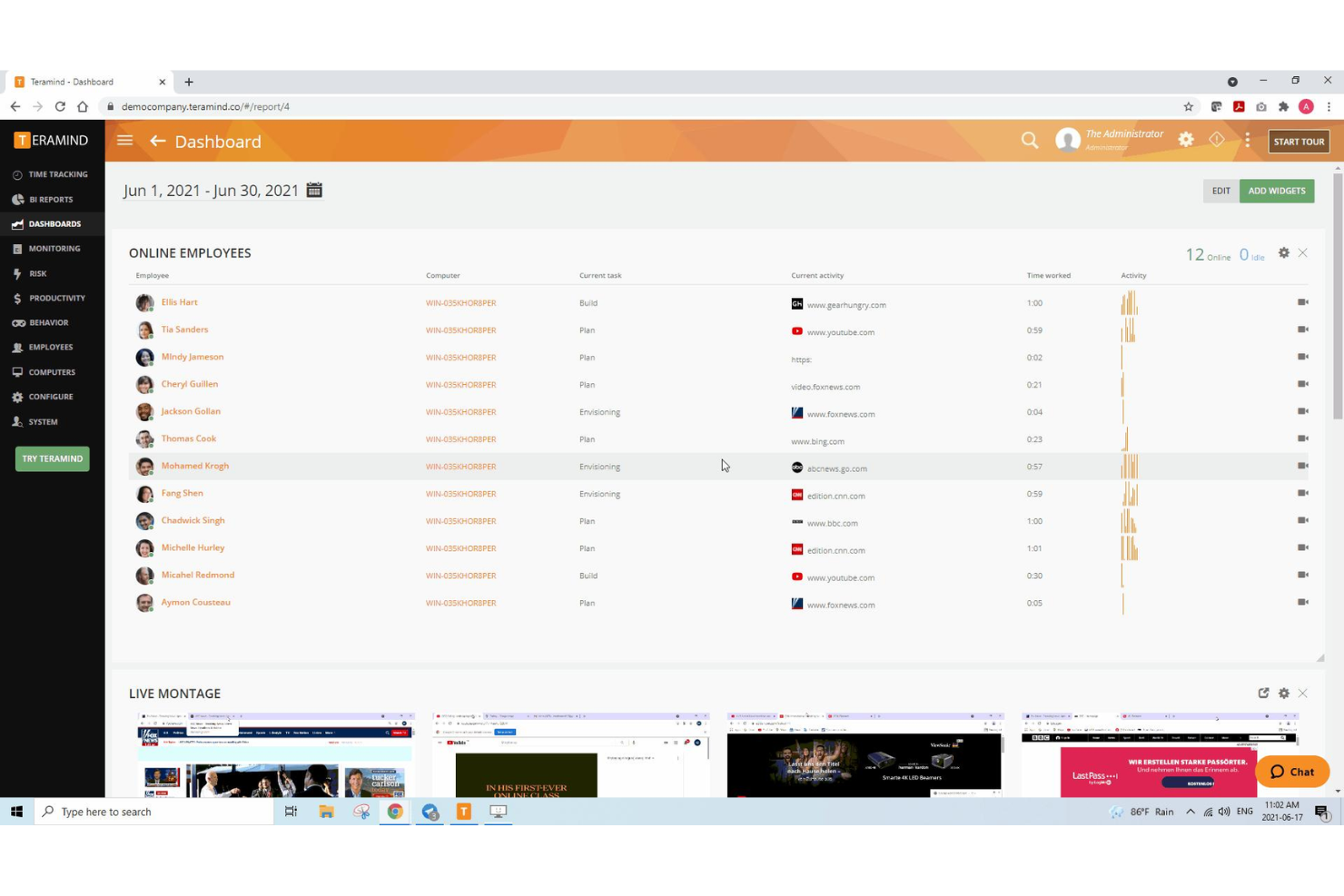
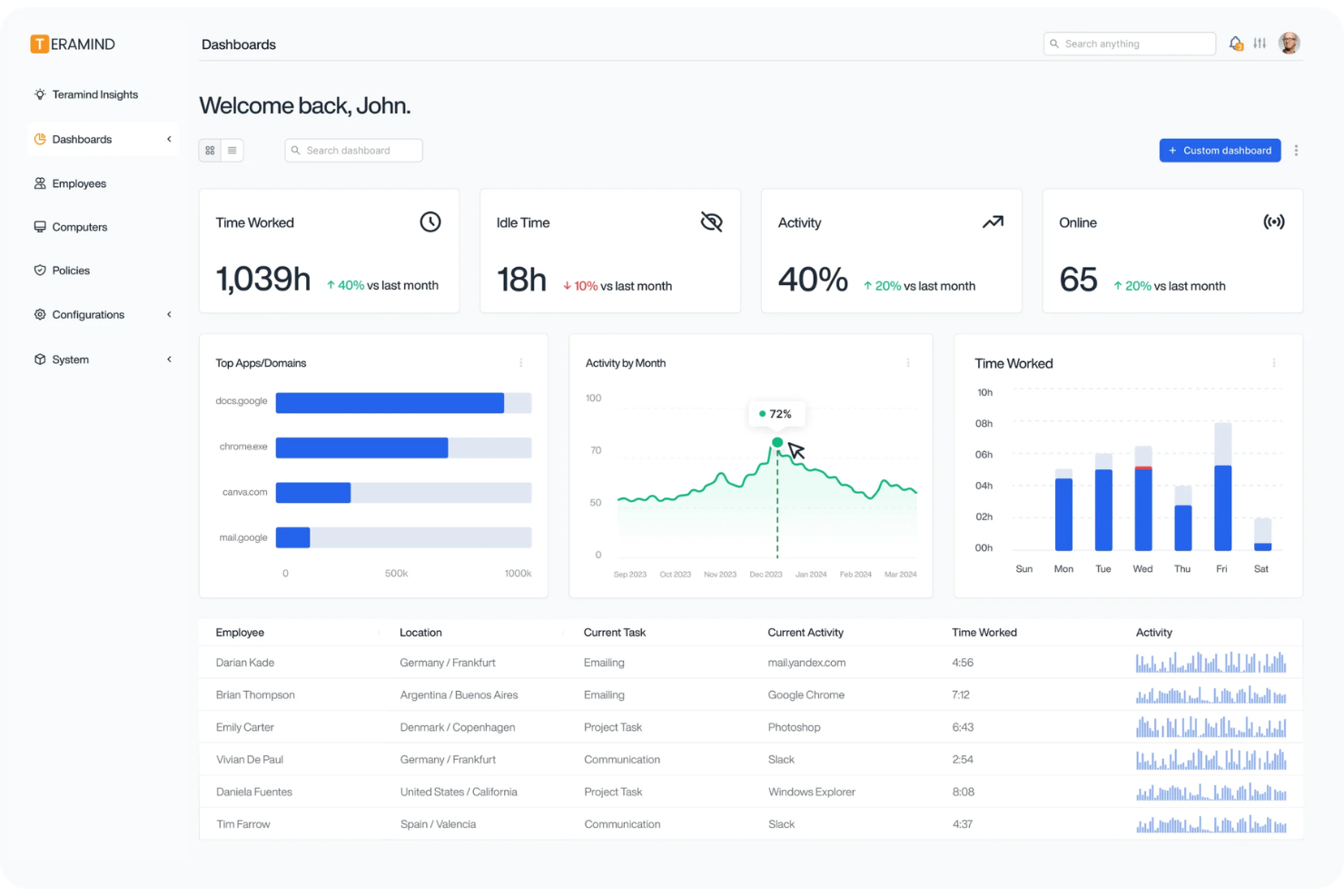
Measure employee productivity with detailed reports on active and idle time. Visual dashboards make comparing productivity metrics across teams easy.
Behavioral Alerts
Set behavior rules to trigger instant notifications for suspicious actions. Respond quickly to policy violations or security threats.
Session Recording
Record user sessions—screen recording, keystrokes, clipboard activity, and audio—for audits, investigations, or training with full playback support.
Insider Threat Detection
Identify potential data leaks with automated risk scoring. Flags unusual user behavior patterns for further investigation.
Policy and Rule Management
Create and enforce custom monitoring policies for different roles. Flexible templates let you tailor oversight to your organization's needs.
Ease of Use
Teramind offers a feature-rich dashboard, but the sheer depth of options can feel overwhelming for new users. Many reviewers mention that setup and navigation require a learning period, especially when configuring custom policies or advanced analytics. However, once you're familiar with the interface, the detailed controls and visualizations make it easy to drill down into workforce data. Teams with technical resources will adapt quickly; smaller teams may find it less user-friendly at first.
Integrations
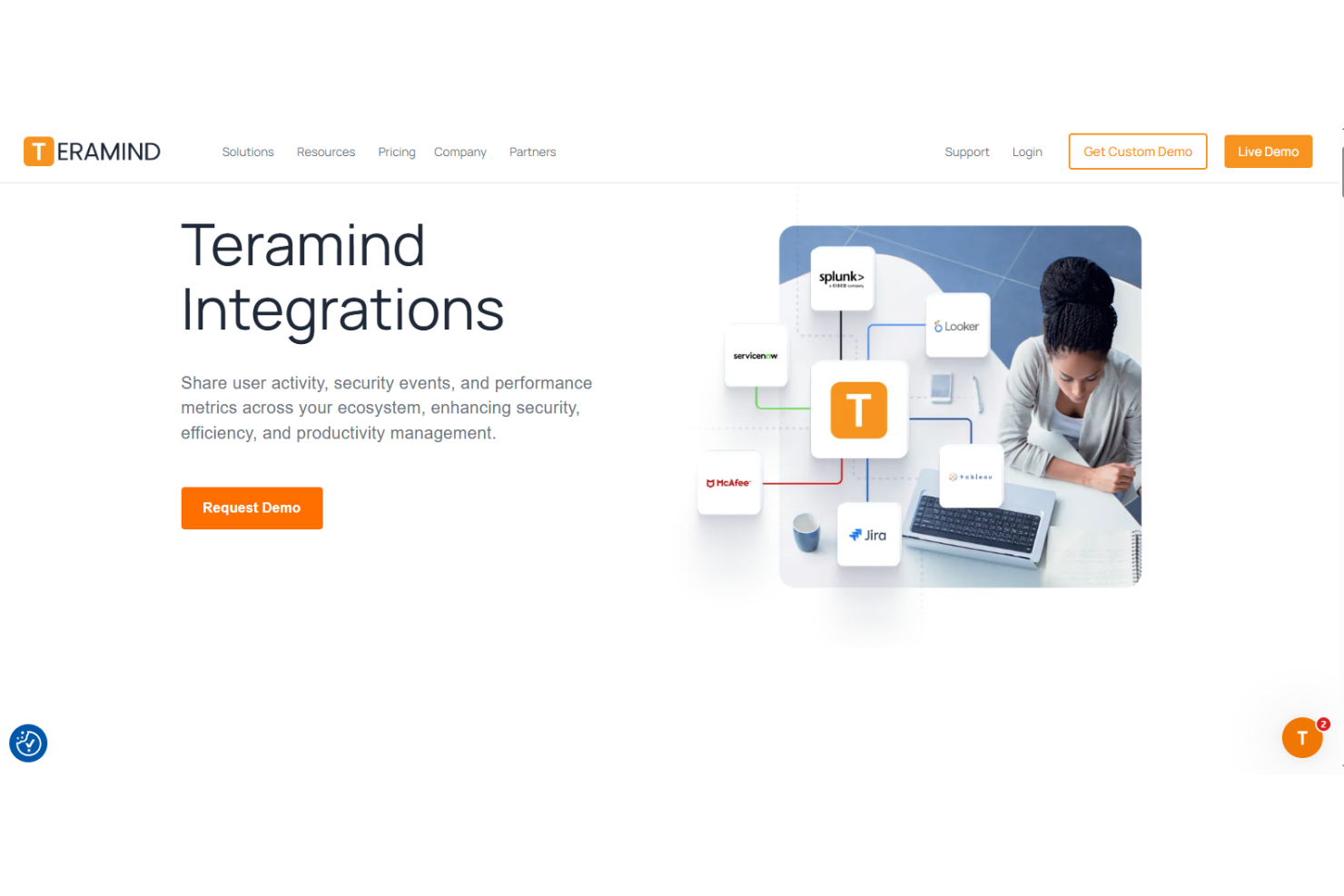
Teramind integrates with ServiceNow, Splunk, IBM QRadar, Jira, and Zendesk, among others.
Teramind also offers a robust API for custom integrations and supports data export in JSON and CEF formats for connecting with third-party tools.
Teramind Specs
- API
- Batch Permissions & Access
- Behavioral Tracking
- Big Data
- Competency Assessment
- Compliance Tracking
- Dashboard
- Data Export
- Data Import
- Data Visualization
- Database
- Employee Database
- Employee Engagement
- Employee Onboarding
- External Integrations
- Feedback Management
- Multi-User
- Notifications
- Password & Access Management
- Performance Appraisal
- Site Access Management
- Social-Media Integration
- Workflow Management