

WorkTango vs. Kudos: Comparison & Expert Reviews For 2026



Employee recognition programs can lose momentum when they feel disconnected from the rest of the employee experience. HR teams may have plenty of recognition activity but still lack context around engagement, participation, and whether employees actually feel valued.
If you’re comparing WorkTango and Kudos, the choice comes down to how broad you want your platform to be. Both are employee recognition platforms, but WorkTango combines recognition and rewards with surveys and engagement insights, while Kudos centers on recognition, rewards, and culture-building tools.
In this article, I’ll compare WorkTango and Kudos across features, pricing, ease of use, security, integrations, and best use cases so you can decide which platform fits your HR team best.
WorkTango vs. Kudos: An Overview
WorkTango
Kudos
Why Trust Our Software Recommendations
Our team has been testing and reviewing software since 2012. As HR experts ourselves, we know how difficult—and important—it is to choose the right software.
For this guide, we evaluated tools using hands-on testing and independent research, scoring tools using our selection criteria. We also draw on insights from industry thought leaders and practicing HR experts.
Our reviews reflect our human editorial judgment, not a sales pitch.
Expert reviewers:
WorkTango vs. Kudos Pricing Comparison
| WorkTango | Kudos | |
|---|---|---|
| Free Trial | Free demo available | Free demo available |
| Pricing | Pricing upon request | Pricing upon request |
WorkTango vs. Kudos Pricing & Hidden Costs
WorkTango uses quote-based pricing with a 12-month minimum contract. Recognition & Rewards and Surveys & Insights can be purchased separately, with 10 million+ reward options for employees to choose from and rewards billed upon redemption. Kudos does not publish pricing details, so buyers need to request a quote to confirm current platform fees, contract terms, and reward costs.
To compare total cost, look beyond the base subscription and factor in reward funding, implementation, integrations, custom swag, and renewal terms. Also consider how pricing changes as headcount grows and whether you need recognition alone or a broader employee experience platform.
WorkTango vs. Kudos Feature Comparison
| WorkTango | Kudos | |
|---|---|---|
| 360 Degree Feedback | ||
| API | ||
| Data Export | ||
| Data Import | ||
| Data Visualization | ||
| Employee Database | ||
| Employee Engagement | ||
| Employee Incentive Management | ||
| External Integrations | ||
| Feedback Management | ||
| Multi-User |
WorkTango vs. Kudos Integrations
| Integration | WorkTango | Kudos |
|---|---|---|
| Slack | ✅ | ✅ |
| Microsoft Teams | ✅ | ✅ |
| Microsoft Outlook | ✅ | ❌ |
| Workday | ✅ | ✅ |
| ADP Workforce Now | ✅ | ✅ |
| BambooHR | ✅ | ✅ |
| Okta | ✅ | ✅ |
| Google Workspace | ✅ | ✅ |
| Paylocity | ✅ | ✅ |
| Justworks | ✅ | ✅ |
| API | ✅ | ✅ |
Both WorkTango and Kudos connect with common HRIS, communication, and identity tools to reduce manual employee-data management and bring recognition into existing workflows. WorkTango spans HRIS, SSO, communication, and workplace integrations within its broader employee experience platform, while Kudos supports recognition workflows alongside HRIS provisioning and identity access. Overall, both cover the integrations most HR teams are likely to need, with WorkTango offering a particularly broad mix across employee experience and workforce systems.
WorkTango vs. Kudos Security, Compliance & Reliability
| Factor | WorkTango | Kudos |
|---|---|---|
| Independent Assurance | Annual SOC 2 Type II audits and penetration testing, with security controls aligned to the NIST Cybersecurity Framework and ISO 27001 practices. | SOC 2 Type II and ISO 27001 certification provide independent assurance around its security and information management controls. |
| Privacy Controls | GDPR support includes a Data Processing Addendum, Standard Contractual Clauses, data minimization, and anonymization measures for survey data. | Provides a Data Processing Agreement and privacy controls covering employee profiles, recognition data, and other customer information, with platform data stored and accessed in Canada. |
| Data Protection | Uses AES-256 encryption at rest and TLS 1.2+ in transit. Surveys & Insights data is hosted in Canada, while Recognition & Rewards data is hosted in the US. | Uses encrypted connections and cloud infrastructure governed by SOC 2 Type II and ISO 27001 controls to protect customer and recognition data. |
| Access Controls | Supports SAML 2.0 SSO and requires two-factor authentication for administrators who do not use SSO. | Supports SSO and just-in-time user provisioning, with identity provider integrations including Okta and OneLogin. |
| Platform Reliability | Uses redundant infrastructure, daily backups, and a defined SLA to support availability and recovery. | Maintains a public status page for platform and integration availability, backed by controls covered under its SOC 2 Type II and ISO 27001 programs. |
Overall, WorkTango emphasizes encryption, data residency, penetration testing, backups, and service-level commitments, supported by SOC 2 Type II assurance. Kudos highlights SOC 2 Type II, ISO 27001, Canadian data hosting, SSO, and user provisioning. Both cover core security and compliance requirements, with WorkTango documenting infrastructure and data protection practices in detail, while Kudos relies on established certifications and access controls.
WorkTango vs. Kudos Ease of Use
| Factor | WorkTango | Kudos |
|---|---|---|
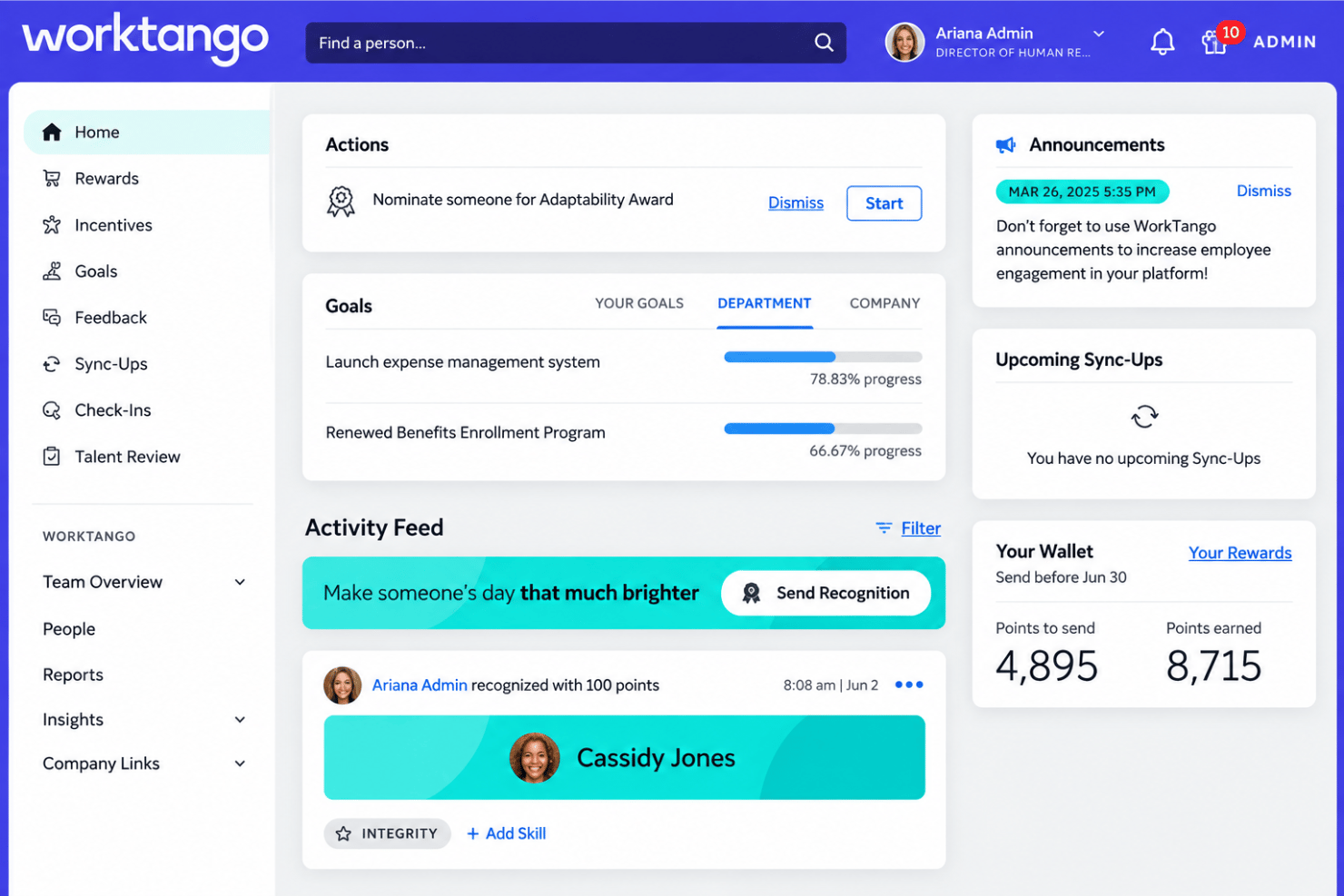
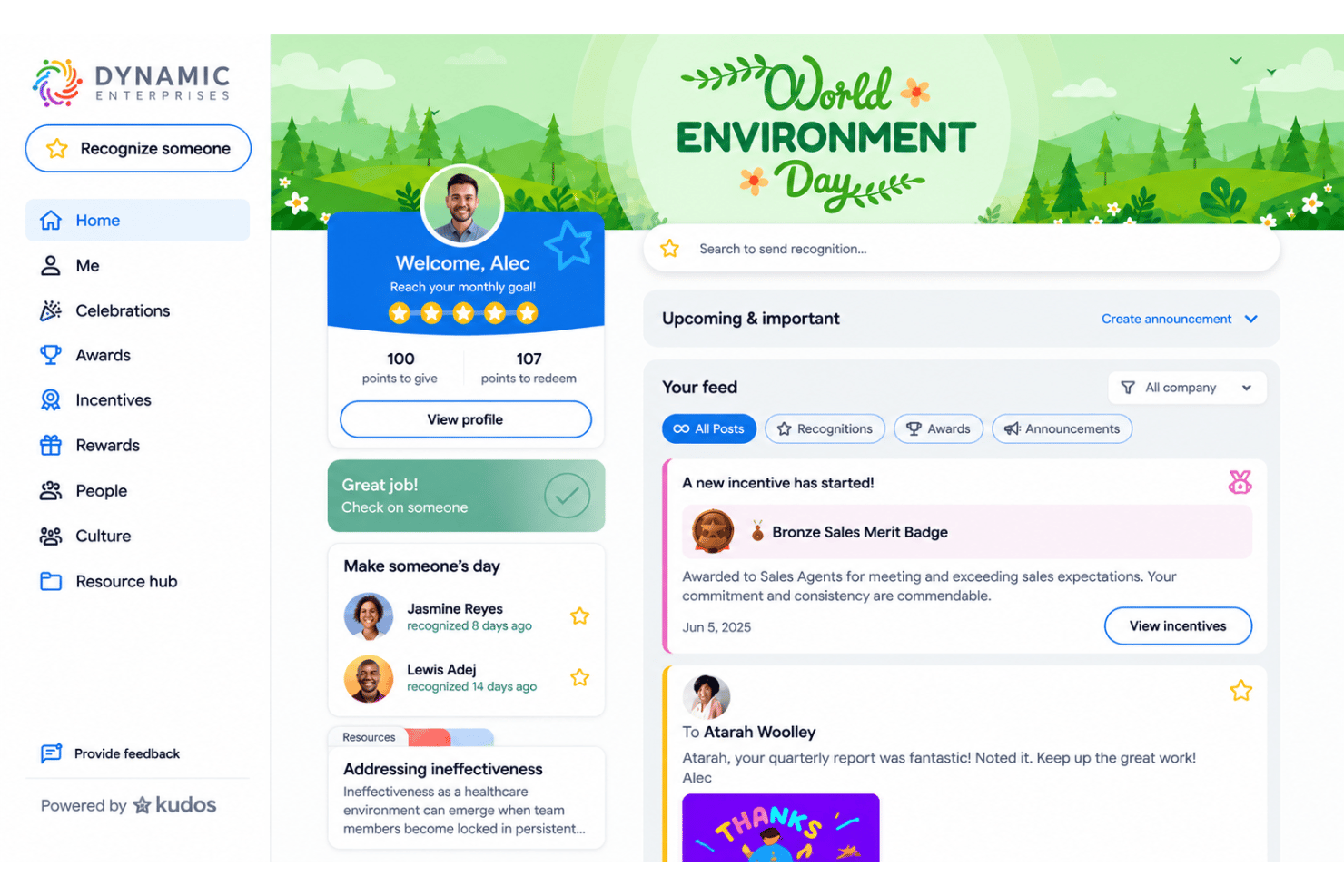
| User Interface | Combines recognition, rewards, surveys, and employee insights in one platform, with separate views for employees, managers, and HR teams. | Uses a recognition-centered workspace with activity feeds, Spaces, eCards, awards, and other tools for everyday appreciation. |
| Recognition Flow | Employees can recognize peers or managers, tie recognition to company values, add points or rewards, and participate through Slack, Teams, or mobile. | Employees can post peer recognition, use values-based awards and eCards, and get writing help from the AI Recognition Assistant. |
| Admin Experience | HR teams can manage recognition, incentives, milestones, surveys, dashboards, and reward budgets, giving admins one place to oversee broader employee experience programs. | HR teams can configure awards, milestones, challenges, rewards, and automated workflows while keeping the admin experience focused on recognition programs. |
| Employee Access | Supports mobile apps, Slack, Microsoft Teams, and multilingual access, making recognition and surveys available across desk-based, hybrid, and frontline teams. | Supports mobile access, workplace integrations, scheduled milestones, and a shared recognition feed for distributed and multi-location teams. |
| Learning Curve | The broader feature set means admins using both product suites have more controls to learn, but guided onboarding and admin training are included. | Its recognition-focused setup keeps everyday workflows fairly straightforward, though admins still need to configure awards, rewards, automation, and program rules. |
From an ease-of-use perspective, WorkTango balances a broader employee experience feature set with guided onboarding, mobile access, and familiar workplace integrations that keep everyday recognition and surveys accessible. Kudos centers its experience on recognition, with feeds, eCards, milestones, and AI-assisted messages built into the workflow. For HR teams that want recognition tied to surveys and engagement insights, WorkTango offers the broader working environment, while Kudos keeps day-to-day use centered on recognition and culture programs.
WorkTango vs Kudos: Pros & Cons
WorkTango
- Combines recognition, rewards, and employee surveys, helping HR teams compare engagement data with recognition activity.
- Recognition & Rewards includes Feedback, Talent Review, and 50+ Incentives templates in the base license rather than reserving them for higher tiers.
- AI tools assess recognition quality and manager recognition patterns, giving HR additional context for coaching.
- Does not support 360-degree reviews, so teams needing full performance management will need another tool.
- Complex, multi-country recognition programs may need more upfront planning and configuration.
- Surveys & Insights does not yet support matrix-style questions, which may limit more complex survey designs.
Kudos
- Peer recognition feeds make appreciation visible across distributed teams.
- Values-aligned awards, milestones, and points support structured recognition programs.
- Culture dashboards combine recognition, sentiment, and engagement data.
- Users report delayed reward redemptions and limited brand voucher choices.
- Reviewers find mobile colleague searches awkward and outdated.
- Recognition data becomes shallow when participation drops without leadership support.
Best Use Cases for WorkTango and Kudos
WorkTango
- Healthcare Recognize clinical, administrative, and support employees while collecting engagement feedback across departments and locations.
- Retail & Food Service Run recognition, rewards, surveys, and milestone programs across large frontline workforces and multiple locations.
- Manufacturing, Logistics & Utilities Support plant, field, warehouse, transportation, and corporate employee groups.
- Financial Services Manage recognition and employee listening across departments while centralizing participation and engagement data.
- Government & Education Use surveys and recognition programs across departments, campuses, and different employee groups.
- SaaS, Agencies & Professional Services Connect employee feedback with recognition data as teams expand across managers, departments, and locations.
Kudos
- Distributed Teams Kudos gives remote and hybrid employees a social recognition feed, values-based awards, eCards, and scheduled milestones.
- Mid-Sized Companies Kudos offers enough recognition features and integrations for mid-sized companies with recurring employee programs.
- Enterprise HR Teams HR teams can connect Kudos with Workday, UKG, ADP, BambooHR, Microsoft Teams, Slack, and identity providers.
- Values-Led Employers Organizations with defined values can connect awards to those values instead of relying only on informal praise.
- People Managers Managers can post recognition, schedule milestones, and use AI writing assistance when drafting employee messages.
- Multi-Location Workforces Companies with offices across locations can provide one recognition feed for employees working in different teams and regions.
Who Should Use WorkTango, and Who Should Use Kudos?
If you want recognition to connect with employee listening, WorkTango is likely the better fit. It suits mid-sized and enterprise HR teams that want peer recognition, rewards, surveys, Anonymous Conversations, engagement analytics, and manager insights in the same broader platform. It also makes sense for distributed or frontline organizations with a dedicated HR owner and enough scale to benefit from structured programs across teams and locations.
Kudos is suited to organizations focused primarily on structured recognition and culture programs. Its values-based recognition, eCards, milestones, challenges, Spaces, AI-assisted recognition, and workplace integrations support distributed teams and people managers running recurring recognition initiatives.
Differences Between WorkTango and Kudos
| WorkTango | Kudos | |
|---|---|---|
| AI & Analytics | Uses Recognition Quality Scores, Leadership Score and Archetypes, the Recognition Index, AI comment analysis, WorkTango Coach, and Constellation for AI-facilitated group conversations. | Uses an AI Recognition Assistant to help employees write recognition and Culture Analytics to review recognition and participation patterns. |
| Employee Listening | Includes unlimited engagement, pulse, and lifecycle surveys, Anonymous Conversations, AI analysis, action planning, and manager-focused guidance through WorkTango Coach. | Offers pulse and culture insights, including eNPS and morale indicators, but lacks the breadth of dedicated employee listening tools. |
| Platform Scope | Combines Recognition & Rewards with Surveys & Insights in a broader employee experience platform, letting HR connect recognition with engagement data. | Centers on employee recognition, rewards, culture programs, and participation tools such as Spaces, eCards, challenges, and celebrations. |
| Recognition & Engagement Data | Connects recognition activity with survey results through shared HRIS data and the Recognition Index. | Keeps recognition and culture analytics centered primarily on recognition activity and participation. |
| Rewards Model | Offers 10M+ reward options across 85 countries with pay-on-redemption funding. | Keeps rewards optional and lets organizations layer rewards onto recognition programs based on their own budget approach. |
| Visit WorkTangoOpens new window | Read Kudos ReviewOpens new window |
Similarities Between WorkTango and Kudos
| Milestone Automation | Both support scheduled recognition for birthdays, service anniversaries, and other recurring employee milestones, reducing the need for HR to track each event manually. |
|---|---|
| Peer Recognition | Both let employees and managers recognize colleagues publicly, making appreciation visible across teams rather than keeping it limited to private messages. |
| Program Reporting | Both give HR teams visibility into recognition activity, participation, and adoption so they can see which teams or managers are engaging with the program and where participation is lower. |
| Social Participation | Both use shared recognition experiences where employees can see and interact with recognition activity, helping distributed teams participate in the same program. |
| Values Alignment | Both can connect recognition to company values, helping HR reinforce specific behaviors and give recognition more structure than generic praise. |
| Visit WorkTangoOpens new window Read Kudos ReviewOpens new window | |