
The skills businesses need from their workforce are changing fast due to market shifts and new technology.
In this episode, host David Rice is joined by Roi Ben-Yehuda—CEO & Founder at NextArrow—to share his insights into the skills of the future and how businesses can develop frameworks to support their employees' growth.
Interview Highlights
- Meet Roi Ben-Yehuda [01:17]
- Roi was born and raised in Israel and moved to the U.S. for love and education.
- Specialized in conflict analysis, resolution, negotiation, and taught graduate courses at Columbia University.
- Founded NextArrow, focusing on leadership and team training to foster sustained excellence through courage.
- Believes courage bridges the gap between knowledge and action in facing challenges.
- Inspiration Behind the Skills of the Future Program [02:48]
- The "Skills of the Future" program focuses on five areas: creative and critical thinking, feedback skills, practical productivity, influence and action, and courageous presentations.
- Inspired by the World Economic Forum's Future of Jobs Report, which highlights the need for upskilling in critical thinking, communication, feedback, collaboration, and resilience.
- Swapped presentation skills with a resilience workshop to address handling setbacks in complex work environments.
- Roi drew inspiration from an I Love Lucy chocolate factory scene, comparing today’s fast-paced demands to a modern "conveyor belt" of AI, DE&I, and market changes.
- Aims to empower overlooked individual contributors with tools to thrive and advance in dynamic workplaces.
- Practical Productivity [05:00]
- Practical productivity is broken into three areas: managing time, attention, and energy, with strategies provided for each.
- Courage is essential for productivity—both self-awareness to address personal habits and courage to set boundaries with others.
- Setting boundaries requires nuanced approaches, not just "saying no," but offering constructive alternatives like "yes, and..." responses.
- Boundary-setting strategies differ based on power dynamics, such as with bosses, peers, or direct reports.
- Tools like priority checks help clarify tasks and prevent burnout by involving managers in prioritization decisions.
- Workshops emphasize both learning and practicing these techniques to ensure actionable outcomes.
- Influence and Action [09:01]
- Influence is essential for managers but must avoid manipulative or unsustainable tactics.
- Traditional methods, like exploiting reciprocity or flattery, can harm long-term relationships.
- Effective influence requires treating others with respect, focusing on their inherent value (I-Thou) rather than as means to an end (I-It).
- Respect, derived from "to see again," emphasizes genuinely understanding and valuing others.
- Workshops teach "attentive curiosity," encouraging active listening and understanding others’ motivations to balance mutual interests.
- The goal is to foster meaningful, respectful connections while achieving influence.
Many managers become managers because they are effective at using influence, but they stop being effective if they forget this and rely solely on power.
Roi Ben-Yehuda
- Challenges for Modern Managers [12:43]
- Managers face challenges reconnecting with teams post-pandemic, especially in remote or hybrid setups.
- Key challenges include:
- Psychological safety: Employees hesitate to share thoughts due to fear of judgment or risks, requiring managers to foster openness.
- Conflict management: Rising workplace conflicts, often reflecting societal tensions or complex team dynamics, demand strong intrapersonal and negotiation skills.
- Mental health balance: Managers must support team well-being while maintaining focus on performance and objectives.
- Solutions include workshops on psychological safety, conflict resolution, resilience, and coaching for meaningful one-on-one conversations.
- Critical and Creative Thinking [16:28]
- Critical thinking involves analyzing assumptions and data for better decisions, while creative thinking integrates and reassembles information in novel ways.
- Biases like "Assumption Sam" and "Confirmation Conrad" hinder both critical and creative thinking; NextArrow workshops personify and address these.
- Critical and creative thinking clash in group settings, like brainstorming, where immediate criticism stifles psychological safety and idea sharing.
- Solution: Use solo brainstorming with quotas (e.g., generating 15 ideas in 10 minutes), then share and build on ideas collaboratively.
- Structured critique: Assign rotating devil’s advocate roles to evaluate ideas critically, normalizing dissent and balancing discussions.
- The Importance of Feedback [19:35]
- Feedback is vital for growth in evolving work environments.
- Feedback training often prioritizes giving over receiving feedback.
- Both giving and receiving feedback require active engagement and balance.
- Key steps for giving feedback:
- Invite the person to the conversation to reduce surprise.
- Focus on facts, not interpretations or "fluff."
- Provide tailored impact statements that matter to the recipient.
- Foster a dialogue by asking questions.
- Key strategies for receiving feedback:
- Cultivate a growth mindset, like shifting from "know-it-all" to "learn-it-all."
- Ask for advice instead of feedback for better insights.
- Practice attentive curiosity, avoiding defensive reactions.
- Conduct self-assessments to improve feedback reception skills.
- Workshops help participants develop and practice these skills effectively.
When receiving feedback, it's important to adopt the right mindset—a growth mindset, a curiosity mindset. Adopt a 'secret feedback identity,' which means shifting from a 'know-it-all' to a 'learn-it-all' when receiving feedback.
Roi Ben-Yehuda
Meet Our Guest
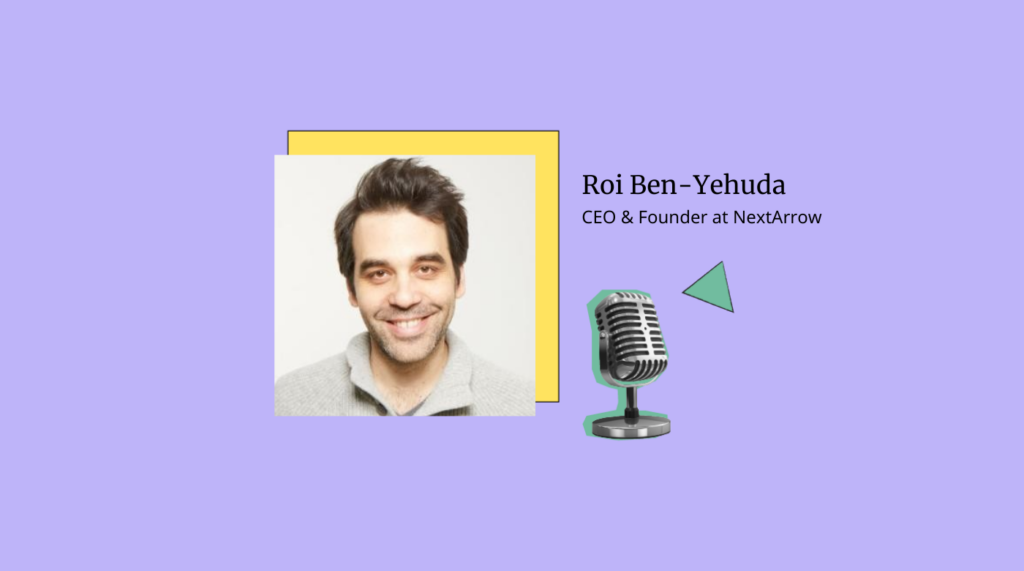
Roi Ben-Yehuda is the CEO and Founder of NextArrow, where he helps leaders and teams from innovative organizations develop skills and courage to achieve excellence.
His award-winning articles have been published by the Harvard Business Review, Time, Fast Company, Charter, Training Industry, The Daily Beast, and many other publications. Roi previously taught courses and seminars on negotiation and conflict management at Columbia University, Princeton University, and John Jay College of Criminal Justice.
Our mission is to help leaders and teams develop both the skills and the courage to achieve sustained excellence. We emphasize the role of courage because we believe it is the missing link—the bridge between knowing and doing, especially when facing challenges.
Roi Ben-Yehuda
Related Links:
- Join the People Managing People Community
- Subscribe to the newsletter to get our latest articles and podcasts
- Check out this episode’s sponsor: Sharebite
- Connect with Roi on LinkedIn
- Check out NextArrow
Related Articles And Podcasts:
- About the People Managing People podcast
- The Emergence Of Skills-Based Learning Is Vital To Teams’ Success
- How To Cultivate Workplace Productivity: Best Practices And Tips
- Transformational Leadership: How To Inspire Others To Be Better
- How To Create Effective Development Plans For Employees
- Beyond Communication: Influence is The Most Important of HR Manager Skills
- How to Give Feedback: 5 Ways to Remain Constructive in Difficult Conversations
- 8 Effective Ways To Get Employee Feedback (+ Pros and Cons)
- Learning And Development: A Comprehensive Guide
Read The Transcript:
We’re trying out transcribing our podcasts using a software program. Please forgive any typos as the bot isn’t correct 100% of the time.
Roi Ben-Yehuda: I think the missing ingredient is courage and courage with respect to yourself and courage with respect to how you interact with others. For yourself, it’s the courage to ask what are some of my tendencies and habits that are getting in my own way that I need to change. Maybe it’s my tendency to just say yes to every request or multitasking or social media usage or sleep habits, whatever it may be. When it comes to others, it’s about the courage to set boundaries.
David Rice: Welcome to the People Managing People podcast. We’re on a mission to build a better world of work and to help you create happy, healthy, and productive workplaces. I’m your host, David Rice. My guest today is Roi Ben-Yehuda. He’s CEO and founder of executive training firm, NextArrow. We’re going to be chatting about skills of the future and how you can build a framework around helping people develop skill sets to evolve with the work environment.
Roi, welcome.
Roi Ben-Yehuda: Thank you, David. Let me start off by saying that I’m actually a fan of the show, of the podcast. I think you select great guests and you have really interesting questions. And my favorite thing about you as a host is that you laugh at your own jokes.
David Rice: I do that. I have a nervous habit of just laughing at my own jokes. I admit that. It’s how you can always tell I’m like, I’m not sure if this is going to fly or not.
So first up, tell us a little bit about you and how you got to where you are and what it is that sort of keeps you up at night as a leader.
Roi Ben-Yehuda: So about me, I was born and raised in Israel. I came to the U.S. because I fell in love with a woman, but also to study.
My academic specialty was conflict analysis and resolution and negotiation. I spent a number of years as a lecturer at Columbia University, teaching graduate courses on theories of competition, theories of collaboration, negotiation, conflict, things of that nature. And simultaneously, I also got into the world of leadership training and managerial training before founding my own organization, which is NextArrow, as you had mentioned.
And we do trainings and coaching on, really our mission is to help leaders and teams develop both the skill and the courage to achieve sustained excellence. And we really emphasize the role of courage because we believe it is the missing link or the bridge between knowing and doing, especially when we’re facing challenges.
As far as what keeps me up at night, my kids, like my kids get me up at night. I have a six year old and a seven year old, so shout out to Kai and Lee, if you’re listening. But to answer your question more seriously, and maybe to give it a positive twist. What keeps me up at night is I get really excited. I get excited about what we’re doing.
I get excited about the team. I get excited about the impact that we’re having. And so I have a lot of ideas at night and they keep me up. And if they don’t, then I’m dreaming about them. This is my world.
David Rice: Today, I want to talk about the skills of the future program that you all have and the frameworks that you’ve put together, because obviously right now skills are something that we’re talking about all the time, right?
It’s one of the big topics of 2024, and it’s basically made up of five parts. I’ll kind of go through them real quick for the audience. That’s creative and critical thinking, giving and receiving feedback, practical productivity, influence and action, and courageous presentations. So if you could just kind of tell us a little bit about what informed this program and what your goals were at the outset and identifying these areas of focus, particularly.
Roi Ben-Yehuda: So the inspiration for skills of the future was a study that was done, it’s ongoing study by the World Economic Forum called “Future of Jobs Report”. And what that study showed us is gave us data that leaders, employers believe that the modern work environment, which is characterized by complexity, interdependence, uncertainty, and constant change in that environment, organizations need to upscale their people.
And chief among those skills, other than the technical skills were critical and creative thinking, communication skills, feedback skills, collaboration, and resilience. So we actually switched the presentation skills workshop with a resilience or a brand new resilience workshop because you need to be able to know how to respond to setbacks and adversity in that complex environment.
Now, that was the academic inspiration. The real inspiration for this workshop was a scene from an I Love Lucy episode. I don’t know if you remember, David, there was the chocolate factory scene where Lucy and Ethel are trying to wrap up some chocolates on a conveyor belt and they can’t keep up with the demands and they’re stuffing it in their mouth and in their shirt.
David Rice: I do remember this.
Roi Ben-Yehuda: When I saw that, I was like, that’s us today. There’s a modern conveyor belt. And instead of chocolate, we have AI. And instead of chocolate, we have DE&I with the E sometimes being pushed off the conveyor belt. And instead of chocolate, we have fluctuating markets and new technologies and so on.
And so to answer your question, the goal for the program itself was to equip ICs, individual contributors, who are often overlooked in trainings with tools to excel and thrive and become more promotable, tomorrow’s managers, tomorrow’s leaders in today’s complex work environment. So that was the inspiration.
David Rice: Practical productivity. Like we’ll just pick at that one in particular, kind of jumped out at me because I think the nature of work as it is now and how some management styles are sort of going, we don’t always have or receive clear answers around what we should be focusing on and what the end product of productivity looks like.
Right? So sometimes it’s like the opposite ends of the spectrum too, where we take on huge tasks or we try to do so much that it’s obviously, you know, productivity because look at how much we did essentially. But we’re killing ourselves in the process. So this is why burnout rates are so high.
So I think an approach that helps us identify what we can do to be productive without overtaxing ourselves is beneficial to everyone. I guess take us through that bit and why we need to start identifying this practical productivity as a skill.
Roi Ben-Yehuda: So when we address productivity at NextArrow, we break it down to three buckets, which is managing time, managing attention and managing energy.
And the workshop provides strategies and tactics for each one of these categories. But to answer your question around clarity, around prioritization and avoiding burnout, I think the missing ingredient, and this might be surprising to some of your listeners in the context of productivity, but it is courage.
And courage with respect to yourself and courage with respect to how you interact with others. For yourself, it’s the courage to ask, what are some of my tendencies and habits that are getting in my own way that I need to change? Maybe it’s my tendency to just say yes to every request or multitasking or social media usage or sleep habits, whatever it may be.
When it comes to others, it’s about the courage to set boundaries. And here, I want to break that down a little bit because there’s a lot of advice out there when it comes to setting boundaries that amounts to just say no. The intention is good, but the advice is not so good because it is vague. Like how do I say no?
And do I say no in the same way in every situation? And often counterproductive, imagine somebody waltzing into their boss’s office and infused with the spirit of Amy Winehouse, just said no. That’s not going to end well for them. You know? Yeah. It’s no is a complete sentence, but so is you’re fired.
That’s also a complete sentence. So in the workshop, we don’t just say you got to say no, but we talk about setting boundaries. And sometimes it is a matter of articulating effectively how to say no or not now, but other times it’s saying yes. And let me teach you how to do this so you can do this on your own next time.
Oh, yes. And can we talk about my schedule? Yes. And I need you to do something first to get started. And the other thing that we do in that section of the workshop, which I think is very relevant and unique, is that we situate boundary setting in the context of power dynamics. So setting boundaries with your boss, with your coworker, and with your direct report are not the same thing.
And to give you an example of what it is that I mean, imagine a scenario where somebody has more power than you, your manager, your boss. Research on power shows us that people with more power tend to pay a lot less attention to people with less power. So it stands to reason that when your boss asks you to do something, they don’t know what’s on your plate.
And if the request is problematic, what we encourage people to do is something that we call a priority check. Which is, it could sound something as I’d love to help, I’m currently working on X, help me understand which is a greater priority. So you make them a partner in making that decision, getting to that place of clarity that you talked about earlier and avoiding burnout.
If that’s not an option, it’s a true fire. You have to tend to everything. Then maybe it’s a matter of agreeing now and aligning later. And so we give people the tools to have those courageous conversations with their bosses. Same thing for meaning different strategies, that’s what I mean by the same thing, with your peers and also with your direct reports.
So with your direct report, maybe it’s a matter of going into a teacher’s mode and showing them how to do something with the explicit understanding that you want them to become more independent. So in the workshop, we not only share a multitude of ways of setting boundaries. But we get people a chance to practice.
It’s not just about knowledge acquisition, but also about application.
David Rice: So NextArrow also has a manager’s journey program and practical productivity is a part of that one as well. One that I think a lot of managers would benefit from is in this sort of skills of the future programming, and it’s that influence and action piece.
Influence is obviously a key area for managers and earning credibility is a big part of that. But as you all know, kind of in your training too often, how that’s taught in the workplaces through like tips and tricks that are maybe a little bit unethical or manipulative, certainly unsustainable. I’m curious, can you give us some examples of what you mean by that and how this seeks to teach a different way of approaching things for managers?
Roi Ben-Yehuda: Yeah, I think you’re right.
It’s true. The managers could also benefit from this workshop. Maybe we’ll include it in the program in the future. And I would say that probably many managers become managers because they’re effective at using influence and they’ll stop becoming managers if they forget that, if they just rely on power.
So I think influence is essential for everyone. To your question, the problem with a lot of the old methods, and we see this in the advice out there and the way the workshops on influence are often taught is that they rely on often data driven tactics that can come across as manipulatory and ethically problematic at best.
So we teach people principles of reciprocity, for example, let’s concede on something that’s of low value right now to activate a sense of debt in the other person or flattery and ingratiation, which I promise you, David, is not what I was doing in the beginning of this podcast. Social proof and so on.
It’s also in the language. If you think about it, we talk about wielding weapons of influence and bending people’s reality so that they feel like they got a good deal. And that may be effective in one off sales situation, it may be effective in an undergraduate classroom when you test the stuff out, it may be effective in extreme hostage negotiation scenarios, but in a real world relationship, where you have a real world context, where you have a thick relationship with the person that you’re working with, it’s not sustainable.
And for me, the big shift came from studying the work of the great Jewish philosopher, Martin Buber, who talked about two ways of relating in the world is the I-It and the I-Thou. An I-It means that I see you as a means to my end. It’s exploitive in its very nature. An I-Thou relationship means I see you as an end in on of yourself, or I see them as an end in and of themselves.
And it is a matter of seeing the whole human being and treating them with respect. I think the word respect here is really crucial. Think about the origin of the word respect. It’s from the Latin respectus, and it’s broken up into two parts; spectus and spectacles to see and res again, to see somebody again.
And so a key word here is respect. And when it comes to gaining influence, what I want to try to do is create more I-Thou moments with the people that I’m interacting with. And one of the tools that we use in our workshops around this is something that we call attentive curiosity, which is when I’m trying to influence somebody, whether it’s on a listening tour or dealing with pushback, I want to default into a mode of genuine curiosity and be extremely attentive to what people say in response to my question.
And when I’m doing that, I can then connect to really motivates and animates people what are their needs and what are their interests and balance, concerned for myself and also concerned for the other person. So these are some of the skills that we talk about in that workshop and thinking about how can we create more I-Thou moments with the people that we’re trying to influence.
David Rice: Yeah, I mean, that’s great advice for managers. I know from the conversation before this and the program materials you’ve shared with me, you’re looking at issues your partners are having all the time.
One thing I see is that a lot of managers sort of lost their way through the pandemic and haven’t quite regained the connection with their teams or are struggling to maintain it at the very least. And this is even in cases where they’re now back in offices.
I’m curious, what are some of the biggest challenges managers are struggling to navigate in terms of connection, in your opinion?
Roi Ben-Yehuda: I think there’s the obvious challenges, which you alluded to, which is dealing with remote work and hybrid environment, creating a feeling of belonging, connection, engagement.
How do I motivate people? How to provide opportunities for growth? I think these are kind of evergreen topics today. Based on what we’re seeing and some of it is based on research and data, the companies are showing us internal data. If I were to select like top three challenges, the first one is what I call a thought bubble problem.
It’s when people are thinking things and simply not sharing it with their manager. So another way to rephrase that it’s a psych safety problem, is a manager, like how do I create an environment where people are willing to take those interpersonal risks on my team without feeling like their status or relationships or their job security is on the line.
It’s an imperative, I think, in that modern work environment that we talked about earlier. And one of the solutions for us, of course, is we provide trainings for managers and for teams around psych safety. But what I’m doing now, I’ve actually, I’m creating a sequel to that. It’s actually in the works. So this is fresh off the press.
It’s in the works right now. It’s a workshop on psych safety that’s designed like a murder mystery. Who killed psych safety? You know, is it the silent leader, the fear monger, the judge, the misleader, the gossiper, and the hint? It’s going to be all of them. And I’m excited about creating that. So that’s stuff that keeps me up at night.
The second challenge. So the first challenge, let’s call it a psych safety challenge or a thought bubble problem challenge. Second one is conflict. And what we see here again in the data is that there’s an increase in workplace conflict with managers being stuck right in the middle. And sometimes a conflict is a microcosm of the tension that exists in our society today.
We’re recording this just a few days after post election, but more often than not, it’s just a consequence of working in an interdependent and increasingly complex environment. It’s a ticket of admission of working with people with different interests and different needs and environment that’s constantly changing and uncertain.
And as a manager, what that means is you need to develop a lot of intrapersonal skills to manage that, to handle that. And one thing that we’ve done at NextArrow is we created, and this is one of my favorite program called from conflict to collaboration, which includes a conflict intelligence workshop and negotiation workshop and a courageous conversations workshop, and some of my favorite workshops to teach.
So that’s the second challenge. And the third is perhaps not surprising is a mental health, so we put it under that category. And the challenge for managers is besides their own mental health struggles is how do I find a balance between tending to the whole person on their team and driving performance? And oftentimes when we’re stressed and we’re full of anxiety, we turn inwards and managers are mandated with turning us outwards, focusing on OKRs and on objectives and performance and so on.
So we address this here by creating this challenge by creating resilience training, coaching, of course, teaching managers how to coach their direct reports more effectively and how to have more meaningful conversations in their one on ones.
David Rice: This episode is brought to you by Sharebite. Looking to elevate your company culture? Sharebite is the ultimate meal benefit solution for boosting employee engagement and fueling productivity. Plus, for every meal your employees order, Sharebite makes a donation to feed someone in need. To learn more, visit go.sharebite.com/pmp.
Let’s talk for a second about the critical and creative thinking piece.
The two don’t always go together, right? Talk to me about laying a foundation for this and how we sort of get in our own way, sometimes when it comes to tapping into our creativity and then bringing that into collaborative spaces.
Roi Ben-Yehuda: Yeah, it’s a really interesting question. I don’t know that we addressed that question in the training, but let’s address it here.
First, let’s define the terms. When you think about critical thinking, or when I think about it, anyway, I think about as a cognitive process involving uncovering assumption and analyzing data in order to create more optimal decisions. When I think about creative thinking, I think about it as integrating information, reassembling it in novel ways.
And the workshop itself, we explore biases that stymie our ability to think more critically and more creatively. David, these biases are so bad, they’re so naughty that we decided to personify them as super villains. And so we have Assumption Sam and Freezing Freddy and Confirmation Conrad and the whole workshop is designed as a comic book in which we develop strategies to manage these particular biases.
But you asked about when they clash. And I think, first of all, they clash because they involve different modes. Our brains is in different mode and our mind is in different mode when we think critically and when we think creatively. And I think a good example of that is like a traditional brainstorming session.
People are going to ideate. They’re going to come up with an idea, maybe a wildcard idea, and somebody’s going to just clip its wings right away and say, Oh, you know, this is, that’s not going to work. That’s not realistic because A, B and C, or we’ve tried that before, and so on. And what that does is it reduces, it just kind of sucks the psych safety out of the room.
So people are less likely to share ideas and especially ideas that are different and unique, and even the ones that are being shared, they don’t get developed. They said that they’re clipping those wings. And the solution to that that we see in the research, I think it’s very useful. And we do it next door all the time internally is solo brainstorming.
And that is, I might say, David, let’s take a moment here. Let’s take 10 minutes to come up with 15 ideas or 15 solutions for a particular problem. And providing a quota is also very helpful. And what we see in the literature on this is that when people do this alone and then afterwards they share it or they pass it on to the next person to build on the ideas that they have written down, that you get more ideas and you get better ideas.
So you can you create that’s a safer space to think. That’s why, by the way, we’re way more creative in the shower and in the bathroom and on bus because we have that space. But we also don’t want to forget the critical components, especially when we need to converge our thinking and make a decision. And so for that, I think we also need to carve out structured time for critical evaluation of those ideas.
One option that we like to use is assigning a devil’s advocate and rotating those roles, so it’s not stuck with just one person, which encourages more of a balanced critique and normalizes dissent in a way that doesn’t even include courage at all, doesn’t need courage. And so those would be some suggestions there.
David Rice: I want to mention the feedback piece before we kind of wrap up, because delivering and receiving feedback, it’s going to be such an important part of all our growth trajectories as the sort of technical demands of our jobs evolve, maybe even faster than we’d like a lot of the time. So what are some of the key areas that people need to concentrate on in developing their approach to both giving and receiving feedback?
Roi Ben-Yehuda: I agree. Feedback is essential today and will be even more essential tomorrow. It’s a necessary condition for learning and growth in a complex work environment. It’s even necessary condition for developing more resilient relationships with one another. I think the problem with feedback and feedback training in particular, it’s often biased towards giving feedback because we think that’s the hard part.
We feel a lot of anxiety around giving feedback and it’s the active part. Often receiving is seen as a little bit more passive, but David, let me ask you a question here, which is who do you think has more power in a feedback conversation? Is it the giver or the receiver?
David Rice: Well, I think it’s the receiver to be honest, because you can implement it in so many different ways, right?
Roi Ben-Yehuda: Yeah. Implement it, but also you’re in charge of how the conversation goes. You can be super defensive. You can not listen. You can not be curious. You can ask questions. You can resist all the way. And of course, in the implementation phase as well. So the solution is really to bring back genuine balance and feedback training to both giving and receiving.
And you asked me, what are some of the key areas that we want to concentrate on? So if I separate the two for a moment for giving feedback, I’ll say there are four steps that I would encourage people to concentrate on. One is to invite the person into the conversation. You want to reduce the element of mystery and surprise.
You don’t want to make people feel blindsided by the feedback conversation itself. The second is to separate what we call fact from fluff. There’s a big difference between giving somebody feedback akin to, Hey, David, I don’t think you have like executive presence. You know, I watched your presentations and this is my feedback to you.
That’s fluff. That’s terrible feedback. Versus you use 10 filler words in your first two sentences. Now you know what we’re talking about. Now you know what we need to change. So training our mind to separate between fact and fluff and communicate facts, data, not our interpretation of the data, not our inference of the data is the second point. Third is to communicate an impact statement.
Like, why does this feedback matter? Why should you care about this feedback? But tailor it to the individual. So what motivates that person? Oftentimes when you have a feedback framework, they talk about impact statements, but they just say, you know, make an impact statement. But why should that particular person care about it?
And what motivates that person? Is it at the individual level? Is it at the team level? Is it organizational level? Do you want to frame it in a way that’s promotive or preventive? What are you trying to prevent? What are you trying to promote? That would be the third tip. And then the fourth is ask questions.
Make sure that it’s a feedback conversation and not a feedback monologue. So that’s four steps for giving. For receiving feedback, there we start with really something that we call our feedback gremlins, which is basically the defense mechanisms we employ to protect us from uncomfortable information.
And these are things like listening to debate the other person, looking, scanning constantly for errors in what the other person is saying, switching tracks and saying, well, okay, let’s talk about you. You mentioned me, let’s talk about you and rationalizing the behavior itself. It all leads to what we call like irritable feedback syndrome.
And we, the whole workshop is kind of geared, moves us away from that. And we look at, again, four strategies to get us out of that state. And so the first one when receiving feedback is to get into the right mindset, which is a growth mindset, which is a curiosity mindset. One of my favorite tips in that workshop is to adopt a secret feedback identity.
And mine is to go from a know it all to a learn it all when I’m receiving feedback. The second tip, it’s a bit counterintuitive, is not to ask for feedback, but instead to ask for advice. And what we see in the literature here is that when people ask for advice, they get more data and they get better data.
Third is coming back again to that construct that we call attentive curiosity. Somebody is giving you feedback. Those gremlins may rear their ugly heads. This is exactly the moment where instead of getting critical, you want to get curious and really listen to what somebody else is saying. And then the last one is self assessment.
Somebody gave you feedback. It hurts. They scored you. You have a chance to what’s in your control is to assess yourself afterwards. How did you receive that feedback? It’s that second score that you can give yourself. And so we give people a framework afterwards in which they can assess how well they did, how well they received the feedback.
And of course they practice all of this in the workshop itself.
David Rice: Excellent. I think our next two presidential candidates in four years should have to go through the receiving feedback framework.
Roi Ben-Yehuda: Let’s do it. There are some limits.
David Rice: Yeah. Yeah. I don’t know if we could save that, right?
Before we go, there’s two things we always like to do to end the show. The first is I want to give you a chance to tell people more about where they can connect with you and find out about what you and NextArrow have going on.
Roi Ben-Yehuda: Yeah. So our website, which is nextarrow.org. Also, we’re very active on LinkedIn. We create a lot of free content there at least three times a week. So we encourage folks to visit us there.
And also my own LinkedIn page, which is Roi, like return on investment, Ben-Yehuda.
David Rice: Excellent. And the second thing that we always like to do, we have a little tradition here on the podcast where you get to ask me a question. So I’m going to turn it over to you. Ask me anything you want.
Roi Ben-Yehuda: Okay, David, I want to know why is there something rather than nothing in the universe? But if that’s not, that doesn’t work, my question to you will be around courage. And when was the last time you summoned courage at work, and what inspired you to be courageous at work?
David Rice: The first thing that comes to mind was writing something that I knew wasn’t going to be well received by my superiors and publishing it.
But I felt like it was a story that needed to be told, and it was something that I just didn’t feel like there was a lot of out there, like this part of it wasn’t being talked about. And, you know, this was a little while ago now, previous job, but it was just something that I felt like, why aren’t we saying this?
We could be the ones to say this and it wasn’t well received. I did get slapped on the wrist for it, but I just felt like the point isn’t whether or not like anything happens to me. It’s just that we get this narrative started. Somebody has got to get the ball rolling on this. And in the end, it actually ended up being one of the most successful pieces I did at that job, even though it wasn’t popular amongst my bosses.
But it was one of those things where I felt like when this proves to be successful, I don’t expect to thank you, but I don’t, I think you’re not going to fire me over this, you know what I mean? But it was a risk. It was one of those things like I had to just be like, well, if it happens, you know, if they prove to be vindictive, then it is what it is.
But Yeah, I think that was probably the last time that I really had to or felt like I had to. I’ve been lucky enough more recently to be in safer spaces where the courage wasn’t, it didn’t feel so hard to find, let’s put it that way. I didn’t feel like that much of an active courage. It just felt like part of the culture.
And that’s what we do here. And that was nice. A nice transition.
Roi Ben-Yehuda: What you say aligns with also the research on the psychology of courage and what we see in that research is that one of the most dominant strategies that people utilize in order to engender courage is to link up the courage to something bigger than themselves.
And it sounds like you did that in that instance.
David Rice: Yeah, and I think it’s driving a lot of people’s, you know, sort of when they exhibit courage, driving a lot of their behavior right now. We’re in a time where I think people are realizing there’s a lot going on that’s bigger than life, so.
Roi Ben-Yehuda: Yeah, so hopefully we’re inspiring some listeners right now.
David Rice: Absolutely.
Well, Roi, I really appreciate the, you coming on and this is a great conversation. That’s a, it was really interesting stuff.
Roi Ben-Yehuda: Thank you. My pleasure.
David Rice: All right listeners, until next time. We should be getting into Christmas time now, so don’t totally disengage. My advice for HR folks is use the downtime. Make the most of your downtime as the rest of the employees start to disengage. This is your time to connect to things that you don’t normally get to connect to. Until next time, have a good one.