How To Humanize The Workplace, Grow Psychological Safety, & Build Connection

What does it mean to truly humanize the workplace? And how can leaders play a pivotal role in making it a reality?
In this episode, host Becca Banyard is joined by Phil Burgess—Co-Founder & Managing Partner at WITHIN—to talk about how he helped rebuild a sinking company culture into one that his employees loved, strategies for growing psychological safety, and what leaders can do to help employees build connection amidst an epidemic of loneliness and isolation.
Interview Highlights
- Phil’s background [1:07]
- Previously he was the Chief People Officer of a global consultancy called C Space.
- Then he decided it was time for change and left his corporate role to set up a new business called WITHIN. He co-founded it with Felix Koch.
- WITHIN is focused on radically improving mental health in workplaces by building connections at work.
- Phil’s hope would be that leaders in organizations start to embrace the idea that they have a much bigger role to provide safe spaces where people can show up.
If you could go to work and show up and feel psychologically safe to be yourself, that would be a pretty incredible place to be.
Phil Burgess
- What comes to mind when you hear these words "humanizing the workplace"? [3:42]
- When Phil was at C Space, their mission for their clients was to make work more human, to make business more human.
- To be human is to be messy. So if you think about work culture, it's about embracing the messiness of culture building.
- A human business is one that both acknowledges that it’s flawed and messy and has contradictions within it. But it's also a home and a place for the people within it who are human, messy, flawed and making mistakes, and growing.
- Phil expands the messiness of culture building that he mentioned [5:25]
- Phil had just been promoted into his first real leadership position as joint managing director of their London office in 2015.
- They had inherited a team of about a hundred people. Just after an acquisition, the company had been rebranded.
- A couple of months into their tenure, a lot of people left the business so they did an engagement survey. The result shows that only 40% of their team planned to still be around in a year's time and only 57% of people felt proud to work at the company.
- So they did a culture audit and decided to tackle the root causes of some of those things.
- They co-created a set of corporate values, and called them Behaviors.
- Who are we on our best day? Who are we on our worst day?
- They brought together a cross-functional team to come up with this new set of behaviors.
- 3 years later things turned around - about 70% of people planned to stick around for another year, and they won various best agency and best place to work awards.
- Anything done to an extreme within an organizational culture can have a dark side.
- How did Phil encourage people to embody those values? [10:01]
- They did a few different things. People weren't dictated by the leadership, but they co-created them with people.
- They tried to develop rituals - they would have an event called Friday at Four, where they would have drinks and food in the office before heading off for the weekend. And people could do shout outs for each other and people would recognize each other for doing what scares them.
- They started to recognize that not everyone liked public recognition - a small handwritten note was just as meaningful. So they created little postcards that people could fill in and they could stick them on people's desks.
- They started to also show the love as being kind enough to give someone direct feedback if they're underperforming. Even though it's difficult, you need to go and have an honest conversation.
- One of the values that they developed over time was "we before me" - the idea that you should focus on the team.
- And then through the pandemic they started to see that people needed to focus on ‘me’. They created a concept called "me day" - they gave their team a small budget to take a “me day”.
- What are some ways that companies can come alongside their employees and help reduce isolation and help improve mental health throughout this loneliness epidemic? [14:04]
- One of the foundational principles that has guided Phil through his career is the concept of “relationships are the source of results”. Businesses that are spending time in very intentional ways helping their people connect and build relationships with one another are going to be the businesses that really thrive in economic terms.
- Managers spend time checking in with people on how they're doing in team meetings, not just diving straight into the agenda. Carve out time intentionally to connect.
- They used to do simple exercises - each member of Phil’s team looked at their phone and sent him a photo from their last two weeks, and then they would take 60 seconds to share with the team what that photo meant to them.
- They used to do things like coffee connections. Sometimes they’d bring everyone together for a staff meeting and instead of holding the meeting, they’d just give everyone $5 or £5 and pair them up randomly in two or three to go for a walk and get to know each other.
- There’s a study that shows 21% of your mental health is determined by your manager at work.
- How can employees be better at listening and how can they be better at talking? [21:14]
- We all have developed bad habits when it comes to listening. Typically in conversation with someone, rather than giving them the gift of our full attention, we might be thinking about how I am going to respond to this person.
- Another habit that we all have is we talk about hijacking the story and we make it about ourselves.
- People need to feel heard and they need to feel safe. They're not looking for you to jump in and share your story. They're not looking to be interrupted.
- A lot of what we do is to teach people a very structured framework, which allows them to listen well and equips them with language to do that.
- There's an expectation that leaders are giving away something a little more personal about themselves these days. People are looking for authenticity.
- As a leader, by sharing something about yourself, by admitting that you don't have all the answers or that you are scared can also tie people to you because they start to root for you and they start to see that you are human too. But the challenge is - how do I choose how much to share with people?
- What other ways can leaders and managers can help build psychological safety in the workplace? [27:18]
- Psychological safety links to identity. Leadership is a privilege - with leadership comes power and privilege.
- It’s a mixture of what you say and what you do, and being intentional about those things so that people see you showing up in a certain way.
- It's about doing things in an intentional way to create permission for others to feel or do the same.
- What is the number one thing that keeps employees happy at work? [31:20]
- It is the ability to come to work and take different things out of it.
- It's being able to show up, feel that you're making a difference, and be heard.
If people feel heard in the workplace, then good things stem from that.
Phil Burgess
- What do you need to be a successful leader? [32:05]
- To be surrounded by a great team.
Meet Our Guest
Phil Burgess is the Co-Founder and Managing Partner of WITHIN, an organization that works with leaders to improve employee mental health by building connection at work.
Previously, he was Chief People Officer at global consulting firm, C Space, where he and his team were proud winners of Learning Team of the Year at the Global Learning Awards. As Joint Managing Director of the London office, he oversaw a culture transformation that led to a number of Best Agency and Best Place to Work awards. Phil is passionate about building kinder, more human workplaces where people can really thrive. After several years in the States, he now lives with his family in Hertfordshire in the UK.
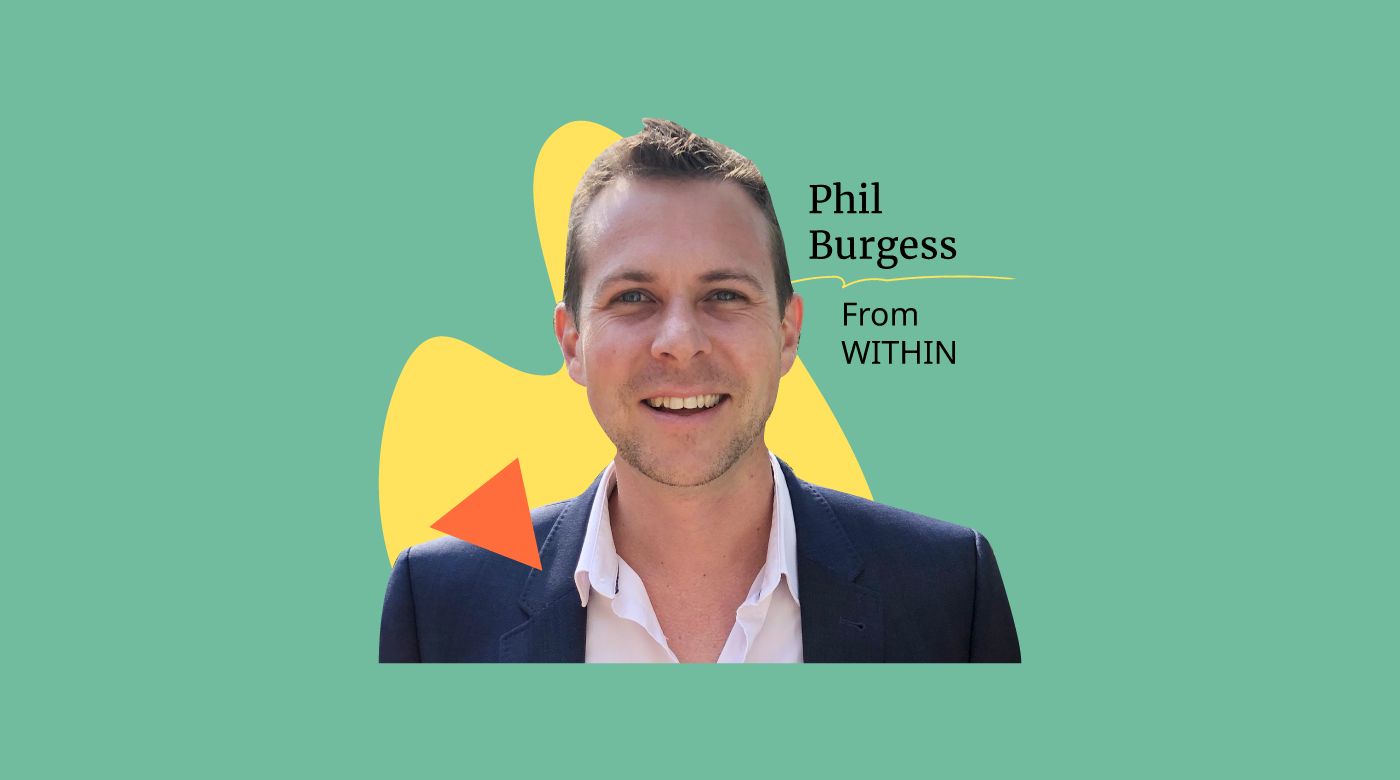
If leaders want cultures where they want people to show up as themselves and take risks, they need to model that behavior.
Phil Burgess
Related Links:
- Join the People Managing People Community
- Subscribe to the newsletter to get our latest articles and podcasts
- Connect with Phil on LinkedIn
- Check out WITHIN
Related articles and podcasts:
- About the People Managing People podcast
- How To Create Psychological Safety In The Workplace
- 5 Subtle Signs Your Workplace Culture Is Turning Toxic (And How To Fix It)
- The Importance of Relationships & How To Overcome When They Get Tough
- 3 Ways To Grow A Happy And High-Performing Team
- Psychological Safety & How To Foster It In Your Own Workplace
Read The Transcript:
We’re trying out transcribing our podcasts using a software program. Please forgive any typos as the bot isn’t correct 100% of the time.
Becca Banyard: What does it mean to truly humanize the workplace? And how can leaders play a pivotal role in making it a reality?
Welcome to the People Managing People Podcast. We are on a mission to build a better world of work and to help you create happy, healthy, and productive workplaces. I’m your host, Becca Banyard!
I’m joined today by Phil Burgess, a seasoned people leader, as well as co-founder and managing partner at WITHIN—an organization that focuses on improving employee mental health by building connection at work. Phil is gonna be sharing stories and lessons learned from his experiences, so stay tuned to learn how he helped rebuild a sick company culture into one that his employees loved, strategies for growing psychological safety, and what leaders can do to help employees build connection amidst an epidemic of loneliness and isolation.
Hello, Phil, welcome to the show!
Phil Burgess: Hello!
Becca Banyard: It’s really great to have you here today. Before we dive into our conversation, could you tell us a little bit about yourself, what you do, how you got to where you are today?
Phil Burgess: Sure. So I’m Phil Burgess and until about nine months ago, I was chief people officer of a global consultancy called C Space based in Boston, and I spent about four years in that role.
Before that, I was direct managing director of the same agency in London. And before that I was worked in a variety of roles in research agencies and consultancies. About nine months ago, I decided it was time for change and left my corporate role and decided to set up a new business. So I’ve just co-founded a new business with a chap called Felix Koch, who I had previously been in the joint managing director role in London with.
And our new business is focused on radically improving mental health in workplaces by building connection at work. We’re called WITHIN and it’s yes, a totally different experience being a startup rather than working in a big organization. Outside work I’m based in London and I live with my wife and two kids.
Yeah. We also run a not-for-profit, which is focused on inspiring people to pick up litter around the world and get involved in making a difference in their local communities one action at a time. So that’s a little bit about me.
Becca Banyard: Wow. Sounds like you’re doing some amazing work. I’d also love to know what’s your personal vision for the future of work?
Phil Burgess: That is a big question. I think it’s such an interesting place for organizations right now with the state of the world, as we’ve emerged from the pandemic and the amount of flux and with all of the pressures that people are facing in the world. We’re in the middle of a pending environmental crisis.
There’s systemic racism in around the world. There are so many big issues that people are grappling with, a loneliness epidemic and a mental health crisis. And I think we all spend so much time at work that I think my hope would be that leaders in organizations start to embrace the idea that they have a much bigger role to provide safe spaces where people can show up.
That maybe seems too simple, but I think if you could go to work and show up and feel safe, psychologically safe to be yourself, and so many people don’t. I think that would be a pretty incredible place to be, and I think the world and the world work would look very different.
Becca Banyard: Yeah, that’s an amazing vision. Thank you for sharing.
So we’re gonna be talking a bit about what you’ve already touched on, mental health in the workplace, how to create psychological safety and help people feel a sense of belonging in the workplace, which all kind of boils down to humanizing the workplace. So what comes to mind for you when you hear these words “humanizing the workplace”? What does that look like for you?
Phil Burgess: Yeah, taking a step back, like when I was at C Space, our mission for our clients was to make work more human, to make business more human. And I always saw my role as chief people officer to make our own business more human. And if you unpick what it is to be human, I always think like being human is quite messy.
To be human is to be messy. So if you think about work culture, I think it’s about embracing the messiness of culture building and the fact that like humans are always changing, businesses always need to change. I think being human is to be emotional and to sometimes to operate with contradictions. So it’s to be kind, but it’s also to be ambitious and it’s also to be flawed.
And I think a human business is one that both acknowledges that itself probably flawed and messy and has contradictions within it. But it’s also a home and a place for the people within it who are human and messy and flawed and making mistakes and growing. So I think at its heart, a human business enables people and allows people to show up in that sort of messiness and works intentionally on its culture to facilitate that.
Becca Banyard: Absolutely. Yeah. Thank you. I’m curious if you could expand upon the messiness of culture building that you mentioned. Do you have any stories from your experience of culture building and how it was perhaps both messy and wonderful at the same time? Or maybe wonderful is not the right word, but both messy and successful.
Phil Burgess: Yeah, absolutely. If we wound the clock back to 2015, I’d just been promoted into my first real leadership position as joint managing director of our London office and we had inherited a team of about a hundred people. Just after an acquisition, the company had been rebranded and frankly, Felix and I in this role had never been in that kind of role before.
So I don’t know if people necessarily trusted that we were gonna do a good job. And a couple of months into our tenure, we were seeing a lot of people leaving the business and we did an engagement survey. And I remember sitting in a room and we got the engagement survey results back and it told us that only 40% of our team planned to still be around in a year’s time.
And only 57% of people felt proud to work at the company. And we were pretty terrified about what we were gonna do. And we had also spent a lot of time as new leaders jumping into rooms and moaning about all of the moaning we were hearing about from our team and all of the entitled millennials and Gen Z folks that were reporting into us.
And then one day we were like, this is down to us, like we have to figure out what we do here. And we looked at all of the sort of Badge behavior, I guess the behaviors we were seeing across the business in ourselves and in our team. So it was a bit like a culture audit almost. We said, and we decided that we needed to tackle the root causes of some of these things.
So we co-created a set of corporate values, we called them behaviors. So we looked at who are we on our best day? Who are we on our worst day? And we brought together a cross-functional team to come up with this new set of behaviors. And we were hearing things like we don’t spend enough time celebrating successes.
So one of our new behaviors was show the love and that was all about how can we show we’re being kind to each other and giving each other recognition and taking time to celebrate success. One of them was “I got this” and that was born out of the fact that we had a sense that no one was really taking ownership of problems in the business, that everyone was passing them up to the person above them to solve.
So “I got this” was about trying to inspire people to take ownership and accountability. Three years later, things turned around and Pride was 87%. About 70% of people were planned to stick around for another year, and we’d won various best agency and best place to work awards. So I guess that’s the nice part of the story.
But to your question of messiness is I think what we started to learn, that anything done to an extreme within an organizational culture can have a dark side. So when we started to look at our behaviors, our values that people were living really strongly, we started to see that there were negative sides to them as well.
So the value around “I got this”, and people taking ownership and responsibility meant that we were starting to see that people were not able or willing to ask for help because they were so determined to prove that they’d got this. One of our values was tell it like it is. It was about trying to encourage candor and honest feedback.
We saw that some people were beginning to weaponize that and use that for an excuse to not actually deliver messages in a kind way. Yeah, so we brought everyone together again, and we started to look at our values, our behaviors, and say how has our business evolved? How have those values evolved? And how do we codify the behaviors that sit underneath them?
And that was something we then had to carry on doing during the pandemic. We started to say, show the love. Became less about showing the love to colleagues and more about encouraging people to look after themselves and practice self-care. Your question’s a great one because I think some people were like, well, shouldn’t value, shouldn’t behaviors be clear?
Shouldn’t everyone know exactly how to interpret them? That’s what they’re about. I guess I would say the value in that, in the way we did things was seeing it as messy, being honest with people that there were sometimes inherent contradictions and saying just like our culture evolves, our values and our behaviors will need to adapt, and we can pull on different lever at different times to encourage different behaviors.
Whether that’s exactly the best practice, I don’t know, but I think it spoke. I think our people appreciated the honesty about the fact that, yeah, times are changing, the business is changing and it’s okay, like as long as we adapt to the messiness. I think some good things can happen and you’re never gonna get it right all the time.
Yeah. Hopefully that brings things to life a little bit.
Becca Banyard: Yeah, definitely. So you recognized that you needed some changes to your company’s values and also that there were negative sides to these new values. How did you encourage people to embody these values? What did you do to really make those values a part of your culture?
Phil Burgess: And we did a few different things. I think one thing that really helped was the fact that they weren’t dictated down by us as a leadership to our team, but we co-created them with people. And the group of people who were part of creating them, of developing the language that we use were the people that promoted them and launched them into the business with us.
I think that really helped. We tried to develop rituals, so we would have an event called Friday at 4, where we would have drinks and food in the office before heading off for the weekend. And people could do shout outs for each other, spontaneously and people would recognize each other for doing what scares them or telling it like it is.
And then we started to recognize that not everyone liked public recognition like that. And actually sometimes a small handwritten note was just as meaningful. So we created little postcards that people could fill in and they could stick them on people’s desks. There was an element of sort of recognition and celebration.
We then wanted to make sure it was also baked into our systems and infrastructure so we started to look at our competency frameworks. So as we thought about how people progress through the business, we didn’t want it to make too formulaic, but we started to weave them into our competencies. What does showing the love look like as a leader?
So that might mean giving people recognition and credit. We started to also see that as, well it’s also showing the love as being kind enough to give someone direct feedback if they’re underperforming. So don’t hide it from them till they’re performance review. That’s not showing the love. Even though it’s difficult, you need to go and have an honest conversation.
So we tried to help people see how our values linked to the behaviors that we expected for managers and leaders. And then we also tried to bake it into one of the things that we did that was quite effective. We wanted to create a culture where people could see we all had stuff to work on. None of us was perfect.
So as a leadership group, we each identified through our 360 reviews what were a couple of the behaviors, the values that we indexed on. And then we created a booklet and a big poster for the wall, which had each of our names and our, the values that we were working on. So I still remember, like mine was, I always struggled to give direct feedback.
So mine was tell it like it is and only accept awesome, because I had a tendency not to put in that final 5%. And I think by helping people see that the values, the behaviors, they’re not just like words stuck up on a wall, but they live and breathe in the agency was a way to help us keep them alive. And then we carried on using them.
As I mentioned earlier, as we used them through the pandemic, one of our values that we developed over time was “we before me”, the idea that you should focus on the team. And then through the pandemic we started to see that people needed for focus on me. And actually sometimes you just need to draw a boundary.
We used our values to create a concept called “me day”, and we gave everyone a small budget and we said, take a me day. This was in the middle of the pandemic. Here’s $50, go and do something amazing that will mean something to you. So some people just went and had brunch, some people went shopping, but the idea was focus on you.
And then we linked that to activities around it’s appropriate to draw boundaries, do help your team. That old sort of adage of if you’re not putting your own oxygen mask on first, then you’re not gonna be in a position to do your best work or help other people. So a lot of it was just how do we keep the same values, the same behaviors, but find new ways of activating them so that they stay fresh in people’s minds.
Becca Banyard: I love that. And I love how you saw that there was a new need and you were able to adjust during the pandemic in order to meet the changing needs of your employees at that time, which leads me to my next question. Earlier you mentioned the loneliness epidemic in the USA and how companies are needing to find solutions to avoid isolation in the workplace to help their employees through this loneliness.
So in the current state of work with hybrid and remote work being so prevalent, what are some ways that companies can come alongside their employees and help reduce isolation and help improve mental health throughout this loneliness epidemic?
Phil Burgess: Such a good question and something I feel really strongly about.
One of the foundational principles that has guided me through my career is the concept of relationships are the source of results. And I think the businesses that are spending time in very intentional ways, helping their people connect and build relationships with one another are going to be the businesses that really thrive in economic terms because they’re helping their people thrive within those businesses.
So I think it can look different for different businesses. If I think of some of the things that we did, I can relate very strongly to that sense of disconnection and isolation through the pandemic. We found that ourselves as an agency, we’ve been very dependent on a very strong office culture where people could get to know each other, go out for drinks after work and socialize, and all of a sudden, like so many businesses around the world, we were dispersed.
And then that has maintained cause we also pursued a strategy of employing diverse talent around the states in different places to tap into people with different life experiences. And we were sensing that people were feeling more isolated and disconnected from work, and that showed up in our engagement results and that showed up in attrition and the way people left the business.
There was just not the social fabric of the organization had been eroded. So like on a simple level, there were things like, making time and space in meetings to connect on a human level to avoid that Zoom sort of fatigue of just jumping onto a call and just diving straight in. So training managers to spend time checking in with people on how they’re doing in team meetings, not just diving straight into the agenda of strategy.
And what’s happening and what are the things that we’re doing, but to carve out time intentionally to connect. So we used to do simple exercises, like I’d ask each member of my team to look at their phone and send me a photo from their last two weeks, and then they would take just 60 seconds to share with the team what that photo meant to them. And you got photos of cats and parents and some people shared happy stories or heartwarming ones, but it was just a simple way of helping people connect.
And I felt that it was so important for people to start to see each other as humans, particularly as at the time we were all these little squares on screens. And in many respects, that’s remained. We used to do things like coffee connections. So sometimes we’d bring everyone together for a staff meeting and instead of holding the meeting, we’d just give everyone $5 or five pounds in the UK and pair them up randomly in, in a two or three and say, go for a walk and get to know each other and coffee’s on us.
Not because that was gonna transform them so much as to signal to them that it was important that they spend time during the working day to connect. And then I think there are more structured things as well, one of the things that we did, which was really the inspiration for the new business that I run within, we recognized that people were feeling disconnected and we partnered with a social enterprise and we brought them into the organization.
And this social enterprise is called Talk for Health and they’d been operating across London in the UK for about a decade in local communities. And we brought them in and trained 50 of our team in therapeutic talking and listening. So, it was a training program that essentially taught people how to listen to each other really well, how not to hijack each other’s conversations, how to create a safe space, how to listen without judgment.
And then we trained people how to set up and run their own mini ongoing groups in groups of two and three, which sustained over time. And we looked at wellbeing measures pre and post the training program where we saw that wellbeing increased. There was a reduction of depressive symptoms when we measured them on the PHQ nine scale. But more than anything, we just heard from people that they experienced this phenomenal sense of connection.
So people were saying things like, I’ve been here for 10 years and I’ve never felt as connected to my colleagues as I do having been through this program. And I think in many ways what we do is we encourage people to tell stories, two minute, three minute stories, and then have them play back to each other by the group.
And that sense of being able to share something personal about yourself and have someone really listen to you, help someone else and then be helped by those people, strengthens those relationships. And I went through it partly because I wanted to create permission for others to devote time to this during the working day.
It was the thing that really inspired me to ultimately leave that role and set up this new company. So that’s now what we do. We take that approach into organizations and I think businesses need it. I think businesses need to think about how they foster connection and because that’s the thing that’s gonna lead to increased innovation, increased creativity, stronger ties, increased engagement, all the things that we’ve been talking about that make for a great place to work.
If you don’t focus on it in an intentional way, in my experience, it just doesn’t happen.
Becca Banyard: Yeah. Connection is so important. As you were speaking, I was just thinking about something in my own company that I’ve always felt so privileged to have as part of our culture, and that’s a weekly one-on-one with our managers.
So every week my manager has a one-on-one with me, and it’s not a time to just give status updates on all of my tasks or projects. It’s an opportunity for my manager to ask me how am I really doing? What’s life been like in the last week? Are there any areas that I’m struggling with or is there anything exciting that I wanna share?
And it’s a time to connect on a human level with my manager and I’ve always so appreciated that. And that’s been, yeah, such a significant part of work life for me. And I’m always amazed when I share this to friends who work in other companies to hear that they don’t have that. That’s not a standard practice.
Phil Burgess: So true, and I’ve had similar experiences. I’ve been lucky enough to always have managers that have made time for me and that’s an example that I’ve then followed and tried to do for the people that I manage. But yeah, it seems crazy to me that doesn’t happen. As I learned more about it, I think I read an article this week that said something like “Your manager is one of the things that has the greatest impact on your mental health, even aside from career progression and how supported you feel and that kind of stuff.”
I think it was some kind of study that had quantified this down to it being like, 21% of your mental health is determined by your manager at work. And I don’t quite know how they came up with that percentage, but it’s it’s significant and it’s the reason why people stay with companies. It’s the reason why people leave companies when they don’t have good managers that make space and time for them and help them feel safe to, yeah, be vulnerable and show up and ask questions and get stuff wrong.
Becca Banyard: Definitely. Yeah. So important. I wanna go back and touch on something that you mentioned previously and that was therapeutic talking and listening. I know that you run a full course on this, but I’d love for you to just share a few points on how leaders, how employees can be better at listening and how they can be better at talking?
Phil Burgess: Yes, of course. So, I think when it comes to listening, what we find is that we have all in our lifetimes developed bad habits when it comes to listening. So typically in conversation with someone, rather than giving them the gift of our full attention, we might be thinking about like, how am I gonna respond to this person?
So how am I going to look clever? Or how am I going to prove them wrong? Or whatever it might be. Another habit that we all have and is very natural is, we talk about hijacking the story and we make it about ourselves. So someone might say, oh, I had a terrible weekend like I was shouting at my kids. And rather than just honor that story, I might then plow in and say, oh, I know what you mean.
Let me tell you a story about how awful my children were this weekend. So that’s natural and human, and it’s a way that we build rapport and empathy with each other. But in the context of someone sharing something deeply personal with you, so perhaps a direct report comes to and talks about being bullied or experiencing racism or the death of a parent.
Like in those moments, people need to feel heard and they need to feel safe. They’re not looking for you to jump in and share your story. They’re not looking to be interrupted. A lot of what we do is teach people a very structured framework, which allows them to listen well and equips them with language to do that.
So how do they mirror back what someone is saying? How do they notice body language? How do they identify with the emotions that they’re feeling themselves, rather than assume to know what emotions the speaker is doing. And that’s what delivers the wellbeing benefit. Because if you’re listened to really well, it can improve your sense of wellbeing.
That answers perhaps some of the stuff. There’s a lot more that I could say, but perhaps you also asked about talking and I think that’s also increasingly challenging. Well, two things. There’s an expectation that leaders are giving away something a little more personal about themselves these days. People are looking for authenticity.
People are looking to understand that their leaders are human, are real people. So I think there’s an expectation that people do share something. And I think as a leader, by sharing something about yourself, by admitting that you don’t have all the answers or that you are scared can also tie people to you because they start to root for you and they start to see that you are human too.
But I think the challenge when it comes to talking is often like, how do I choose how much to share with people? So I’m on the C-suite. Do people want to know that I’m having a rough time of it? Like I need to set the tone and I have to be the one that knows the answers. I think that’s the old paradigm of leadership, right?
Like that the leader knows the answers. I increasingly feel that, and I experienced this during the pandemic. I remember doing a staff meeting where I shared with people how the pandemic was making me feel and how I had broken down at my desk. Not triggered by anything in particular, but I just had to lay off a load of people the previous week.
I just broke down at my desk and I remember sharing that with people and I remember getting this sort of onslaught, I dunno if that’s quite the right word, but so many different messages from people just saying, I think it was natural for me to do it on the time, but I also did it with some intention.
Like I chose to share that information with people cause I think it’s really important that people saw that in their leaders. So yeah, a lot of what we do is like, how do you tell those stories? How you decide what to share and how do you listen well? It’s very much a sort of reciprocal relationship in the program that we teach, but also in business, right? If someone taughts you listen, and then typically the reverse happens, and that’s how relationships built.
Becca Banyard: Thank you for sharing that. I love that you were so honest with your employees in that moment back in the pandemic, and it makes me think of just an experience I had with my own leader. We would start all of our meetings using a framework that he got from an app called Checking In where we would all share a number for our energy level as well as a word to describe how we were feeling.
And he as our leader was also, he was leading the way in being honest with how he was feeling and what his energy levels were. And it really helped to build trust and also this sense of team comradery and support. Because if we saw one of our colleagues, or even him as the leader, struggling that day or that week, then we would come around and support and find ways that we could help each other in our work. And it was such a special way of doing things as a small team.
Phil Burgess: So powerful. In many ways, he’s establishing psychological safety with you, right?
He’s creating permission for other people to say I’m struggling too, or, and I think that’s one of the most important roles that leaders can play in building high performing teams, in building high performing organizations. If they want cultures where they want people to show up and ask themselves and take risks, they need to model that behavior.
I wouldn’t want my team like struggling on with something they don’t understand. So I need them to ask me for help without any kind of fear that I’m gonna judge them for asking me for help. And the best way I can help them to do that is for them to see that I don’t have the answers that I need help and I have either asked them for help or they’ve seen me ask my boss for help.
And so the ripple effect continues. So yeah it’s fantastic that’s what he was doing and it had that impact on you.
Becca Banyard: Yeah, definitely. And you’re right, it did create psychological safety. I felt a lot more comfortable sharing when I really was having a challenging time because I knew he does the same or did the same. So I knew he’d be okay with me being honest, and he encouraged honesty in it. So yeah, it was really special.
What other ways do you think leaders and managers can help build psychological safety in the workplace? Because I think that helps humanize the workplace and helps people feel more themselves.
Phil Burgess: I think a lot of it is what you say, a lot of it is what you do. So if I think of what you say it, it’s saying, I don’t know. It’s saying I need help, I don’t know the answer. It’s saying, I’m sorry I got that wrong. Like I think any of those things said with sincerity, like publicly establishes permission for others to also get things wrong and say things wrong.
I think psychological safety is also about, I think it links to identity. Leadership is a privilege. With leadership comes power and privilege. And then of course you have identity-based privileged as well. So I’m a straight white guy in a leadership role. So, some of the things that I do can either create or erode trust and psychological safety for other people who may identify in different ways.
So I know on a very basic level, it might be something like, if I am open with my team about taking time off to go and see my kids play sport, that creates permission for other people on my team to do that. If I draw boundaries about my working day, that creates permission for others. Felix, my co-MD in London was very vocal about taking shared parental leave as a man and effectively taking three months off to look after his child.
And we always talked about like he shouldn’t be congratulated for taking time out to look at after his own child. And yet not many men do that still despite the fact that they are allowed despite the policies that have encouraged it, although things are certainly moving in the right direction. But he always was very vocal about it because we felt that it was important to create that sense that it is okay to do that and it should not impact your career.
So I think it’s a mixture of what you say and then what you do, and being intentional about those things so that people see you showing up in a certain way. Sometimes people would say to me, Phil, are you just putting that on LinkedIn for the likes? And I would be a little bit triggered, but I would take a photo of myself going for a walk during the day on a conference call, and I would stick it on LinkedIn or in the social media channels at work and be like, I’ve just been for a walk.
I’ve done a walk and talk. Or I turned my video off and I wasn’t doing it to get likes. I was doing it because I wanted other people in the organization to see that it’s okay, that during the middle of the day, if you’re feeling overwhelmed, you can go for a walk. And if you want to eat some cereal during a video call, because you’ve got the kids behind you, you don’t have to turn your video off, just eat some cereal, like that’s okay.
You’re still doing your job. Like I worked from my ironing board during the pandemic for about three months, and of course I can afford a desk and I had a desk downstairs. But one day I set my ironing board up in my bathroom. I started working from it. Three months later, I was still working from it, so I took a photo of it and let people know that I was working for my ironing board.
And that was partly because I was seeing all of these CEOs in their oak offices at home in our organizations. And I knew that we had employees who were working from bed and shared flats with no wifi. And in some ways it seems silly, but I hope, or maybe I’m deluded, but I hope that people are like, okay, yeah.
Like we’re all just trying to get by and I think those things start to create a sense of psychological safety and I hope it doesn’t sound too contrived. My point is much more about, I think it’s about doing things in an intentional way to create permission for others to feel or do the same.
Becca Banyard: Sounds so good and is so important for leaders to be modeling the behaviors that they want to encourage employees to do.
Phil Burgess: Yeah, I think that’s it. Yeah. Modeling is a great word.
Becca Banyard: Yeah. Well, we are running out of time, but I have two last questions for you. And these are questions I ask all my guests and I apologize, but haven’t shared them with you yet.
Phil Burgess: No. Hit me with them.
Becca Banyard: Okay. The first question is, what do you believe is the number one thing that keeps employees happy at work?
Phil Burgess: That’s a tough one. So hard to boil down to one thing, cause I think happiness means different things to so many people. So I dunno if I can turn that on its head and perhaps it is the ability to come to work and take different things out of it.
I’m trying to think, how would I express this? I think I would probably say it’s actually, it’s being able to show up, feel that you’re making a difference and be heard. I think if people feel heard in the workplace, then good things stem from that. I would say it’s, if they’re feeling heard, took me a while to get there, but I’ll keep it simple.
Becca Banyard: That’s great. The last one is, what do you personally need to be a successful leader?
Phil Burgess: I think to be a great leader for me, what I personally need is to be surrounded by a great team. I think the thing I appreciated most in my previous role, and I have to admit, I really miss it now. Now I’m setting up out this new business, although I’m looking forward to it in the future.
I miss having a team around me who can catch me when I’m down. So I was part of a team and we worked really hard to support one another, and I appreciated being able to show up to my team as myself. Like I never really felt like I had to put on an act. So I felt like if I was having a rough day, I could just be honest with them that I was having a rough day.
If I needed a bit of a cry, I didn’t break down on normal the time or anything like that, but if I got a little emotional in a team meeting, cuz I just had to conduct layoffs, my team were there for me. So I think having a team that’s got your back is probably the thing that I would say I need. Cuz I know that if I can show authentically to them, I can be a good leader to other people cuz I’ve got that support behind me.
Becca Banyard: Awesome. Well, Phil, it has been such a pleasure chatting with you. I have really enjoyed our conversation. Thank you so much for being here. And if people want to connect with you or follow your work, get in touch, where can they do that?
Phil Burgess: The best bet is just to pop me a message on LinkedIn, Phil Burgess. They look me up and the company on LinkedIn is WITHIN, so within.business is our website. But LinkedIn is the place where I often hang out and always keen to connect with interesting, inspiring people. So yeah, I’d love to connect.
Becca Banyard: Great. We’ll put the link in the show notes.
And to our audience, thank you so much for listening. If you enjoyed this episode, please leave a review or give it a and if you’d like to stay in touch with all things HR and leadership, head over to peoplemanagingpeople.com/subscribe to join our newsletter community.
Bye for now!