

O software de processamento salarial na Alemanha ajuda as empresas a gerir salários, declarações fiscais e conformidade local de acordo com a legislação laboral alemã. Se está à procura de soluções de processamento salarial, é provável que precise de ferramentas capazes de lidar com regulamentações locais complexas, automatizar processos morosos e reduzir os riscos para a sua equipa.
Escolher o fornecedor certo é importante — não só para garantir a conformidade, mas também para dar aos funcionários a confiança de que os pagamentos são processados corretamente. Neste guia, encontrará o melhor software de processamento salarial atualmente disponível na Alemanha e verá como cada solução responde a necessidades empresariais específicas.
Why Trust Our Software Recommendations
6,700+
Reviews
20
Industry experts
16+
Evaluation factors
14
Years
Our team has been testing and reviewing software since 2012. As HR experts ourselves, we know how difficult—and important—it is to choose the right software.
For this guide, we evaluated tools using hands-on testing and independent research, scoring tools using our selection criteria. We also draw on insights from industry thought leaders and practicing HR experts.
Our reviews reflect our human editorial judgment, not a sales pitch.
Expert reviewers:
- Phil GrayCOO
 Kim BehnkeHR Tech Editor & Analyst
 Josh BarkerPeople Ops Manager

Tabela comparativa de software de processamento salarial na Alemanha
A tabela abaixo compara os detalhes de preços das minhas principais escolhas de software de processamento salarial na Alemanha.
| Tool | Best For | Trial Info | Price | ||
|---|---|---|---|---|---|
| 1 | Best for hiring without a local entity | Free demo available | From $599/user/month | Website | |
| 2 | Best for consolidating global payroll invoices | Free plan + free demo available | From $199/user/month | Website | |
| 3 | Best for cross-border payroll and global hires | Free demo available | From $29/user/month | Website | |
| 4 | Best for parallel-run payroll migration | Free demo available | Pricing upon request | Website | |
| 5 | Best for scalable payroll process automation | 30-day free trial | Pricing upon request | Website | |
| 6 | Best for switching payroll service levels | Not available | Pricing upon request | Website | |
| 7 | Best for integrated workflows with tax advisors | Not available | From €15.86/month | Website | |
| 8 | Best for industry-specific payroll configurations | Not available | Pricing upon request | Website | |
| 9 | Best for Steuerberater-managed payroll processing | Free demo available | Pricing upon request | Website | |
| 10 | Best for multinational payroll support in Germany | Free demo available | Pricing upon request | Website |


Avaliações do melhor software de processamento salarial na Alemanha
Seguem-se os meus resumos detalhados do melhor software de processamento salarial na Alemanha que integrou a minha lista restrita. As minhas avaliações apresentam uma análise detalhada das funcionalidades, dos melhores casos de utilização e das capacidades de conformidade de cada software, para o ajudar a encontrar a melhor opção para si.
 1Best for hiring without a local entity
G-P
- Free demo available
- From $599/user/month
Visit WebsiteCustomer Rating:4.5/5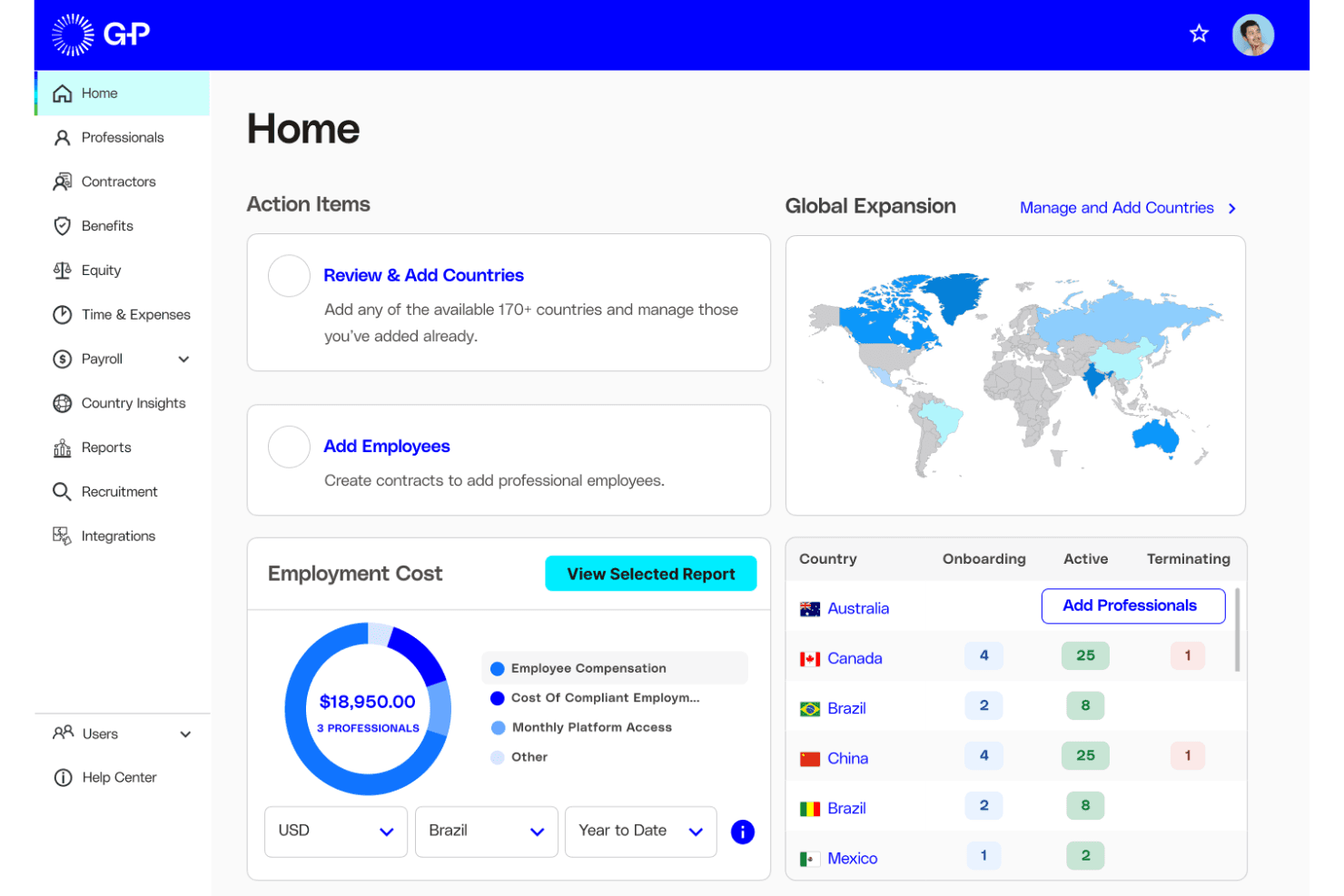
G-P's platform offers a centralized home dashboard for managing global employment costs, employee onboarding, and country-level workforce expansion. G-P is a global employer of record (EOR) platform that manages payroll, tax withholding, social security contributions, and statutory compliance for companies hiring employees in Germany and 180+ other countries without setting up a local legal entity.
Who Is G-P Best For?
G-P is a strong fit for multinational companies that want to hire employees in Germany without setting up a local legal entity.
Why I Picked G-P
I've included G-P in my top picks because it's the strongest option I've found for companies that need to hire employees in Germany without setting up a local legal entity (GmbH). G-P holds the mandatory AÜG license required to operate as a legal employer in Germany and manages the full Lohnsteuer, Solidaritätszuschlag, and all five social security pillars on your behalf. Its ELStAM integration pulls each employee's Steuerklasse and church tax data directly from the German tax authority during onboarding, so there's no manual lookup required.
G-P Key Features
- AÜG license compliance: G-P holds the mandatory Arbeitnehmerüberlassungsgesetz license required to legally operate as an employer of record in Germany.
- ELStAM-based onboarding: During employee setup, G-P retrieves each worker's Steuerklasse, church tax status, and child allowances directly from the ELStAM system.
- Employee self-service portal: Employees access their payslips, time-off requests, and expense submissions through G-P's self-service portal and mobile app.
- G-P Gia™ AI compliance agent: Gia generates compliant German employment contracts and delivers automated alerts when German payroll or labor regulations change.
G-P Integrations G-P’s integration suite supports 200+ HCM and payroll partners, including Workday, SAP SuccessFactors, ADP, BambooHR, HiBob, and UKG. Its API-first architecture supports custom integrations with HRIS, ERP, and accounting systems.
Pros and Cons
Pros:
- Manages full Lohnsteuer and social security filings
- Eliminates need for a German legal entity
- Handles all required German payroll compliance
Cons:
- No client visibility into ELSTER or DEÜV filings
- Lacks DATEV integration for Steuerberater workflows
Learn more about G-P: Best for consolidating global payroll invoices
- Free plan + free demo available
- From $199/user/month
Visit WebsiteCustomer Rating:4.5/5
RemoFirst tracks global workforce distribution across countries in one dashboard. RemoFirst is a global payroll platform that consolidates international employee and contractor payroll across multiple countries into a single dashboard, with multi-currency payments, local-law compliance support, and integrations with HR systems like Workday and ADP Workforce Now.
Who Is RemoFirst Best For?
RemoFirst is a strong fit for finance directors and HR managers at mid-sized companies running payroll across multiple countries who need one consolidated invoice instead of dozens.
Why I Picked RemoFirst
I picked RemoFirst as one of the best because it solves a specific pain point I see constantly in global teams: managing Germany payroll alongside a dozen other country payrolls without drowning in separate invoices. RemoFirst consolidates all of that into one approval workflow and one payment, letting you track total payroll spend in a single currency while still paying employees in their local currencies. You can also see your full workforce by country and classification in one dashboard, which makes cross-border oversight far less fragmented.
RemoFirst Key Features
- Local-law benefits administration: RemoFirst handles time-off requests, yearly bonuses, and financial benefits according to each employee's local legal requirements.
- Multi-currency payroll payments: Employees are paid in their local currencies, while you can invoice and track total payroll spend in a single currency.
- Employee self-service portal: Employees can view and download payslips directly from the Payments section of the RemoFirst platform.
- HRIS integrations: Native connections to Workday, BambooHR, and ADP Workforce Now let you sync global workforce data with your existing HR systems.
RemoFirst Integrations
RemoFirst offers native integrations with Workday, BambooHR, ADP Workforce Now, and GoCardless for workforce data and payroll funding.
Pros and Cons
Pros:
- Reviewers report timely payroll payments
- Employees can access payslips online
- Consolidates international payroll approvals
Cons:
- Reviewers report inconsistent local compliance guidance
- German statutory filing support is undocumented
 Best for cross-border payroll and global hires
- Free demo available
- From $29/user/month
Visit WebsiteCustomer Rating:4.9/5
Deel Payroll offers a Global Payroll configuration page for a DE (Germany) entity, showing payroll report items, payroll groups, funding settings, and deliverables. Deel Payroll is a global payroll platform that manages multi-country payroll runs, employer of record services, contractor payments, and compliance across 150+ countries, including Germany.
Who is Deel Payroll Best For?
Deel Payroll is a strong fit for multinational companies and HR directors managing employees across multiple countries, including Germany, without a local legal entity.
Why I Picked Deel Payroll
I've included Deel Payroll in my top picks because it's the only platform I know of that lets you hire and pay an employee in Germany in as little as four days, using Deel's wholly-owned German entity. That means no local entity setup and no third-party subcontracting risk. I also like the Payroll Connect feature, which lets my team view Deel-managed payroll alongside any third-party payrolls in one dashboard, which is genuinely useful when Germany is just one of many countries you're running payroll in.
Deel Payroll Key Features
- Automated compliance engine: Monitors and applies local labor laws, filings, and statutory requirements in Germany automatically before each payroll run.
- Digital employee document management: Centralizes employee contracts, payslips, and onboarding materials in a secure, accessible portal.
- Multi-currency and crypto payroll: Supports payments in over 120 currencies, including local rails and crypto payout options for international teams.
- 130+ native HR and finance integrations: Connects to tools like Workday, SAP, Oracle, NetSuite, BambooHR, and HiBob for unified workforce management.
Deel Payroll Integrations
Deel Payroll offers 130+ native integrations, including Workday, SAP, Oracle, NetSuite, BambooHR, HiBob, Okta, and Azure Active Directory. An API is available for custom integrations.
Pros and Cons
Pros:
- Owned German entity eliminates subcontractor risk
- Runs payroll across 150+ countries simultaneously
- Hire in Germany without a local entity
Cons:
- Costly for businesses with Germany-only payroll
- No native DATEV or ELSTER filing support
Learn more about Deel Payroll: Best for parallel-run payroll migration
- Free demo available
- Pricing upon request
Visit WebsiteCustomer Rating:4.3/5
Personio breaks down gross pay with base, recurring, and one-time compensation. Personio Payroll is a native German payroll solution that handles gross-to-net calculations, statutory filings, social-insurance reporting, and DATEV integration while keeping HR and payroll data in one place.
Who Is Personio Best For?
Personio Payroll is a strong fit for payroll specialists at mid-market German companies who want HR and payroll data in one place and need ITSG-certified, automated compliance without relying on a fully outsourced payroll provider.
Why I Picked Personio
I've included Personio in my top picks because its structured parallel-run implementation process is what genuinely sets it apart when you're migrating payroll from another system. Before go-live, Personio runs payroll alongside your previous system so you can compare results side by side and catch discrepancies before they become compliance issues. I also like that the product handles gross-to-net calculations, ELStAM registration, and automatic transmission of contribution statements to social-insurance institutions all within the same platform where your HR data already lives.
Personio Key Features
- ITSG-certified compliance reporting: Personio Payroll holds ITSG certification, covering payroll calculations and automated data submissions to social-insurance authorities, including euBP electronic audit support.
- Multi-entity payroll processing: Run payroll across multiple legal entities within a single account, with DATEV tenant mapping available for each subcompany.
- Automated ELStAM registration: New eligible employees are automatically registered through ELStAM on their first working day, with tax characteristics retrieved using their tax ID and date of birth.
- DATEV data transfer: Export payroll data including salaries, absences, hourly wages, and recurring compensation directly to DATEV LODAS or Lohn und Gehalt, and import released documents back into Personio.
Personio Integrations
Personio lists 200+ Marketplace integrations, including DATEV and NL | Loket for payroll-related data transfers. It also offers a public API and webhooks for custom integrations.
Pros and Cons
Pros:
- Employees can access payroll documents through the portal
- HR-linked payroll keeps employee data alongside calculations
- Parallel runs catch migration discrepancies before go-live
Cons:
- Teams retain payroll approval rather than outsourcing
- Unsupported KUG and net-to-gross calculations limit coverage
Learn more about Personio: Best for scalable payroll process automation
- 30-day free trial
- Pricing upon request
Visit WebsiteCustomer Rating:4.3/5
Sage Payroll includes a Run Payroll screen with employee payment statuses, HMRC submission tracking, and payslip management across 68 employee records. Sage Payroll is a cloud-based German payroll solution that handles gross-to-net calculations, statutory reporting (ELSTER, DEÜV), payslip generation, and employee self-service within a single platform built for SMEs.
Who is Sage Payroll Best For?
Sage Payroll is a strong fit for German SMEs with up to 150 employees that need a self-contained, regulation-ready payroll tool without a dedicated payroll specialist on staff.
Why I Picked Sage Payroll
I picked Sage Payroll as one of the best because of how far it takes payroll automation specifically within the German compliance context. You can configure a recurring pay date once, and Sage handles the full monthly cycle automatically: gross-to-net calculations, payslip generation, and DEÜV and ELSTER submissions, all without needing a separate ITSG certificate. I also like that the same subscription scales from 5 to 150 employees, so growing teams don't have to migrate to a new platform as headcount increases.
Sage Payroll Key Features
- DATEV-compatible data export: Export payroll data in standard formats ready for direct import into DATEV accounting systems.
- German payslip generation: Create statutory-compliant payslips with all relevant pay components and deductions.
- Automatic ELSTER and DEÜV submissions: Electronically file payroll tax and social insurance reports directly from the platform.
- Employee self-service portal: Employees access digital payslips, tax documents, and manage some personal data online.
Sage Payroll Integrations
Sage Payroll offers native integrations with Sage HR and accounting products like Sage 50 and Sage Intacct, and supports DATEV-compatible export for collaboration with tax advisors. An API is available for custom integrations.
Pros and Cons
Pros:
- Scales from 5 to 150 employees
- No ITSG certificate required for submissions
- Handles Minijob and Midijob thresholds automatically
Cons:
- Customer support response times reportedly slow
- Limited support for complex Tarifvertrag scenarios
Learn more about Sage Payroll:

Paychex displays a detailed payroll labor cost breakdown by department. Paychex is a cloud-based payroll software for Germany that covers gross-to-net calculation, statutory filings, digital payslips, and employee self-service across three configurable service tiers—self-service, assisted, and managed.
Who Is Paychex Best For?
Paychex is a strong fit for HR teams and payroll specialists who want the flexibility to start hands-on and scale into a fully managed payroll service without switching systems.
Why I Picked Paychex
I picked Paychex as one of the best because it's the only tool on my list that lets you switch between self-service, assisted, and managed payroll without changing systems. If your team grows or your capacity shifts, you can move from running payroll yourself to having Paychex's specialists prepare, review, and execute it entirely, all within the same platform. I also like that the service tiers aren't just support levels—Managed Service includes payroll calendar monitoring and deadline tracking, so nothing slips through when your team is stretched.
Paychex Key Features
- ITSG-certified DEÜV reporting: The platform submits social insurance reports automatically through ITSG-certified interfaces after each payroll run.
- Employee self-service portal: Employees can access digital payslips, view assigned documents, and update their own master data directly in the platform.
- Payroll simulations: Users can run payroll simulations for individual employees or the entire company before committing to a final payroll run.
- Digital personnel files: HR teams can store, manage, and access employee records and documents in a secure cloud-based archive within the platform.
Paychex Integrations
Paychex advertises 100+ standard connectors for HR, time, and finance systems, but doesn’t name specific vendors. It also offers a Public API plus CSV, Excel, and DLS import and export for custom or file-based data exchange.
Pros and Cons
Pros:
- Service tiers let teams change support levels
- Specialist guidance supports early payroll runs
- Scenario-specific fields reduce payroll entry friction
Cons:
- Support response times vary by contact
- Payroll transitions can require significant coordination
Learn more about Paychex : Best for integrated workflows with tax advisors
- Not available
- From €15.86/month
Visit WebsiteCustomer Rating:3.4/5
DATEV Payroll includes a spreadsheet-based Lohn Vorerfassung (payroll pre-entry) interface in Excel for managing employee wage types and billing months. DATEV Lohn und Gehalt is a German payroll software that handles gross-to-net calculations in full compliance with German legislation, statutory e-filing (ELSTER, DEÜV), and payslip generation natively within the DATEV cooperative infrastructure used by tax advisors across Germany.
Who is DATEV Payroll Best For?
It's a strong fit for German Mittelstand companies and payroll specialists who already work within the DATEV ecosystem alongside a tax advisor (Steuerberater).
Why I Picked DATEV Payroll
DATEV Payroll earns its spot on my shortlist because no other payroll tool in Germany is as natively embedded in the tax advisor workflow. When my team runs payroll, data transmits directly to health insurance funds, ELSTER, and banks through the DATEV data center in one click, with no manual export or reformatting. I also appreciate the historical master data feature: if a contribution rate changes retroactively, DATEV recalculates the entire previous year automatically.
DATEV Payroll Key Features
- Tarifvertrag and collective agreement logic: Supports IG Metall, TVöD, and other German industry agreements for bonuses, allowances, and statutory church tax considerations.
- Employee self-service portal: Lets employees securely access their payslips, certificates, and tax documents online.
- Automated ELStAM and SV-Meldungen retrieval: Fetches wage tax data and transmits social security notifications electronically.
- Benefits-in-kind management: Calculates and reports non-cash perks like company cars, meal vouchers, and Jobticket as required by German law.
DATEV Payroll Integrations
DATEV Payroll offers native integrations with DATEV Rechnungswesen, Personio, Factorial, ATOSS, and TimeTac. An API is available for custom integrations.
Pros and Cons
Pros:
- Direct ELSTER submission via DATEV data center
- Retroactive payroll recalculation runs automatically
- Certified GKV compliance for SV reporting
Cons:
- Best suited for existing DATEV ecosystem users
- Admin interface available in German only
Learn more about DATEV Payroll: Best for industry-specific payroll configurations
- Not available
- Pricing upon request

Zalaris lets employees request earned wages before payday. Zalaris is a managed HR and payroll outsourcing service that handles gross-to-net payroll calculations, statutory compliance filings, payslip distribution, and HR system integrations for businesses operating in Germany and across multiple countries.
Who Is Zalaris Best For?
Zalaris is a strong fit for mid-to-large enterprises managing payroll across Germany and multiple countries who need a fully managed service with deep statutory compliance support.
Why I Picked Zalaris
I picked Zalaris as one of the best because it handles German payroll configurations with a level of specificity I genuinely appreciate, covering all six wage-tax classes, church-tax-dependent calculations, and filings across 93 statutory health insurance funds. Its Payroll Control Centre runs pre-processing validation checks before every pay run, catching exceptions in tax details, bank accounts, and contracts before anything goes to the authorities. The ELSTER integration automates wage-tax declarations and updates automatically when German legislation changes, like the 2026 retirement-age income exemption rule.
Zalaris Key Features
- Payroll Control Centre: Runs real-time validation of tax IDs, bank details, and contracts before each pay run, flagging exceptions before payroll is finalized.
- PeopleHub self-service portal: Gives employees mobile and desktop access to payslips, time-off requests, and personal data without involving HR.
- Multi-system integration: Connects with SAP SuccessFactors, Workday, Oracle HCM, HiBob, and DATEV via pre-built connectors and an open API.
- ISAE 3402 Type II and ISO 27001:2022 certified infrastructure: Hosts payroll data in EU-based data centers, including Hamburg and Frankfurt, with role-based access controls and audit logging.
Zalaris Integrations
Zalaris integrates with SAP SuccessFactors, SAP HCM, Workday HCM, Oracle HCM, HiBob, DATEV, and ELSTER. It also supports an open API for connecting other HRIS platforms and existing payroll systems.
Pros and Cons
Pros:
- German tax rules receive detailed coverage
- Pre-run checks flag payroll data exceptions
- Mobile payslip access earns reviewer praise
Cons:
- Reviewers report slow support and unresolved tickets
- Some reviewers report incorrect pay and deductions
Learn more about Zalaris: Best for Steuerberater-managed payroll processing
- Free demo available
- Pricing upon request

edlohn includes an employee overview with payroll data, notifications, and client details. edlohn is a cloud-based payroll platform by eurodata AG built for tax advisors and payroll bureaus, covering German gross-to-net calculations, statutory e-filing via ELSTER and DEÜV, multi-client management, and digital payslip distribution.
Who is edlohn Best For?
edlohn is a strong fit for Steuerberater and Lohnbüros that manage payroll across multiple client accounts from a single platform.
Why I Picked edlohn
I picked edlohn as one of the best because its multi-client architecture is built specifically around how Steuerberater actually work. I like that the edcloud portal lets tax advisors and clients share payroll data securely without email back-and-forth. The built-in ITSG-certified transmission for ELSTER and DEÜV filings means I'm not relying on third-party certificates or manual uploads.
edlohn Key Features
- Compliant payslip generator: Produces German payslips that meet all statutory requirements for digital or print distribution.
- Automated SV-Meldungen and DEÜV reporting: Handles electronic health insurance and social security filings directly from the platform.
- Digital personnel file (eLohnakte): Stores payroll documents and employee records securely for compliance and audits.
- ELStAM data management: Automates electronic wage tax data retrieval and updates linked to each employee.
edlohn Integrations
Native integrations are not publicly listed. An API is available for custom integrations, and time-tracking tools like edtime are supported directly.
Pros and Cons
Pros:
- Automated annual regulatory updates for Lohnsteuer and Mindestlohn
- Multi-client payroll management from one account
- ITSG-certified for GKV social security e-filing
Cons:
- Interface and documentation are German-only
- Primarily designed for Steuerberater, not in-house HR teams
Learn more about edlohn:

SD Worx includes a detailed payslip breakdown with fixed salary, deductions, tax, and year-to-date earnings. SD Worx is a European payroll and HR platform with a proprietary German payroll engine, covering gross-to-net calculations, statutory e-filing, employee self-service payslips, time and attendance, and multi-country payroll coordination.
Who is SD Worx Best For?
SD Worx suits mid-market and enterprise companies managing payroll across multiple European countries, including Germany, under a single provider.
Why I Picked SD Worx
I picked SD Worx as one of the best because it runs a proprietary payroll engine in Germany, not a third-party processor, which means German Lohnsteuer, Sozialversicherung, and statutory filings are handled by owned local expertise. I also like that multi-country payroll across other European entities runs under one contract and service model, with Workday and SAP integrations confirmed live in Germany to keep global HRIS and payroll data in sync.
SD Worx Key Features
- Time and attendance management: Track working hours, absences, and leave in compliance with German labor law.
- Digital payslip portal: Employees access secure, multilingual digital payslips and tax documents online.
- Multi-country payroll coordination: Manage payroll processes for several European countries using one unified system.
- Workforce scheduling tools: Plan and adjust shift schedules with built-in compliance to German regulations.
SD Worx Integrations
SD Worx offers native integrations with SAP, Workday, and Oracle. An API is available for custom integrations.
Pros and Cons
Pros:
- Bilingual employee self-service portal available
- Covers German statutory filings automatically
- Handles payroll across multiple European countries natively
Cons:
- German SMBs may find it oversized
- Implementation can be lengthy for smaller companies
Learn more about SD Worx:
Outro software de processamento salarial na Alemanha
Eis algumas opções adicionais de software de processamento salarial na Alemanha que não integraram a minha lista restrita, mas que continuam a merecer atenção:
- 11RipplingBest for unified HR, IT, and payroll workflows
- 12Papaya GlobalBest for multinational wage compliance management
- 13RemoteBest for simplified payroll setup for remote teams
- 14LohndirektBest for outsourced payroll for German SMEs
- 15Lexware PayrollBest for small business payroll compliance
- 16Agenda LohnBest for care-shift premiums and cost allocation
How I Evaluate Payroll Software in Germany
I split my evaluation into three parts, weighting core functionality most: calculate German gross-to-net pay and submit statutory filings. Next, I look for standout features such as payslip self-service or tax-advisor collaboration. Finally, I consider beyond-feature factors like implementation support, compliance history, and pricing that scales with headcount.
Core Functionality (Table Stakes For This List)
When I'm selecting tools for my list, I score each one on a scale from 0 (does not offer the functionality) to 5 (excels in this area) for each core functionality listed below. I then convert the total into a percentage to help assess each tool's overall fit, with extra weight on any functionalities I’ve deemed essential.
- German Compliance (Essential): I look for current German tax and social insurance rules, including support for reporting requirements such as ELStAM and DEÜV.
- Payroll Calculations (Essential): I assess gross-to-net calculations across salaries, variable pay, benefits, and deductions, checking how the tool handles different employee scenarios.
- Payslip Access: I check whether the software generates payslips and gives employees secure access to current and past documents.
- Authority Reporting: I evaluate electronic payroll submissions to German tax offices and social insurance carriers, including how the tool flags issues.
- Payroll Records: I look for useful tax summaries, contribution statements, and reports that support audits and routine record-keeping.
- HR And Accounting Links: I check how payroll data moves between the tool and HR or accounting systems, including options for teams working with external providers.
Once I have a list of tools that meet the criteria, I consider what sets each platform apart.
Differentiating Factors (What Sets Vendors Apart)
Here's how I compare and contrast different vendors:
Standout Features
I look for tax advisor collaboration tools that let your external tax advisor (Steuerberater) review and approve payroll runs directly inside the platform, cutting out manual file exchanges around month-end. Automated legislative updates matter just as much—I check whether the tool pushes new social insurance thresholds and tax table changes on its own, since missing even one update can cascade into incorrect net pay across your entire workforce. I also evaluate multi-language interface support, which is essential when your HR team or employees work in both English and German.
Beyond Features
I check whether payroll data stays hosted in Germany or the EU, since GDPR (DSGVO) compliance is non-negotiable for sensitive wage records. DATEV compatibility matters just as much—tools like Personio and DATEV integrate directly, letting your tax advisor pull payroll exports without reformatting files each cycle. I also evaluate onboarding support, specifically whether the vendor provides German-speaking specialists who can migrate historical payroll data before your first live run.
Como escolher software de processamento salarial na Alemanha
É fácil perder-se em listas extensas de funcionalidades e estruturas de preços complexas. Para o ajudar a manter-se focado enquanto analisa o seu processo específico de seleção de software, eis uma lista de fatores a ter em conta:
| Fator | O que considerar |
|---|---|
| FatorEscalabilidade | O que considerarO software consegue lidar com alterações no número de funcionários, nas localizações ou nas estruturas jurídicas à medida que a sua empresa cresce? Informe-se sobre restrições ou custos adicionais associados ao crescimento. |
| FatorIntegrações | O que considerarEstabelece ligação nativa com o seu HRIS, ferramentas de contabilidade, controlo de tempo ou serviços bancários? Verifique a existência de opções DATEV, Personio e API relevantes para o seu conjunto de ferramentas. |
| FatorFacilidade de utilização | O que considerarAs equipas de RH, processamento salarial e contabilidade conseguirão dominar rapidamente o sistema? Considere os fluxos de trabalho apresentados nas demonstrações, o idioma da interface e os materiais de apoio ao utilizador. |
| FatorImplementação e integração inicial | O que considerarQuanto tempo demorará a configuração e que formação ou apoio à migração estão disponíveis? Informe-se sobre o apoio dedicado e as estimativas de prazo específicas para a Alemanha. |
| FatorCusto | O que considerarOs preços são transparentes e previsíveis à medida que adiciona funcionários ou novas localizações? Tenha atenção às taxas de configuração ou aos custos ocultos por recibo de vencimento no processamento salarial alemão. |
| FatorMedidas de segurança | O que considerarOnde e como são armazenados os dados salariais sensíveis? Garanta a conformidade com o RGPD, controlos de acesso robustos e a residência dos dados na Alemanha/UE, para maior tranquilidade jurídica. |
| FatorRequisitos de conformidade | O que considerarO fornecedor atualiza anualmente a lógica regulamentar para acompanhar as alterações nos impostos e na segurança social alemães? Procure provas de certificação ITSG e de preparação para auditorias. |
| FatorDisponibilidade do apoio | O que considerarQuando e como pode aceder ao apoio em alemão? Terá ajuda em direto se as exportações ELSTER, SV-Meldungen ou DATEV falharem antes do prazo? |
O que é o software de processamento salarial na Alemanha?
O software de processamento salarial na Alemanha é uma ferramenta especializada que automatiza os cálculos salariais do bruto ao líquido, as declarações obrigatórias e a geração de recibos de vencimento, em conformidade com as regras fiscais e de segurança social locais. Estas plataformas ajudam as equipas de RH e de processamento salarial a gerir os dados dos funcionários, as deduções e as obrigações de comunicação, garantindo simultaneamente o cumprimento dos rigorosos requisitos legais e de auditoria alemães.
Funcionalidades
Ao selecionar software de processamento salarial na Alemanha, esteja atento às seguintes funcionalidades principais:
- Cálculo salarial alemão: Processa o salário bruto-líquido com aplicação automática das regras relativas ao Lohnsteuer, Kirchensteuer, Solidaritätszuschlag e às contribuições para a segurança social.
- Envio eletrónico obrigatório: Permite gerar e enviar eletronicamente declarações fiscais ELSTER, comunicações SV-Meldungen e relatórios DEÜV diretamente às autoridades alemãs.
- Integração com a DATEV: Liga os resultados do processamento salarial à DATEV ou exporta ficheiros em formatos compatíveis com a DATEV para facilitar a colaboração com consultores fiscais e contabilistas.
- Geração de recibos de vencimento em conformidade: Produz recibos de vencimento detalhados e legalmente obrigatórios (Lohnabrechnung) no formato alemão, com todas as deduções legais e tipos de remuneração discriminados.
- Portal de autosserviço para colaboradores: Disponibiliza um portal seguro onde os colaboradores podem consultar recibos de vencimento, certificados fiscais e dados salariais pessoais em alemão e inglês.
- Gestão de convenções coletivas: Suporta componentes salariais e regras associadas a Tarifverträge nacionais ou regionais, como subsídios de férias e suplementos especiais por turnos.
- Gestão de benefícios em espécie: Automatiza o cálculo de benefícios não monetários, como viaturas da empresa (geldwerte Vorteile), vales de refeição e contribuições para planos de reforma.
- Atualizações regulamentares automáticas: Mantém a lógica salarial atualizada face às alterações anuais da legislação fiscal, aos ajustes do salário mínimo e aos novos requisitos de seguro social.
- Biblioteca personalizada de tipos de remuneração: Permite configurar e gerir vários tipos de remuneração, prémios e subsídios específicos da sua força de trabalho e do seu setor.
- Segurança de dados em conformidade com o RGPD: Garante que os registos salariais são armazenados em segurança em centros de dados da UE, com controlos de acesso rigorosos e registos de auditoria para assegurar a conformidade legal.
Vantagens
A implementação de software de processamento salarial na Alemanha proporciona várias vantagens para a sua equipa e para a sua empresa. Eis algumas das que pode esperar:
- Tranquilidade regulamentar: O software mantém-se atualizado face aos requisitos alemães em matéria fiscal, de segurança social e de comunicação, reduzindo o risco de incumprimento.
- Ciclos salariais mais rápidos: Os cálculos brutos-líquidos automatizados, o envio eletrónico e a distribuição dos recibos de vencimento reduzem o trabalho manual e permitem poupar tempo valioso todos os meses.
- Declarações legais precisas: As funcionalidades integradas ELSTER, DEÜV e SV-Meldungen ajudam a gerar, enviar e arquivar os relatórios obrigatórios com confiança.
- Colaboração simplificada com a DATEV: A integração nativa com a DATEV permite que o seu consultor fiscal ou contabilista processe os dados salariais sem introdução adicional de dados ou conversão de ficheiros.
- Colaboradores mais autónomos: Os portais de autosserviço seguros e bilingues proporcionam aos trabalhadores acesso imediato a recibos de vencimento, certificados fiscais e históricos salariais.
- Maior segurança dos dados: O alojamento em conformidade com o RGPD e os controlos de acesso garantem que os dados salariais sensíveis estão sempre protegidos e prontos para auditoria.
- Escalabilidade para o crescimento: As plataformas na nuvem acompanham o crescimento da sua força de trabalho, suportando facilmente novas contratações, vários locais ou alterações na estrutura da empresa à medida que esta se expande.
Custos e preços
A seleção de software de processamento salarial na Alemanha exige uma compreensão dos vários modelos de preços e planos disponíveis. Os custos variam consoante as funcionalidades, a dimensão da equipa, os complementos, entre outros fatores. A tabela abaixo resume os planos comuns, os respetivos preços médios e as funcionalidades normalmente incluídas nas soluções de software de processamento salarial na Alemanha:
Tabela comparativa de planos de software de processamento salarial na Alemanha
| Tipo de plano | Preço médio | Funcionalidades comuns |
|---|---|---|
| Tipo de planoPlano gratuito | Preço médio$0 | Funcionalidades comunsProcessa ciclos salariais básicos, produz recibos de vencimento alemães padrão, permite a introdução manual de dados e inclui apoio limitado. |
| Tipo de planoPlano pessoal | Preço médio$5-$15/utilizador/mês | Funcionalidades comunsDisponibiliza cálculos automatizados, portal de autosserviço para colaboradores, distribuição digital de recibos de vencimento e envio eletrónico legal padrão. |
| Tipo de planoPlano empresarial | Preço médio$15-$30/utilizador/mês | Funcionalidades comunsAdiciona integração com a DATEV, suporte para convenções coletivas, tipos de remuneração configuráveis, gestão de benefícios em espécie e registos de auditoria. |
| Tipo de planoPlano empresarial avançado | Preço médio$30+/utilizador/mês | Funcionalidades comunsDisponibiliza integrações personalizadas, segurança avançada, gestão dedicada de contas, apoio respaldado por SLA e escalabilidade para várias entidades. |
Perguntas frequentes sobre software de processamento salarial na Alemanha
Aqui estão algumas respostas a perguntas frequentes sobre software de processamento salarial na Alemanha:
Preciso de software de processamento salarial específico para a Alemanha se a minha empresa operar na Alemanha?
Sim, precisa de software de processamento salarial concebido para a Alemanha. As regras locais relativas a impostos, segurança social e declarações legais são complexas e mudam frequentemente, pelo que utilizar software desenvolvido para o mercado alemão garante a conformidade e uma colaboração mais fluida com os consultores.
Como é que a integração com o DATEV ajuda a minha empresa?
A integração com o DATEV reduz a introdução duplicada de dados e as transferências de ficheiros entre a sua plataforma de processamento salarial e o seu Steuerberater. Isto melhora a colaboração, especialmente ao lidar com recibos de vencimento mensais, revisões por contabilistas ou o processamento de fim de ano.
O que acontece se as leis fiscais ou de segurança social alemãs mudarem durante o ano?
Os principais softwares de processamento salarial são atualizados anualmente (e, por vezes, com maior frequência) para refletir todos os novos requisitos legais, incluindo escalões de imposto, taxas de contribuição ou alterações ao salário mínimo. Confirme sempre se o seu fornecedor atualiza regularmente a lógica regulamentar.
Os gestores estrangeiros podem utilizar software de processamento salarial alemão em inglês?
Muitas plataformas disponibilizam uma interface bilingue ou, pelo menos, recibos de vencimento e guias de utilização em inglês. Isto é útil para equipas internacionais que operam em cidades como Berlim, Munique ou Frankfurt. Confirme sempre as opções linguísticas durante o processo de seleção.
Como funciona o processamento salarial na Alemanha?
Na Alemanha, o processamento salarial é normalmente realizado mensalmente. Os empregadores calculam o salário bruto, deduzem o imposto sobre o rendimento e a parte do trabalhador nas contribuições legais para a segurança social e pagam o salário líquido restante ao trabalhador. Os empregadores tratam também das declarações obrigatórias relativas ao processamento salarial e das suas próprias contribuições para a segurança social. Como as regras alemãs relativas ao processamento salarial e aos impostos são complexas, muitas empresas utilizam software de processamento salarial ou externalizam este serviço para um Steuerberater (consultor fiscal).
Qual é o software de processamento salarial mais utilizado na Alemanha?
O DATEV é o software de processamento salarial mais utilizado na Alemanha, especialmente entre PME, consultores fiscais e prestadores de serviços de processamento salarial. O DATEV comunicou que, em 2025, foram processados mensalmente, em média, aproximadamente 14,9 milhões de trabalhadores utilizando o seu software de processamento salarial. A SAP destaca-se particularmente entre as grandes empresas alemãs.
Quais são as principais empresas de software na Alemanha?
Entre as principais empresas de software da Alemanha encontram-se a SAP, DATEV, TeamViewer, Celonis, Software AG, Personio e DeepL. A SAP é a empresa alemã de software empresarial mais conhecida, enquanto o DATEV é um importante fornecedor de tecnologia de contabilidade e processamento salarial. No ranking da G2 das Empresas alemãs de software de 2026, SAP, SimScale, TeamViewer, Awin e Leapsome ocupam os cinco primeiros lugares.