



Aeqium vs. CompXL: Comparison & Expert Reviews For 2026


Aeqium uses Active AI to execute your compensation work (building bands, running analyses, configuring cycles), while CompXL offers a highly customizable enterprise-ready tool for managing complex compensation plans through manual configuration.
While both aim to simplify compensation management, they take fundamentally different approaches: Aeqium uses AI agents to do the tactical work that would normally require dedicated analysts or platform experts, while CompXL provides deep customization capabilities that require significant admin setup and configuration expertise. In this article, you'll find a detailed comparison of their features, pros and cons, pricing, and more to help you choose the right compensation management software for your team.
Aeqium vs. CompXL: An Overview
Aeqium


CompXL
Why Trust Our Software Reviews
Our team has been testing and reviewing software since 2012. As HR experts ourselves, we know how difficult—and important—it is to choose the right software.
For this guide, we evaluated tools using hands-on testing and independent research, scoring tools using our selection criteria. We also draw on insights from industry thought leaders and practicing HR experts.
Our reviews reflect our human editorial judgment, not a sales pitch.
Expert reviewers:
Aeqium vs. CompXL Pricing Comparison
| Aeqium | CompXL | |
|---|---|---|
| Free Trial | Free demo available | Free demo available |
| Pricing | Contact for pricing | Pricing upon request |
Aeqium vs. CompXL Pricing & Hidden Costs
Aeqium's pricing follows a custom-quote model where core compensation cycle modules (including AI-powered band building and analysis), AI-powered instant reports & analysis, as well as total rewards portals are included. The Active AI can reduce implementation time and ongoing administrative costs by executing work that would otherwise require dedicated compensation analysts or consultants. CompXL uses modular licensing where you select modules for merit, bonus, equity, commissions, etc., and you may incur extra costs for heavy customization, implementation support, or on-premise deployment.
Aeqium vs. CompXL Feature Comparison
With Aeqium, you get Active AI that executes compensation work. Aeqium Assist and The Analyst can build salary bands, run pay equity analyses, configure complex cycle rules, and generate custom reports on demand. The system provides real-time analytics, flexible modeling, live budget tracking, and AI-driven insights such as pay-equity gaps without requiring manual configuration or spreadsheet work.
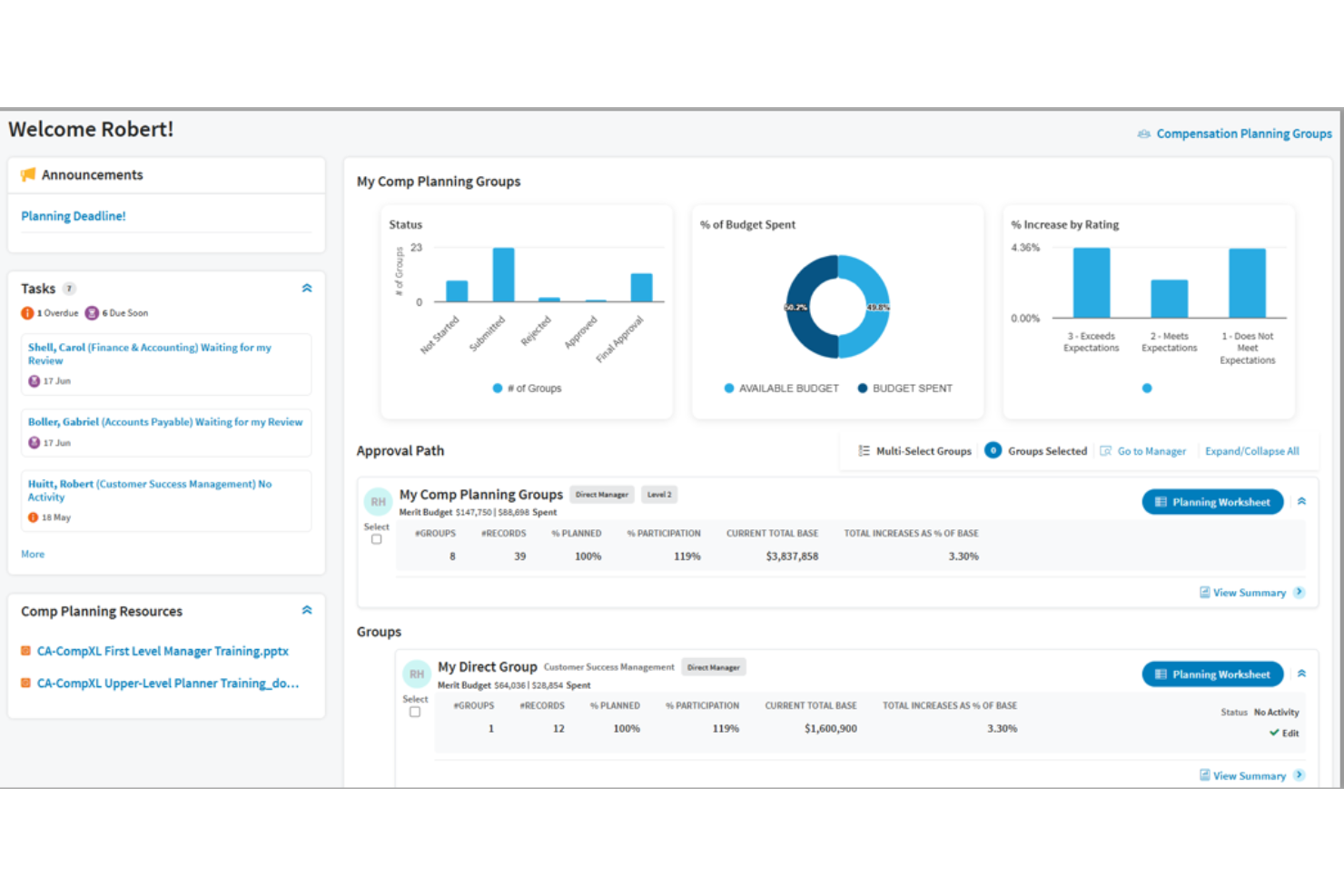
CompXL emphasizes support for complex compensation structures through extensive manual configuration: merit increases, multi-factor bonus planning, equity tracking, commissions, and total rewards statements. The platform provides deep customization capabilities for organizations that need scalable, but granular control over compensation programs.
| Aeqium | CompXL | |
|---|---|---|
| 360 Degree Feedback | ||
| API | ||
| Budgeting | ||
| Comparative Reporting | ||
| Competency Assessment | ||
| Competency Scale | ||
| Custom Assessments | ||
| Dashboard | ||
| Data Export | ||
| Data Import | ||
| Data Visualization | ||
| Employee Database | ||
| Employee Engagement | ||
| Employee Incentive Management | ||
| Employee Onboarding | ||
| Expense Tracking | ||
| External Integrations | ||
| Feedback Management | ||
| Forecasting | ||
| Multi-Account | ||
| Multi-Currency | ||
| Multi-User | ||
| Notifications | ||
| Objectives Tracking | ||
| Onboarding | ||
| Online Surveys | ||
| P&L | ||
| PDF Export | ||
| Paper Surveys | ||
| Payroll | ||
| Performance Appraisal | ||
| Performance Reviews | ||
| Report & Compliance | ||
| Self-service Portal | ||
| Tax Management | ||
| Travel Management |
Aeqium vs. CompXL Integrations
| Integration | Aeqium | CompXL |
| Workday | ✅ | ✅ |
| BambooHR | ✅ | ✅ |
| ADP Workforce Now | ✅ | ✅ |
| SAP SuccessFactors | ✅ | ✅ |
| Paylocity | ✅ | ✅ |
| Carta | ✅ | ❌ |
| Radford (AON) | ✅ | ❌ |
| Shareworks (Morgan Stanley) | ✅ | ❌ |
| Pave | ✅ | ❌ |
| Custom API Integrations | ✅ | ✅ |
Aeqium's integrations are designed for modern HR stacks, pulling in employee, salary, equity, and performance data. Once integrated, the Active AI can immediately work with this data to build bands, run analyses, and generate insights. CompXL likewise connects to HRIS and payroll systems but typically requires more configuration work to set up the custom workflows and calculations needed to process the data.
Aeqium vs. CompXL Security, Compliance & Reliability
| Factor | Aeqium | CompXL |
| Data Privacy | Strong encryption, SOC 2 Type 2 certification, audit trails and granular permissions. | Provides secure cloud or on-premise deployment, audit logs and role-based access. |
| Encryption | Uses strong encryption for data in transit and at rest to protect comp plans and employee data. | CompXL uses SSL encryption to secure data during transfer processes. |
| Regulatory Compliance | Built for multi-currency, multi-entity, global compensation cycles with traceability. | Designed for complex incentive plans, global roll-outs, and deep historical data reporting. |
| Uptime Reliability | Aeqium guarantees 99.9% uptime with robust server infrastructure. | CompXL ensures 99.8% uptime through redundant systems and backups. |
Aeqium and CompXL both prioritize security and compliance, but Aeqium tends to offer more extensive data privacy measures. To choose the right vendor, assess your industry's specific compliance requirements and evaluate how each tool's security features align with those needs.
Aeqium vs. CompXL Ease of Use
| Factor | Aeqium | CompXL |
| User Interface | Aeqium offers a clean, intuitive dashboard that simplifies navigation and task management. | CompXL features a detailed interface with customizable dashboards for complex data views. |
| Onboarding Experience | Aeqium can technically set up a compensation cycle in hours. Full implementation typically takes 4-6 weeks due to customer-side work (data cleaning, security reviews, training), though AI accelerates system configuration. | Implementation may take longer given customization and module setup. |
| Configuration | Active AI executes compensation work for you. Instead of manually configuring comp logic, review cycles, bands, and approvals, you can ask Aeqium Assist to build them. For example, "build engineering bands at the 65th percentile," and the AI creates them. | Very deep manual configuration: custom objects, workflows, calculators, individual modules that require admin expertise to set up. |
| Support | Dedicated CSM, high responsiveness, hands-on support during key cycles. AI handles tasks that would typically require vendor assistance. | Enterprise-level support, but you may invest more time in training and setup, given the complexity. |
From my viewpoint, Aeqium eliminates the need for deep platform expertise because the AI does the work for you, while CompXL requires significant admin knowledge and configuration skills. If you want to run sophisticated compensation programs without needing dedicated platform experts or compensation analysts, Aeqium is the better fit. If you have the resources for extensive customization and prefer complete manual control over every aspect of configuration, CompXL is worth the investment.
Aeqium vs CompXL: Pros & Cons
Aeqium
- Active AI eliminates hours of manual work by building bands, running analyses, and executing comp tasks.
- Real-time collaboration during reviews lets you see updates as they happen, cutting reworks and confusion for distributed teams.
- Simple interfaces and powerful automatic guardrails mean reduced errors and increased decision-making, especially for non-comp managers
- Aeqium doesn't include built-in benchmarking data, so you'll import from your preferred vendors (Radford, Pave, Comptryx, etc.).
- Approved changes need to be exported and uploaded to your payroll system; there's no automatic sync yet.
- Like any comp platform, you'll need clean employee data, documented comp philosophy, and clear band structures to get started.
CompXL
- Handles complex compensation plans with high flexibility
- Responsive customer support and hands-on onboarding
- Customizable reporting and approval workflows
- Interface design feels dated compared to newer tools
- Limited prebuilt integrations with HRIS or payroll systems
- Pricing details are not transparent on the website
Best Use Cases for Aeqium and CompXL
Aeqium
- High-Growth Tech Your team can manage rapid hiring, frequent promotions, and equity refreshes while Aeqium's AI builds bands, analyzes equity positioning, and keeps budgets consistent across managers and locations without needing a compensation analyst for every headcount milestone.
- Mid-Market Orgs You need sophisticated compensation capabilities without a large comp team. Aeqium's AI agents execute complex analyses and band building that would typically require dedicated analysts or consultants.
- Spreadsheet Switchers You're done with manual errors and hours spent building analyses in Excel. Aeqium's AI executes the work automatically, and real-time review workflows replace sheets and reduce rework.
- Equity-Heavy Teams You manage salary, bonus, and equity together. Aeqium's AI can analyze equity positioning, build total comp bands, and help managers make holistic decisions quickly with full compensation history in view.
- Global Workforces Multi-currency support, AI-powered band analytics, and flexible budgeting help you keep compensation coherent across countries and entities. The AI can build localized bands and run analyses across different markets without separate manual work for each region.
- Teams Focused on Pay Parity You need to track internal fairness, but lack dedicated comp analysts. Aeqium's AI runs regression-based pay equity analyses, spots gaps, and helps you judge adjustments with confidence.
CompXL
- Global Enterprises CompXL supports multi-currency pay and localized pay rules for international teams, streamlining complex global compensation cycles.
- Financial Services Handles complex bonus, incentive compensation, and deferred compensation structures across planning cycles.
- Manufacturing Companies Manages layered pay plans and union-specific compensation agreements.
- Healthcare Organizations Tracks compliance and manages variable pay for diverse roles.
- HR Departments Customizes approval workflows and reporting for unique business rules.
- Private Equity Firms Supports confidential, performance-based, and multi-entity compensation plans.
Who Should Use Aeqium, and Who Should Use CompXL?
Aeqium is ideal for total rewards or compensation leaders running complex merit, bonus, and equity cycles across multiple teams or locations who need sophisticated compensation capabilities but don't want to depend on platform experts or large compensation teams. The Active AI handles the tactical work (building bands, running analyses, configuring rules) that would normally require deep system expertise or dedicated analysts. Choose Aeqium if you want to eliminate the dependency on compensation experts while still running enterprise-grade programs.
On the other hand, CompXL is better for organizations that have highly customized compensation schemes, many incentive modules (merit, bonus, commissions, equity), and possess the internal resources and expertise to handle extensive manual configuration. Choose CompXL if you have dedicated platform administrators and prefer complete manual control over every aspect of your compensation system configuration, or if you require on-premise deployment.
Differences Between Aeqium and CompXL
| Aeqium | CompXL | |
|---|---|---|
| Artificial Intelligence | Active AI agents (Aeqium Assist and The Analyst) execute compensation work, like building bands, running analyses, configuring cycles, and generating insights. | Does not include AI execution capabilities. All configuration, analysis, and band building must be done manually by trained administrators. |
| Collaboration | Built-in portals, interactive offer letters, total-rewards statements, and AI-generated communication support. | Supports detailed workflows suited for organizations where multiple stakeholders need to review data, calculations, and approvals at different stages. |
| Execution Model | AI executes tactical work (builds bands, runs analyses, configures rules). Your team provides strategic direction and AI handles execution. | Manual execution model where admins must configure all logic, build all structures, and customize workflows themselves. |
| Setup Time | Can set up compensation cycles in hours once customer data is ready. Full implementation (including customer data prep, security reviews, and training) typically takes 4-6 weeks. | Setup typically takes longer due to extensive module configuration and customization requirements. |
| User Interface | Clean, intuitive dashboard with AI assistance. Can request tasks in plain language. | Detailed interface with extensive customization options requiring admin expertise to navigate and configure. |
| Visit AeqiumOpens new window | Read CompXL ReviewOpens new window |
Similarities Between Aeqium and CompXL
| Approvals | Each platform includes structured approval paths that help maintain consistency and compliance across review cycles. Whether reviews are simple or complex, both tools offer ways to keep processes organized and auditable. |
|---|---|
| Core Focus | Both Aeqium and CompXL are built to help organizations run compensation cycles more efficiently and make pay decisions with greater clarity, though they achieve this through fundamentally different approaches (AI execution vs. manual configuration). |
| Data Security | Both Aeqium and CompXL prioritize data security with strong encryption methods, ensuring your data stays protected. Aeqium uses AES-256 encryption while CompXL employs SSL encryption for data transfers. |
| Global Reach | Each tool supports multi-currency and multi-entity compensation structures for global organizations. |
| Reporting | Both platforms provide customizable reporting capabilities. Aeqium's AI can generate reports on demand, and CompXL supports a more manual report configuration approach. |
| Visit AeqiumOpens new window Read CompXL ReviewOpens new window | |