



Intuit Enterprise Suite vs. NetSuite: Comparison and Expert Reviews for 2026


As organizations grow, managing finances, payroll, approvals, reporting, and day-to-day operations across multiple teams becomes increasingly complex. Choosing business management software that can support administrative workflows while improving visibility, automation, and control is an important decision.
Intuit Enterprise Suite and NetSuite are two leading business management platforms that help organizations manage financial operations, reporting, workflow automation, and day-to-day administrative processes.
In this comparison, I'll break down their features, pricing, pros and cons, security, and ideal use cases to help you determine which solution is the better fit for your organization.
Intuit Enterprise Suite vs. Oracle NetSuite: An Overview
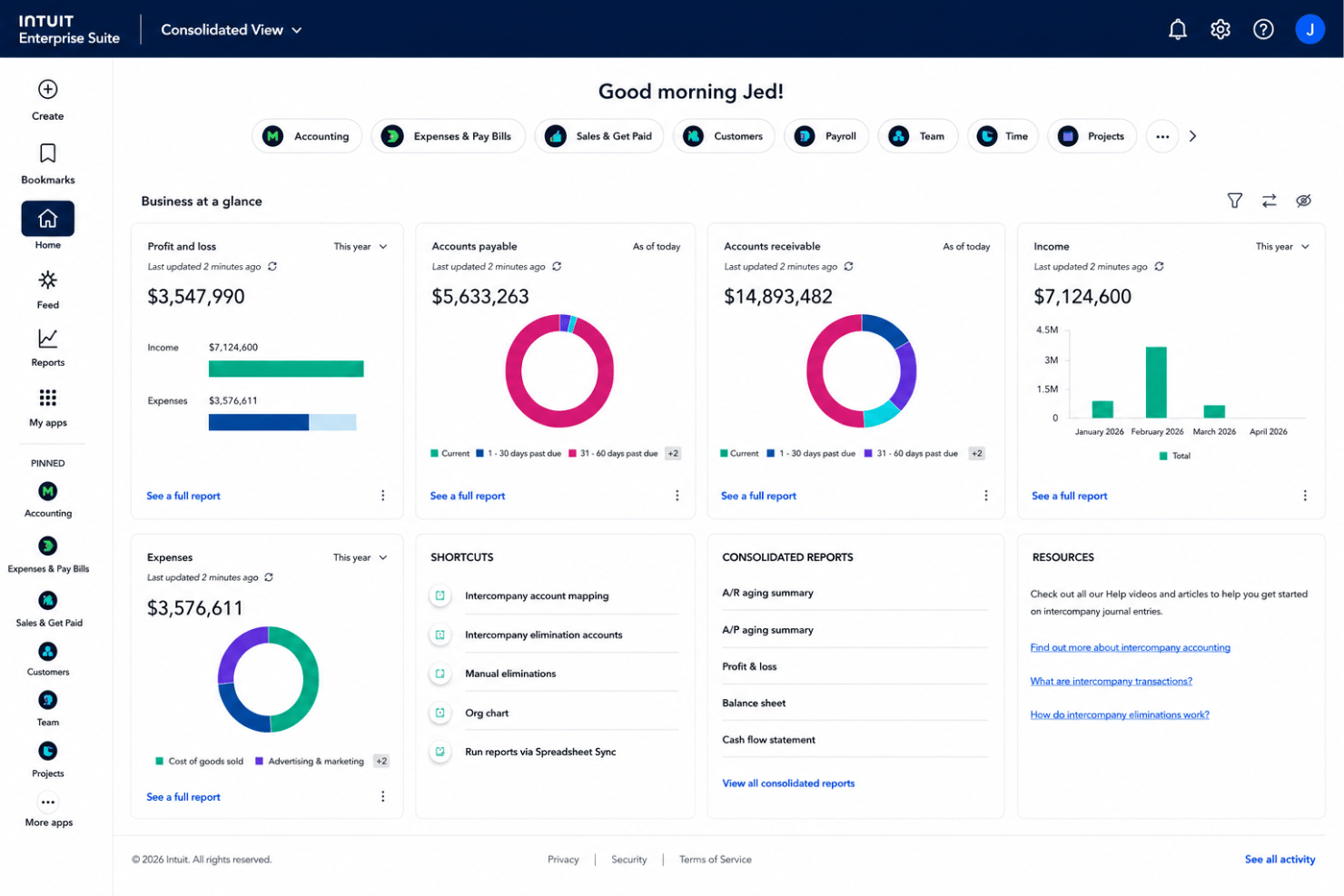
Intuit Enterprise Suite
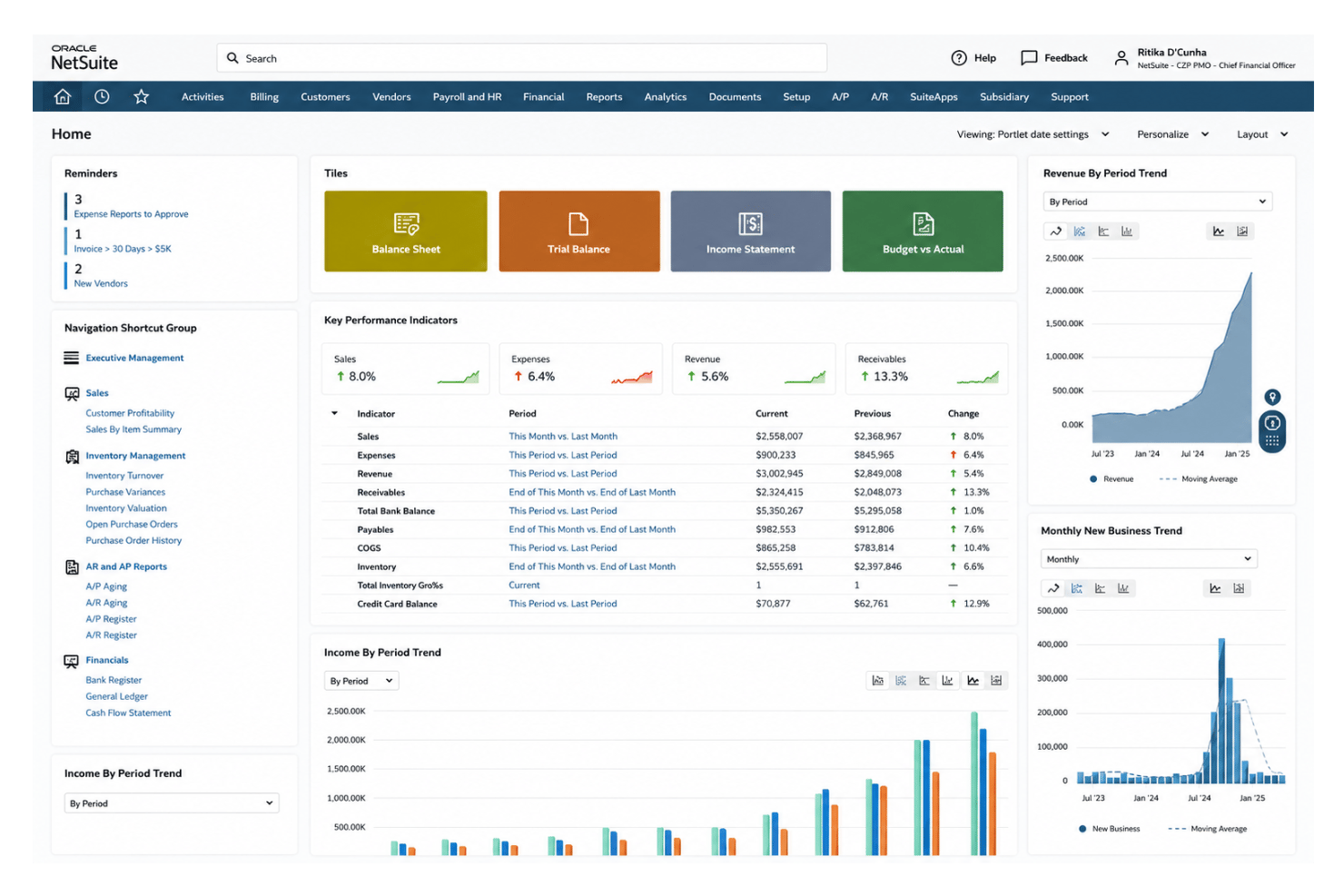
Oracle NetSuite
Why Trust Our Software Reviews
Our team has been testing and reviewing software since 2012. As HR experts ourselves, we know how difficult—and important—it is to choose the right software.
For this guide, we evaluated tools using hands-on testing and independent research, scoring tools using our selection criteria. We also draw on insights from industry thought leaders and practicing HR experts.
Our reviews reflect our human editorial judgment, not a sales pitch.
Expert reviewers:
Intuit Enterprise Suite vs. Oracle NetSuite Pricing Comparison
| Intuit Enterprise Suite | Oracle NetSuite | |
|---|---|---|
| Free Trial | Free demo available | Free demo available |
| Pricing | Pricing upon request | Pricing upon request |
Intuit Enterprise Suite vs. NetSuite Pricing & Hidden Costs
Intuit Enterprise Suite and NetSuite both use custom pricing, so you'll need to contact their sales teams for a quote. Pricing depends on factors such as the number of users, selected modules, implementation requirements, and overall business complexity. While both platforms require a tailored proposal, implementation services, add-ons, integrations, and ongoing support can increase the total cost beyond the base subscription.
To compare pricing effectively, request a detailed quote that includes implementation, support, integrations, additional users, and optional modules. Looking beyond the initial subscription cost will help you determine which platform offers the best long-term value for your organization's needs and growth plans.
Intuit Enterprise Suite vs. Oracle NetSuite Feature Comparison
| Intuit Enterprise Suite | Oracle NetSuite | |
|---|---|---|
| API | ||
| Budgeting | ||
| Calendar Management | ||
| Customer Management | ||
| Dashboard | ||
| Data Export | ||
| Data Import | ||
| Data Visualization | ||
| Expense Tracking | ||
| External Integrations | ||
| Forecasting | ||
| Inventory Tracking | ||
| Multi-User | ||
| Notifications | ||
| Project Management | ||
| Scheduling | ||
| Supplier Management | ||
| Third-Party Plugins/Add-Ons |
Intuit Enterprise Suite vs. NetSuite Integrations
| Integration | Intuit Enterprise Suite | NetSuite |
|---|---|---|
| Shopify | ✅ | ✅ |
| Salesforce | ✅ | ✅ |
| PayPal | ✅ | ✅ |
| Stripe | ✅ | ✅ |
| DocuSign | ✅ | ✅ |
| Square | ✅ | ✅ |
| Amazon Marketplace | ✅ | ✅ |
| HubSpot | ✅ | ✅ |
| Knowify | ✅ | ❌ |
| Wix | ✅ | ❌ |
| API | ✅ | ✅ |
| Zapier | ❌ | ✅ |
Both Intuit Enterprise Suite and NetSuite support integrations across finance, ecommerce, payments, CRM, and operations. Intuit Enterprise Suite leans on the broader Intuit ecosystem to keep payroll, payments, workforce management, marketing, and business data connected, while NetSuite offers API access, Zapier support, and broader connector flexibility. Overall, Intuit Enterprise Suite fits teams that want connected Intuit-led workflows, while NetSuite fits organizations with more complex tech stacks and integration needs.
Intuit Enterprise Suite vs. NetSuite Security, Compliance & Reliability
| Factor | Intuit Enterprise Suite | NetSuite |
|---|---|---|
| Data Encryption | Encrypts data in transit and at rest to help protect sensitive financial and operational information. | Uses encryption for business data and supports enterprise-grade authentication controls. |
| Regulatory Compliance | Supports SOC reports, ISO 27001-certified information security practices, PCI DSS compliance for applicable payment services, and VPAT documentation. | Offers broad enterprise compliance documentation, including SOC, ISO, PCI, and global audit standards. |
| Access Controls | Includes role-based access controls so organizations can limit access to sensitive financial, payroll, and operational data. | Offers granular permissions, MFA, SSO, and token-based authentication for complex enterprise environments. |
| Reliability | Provides enterprise security and compliance resources, though a specific IES uptime SLA is not publicly listed. | Publishes more detailed infrastructure and availability information, including uptime and disaster recovery details. |
Intuit Enterprise Suite covers key security controls, including encryption in transit and at rest, role-based access controls, SOC reports, ISO 27001-certified practices, and PCI DSS compliance for applicable payment services. Meanwhile, NetSuite provides more public detail on infrastructure, uptime, and global compliance. Overall, Intuit Enterprise Suite fits growing businesses with secure financial, administrative, and operational data needs, while NetSuite may suit organizations with more complex compliance requirements.
Intuit Enterprise Suite vs. NetSuite Ease of Use
| Factor | Intuit Enterprise Suite | NetSuite |
|---|---|---|
| User Interface | Uses a familiar Intuit-style interface with organized navigation for finance, payroll, reporting, and workflows. | Uses a unified ERP interface across finance, CRM, procurement, inventory, projects, and global operations. |
| Onboarding | Provides guided onboarding, customer success support, data migration help, and training options. | Uses SuiteSuccess, implementation partners, training resources, and role-based setup support. |
| Customization | Supports configurable workflows, reports, integrations, entities, dimensions, and approvals. | Supports deep ERP customization through SuiteCloud, SuiteBuilder, SuiteFlow, and SuiteScript. |
| Everyday Tasks | Helps teams manage financial operations, payroll, payments, reporting, and approvals through connected Intuit tools. | Supports daily workflows across finance, CRM, inventory, procurement, projects, and subsidiaries. |
| Support & Help | Offers product support, customer success guidance, training plans, and premium support options. | Offers support services, training programs, implementation resources, and partner support options. |
Intuit Enterprise Suite focuses on guided adoption, familiar workflows, and connected business management tools for growing organizations. Meanwhile, NetSuite supports broader ERP processes, deeper configuration, and larger operational structures. The right fit depends on whether your team needs a streamlined Intuit-led experience or a highly configurable ERP environment.
Intuit Enterprise Suite vs Oracle NetSuite: Pros & Cons
Intuit Enterprise Suite
- Multi-entity management simplifies financial operations across growing organizations.
- AI-powered automation helps reduce manual financial, administrative, and operational tasks.
- Advanced reporting and real-time business insights improve decision-making.
- May offer more functionality than smaller businesses with basic accounting needs.
- Organizations migrating from simpler accounting software may face a learning curve.
- Advanced customization and complex implementations require additional planning and configuration.
Oracle NetSuite
- Real-time dashboards support detailed and customizable reporting.
- Multi-subsidiary management works across currencies and countries.
- Automates manual tasks in HR, finance, and operations.
- Implementation projects often take several months to complete.
- Advanced features usually require additional modules or fees.
- User interface can feel cluttered in complex workflows.
Best Use Cases for Intuit Enterprise Suite and Oracle NetSuite
Intuit Enterprise Suite
- Multi-Entity Organizations Manage multiple legal entities, automate intercompany transactions, and consolidate financial reporting from a single system.
- Professional Services Firms Track projects, manage financial performance, and automate accounting workflows while improving visibility across teams.
- Technology & SaaS Companies Support growing operations with AI-powered reporting, forecasting, and financial controls as the business scales.
- Construction & Project-Based Businesses Manage project accounting, budgeting, and financial reporting with workflows designed for project-driven organizations.
- Manufacturing, Wholesale & Distribution Monitor financial performance across products, locations, and business units while improving operational visibility.
- Growing Mid-Market Businesses Organizations expanding across multiple entities or locations can benefit from enterprise-level financial management without the complexity of a traditional ERP.
Oracle NetSuite
- Mid-Sized Manufacturers NetSuite's inventory, production, and workflow automation features fit manufacturers managing multiple processes and warehouses.
- Global Companies The platform natively supports subsidiaries, currencies, and tax rules, making it ideal for cross-border and multi-entity businesses.
- Nonprofit Organizations Purpose-built nonprofit editions track grants, finances, and compliance requirements in a unified system.
- Finance Departments Finance teams get automated reporting, advanced analytics, and centralized financials for better decision-making and compliance.
- eCommerce Businesses Direct order, shipping, inventory, and CRM management help eCommerce companies keep up with online sales demands.
- Professional Services Firms Project accounting, resource tracking, and expense management streamline operations for consulting, IT, and service-driven companies.
Who Should Use Intuit Enterprise Suite, and Who Should Use NetSuite?
If you’re looking for business management software that combines AI-powered automation with connected Intuit tools for finance, payroll, payments, bill pay, and reporting, Intuit Enterprise Suite is likely the better fit. It’s ideal if you need multi-entity management, advanced reporting, and guided implementation without taking on the full complexity of a traditional ERP deployment.
If, instead, you need a broader ERP system with AI layered across global operations, complex subsidiaries, advanced inventory, procurement, CRM, and highly configurable workflows, NetSuite may be the better fit. NetSuite Next adds conversational intelligence, agentic workflows, and natural-language search, making it a good fit for organizations that want AI support across a wider ERP environment.
Differences Between Intuit Enterprise Suite and Oracle NetSuite
| Intuit Enterprise Suite | Oracle NetSuite | |
|---|---|---|
| AI Experience | Uses Intuit AI Agents to support automation, financial insights, and workflow assistance across business operations. | Uses NetSuite Next and embedded AI for conversational intelligence, agentic workflows, natural-language search, and broader ERP analysis. |
| Customization Model | Supports configurable workflows, reports, integrations, dimensions, entities, and approvals. | Supports deeper ERP customization through SuiteCloud, SuiteBuilder, SuiteFlow, SuiteScript, and partner extensions. |
| Global Operations Depth | Supports growing businesses with multiple entities, locations, projects, and product lines. | Supports complex global operations through OneWorld, including subsidiaries, currencies, tax rules, and international reporting. |
| Implementation Approach | Uses guided onboarding with customer success support, migration help, training, and a shorter implementation timeline than traditional ERPs. | Uses a more formal ERP implementation model through SuiteSuccess, training, configuration, and implementation partners. |
| Native Financial Services | Includes built-in payment processing, bill pay, and access to business lending through the Intuit ecosystem. | Supports payments and bill pay, but some capabilities may rely on external partners, add-ons, or third-party apps. |
| Visit Intuit Enterprise SuiteOpens new window | Read Oracle NetSuite ReviewOpens new window |
Similarities Between Intuit Enterprise Suite and Oracle NetSuite
| Cloud-Based Access | Both platforms are cloud-based, allowing teams to access business data, workflows, and reports online. |
|---|---|
| Core Financial Management | Both support key financial workflows such as AR, AP, general ledger, project accounting, and financial reporting. |
| Multi-Entity Support | Both help organizations manage multiple entities and consolidate financial data across business units. |
| Reporting & Planning | Both offer reporting, dashboards, forecasting, budgeting, and business intelligence tools for decision-making. |
| User Permissions | Both include role-based permissions to help control access to sensitive business, finance, and operational data. |
| Visit Intuit Enterprise SuiteOpens new window Read Oracle NetSuite ReviewOpens new window | |