



Juicebox vs. Gem: Comparison & Expert Reviews for 2026



Recruiting teams can invest in AI and still lose time moving between sourcing, outreach, application review, and reporting. The challenge is choosing a platform that improves the right part of the hiring workflow without adding unnecessary complexity.
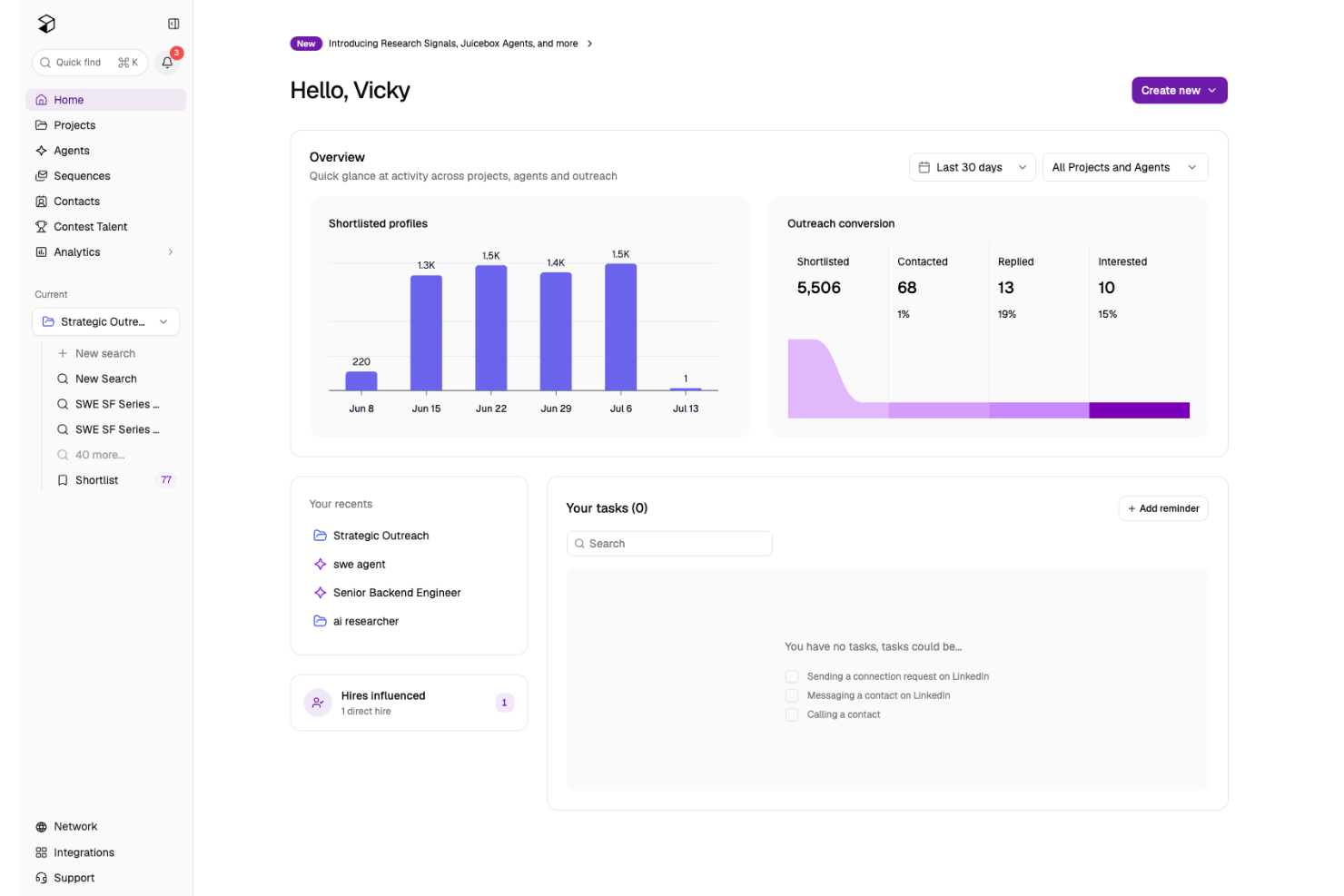
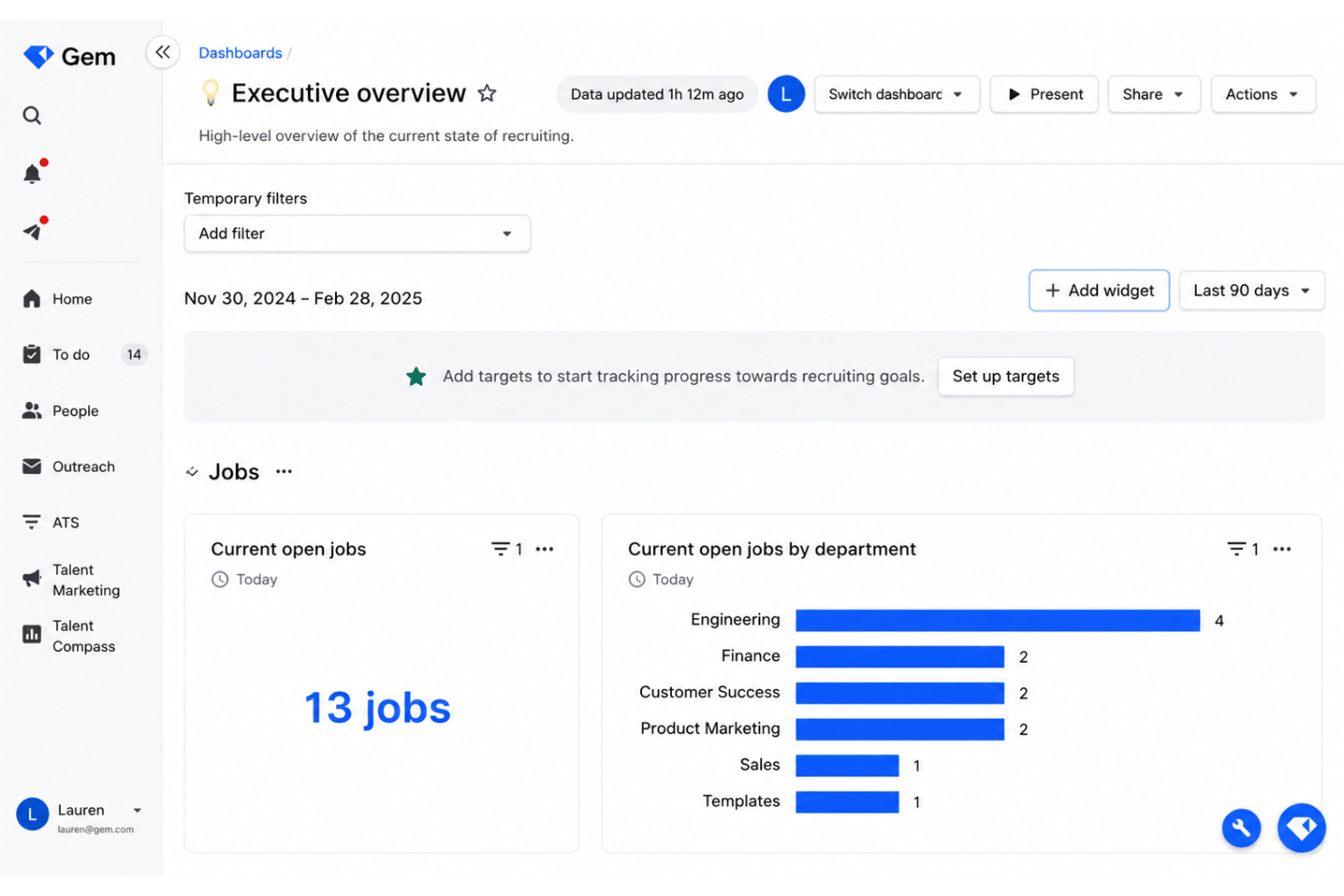
Juicebox and Gem are AI recruiting platforms with different areas of focus. Juicebox centers on plain-language sourcing, explainable candidate matches, recruiting CRM, outreach automation, and Talent Insights, while Gem supports a broader workflow across sourcing, engagement, application review, scheduling, analytics, and ATS capabilities.
In this comparison, I’ll cover their key features, pricing, integrations, security, ease of use, pros and cons, and ideal use cases to help you decide which platform better fits your hiring process.
Juicebox vs. Gem: An Overview
Juicebox
Gem
Why Trust Our Software Recommendations
Our team has been testing and reviewing software since 2012. As HR experts ourselves, we know how difficult—and important—it is to choose the right software.
For this guide, we evaluated tools using hands-on testing and independent research, scoring tools using our selection criteria. We also draw on insights from industry thought leaders and practicing HR experts.
Our reviews reflect our human editorial judgment, not a sales pitch.
Expert reviewers:
Juicebox vs. Gem Pricing Comparison
| Juicebox | Gem | |
|---|---|---|
| Free Trial | Free plan + free trial + free demo available | 7-day free trial |
| Pricing | From $99/user/month (billed annually) | From $99/user/month (billed annually) |
Juicebox vs. Gem Pricing & Hidden Costs
Juicebox offers a Free plan, per-seat Starter and Growth tiers, a custom Business plan, and Juicebox Agents sold separately. Costs can rise with additional users, contact and export allowances, integrations, support, and the number of Agents deployed. Meanwhile, Gem offers custom-priced Gem + Your ATS and Gem All-in-One options, alongside published discounts for eligible startups. Its total cost depends on company size, deployment model, Standard and AI-Powered seat mix, and selected workflows such as scheduling, analytics, and fraud detection.
When comparing the two, consider whether you need a specialized sourcing platform or broader recruiting software with optional ATS capabilities. Juicebox provides a clearer public plan progression, although seats and Agents can add up, while Gem’s custom pricing varies by headcount, deployment model, seat mix, and selected workflows. Factor in your existing ATS, expected users, automation needs, usage allowances, and required workflows when estimating the full annual investment.
Juicebox vs. Gem Feature Comparison
| Juicebox | Gem | |
|---|---|---|
| 360 Degree Feedback | ||
| API | ||
| Application Tracking | ||
| Batch Permissions & Access | ||
| Compliance Tracking | ||
| Dashboard | ||
| Data Export | ||
| Data Import | ||
| Data Visualization | ||
| Employee Database | ||
| Employee Engagement | ||
| Employee Incentive Management | ||
| Employee Onboarding | ||
| External Integrations | ||
| Feedback Management | ||
| Multi-User | ||
| Notifications | ||
| Scheduling | ||
| Travel Management |
Juicebox vs. Gem Integrations
| Integration | Juicebox | Gem |
|---|---|---|
| Greenhouse | ✅ | ✅ |
| Lever | ✅ | ✅ |
| Workday | ✅ | ✅ |
| iCIMS | ✅ | ✅ |
| Sage HR | ✅ | ✅ |
| Gmail | ✅ | ✅ |
| Outlook | ✅ | ✅ |
| Salesforce | ✅ | ✅ |
| BambooHR | ✅ | ✅ |
| SAP SuccessFactors | ✅ | ✅ |
| DocuSign | ❌ | ✅ |
| API | ✅ | ✅ |
Both Juicebox and Gem integrate with widely used ATS, CRM, email, and HR systems, helping candidate data move into existing recruiting workflows. Juicebox offers broad coverage across core sourcing and engagement tools, with API access for more tailored connections. Gem, meanwhile, extends further into downstream hiring workflows through integrations such as DocuSign. Overall, Juicebox is well-suited to teams strengthening proactive sourcing alongside their current stack, while Gem provides broader connectivity across more of the recruiting lifecycle.
Juicebox vs. Gem Security, Compliance & Reliability
| Factor | Juicebox | Gem |
|---|---|---|
| Privacy & Compliance | Maintains SOC 2 Type II, ISO 42001, GDPR, and CCPA compliance, with privacy documentation and a public list of subprocessors available through its Trust Center. | Maintains SOC 2 Type II, GDPR, and CCPA compliance, with additional privacy policies covering data retention, access, and deletion rights. |
| AI Governance | Customer data is not used to train its AI models, the platform undergoes AI bias testing, and recruiters retain responsibility for evaluating candidates and making hiring decisions. | Gem removes personally identifiable information before AI processing, undergoes annual third-party bias audits, and provides explainable scores while leaving hiring decisions with recruiters. |
| Security Controls | Provides a SOC 2 Type II report, penetration-test report, Data Protection Impact Assessment, incident-response controls, and other security documentation through its Trust Center. | Encrypts stored data with AES-256 and data in transit with TLS, alongside administrative, technical, and physical safeguards designed to protect recruiting data. |
| Access & Auditability | Documents authentication, restricted access, event logging, security monitoring, and access-control policies, with detailed materials available for enterprise review. | Provides audit logs covering login attempts, user changes, session activity, role assignments, and API-key activity for administrative and compliance reviews. |
| Reliability | Uses AWS and Google Cloud infrastructure with uptime, error, and AI observability monitoring, although no public uptime commitment was verified. | Publishes a 99.9% uptime commitment and operates a public status page covering its application, integrations, scheduling, AI features, extension, and API. |
Both platforms provide enterprise-ready security and compliance controls, but their documentation emphasizes different priorities. Juicebox provides detailed visibility into AI governance, model-data practices, bias testing, and security controls through its public Trust Center. Meanwhile, Gem publishes more specific information about encryption, audit logs, and service availability. Overall, Juicebox emphasizes responsible AI transparency, while Gem pairs established data-security controls with broader infrastructure and uptime documentation.
Juicebox vs. Gem Ease of Use
| Factor | Juicebox | Gem |
|---|---|---|
| User Interface | A focused workspace keeps plain-language search, candidate profiles, CRM activity, outreach, and Talent Insights closely connected, making it easy to move from discovery to engagement. | A broader interface combines sourcing, CRM, application review, scheduling, analytics, and ATS workflows across more of the recruiting lifecycle. |
| Search Experience | Plain-language queries replace complex Boolean strings, while AI summaries and profile citations explain each match and support detailed criteria such as tenure, company size, and growth signals. | Natural-language search, filters, and AI suggestions help teams define requirements and surface candidates across Gem’s database and connected systems. |
| Onboarding | Self-service setup supports smaller teams, while Business customers receive onboarding, training, migration assistance, and help connecting supported ATS or CRM platforms. | Guided implementation and onboarding support help teams configure selected products, integrations, and recruiting workflows. |
| Learning Curve | The focused sourcing workflow is approachable without advanced Boolean expertise, although Juicebox Agents perform best when teams provide clear role criteria and outreach instructions. | Broader coverage can reduce tool switching, but teams adopting its ATS, scheduling, analytics, and automation features may need more time to learn the platform. |
| Support Access | A Knowledge Base, Help Center, chat and email support, and same-day search assistance are available across all plans, with priority Business support through email, chat, and Slack. | Help documentation, customer support, and implementation guidance are available, with additional onboarding assistance for broader deployments. |
From an ease-of-use perspective, Juicebox offers the more focused and approachable experience for proactive sourcing and outreach. Its search, explainable results, CRM, and outreach automation stay closely connected, although Agents still require clear instructions. Meanwhile, Gem covers more of the recruiting lifecycle, which may reduce tool switching but also introduces more workflows to configure and learn.
Juicebox vs Gem: Pros & Cons
Juicebox
- Plain-language search helps recruiters find candidates without complex Boolean strings.
- AI sourcing agents automate discovery, evaluation, outreach, and follow-up, and can run across multiple open roles at once.
- Profile citations explain candidate matches, while Talent Insights helps assess talent pools and hiring markets.
- AI Agents need clear search criteria and hiring goals to return relevant candidates.
- Juicebox focuses on sourcing and outreach, so teams still need an ATS for the broader hiring lifecycle.
- Recruiters must still review matches and make final hiring decisions.
Gem
- Sourcing automation uncovers passive candidates missed by others
- Visual pipeline analytics give real-time hiring insights
- Email outreach tracking shows candidate engagement and response rates
- Pricing is higher than most recruiting platforms
- Some dashboards require manual updating for accuracy
- Boolean search lacks advanced filtering options
Best Use Cases for Juicebox and Gem
Juicebox
- Technology and SaaS Juicebox helps technology and SaaS companies proactively source candidates for specialized engineering, product, sales, and other knowledge-worker roles.
- Staffing and Recruiting Agencies Agencies can manage searches for multiple clients, organize reusable talent pools, and automate personalized outreach and follow-up, with per-client permissions and shared visibility across the team.
- Professional Services Firms Professional services firms can search for candidates based on industry background, seniority, technical expertise, and other role-specific requirements.
- Financial Services Organizations Juicebox supports financial services teams sourcing experienced professionals for specialized roles that may be difficult to fill through inbound applications alone.
- Enterprise Talent Acquisition Teams Enterprise teams can use Juicebox across multiple departments, locations, and open roles while connecting sourced profiles with supported recruiting systems.
- B2B Knowledge-Worker Hiring Juicebox suits B2B organizations that hire experienced professionals regularly and need an ongoing pipeline of proactively sourced candidates.
Gem
- Tech Startups Fast-growing startups targeting engineers and product talent gain huge value from Gem’s automation and outreach tracking.
- Enterprise HR Large HR teams benefit from Gem’s deep integration with leading ATS platforms for collaboration and reporting.
- Recruitment Agencies Agencies with many clients rely on Gem’s analytics and multi-project tools to monitor performance and manage candidate communications efficiently.
- Healthcare Recruiting Healthcare recruiting groups use Gem to coordinate high-volume candidate engagement and centralized workflows across locations.
- University Hiring Campus recruiting teams leverage Gem’s bulk messaging and pipeline analytics for sourcing entry-level or intern talent.
- Sales Talent Searches Sales organizations making proactive outreach appreciate Gem’s pipeline tracking and automated touchpoints for high-volume candidate searches.
Who Should Use Juicebox, and Who Should Use Gem?
Juicebox is best suited to mid-sized and enterprise recruiting teams focused on proactive sourcing, outbound recruiting, and talent intelligence for knowledge-worker roles. Its plain-language search, profile citations, Talent Insights, recruiting CRM, and AI-powered outreach automation help technology companies, staffing agencies, professional services firms, and other B2B teams find candidates, personalize engagement, and automate follow-up alongside their existing ATS.
Meanwhile, Gem is a stronger fit for organizations managing broader or higher-volume recruiting workflows. Tech startups, enterprise HR teams, recruitment agencies, healthcare recruiters, university hiring teams, and sales organizations may benefit from its sourcing, multi-channel engagement, application review, scheduling, analytics, and ATS capabilities when several recruiting functions need to work within the same platform.
Differences Between Juicebox and Gem
| Juicebox | Gem | |
|---|---|---|
| Analytics Focus | Talent Insights analyzes external talent pools through skills, employers, locations, seniority, experience, and other market patterns to help teams refine sourcing strategies. | Talent Compass combines pipeline analytics, forecasting, benchmarks, and DEI insights across the recruiting funnel to support operational and headcount planning. |
| Automation Model | Juicebox Agents automate sourcing, candidate evaluation, personalized outreach, and follow-up across multiple roles using recruiter-defined criteria and manual review checkpoints. | Gem’s AI agents extend across sourcing, application review, talent rediscovery, and fraud detection, applying automation to both outbound and inbound recruiting workflows. |
| Outreach Channels | Automates personalized multi-step email sequences and follow-ups, supports send-on-behalf-of messaging, and tracks opens, clicks, replies, and bounces. | Supports multi-stage outreach across email, SMS, and InMail, alongside send-on-behalf-of messaging and channel-level performance tracking. |
| Platform Scope | Specializes in proactive sourcing, recruiting CRM, outreach automation, and talent intelligence before candidates apply, while supported ATS and CRM platforms manage the broader hiring lifecycle. | Can layer sourcing, CRM, scheduling, and analytics onto an existing ATS or serve as an all-in-one platform with applicant tracking, application review, and offer management. |
| Search Controls | Replaces complex Boolean strings with plain-language queries and supports detailed criteria such as nested requirements, average tenure, company size, and company-growth signals. | Combines natural-language sourcing with advanced filters and Boolean search, using job descriptions, ideal profiles, and talent-market context to shape results. |
| Visit JuiceboxOpens new window | Read Gem ReviewOpens new window |
Similarities Between Juicebox and Gem
| ATS and CRM Connectivity | Both connect with established recruiting systems so candidate profiles, evaluations, outreach activity, and related data can move into existing workflows with less manual work. |
|---|---|
| Candidate Database | Both provide access to more than 800 million candidate profiles and let teams apply role criteria to surface relevant prospects across large talent pools. |
| Explainable AI | Both provide context behind candidate matches or rankings, helping teams understand why someone surfaced while keeping candidate review and hiring decisions with people. |
| Recruiting CRM | Both centralize candidate profiles, notes, activity history, talent pools, and re-engagement workflows so promising prospects remain useful across current and future roles. |
| Team Collaboration | Both support shared recruiting work through candidate groups, profile reviews, stakeholder feedback, and activity visibility across the hiring team. |
| Visit JuiceboxOpens new window Read Gem ReviewOpens new window | |