



Juicebox vs. Metaview: Comparison & Expert Reviews for 2026



A recruiting tech stack can look efficient on paper and still leave your team bouncing between candidate sourcing, application review, interview notes, and follow-up. For HR and talent acquisition teams, the real question is not whether AI can help, but which platform fits the work you actually need to improve.
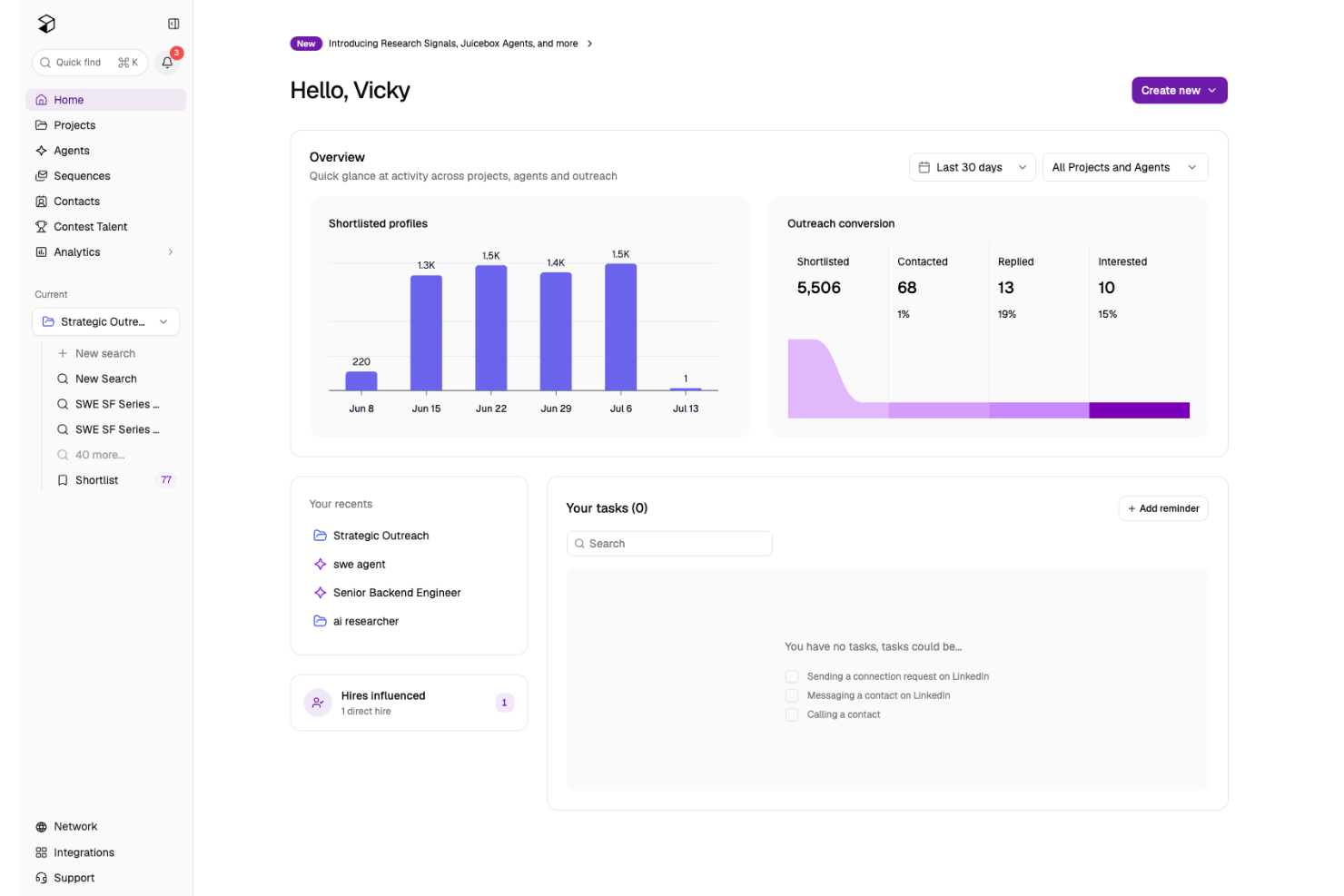
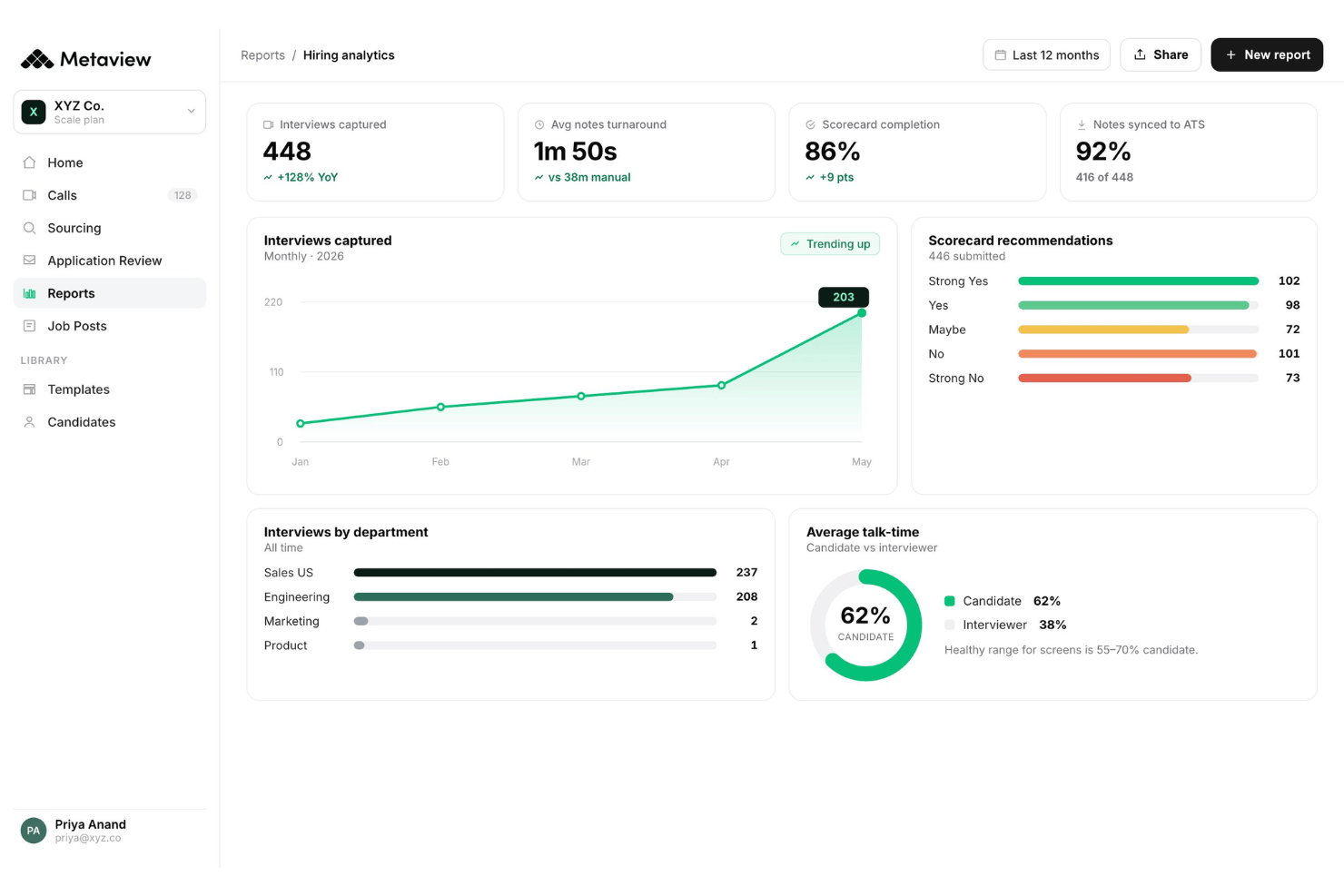
Juicebox and Metaview are AI recruiting platforms that support different parts of the hiring process, with both offering AI sourcing tools for proactive candidate discovery. Juicebox focuses on plain-language search, outbound outreach, recruiting CRM, and talent intelligence, while Metaview brings together sourcing, application review, interview notes, reporting, and other recruiting automation.
In this comparison, I’ll cover their key features, pricing, integrations, security, ease of use, and ideal use cases to help you decide which platform better fits your hiring workflow.
Juicebox vs. Metaview: An Overview
Juicebox
Metaview
Why Trust Our Software Reviews
Our team has been testing and reviewing software since 2012. As HR experts ourselves, we know how difficult—and important—it is to choose the right software.
For this guide, we evaluated tools using hands-on testing and independent research, scoring tools using our selection criteria. We also draw on insights from industry thought leaders and practicing HR experts.
Our reviews reflect our human editorial judgment, not a sales pitch.
Expert reviewers:
Juicebox vs. Metaview Pricing Comparison
| Juicebox | Metaview | |
|---|---|---|
| Free Trial | Free plan + free trial + free demo available | Free plan available |
| Pricing | From $99/user/month (billed annually) | From $100/user/month |
Juicebox vs. Metaview Pricing & Hidden Costs
Juicebox uses per-seat pricing across its Free, Starter, Growth, and custom Business plans, with higher tiers adding more contact and export credits, collaboration features, integrations, and support. Juicebox Agents are priced separately, so costs can increase as teams add users or deploy agents across more roles. Metaview takes a more modular approach, letting teams pay for Sourcing, Application Review, Notetaker, or a broader agent package; its Sourcing plans scale mainly by the number of profiles sourced, with custom volume, training, support, and security available for enterprise customers.
The main budgeting difference is how each recruiting technology is packaged: Juicebox offers a sourcing-focused platform with optional agents, while Metaview lets teams purchase tools according to the workflows they need. Before choosing, confirm expected seat counts, sourcing volume, contact and export allowances, agent requirements, integrations, and whether you will need more than one Metaview product, since those factors will shape the total cost more than the headline subscription alone.
Juicebox vs. Metaview Feature Comparison
| Juicebox | Metaview | |
|---|---|---|
| 360 Degree Feedback | ||
| API | ||
| Application Tracking | ||
| Batch Permissions & Access | ||
| Compliance Tracking | ||
| Dashboard | ||
| Data Export | ||
| Data Import | ||
| Data Visualization | ||
| Employee Database | ||
| Employee Engagement | ||
| Employee Incentive Management | ||
| Employee Onboarding | ||
| External Integrations | ||
| Feedback Management | ||
| Multi-User | ||
| Notifications | ||
| Scheduling | ||
| Travel Management |
Juicebox vs. Metaview Integrations
| Integration | Juicebox | Metaview |
|---|---|---|
| Greenhouse | ✅ | ✅ |
| Lever | ✅ | ✅ |
| Workday | ✅ | ✅ |
| BambooHR | ✅ | ✅ |
| Zoho Recruit | ✅ | ✅ |
| Manatal | ✅ | ✅ |
| Salesforce | ✅ | ❌ |
| Ashby | ✅ | ✅ |
| Workable | ✅ | ✅ |
| Zapier | ❌ | ✅ |
Both Juicebox and Metaview integrate with widely used ATS platforms, helping sourcing, candidate, and interview data flow into existing recruiting workflows. Juicebox offers broader native coverage across the systems shown here, including Salesforce, which gives teams more flexibility across ATS and CRM environments. Metaview, by contrast, pairs strong ATS support with Zapier, making it easier to extend workflows beyond its native connections. Overall, Juicebox leans toward broader built-in recruiting integrations, while Metaview offers more flexibility through workflow automation.
Juicebox vs. Metaview Security, Compliance & Reliability
| Factor | Juicebox | Metaview |
|---|---|---|
| Data Privacy | Maintains GDPR and CCPA compliance, provides data-processing documentation, and states that customer data is not used to train its AI models. | Maintains GDPR and CCPA compliance, gives customers control over retention and deletion, and stores customer data securely within its AWS environment. |
| AI Governance | Maintains ISO 42001 compliance, provides an AI bias audit through its Trust Center, and keeps candidate evaluation and hiring decisions under human control. | Publishes AI policies, training-data and bias controls, and EU AI Act documentation through its Trust Center for responsible use reviews. |
| Access & Authentication | Supports SSO and role-based permissions, allowing organizations to control access across administrators, hiring managers, and other users. | Supports secure SSO, role-based access to transcripts and structured outputs, and customer-controlled access policies for sensitive interview data. |
| Independent Assurance | Maintains SOC 2 Type II compliance and provides a penetration-test report, Data Protection Impact Assessment, and additional security documentation on request. | Maintains SOC 2 Type II certification and provides its audit report, penetration-test report, DPIA, and related compliance materials through its Trust Center. |
| Reliability & Data Resilience | Uses AWS infrastructure, uptime monitoring, incident-response controls, and documented business continuity and disaster recovery policies, although no public uptime SLA was verified. | Uses AWS infrastructure, encrypted backups, status monitoring, configurable retention, and documented business continuity and disaster recovery controls, with no public uptime SLA confirmed. |
Both platforms provide security documentation suitable for enterprise review, but their emphasis differs. Juicebox offers particularly clear documentation around AI governance, bias testing, and the separation between sourcing assistance and human hiring decisions, while Metaview publishes more detail about encryption, data residency, retention, transcript access, and recovery controls for sensitive interview records.
Juicebox vs. Metaview Ease of Use
| Factor | Juicebox | Metaview |
|---|---|---|
| User Interface | Juicebox keeps natural-language search, candidate profiles, CRM activity, outreach, Talent Insights, and Agents within a focused workspace, making it easy to move from discovery to engagement without jumping between disconnected tools. | Metaview organizes sourcing, application review, interview notes, reports, and job-post workflows within a broader recruiting environment. |
| Search Experience | Users can describe an ideal candidate in plain language, refine the generated criteria, and review profile citations explaining why each person matches instead of building complex Boolean searches from scratch. | Its sourcing workflow builds candidate criteria from role information and allows teams to refine results as they review suggested profiles. |
| Onboarding | Smaller teams can start through self-service setup, while Business customers receive onboarding, training, migration assistance, and help connecting supported ATS or CRM systems. | Setup varies by product, with additional configuration required when teams connect sourcing, application review, calendars, interviews, and recruiting systems. |
| Workflow Automation | Juicebox Agents can operate as autonomous agents for sourcing, candidate evaluation, outreach, and follow-up, while manual review checkpoints keep profile review and hiring decisions with the team. | Metaview combines application review, interview notes, summaries, and reporting with calendar-based scheduling automation that automatically adds its Notetaker to eligible recruiting calls. |
| Support Access | Juicebox provides a Knowledge Base, Help Center, chat and email support, same-day search assistance, and expanded onboarding and priority support for Business customers. | Metaview provides a Help Center, quickstart guides, video tutorials, and access to onboarding specialists, with dedicated support and training included for enterprise customers. |
From an ease-of-use perspective, Juicebox offers the more focused experience for teams improving proactive sourcing and outbound engagement. Its plain-language search, recruiting CRM, and outreach tools stay closely connected, making the day-to-day workflow easier to follow. However, Juicebox Agents still need clear hiring criteria to produce relevant results. Meanwhile, Metaview covers more stages of recruiting, from application review to interview documentation and reporting. As a result, it may suit teams seeking broader automation, although that wider scope can require more setup and workflow configuration.
Juicebox vs Metaview: Pros & Cons
Juicebox
- Plain-language search helps recruiters find candidates without complex Boolean strings.
- AI sourcing agents automate discovery, evaluation, outreach, and follow-up, and can run across multiple open roles at once.
- Profile citations explain candidate matches, while Talent Insights helps assess talent pools and hiring markets.
- AI Agents need clear search criteria and hiring goals to return relevant candidates.
- Juicebox focuses on sourcing and outreach, so teams still need an ATS for the broader hiring lifecycle.
- Recruiters must still review matches and make final hiring decisions.
Metaview
- Automatic interview transcripts drastically reduce manual note-taking time
- Conversation insights help highlight interview trends for hiring teams
- Candidate feedback summaries are structured and easily shareable
- Pricing may limit access for small recruiting teams
- Lacks built-in scheduling and applicant tracking features
- Limited language support compared to other AI platforms
Best Use Cases for Juicebox and Metaview
Juicebox
- Technology and SaaS Juicebox helps technology and SaaS companies proactively source candidates for specialized engineering, product, sales, and other knowledge-worker roles.
- Staffing and Recruiting Agencies Agencies can manage searches for multiple clients, organize reusable talent pools, and automate personalized outreach and follow-up, with per-client permissions and shared visibility across the team.
- Professional Services Firms Professional services firms can search for candidates based on industry background, seniority, technical expertise, and other role-specific requirements.
- Financial Services Organizations Juicebox supports financial services teams sourcing experienced professionals for specialized roles that may be difficult to fill through inbound applications alone.
- Enterprise Talent Acquisition Teams Enterprise teams can use Juicebox across multiple departments, locations, and open roles while connecting sourced profiles with supported recruiting systems.
- B2B Knowledge-Worker Hiring Juicebox suits B2B organizations that hire experienced professionals regularly and need an ongoing pipeline of proactively sourced candidates.
Metaview
- High-Volume Tech Hiring Metaview excels at automatically documenting technical interviews, giving hiring managers clear feedback and evaluation records for engineering and product roles.
- Enterprise Recruiting Teams Advanced analytics, security, and workflow controls cut screening time and make it a solid pick for large organizations with complex hiring needs.
- Distributed Hiring Panels Global teams conducting interviews across time zones benefit from shared structured notes, transcripts, and summaries to keep everyone aligned.
- Multi-Department Hiring HR and talent teams needing to track interviews across multiple business units can leverage Metaview’s AI tools and searchable archive for centralized decision-making.
- Remote-First Companies Teams who run all interviews virtually will appreciate Metaview’s integrations for seamless intake call recording and instant documentation.
- Regulated Industries If your company requires strict data compliance and auditability—like in finance or healthcare—Metaview’s best-in-class privacy controls stand out.
Who Should Use Juicebox, And Who Should Use Metaview?
If your mid-sized or enterprise organization relies on proactive sourcing, outbound recruiting, and talent intelligence, Juicebox is likely the better fit. It suits technology and SaaS companies, staffing and recruiting agencies, professional services firms, financial services organizations, and other B2B teams hiring knowledge workers that want plain-language search, AI sourcing agents, personalized outreach, and a recruiting CRM without replacing their existing ATS.
Metaview may be the stronger choice when interview volume and hiring documentation create the bigger bottleneck. It fits fast-scaling companies, distributed hiring panels, remote-first teams, and multi-department or regulated organizations that need automated interview notes, structured summaries, and consistent evidence across candidate conversations. It can also support technical recruiting teams that need clearer records of technical screens and more grounded handoffs between interviewers and hiring managers.
Differences Between Juicebox and Metaview
| Juicebox | Metaview | |
|---|---|---|
| Analytics Focus | Talent Insights examines the external talent market through patterns in skills, experience, employers, locations, seniority, and education to help teams calibrate sourcing strategies. | Reports concentrates on interview activity, team performance, pipeline health, scorecard completion, and other recruiting signals captured across connected workflows. |
| Candidate Management | Its built-in recruiting CRM centralizes profiles, notes, tags, tasks, activity history, and re-engagement workflows so promising candidates remain useful across current and future searches. | Candidate activity is organized through Sourcing, Sequences, Application Review, Notes, and connected ATS records rather than a dedicated recruiting CRM. |
| Interview Intelligence | Juicebox keeps its main workflow centered on finding, evaluating, organizing, and contacting prospective candidates rather than interview recording and documentation. | Its Notetaker records hiring conversations, produces structured notes and summaries, and links supporting transcript evidence for later review and sharing. |
| Job Post Creation | Role requirements and hiring criteria primarily guide Juicebox searches and Agents, rather than feeding a separate job-description creation module. | Job Posts drafts and maintains job descriptions using intake calls and role context, helping teams keep hiring criteria and published role content aligned. |
| Recruiting Scope | Built primarily for the pre-application stage, Juicebox focuses on proactive sourcing, outbound engagement, talent intelligence, and candidate nurturing, while pipeline management, interviews, and offers remain in the connected ATS. | Metaview spans more of the recruiting process through Sourcing, Application Review, interview Notes, Reports, and Job Posts, giving teams automation before, during, and after candidate conversations. |
| Visit JuiceboxOpens new window | Read Metaview ReviewOpens new window |
Similarities Between Juicebox and Metaview
| AI-Assisted Candidate Evaluation | Both assess profiles against defined hiring criteria and explain the reasoning behind their recommendations while leaving candidate review and progression decisions with people. |
|---|---|
| ATS Connectivity | Both connect with supported applicant tracking systems so candidate profiles, notes, evaluations, and related activity can move into established recruiting workflows. |
| Personalized Outreach | Both support tailored email sequences and follow-up workflows that reduce repetitive messaging while helping teams engage prospective candidates across active searches. |
| Plain-Language Search | Both let teams begin with a plain-language description or role document, generate structured candidate criteria, and refine the search without building every filter or Boolean string manually. |
| Security and Privacy | Both maintain SOC 2 Type II, GDPR, and CCPA compliance and provide documented controls for protecting candidate and company information. |
| Visit JuiceboxOpens new window Read Metaview ReviewOpens new window | |