

Los programas de nóminas para autónomos ayudan a las empresas gestionadas por sus propietarios a pagarse a sí mismos y a sus trabajadores, gestionar los impuestos sobre las nóminas y mantener organizados los registros de pagos. La opción adecuada depende de si necesitas un salario W-2 para el propietario, pagos a contratistas, nóminas de empleados o asistencia fiscal. Compara 20 opciones para encontrar un programa que se adapte a tu configuración de pagos actual y a tus planes de crecimiento.
Por qué confiar en nuestras reseñas de software
6,700+
Reviews
20
Industry experts
16+
Evaluation factors
14
Years reviewing software
Nuestro equipo lleva probando y evaluando software desde 2012. Como expertos en RR. HH., sabemos lo difícil —y lo importante— que es elegir el software adecuado.
Para esta guía, evaluamos las herramientas mediante pruebas prácticas e investigación independiente, puntuando las herramientas según nuestros criterios de selección. También nos basamos en la experiencia de líderes de opinión del sector y de profesionales de RR. HH. en activo.
Nuestras reseñas reflejan nuestro criterio editorial humano, no un discurso de ventas.
Revisores expertos:
- Phil GrayCOO
 Kim BehnkeEditora y analista de HR Tech
 Josh BarkerGerente de People Ops

Tabla comparativa: programas de nóminas para autónomos
Compara lado a lado los precios y las especificaciones de los programas de nóminas para autónomos que han entrado en mi selección.
Score legend (out of 5)
- Excellent4.5–5
- Good4–4.4
- Average3–3.9
- Below average2–2.9
- Poor1–1.9
Sorted by: Default
| Tool | Starting Price | Website | |||||||
|---|---|---|---|---|---|---|---|---|---|
Best for owner-led businesses adding staff | 2.8 out of 5 | 3 | 2 | 3 | 1 | 4 | 4 | Pricing upon request Free demo available | Website |
Best for S-corp owners paying a W-2 salary | 2.8 out of 5 | 3 | 3 | 3 | 2 | 3 | 3 | $29 USD/month + $7/employee/month Not available | Website |
Best for S Corp payroll and tax coordination | 3.5 out of 5 | 4 | 4 | 4 | 3 | 3 | 3 | $349 USD/month for the S Corp plan Not available | Website |
Best for therapists' payroll and tax support | 3.0 out of 5 | 4 | 3 | 3 | 2 | 3 | 3 | $169/month No free trial available | Website |
Best for owner payroll across S-corp election | 4.0 out of 5 | 4 | 4 | 4 | 3 | 4 | 5 | $49 USD/month + $6/payroll recipient/month Free trial + free demo available | Book Demo |
Best for teams with employees and contractors | 2.8 out of 5 | 3 | 2 | 4 | 1 | 4 | 3 | $50 USD/month + $8/employee/month Free demo available | Website |
Best for owner payroll with a solo 401(k) | 3.0 out of 5 | 2 | 4 | 2 | 2 | 4 | 4 | Pricing upon request Free demo available | Website |
Best for QuickBooks users paying contractors | 2.7 out of 5 | 3 | 1 | 4 | 1 | 3 | 4 | $50 USD/month + $7/employee/month 30-day free trial + Free demo available | Website |
Best for paying yourself and contractors | 3.3 out of 5 | 3 | 4 | 4 | 2 | 4 | 3 | $49 USD/month + $6/worker/month Free trial + free demo available | Website |
Best for multi-state staff and contractor pay | 3.2 out of 5 | 3 | 3 | 4 | 1 | 4 | 4 | $37 USD/month + $5/worker/month 30-day free trial + Free demo available | Website |


Análisis de programas de nóminas para autónomos
A continuación encontrarás mis resúmenes detallados de los mejores programas de nóminas para autónomos de mi selección. En mis análisis examino las funciones de nóminas, las capacidades de pago al propietario y la asistencia fiscal de cada opción para ayudarte a encontrar la más adecuada.
 Best for owner-led businesses adding staff
- Free demo available
- Pricing upon request
Visit WebsiteCustomer Rating:4.7/5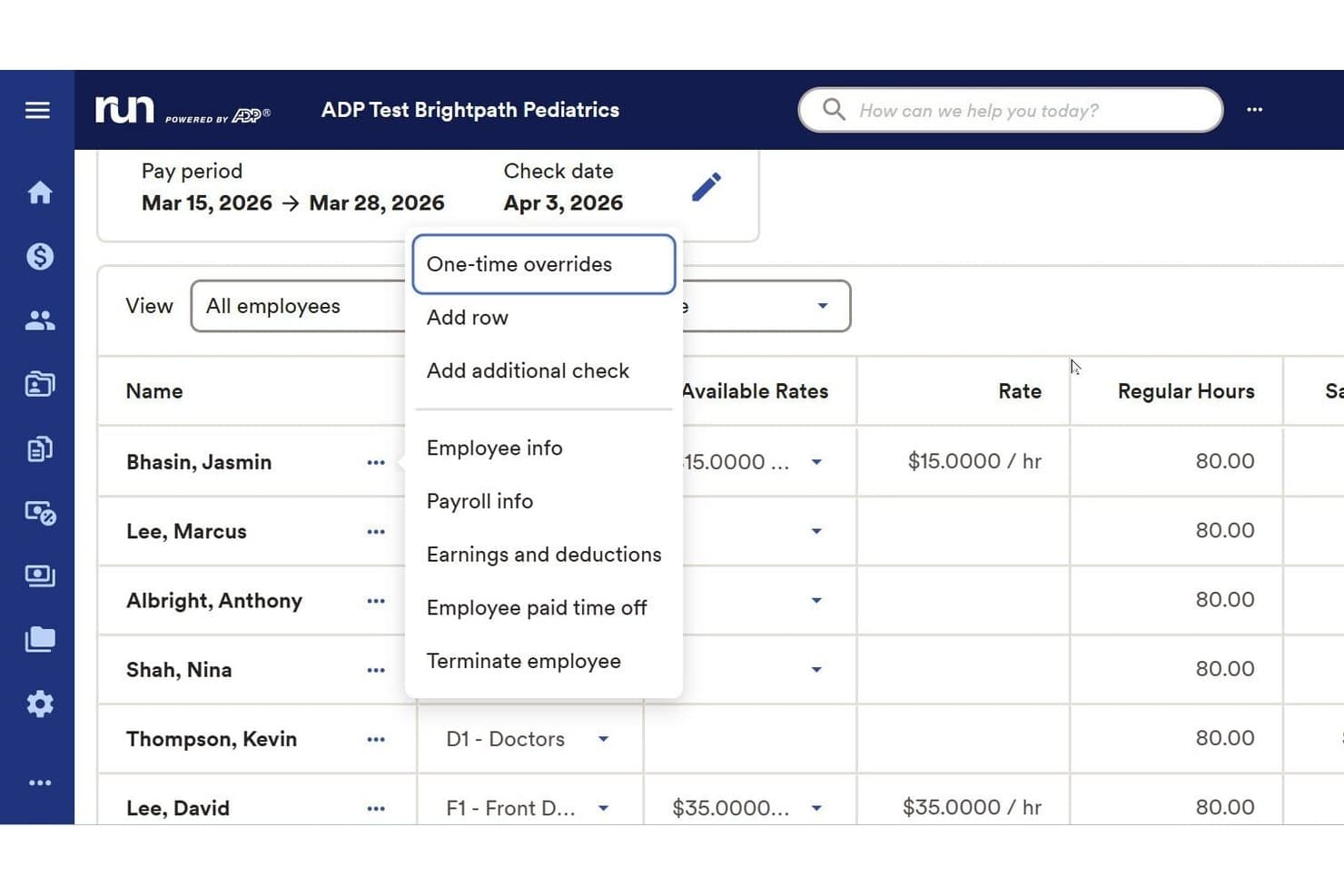
ADP Run payroll screen with one-time overrides and employee actions menu for a pay period. RUN Powered by ADP is a payroll and HR platform built for small businesses with employees, covering payroll processing, tax filing, new-hire onboarding, and contractor payments.
Who Is RUN Powered by ADP Best For?
RUN Powered by ADP is a strong fit for small business owners who are actively hiring and need payroll, tax filing, and HR tools to grow beyond a solo operation.
Why I Picked RUN Powered by ADP
I've included RUN Powered by ADP in my top picks because it's built for the moment a solo operator becomes an employer. When you're bringing on your first hire, RUN handles new-hire reporting, W-2 and 1099 filing, and multi-state payroll tax calculations automatically. I particularly like the new-hire onboarding flow, which lets employees complete their W-4, direct deposit details, and Form I-9 electronically before day one.
RUN Powered by ADP Key Features
- Multi-state payroll tax filing: RUN calculates, files, and deposits payroll taxes across multiple states and local jurisdictions automatically.
- Contractor payment bundle: Pay contractors and generate year-end 1099 forms through a dedicated contractor payment add-on.
- General Ledger Interface: Export payroll journal entries directly to QuickBooks, Xero, Wave, or Creative Solutions.
- ADP Assist™ payroll inspector: An AI-enabled tool that flags potential payroll errors before you submit each pay run.
ADP Run Integrations
RUN connects with QuickBooks, Xero, and Clover. Its General Ledger Interface also supports exports for Wave and Creative Solutions.
Pros and Cons
Pros:
- Supports contractor payments and 1099s
- Users value straightforward payroll setup
- Reviewers praise multi-state payroll handling
Cons:
- Sole proprietors must track draws separately
- Doesn’t calculate owners’ self-employment taxes
Learn more about ADP Run: Best for S-corp owners paying a W-2 salary
- Not available
- From $29 USD/month + $7/employee/month
Visit WebsiteCustomer Rating:4.3/5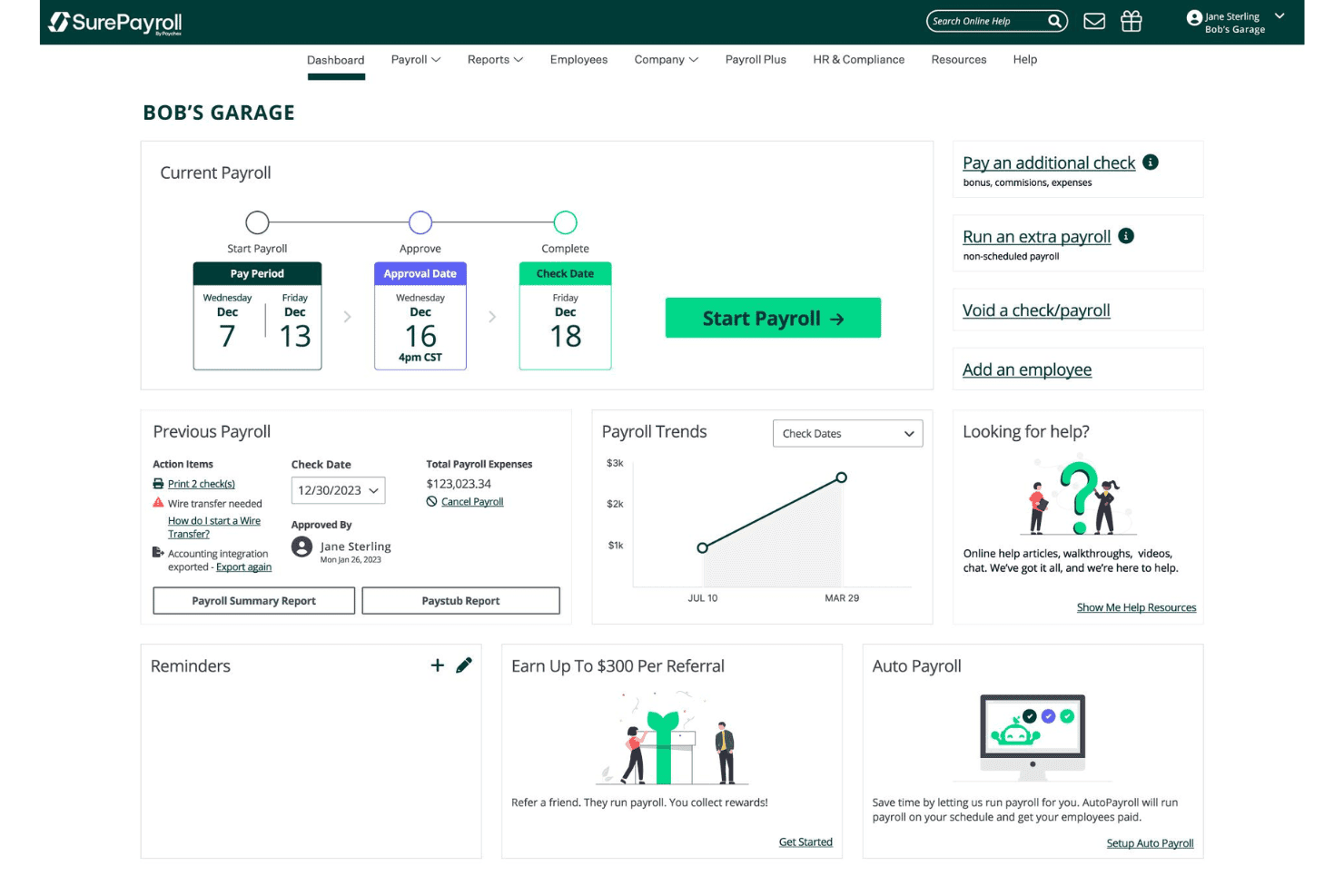
The SurePayroll dashboard shows current payroll steps, previous payroll status, and payroll trends at a glance. SurePayroll is a small business payroll platform that handles W-2 employee and 1099 contractor pay runs, automated payroll tax calculations, and federal and state tax filing—with a dedicated one-employee payroll option built around S-corp owner-employee scenarios.
Who Is SurePayroll Best For?
SurePayroll is a strong fit for S-corp owner-employees who need to pay themselves a consistent W-2 salary and have federal and state payroll taxes filed automatically.
Why I Picked SurePayroll
I picked SurePayroll as one of the best because it's one of the few payroll platforms with a dedicated one-employee setup built specifically around the S-corp owner-employee scenario. When you elect S-corp status and pay yourself a W-2 salary, SurePayroll calculates, withholds, and files your federal and state payroll taxes automatically, including quarterly Form 941 filings. It also handles direct deposit and year-end W-2s, so the paper trail required for S-corp compliance is covered in one place.
SurePayroll Key Features
- Automatic payroll scheduling: Set payroll to run on a recurring schedule so your W-2 salary goes out consistently without manual runs each pay period.
- 1099 contractor payments: Pay independent contractors alongside W-2 employees in the same account, with integrated 1099-NEC form preparation.
- Unlimited off-cycle payroll runs: Run bonus or correction payrolls at any time without extra charges beyond your standard monthly fee.
- Online payroll records access: View and download pay stubs, payroll reports, and tax filings from your account 24/7.
SurePayroll Integrations
SurePayroll integrates with stratustime for time tracking. Accounting and timeclock integration services are available as paid options.
Pros and Cons
Pros:
- Pays W-2 employees and 1099 contractors
- Payroll tax filings cover owner-employees
- Scheduled payroll supports S-corp owner salaries
Cons:
- Contractor deposits can snag with Tax IDs
- Self-employment tax isn’t calculated within payroll
Learn more about SurePayroll: Best for S Corp payroll and tax coordination
- Not available
- From $349 USD/month for the S Corp plan
Visit WebsiteCustomer Rating:5/5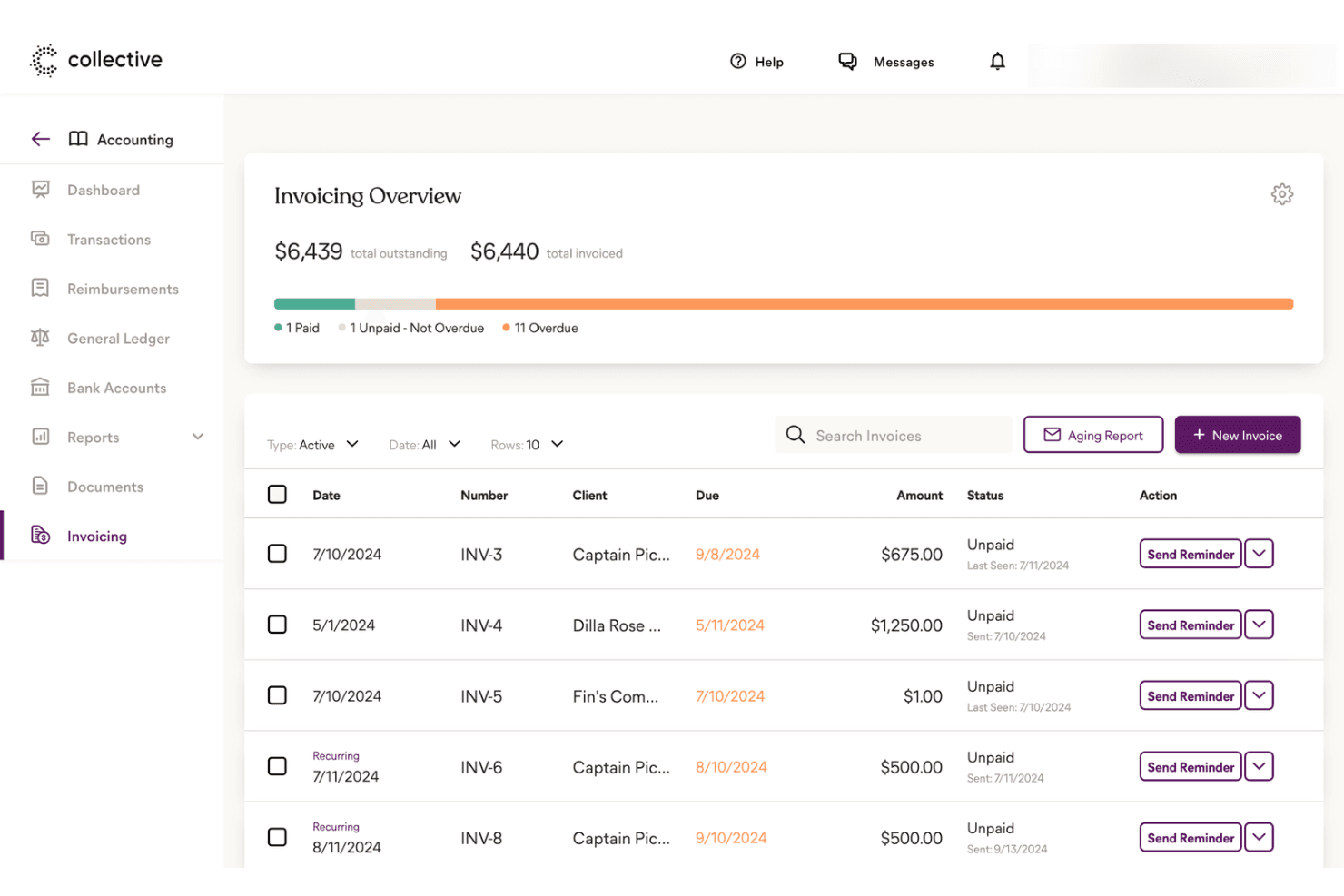
Collective's invoicing dashboard tracks outstanding and overdue invoices, with reminders and aging reports. Collective is a back-office membership platform for self-employed business owners that bundles S Corp formation, bookkeeping, payroll, tax filing, and contractor payments into a single subscription.
Who Is Collective Best For?
Collective is built for self-employed business owners running as an S Corp who want bookkeeping, payroll, and taxes handled under one membership.
Why I Picked Collective
Collective earns its spot on my shortlist because it's the only platform I've found that bundles S Corp payroll directly with bookkeeping and business tax filing under one membership. I particularly like the reasonable-compensation guidance, which helps S Corp owners set a compliant salary rather than guessing, and the payroll-to-books sync that automatically reconciles each payroll run with monthly financials. Contractor payments with 1099 generation are built into the same workflow, so there's no juggling separate tools at year-end.
Collective Key Features
- Automated monthly payroll: Set up recurring monthly payroll runs so your S Corp salary processes without manual intervention each pay period.
- State payroll registration: Collective registers your required state withholding and unemployment tax accounts so your payroll is compliant from the start.
- Employee W-2 payroll: Beyond paying yourself, the S Corp plan supports payroll for W-2 employees, with tax filings handled through Gusto.
- Invoice-to-books sync: Invoices created in Collective sync directly to your books, keeping your financial records current without manual data entry.
Collective Integrations
Collective uses Gusto to power payroll processing and connect payroll with its bookkeeping workflow.
Pros and Cons
Pros:
- Reviewers praise patient S Corp setup guidance
- Reasonable-salary guidance supports S Corp payroll
- Payroll runs reconcile into monthly books
Cons:
- Some reviewers report delayed human support
- Transaction misclassification can distort reported income
Learn more about Collective: Best for therapists' payroll and tax support
- No free trial available
- From $169/month (billed annually)
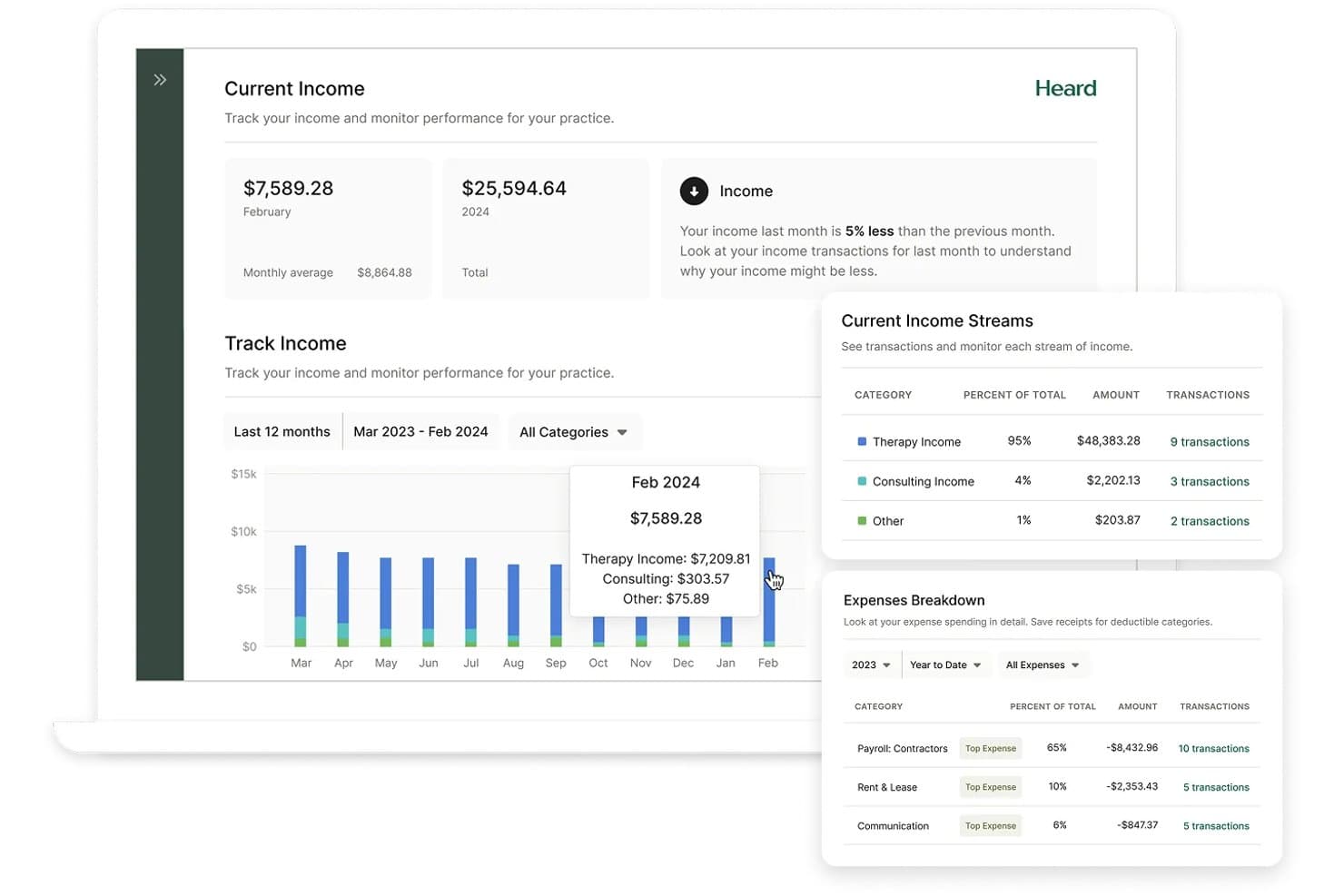
Heard's dashboard tracks monthly income, income streams, and top expense categories in one view. Heard is a done-for-you financial platform for therapists and wellness practitioners that combines bookkeeping, tax preparation and filing, and business banking, with payroll processing available as an optional paid add-on.
Who Is Heard Best For?
Heard is built specifically for therapists and wellness practitioners running solo or small private practices who want bookkeeping, taxes, and payroll handled in one place.
Why I Picked Heard
I picked Heard as one of the best because it's the only self-employed payroll software built specifically for therapists and wellness practitioners, bundling bookkeeping, tax filing, and Gusto-powered payroll under one roof. I love that S corp owners get quarterly salary and distribution guidance alongside payroll, so reasonable compensation stays compliant without hiring a separate CPA. The platform also files payroll taxes automatically each time payroll runs and generates W-2s and 1099s directly within the app.
Heard Key Features
- Profit allocation guide: View a built-in guide that recommends how to split practice income across taxes, savings, and owner pay each month.
- S corp reasonable salary guidance: Get quarterly reviews of your owner salary and distribution split to stay compliant with IRS reasonable compensation rules.
- Business banking with auto-categorization: Open separate checking and savings accounts where transactions are automatically sorted into therapist-specific tax categories.
- Tax document management: Store, organize, and receive automated reminders for tax filing deadlines and required documents directly within the platform.
Heard Integrations
Heard Payroll is powered by Gusto for payroll processing and payroll tax filing.
Pros and Cons
Pros:
- Contractor payments include 1099 generation
- Payroll taxes filed with each run
- Therapist-focused tax and bookkeeping support
Cons:
- Some users report delayed support responses
- Sole proprietors cannot run owner payroll
Learn more about Heard: Best for owner payroll across S-corp election
- Free trial + free demo available
- From $49 USD/month + $6/payroll recipient/month
Customer Rating:4.6/5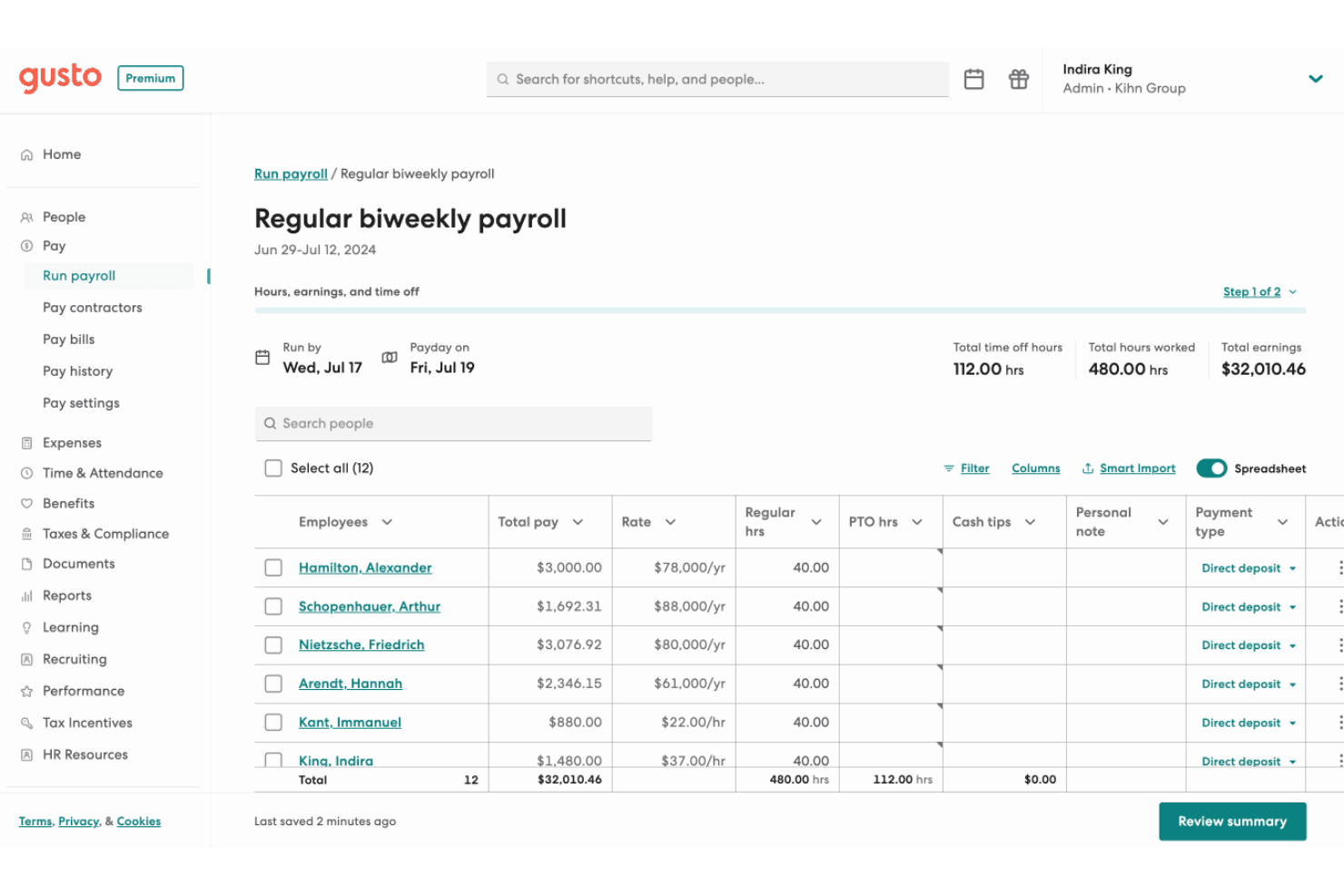
Gusto's payroll run screen lets admins review hours, earnings and time off before submitting biweekly payroll. Gusto is a payroll platform built for solopreneurs and small business owners that handles owner payroll, S-corp election setup, contractor payments, and automated federal and state tax filings.
Who Is Gusto Best For?
Sole proprietors generally take owner’s draws rather than pay themselves a W-2 salary. Owner payroll applies to qualifying corporate tax structures, such as S-corps, where owners can receive wages as employees of their business.
Why I Picked Gusto
I picked Gusto as one of the best because it's the only tool on my list with a dedicated owner-only payroll plan built specifically around S-corp election. The Solo plan includes a reasonable salary calculator that factors in your role, location, and business revenue, plus guided Form 2553 preparation with postage included. Automated quarterly payroll tax filings and W-2 generation mean the S-corp compliance side of owner payroll runs without manual intervention.
Gusto Key Features
- Payroll on AutoPilot: Automates recurring payroll runs so your owner salary processes on schedule without manual intervention each pay period.
- Domestic and global contractor payments: Pays contractors in the US and across 120+ countries directly through the platform, with integrated 1099 generation.
- Multi-state tax filing: Automatically calculates and files federal, state, and local payroll taxes, with state tax registration support across all 50 states.
- W-2 and 1099 generation: Produces and files both W-2s and 1099s automatically, with electronic copies delivered to recipients at year-end.
Gusto Integrations
Gusto integrates with Aplos, Bench, Bookkeeper360, and Betterment. Its App Integrations API supports approved app connections.
Pros and Cons
Pros:
- Reviewers praise straightforward recurring payroll runs
- Automated payroll taxes and W-2 filings
- Purpose-built S-corp owner payroll
Cons:
- Broader HR tools can clutter solo workflows
- No Schedule SE or personal estimated taxes
 Best for teams with employees and contractors
- Free demo available
- From $50 USD/month + $8/employee/month
Customer Rating:4.6/5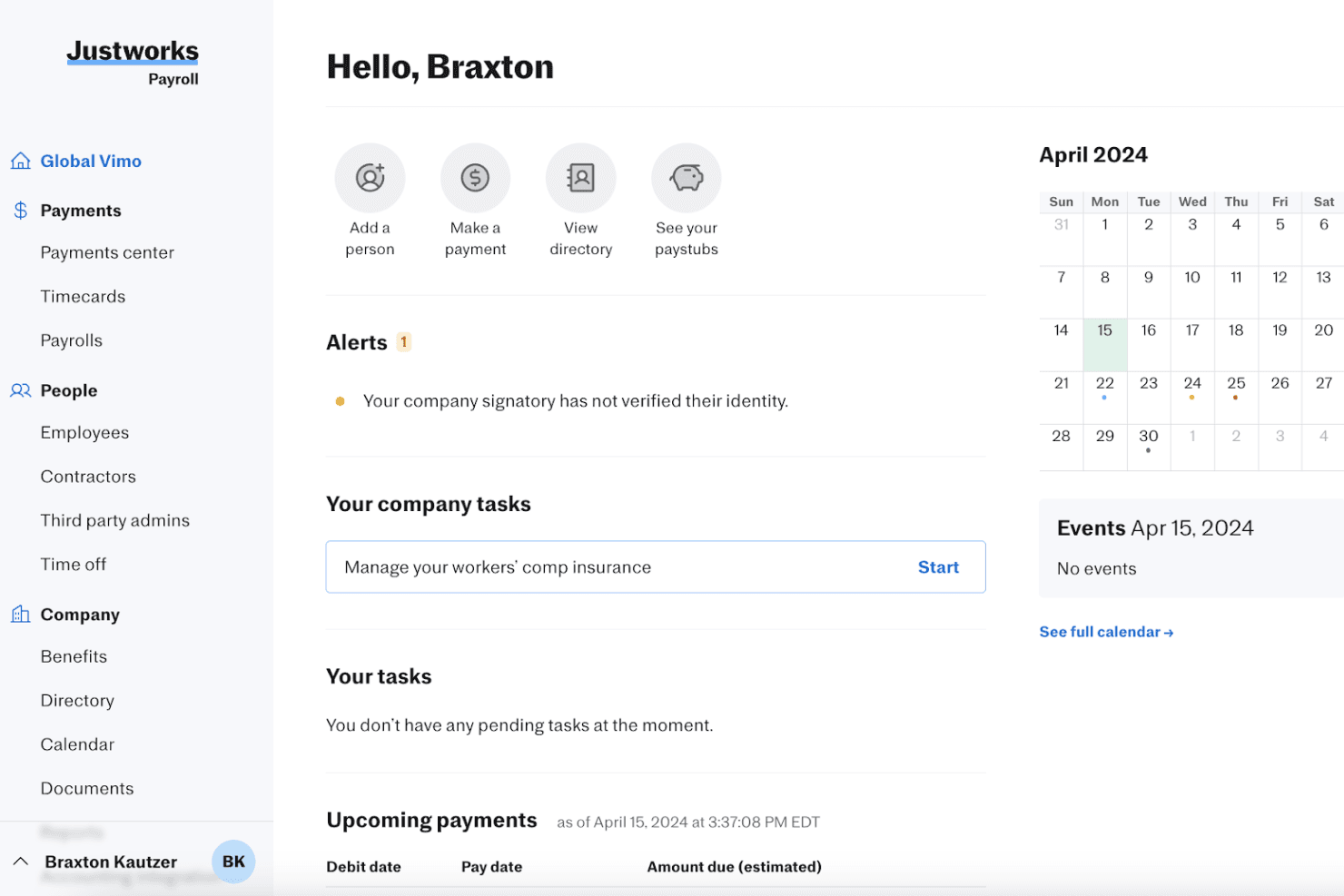
The Justworks Payroll dashboard, with quick actions, alerts, tasks, and upcoming payments in one view. Justworks Payroll is a small business payroll platform that handles employee and contractor payments, payroll tax filings, multi-state compliance, and HR tools like onboarding and document management. Time tracking is available as a paid add-on.
Who Is Justworks Best For?
Justworks Payroll works well for small businesses that pay a mix of W-2 employees and contractors and need multi-state tax compliance handled alongside HR tools like onboarding and document management.
Why I Picked Justworks
I've included Justworks in my top picks because it handles W-2 employee and contractor payments from the same platform, which is a real advantage when your team is a mix of both. I like that contractor payments extend to 60-plus countries alongside US-based payroll, and that multi-state tax filings and compliance alerts are built in rather than bolted on. It's the right fit when you need employee payroll and contractor management under one roof without juggling separate tools.
Justworks Key Features
- Payroll tax filing: Justworks files your federal and state payroll taxes, including W-2 and 1099 forms, on your behalf.
- Off-cycle payments: Run bonus, reimbursement, or owner draw payments outside of your regular payroll schedule at any time.
- Document Center: Store, organize, and access employee and company documents directly within the platform.
- Compliance alerts: Receive federal and state compliance notifications so you can stay ahead of regulatory changes.
Justworks Integrations
Justworks Payroll integrates with QuickBooks, Xero, and Brex.
Pros and Cons
Pros:
- Reviews praise straightforward payroll and onboarding
- Handles multi-state employer payroll filings
- Pays contractors alongside W-2 employees
Cons:
- Owner draws require manual off-cycle payments
- Doesn’t calculate self-employment taxes
Learn more about Justworks: Best for owner payroll with a solo 401(k)
- Free demo available
- Pricing upon request
Visit WebsiteCustomer Rating:4.2/5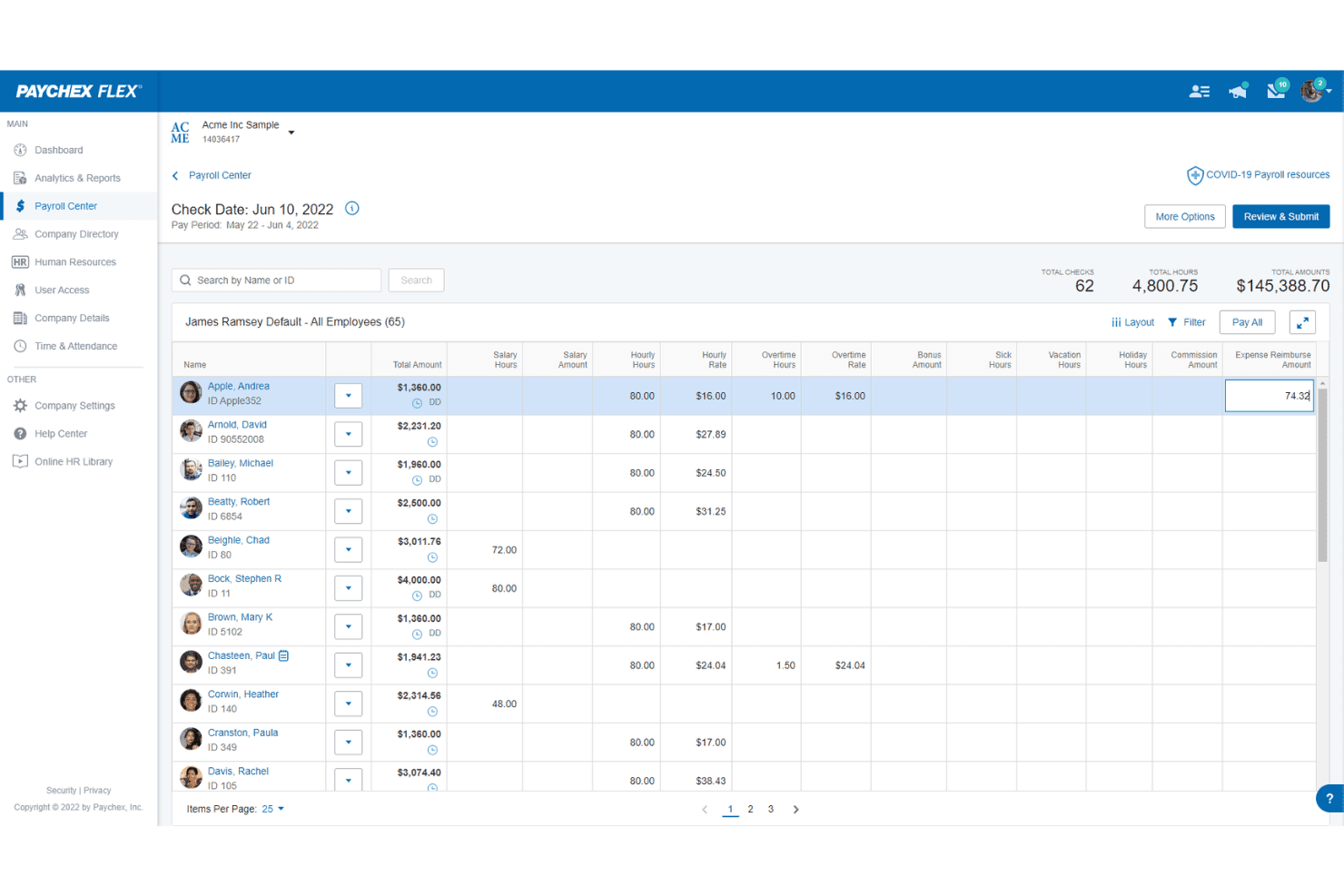
The Paychex Flex Payroll Center lists each employee's pay, hours and totals before payroll is reviewed and submitted. Paychex Flex is a payroll and HR platform built for businesses of all sizes, including owner-only businesses, that handles payroll processing, payroll tax administration, and retirement plan integration for self-employed owners.
Who Is Paychex Flex Best For?
Paychex Flex is a strong fit for incorporated sole proprietors and S-corp owners who want to run owner payroll and pair it with a solo 401(k) on a single platform.
Why I Picked Paychex Flex
I picked Paychex Flex as one of the best because it's one of the few payroll platforms that directly pairs owner payroll with a solo 401(k) in a single setup. If you're running an incorporated sole proprietorship or S-corp, Paychex lets you run payroll for yourself as an employee of your own business, handle federal and state payroll tax withholding automatically, and funnel pre-tax contributions straight into a solo 401(k) without juggling separate systems.
Paychex Flex Key Features
- Multi-state payroll tax administration: Automatically calculates, withholds, files, and remits federal, state, and local payroll taxes across every state where you work.
- Direct deposit and pay card support: Pay yourself via direct deposit, paper check, or pay card, depending on what works best for your setup.
- Year-end tax form access: Generates and provides digital W-2 and 1099 forms through the platform so your records are ready at tax time.
- Employee self-service mobile app: Access pay stubs, tax forms, and direct deposit details from iOS or Android without contacting support.
Paychex Flex Integrations
Paychex Flex integrates with QuickBooks Online, Xero, and Sage Intacct. Paychex also supports API-based connections.
Pros and Cons
Pros:
- Reviewers praise straightforward payroll processing
- Automatic multi-state payroll tax filing
- Solo 401(k) contributions pair with owner payroll
Cons:
- Reviewers report delays resolving support issues
- Self-employment tax calculations aren’t clearly documented
Learn more about Paychex Flex: Best for QuickBooks users paying contractors
- 30-day free trial + Free demo available
- From $50 USD/month + $7/employee/month
Visit WebsiteCustomer Rating:4.4/5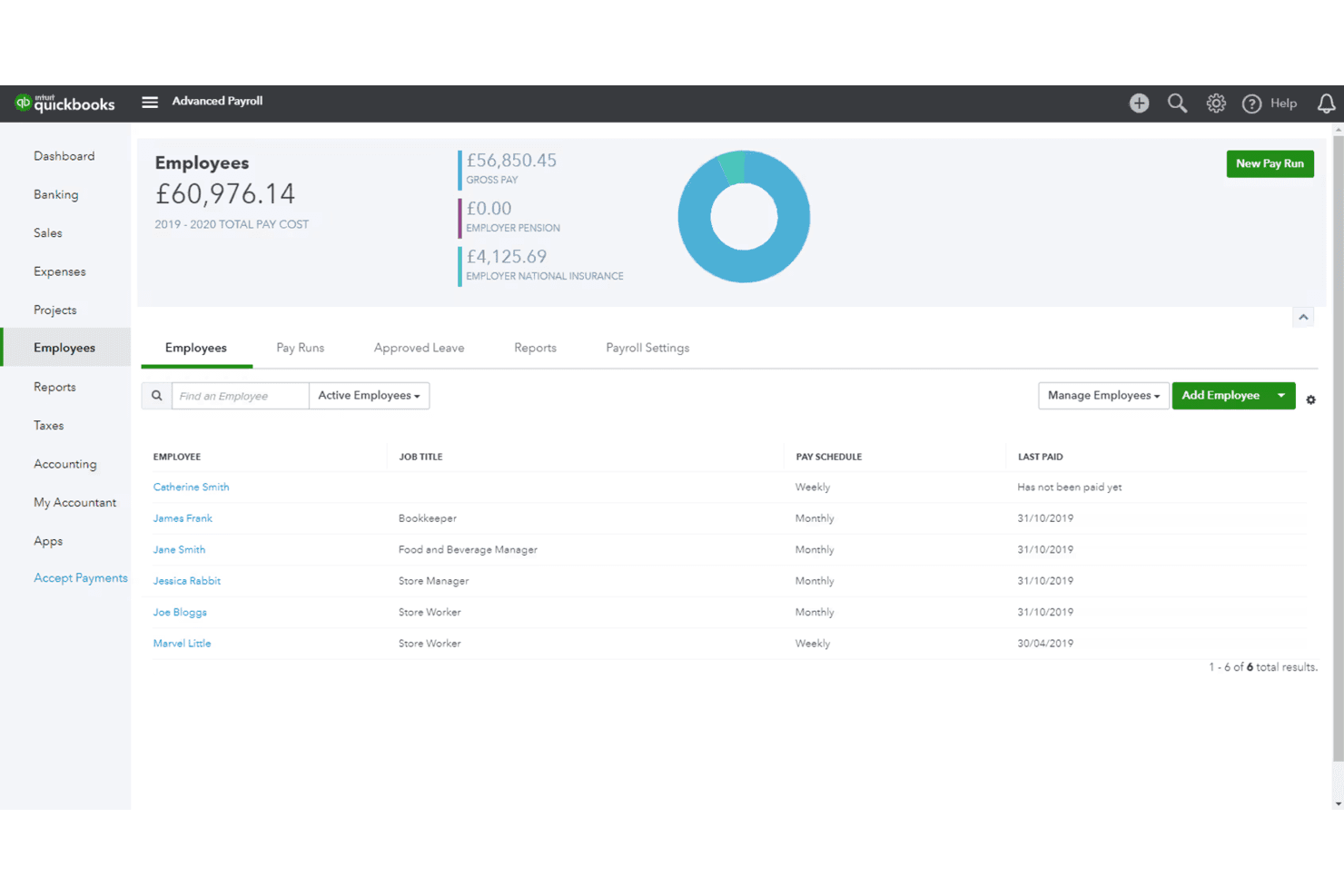
The Employees screen in QuickBooks Payroll lists staff with their job titles, pay schedules and last paid dates. QuickBooks Payroll is a full-service payroll platform that handles payroll tax calculation, filing, and payment, plus contractor 1099 e-filing, direct deposit, and employee HR tools.
Who Is QuickBooks Payroll Best For?
QuickBooks Payroll is a natural fit for small business owners who already use QuickBooks Online and need to pay both W-2 employees and 1099 contractors from one place.
Why I Picked QuickBooks Payroll
I picked QuickBooks Payroll for this list because, if you're already running your books in QuickBooks Online, the payroll and accounting data sync natively, so contractor payments post directly to your general ledger without manual reconciliation. What I really like is the unlimited 1099-MISC and 1099-NEC e-filing built into every plan, which means you can pay as many contractors as your business needs and file their forms directly with the IRS from the same dashboard.
QuickBooks Payroll Key Features
- Full-service payroll tax filing: Calculates, files, and pays federal and state payroll taxes automatically, covering garnishments and deductions in every plan.
- Auto payroll: Runs payroll automatically for eligible salaried employees on direct deposit, flagging the run for your review before paychecks go out.
- Next-day direct deposit: Sends contractor and employee payments via direct deposit as quickly as the next business day on the base plan, with same-day deposit on higher tiers.
- Payroll Agent: Collects employee time and attendance data, scans for inconsistencies, and prepares a draft payroll for your approval via SMS or the Workforce app.
QuickBooks Payroll Integrations
QuickBooks Payroll connects with QuickBooks Online and offers integrations with Allstate, Vestwell, NEXT, and Checkr.
Pros and Cons
Pros:
- Users praise straightforward payroll runs
- Payroll taxes calculate, file, and pay automatically
- Unlimited 1099 e-filing accompanies contractor payments
Cons:
- No clear owner self-pay workflow
- No documented self-employment tax calculations
Learn more about QuickBooks Payroll: Best for paying yourself and contractors
- Free trial + free demo available
- From $49 USD/month + $6/worker/month
Visit WebsiteCustomer Rating:5/5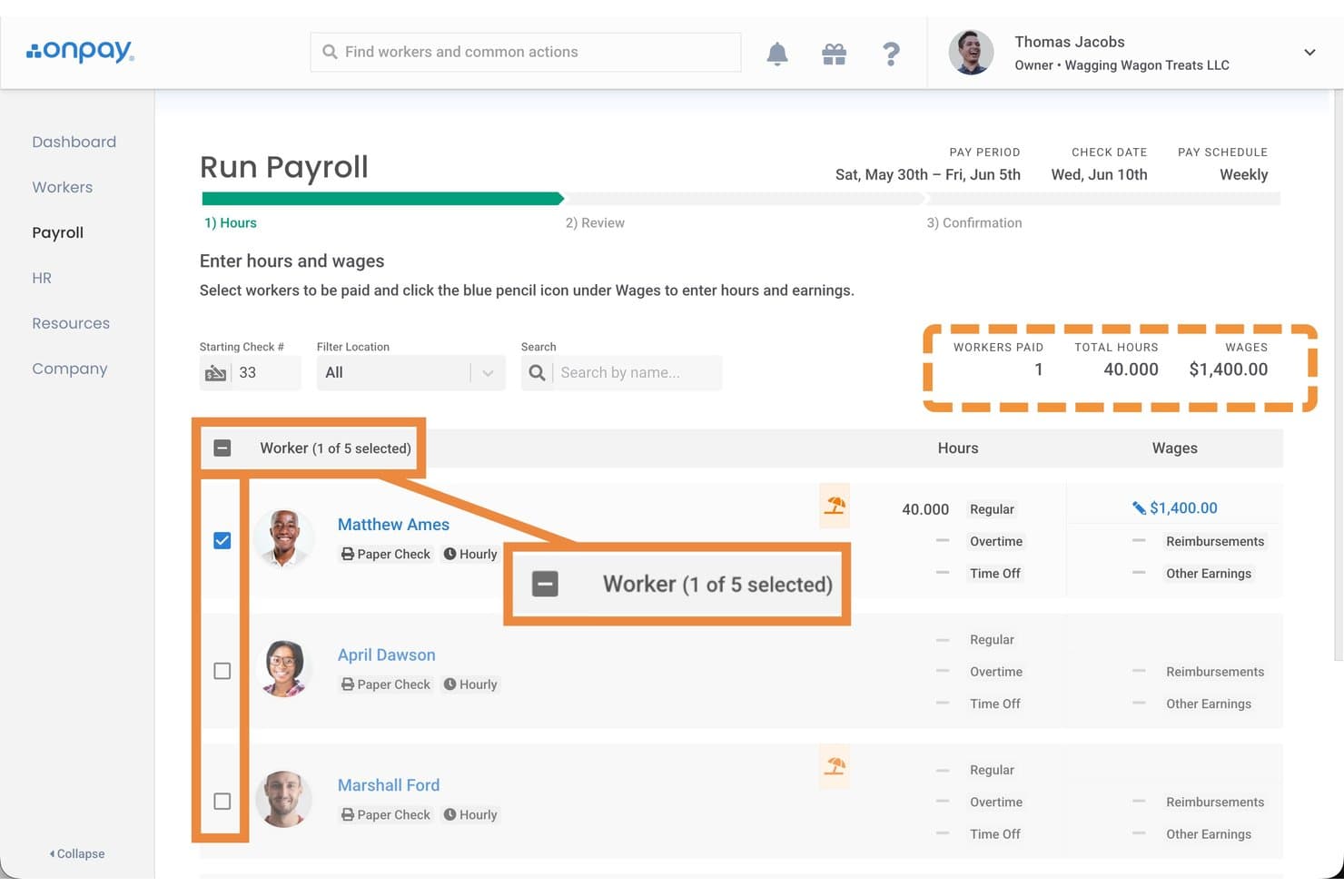
OnPay's Run Payroll screen, where users select workers and enter hours and wages for each pay period. OnPay is a full-service payroll platform that handles owner payroll, W-2 and 1099 contractor payments, automated tax filings, and multi-state compliance for small and solo businesses.
Who Is OnPay Best For?
OnPay is a strong fit for S-corp owners who need to pay themselves a regular W-2 salary, as well as sole proprietors who need to manage employee and contractor payments.
Why I Picked OnPay
I picked OnPay as one of the best because it has a dedicated owner-payroll workflow that lets you set your own federal and state income-tax withholding and lock in a reasonable compensation amount in just a few clicks. I also like that W-2 and 1099 contractor payments run in the same payroll, so you can pay a freelance designer alongside your own salary without juggling separate tools. Automated quarterly and year-end filings, including blank filings for low-activity periods, round out the solo-business use case well.
OnPay Key Features
- Multi-state payroll compliance: OnPay calculates and files federal, state, and local taxes across all 50 states, including automatic state tax registrations.
- Custom payroll report designer: Build and save custom payroll reports using more than 50 data fields, with real-time filtering and PDF or spreadsheet export.
- Employee self-service portal: Employees can log in to view and download their own pay stubs and tax documents at any time.
- PTO accrual policy management: Set custom PTO accrual rules and let OnPay calculate balances automatically with each payroll run.
OnPay Integrations
OnPay integrates with QuickBooks Online, Xero, QuickBooks Time, Deputy, and When I Work. It also lists Middesk for state tax registration.
Pros and Cons
Pros:
- Reviewers praise responsive onboarding support
- Contractors share owner payroll runs
- Owner payroll supports adjustable tax withholding
Cons:
- Inactive months cannot pause accounts
- No dedicated self-employment tax calculations
 Best for multi-state staff and contractor pay
- 30-day free trial + Free demo available
- From $37 USD/month + $5/worker/month
Visit WebsiteCustomer Rating:5/5
Patriot Payroll's Employee Info page, showing personal, contact, work and demographic details for an employee. Patriot Payroll is a small business payroll platform that handles W-2 employee and contractor payments, payroll tax calculations, 1099 generation, and direct deposit. Its Basic Payroll plan calculates payroll taxes, while the Full Service Payroll plan also handles tax filings and payments.
Who Is Patriot Payroll Best For?
Patriot Payroll is a strong fit for small business owners who need to pay a mix of W-2 employees and contractors across multiple states without paying enterprise-level prices.
Why I Picked Patriot Payroll
I've included Patriot Payroll in my top picks because it handles multi-state W-2 and contractor payroll in a single run, which is exactly what small business owners with staff spread across states need. Full Service Payroll automatically files and deposits federal, state, and local taxes across all 50 states, and 1099 generation with e-filing is built right into the contractor workflow.
Patriot Payroll Key Features
- Auto payroll: Set up recurring payroll runs for salaried or hourly workers, with advance notifications before each scheduled run processes.
- S-corp health insurance handling: Add company-paid health premiums for shareholders owning more than 2% directly to their W-2s.
- Employee and contractor self-service portal: Let workers view pay stubs, manage direct deposit details, and access tax forms without contacting you.
- Net-to-gross payroll calculation: Enter a target take-home amount and Patriot calculates the gross pay needed to cover taxes and deductions.
Patriot Payroll Integrations
Patriot Payroll connects with Patriot Accounting and QuickBooks Online, with export support for QuickBooks Desktop. It also integrates with SimplyInsured, Vestwell, and ERGO NEXT.
Pros and Cons
Pros:
- Multi-state payroll tax filings cover all states
- Contractor payments and 1099 filing together
- S-corp owners report straightforward monthly payroll
Cons:
- Standard direct deposit needs four-day lead time
- No self-employment tax or Schedule SE calculation
Learn more about Patriot Payroll:
Otros programas de nóminas para autónomos
Aquí tienes algunas opciones más que no entraron en mi selección, pero que merece la pena consultar:
- 11FreshBooksBest for freelancers linking books and payroll
- 12MelioBest for contractor payouts and 1099 filing
- 13Square PayrollBest for Square sellers with tipped staff
- 14Wave PayrollBest for Wave users keeping payroll in books
- 15XeroBest for solo businesses adding staff payroll
- 16WagepointBest for Canadian employee and contractor pay
- 17Roll by ADPBest for paying staff and contractors together
- 18Payroll MateBest for payroll across multiple companies
- 19Payroll4FreeBest for free monthly pay for up to nine people
- 20FoundBest for freelancer banking and tax tracking
How I Evaluate Self-Employed Payroll Software
I split my evaluation into three parts. First, core functionality: the tool must calculate self-employment taxes automatically and support owner payroll runs—this carries the most weight. Second, I look for standout features like owner's draw versus salary guidance. Third, I consider support access, onboarding clarity, and pricing transparency.
Core Functionality (Table Stakes for This List)
When I'm selecting tools for my list, I score each one on a scale from 0 (does not offer the functionality) to 5 (excels in this area) for each core functionality listed below. I then convert the total into a percentage to help assess each tool's overall fit, with extra weight on any functionalities I've deemed essential.
- Self-Employment Tax Calculation (Essential): I check whether the tool calculates Social Security and Medicare obligations for owners and adjusts as income changes throughout the year.
- Owner Payroll Processing (Essential): I evaluate how well each tool handles owner pay runs, including whether it adapts to different structures like S-corp salary or owner's draw.
- Tax Form Filing Support: Tools that generate and e-file forms like 1099s and quarterly estimates score higher than those that only pre-fill templates for manual submission.
- Direct Deposit or Disbursement: I look at deposit speed, scheduling flexibility, and whether the tool supports electronic payments for both owner and contractor payouts.
- Multi-State and Federal Compliance: Each tool's ability to apply and update the correct federal and state tax rates matters, especially for owners who work or hire across state lines.
- Contractor Payment Management: I evaluate whether contractor payments and 1099 tracking live in the same workflow as owner payroll or require a separate process.
Once I have a list of tools that meet the criteria, I consider what sets each platform apart.
Differentiating Factors (What Sets Vendors Apart)
Here's how I compare and contrast different vendors:
Standout Features
I look for integrated bookkeeping sync because it eliminates double entry between payroll and your books. Tools like Gusto and QuickBooks Payroll handle this differently, so I check whether the sync is native or requires a connector. Quarterly tax savings automation matters too—especially for owners who owe estimated taxes and want funds set aside automatically. I also evaluate whether a tool offers owner's draw versus salary guidance, since S-corp owners need clarity on how to split compensation for tax purposes.
Beyond Features
I check whether pricing stays predictable as you move from solo owner payroll to adding a contractor or W-2 employee—tools like Gusto and OnPay handle that scaling differently. Onboarding clarity matters just as much, since most self-employed owners aren't payroll specialists and need plain-language setup wizards to avoid costly misclassifications. I also evaluate how well each tool connects to accounting platforms and business bank accounts, because a direct sync between payroll and your books cuts reconciliation work during tax season.
Cómo elegir un programa de nóminas para autónomos
Elige el programa haciendo coincidir tu estructura de pagos y tus responsabilidades fiscales con lo que el proveedor procesará, presentará y documentará.
| Si tu prioridad es | Busca |
|---|---|
| Si tu prioridad esPagarte un salario | BuscaNóminas del propietario compatibles con la estructura de tu empresa y que registren cada ejecución de nómina |
| Si tu prioridad esPagar a contratistas | BuscaPagos a contratistas, formularios fiscales de final de año y responsabilidades de presentación en un mismo flujo de trabajo |
| Si tu prioridad esGestionar las obligaciones fiscales | BuscaGestión clara de los impuestos sobre las nóminas, los impuestos estimados y las presentaciones obligatorias |
| Si tu prioridad esAñadir trabajadores en distintas ubicaciones | BuscaConfiguración de los impuestos estatales y responsabilidades de cumplimiento documentadas para cada ubicación de trabajo |
Cómo evaluar tu selección
- Prueba una ejecución de nómina del propietario: Utiliza una prueba o demostración para introducir una nómina del propietario y, después, pide al proveedor que explique el recibo de nómina resultante y los cálculos fiscales.
- Solicita un paquete fiscal de muestra: Pide un paquete de final de año con los datos confidenciales ocultos que muestre qué formularios prepara y presenta el proveedor, y cuáles quedan a tu cargo.
- Abre una consulta sobre un supuesto: Pregunta cómo gestiona el proveedor el cambio de retiradas del propietario a salario y guarda su respuesta por escrito y el número de la consulta.
- Solicita un presupuesto de crecimiento: Pide un cálculo por escrito para un propietario, un contratista y un empleado adicional, con cada cuota periódica y de presentación desglosada.
- Elige el equilibrio que prefieras: Compara un servicio exclusivamente de nóminas con un proveedor que coordine el trabajo de nóminas y fiscalidad; utiliza la lista escrita de responsabilidades para decidir si se adapta mejor a tus necesidades un alcance de servicio más limitado o una asistencia integral.
¿Qué es un programa de nóminas para autónomos?
Los programas de nóminas para autónomos ayudan a los propietarios de empresas a pagarse a sí mismos y a sus trabajadores, calcular los impuestos sobre las nóminas y conservar los registros de pagos. Las funciones adecuadas dependen de la estructura de tu empresa: el propietario de una sociedad S puede necesitar gestionar una nómina W-2, mientras que un empresario individual normalmente realiza retiradas en lugar de percibir un salario. Algunas herramientas también admiten pagos a contratistas, formularios fiscales y presentaciones de impuestos sobre las nóminas.
Funciones
Estas son las principales funciones que busco en un programa de nóminas para autónomos:
- Procesamiento de nóminas del propietario: Permite gestionar tu propia remuneración en función de la estructura de tu empresa. Por ejemplo, un propietario que necesita un salario puede registrar nóminas, mientras que uno que recibe retiradas necesita una herramienta que mantenga esas operaciones diferenciadas de los salarios de los empleados.
- Cálculo de impuestos sobre nóminas: Calcula los impuestos aplicables sobre las nóminas utilizando los importes pagados y los datos de los trabajadores. Comprueba si gestiona los impuestos de los propietarios y los empleados por separado, ya que su tratamiento fiscal puede ser diferente.
- Ayuda con la presentación y el pago de impuestos: Prepara, presenta o te ayuda a realizar el seguimiento de las declaraciones y los pagos de impuestos sobre nóminas necesarios. Confirma qué pasos gestiona el proveedor y cuáles siguen siendo responsabilidad tuya.
- Pagos a contratistas y formularios fiscales: Registra los pagos a contratistas y permite realizar las declaraciones fiscales obligatorias de final de año. Esto mantiene los pagos a contratistas separados de las nóminas de los empleados y aclara si el software prepara o presenta los formularios.
- Ingreso directo y programación de pagos: Envía los salarios por vía electrónica y permite programar las fechas de pago. Comprueba los plazos de procesamiento y si los pagos a contratistas y propietarios utilizan las mismas opciones de pago.
- Registros e informes de pagos: Guarda los detalles de las nóminas y proporciona informes o recibos de salarios que puedes consultar más adelante. Estos registros te ayudan a conciliar las nóminas, responder a las preguntas de los trabajadores y prepararte para las declaraciones fiscales.
- Configuración fiscal basada en la ubicación: Aplica las normas fiscales pertinentes en función del lugar donde operan tu empresa y tus trabajadores. Revisa las ubicaciones compatibles y confirma cómo gestiona el software los cambios cuando tú o un trabajador os trasladáis.
- Conexiones contables: Transfiere los datos de las nóminas a un sistema contable conectado, directamente o mediante un conector. Comprueba qué detalles de pagos, impuestos y gastos se sincronizan para saber qué debes introducir manualmente.
Ventajas
El software de nóminas para autónomos puede ayudarte a gestionar la remuneración del propietario y las tareas fiscales, con ventajas como las siguientes:
- Cálculos fiscales: Las funciones de cálculo fiscal pueden estimar los impuestos aplicables sobre el trabajo por cuenta propia o las nóminas a partir de los ingresos y los detalles de los pagos.
- Registros de pagos del propietario: Las herramientas de nóminas para propietarios registran las nóminas salariales por separado de las retiradas, lo que te ayuda a mantener registros adecuados para la estructura de tu empresa.
- Ayuda con las declaraciones fiscales: Las funciones de presentación pueden preparar o enviar formularios y pagos de nóminas, al tiempo que aclaran qué tareas fiscales siguen siendo responsabilidad tuya.
- Gestión de contratistas: El seguimiento de los pagos a contratistas y los formularios fiscales de final de año mantienen los pagos a trabajadores y los datos de las declaraciones en un único flujo de trabajo.
- Pagos electrónicos: El ingreso directo y la programación de pagos permiten enviar electrónicamente los pagos a propietarios o trabajadores cuando estas opciones son compatibles.
- Configuración fiscal basada en la ubicación: La configuración de los impuestos estatales y federales ayuda a aplicar las normas pertinentes a las ubicaciones de tu empresa y tus trabajadores.
- Registros contables: Las conexiones contables pueden transferir los detalles de las nóminas a tus libros contables, reduciendo la introducción manual durante la conciliación.
Precios
El coste del software de nóminas para autónomos depende de la estructura de tu empresa, del número de trabajadores y del nivel de ayuda con las declaraciones fiscales que necesites. La siguiente tabla proporciona precios orientativos en USD basados en las tarifas publicadas por los proveedores.
Tabla comparativa de planes de software de nóminas para autónomos
| Prueba gratuita o demostración | $0 | Acceso temporal o demostraciones del producto, según el proveedor. |
| Nóminas básicas | Desde $17/mes + $4/trabajador/mes | Procesamiento de nóminas, ingreso directo y cálculos fiscales. |
| Nóminas con servicio completo | Desde $37/mes + $5/trabajador/mes | Presentación automatizada de impuestos sobre nóminas, pagos y formularios fiscales de final de año. |
| Nóminas del propietario de una S-Corp | Desde $49/mes + $6/beneficiario de nómina/mes | Procesamiento del salario del propietario, presentación de impuestos sobre nóminas y generación del formulario W-2. |
| Servicios financieros integrales | Desde $349/mes | Contabilidad, presentación de impuestos empresariales y ayuda con las nóminas de una S-Corp. |
Pueden aplicarse tarifas adicionales por las declaraciones en varios estados, los servicios opcionales y otros complementos.
Preguntas frecuentes
Aquí encontrarás respuestas a preguntas frecuentes sobre el software de nóminas para trabajadores por cuenta propia:
¿Necesito software de nóminas si trabajo por cuenta propia?
No siempre. Si eres empresario individual o una LLC unipersonal que tributa como empresa individual, por lo general retiras fondos del propietario en lugar de pagarte mediante una nómina W-2. El software de nóminas también puede ser útil si pagas a empleados o contratistas. Si tu empresa tributa como una corporación S, normalmente tendrás que gestionar tu propia nómina como empleado. Adapta el software a tu estructura fiscal y confirma tus obligaciones con un profesional fiscal antes de establecer la forma de pagarte.
¿Puedo pagarme un sueldo como empresario individual?
No, por lo general un empresario individual no puede pagarse un sueldo W-2 desde su propia empresa. Retira fondos, que no son salarios y no llevan retenciones de impuestos sobre la nómina como el sueldo de un empleado. Los beneficios de la empresa pueden seguir estando sujetos al impuesto sobre la renta y al impuesto sobre el trabajo por cuenta propia. Si has optado por tributar como una corporación S, las normas son distintas: el propietario que trabaja en la empresa normalmente debe recibir una remuneración razonable a través de la nómina. Comprueba la forma jurídica y la situación fiscal de tu empresa antes de elegir un proceso de nóminas.
¿El software de nóminas gestiona los impuestos trimestrales estimados?
Algunas herramientas de nóminas ayudan a calcular o reservar fondos para los impuestos estimados, pero la presentación de los impuestos sobre la nómina y los pagos estimados del impuesto sobre la renta son tareas distintas. El software de nóminas puede retener y pagar los impuestos asociados a los salarios de los empleados, pero es posible que aún tengas que realizar pagos estimados sobre los ingresos de la empresa. Pregunta al proveedor qué impuestos calcula, paga o presenta, y qué tareas siguen siendo responsabilidad tuya. Antes de confiar en una estimación, compárala con el conjunto de tus ingresos y tu situación fiscal con la ayuda de un profesional fiscal.
¿Cuál es la diferencia entre el impuesto sobre el trabajo por cuenta propia y los impuestos sobre la nómina?
El impuesto sobre el trabajo por cuenta propia suele incluir los impuestos de la Seguridad Social y Medicare sobre los ingresos netos del trabajo por cuenta propia. Los impuestos sobre la nómina son impuestos asociados a los salarios de los empleados, incluidos los importes retenidos al empleado y los importes que paga el empleador. La estructura de tu empresa determina qué normas se aplican: las retiradas de fondos de un empresario individual no son salarios, mientras que el propietario de una corporación S que trabaja en la empresa normalmente recibe un salario a través de la nómina. Comprueba que la herramienta distinga entre retiradas del propietario, salarios y pagos a contratistas, en lugar de tratar todos los pagos de la misma manera.