Wat we verkeerd begrijpen over diversiteit, gelijkwaardigheid en inclusie

Wat kunnen leiders doen om het voortouw te nemen en inclusieve werkculturen te creëren die divers en gelijkwaardig zijn?
In deze aflevering praat presentator Becca Banyard met Judith Germain—leiderschapsconsultant bij The Maverick Paradox—over de veelvoorkomende uitdagingen waarmee organisaties worden geconfronteerd bij het implementeren van DE&I-initiatieven, hoe leiders culturen van verbondenheid kunnen creëren en wat bedrijven kunnen doen om ervoor te zorgen dat DE&I niet slechts een meetwaarde wordt.
Hoogtepunten uit het interview
- Judiths achtergrond [1:00]
- Leiderschapsconsultant bij De Maverick-paradox
- Ze helpt heldere denkers en besluitvaardige leiders te creëren.
- Ze heeft een achtergrond als hoofd HR en werkt sinds 2005 voor zichzelf.
- Auteur van De Maverick-paradox: De geheime kracht achter succesvolle leiders
- Hoe legt DE&I de basis voor het succes van een organisatie? [1:23]
- Hoe diverser de teams die je hebt, hoe slimmer de organisatie, omdat dit innovatie, meer creativiteit en verschillende perspectieven mogelijk maakt.
- Zorg voor cognitieve diversiteit: mensen van verschillende scholen, die in verschillende gebieden en verschillende landen wonen, met verschillende perspectieven.
- Hoe kunnen organisaties neurodivers talent aantrekken en aannemen? [3:01]
- Dat doen ze al — ze weten het alleen niet.
- Het kan erg onveilig voelen om te vertellen dat je neurodivers bent, omdat mensen zulke vastgeroeste stereotypen hebben.
- Werving is niet het probleem, maar het behouden van medewerkers.
- Hoe kunnen organisaties die meer neurodivers talent en ondervertegenwoordigde groepen willen behouden, hun cultuur zo vormgeven dat deze personen worden ondersteund en kunnen slagen en floreren binnen de organisatie? [3:54]
- Het draait allemaal om begrijpen wat cultuur is.
- Jarenlang definieerden mensen cultuur als: wat doen we hier? Nu gaat het om twee dingen: wat doen we hier en wie zijn we hier?
- Zorg ervoor dat je een cultuur van verbondenheid opbouwt, zodat iedereen het gevoel heeft dat diegene zichzelf volledig, of zoveel daarvan als gewenst, mee naar het werk kan nemen.
- Zorg er daarom voor dat we open zijn en een omgeving creëren waarin veel stemmen mee kunnen spreken bij het nemen van beslissingen.
- Hoe hoger je komt, hoe minder diversiteit er is — dat betekent dat beslissingen worden genomen door mensen die niet naar verschillende perspectieven luisteren.
- Praktische manieren waarop organisaties en hun leiderschap in hun werkwijze meer ruimte kunnen creëren zodat alle stemmen worden gehoord [5:40]
- Geef het goede voorbeeld — zorg voor een zeer duidelijke visie en heldere waarden, en zorg ervoor dat de beleidsregels en werkwijzen binnen de organisatie deze ondersteunen.
- Externe hulp inschakelen is echt essentieel — vaak kan diversiteit lastig zijn voor HR, dus kan het nuttig zijn om iemand van buitenaf te laten komen die de inspanningen van HR kan ondersteunen.
- Voorbeelden die Judith heeft gezien van organisaties die diversiteit, gelijkwaardigheid en inclusie hebben geïmplementeerd of ondersteuning hebben ingeschakeld en verbeterd binnen hun organisatie [7:31]
- Er was een liefdadigheidsorganisatie met een bestuur dat inzag dat de mensen die zij bedienden uit een diverse mix bestonden, maar dat dit niet gold voor de mensen die leidinggaven.
- Ze organiseerden bewustwordingstrainingen en richtten zich vooral op werving en het behouden van medewerkers. Daarna startten ze een opleidingsprogramma voor hun organisatie.
- Nu hebben ze een zeer goede mix van mensen die zij bedienen en leiderschap binnen de organisatie.
- Wat zegt het wanbeheer van diversiteit, gelijkwaardigheid en inclusie over een organisatie en haar leiderschap? [9:10]
- Dat ze geen leiding kunnen geven.
- Je taak als leider moet onder meer zijn om het beste uit iedereen te halen en de klant zo goed mogelijk te bedienen.
- Waarom zou je diversiteit niet ondersteunen, als dat zou betekenen dat je de mentale gezondheidsproblemen binnen je organisatie vergroot? Je vermindert het vermogen om te innoveren. Dat is slecht leiderschap.
- Judiths aanbeveling aan leiders over hoe zij beter kunnen worden in het managen van diversiteit, gelijkwaardigheid en inclusie binnen hun organisatie [10:35]
- Zelfreflectie, waarbij je naar de organisatiecultuur kijkt
- Praten met vertrouwde medewerkers, collega’s, potentiële klanten — om te horen wat hun gedachten zijn
- Wat zijn enkele van de huidige uitdagingen waarmee leiders worden geconfronteerd, die hen ervan weerhouden of het moeilijk maken om initiatieven op het gebied van diversiteit, gelijkwaardigheid en inclusie echt succesvol binnen hun organisaties te implementeren? [13:25]
- Erken waar je staat, wat de historische achtergrond is en in welke omgeving je je bevindt.
- De angst om het verkeerde te zeggen. Maar je moet iets zeggen, want door niets te zeggen, zeg je: “Het kan me niet schelen”, en dat heeft grote gevolgen.
- De te gebruiken taal — soms zeggen we iets verkeerds en geven we dat toe, en dat is belangrijk — wanneer je je niet verontschuldigt, lijkt het alsof je het met opzet hebt gedaan, terwijl dat niet je bedoeling is.
Als het je bedoeling is om de andere persoon te ondersteunen, of dat nu op het gebied van neurodiversiteit, hun gender, queer-zijn of wat dan ook is, dan kun je niet verkeerd gaan, want mensen kunnen dat zien.
Judith Germain
- Hoe kunnen organisaties diversiteit, gelijkheid en inclusie meten en bijhouden? [20:37]
- Richt je op het gevoel erbij te horen — dat is één meetpunt.
- Als er door de manager een giftige werkomgeving is ontstaan, hebben zij gefaald.
- Als je de best mogelijke persoon wilt aantrekken, doe je er alles aan om de beste prestaties te verkrijgen.
- Wat is de beste manier om daadwerkelijk bij te houden of medewerkers het gevoel hebben erbij te horen, en wat zijn enkele goede methoden om een cultuur van erbij horen te creëren? [23:21]
- Medewerkersonderzoeken — maar je moet nadenken over de vragen die je stelt.
- Zijn vergaderingen open? Praten mensen gemakkelijk met elkaar? Als er een nationale feestdag is, kunnen mensen die dan wel of niet ondersteunen? Kun je je natuurlijke haar op kantoor dragen, of word je onprofessioneel gevonden als je dat doet? — dat zouden meetpunten voor het gevoel erbij te horen zijn.
- Als je niet vanaf het begin over diverse medewerkers beschikt, schakel dan een professional in die je kan helpen de meetpunten op te stellen. En die meetpunten moeten misschien van tijd tot tijd ook worden aangepast.
Diversiteit, gelijkheid en inclusie zijn zo belangrijk omdat ze het levensbloed van het bedrijf en van de klantervaring vormen.
Judith Germain
- Wat is het allerbelangrijkste dat medewerkers tevreden houdt op de werkplek? [26:34]
- Hun managers en de mensen om hen heen.
- Het gevoel erbij te horen — bevorder een echt gevoel van erbij horen, waarbij iemand kan vertellen wat die in het weekend heeft gedaan zonder te denken dat dit niet gepast is voor het bedrijf.
- Wat heb je nodig om een succesvolle leider te zijn? [27:26]
- Integriteit, empathie en passie.
- Herken hoe je mensen kunt beïnvloeden, hoe je mensen op één lijn kunt brengen en hoe je oprecht om mensen kunt geven.
Maak kennis met onze gast
Judith Germain is een strategische innovator en gecharterd fellow van het Chartered Institute of Personnel and Development. Ze is de toonaangevende autoriteit op het gebied van eigenzinnig leiderschap, en is auteur, consultant, trainer, spreker, mentor en coach.
Judith is ook een laterale denker (iemand die buiten de gebaande paden denkt), iemand die de status quo uitdaagt, een levenslustige, gepassioneerde gesocialiseerde eigenzinnige, enthousiast over eigenzinnig leiderschap in al zijn verschijningsvormen.
Daarom richtte ze The Maverick Paradox en Maverick Paradox Media op.
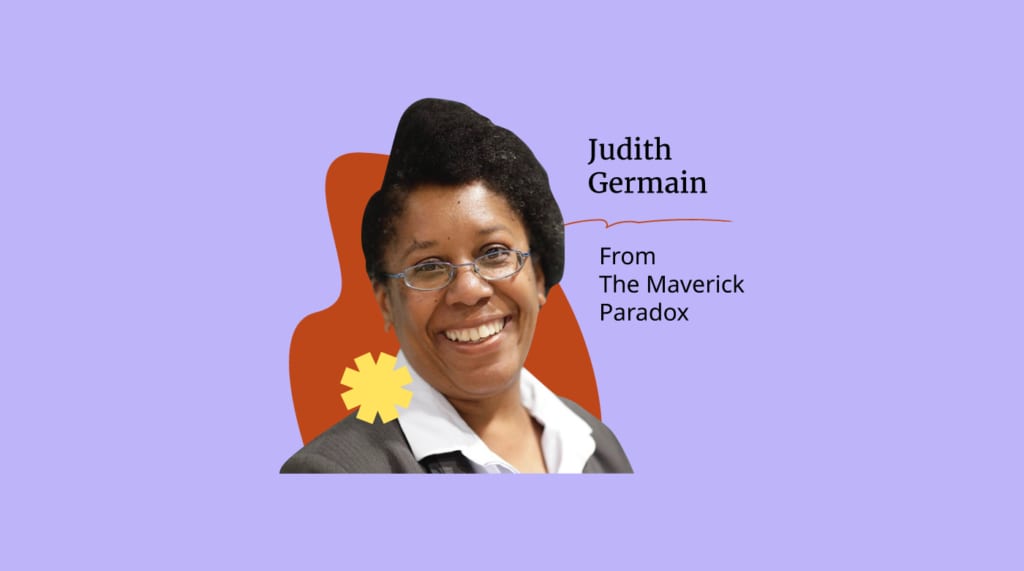
Jouw taak als leider moet inhouden dat je het beste uit iedereen haalt en de klant op de best mogelijke manier bedient.
Judith Germain
Gerelateerde links:
- Word lid van de People Managing People-community
- Abonneer je op de nieuwsbrief om onze nieuwste artikelen en podcasts te ontvangen
- Maak contact met Judith op LinkedIn
- Bekijk The Maverick Paradox
- Bekijk Judiths boek “The Maverick Paradox: De geheime kracht achter succesvolle leiders”
Gerelateerde artikelen en podcasts:
- Over de People Managing People-podcast
- Neurodiversiteit op de werkplek ondersteunen: een onaangeboord talentenbestand
- Psychologische veiligheid & hoe je die op je eigen werkplek bevordert
- Hoe je een cultuur van balans en verbondenheid creëert
- Hoe je een organisatie opbouwt die gebaseerd is op diversiteit, gelijkwaardigheid & inclusie
- Het perspectief van een immigrant op inclusief leiderschap
- 5 subtiele signalen dat je werkplekcultuur toxisch wordt (en hoe je dat oplost)
- Hybride werken: wat is het en hoe pak je het aan?
Read The Transcript:
We’re trying out transcribing our podcasts using a software program. Please forgive any typos as the bot isn’t correct 100% of the time.
Becca Banyard: My guest today believes that diversity, equity, and inclusion are the foundation of a successful organization and that the inability to manage DE&I is actually caused by a lack of leadership skills. So what can leaders do to step up to the plate and start building diverse, equitable, and inclusive workplace cultures?
Welcome to the People Managing People podcast. We're on a mission to build a better world of work and to help you create happy, healthy, and productive workplaces. I'm your host, Becca Banyard!
Today, I'm joined by Judith Germain, a leadership consultant at The Maverick Paradox, and she's going to be sharing with us common challenges that organizations face when implementing DE&I initiatives, how leaders can create cultures of belonging, and what companies can do to ensure that DE&I doesn't merely become a metric. So stay tuned!
Hello, Judith. Welcome to the show. It's so great to have you here today.
Judith Germain: Thank you, Becca. I'm so pleased to be here.
Becca Banyard: So we're going to be talking about diversity, equity, and inclusion and how it can be the foundation for a successful organization. But before we dive in, I'd love for you to just share a little bit with our audience about yourself.
Could you just tell us a bit about your background and what you do now?
Judith Germain: Okay, so I create clear thinking and decisive leaders. I have a background as head of HR and I've been working for myself since 2005. I'm an author, consultant, and I speak and give my opinion to national and trade press.
Becca Banyard: So I want to just jump right in to a big question. How does DE&I lay the foundation for an organization to be successful?
Judith Germain: Well, actually, there's quite an easy answer to that. And it's easy because all the research is showing that the more diverse teams that you have is the smarter organization, and it's smarter because it allows innovation, more creativity, different perspectives, and it has to be truly diverse.
So, diversity doesn't mean that you have one female, one black person, one gay person, one disabled person, whatever the quote has happened to be. Because all those people could have the same thought processes. So there's not true diversity, so you want to make sure you pick up cognitive diversity as well.
Becca Banyard: Can you go into a little bit more detail what you mean by cognitive diversity?
Judith Germain: Okay, so everybody has different lived in experiences. So whilst you could have a complete diversity of ethnicity, for example, and gender, but if they're all raised in the same middle class area, going to the same schools, then they're going to think in exactly the same way. Where if you have people who have come from different schools, lived in different areas, in different countries, different perspectives, then the culture of themselves that they bring is going to be quite different.
And that's where real diversity is and real innovation. And that's the same with neurodiversity as well. So neurodiverse people will definitely see the world in a different way. And that comes into the cognitive diversity.
Becca Banyard: I'm curious how organizations can become more neurodiverse because neurodiversity is something that is often invisible. So how can organizations attract and hire neurodiverse talent?
Judith Germain: That's a fantastic question. I think the funny thing is, they already are. It's just that they don't know about it, because it can feel very unsafe if you're neurodiverse to declare it because people have such fixed stereotypes. So I would say to hire more neurodiversity, it's to state that you hire neurodiversity to make it welcoming, but it's not really the recruitment that's the problem, it's the retention. So it's looking at the processes and the systems and the environment that you have to make sure that it's equitable for neurodiverse individuals.
Becca Banyard: So for organizations that want to retain more neurodiverse talent, as well as underrepresented groups, how can they establish their culture to be supportive of these individuals and to help them succeed and thrive in the organization?
Judith Germain: Well, I think it's all about understanding what culture is. Okay, so for years people have been defining that culture as what we do around here. Now, the way I look at it is that it's two things. It's what do we do around here, but who are we around here as well. And culture, everybody has their own individual culture.
So, our ethnicities, our lived experiences, our values, beliefs, all that is our own individual culture. Then we get into an organization, and as we start to interact with other people, we form a leadership culture that's collective. And that's all about, do we have toxic environments, do we create, psychological safety, how open are we to risk and all those kinds of things.
And then the organization then supports that leadership culture and the customer feels the reality of that culture. So to make sure that the customer has a great experience as well as the employees is to make sure that we build a cultural belongingness so that everybody feels that they can bring their whole self to work or as much of it as they want to.
And to do that is to make sure that we are open and having an environment where many voices get to speak in a decision making. Because diversity often is really diverse at the bottom of the, of everyone, okay? And the higher up you get, the less the diversity is, which means that decisions are made with people who are not listening to different perspectives.
Becca Banyard: Do you have one or two practical ways that organizations and their leadership can implement into their practices in order to create more space for all voices to be heard?
Judith Germain: I think what they could do is a few things. One, lead by example. So one of the conversations that they're supporting, what are they demonstrating to others, making sure they've got a very clear vision set of values, and that they, the policies and practices within the organization supports that.
So what I've seen is people have a great vision when they talk about diversity, but then when they appraise people and look at performance reviews, there's nothing in the objectives that has anything to do with diversity in it. So therefore it becomes something that the leaders don't feel is important.
So they don't prioritize it, which is really silly when you think about it because you're actively taking money off the bottom line when you don't do that. So if it's as important to increase profits by 5%, let's not increase turnover rates and absence rates and all this issues by just objectivizing people.
I think if we can encourage diverse representation, I don't know what they're called in the States, like employee representation groups? So you have the employees that get to say if a state was well, there are a few things that can be done. And I think also, I think getting external help is really key.
And I say this as a ex-head of HR, I think quite often it can be difficult for HR around diversity. They can help guide and set the strategy, but to have the influence to change can be difficult for a number of HR people. So it might be useful to have an external person that can come in and support the efforts of HR.
Becca Banyard: Do you have examples from either your previous experience or from other companies that you've seen who have implemented or who have brought in support and improved the diversity, equity and inclusion at their organization?
Judith Germain: Yeah, I worked with an organization a little while ago and they're a charity. And rather large charity, so they had the trustee board and they recognized that the people that they were serving were from a diverse mixture, but the people that leading wasn't. And they recognized they wanted to do something about it. And what they did, they were great. So first of all, they did some sort of awareness training and look particularly on recruitment and retention.
So they may, and then they, from the awareness training, they went away and did policies. We also worked with the trustees and following the work with the trustees, they decided to extend the trustee board and have some more diversity within the trustee boards as well. And then they went for a program of education for your organization and make it very much away.
So now they've got really good mixed with the people that they're serving and the leadership around the organization. I think the difference there, what made it really work is they chose to, because when they asked me, how can I help? I've said, there's no point in just doing it for the sake of doing it.
What's the key thing that you're concerned about? And for them, it was recruitment and retention. So once we did the awareness training, we focused on working on those areas. And that's what made quite a substantial difference.
Becca Banyard: I'd love to talk just about leadership for a moment. In your experience, what does the mismanagement of diversity and equity and inclusion say about an organization and its leadership?
Judith Germain: That they can't lead. I think it's as simple as that. Because my view is that your job as a leader must include getting the best out of everybody, must include serving the customer in the best way. And it's absolutely possible to do that in this modern age without looking at the diversity of the people that are making decisions and the people that are serving the customer.
There's been so much statistics around the pink dollar, the black dollar, the female dollar, all of this. And then you've got all these pockets of individuals that are completely missed because there's no diversity in those decision making. So, I think that if you are a leader, you want the absolutely best out of everybody.
So why would you not support diversity, which would mean that you're increasing the mental health issues within your organization? You're decreasing the ability to innovate. It doesn't make any sense to me. I think it's poor leadership. If you're focused on keeping the status quo, that's actively going to lose you money, staff and reputation. Makes no sense to me.
Becca Banyard: For a leader who recognizes that they haven't done a good job at managing diversity, equity and inclusion at their organization, what would you say to them? What would be the first recommendation for how they could grow in this area?
Judith Germain: What a great question. I think if they recognized it, then there must be something that they recognized.
So it could be turnover has suddenly shot up. Could be recruitment issues. I think it would depend on what they're doing. But I think generically, self reflection would make sense, looking at the organization culture and what are the senior team really supporting in the actions that they're doing.
And speaking to trusted members of their staff, peer group, potentially customers, to see what their thoughts are. I remember years and years ago, I walked into an organization and one of the senior managers called me over. I was head of HR there. Then they said, I'm so surprised that you're here, but I'm so pleased that you're here. And I was like, Oh, that's kind of interesting.
And why like second day? And he said, because nobody who is black stays in this organization for longer than six months. And I was like, wow, that's kind of a, that's quite a big statement. So that's the sort of thing that you need to do is seek out the opinions of others before you make your strategy.
Becca Banyard: What happened at that company? Were they able to turn things around?
Judith Germain: Quite interesting because it was a, almost a company of two halves. Within the same building they had two same job, two different client bases, one part of the office. It was all Wesley Cajor lying down, one half was very diverse serving a diverse population. And the other half was all the same. So I think over time, part of it was enabling the employees to lose the fear of other saying what I literally walked in people were like, Oh, no, I've never seen a senior leader. He was black, so they were worried, so I had to spend a lot of time talking to them and dealing with the stereotypes just to have, just to work through the diversity issues.
And you can see the difference as well, because it was the, that part of the company had a lot of tribunals, which is employment tribunals. The employees had taken them to court because there was discrimination issues. It was on my 1st day I was given, I think it was six files, which is really unheard of, you'd be lucky to get one in your career, I had six and it was like, they're all race ones.
So it's like, ah, this is a problem here. It was interesting.
Becca Banyard: Sounds like it. So what, in your opinion, are some of the current challenges that leaders are faced with that are stopping them or getting in the way of them really successfully implementing diversity, equity, and inclusion initiatives in their organizations?
Judith Germain: I think, first of all, we have to recognize the environment and the country you're in. So, if I look at the US, obviously I'm not in the US, but I can see across the pond there, there is this political polarization. So, the issues there is quite different from the UK. So, from what I can see, you have the historical context in the US as well as the political environment.
So there are issues and challenges around the activism side of it. It's not fair, affirmation, action, it's causing all these issues. Whereas in the UK, you don't have that polarisation as stark in that way. Here, it's more, do we really have a problem? Is it worth us doing anything?
Because everything's okay. So, and the activism is probably quite strong. So, part of it is recognizing where you are and what the historical background is and the environment you are in. Again, Europe has a different set of issues. And I think outside of politics of it, I think there's a sphere of getting it wrong.
So I recently did some allyship training and one of the things that came up from the group was, I'm afraid of saying the wrong thing. I'm afraid if I say something, someone's going to get angry or it's not my fault that this has happened. So why am I to be blamed for this? Not that they are being blamed for it, but it's a defensive gesture.
So I think there's a fear that needs to be overcome. And I think there's also an uncertainty as to what to do. So if we think about the George Floyd murder in the UK, so the UK response was a lot of companies didn't know how to respond. So they responded with a great, I would say, marketing message, but internally there was silence.
So, so whilst consumers got a message, one message, the employees didn't get any messaging. So there was a huge mismatch between the employer brand and the consumer brand.
Becca Banyard: What would have been your recommendations for organizations to do in that situation in terms of speaking to the employer brand to speaking to the employees, like around the time of the George Floyd murder?
Judith Germain: I think if they had to choose which message to send, it should have been the employee/employer brand, they should have been more concerned about. Because as I said to you earlier, how the employee experiences the culture is exactly what the customer is going to get amplified. To be honest, they should have said something.
I think what was really stark was it was only a few weeks after the country shut down for COVID and the response from HR organizations around COVID was so fast compared to anything else. It was just super quick and it was amazing. And then when the George Floyd incident happened, there was nothing. So there was that stark contrast, which made things worse.
So I think that my advice would have been, you need to say something, even if your first initial message to staff is, we don't know what to say other than we're here, come talk to us and we'll figure it out. Something had to be said and I think people would have accepted a message of "we have no idea what to do now" and it would have meant that they cared enough to say something. But the silence was absolutely deafening, especially because it was contrasted with all the actions around COVID.
Becca Banyard: Yeah. I want to go back to something you said not too long ago about often people don't do anything because they're afraid of saying the wrong thing. So, what is your advice to people who are feeling that way?
Judith Germain: I think, you know what, I think people can sense your intention, especially if you're clear with, it's a bit like a death. When someone dies, people avoid the spouse or whoever's left behind, because they don't know what to say. And that person feels terrible because no one's talking to them anymore. Yeah, literally people cross the street.
It's the same thing, and I think you need to say something, because by not saying something, you're saying I don't care and you saying I don't care has a major ramifications. And I think also, like I said recently, one of the trainings I did, not everybody is ready to accept the message because it depends on their own journey and where they are.
And some people may get upset, but that's life. It's like with anything, you have to recognize that maybe this isn't about you. This is about something completely different. And you just happen to be the person that's done something that day. And that isn't any different from anything else that could happen.
And I think, as, after 400 years, people, not everyone's going to be like, okay, that's fine. So you don't know? You're saying this and that's okay. Not everyone's going to be like that today, but they might be like that tomorrow. And I think if you center the other person rather than yourself, you're not going to go far wrong. If you're honestly, your intention is to support the other person, whether it's in the neurodiversity and their gender or in the, queerness or whatever, you're not going to go that wrong because people can see that. And, we make mistakes, and also one of the things that came up with the training was the language to be used. Like a lot of things, language changes all the time.
So one of the things in this country is BAME. So BAME, which is sort of Black Asian Minority Ethnic has been used for a number of years. But Black people generally don't like it. So they're moving for change. And some people are like, but we like using BAME. It's like, yeah, but it doesn't describe you. They don't like it. Those conversations can be uncomfortable, but so for a lot of things.
Becca Banyard: So what I'm hearing is just that it's not about being perfect, but it's about truly caring about other people.
Judith Germain: Yeah, because I mean how many times have we said something to someone accidentally like you might say to a blind person, did you see that? Because you forgot that they're blind or we sounds really speedy, but either sometimes you just say something can it's the wrong thing to say. But you would admit it, wouldn't you? You'd automatically go, oh, look, I'm really sorry. Or you might say, how's your wife? And they only just started, you're like, oh.
But you would say, I'm sorry. And that's no different by calling somebody, who, in that kind of diversity suite, the wrong thing. When you don't apologize, then it makes it look like it's on purpose, which is not your intention.
Becca Banyard: So going back even farther now in our conversation, because you mentioned something about how if diversity, equity, and inclusion isn't reflected in performance reviews, that there's a problem there and that it obviously isn't something that leadership really cares about.
So how can organizations measure and track diversity, equity, and inclusion? What's the best way to do that and what's the best way to do that so that it doesn't just become a KPI?
Judith Germain: I think if you focus on belongingness, so do the people in the organization feel like they truly belong here, is one measure. Then there's, I'm also wanna thinking about countermeasures.
If there's a toxic environment caused by the manager, he has failed. So I think if we look for quotas of things, that's where we get all caught up and we end up tick boxing the wrong thing. And then you get all this resentment from the people that have got the job and who haven't got the job, so it's a case of how do you get the right people, and I think you need to make sure that you do set some sort of goals, and you know where you started and where you want to be, but you've also got to think about looking at what the third party view would be. So, if you had somebody came in and did an audit, and then you work to improve in that audit, but you need to try to make the change in a way that honors the values of the organization, not one that appears to everybody that you tick in the box.
Because it's basic. If you want to get the best person possible, which is what a leader wants within an organization, the best performance possible, then you do everything you can to get the best performance, wouldn't you? And if you were hiring for a job, you want the best person, then you would put your recruitment ads out everywhere, so you would deliberately try to widen the amount of people that can come in rather than trying to restrict it. But I think it's also thinking about what are the things that you're asking for.
So if you're asked within your organization that you need someone to have a PhD, for example. Do you? Because having a PhD might mean that person who has a family can't devote the time. It might mean if you don't have somebody else with a secure income, you can't do your PhD or your MBA or whatever you're doing.
So you're starting to restrict or maybe it's harder for women now or maybe it's harder for younger people that and it's not necessarily what the job needs. So it's going back and saying, well, what's actually required within this role to make this work?
Becca Banyard: Yeah. I love that. I had a conversation yesterday with somebody who said something very similar and yeah, I love that you brought that up. That's so important.
So belonging, what's the best way to actually track that employees are feeling like they belong and what are some best practices around establishing a culture of belonging?
Judith Germain: Yeah. It's difficult, isn't it? Because part of it is what does it feel like, which is harder now that we're hybrid.
So when you're in the office, you get a really good sense of what it feel likes to be there. And you can't do that. So there's things like employees surveys, but you need to think about the questions that you're asking. Because sometimes, say, if you've got a particular minority, whatever that happens to be disabled, neurodiverse or whatever.
And so you've got five of them, and then you've got people to identify who they are by the ethnicity. Then it's going to be impossible for that person to be honest, because everybody knows what you're talking about. So, what are the measures for belongingness? Do you have, are meetings open?
People talk easily. If there is a national holiday, can people support that or not support it? Or if they're from another country, can they support the stuff they do? Do, when you go into the office and people have microwaves, do people say, this type of culture foods too smelly, so they shouldn't be used in the microwave.
So somebody might think, oh, this is about the smell in the office. Somebody else might say, I'm not wanted here. Particularly with the CROWN Act in the States, can you wear your natural hair in the office or you're unprofessional whe you do so? That would be a measure of belongingness.
But I think probably one of the best ways of doing it is to ask the employees. And if you haven't got diverse employees to begin with, get a professional in that can help you draw up the measures. And those measures might need to change from time to time too.
Becca Banyard: Amazing. Thanks for sharing. We're about to wrap things up, but I have a couple questions that I ask all my guests that I would love to ask you.
Before I ask them, is there any other question that you feel like I should have touched on? Anything else that you wanted to share before I go into those questions?
Judith Germain: I think diversity, equity, and inclusion is so important because it's the lifeblood of the business and it's the lifeblood of the customer experience.
And I think if we really do believe that employees are our greatest assets, then we need to think of all the employees. And, all the evidence shows if you make the workplace equitable for everybody, everybody wins. If you looked at what neurodiverse people have brought over history, in fact the argument is all major changes has actually come from xx people.
And you think, what can you do to make it open as possible and not see it as a chore? One person winning doesn't mean somebody's losing. I think that tends to be the negative attitude. If I support X group, what about that group? And the idea is if you support all groups, everybody, as I say, the rising water rises all ships, isn't it?
Becca Banyard: Thanks for sharing that.
Okay, so as we wrap up, here are my two questions for you that I ask everybody. What do you believe is the number one thing that keeps employees happy in the workplace?
Judith Germain: I'll tell you what, the number one thing that why people leave is because of their managers. So I think the thing that keeps people happy, so conversely people say the thing that keeps them happy in the organization is the other people that are around them.
Well, now that we have a hybrid working, the people that are around them is themselves. So, I think the number one thing is to keep people happy in the workplace is to foster a sense of true belonging. So, somebody can talk about what they did over the weekend and not think that's not an appropriate thing for the business, because that's one ethnic group, and so it's another ethnic group, for example. So I think, but sorry, I waffled a lot there. I think belongingness.
Becca Banyard: Okay, and for you personally, what do you need to be a successful leader?
Judith Germain: I think you need integrity, empathy, and passion. Because I think you have authority over people because they give it to you.
Love something that you demand is something that's freely given. So I think to be successful as a leader is to recognize how to influence people, how to align people and to truly care for people. Because people know if you don't care and Generation Z, late Millennials, will not stick around if you don't care.
Becca Banyard: Wow, so beautifully said. Thank you. Judith, it has been such a pleasure having you on the show. If people want to connect with you or follow your work, where can they do that?
Judith Germain: Okay, so you can follow me on LinkedIn, and that's Judith Germain. Or you can go to the website, maverickparadox.co.uk. I have a magazine, a podcast and a book out there as well.
Becca Banyard: Amazing. Thank you so much for joining us.
Judith Germain: Thank you. It's been fun.
Becca Banyard: Everybody listening, thank you for tuning in. If you'd like to stay in touch with all things HR and leadership, head over to peoplemanagingpeople.com/subscribe to join our newsletter community.
Until next time, have a great day!