For decades, career advice has been simple: specialize, build deep expertise, and become indispensable. But what happens when AI makes that expertise accessible to almost anyone? The value of knowing how to do something is shifting toward knowing what should be done, why it matters, and whether the result is actually any good.
In this episode of People Managing People, host David Rice speaks with Tony Castellanos, Head of People at Nextdoor, about why judgment, curiosity, and taste are becoming critical leadership capabilities. They explore how AI could invert the traditional hierarchy of specialists and generalists, why organizing teams around business problems makes more sense than defending functional boundaries, and what happens when the org chart stops dictating who gets to solve what.
What You’ll Learn
- Why specialization alone is no longer enough: How AI changes the value of deep expertise without eliminating the need for specialists.
- Why taste and judgment are becoming leadership essentials: What separates useful AI-generated work from polished output that misses the point.
- How AI could reshape organizational structures: Why cross-functional problem-solving may become more valuable than operating within traditional departments.
- What career development looks like when breadth matters: How curiosity, experimentation, and business context can accelerate learning.
- How to preserve human accountability: Why AI-assisted decisions still require oversight, skepticism, and clear ownership.
Key Takeaways
- Expertise isn't disappearing. Its value is moving upstream.
AI makes specialized knowledge easier to access, but that doesn't make experts obsolete. Much like Excel changed the work of finance teams, AI shifts the value from performing technical tasks to deciding which problems deserve attention and what the results mean for the business. Specialists who connect their knowledge to broader outcomes will be better positioned than those whose value rests entirely on repeatable tasks. - Taste is built through experience, not another competency framework.
When AI can produce 20 versions of something in minutes, generating content is no longer the hard part. Recognizing what's good is. Tony argues that taste develops through repetition, experimentation, and the occasional painful mistake. Leaders need to give employees opportunities to exercise judgment rather than simply approve whatever an AI system produces. - AI should distribute expertise, not decision-making responsibility.
Nextdoor's compensation agent, Compadre, gives recruiters and people business partners access to compensation data and internal equity context without requiring constant specialist intervention. Crucially, it provides information rather than recommendations. The goal is to make better-informed decisions faster, not outsource accountability to software. - Curiosity may matter more than staying in your lane.
Traditional career development rewards progressively deeper functional expertise. Tony sees an opportunity for employees to use AI to explore adjacent disciplines, test ideas, and learn through actual business problems. Managers can encourage this by pushing employees to ask why existing processes work the way they do instead of assuming yesterday's constraints still apply. - Trusting AI doesn't mean you can stop checking its work.
As people become comfortable with AI, they naturally scrutinize its output less. Tony suggests introducing a skeptical third perspective, potentially another AI service, to challenge results and force reconsideration. The point isn't to automate every review. It's to keep humans actively exercising the judgment they're supposedly being freed up to use. - The org chart shouldn't be a permission structure.
Tony predicts that organizations will increasingly rely on smaller groups of specialists surrounded by generalists who can apply expertise across business problems. Cost centers may remain necessary for accounting, but they shouldn't determine who owns an issue or contributes to solving it. The opportunity is to organize around outcomes rather than perpetuate handoffs simply because that's how departments have always worked.
Chapters
- 00:00 — The Changing Value of Expertise
- 02:20 — The Risks of Specialization
- 05:29 — Why Taste Matters
- 09:43 — AI Accountability
- 10:19 — Organizing Around Problems
- 13:21 — Generalists vs. Specialists
- 16:47 — Preventing AI De-Skilling
- 18:44 — AI-Powered Compensation
- 22:21 — Managing Information Overload
- 25:32 — Rethinking Career Development
- 27:38 — Curiosity and First Principles
- 30:14 — The Future of Org Charts
- 34:09 — Closing Thoughts
Meet Our Guest
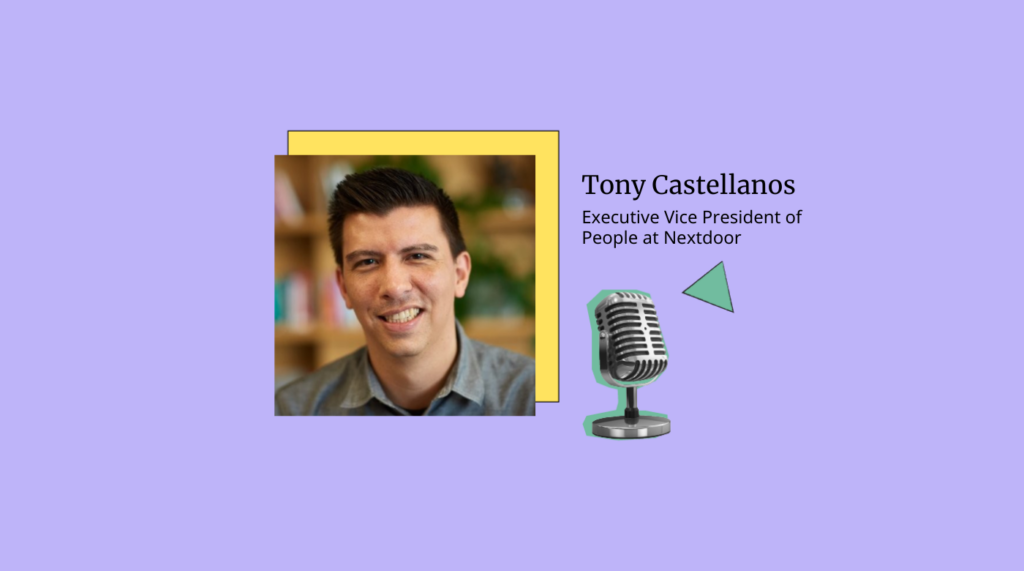
Tony Castellanos is the Executive Vice President of People at Nextdoor, where he leads the company's people strategy, talent acquisition, compensation, benefits, and HR business partnering. With nearly two decades of experience in human resources and talent leadership, he previously held roles at Google, Square, and Nuna. Since joining Nextdoor in 2020, Tony has helped transform its People function into a strategic business partner, championing AI-powered HR operations that improve efficiency while preserving human connection. His work focuses on building high-performing teams, strengthening organizational culture, and using emerging technologies to create more impactful employee experiences.
Related Links:
- Join the People Managing People Community
- Subscribe to the newsletter to get our latest articles and podcasts
- Check out this episode’s sponsor: Teamflect
- Connect with Tony on LinkedIn
- Visit Nextdoor
Related articles and podcasts:
David Rice: For most of our careers, the advice has been the same: specialize. Go deep on something valuable. Build expertise nobody else has. Today’s guest thinks that advice needs an update, not because expertise is dying, but because AI means we need fewer people who are deeply in any one domain. The knowledge is more accessible now.
The value proposition shifts. On today’s show, I’m talking with Tony Castellanos, Head of People at Nextdoor, about what actually becomes more valuable as AI takes over the codifiable stuff. His answer? Taste. Knowing what good looks like is becoming more important than knowing how to produce it, and you can’t train taste in a classroom.
It comes from reps, at-bats, gut punches, accumulating enough wins and misses that you start to recognize the difference instinctively. The org chart conversation is where things get kind of interesting. Tony thinks the generalist is about to be revalued. Today, they’re treated as the operational layer, junior, not quite as useful.
That flips. Experts become fewer. The people who can weave expertise across domains, who can figure out what a company can do when you pull from multiple centers of knowledge, those people move to the center. And the concept of a cost center? Tony thinks that label stops defining who gets to take on a problem.
The org chart evolves from a map of where information sits to something more fluid, teams forming and dissolving around a problem at hand. So today, we’re covering why deep specialization increases your AI exposure unless you can connect it to broader business problems, how taste develops, and why it’s becoming a core leadership competency, the inversion of experts and generalists in AI-era organizations, and why the cost center model may be what looks strangely outdated five years from now.
I’m David Rice. This is People Managing People, and if you’ve been building your career around depth in a single domain, this conversation is worth thinking through. Let’s get into it.
For seamless performance review processes and enterprise-grade security, try Teamflect for free, the number one rated performance management platform in Microsoft ecosystem. Trusted by enterprises worldwide to align goals, run performance reviews, and develop talent at scale.
Tony, welcome to the show. It’s good to have you.
Tony Castellanos: Thanks so much. It’s a pleasure to be here.
David Rice: Where I wanted to kind of start our conversation today was around, you know, for most of our careers really, the advice has always been specialize.
You know, you want to specialize in something that’s got high value. You want to develop deep expertise that other people don’t have, right? But you raise this sort of counterintuitive idea that extreme specialization now can increase your exposure to AI if that expertise can be documented and codified.
My question to you to get us started is, are we reaching a point where being exceptional at one thing is actually a risk unless you can connect that expertise to a, a much broader business problem?
Tony Castellanos: Important question, and yes, we, we’ve all been trained that you go deep on one thing, you’re the best at it, and you stand on that platform.
And I think that maybe the headline exaggerates it a touch, like ’cause expertise isn’t dying. Expertise is still really important. We need to know how to do things. I think what changes in the world of AI is we just need fewer of the people who are deeply in a specific domain, and that’s because their knowledge, their expertise, and the broader knowledge base is much more accessible to people around it You know, if I think about the skills that become more valuable, like you still need that person who understands what’s happening because we need to be able to audit what is AI delivering, how is it calculating this, how is it thinking about that?
But I think there’s a ton of value in being able to weave that expertise into how your business is moving forward. An example of this, right, is if you go back in time, right, there were companies that would have lots of people who were in roles where calculation was the core. I mean, if you were in finance, if you were an analyst, if you were an engineer, right, there, there was a lot of math being done.
And then all of a sudden Excel arrives. You’re like, "Well, we need a fraction of those people to actually do the math behind what the business is." But that didn’t just eliminate the need for the people. It created a different value proposition for them. So, the new value in a human was understanding what should you be calculating?
What’s the right model to build? What does it mean? Can we make better business decisions from this information? So it’s really how do you use that expertise? And I don’t think anybody would make the argument that Excel ended financial expertise. Like we all have those teams in our companies.
But I think the real value became like you have a few people who are deep experts in this, and really what they bring to the company moves up a level in terms of how do they position that strategically with what they know? So I kind of think that’s what’s happening again. It’s just faster, and it’s really across every function that AI touches.
David Rice: Yeah. And so much of it is like there’s certain types of work that I think that it accelerates at, right? Why it’s having such a disruptive factor in coding is you write code, and it either works or it doesn’t, right? So it doesn’t work, you know, you know what you gotta do.
Tony Castellanos: It’s great for binary outcomes.
You know, right and wrong, true, false. I mean, it still gets those things wrong, which is why you need the experts to, to check it. But I think anytime you get into rules-based programs or systems, it can be really effective there, and when you get into knowledge dissemination that is really rooted in specifics rather than lead into judgment.
David Rice: Yeah. Well, you mentioned the piece judgment there ’cause I was listening to somebody talk last week, and they were talking about how do you know when a marketing campaign is ready to go? Ultimately, like somebody with the taste to say, "Yes, this is all complete," has to stand there and say, "I, I sign off on this."
And we talked about this idea of taste beforehand, which is a word that up until now I don’t think a lot of CHROs had in their competency models, right? Five years ago-
Tony Castellanos: Unless they’re hungry, you know?
David Rice: Right. Five years ago, I don’t remember seeing a job description in which taste was involved. But I guess if AI makes knowledge and technical capability much more accessible, does knowing what good looks become more valuable than knowing how to produce it?
And if that’s the case, then how do organizations sort of identify and develop something as intangible as taste?
Tony Castellanos: I think it’s incredibly important in this AI-enabled world ’cause you can produce so much content, right? So I think we’re, we’re all being flooded. I mean, if you just go look at your Google Drive right now, I’m sure there’s like 10x the docs that you had a year ago because you’ve started all these things with Claude or with Clo- Codex or Gemini or whatever.
And so yeah, I do think taste becomes incredibly important for refining that into a way that’s going to be digestible for any human that’s gonna consume it. And, like, how you develop that My honest answer is just it’s repetition. It’s at-bats. There’s not really a course in training that you’re gonna get for it.
It’s the accumulation of the wins and the gut punch bruises when you get something wrong, right? If you do that enough, you really start to refine what does good look like and what does subpar look like. And I think that’s hard because it requires the opportunities to do that, but this is one where I think AI also just changes the pace at which you get some of those at-bats, right?
‘Cause you can keep pressure testing things dozens of times, I mean, in the span of an hour. And that’s how we think about AI at Nextdoor, right? It’s very much about brainstorming and experimentation. It’s not about generating the answer for you. So you can do it, but, but I agree with what you said. It puts a lot more pressure on the person to define that because AI’s gonna hand you something that is sophisticated, it is persuasive, and it’s gonna be just flat wrong, right?
So… And as a human, you’re the only thing standing between that artifact and the audience that it might reach. So I do think it’s incredibly important.
David Rice: That’s interesting. I like the idea of just at-bats, you know? To use the baseball reference. But I, I like… reps is what… And you think about, like, how did somebody who, let’s say they’re in a…
I used the, the marketing example before, so we’ll stick with that, but it was like, you know, they’ve seen this in a year. You know, you go back 10 years, they might see that problem come up a dozen times. But now with this, they’re just seeing the same type of thing that they’ve got to approve 10 times that many times in some cases.
So the at-bats can teach us at least more quickly, and I think the question I have is will people be able to see the whole picture? Because of the– you described the volume of stuff that’s happening now. It gets harder and harder for leadership in particular to still see the whole picture when everybody’s producing so much more.
I think that’s gonna be an interesting thing to watch.
Tony Castellanos: Agree 100%, and if… i’ve tried to read most of the docs that have come my way, but- … honestly, they’re just flowing in so fast. But this is where it comes back to judgment and taste, right? Are you putting something together that is succinct, that is clear, that makes the connections to what you’re trying to accomplish?
And, and the nice part about AI enabling that is you can literally just tell it, "Create 20 versions of this for me. Make sure you prioritize this, this, and this." You look at them, you pick the best one, you refine it, and so, you… It’s so much faster to get to an end product. But I do agree that the deluge of information that comes our way right now can be overwhelming, and so there, there’s a lot of pressure on just distilling it into something that’s gonna be useful for a person.
David Rice: I mean, especially now that we’re getting into this era of agents. I’m waiting to see the story where it was, like, some manager And it did all these things that the person was– couldn’t even process or didn’t even know existed because it’s just working so fast and generating so much. That story’s bound to come out at some point, so.
Tony Castellanos: I mean, it just happened with a, an escaped version of an LLM. Oh, yeah. Yeah. And I’m not gonna name it because I feel like I might get in trouble for that. And that’s one of the things, like one of our principles is, is own what your AI does, right? And so I think it– people just can’t take it for granted.
They can’t just ship what AI produces. They also can’t just allow AI to ship what it produces right now, and I think getting that right, whether there’s a human audit before anything moves outward, or whether there’s guardrails or an audit trail after the fact that sort of edits it, that will catch things that, that need to be sort of pulled back, there has to be some sort of mechanism like that.
David Rice: Yeah, you’ve started experimenting with organizing the people team around problems rather than sort of traditional HR specialties, and I think that’s like an interesting kind of approach. Potentially much bigger change than adding AI to an existing job, right? So if we start organizing around outcomes instead of expertise What happens to the sort of functional structures that career ladders and ownership models, you know, we spent decades building?
Tony Castellanos: This is a fun one, and full transparency, we haven’t blown up our org chart right now. We still have recruiters, we have compensation, we have people, business partners. But you’re right, we have started to look at what are the actual problems that that group is intended to tackle together. So we’ve tried to orient the teams around the things that are true across the people realm, and for us, that comes down to talent, activation, which is a combination of engagement and enablement, and culture.
And so for every one of those there’s no version of it that’s just recruiting specific or PVP specific, right? There is this entire body of work that goes into making sure that you’re bringing in and cultivating the right people and the right talent base, right? That you’re supporting employees in the right way, that you’re building an environment where everybody can do their best work.
You know, there have been functions that have been focused on specific aspects of that, and that’s been because the expertise has lived in those functions. But I think what AI enables is more cross-understanding of how they come together to make those things real. And so what we’re trying to do on our team is really to create more of a mindset around what is the ultimate goal here rather than what is the recruiting piece of this pod.
You know, I don’t want people thinking in terms of their operating lanes. It-it’s really did the people organization deliver value in this dimension?
David Rice: It feels like it requires people to be a little bit more, I mean, not– w-obviously adaptable, but it’s almost kind of philosophical about their place within things, you know?
Maybe that’s a little too deep of a word, but i-in a way it’s like, where does my skill set impact this overall outcome that we’re seeking? That’s a different way to look at our work versus how can my skills influence the outcome that we wanna find.
Tony Castellanos: It’s there, and I think it’s even a step further that is like, what can I learn and apply here?
I see the problem, and I’m not limited to the fact that I’m a recruiter or I’m a compensation person or whatever it is. I’m a member of the people team. There is an end-to-end flow of bringing talent in to developing it, to promoting it, and all these things. Like, how do I assist or move that all forward?
And I think that one of the fun things is that you get a lot more– We go back to reps. There’s a lot more iterative cycles that you can get, and, like, how can you apply your expertise and what can you learn? Because AI is gonna be your partner in that. So I really want to extend the way that people think about Again, their function to really ultimately what is the end goal of this really?
David Rice: There’s an obvious danger in pushing everybody towards sort of broader roles, and I, I’m– I think anyways. I think you, you can k- end up with a workforce of generalists in theory, right? Who know a little bit about everything, but not a lot about everything. And I think that you kinda answered this earlier.
You said expertise isn’t necessarily going anywhere. But, you know, how do you create people who operate end-to-end across a problem and still preserve their expertise that will allow the business to function should, let’s just say an LLM crashes for a few days? They still can go and do the things that they need to do at the depth that they were able to do it before.
Tony Castellanos: For sure. So if I were to take a step back on this one, right, I think that the thing that I, I worry about most in a world of you have more generalists, it’s less about lack of understanding, because I think people who are intrinsically motivated and curious as they work through problems at their organization, they’re gonna develop that context, right?
So they’re not just gonna be flying blind. But I think the real risk is in people just taking the output of AI, shipping that, and moving on. A-and that is not confined to generalists, right? Specialists can do that, too. So it comes back to this idea of that it’s a problem of breadth and really depth and judgment rather than it is sort of context awareness.
I think that as long as you hire people who genuinely want to understand their environments that they’re operating in, and I think that’s gonna become a, a new criteria for us. Like the term curiosity is really rising up the chain on how we think about evaluating talent coming in. Like we wanna make sure that people are absorbing what’s around them, and that’s allowing them to make better decisions.
There’s a lot of opportunity in setting up teams that way. But to go back, sorry, I’m stuck on now the LLM goes down question. I do think that’s one where personally, oh man, I would feel far less effective. I actually don’t even know if I could do my job anymore. But in that realm where you have generalists who are enabled by AI and it goes down, I don’t think that you lose the knowledge, right?
What you lose is the link to the knowledge. What AI is doing for them is it’s really expediting, like how quickly can I get all the context, all the metrics, all the everything to make this decision or to move this program forward. It doesn’t then eliminate that person’s mental model for what do I need to make this decision?
It just puts them back into the mode of yesteryear when I have to manually go collect, like what actually happened on this product? What is the revenue that this generated? And so it just takes longer to fill in the pieces. But I do think that if that person has been AI-enabled for a long while, they have a really clear picture of what information and data sets they need that will inform their work going forward.
David Rice: Curiosity is the big one, right? Like I come back to as well, like you can’t– That’s one thing about humans that I think is where we will be resilient. It’s like you won’t eliminate people’s just desire to know things, to be able to do different things. Yes, this technology can do a lot of the things better than us, but people like doing stuff People like learning stuff.
That’s just the way we are, right? We’re hardwired for it, and we’re not gonna undo thousands of years of evolution just by introducing an AI. It’s not gonna happen.
Tony Castellanos: No. And I think for the right people, that creativity is unleashed through this because you get so much farther so much faster. But again, I think there’s also the risk that it is you just take things at face value, and that’s where things start to really degrade.
David Rice: Yeah, that judgment piece, and that’s– we’ve already seen some data come out of, you know, of executives worried about de-skilling, that they’re seeing people just after a period of time, maybe six months, they’re really working with the model really closely, validating everything, exercising judgment, and then over time something happens and you just sort of start to allow it.
I’m wondering what’s gonna be some of the most successful strategies against that happening. Like, how do you keep that… Because it could maybe, I think it, we’re at risk of it becoming a bit boring or just routine, and so how do we keep the, the people invigorated in it and really obsessing over the judgment piece and the taste piece?
Tony Castellanos: Well, I think what you just said, I mean, that’s a human relationship too, right? You have a new hire. You don’t automatically trust everything that they do, but over time they deliver, they get things right, and you more and more trust them, just like you’re gonna more and more trust an LLM. And that means as they’re sending things to you to proofread, to audit, to check, you’re probably doing less and less and less of that over time.
It’s just a natural human behavior when you trust something. The nice part about AI is it’s really good at also all those audit points. It’s way better at proofreading a document than I’m ever gonna be ’cause my eyes start to glaze over. We’re gonna need to create a world where you have the multiple teammates, the ones that you start to trust more and more because you’ve been in sync, it’s gotten things right, you’ve shipped work product together, but then you have the third skeptic, right?
Who comes in and is like, "Wait, you two are wrong." And that can also be an AI-enabled service. And that doesn’t mean that either of those are right, but to your point, it’s provocative. It puts the human back in the driver’s seat to say, "Wait, these two services are disagreeing. What’s the right call? What’s the right thing for me?
What’s the right thing for my organization?" So as long as we don’t fall into the trap of just blindly shipping and that you are always critiquing what’s coming out, and you can encode that if you want, which I think is helpful, I think we’re gonna be in an okay spot.
David Rice: Yeah, absolutely. I agree. When we were chatting before this, you mentioned a compensation agent, and I thought it was interesting because it’s not really replacing your compensation function, as you were saying before, but it is distributing some of that function’s expertise to recruiters.
I’m curious do you think that that is ultimately the bigger sort of organizational impact of agents, right? They’re not replacing expertise, but they allow expert knowledge to sort of travel much faster throughout the company.
Tony Castellanos: Yeah, I think that’s one of the huge highlights for AI for sure. And so what you’re describing, our compensation agent is what we’ve built is it’s this service that plugs into our compensation architecture, and it looks at our employee base.
And then what it does is it’s accessible to our people business partners and to our recruiters, and it doesn’t look to analyze situations. It doesn’t provide recommendations. What it surfaces is factual information so that those people can make informed decisions. And what this does is, you know, so a recruiter can say, "Hey, I want to make an offer at X.
How does that compare to the bands or how should I think about that?" And it will say, "Here’s where it sits within our compensation practices, and here’s an approximation of how it compares to people internally." We don’t expose any individual employee information, and we make sure that everything is anonymized enough that you, you can’t actually get to an individual’s compensation.
But by equipping the, the recruiter with not only does it– this is where it sits in the band, but also this is the equities or inequities that it will create internally. It allows them to expand their perspective from closing the candidate to build a harmonious team And it does that without needing a compensation person.
‘Cause I mean, I grew up in recruiting, right? And I’m so accustomed to, all right, I’m gonna get the offer details from the candidate. I’m gonna go talk to compensation maybe a day or two later. Whenever that person is available, I’m gonna come back. And instead of that multi-day chain where you’re debating with somebody ’cause you don’t have the relevant context, it’s at your fingertips.
And so I think it just makes things go faster. And by exposing the actual data, it equips you– We were talking about earlier about generalists. It builds a context layer that you can continually draw from. So I think it is developmental as well as effective.
David Rice: I’m interested ’cause you’ve got enough specificity there that this agent is sort of contained, and it, it’s gonna– it’s the type of a task that it can excel at.
What was sort of the conversation like when you sat down to think about, like, how you wanted to develop this and essentially goal set for it? Because we talk about agents like they are employees in some ways. And w- how are you sort of developing the role that you wanted this to take on?
Tony Castellanos: Yeah, agents as employees is a big one for us, so, we lovingly have named this Compadre, your comp friend.
And that is full credit to Orion Cawthorne, who’s our head of compensation. And where did this come from is you have recruiters and compensation people who are sitting in these discussions who are saying, "Do we really need to be here?" You know? "Isn’t there a different way to do it?" And so this started way back when we kicked off a few people team AI days, where everybody was focused on solving a problem with AI, and we’ve been doing this for a while now.
And one of the things that came from it is can you build a service that makes this information accessible, but does it in a very responsible way where you’re protecting privacy, but you’re also equipping recruiters and PBPs to make the right decisions? So it came out of the team just not wanting to spend time on this thing because it was a transactional meeting, and that’s one of the things that AI is great at, is removing the overhead associated with these tactical interactions that we have constantly day to day.
David Rice: Yeah. I can think of about five of them that I’d like to make right now.
Tony Castellanos: Right. And I think, you know, as you start to make them… I mean, I have a little chief of staff, Sam Wise, who does things like meetings prep and agenda organization and will give me previews of the day. And there’s just a lot of our days are consumed by engaging one-to-one or with groups that’s just information absorption, and that’s something that AI can do for you.
And so when you have that as the precursor to a conversation, it makes the actual conversation much richer, much more informed, so you’re not having to take the time of everybody just for information sharing.
David Rice: Yeah, it’s interesting, and you just said the information absorbing thing, and it got me thinking about a conversation I was having last year with somebody who was– We were kicking around ideas for things we could maybe build.
The person I was talking to is in Scotland, and he was saying to me, he’s like, "You know, one universal problem I think no matter where you work in the world, so much information comes at you. Some of it will irritate you, some of it will excite you, some of it will bore you to death But none of that has anything to do with what’s most important, right?
And so if it can just synthesize, at the end of the day, it’s gonna give you a five-minute little personal podcast. You can listen to it on your drive home or in your earbuds, and it’ll say "Most important things from the day, things you need to remember for Monday," or whatever, and it just lists them out.
You know? It’s actually, that would be great. A lot of us are in information barrage all the time. It’s like, "Oh my God, I can’t even remember everything we’re doing."
Tony Castellanos: I mean, have you tried to look at Slack?
David Rice: Yeah. It’s just like- Yeah … 500 channels. Totally. Can’t even find it all.
Tony Castellanos: 100%. So my version of this from Samwise is I get Sunday evening a brief delivered to me that is about the week ahead, and it’s a combination of what I’ve said was the important bit is giving me guidance.
These are the three things that are most important to me. So I want you to scour Slack. I want you to look at all my meeting notes, et cetera. What are the things that fit in these three buckets that I need to know about for next week? But then I also have a section where Samwise gets to discover things.
And what do you think I should be aware of? What did you come up with that is not in these three things that actually should be on my radar but don’t fit cleanly into this? In that way, look, is there stuff that I’m missing? Probably. Am I relying solely on AI to filter, though? No. I’ve given it parameters because there are things that I wanna make sure I, I stay in touch with.
And I think the danger is what we just described earlier where you say, "Show me what’s important," and you allow AI to decide what’s important. That’s a world that we can’t enter.
David Rice: Yeah, that’s ultimately the conclusion that we arrived at around that. We were like, "Well, yeah, but who’s defining important, and is it aligned with A, the business, B, your manager, B, your goals or C, your go…"
You know, it’s just there’s a lot of factors that are gonna change the context of what it should produce, and that’s ultimately where the big challenge came in for it ’cause neither one of us knew how to quite solve for that, you know?
Tony Castellanos: Yeah. Although now I’m thinking I should have Samwise produce a slide deck ’cause I think now Google has an automated presenter thing through Google- Yeah
Google Slides, right? And so that might be fun to have your service build a slide deck and then have the, another service present it to you. Your own personal, like, mini chief of staff team. It’d be amazing.
David Rice: Yeah. Actually, that would be incredible. The future employee, right, they need breadth, they need judgment, they need the ability to move across problem spaces, right?
Doesn’t that kinda create a, a pretty fundamental problem with how we develop people today? ‘Cause I think most career paths, they kind of reward getting progressively deeper inside of a function. What would development and progression look like if breadth becomes part of seniority rather than a detour from it?
Tony Castellanos: Yeah, no, this is one where it is counter to the way that we’ve developed people, but the nice part is the thing that’s creating the problem is also creating the solution. AI is really giving people enormous amounts of autonomy over their own growth, right? They can go investigate and interrogate a topic.
Now, you do need the guardrails to know what is real and what is not, but you can build a foundation for yourself and take that to an expert for collaboration or for edit or for critique so that you’re just accelerating your learning. And in this way, you know, what we found and what we’ve encouraged all of our employees to do here is don’t wait for the learning and development team to build a curriculum.
Don’t wait for your manager to find a couple hours to sit down and deep dive on this thing. Go explore the thing that you’re wondering about or that you’re curious about or the problem that you see. And, and the great part about doing this with AI in your company is that you’re not doing this in an academic, sterile setting, right?
You’re doing this in your company’s context. So I mean, even if you’re– you know, things go haywire, you’re still learning about what your company does. But really the benefit is you’re coming with an informed point of view on what your company actually does. And so you create this amazing feedback loop between your manager or whoever, where if you’re trying to build breadth, you go to the party that’s adjacent to your function or who’s involved in this, and you can actually get feedback on something real and tangible versus a made-up exercise.
And, and in that way, we don’t have people sitting around waiting for assignments or stretch opportunities, right? You can actually just stretch yourself every day. It’s a form of experiential learning, but it’s just a lot faster.
David Rice: One thing I think that’s so dependent on, right, though, is exposure.
So I don’t know what I don’t know until I’m exposed to that fact How do we have to kind of, think differently about workflows right now? So people are getting exposed to going, "Oh." They’re getting that curiosity, right? ‘Cause they wanna learn about what this other thing that they’ve gotta tackle, but they don’t quite know it yet.
And so they can develop a curriculum, or they can work with other people to kinda learn what it is they need to know. Is there a major workflow shift coming? ‘Cause that’s kinda what I’m hearing.
Tony Castellanos: I don’t know if it’s a workflow shift, but I think it’s you, you, you hit it there in the question, though, that it is a c- we’ve come back to curiosity so many times, and I think that it’s actually gonna be less about workflow, and it’s gonna be more about mindset and behaviors ’cause w- when I hear you ask that question, right, it’s like, well, the nice part about AI is you can actually start with a question.
"I don’t know what I don’t know." You can literally start with that question. But I think that we’re gonna see maybe not more pressure, but I think you’re gonna see great managers start to push on the five whys, and that’s gonna get people into this mode of really investigating, "Why does this thing exist the way that it does?
What is it trying to accomplish?" And if I were to revert to more first principles thinking, would I do this this way with the tooling that’s available to me today? And that’s gonna be one of the biggest things, I think, that we come up against, is inertia and entrenched process because it’s really hard to get back to what are the doors that we closed because it wasn’t possible to pursue that path back then?
But AI has unlocked so much potential that recruiting is a good example, right? Where it was a given. I used to work at Google a long while back. It was a given for most companies that, you know, when you’re at that scale, you can’t actually review every single resume. Now, we actually m- did make a concerted effort to do that, which was crazy ’cause we had people whose jobs it was just to review resumes.
But for most companies, you just assume "Look, I’m getting tens of thousands of these things a day. I’m not gonna get to all of them." With AI, you can actually… It can get some review. It can’t get a human review. It can go flow to a system that’s going to look at the content there, and that’s just not a thing you would’ve ever thought was possible way back when.
So how many other doors have we mentally shut is gonna be where the real opportunity is.
David Rice: Yeah. I, I just have to challenge myself on that all the time. I’m like, "You’re just used to doing it this way," you know?
Tony Castellanos: Which is terrible ’cause old dog, I don’t want new tricks. But we’re, like, being forced into this world.
David Rice: Yeah, you have to remind yourself "No, you need some new tricks," you know?
Tony Castellanos: Yeah that’s true. Fair.
David Rice: You gave this example of something as ordinary as hiring a contractor, right? You know, touches people, finance, legal, systems, and approvals, right? You know? Today, we’ve designed the organization around all those sort of functional handoffs.
But if, if agents eventually start to carry context across that whole process- Do we still have to organize humans around the same boundaries? I’m curious if not, what’s one part of today’s org chart you think AI could make look strangely outdated five years from now?
Tony Castellanos: Yeah, that’s a fun one. I do think the thread of this conversation, right, I think we’re gonna see this inversion that we’ve been talking about where functions are gonna have a limited number of experts, and they’re gonna be really surrounded by generalists who know how to apply that knowledge across domains.
And, you know, I think in today’s world we still have generalists, right? But they’re more or less treated as this operational layer that is more junior, that is not quite as useful. And, and so I think that flips, and those people become the folks who are really focused on company level capabilities, like what can we do if we pull from all these different centers of expertise?
I think that if you’re to go five years out, the thing that might seem strange to people then is this concept of cost center, actually. And not, not because I think cost centers are going away necessarily. You’re measuring your investments. You, you have to, right? There are certain accounting and compliance requirements there.
But I think that we stop letting that measurement dictate how things run. If I think about a cost center right now yes, it’s doing that accounting function, but in many ways it’s also defining where specific problems live, because that’s where historically the expertise has been. I think that those two things start to come apart in a way, because we now have this ability to tap into that expertise from different parts of the company ’cause it’s either flowing through AI or it’s systematized or it’s encoded, what have you.
And the org chart becomes– it evolves from this map of where information sits to something that is much more amorphous, where teams are forming and dissolving depending on what the problem space is that they’re tackling. So, you know, I think we’ll have fewer experts. We’ll have more people who think about how to wield that expertise.
And, and this is not– when I say fewer experts, it’s not a story about the companies or the teams shrinking necessarily. It’s saying that the proportion of the team that is an expert will be smaller. The remaining team will be deploying that expertise and actually solving problems and advancing work. So in a lot of ways, I think everybody’s problem space gets much bigger than their cost center.
It’s just that that label stops defining who gets to take on a specific problem.
David Rice: Well, I’m sure HR leaders who have heard themselves referred to as a cost center will be relieved to hear that.
Tony Castellanos: Oh my God, believe me, like, when I think about the term G&A I do take a little offense.
David Rice: Oh, that’s great. That’s a great answer.
Tony Castellanos: But actually, the G and, G&A one is just to tie this off, is a good example of, I think that you’ll stop thinking about what is our G&A investment and what is our legal investment, what is our finance, all these things, and you’ll talk about what does it take to run the company?
And I think that’s a much healthier place for humans to be.
David Rice: I agree. And I th- I like the idea of everybody has access to the expertise, and now you’re gonna go put it into play. I think that is a much more efficient use of people’s time, but I don’t mean efficient in the, in the s- sort of you know, we’re trying to drive efficiency way.
It’s, it’s just more so how do we help people achieve their goals that support the business in a better way?
Tony Castellanos: It’s a lot more fun. You know, again the accountants who got the benefit of Excel, right? Now they get to not just be deep in the calcs, but actually get to go advance different work products.
So I think it’s it’s a lot of fun for all of us.
David Rice: Tony, this has been a great conversation. I appreciate you coming on.
Tony Castellanos: Thanks so much for having me. It’s been a ton of fun. And I can’t wait for this to play in a year in my head and to see all the things I got wrong.
David Rice: Oh, I, I can’t wait to see in a year how much more of this is gray. So…
Yeah, it’s always interesting listening back to them later ’cause you’re like, "Yeah, that was a big problem at the time, and now we’re just sort of don’t really think about it so much."
Tony Castellanos: Oh my gosh, right?
David Rice: Things are changing so fast, you know?
Tony Castellanos: What a world, and it’s a ton of fun to be in, though.
David Rice: One thing you can’t call it is boring, so…
Tony Castellanos: Very true.
David Rice: All right, well, listeners, until next time, head on over to peoplemanagingpeople.com/aisignal. Get signed up for our newest newsletter product. It’s an executive breakdown of all the things you need to learn this week, or of one thing you need to learn this week. Not all of them. Well, actually, actually, that’s the whole point is to find the signal and harness it, right? Rather than listening to all the headlines and chaos.
And until next time, don’t stop developing your expertise. It’s not necessarily going anywhere.
Tony Castellanos: Yes, indeed.
David Rice: Tired of chasing employees for performance reviews? Meet Teamflect, the number one rated performance management and employee engagement platform built for Microsoft Teams. Easier adoption, right where your team already works. Get started on Teamflect.com.