

Is Leadership Experience Becoming a Liability?

Most leaders think they’re navigating another wave of disruption. Sara Loncka argues we’re in something far more unsettling: discontinuity. The old assumptions don’t just need tweaking—they’ve stopped working altogether. Past experience, the thing leaders have spent entire careers building confidence around, is suddenly less reliable as a guide for the future. And that’s creating a strange kind of friction: teams keep pushing harder with familiar playbooks while the terrain underneath them quietly changes shape.
In this conversation, David Rice and Sara unpack why experienced leaders are often the most vulnerable in moments like this, how organizations get trapped by expertise, and why the future of strategy looks less like certainty and more like continuous inquiry. They also explore collective intelligence, learning agility, and why redesigning work now requires leaders to think more like designers than operators.
What You’ll Learn
- Why discontinuity is fundamentally different from disruption or transformation
- How leadership expertise can quietly become a liability during periods of rapid change
- Why many AI transformation efforts already feel outdated
- What “strategic sensemaking” looks like in practice
- Why leaders need to stop mistaking friction for proof they should push harder
- How collective intelligence differs from traditional collaboration
- Why organizations may need to rethink talent, learning, and leadership development models entirely
- The growing importance of learning agility, experimentation, and inquiry-based leadership
- Why future-ready organizations will reward adaptability over certainty
Key Takeaways
- Discontinuity means the map no longer matches the terrain.
Leaders are used to navigating disruption. Discontinuity is different because the underlying assumptions that once produced success stop applying altogether. - Expertise becomes dangerous when it hardens into certainty.
The longer someone has been rewarded for being right, the harder it becomes to treat their ideas as hypotheses instead of facts. - Most organizations still confuse friction with execution problems.
When a strategy struggles, leaders often respond by pushing harder—more alignment meetings, more stakeholder management, more messaging. But sometimes friction is the signal that the entire approach is outdated. - Strategy is shifting from planning to experimentation.
Sara argues organizations need fewer rigid long-term plans and more systems built around testing assumptions, gathering signals, and adapting quickly. - Collective intelligence is not the same as collaboration.
Traditional collaboration often means experts contributing from their silos. Collective intelligence depends on tension, contradiction, and perspectives that challenge existing assumptions. - Frontline workers often see reality sooner than executives do.
Senior leaders may still be operating from outdated mental maps while people closer to the work are already adapting to changing conditions in real time. - Learning agility is becoming more valuable than static expertise.
The future favors leaders who can continuously rethink what they know—not just apply what worked before. - Organizations are redesigning leadership in real time.
The competency models, career ladders, and leadership frameworks built over the last two decades are being stress-tested by AI, generational shifts, and changing expectations around work. - Leaders need to rediscover design thinking.
If work itself is being redesigned, leaders need to understand the principles behind systems, workflows, and human behavior—not just operational efficiency.
Chapters
- 00:00 — Defining Discontinuity
- 02:12 — When Mental Models Break
- 04:00 — The Expertise Trap
- 07:31 — Why AI Strategies Fail Fast
- 09:24 — Learning Agility
- 12:34 — Rethinking Strategy
- 16:28 — Collective Intelligence
- 20:09 — Talent Models Are Shifting
- 21:14 — What Leaders Should Stop Doing
- 24:42 — The Need for Community
- 26:52 — Leadership Development Is Changing
- 27:32 — Apprenticeship and Cross-Functional Learning
- 31:15 — Leaders as Designers
- 33:12 — Closing Thoughts
Meet Our Guest

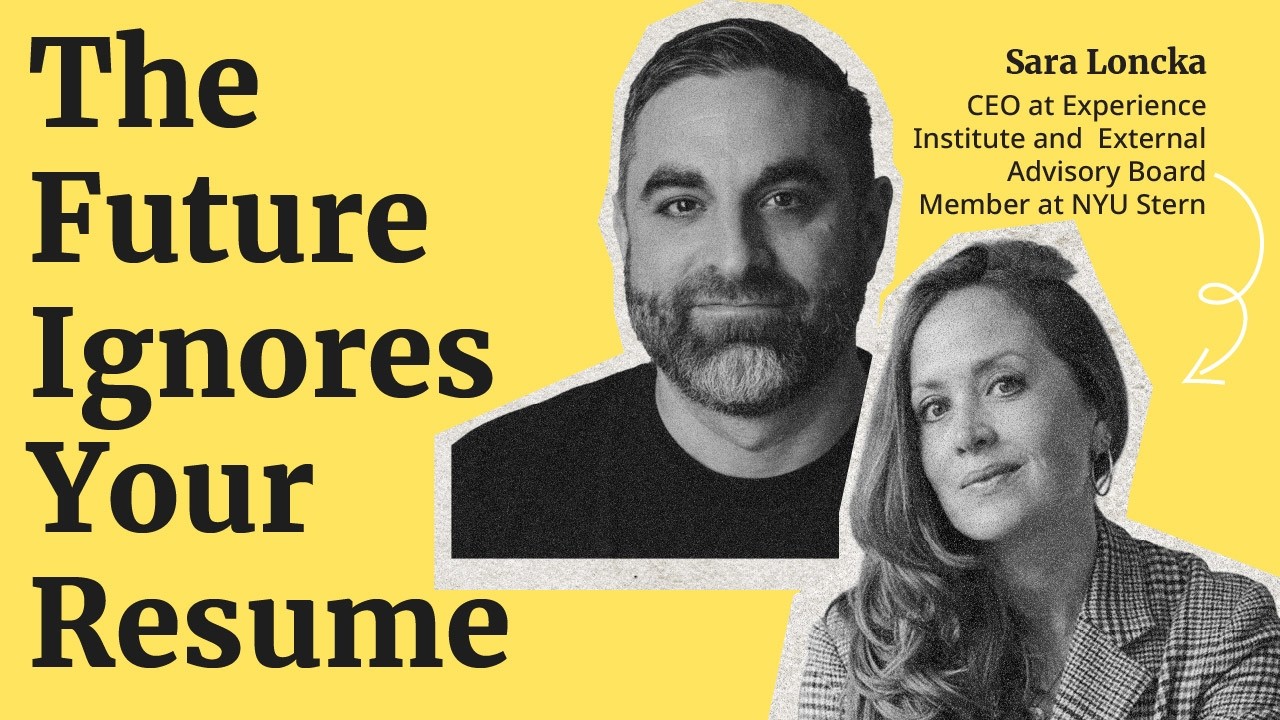
Sara Loncka is the CEO of Experience Institute and an External Advisory Board Member at NYU Stern, where she helps shape the future of learning, workforce development, and experiential education. With a background spanning higher education innovation, organizational strategy, and leadership development, Sara is passionate about reimagining how people build meaningful careers through applied learning and real-world experience. She is a recognized voice on the future of work, human-centered leadership, and lifelong learning, helping organizations and institutions bridge the gap between education and evolving workforce needs.
Related Links:
- Join the People Managing People Community
- Subscribe to the newsletter to get our latest articles and podcasts
- Connect with Sara on LinkedIn
- Visit Experience Institute and NYU Stern
Related articles and podcasts:
David Rice: When does past experience lose its value for making decisions about the future? That's the definition of discontinuity. And Sara Loncka thinks most of us are living in a moment of discontinuity right now, whether we've realized it or not. On today's show, I'm talking with Sara about why the most successful leaders are having the hardest time with this moment.
You've been rewarded your whole career for being right. You built confidence by applying the same mental models over and over, and now those models are actively working against you in some cases. You're still carrying the map, but the terrain has completely changed. The thing is, leaders aren't strangers to friction.
You roll out a new strategy, you experience resistance. But you work harder, leverage stakeholders, shift messaging, and keep trying. That's what you've always done. So when your AI framework stops working six months after you built it, when your transformation effort keeps coming up short, it doesn't necessarily register as a signal that you're applying the old map to new territory.
It just feels like normal friction. Sara calls this the expertise trap. You stop treating your ideas as hypothesis and start treating them as facts, and there's a lot to lose when you've been right for a long time. What she's proposing instead is what she calls strategic sensemaking, moving away from strategy based on historical data and treating every decision as an experiment.
So on today's show, we're gonna cover why discontinuity is different from disruption or transformation; the expertise trap, when being right repeatedly actually makes you wrong; strategic sensemaking versus traditional strategy; and why leaders need to understand design principles to redesign work.
I'm David Rice. This is People Managing People. And if you've been treating this moment like a normal change you just need to push through harder, this conversation will hopefully reframe what's actually required. Let's get into it.
So Sara, welcome to the show.
Sara Loncka: Thanks, David. Glad to be here.
David Rice: Absolutely. So we met at Transform recently, and we were to have a sort of a wide-ranging chat.
But you've been using this term discontinuity instead of disruption or transformation, right? I'm curious, you know, what's the difference between those things? And sort of more importantly, like, how do leaders know when they're actually in a discontinuity moment rather than just dealing with normal change?
Sara Loncka: Well, I'll start by saying that I think most of us are in a moment of discontinuity, regardless of what industry or what place in life we are in. But I'll make that argument clear momentarily. At its root level, just some base understanding, discontinuity is when past experience loses its value for making decisions about the future.
So let me break that down a little bit. Right now, we are, as a society, experiencing fundamental breaks in the way that things work, in the way that things have worked in the past. When we've experienced things like disruption, oftentimes disruption is one instance. It's something that kind of breaks the way that things are working.
Think COVID perhaps. But we also can have a general assumption that things will go back in some ways to the way that things were. Now, that wasn't necessarily the case with COVID, but I think most people operated with the assumption is, as soon as we're through this, we'll go back to a semblance of what was.
Transformation, oftentimes there's a predictable arc, so we know what we're trying to shift. We're trying to make a new world, but we're having a little bit more control over that. Discontinuity is representing just some permanent breaks in the way that things work that are saying we're not going back to the way things are, so we actually have to actively challenge the past experiences that we've used in order to make decisions to make better decisions for the future.
David Rice: Yeah, it feels like, you know, obviously we have the AI moment of discontinuity, but I'm hoping that we're just limited to that. Maybe other things will go back to normal. Just kidding, that's not happening,
Sara Loncka: i'm optimistic, David. I hope so too in some ways.
David Rice: It sounds to me a little bit like, you know, discontinuity isn't just change, sort of when your mental model for something breaks.
You know, like you're using the same map, but the terrain has gone in another direction, right?
Sara Loncka: 100%, well said. And I would say, yeah, that is what the major risk is that we are... I think especially for leaders who've had a lot of success, you've just constantly been affirmed and reaffirmed that your mental model is correct or is good or is best or is smart And so that's why oftentimes we're seeing people that have high degrees of success in leadership actually having the most challenge with this time because what they've relied on in the past to get them to where they are is actually actively, in many ways, working against them.
Because you're right, they're so attached to the map. It's, you know, the map is still there present with them, but the territory has totally changed, so they can't apply the same map to it.
David Rice: Yeah. I think, like even some, they might just like, "Well, this is normal change." You know, a lot of leaders feel like this is a normal change or, you know, we've gone through these types of things before, but I think you were...
There's actually, this moment is a lot more disorienting and probably that explains why some of these transformation efforts feel so frustrating, right? 'Cause they're not really solving the bigger problem, so to speak. You describe these moments where like really smart, capable teams, they keep reaching for the same playbook, they come up short.
I'm curious, you know, like why is it so hard for experienced leaders to recognize when their instincts that, you know, obviously they've built a lot of success on, but once it's no longer serving them, how come they can't recognize that?
Sara Loncka: I mean, I think we kind of just covered that, right? It's, there's a lot to lose when you have been right for a long time.
So I think part of it is that there's just this set of assumptions that oftentimes people are working with and this is the way that the world works, and leaders get to the top by being right repeatedly, and that builds a lot of confidence. It builds a lot of confidence and those are positive things.
But I think what happens is that we stop thinking about ideas as hypotheses, and we start thinking about them as facts. And so oftentimes too, you know, leaders are not strangers to friction. So I have a new strategy, I have a new product, I have a new way of implementing a process change in the world. I'm gonna put that out and I'm experiencing some friction.
Well, that doesn't necessarily register as a signal that I'm applying the old map to this new territory. That could just sort of represent what they've experienced in the past as well, which is like, I have to work harder, I have to leverage my stakeholders, I have to shift the messaging, I have to keep trying.
Versus maybe taking a step back and thinking like, "Oh, actually, this is a signal that perhaps this is not the right approach for right now." That's really disorienting. That's really challenging, I think, for a lot of leaders, and it's not something that we've rewarded as a society often.
David Rice: Yeah. That's interesting too, 'cause like I'm thinking about all these frameworks that we're seeing right now with AI, right?
As somebody develops a framework and then like the next rollout of the technology essentially changes that same thing. It's like, like, you know what I mean? Like the event, essentially You know, like you said, or you've done this thing, you got rewarded for it because it worked, but then the environment changed.
That's what I'm seeing right now is like the environment changed again, and the thing that worked six months ago is now struggling or is not as important as it was. How do you begin to sort of keep your-- Because I think we've talked about like the expertise trap, but I think like how do you keep it so flexible that it almost isn't really...
It's just always evolving and always sort of staying in a place where you're trying to read the tea leaves. You're not necessarily pulling on past experiences all the time, right?
Sara Loncka: Yeah. I mean, two thoughts. I think like one of the things that you're talking about is why companies are having such a hard time with a lot of AI enablement and adoption because it is.
It's like as soon as you get people technically trained around something, then the technicalities of it have shifted. And so it's like, okay, how do I keep up with this? I mean, that's what we're working with a lot of teams to do is instead of moving forward with... You can almost look at it as like a shift in how we do strategy.
I'm not saying that strategy is now bad or we should cease doing it altogether. But oftentimes strategy as well is based on, let's look at historical data, let's look at what's worked, let's look at so obviously some market signals, and let's set a plan in place that we're gonna commit to and push forward.
And I think the adjustment to this process needs to be less about setting a plan and implementing it and more about living in continuous inquiry. And so I think that's sort of the answer to what we're saying here too, which is like, okay, how do I as a leader of any level or just as a person in the world right now, honestly, become more aware of the assumptions that I'm holding, period.
And oftentimes we're not even clear about the assumptions we're using or leaning on or the specific past experiences we're leveraging that are creating sort of the thoughts in our minds that are then creating the strategies that are then creating the playbooks. So I think one of the biggest things is being able to have that pause and that reflection moment and that real self-inquiry and inquiry of the team too about like, what are we actually-- what truths are we operating from here, and how do we know those things are true or How do we know they're not true?
And how do we forge perhaps new assumptions or hypotheses and test those? And what signals do we need to be aware of if we experience them that sort of tell us like, "Okay, this isn't the right assumption or this isn't the right strategy or plan"?
David Rice: I don't wanna make it sound like we throw expertise out altogether, right?
Like, that's not realistic. But I wonder about expertise sort of becoming a filter and it's like, it's not just what you see, but what you don't see based on your expertise, and you're sort of those experiences that have informed what you know good looks like. And we talk about that all the time, right?
Like people-- How is the next generation gonna know what a good AI output is, right? We have that conversation. And it's the same thing in leadership, like when you see sort of the same trends unfolding, you don't wanna like filter it out because you think like, "Well, that's not relevant anymore." Your experience still has value, and it should still inform what you're doing.
I'm just not sure it's the only thing now, right?
Sara Loncka: Yeah. No-
David Rice: There's so much context that goes into everything now.
Sara Loncka: That's exactly it and you know, often when our team is having conversations with leaders about this, you can see people like, "Ooh," when we say, "Well, past experience has no relevance for future decisions," you know?
And they're like, "Okay, are you saying I need to unlearn everything that I've learned and put my career and life towards?" And it's not that However, I think most people have an over-reliance on that experience, and that's what we're trying to push against by saying just like, "Hey, let's have some deeper awareness of the fact that we are overly relying on a set of assumptions and experiences in a world that really doesn't exist anymore.
And so how can you put those sort of touchpoints in place to make sure you're really challenging those actively?" At Transform, I don't know if you heard some of these conversations or there was a lot around, you know, what are the most important skills for today's leader and which is always a hot topic no matter what HR conference you go to.
But the one that I kept hearing was learning agility, was people that are really able to learn how to learn and have that practice and have that as part of their workflow. And I think like what we're talking about is not exactly the same by any means, but they're complimentary. It's just saying like, how do you ensure that even at the highest levels, people are curious about themselves, about others.
They're not just making decisions from their sort of isolated perspective, but they're really actively challenging that as well.
David Rice: Yeah. Learning agility, and the other one I have kept hearing a lot was empathy. The next thing w- would always be said was, that's not like a fufu type thing, you know, like a soft type thing.
And I was like, we shouldn't have to justify having empathy, but-
Sara Loncka: But okay ...
David Rice: this is the world that we're in. We just have to.
Sara Loncka: Exactly. Yeah.
David Rice: You know, I guess I just gotta let it happen.
Sara Loncka: Just be glad it's there, David.
David Rice: Yeah. Yeah. The fact that we are at least mentioning it, giving it an honorable mention is something.
Well, a lot of strategy is built on, you know, what we know and what we've experienced, like we've been saying, and that assumption that the future will resemble the past, right? But so in the discontinuous environment, a lot of that goes out the window, and we're seeing in our workplaces right now that's happening.
A lot of tools, these tools that we make are built to project or predict based on what has happened, right? Not necessarily what is happening right now. So I guess when you said earlier like we gotta rethink why we do strategy, like what does strategy even look like when we don't have predictability to sort of rely on?
Sara Loncka: Yeah, that's a great question. Also, I'll just say that I'm not a management consultant or a strategy consultant. I'm a learning expert, so that's the perspective I'm bringing to this. So with that caveat, I think it's pointing back to a little bit of what I said earlier, which it's We put so much emphasis as strategy being about knowing where we're going and about communicating clarity, and I think leaders have a lot of pressure to communicate that clarity.
But I've also seen conversations, and I've been encouraged by them about how right now it's actually more important or it-- more equally, it's highly relevant for leaders to be able to own that they don't have full clarity, but that they're still moving forward. And it's more about saying, "Okay, what are the things that we do know to be true right now?
And how do we know that those things are true? And how will we know when those truths change? What signals will we receive? And then what's sort of our process as a team to address that versus just sort of digging our heels in? How do we know-- Or what does it look like for us to pivot?" I mean, at its root, now strategy is more about building an organization that both knows when and how to change course if they need to, which is a really different framework and design problem than I think many of us were trained to when we considered strategy.
So it's really that, I think that relationship with inquiry that we were talking about earlier. I think another interesting part about strategy generally is that we're pretty good at thinking about like why did this thing go wrong, but we're often not that great about saying why did this thing go well or why did this work and breaking that down as well to sort of decipher some of those signals or those quote truths.
David Rice: It's interesting 'cause like I think so much of strategy has been about reducing uncertainty. Like you said, we kept hearing about it in conference and different things like in this environment you're not ever gonna eliminate uncertainty. You just have to like work with it.
Sara Loncka: Yeah. Yeah.
David Rice: And pretending like you have answers is not playing well at the moment. We keep hearing that.
Sara Loncka: Yeah.
David Rice: I think it's where a lot of this friction comes from. Like you try to force clarity whether it doesn't exist because you know that people want clarity and there's a desire for it. But I think it's a little, I guess, overambitious to think that you can provide it. You know what I mean?
Sara Loncka: Yeah, entirely, right? Like so I'll just take my company and my team. A few years ago we used to kick off each year with a five-year plan and then ladder that to a three-year plan and then ladder that to a one-year plan and then ladder that to a quarterly plan with our KPIs and our indicators of what the, based on what the market has wanted and what we think it will need this year and where it's shifting.
Flash forward to this January and we're basically operating our strategy as a set of hypotheses and experiments. So you know, here's who we are as a company, here's our mission here's our vision and our purpose in the world. That's not shifting. We're certainly looking at some of the data points from last year.
What are clients interested in? How are clients finding us? All of that. But then we're making a set of three to five hypotheses to take us through the quarter, and then we just checked in on this last quarter and said, "Okay, which of these hypotheses do we wanna keep operating from?" Which feel like great, we tested that and here's the data that's pointing us in a different direction.
But, you know, I run a small company, so I have the privilege of being more nimble, I think, than like a Fortune 500 or 100 who needs to set something certainly more solid than that. But I think figuring out how to adopt that mindset and use that as part of the way that you proceed with that quote clarity then your clarity can be a little bit more flexible and you can bring people in on that.
And like the clarity is, "Hey, this is something that we think might work. Let's try this together. Let's see how it goes, and let's reflect and then pivot."
David Rice: One of the things that you pointed out, I've seen you talk about a little bit in the past, is that like discontinuity can't be just solved by like smarter individuals, right?
It requires a different kind of collective intelligence. So I guess the natural question is like what changes when teams shift from relying on that individual expertise to building more of a shared understanding? And then do you think the stress and skill demands of this moment, do you think it's creating a greater appetite for collective intelligence than maybe we had 10 years ago?
'Cause I don't remember anybody talking about this in 2016, to be honest.
Sara Loncka: No. Yeah, that's a great question. I mean, I think in so many ways, even in pop culture, we have an obsession with a knight in shining armor. You know, like the one person who can come in and save the day, like the hero's journey, the hero's story that's represented across.
And so it's not just a necessary, I think, pivot for teams and companies to do, but it's a challenging, I think, shift for us to consider in our minds. Like, we wanna be the hero or we wanna work for the hero, or we wanna see the hero succeed. So I think your second question, no, I don't think, I don't think until it's necessary it's gonna become something that people are really pursuing as a collective.
Maybe there'll be individual po- there are individual pockets of it. But really when I think about collective intelligence, you're right. It's like we're really good at collaborating, but collaborating is still experts coming to a room. You've got the marketing head, you've got the product head, you've got the operations head, and they're all coming to the room.
They're all offering their expertise, and then they're like, "Okay, where-- how can we learn from each other's experience and expertise to think of a way forward?" And collective intelligence is different because what it's relying on is actually the friction that comes from those conversations versus the building upon, and then ideally outputs a perspective that could not have existed without that group of people, and not just taking sort of like the one smartest person's idea or a combination of the two smartest people's idea in the room.
And it also introduces different hierarchical levels as well into the space to say expertise can be helpful certainly, and experience can be helpful, but actually we need the perspective of folks that are more on the ground or in mid-level organization. There's another panel at Transform, of course, they're all gonna get mixed in my mind, but maybe you were here for this one too.
But she was talking about the importance of frontline workers sharing their experiences and their perspectives to senior leadership because oftentimes senior leadership is, you know, their map is very different than the map of those that are doing the groundwork. And so even having those perspectives in that conversation is really helpful.
David Rice: I've heard that a little bit recently. There's been a big emphasis on frontline workers and being able to learn from that experience. It's interesting 'cause like we s- yeah, we spent decades probably optimizing for sort of like individual performance and brilliance But I think that if anything, this current time sort of shows, like I've been hearing more and more about community, for example, in the last two years than I heard for probably my whole life, to be honest with you.
I think the reason is it's sort of the moment is exposing the limits of like the individual brilliance and sort of that single leader that can take us to the promised land kind of mentality. I think no one person can hold enough context at this point to be able to truly do that, and I think you're getting at, you know, the real advantage now is how well can we make sense of all this together?
And that's a way different skill set than most organizations have traditionally rewarded and certainly ever tried to develop.
Sara Loncka: And your word rewarded is a really important part about that because I think it's now it's gonna have to also come back to talent strategy and how folks are rewarded versus them being excellent in individual contributors.
What does it look like to contribute to a team, and how do you measure s- team success differently? So from a talent perspective, there have been organizations that have spent the last 20 years really perfecting their approach to attracting and retaining that kind of talent, and it's competitive comp, it's the strong culture, it's all these perks, it's career ladders, and that's really calling to individuals that are excellent, and I think that worked for a long time.
And then even just look at that space in, in regards to discontinuity, it was like COVID and remote work, then AI and a generational shift. And so it's like we created this playbook that was supposed to really support this current iteration of talent and what talent needs, and then these three huge things have happened, and now that whole playbook has to be reconsidered and regenerated 'cause we're solving for a problem that has totally essentially changed its shape.
David Rice: Yeah, totally. Well, let me ask you this. If I'm a leader listening to this and I've had my moment of realization, right? I've come out from under my rock, and now you've convinced me that we're in one of these moments, right? What's the first thing I should stop doing, and what's the first thing I should start doing differently?
Sara Loncka: Yeah. Hopefully they're conv- hopefully they're not too disheartened. They're like, "Okay, I feel entertained by this."
David Rice: I mean, if they've just realized it, then they may even-
Sara Loncka: Yeah. Yeah, we have a lot of conversations that just start with like, "Hey, we're just gonna see if this problem resonates with you." And oftentimes, honestly what we're finding is-- and the first time that I even became really engrossed in this work through the partner that we're working with, I remember having this experience of like you are putting words to what I have felt and not been able to name for a long time, and that is the response we keep getting, which is like, "Yes, but I didn't know what to call it."
'Cause you're right, like it's not change, it's not disruption, it's not transformation. It's unfamiliar, but there are familiar elements to it. So anyway, to answer your question, I think the first thing Is just to stop explaining away the friction and making excuses just to sort of sit and own that this is a different and really challenging time.
And then I think after that, it depends on, you know, where you are in that organization. But I think one really important thing for leaders to do is some of the work that we talked about earlier, which is just like even on an individual level, thinking what are some of the assumptions that I'm currently operating from in the way that my business works, the way that my team works, and the way that I'm approaching this challenge?
How often am I having conversations with myself about this? How often am I actively having my team have conversations about this with themselves and with each other? So I think oftentimes the thing that leaders wanna do is shrink the discomfort or provide that clarity or explain away the challenges.
And I'd say like, that's a dangerous thing to do, is like don't-- resist the temptation to do all that. And instead even name the tension, name the discomfort, name, name it this is a different time. And then begin to start those conversations about what would it look like if we approached our work differently.
David Rice: Yeah. It's like obviously it's a big shift to let go of the idea of certainty. And so like we always say, create space to explore. So I think to a lot of leaders it's like, "What are you talking about when I say, you know, like, well, that doesn't make any sense." But I look at leaders like in L&D right now, for example, right?
And in some cases they're having to just like let go of the business model that they had and just go, "Well, why don't we just see if we can do this?" And that sounds a little bit crazy. You're a CEO or you know, you're a high level manager in one of these organizations. You've grown through this expertise and you think like, well, we created this really successful business, but now this thing has come along that is forcing you to reinvent yourself.
And it's scary. But the thing I think we can all take comfort is we're not alone. Like, there's so many of us going through this at the same time. So it's not really the time to like try to layer old assumptions onto a new approach. You just gotta go, let's see what happens. Let's be a little bit flexible and let's have a few irons in the fire.
You know? Like, and that's not always like how businesses were taught. I mean, they don't teach any of this stuff in business school, right? So-
Sara Loncka: Right. They don't teach old models in business school.
David Rice: Yeah, exactly. So this is a time where it just feels like everything's breaking and you don't know where the glue is.
Sara Loncka: Yeah. Yeah. Well, you said something earlier I think that applies to this, which is community. And I think, I mean, I work in the L&D space, that's many of our clients. And often when you're L&D or just like in the people space, which is why I think people flock to experiences like Transform- Is that you spend so much time taking care of other people and thinking about the individuals in your organization just to even have that care for yourself and to be able to connect with other people who are asking and struggling through some of these same challenges.
I mean, for the people leader community, you just think about some of the things I named earlier, the amount of stuff that has been on their plate in the last six years with COVID now AI. I mean, how many chief people officers did you see it transform that now are chief people and AI transformation? It's like we found that those two things have to go together.
So there's just been... And then the generational divide, you know, having the most amount of generations in the workplace that we've ever had. So there are some huge things that are on the plates of people And I think being able to, like you said, sort of first realize we're not alone in navigating this new world.
But then secondly, not only acknowledging that, like where are the groups that I can be connected to or where are the people that I can reach out to? Because that in itself, I think I heard echoed in the hallways, which is like, I'm just so glad that other people are feeling this way because I didn't know people were, or-
David Rice: Yeah, you hear a lot of that.
Sara Loncka: Yeah. Well, I mean, I think you said something about L&D, which made me think for so long our leadership confidence models have been developed too on that like singular leader framework of like, how do we develop really fantastic individual leaders? And so there's a real challenge I think that's confronting the L&D industry and saying not just the individual programs perhaps that you roll out, but like all of the frameworks and competencies are gonna need to be reconsidered.
But at the same time, they're like, "Okay, great, I can reconsider those", but like what has to replace them? Because also we can't get our feet on solid ground in order to map that out. I think there's a lot of challenge there, so.
David Rice: Well, I mean, there's like it never ends, right? 'Cause it's like that's on the leadership side and on the entry-level side, we have to start thinking differently about how we set these people up for success and what do the roles look like.
And I was talking to somebody earlier today, and I was saying like I said this when I did my first episode of this podcast, but one thing I still come back to all the time is eventually like the apprenticeship model, where essentially you pay somebody to train and be on the job learning and being in different business functions, and you have like a sort of apprentice model that they follow.
I don't see another way right now to create that like T-shaped or M-shaped, we're telling now, you know, professional that's gonna be really impactful in this next era.
Sara Loncka: Yeah. Our-- actually, our company has roots in apprenticeship models, and so a big believer over here and also learning by doing. And I know that there's like some real structural blocks for many companies to integrate something as significant as an apprenticeship program.
So I think for those if somehow there's this thing like, oh, that'd be nice, but I can't, like I would offer something smaller. Like how do you create learning experiences where people can self-design their own projects that take them out of their day-to-day and integrate them in other departments so they can stay in their role that they've hired, but the way that you're running these projects require them to take more of a cross-functional and experimental lens.
So that way they're still stretching themselves, but they're still also connecting to the business outcomes. We run a lot of programs that do just that, and it's a way to kind of find that middle ground between we can't take people out of their day-to-days for a significant amount of time, but we do need to take them out of the way that they approach problems or the way that they are siloed in their department, et cetera.
And that honestly, I mean, you're talking about early career, which I think is really important, but I also think as people get later in their career quickly-
David Rice: That's across the board ...
Sara Loncka: yeah, it's like because they get more entrenched, right? So-
David Rice: Well, it's like we always talk about like the things that you were always rewarded for.
So you were-- you've become trained mentally to be, oh, these are-- these tasks have value. This is where my value is, and this is what I get rewarded for. And like we're all having to go, well, maybe, 'cause I don't know if I'm gonna get rewarded for that much longer. And so yeah, it's like the flexibility has to be from top to bottom. We have to create that environment.
Sara Loncka: Yeah. And I think, you know, what we've-- I've been talking a lot about, oh, challenge your assumptions and all that, and I think similar, you made a remark earlier around like, I can't remember exactly what you said, but like explore or something like that. It's like these, like, really nice to have, like abstract pieces of advice.
Yeah, that would be great, but how do I actively challenge my assumptions? Like- ... hopefully I gave a little bit of insight to that, but I think there are real programmatic structural things that you can do to help people develop the mindsets and abilities to actively challenge their assumptions. I think simply one in, in a program that we run is taking people completely out of their context.
So we're not just talking about your role, we're talking about your industry, and thinking about, okay, if I have an innovation challenge at hand, what can I learn about how other industries handle innovation? How can I like completely... You know, 'cause we just come with so many preconceived notions when it's something that we know, so how can you take people completely out of that container of what they know and put them in something different so that they're looking at it freshly?
I think that's one. And then there are other-- I used to run a nonpartisan political fellowship that was geared to train folks that wanted to come into elected office eventually, but with the idea that they needed to have exposure, deep exposure to multiple sectors in order to make cross-functional decisions that had implications beyond just what they were doing.
And that is what we spent nine months doing, was getting them out of their comfort zones, getting them into various industries and sectors, thinking about systems like how does the water get to my faucet? And really understanding all of the touch points there. So it's just ways to almost disrupt, like we're on this hamster wheel of thought and life and work And how do you put those small little wedges in there purposely to have people look up and stop and think, "Oh, whoa, how did I arrive here?"
Or, "How does water get to my faucet?" Or, "How did I come to this decision?" Or, "What would this other industry say about this challenge that I'm experiencing right now?" And I think developing those types of mindsets and practices are gonna be really important moving forward.
David Rice: Yeah, you know, it's funny you just said that, and it made me think, like, 'cause I-- there's a book called The Design of Everyday Things.
I had to read it for something I was working on years ago. But I saw it in my phone the other day, and it made me think about, you know, really paying attention to things again, like the-- how a door is designed or how, you know, like, basic things that even-- the faucet. How you-- that works on a mechanical level.
And how-- why did they decide to make the levers move like this? And... But what-- It's funny what you just said, is I'm like, what we need to get back to is for leaders, you've got to understand some design principles 'cause we-- if you're-- you can't redesign the future of work if you're not familiar with at least the principles of, like, how this mechanism is gonna go in the future.
And all of that is changing really fast, but it's important that you kinda, like, keep your hand on the lever a little bit.
Sara Loncka: Yeah. '
David Rice: Cause we can control the pace of it.
Sara Loncka: Yeah, when you were talking too, I was thinking probably because I'm about to have my first child, and that is one of the things when people are asking me, "What are you most excited about?"
And probably because I'm so entrenched in this work, I'm like, "Oh, I'm so excited to h- be forced to see the world in a different way." And there are so few experiences I think we have in life that truly force us to see the world in a different way. It is hard to just intellectualize that. It's like you have to have either a, like, profound travel experience or, unfortunately, something catastrophic or something really positive like the birth of a child or a new relationship, et cetera, a move.
Like, there's these things that are sort of like touchstones that create that. But oftentimes, you can go years without something like that happening. So it's like, to your point, how do you install maybe engaging in, in design again or engaging in basically things that just take us out of our zones of comfort and our zones of knowing and make us think differently?
And even just-- even if it's not about the thing that we're thinking differently about, just the practice of having to do that is really important.
David Rice: Absolutely. Well, Sara, thanks for coming on the show today. I've been-- It's been great chatting with you.
Sara Loncka: Oh, my pleasure. It's been really fun. I can talk about this stuff all day, anytime.
David Rice: Absolutely. Well, it was great catching up with you at Transform as well, and hope to see you at the next one.
Sara Loncka: Sounds good. Take care, David.
David Rice: All right listeners, if you haven't done so already, make sure you get on over to peoplemanagingpeople.com/subscribe. Get signed up for the newsletter. You'll get all this content straight to your inbox.
And until next time, sit down and go back to the basics of design.

