

What AI Surveillance Can’t Tell You About Your Employees
Nobody sets out to build a workforce surveillance system. It usually arrives dressed up as optimization, productivity, wellness, or efficiency. But as AI makes it possible to monitor everything from keystrokes and mouse movements to emotions and physical behavior, the line between legitimate measurement and invasive surveillance gets harder to ignore.
In this episode, I speak with Lynn Parramore, Director of Special Projects at the Institute for New Economic Thinking, about what gets lost when leaders assume everything valuable at work can be measured. We dig into why constant monitoring erodes trust, how algorithms strip context from human behavior, why younger workers have good reason to be skeptical of AI, and why leaders need to get philosophical—not just practical—about where this technology belongs.
What You’ll Learn
- How to distinguish legitimate workplace monitoring from invasive surveillance
- Why more employee data doesn’t necessarily produce better management decisions
- How continuous monitoring can undermine trust, psychological safety, and intrinsic motivation
- Why algorithms struggle with intent, judgment, context, creativity, and tacit knowledge
- How involving employees in decisions about monitoring can lead to better outcomes
- Why AI adoption requires leaders to consider ethical and societal consequences, not just efficiency
Key Takeaways
- Measure for a legitimate purpose, not because you can. Monitoring can make sense when it’s narrowly connected to safety, ergonomics, cybersecurity, or another clear need. Collecting data simply because the technology allows it is how optimization quietly turns into surveillance.
- More visibility can mean less trust. Constant monitoring sends an implicit message: we don’t trust you unless we can verify you. That’s a costly trade when trust underpins engagement, innovation, retention, and people’s willingness to exercise judgment.
- Data captures behavior. It doesn’t necessarily explain it. An employee taking longer on a customer call might look inefficient to an algorithm while actually doing exactly what you want: sticking with a difficult problem until it’s solved. Information without context isn’t understanding.
- Human value doesn’t fit neatly on a dashboard. Helping a colleague, thinking through a difficult problem, showing moral courage, exercising good judgment, or simply staring into space while an idea comes together can all look like unproductive time. Sometimes the spreadsheet is wrong, not the employee.
- People will optimize around surveillance, too. Frederick Taylor’s workers messed with his clocks. Modern workers use mouse jigglers—and apparently even strategically placed pineapples. When the metric becomes the job, people learn to satisfy the metric.
- Keep humans capable of overriding the machine. An algorithm should be an aide, not an invisible supervisor. When employees can’t challenge automated assessments—even when their professional judgment tells them the system is wrong—you aren’t augmenting expertise. You’re overriding it.
- AI skepticism isn’t necessarily anti-technology. Younger workers grew up surrounded by technology and have also watched companies collect their data, break promises, and reshape their lives around business models they didn’t choose. Leaders shouldn’t dismiss that skepticism. They should earn the trust they’re asking for.
- Know when to hit pause. Moving fastest isn’t automatically the same thing as leading well. If you don’t understand the consequences of an AI system—on workers, communities, or society—slowing down can be the more intelligent business decision.
Chapters
- 00:00 — When Monitoring Becomes Surveillance
- 02:31 — Drawing the Line
- 04:58 — The Panopticon at Work
- 07:33 — Tracking Employee Emotions
- 09:43 — What Data Can’t Measure
- 11:54 — The Cost of Constant Monitoring
- 15:00 — Information vs. Understanding
- 17:33 — The Rise of Workplace Surveillance
- 21:08 — Gaming the System
- 23:57 — What Algorithms Can’t See
- 27:12 — Trust Requires Uncertainty
- 28:27 — AI as an Invisible Supervisor
- 31:12 — The Ethics of AI
- 34:04 — Gen Z’s AI Skepticism
- 37:12 — Algorithms vs. Human Judgment
- 40:21 — Supporting Workers Through AI
- 45:07 — What Are Corporations For?
- 47:02 — Knowing When to Pause
Meet Our Guest
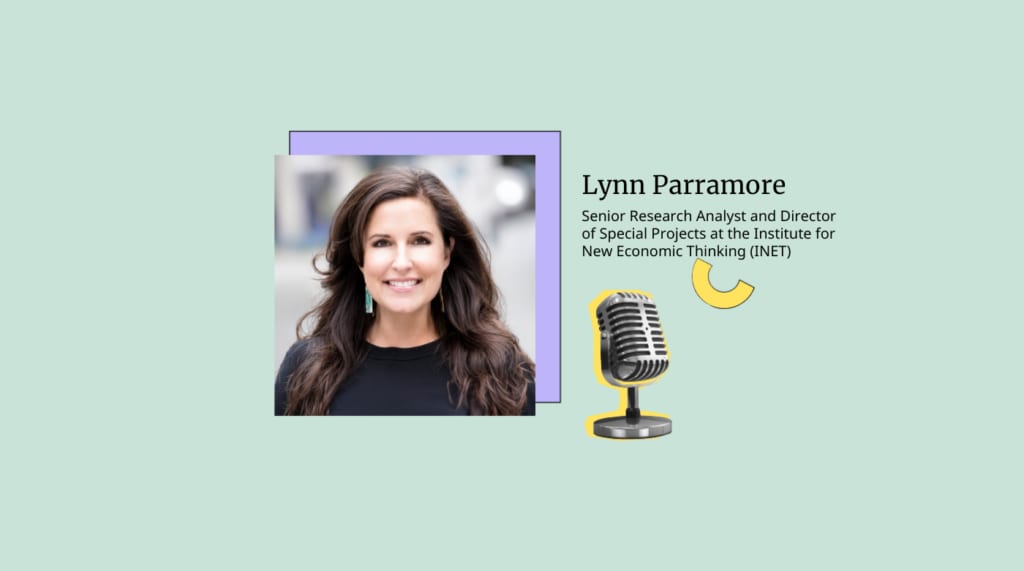
Lynn Parramore is a Senior Research Analyst and Director of Special Projects at the Institute for New Economic Thinking (INET), where she explores the connections between economics, history, culture, and psychology. A cultural historian, author, and journalist, she translates complex economic research into accessible narratives about inequality, corporate power, work, and economic justice. Lynn holds a Ph.D. from New York University and is the author of Reading the Sphinx and co-editor of How the Occupy Movement Is Changing America. Her commentary and writing have appeared across major media outlets, bringing a multidisciplinary perspective to debates about the economy and its impact on everyday life.
Related Links:
- Join the People Managing People Community
- Subscribe to the newsletter to get our latest articles and podcasts
- Connect with Lynn on LinkedIn
- Check out Lynn’s book — Reading the Sphinx: Ancient Egypt in Nineteenth-Century Literary Culture
Related articles and podcasts:
David Rice: Nobody really sets out to build a workforce surveillance system. It starts as optimization, productivity improvement, time management. Sounds inherently positive, right? And then gradually, without anyone making a conscious decision, you've crossed a line. On today's show, I'm talking with Lynn Parramore, Director of Special Projects at the Institute for New Economic Thinking, about where that line is and why AI is making it harder to see.
Lynn's central argument is that workplace monitoring rests on a flawed assumption, that everything important at work is measurable. Helping a colleague, good judgment, moral courage, creativity, none of that shows up in a keystroke log, but those are often what makes someone genuinely valuable. When you start reducing people to collections of data points, you change what you're actually managing.
And surveillance isn't neutral. The moment you decide to watch someone constantly, you've already made an assumption about them, and employees feel that. It erodes trust. And trust, as Lynn points out, is the linchpin to everything else: engagement, innovation, retention. So today we're covering where legitimate monitoring ends and surveillance begins, why the assumption that everything important is measurable is flawed, the inverse relationship between monitoring intensity and trust, and why leaders need to be philosophical about AI, not just practical.
I'm David Rice. This is People Managing People, and if your organization has been treating workforce monitoring as a productivity tool, this conversation is worth your time. So let's get into it.
If you're a small business owner who's hiring your first employee, payroll can feel like a big step. QuickBooks Workforce helps make it easier by simplifying payroll, direct deposit, and employee record management all in one place. Your employees can access their own pay stubs and tax forms through a self-service portal, saving you time and paperwork. If you're ready to spend less time managing payroll and more time growing your business, check out QuickBooks Workforce.
Lynn, welcome to the show!
Lynn Parramore: Thanks for having me.
David Rice: We were talking before this, you know, we kinda mentioned we've always measured work in some way, one form or another, but AI is sort of fundamentally changing the scale and really the intimacy of what's possible.
I'm curious to get your opinion at what point does measuring work sorta stop being about improving performance, and then it just becomes surveillance?
Lynn Parramore: It's a question I think we're all wrestling with, both on the employee side and the employer side. And I guess I should start out by saying there are some good applications of algorithmic monitoring or AI-driven surveillance whatever you wanna call it.
You know, for example, fatigue detection. We could imagine a pilot using wearable devices to detect fatigue. I think most of us would agree, okay, that makes sense. There's AI devices that can work for ergonomic coaching. You know, if somebody is doing heavy lifting, it can detect what kinds of movements are gonna be more liable to produce injury.
You know, there are cybersecurity applications. So there are applications in which this stuff can be useful, and that it doesn't feel like an invasion of privacy. But, you know, it has to have a clear, legitimate purpose, number one, and you want the employer to be collecting only the necessary data, not saying it's for one thing and then collecting it for another.
You want it to be transparent to the employee about what's being collected, how it's being collected, how this data is being stored, and you want a human being kept involved in all the decision-making that might come from this data collection, whether it's promotion or whether it's discipline or termination.
And you don't wanna use it to automatically apply consequences. So that's where it gets into things that have become troubling for a lot of us. Things like constant webcam surveillance or collecting data on every single keystroke or mouse movement or taking screenshots every twenty seconds or something.
These are the kinds of applications that become, you know, move into the invasion-of-privacy category and can really have a negative impact on employee performance.
David Rice: It's interesting, right? This is Something that I feel like happens gradually. It starts out as I don't think anybody says at the start, we're gonna surveil our workforce, right?
It's like, let's improve productivity, let's focus on time management and all these other things, right? It sounds-- it's like optimization, so it sounds inherently positive, right? But eventually, it does sort of cross this line, and, and I wonder is it 'cause leaders become so focused on data they're collecting that they stop kind of asking whether they're collecting it is changing how people behave or worth collecting?
Lynn Parramore: Absolutely. And you know, it, it comes from this really human impulse that we kind of worry about what we can't see. I mean, that's just a, a natural human impulse. Employers have always had concerns about when they, you know, can't see what's going on, and it really goes back to changes that occurred with the Industrial Revolution.
If you-- let's say you were working in a cobbler's shop, you know, back before the Industrial Revolution, your boss is sitting right there, so that person can see what you're doing, and, you know, they might be looking over your shoulder, but there's not a big question about what's happening. But when you start having factories and you, you start having larger scale workforces, that's when employers begin to get a little concerned about what was going on beyond what they could see.
And, you know, in the late eighteenth century, that's when we get the idea of the panopticon that some people are familiar with. Jeremy Bentham, the philosopher, is associated with this. It was actually his brother, Samuel, who came up with the concept. He was working for a Russian statesman, and they were having this problem in factories.
People were getting drunk. They were getting into brawls. It was just chaos. So we gotta do something. So Samuel Bentham came up with this design for a factory where you would have a space in the middle where somebody could watch the employees who were situated, you know, in a circular fashion around that central observation tower, and they wouldn't necessarily know when they were being watched.
So it kinda kept everybody on their toes, and it did reduce some of this chaotic activity. Jeremy Bentham went on to create a, a similar design for a prison, and I think that's where the association gets a little bit uncomfortable. Wait, what are we being watched for, and for what purpose? And surveillance can kind of change the assumptions you have about people.
You know, it sort of moves from, "Oh, this is an employee working in good faith," to, "This is a person I have to watch at all times and control and monitor their behavior." And those are two different kinds of perspectives, and they have different effects on the employee, obviously. So, you know, it's a fine line, but nobody likes to feel like they're being monitored all the time and distrusted.
That reduces a feeling of psychological safety, and it has a number of negative consequences, and nobody wants to feel like they're in a prison when they're at work.
David Rice: Yeah, engagement is low enough, I mean, without feeling like you're in an actual jail. So, not gonna help.
Lynn Parramore: No, no. And you know, some of the advances in technology, you know, they've allowed us to monitor things on a more granular level and monitor things that we didn't really ever expect employers to be monitoring necessarily.
Emotion tracking is one of these very controversial areas. You might have wearable devices or other kinds of webcam monitoring and so on to detect things like emotions manifesting in voice or body movements, and it's really not very easy to imagine a situation in which that would be applied in a way that would make employees feel comfortable.
Maybe, let's say, a voluntary coaching problem. Let's say you're working on an emergency hotline, and it's really important for you to keep a calm demeanor during the call. Well, maybe during your training, you could volunteer to have assessments made by an AI program that detect how your emotional level is being sustained during the call.
But even that, you know, the key word would be voluntary, and this is not about disciplinary action. This is not about judging you as an employee because problems come in based on the fact that we don't all express emotions in the same way, depending on our gender, depending on our age, our ethnic background, our cultural background, all kinds of things.
And psychologists and sociologists have been studying this emotion-tracking data collection and find that it's not very accurate in many cases. So you really don't want judgments about employees being made, both because it's inaccurate and because it feels very invasive to the employee.
David Rice: Yeah, it's interesting.
I mean, we've had people on this show, you know, who come on and talk about sort of like a wellness angle to a lot of this. So organizations will justify it, saying that this is for well-being or even employee support, right? But you argue there's more-- there's almost an inverse relationship between this type of surveillance and trust, and that, of course, impacts people's well-being in, in a lot of ways.
What does measuring more often lead people to trust less? Or I guess why is what I mean to say. Why does that, that's the case?
Lynn Parramore: Yeah. I think it goes back to that idea that it's based on assumptions you have about the people that work for you. Are they showing up intending to do a good job? Are they coming in in good faith?
Or are they people that you want to watch all the time and, and, you know, micromanage their behavior and really turning them into collections of data points? And it goes back to this fundamental idea of, of what exactly is an employee or a worker? You know, are we just collections of data points? Is everything we do that's important at work something that can be measured?
You know, people that get a little over-enthusiastic about bossware or algorithmic monitoring and management, you know, sometimes carry the assumption that everything is measurable. Everything that's important that an employee would do is measurable. But, you know, guess what? Things like helping your fellow employee, that's maybe not measurable.
Having good judgment, having creativity, having moral courage. There are all kinds of things, what's often called tacit knowledge. This just cannot be measured, but all of these things are really important to having a good employee. So I think it... You know, sometimes the enthusiasm for this kind of monitoring, it pushes aside what actually makes a good employee.
David Rice: It's interesting 'cause the more we try to verify behaviors through technology, there's just less and less room for trust.
Lynn Parramore: Yeah.
David Rice: Right? So... And trust is, is incredibly hard to measure, but it underpins almost everything that we care about in terms of the workplace, right? Like engagement, innovation, retention, all these things.
Trust is the linchpin to that. And it's-- Once people start feeling like they're being evaluated all the time, especially by something that feels, like, omniscient, like it's everywhere, I have no idea where it actually is looking. You can't even optimize for a metric. Normally you'd be like, "Oh, I'm being measured on this, so I'm gonna optimize to meet that thing."
In this case, because it's got this omniscient feeling, it's like it's watching everything I do, and that just creates a ton of discomfort and a ton of "Why do you even wanna know that?" towards your employer. You know what I mean?
Lynn Parramore: Exactly. You know, and this is playing out in, in real-world scenarios.
JPMorgan Chase announced that they were introducing monitoring systems for their junior bankers. Now, they had had a problem with junior bankers keeping these crazy hours and there being a lot of expectation of them to work in a way that was causing a lot of stress and fatigue. Fair enough. So they introduced this program as a wellness tool, and that sounds really good, but when it's measuring every single keystroke that the employee makes and it's constant, that becomes a different thing, and employees are not necessarily happy about it.
And how do you consent to this kind of monitoring? I mean, is it really a choice when you sign up for the job, especially if you're the junior employee? What choice do you really have? So that also creates some tension. There is evidence that shows that far from increasing wellness, certain kinds of monitoring, especially that continuous monitoring, can increase stress.
It can increase anxiety, this kind of anticipatory stress. "Wait, if I'm idle at my computer for a few minutes just maybe thinking about a problem, am I gonna get flagged for that?" So there is this, you know, continual feeling of being watched, not knowing exactly how the information is gonna be used, not knowing if it's gonna be leaked somewhere.
There have been real-world cases of employee data being collected through algorithmic monitoring and that information getting leaked. There was a case in twenty twenty-five. There was a company called WorkComposer that made software that was to be installed on employee computers to monitor them, and that data got compromised It became publicly available and it wasn't supposed to be.
And, you know, some of that material was webcam raw footage of employees and what they were doing at work. Now, I don't think anybody wants to have that floating around in the public and used for whatever random purposes, and it can be an accidental data leakage, it can be a hacking. This information could be used for malicious purposes, and sometimes, you know, employers will say, "We're only gonna have access to this data in this one division," but then you find internal leaks that say, no, actually, it was used more broadly than that.
So this distrust kinda snowballs, and pretty soon you get a workforce that has lost intrinsic motivation, that, you know, feels less loyal to their employer and, and, you know, m- may end up looking for another job.
David Rice: When we were talking before this, you know, one thing that kinda really stood out to me was your point that algorithms, they can measure behavior, but they can't measure intent, judgment, context, and that's, I think, really important because If you're looking at everything I do, do you know why I do it?
You know what I mean? Like, how many people have felt like their boss doesn't really understand what they do? I think that's a very common feeling, right? And so it's like in a workplace where everything's increasingly data-driven, I'm curious, do you think are we starting to confuse what can be measured with what actually matters?
Lynn Parramore: Yeah, and also the question of just because you can measure it, should you be measuring it? And what are the unintended consequences of that measurement? You know, just a really simple example, there are monitoring systems that take note of how long a customer service representative spends on a call, and they get flagged if the calls are going over the amount of time that's specified as, as optimal.
But you know what? A good employee may stay extra time on a call with a customer because they have a really difficult problem to work through. And if they're being penalized for having longer calls, are they gonna start passing off that customer to someone else? Are they gonna just cut the call short?
And then pretty soon you're gonna have customer dissatisfaction as well as employee dissatisfaction. So there's never a one-size-fits-all, and that can be a problem too. What you're measuring doesn't take into account, again, intent, in that case, the intent of an employee to help a customer through a difficult problem, and it doesn't take into a-account context or nuance.
Maybe someone is having a bad day. It happens as an employee. Are you gonna get flagged for that? Is that data gonna show up on your employer's dashboard and penalize you in ways that maybe you can't even see? You don't even know exactly what day the data was collected and how it was collected and for what purpose.
And, you know, that just ultimately, I think, will result in a real breakdown of trust between employer and employee.
David Rice: Yeah, you mentioned nuance there, and I think it's just, to me, it's ever increasingly important in our world today because so much of how we talk about things and how we react to things lacks Nuance, but it's like this distinction between information and understanding.
It's super important. I don't know how many times we have to see a case where, you know, you think of-- I don't-- I'm a big true crime kinda guy. But how many times have we seen cases where behavior without context was incredibly misleading, and it just threw off the whole thing, and there's a miscarriage of justice because we got lured into looking at the wrong things.
And leadership has always been about interpreting nuance, you know, why something happened, not just that it happened. And I, I... Yeah, I think we're at a place, the way we talk about data almost kinda fetishize it in a way. And so there, there's this danger that leaders really mistake complete data for complete understanding when it's really just information.
Lynn Parramore: Absolutely. Some of this is rooted in a movement in the early 2000s. There was a fellow at MIT, Alex Pentland, who was developing wearable devices. And a lot of this came out of the military and of the world of sports. You could have a wearable device that would track how a pitcher is functioning on the field or how someone is getting exerted in a military operation.
Now, that is all really interesting data that can be useful and even beneficial to the person that's being measured. But, you know, to then transfer that kind of thing to the ordinary workforce to, let's say, some bank employees or customer service reps It doesn't always transfer the way you want it to or expect it to, or in a way that's actually beneficial.
And just the fact that a lot of this comes out of the military and prisons, as we mentioned, gives you a little bit of a flavor of how this can feel intrusive and invasive and problematic in the workplace. And, you know, people care about their privacy. As human beings, you know, we worry about we can't-- what we can't see, but we also worry about being seen too much.
The European Union has stronger laws applying to privacy as a fundamental right in the workplace, you know, and they have a lot more restrictions on data being collected. The employer really has to show a just cause, you know, as limited as possible. The data collection has to be very targeted and limited, and the worker has the right to push back or question or challenge the data that's being collected.
It has to be very transparent. In some cases, the employer has to consult with work councils or unions about how these programs are gonna be rolled out, and we have a much more fragmented, confusing situation in the United States. You know, we don't have a privacy at work law. There's this default assumption that a company, as long as they own the device, they can monitor you.
And that sort of became a creeping problem during the pandemic when more people were working from home and employers thought, "Hmm, this makes us awfully nervous about all these people working from their living room, so in some cases, we're just gonna attach a device to the company-owned laptop and monitor them all day long," and have programs that made them actually key in a reason if they're taking a bathroom break or a five-minute break So the pandemic became kind of an excuse to really increase this kind of monitoring and surveillance, and it happened so fast that the law really hasn't kept up with it, and I think we're behind.
And it's a fragmented system. It varies from state to state. In some states, like California, for example, or New York, where I live, there are restrictions. But in other states, it's a bit of a free-for-all, and there are all kinds of loopholes and exceptions about what the employer could do. But there's kind of an assumption if the employer owns the device, then they get to do whatever they want with that device.
And that is really becoming a problem.
David Rice: The pandemic was great 'cause, I mean, I like remote work as much as anyone, so it stood that up, but it came with some price tags, right? So, I mean, obviously the broader social ones, but yeah, this really did open up this can of worms in a way that, you know, we always just relied on a manager looking over somebody's shoulder before.
And now, there's so many different things that can be the eyes over the shoulder that it's
Lynn Parramore: Yeah. There's the question, what are you really measuring? If you're measuring how many sales were closed that day, does it really matter if someone took three bathroom breaks during the morning or not? I mean, what is the purpose of this data that's being collected?
And you know, if you go overboard with it or you're not transparent about it, employees will push back, and they'll find ways to game the system. And this, you know, goes back to, you and I were talking before about a gentleman named Frederick Taylor. If you were in Philadelphia in the 1880s at one of the steel companies, you might see this guy on the floor.
They called him Speedy Taylor 'cause he was always holding a stopwatch, and he was trying to break down the activities on the factory floor into these very discreet, measurable units to speed things up, obviously. And it worked up to a point, but the point at which it didn't work was that employees got really frustrated with it, and they started messing around with the system.
You know, they would reset the clock when he left the room. They would do all kinds of things, and you began to see this during the pandemic. People would figure out ways to adjust their mouse so it looked like it was continually moving even though it wasn't.
David Rice: Yeah, the jiggler.
Lynn Parramore: Yeah, the jiggler. There was even a funny thing I read about where somebody figured out that if they sat a pineapple down in front of their laptop, it would look like a person's head was there, and then that would satisfy the data collection.
So I mean, all kinds of things like that happen. I mean, people, people just have an innate resistance to invasive, intrusive monitoring, and that's not gonna change. That's just human nature.
David Rice: Quick pause. Has payroll gotten more complicated as your business has grown? Maybe you're managing full-time employees alongside contractors, juggling different pay schedules, or operating across multiple states.
QuickBooks Workforce is built to help simplify those growing pains with automated payroll, tax calculations, compliance support, and tools to help keep your team paid accurately and on time. If your payroll processes are becoming more complex, learn how QuickBooks Workforce can help streamline them.
It's interesting you bring up Taylor there, and w- there's a-- the scientific management stuff, it's over a century old, right?
But it feels like we're in this moment where that's being revived, and these ideas are happening at a different type of scale. And we seem to have s- lost some of the lessons of that era. And you mentioned there the-- them turning the clocks back. I'm like, shadow activity. That's what that is, right?
This type of thing creates a ton of shadow activity. It's just human nature. There's a school of thought that says, "Well, you know, you just have to be transparent about it and explain why you're doing it." And I'm like, "Of course, you do. That doesn't mean that everybody's gonna go along, though."
Lynn Parramore: No, it really doesn't.
And if they are complying, you might not be even getting the best performance out of that employee. I mean, an algorithm might know how long you took on a particular task, but it-- did it know that you were actually spending extra time on it because you were trying to help a colleague? No, it doesn't know that, but that's the kind of behavior that you want out of an employee.
We need recognition of our humanity, and that flies in the face of certain kinds of observation. Recognition of our intent, recognition of our good faith, recognition of our complexity. You know, the more complex the activity is, the harder it is to really boil it down into discretely measurable units. And I think we, you know, again, we need recognition of that, of what makes us human.
As employees, are we human beings that are growing and learning, or are we inputs? And we also need the experience of being able to make mistakes and not be terminated by an algorithm, by this invisible supervisor that we can't see, and we don't even know what they're measuring. So, there's a lot that really get-- boils down to what makes us human and what makes us thrive, that some of this algorithmic management and bossware is flying in the face of what we know about human beings.
David Rice: Yeah, I mean, you mentioned there does it understand why you did it the way you did it? I'm like, does it understand that you had to put your dog down last week? When you say the humanity piece does it understand that, you know, you had a big fight with your sister? Or what, you know, no, it doesn't.
And that's the part of the problem is we're stripping out layers of management to put in something that can't understand who we are or why we behave the way that we behave. And so I think that's a big mistake f- you know, at least in the short term, but probably in the long term as well.
Lynn Parramore: Absolutely.
You know, I do a lot of writing and research, and I will tell you that one of my key activities during the day is what appears to be staring off into space Doing nothing. Because I'm actually thinking, you know? Or maybe I'm just taking a walk in circles around my apartment. I'm pacing because that helps me think.
How is an algorithmic management system gonna pick that up? It's, it's probably gonna flag me. But a lot of what we do that's very necessary to doing our job well doesn't fit into these discrete units and systems. It just never will.
David Rice: It's not gonna understand I do eat a lot of pretzels, but there's a reason.
That's, that's sort of how I break things down.
Lynn Parramore: You know, and it's funny that you say that because one of the things that employees were complaining about with some of these algorithmic systems that were installed during the pandemic is that they didn't want employees to eat on the job. Okay, now, if you're a service representative or you're talking to customers on the phone, of course nobody wants you chomping pretzels while you're doing that.
Having a pretzel when the call is done, why is that a problem, you know? And it also infantilizes us, right? Checking on us when we go to the bathroom, checking us when we wanna eat a pretzel. All of that is very infantilizing, and it takes away our dignity as workers and as human beings, and obviously we don't want that.
David Rice: Nobody likes to be micromanaged through a process, never mind told when to eat and when not to. It's like, "What is this, lunchtime?" "This is elementary school? I'll eat whenever I want."
Lynn Parramore: I think every, you know, parent of a teenager struggles with this line between what you want to monitor and what the results are gonna be of that monitoring.
And at a certain point, anybody that we trust, we're gonna have to accept a certain amount of uncertainty. And again, I think there are cases when there's a legitimate purpose for it. You know, maybe your kid had a drunk driving incident, and you're gonna have them test their breath alcohol level in the car for the next six months.
I think, you know, many people would say that that makes sense. But if you're gonna do it all the time indefinitely, there's no way for your kid to show you that you, they've regained your trust, then you're gonna have a breakdown in the relationship I don't wanna equate a supervisor at work to a parent.
I mean, I think that's exactly the problem in some cases. We're not a parent. You are human beings who are working together, and a certain amount of trust in each other is necessary to get the job done.
David Rice: I mean, not to bring another sports thing into it, because I think we do drag military and sports stuff into business too often, but, you know, it is more like a coach, right?
You set the players with a mindset and a plan, and you put 'em out there, but you gotta let them do their thing at that point. You gotta let them express themselves and, and let their talent be their talent.
Lynn Parramore: Yeah. Even as a high-performing sports figure, this is true. And, you know, everything is not Moneyball, you know?
Everything is not about optimization in that way. Again, the kinds of programs that were put in place even for sports teams got some pushback. You know, when the coach wanted to know exactly how much somebody was sleeping every night, okay, maybe there could be a legitimate purpose to that in certain scenarios, but all the time, every night, that becomes invasive, and people don't like it.
If you put GPS tracking on a car, if somebody's making deliveries, okay, if you wanna do that during work hours, but then if you're doing it after work hours, you know, that's way over the line, and people are gonna push back against that. And I think, you know, because our laws are so fragmented in the United States, there is a lot of sort of activism coming about, employees sort of collectively expressing their unease with these systems.
We've been lately hearing about Meta employees who are very concerned about the rollout of algorithmic monitoring, which in this case is actually algorithmic monitoring that is supposed to teach the AI systems what the employee is doing. So that kind of adds a whole other layer of unease to it. Am I m- being monitored so that this AI system can eventually take my job?
I mean, that's another part of this that I think is making people really uncomfortable. We're really at an interesting stage, and we've gotta decide where to draw the line. And I think in the United States, we're a little bit behind the curve, and we need to have more privacy protection in place and more ability for workers to be participating in the conversation.
I mean, I think that's one of the key things for employers to realize. If you have employees as part of the conversation about how these programs get rolled out and what they're gonna be monitoring under what conditions, you're gonna have a much more successful program. Because again, employees aren't uniformly against every single kind of monitoring.
In fact, there are cases where, you know, if somebody is experiencing bias at work or they have a supervisor who they just sort of feel like doesn't like them or is out to get them, you know, maybe some kinds of measuring of their performance could help them provide evidence that they actually are doing a good job.
So there are cases in which monitoring can be used to really support the rights of the employee, you know? These are tools, and they can go in different ways depending on, on the intent of the employer that, you know, we talked about intent, and the intent of the employer is really important too. It's one thing to feel like you have an aide or a helper in a, an AI program, but it's another thing to think that you have an invisible supervisor, and I think pretty much no one wants that.
David Rice: No, this goes back to it's a ethics and philosophy conversation, right? We were talking before this, and, and I say this to folks all the time, you gotta be a little bit philosophical about this stuff at this stage because we're in a place where business could be good for society, it could also be really bad for society.
It's not inherently a good thing, you know? And I, I'm kind of-
Lynn Parramore: We found out this with the tobacco industry. I mean, we- E- exactly ... we all know how harmful to society certain business activities can be. We've learned the hard way, and we shouldn't have to learn that lesson over and over.
David Rice: And we are, right? We've seen it with the social media companies. We've seen it with A different ad company. You know, go down the line through the years, we've seen it through different tech companies, and it's just one of those things, like-
Lynn Parramore: And that's a trust issue, you know, with the general public. And I think it's surprising some of the folks in Silicon Valley, the amount of public backlash that there has been against AI in general, and the kind of worry about surveillance is a big part of that.
Because we've been burned before. We have had companies tell us that something is perfectly safe and beneficial, and it turns out not to be. And you know, there's a problem that's occurring. We don't even know what research to trust at this point. A lot of people who might've been working for universities doing research on AI have found themselves out of a job, and they've gone to work for, you know, under the current administration, they've gone to work for private companies.
And you'll see research papers when they're coming out concerning things like AI surveillance. Often, there is a company person as a co-author. And so that's a problem, too, and that becomes reminiscent of, you know, the studies that were being sponsored by R.J. Reynolds that were telling us that nicotine wasn't addictive.
So there is a distrust that has built up around technology and how it's gonna benefit us as workers and employees, whether our increased productivity is gonna result in higher wages, less work, all these things that we're being promised. Well, for the last forty or fifty years, those promises haven't been delivered.
And so people are understandably nervous, especially given how fast this is happening and the scale at which it's happening.
David Rice: You made a interesting point when we were talking before about younger workers, right? And this is important because for leaders they have to understand that this generation is both a little bit idealistic, but it's openly skeptical.
Unlike previous waves of workplace technology, you know, it, it was a lot easier to embrace a lot of that stuff than I think many Gen Z's are finding it to embrace this, right? They're openly even hostile towards AI in the workplace. We see the reaction at the graduation ceremonies I'm curious, why do you think this generation is reacting so differently, and what are leaders kinda supposed to take into their approach to it?
Lynn Parramore: Yeah, it's a really interesting phenomenon. I mean, if you think about the older side of Gen Z, people who are in their mid to late 20s now, I mean, look at what they've lived through. Their life on Earth started with, you know, geopolitical upheaval that had been unknown for a generation. You know, you get 9/11.
You get the financial crisis. You know, you have just gotten crisis after crisis. The 21st century has been pretty tumultuous so far. So these young people have had a feeling of instability. They had the Great Recession. They have been told over and over that upward mobility is getting stalled in the US, that they're not necessarily gonna do better than their parents.
And now they're being told those who have worked really hard, and they've gone to college, and they're about to get their degrees and enter the workforce, now they're being told, "Well, mm, guess what? There might not be any entry-level jobs for you. You might not even be needed for this economy." And the economy is hard enough as it is.
There's inflation. There's all kinds of things happening that are headwinds for these kids. And so it's pretty understandable that they're upset, and the AI is kinda getting pushed on them before they've had any time to adjust, and sometimes, you know, their major is no longer relevant they're being told.
Their entire career path, they don't even know what the job they trained for or prepared for or the field they prepared for is gonna look like in five years, maybe even in six months. This is a very scary place to be. And they've already seen how Silicon Valley has betrayed them, for example, with social media, with collecting their data, with advertising to them in ways that are very pernicious and even destructive.
They've seen all of that. They're hip to it. And so trying to tell them that AI is gonna be the greatest thing since sliced bread, and it's gonna make their lives easier, I don't think they're buying it, and I think they have good reason not to buy it.
David Rice: No, that's absolutely true. And this generation grew up with technology.
These are not Luddites. They're not anti-tech, right? They've generally embraced everything they've ever been handed, just like everybody before them. If anything, they're probably the most technologically fluent generation we've ever had.
Lynn Parramore: Yes.
David Rice: But their skepticism, I don't think it is about AI itself. I think it's about where they draw b- the line between what's useful and intrusive, and do they trust...
And I always come back to this. I'm like-- And I ask people this. I'm like, "Do you trust the people that are developing it and operating it right now? Did you trust the Mark Zuckerbergs and the, you know, all the other social media CEOs," right? It's the same thing. We have been burned so many times by bad leaders People with bad intentions, like you mentioned the social media example there.
Now that was weaved into their lives from a much younger age than it was mine. And what was it largely used for? It was used to keep them doom scrolling, put them in a doom loop, and to make them feel like crap about themselves.
Lynn Parramore: Yes.
David Rice: That's what it got used for. And I'm like, you can't expect people who have had that experience To not be scarred by it and think, "How are they trying to screw me with this?"
Lynn Parramore: Exactly. When the employer says, "We're gonna collect this data about you, but the storage is gonna be protected." Really? Because every time, you know, you listen to the news, there's something about a giant data breach, so why would anybody trust that? You know, "We're gonna do this for your wellness." Really?
"This technology is gonna save humanity." Really? These young people are just not gonna be sold that bill of goods at this point, and they're pushing back. When you have an economy that's really not offering them a lot, why should they be loyal to it? Why shouldn't they push back? If you're telling them that they are not even gonna have a job or a career, that they're basically dispensable, you're telling an entire generation, "Mm, yeah, you just might not even-- we might not even need you," why shouldn't they push back?
I think it's a natural reaction, and this generation is graduating into a scenario of uncertainty that might be unprecedented, you know, when it comes to climate change, when it comes to political upheaval, when it comes to the, the advancement of technology, and all of the scary things around that. You know, I'm Generation X, and I feel like, boy, did I have it lucky.
I mean, I thought I was graduating into a recession in the 90s, and that was bad, but it was nowhere near as bad as this, and I really do, I, I feel for them. You know, I talked to one young woman recently who has her first job as a nurse. She's trained to be a nurse. All of the judgment and good intent and moral courage and all of those wonderful things that went into her decision to become a nurse and her practice in that field, now she's been given an algorithmic program that determines which of her patients are fall risks in the hospital.
It's got these different data points, and it assesses who is at risk of a fall and who is not. If they are at risk, all these protocols have to go into place. Okay, that sounds really good, except she knows, and her fellow nurses know, it's sometimes wrong, and they can't override it. So they have to figure out ways to work around this algorithmic program that's gonna flag them if they don't follow its protocols, at the same time trying to keep their patients safe.
And so that's not what we want people to experience when they enter the workplace, is to have their human judgment completely overridden in that way. If you wanna decrease morale instantaneously, that's a good way to do it. Not to mention that in this case is you're talking about the safety of human beings.
You're talking about potentially life and death. You can't leave that up to an algorithm.
David Rice: No, it's, it's interesting you mention the, being Gen X. I often think as an elder millennial, I mean, yeah, I came out to the 2008 crisis when I came out of school. But at the same time at least I had years of building experience and expertise to now kind of Thrive off of.
As you were talking, I was thinking about even you think about there's no wonder why they don't trust, right? Even when they were younger, everything's been a lie. You told them for years to specialize, focus on math and science, learn to code, do all these things, and now you're like, "Well, it's the soft skills that are gonna be important."
Yeah, exactly. And it's, it's, it's you gotta learn how to do documentation and express yourself in writing, and it's like, is everything a lie? If I was them, I'd feel like everything is a sham.
Lynn Parramore: And what are you supposed to do with that? You know, you have been a STEM major, and you're about to enter the workplace, and now people are telling you, "Actually, it'd be really nice if you were a philosophy major," because they really want that in Silicon Valley now.
How are you supposed to reverse gears at this point? The approach to learning is very different if you're going to be s- having a liberal arts education versus a STEM education. You can't go back and undo four years of that kind of training. Now, we're gonna have conversations about adjusting our curricula and our expectations of college students for sure, but what are we gonna do to help the ones who have had the game changed and the rug pulled out from under them?
You know, they deserve to be supported by society. They deserve to have training programs, retraining programs, education programs available to them, all kinds of things. That may start to sound like the New Deal under FDR, but the scale of the problem is big, and I think society's response to it has to be big.
You can't just throw an entire generation under the bus. You wanna talk about unrest, boy, are you gonna have some unrest if you do that. If you have a bunch of young people with no hope and expectation and no resources, that's an explosive situation potentially.
David Rice: Yeah, I mean, you're talking about by the time it's all said and done, the dust has settled, 5 to 10 graduating classes of people. This is a lot of trained workers that now have to just find their way in this thing. It's, it's gonna-- There's no way for this to not be messy.
Lynn Parramore: No, there's no way, and but it doesn't have to be as painful-
David Rice: Correct.
Lynn Parramore: Yeah ... it's going to be if we don't have a smarter response to it. And again you know, a big company, let's say Microsoft, for example.
We were talking about this the other day. The, the CEO made $100 million last year, and they're laying off workers. How about using some of those resources, or perhaps the resources that you're using to do stock buybacks to enrich your shareholders, how about using some of those resources to retrain some of those employees you just threw out?
I think if we begin to change our norms around our expectations of what these leaders are gonna do... Look, you have a public corporation and a charter granted by society. You owe something back to society, and you owe something to the people who have done the work to make your company succeed. It's not just all the shareholders who should be getting the benefits.
We've been operating under this mentality, I think, since the go-go '80s, that somehow the purpose of a corporation is to enrich its shareholders. Well, I am really hoping that the pendulum swung so far in that direction that it's gonna start swinging back, and we're gonna start reassessing, as society, what we expect of these business leaders and these corporations because it wasn't always the case that we expected them to just primarily focus on enriching shareholders.
There was a time, say, in the 1960s and the 1950s, when the expectations were very different, and corporate leaders were being held to a different standards, and they spoke publicly about their responsibility to multiple stakeholders, to employees and communities, et cetera, et cetera. I hope that we can begin to return to that because it's not like business activity fell apart just because CEOs were expected to cater to multiple stakeholders.
They did pretty well. A lot of them got very rich. They made their nice profits. They bought a yacht. They may not have bought five super yachts, but somehow everybody survived. You know, when we talk about the good old days, that's the aspect of the good old days that I'm thinking about, a time when there was more of a balance between business owners and workers and more of a balance of expectations of who they have responsibilities towards.
David Rice: You're not the first person to use the pendulum, right, as a visual reference, but I was thinking about it, and I was like, it's more like, you know the ship ride at the carnival that goes like this, and eventually- Oh, yes.
Lynn Parramore: One of my favorites ...
David Rice: eventually it goes all the way around, and you turn upside down, and everything feels like you might die for a second, right?
That is also a possibility that we need to be prepared for, and I think what that looks like is eventually society may have to change how it awards corporation status.
Lynn Parramore: Yes.
David Rice: It was different once upon a time. You go back to the time of the Founding Fathers, you know, the eighteenth century, you had to demonstrate a public good to be considered a corporate entity and to get all the benefits that come along with that.
And somewhere along the line we made it, "Well, I went online and I paid a hundred and fifty dollar fee and now I'm a corporation." And so, that has gone too far, and changing it would turn things upside down, and it may almost feel like we're all gonna die for a minute. We may come back down on the other side where things are more aligned to what we're talking about, you know?
Lynn Parramore: Exactly. Exactly. What is the corporation for? It shouldn't be just to make a few people rich, that, and to produce trillionaires. That's ultimately not good for society. It doesn't work very well with a democracy. I mean, somebody once said you can have the concentration of wealth or you can have a democracy, but it's really tough to have both at the same time.
Ultimately, yeah, we want corporations that make good products and services, that don't commit fraud in the name of jacking the stock price up, that don't use all of their available profits and resources just to enrich a few people who aren't even really doing the work. Regardless of where you are on the political spectrum, I think that's something that most of us can agree with.
You have people like Bernie Sanders talking about shareholder value thinking as a problem. You also have people like J.D. Vance talking about it, so it's not like this is just something that's associated with one party. I think everyone is beginning to see that the system has gotten really out of balance.
And what is the tipping point, you know? I'm not sure, but with AI, the question becomes that much more urgent because this is happening so fast, there's such big promises made about what this technology can do, and so many questions about the harm. I mean, data centers being just one of them. These things are getting rolled out.
I mean, even for me, and I study this stuff, the amount of energy used from one, you know, so-called hyperscaler is mind-boggling to consider. You know, one hyperscaler facility can use up as much energy as a small country. And there are already several hundred of them, for example, in northern Virginia.
And, you know, what is this doing to everything from electricity prices to pollution, water consumption? How are farmers gonna deal with it? All of these are big, big, big questions, and you, you as a corporation shouldn't be able to just decide that w- you know, we're just gonna do this without any regulation or input from communities affected.
That is a big recipe for disaster.
David Rice: And when you're talking to employees that are feeling idealistic, they are feeling screwed over by it, what do you think their reaction to more AI is, knowing the social cost that goes along with all that? I feel a little bit for some leaders who are trying to navigate this in an ethical way 'cause it's not easy all the time.
But at the end of the day it's part of the job now. This is why you have to be a little bit philosophical about it and really just be willing to get into the weeds of it and think through how what is the most intelligent way that we can use this technology? What is the most important things that we want to achieve with it, and what do we just not need it to do?
Lynn Parramore: And be willing to hit the pause button. You know, we have definitely seen a lot of cases of companies rolling AI out too quickly and not thoughtfully enough and having it backfiring, in some cases laying off workers because you thought that AI could do their job, and whoopsie, it turns out that that's not really the case.
You really did need those workers, and you have to rehire them. I mean, it's creating messes like that when people are, are just trying to go too fast with this. And I think that's true for business leaders, and it also needs to be true for society as a whole. Building these data centers in a lot of cases, we really need to hit the pause button until we know more about the ramifications of these things.
So, you know, there's always the excuse, "Well, if we don't race ahead, then China is gonna do it," et cetera. And yes, that is a problem, but it also becomes an excuse to just do anything that you wanna do without any regulation. You know, when this technology is entering into weapons systems, et cetera, nuclear facilities, it becomes very concerning when you're doing it with very little regulation.
David Rice: Lynn, I wanna thank you for coming on the show today. This has been a great conversation. I've really enjoyed it.
Lynn Parramore: Well, thank you. I'm so glad that you're talking about it. I'm, I'm sure we'll have more to talk about as this continues to emerge, so thank you for the discussion.
David Rice: Absolutely. Listeners, if you wanted to learn more from Lynn, be sure to check her out on LinkedIn. She's got a book out. It's definitely worth reading.
But until next time, if you haven't done so already, be sure and go on over to peoplemanagingpeople.com/subscribe. Get signed up to the newsletter. Get all this podcast plus everything else that we do. We've got a ton of articles. We've got virtual events coming up in the fall.
We've got a lot of things coming up, so get signed up for the newsletter. And until next time, don't be afraid to get philosophical about it.
Before we wrap up, here's something for businesses with teams in the field. If you're managing crews across multiple job sites, keeping track of hours and labor costs can quickly become a challenge. With QuickBooks Workforce and QuickBooks Time, you can track employee time, monitor labor, cost by project, and help keep payroll connected to the work happening in the field.
Whether you're in construction, field services, or another project-based business, QuickBooks Workforce can help simplify payroll and workforce management. Learn more to see how it can support your team.

