

Betterworks vs. Leapsome: Comparison & Expert Reviews for 2026



Choosing between Betterworks and Leapsome can feel overwhelming when your team needs the right mix of clarity, accountability, and flexibility. If you’re tired of clunky check-ins, unclear goals, or feedback that fizzles out, I get it. The right performance management software can make a real difference in how your people grow and how you lead.
In this article, you’ll find a clear comparison of Betterworks and Leapsome, including pros and cons, use cases, pricing, security, and usability. I’ll help you see where each tool shines, where it falls short, and how to spot the best fit for your team.
Betterworks vs. Leapsome: An Overview
Betterworks
Leapsome


Why Trust Our Software Reviews
Our team has been testing and reviewing software since 2012. As HR experts ourselves, we know how difficult—and important—it is to choose the right software.
For this guide, we evaluated tools using hands-on testing and independent research, scoring tools using our selection criteria. We also draw on insights from industry thought leaders and practicing HR experts.
Our reviews reflect our human editorial judgment, not a sales pitch.
Expert reviewers:
Betterworks vs. Leapsome Pricing Comparison
| Betterworks | Leapsome | |
|---|---|---|
| Free Trial | Free demo available | Free demo available |
| Pricing | From $8/user/month | Pricing upon request |
Betterworks vs. Leapsome Pricing & Hidden Costs
Betterworks and Leapsome both use quote-based pricing, but they structure their offerings differently. Betterworks primarily sells two enterprise-focused plans — Mid-Market (starting at 500 employees) and Enterprise (starting at 2,500 employees) — with most core performance management, talent intelligence, integrations, analytics, and security features included across both tiers.
Leapsome takes a more modular approach, letting you purchase HRIS, reviews, goals, surveys, learning, compensation, and other modules individually or combine them into a broader people platform.
To pick the right fit, start by mapping out your must-have features and the number of users you’ll need to support now and as you grow. Ask each vendor for a detailed price breakdown that covers onboarding fees, training, integration charges, and support costs. This approach will help you see what you’re really paying for and avoid surprises after you sign.
Betterworks vs. Leapsome Feature Comparison
| Betterworks | Leapsome | |
|---|---|---|
| 360 Degree Feedback | ||
| API | ||
| Application Tracking | ||
| Attendance Tracking | ||
| Budgeting | ||
| Calendar Management | ||
| Dashboard | ||
| Data Export | ||
| Data Import | ||
| Data Visualization | ||
| Employee Database | ||
| Employee Engagement | ||
| Employee Incentive Management | ||
| Employee Onboarding | ||
| External Integrations | ||
| Feedback Management | ||
| Forecasting | ||
| Multi-User | ||
| Notifications | ||
| Onboarding | ||
| Scheduling | ||
| Timesheets | ||
| Vacation & Absence Calendar |
Betterworks vs. Leapsome Integrations
| Integration | Betterworks | Leapsome |
|---|---|---|
| Slack | ✅ | ✅ |
| Microsoft Teams | ✅ | ✅ |
| Workday | ✅ | ✅ |
| BambooHR | ✅ | ✅ |
| Rippling | ❌ | ✅ |
| Oracle | ✅ | ❌ |
| SAP SuccessFactors | ✅ | ✅ |
| Jira | ✅ | ✅ |
| Greenhouse | ❌ | ✅ |
| HiBob | ❌ | ✅ |
| API | ✅ | ✅ |
| Zapier | ❌ | ❌ |
Both platforms cover major HRIS and collaboration integrations like Slack, Microsoft Teams, Workday, Jira, and SAP SuccessFactors. That said, Leapsome offers a broader range of native integrations overall, especially for modern HR and ATS platforms like Rippling, Greenhouse, and HiBob, while Betterworks is more focused on enterprise-grade integrations and performance workflows. Both tools provide API access, so you can build custom integrations and workflows when native connections are not enough.
Betterworks vs. Leapsome Security, Compliance & Reliability
| Factor | Betterworks | Leapsome |
|---|---|---|
| Data Encryption | Uses AES-256 encryption at rest and TLS 1.2+ encryption in transit. | Uses AES-256 encryption at rest and TLS 1.2+ encryption in transit. |
| Regulatory Compliance | Supports SOC 2 Type II, ISO 27001:2022, GDPR, CPRA, TX-RAMP Level 2, and Data Privacy Framework requirements. | Supports ISO 27001:2022, GDPR, CCPA, DPA agreements, and EU-hosted infrastructure. |
| Access Controls | Offers granular permissions, SSO, MFA, and enterprise access management controls. | Provides role-based permissions, SSO, custom access roles, and audit visibility tools. |
| Service Reliability | Uses AWS-hosted enterprise infrastructure with US and EU data residency options and high-availability failover architecture. | Maintains a documented 99.5% availability target with AWS hosting in Frankfurt, Germany. |
Both Betterworks and Leapsome set a high bar for data security and compliance, offering enterprise-grade encryption, access controls, and regulatory certifications. Betterworks is more heavily optimized for large-scale enterprise governance and regulated environments, while Leapsome offers strong trust documentation, Germany-based infrastructure, and a strong focus on privacy and compliance for globally distributed teams.
Betterworks vs. Leapsome Ease of Use
| Factor | Betterworks | Leapsome |
|---|---|---|
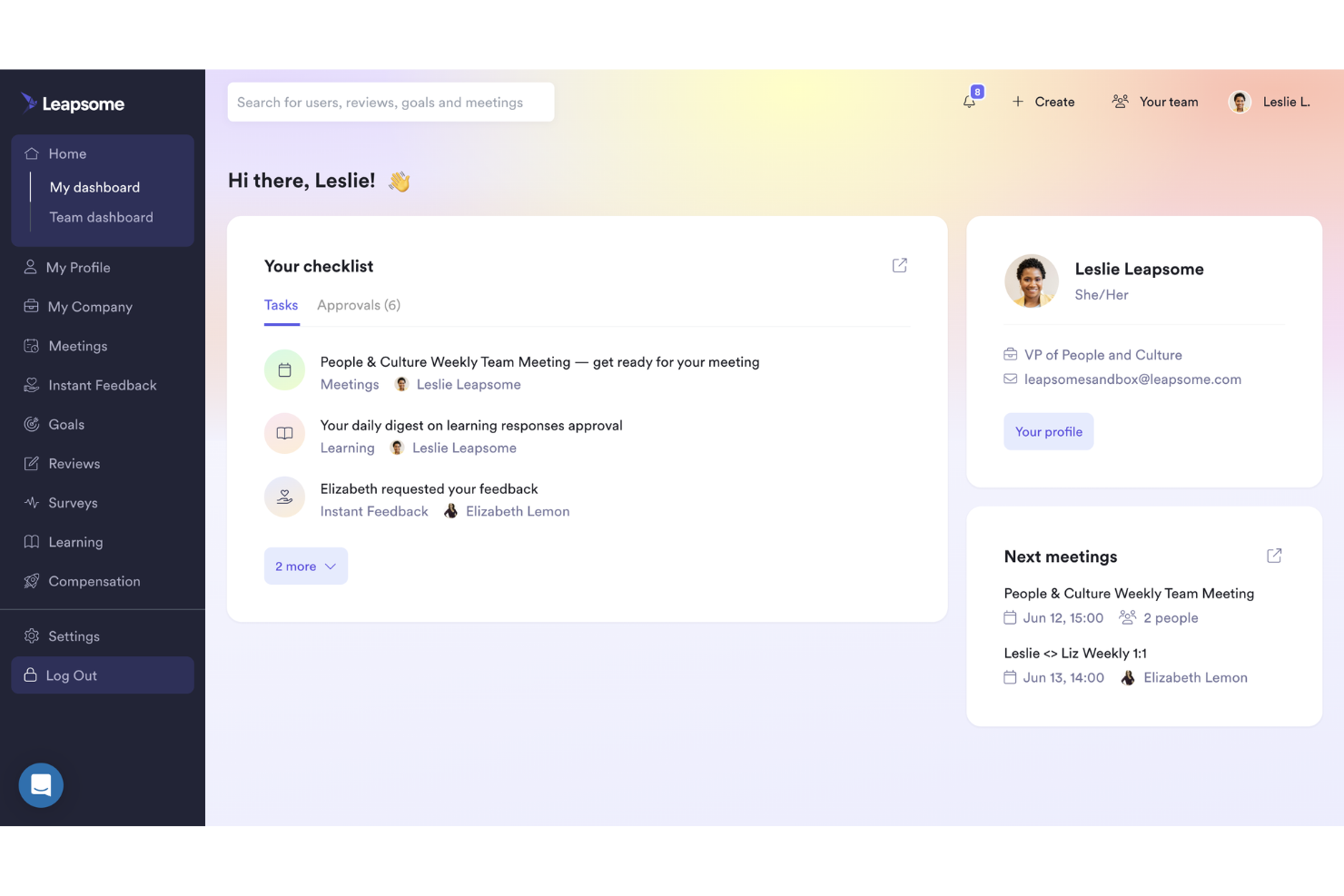
| User Interface | Modern interface with strong dashboards and analytics, though some enterprise workflows can feel complex. | Clean, intuitive interface designed to keep navigation approachable for employees, managers, and admins. |
| Onboarding | Guided enterprise onboarding with implementation support, integrations, and change management planning. | Structured onboarding with templates, training resources, integrations, and faster implementation timelines. |
| Customization | Strong enterprise configuration options for goals, reviews, calibration, and performance workflows. | Flexible templates and modular configuration help simplify setup across HR and talent workflows. |
| Support | Dedicated customer success resources, implementation guidance, and enterprise support services. | Responsive support, Success Center resources, webinars, and accessible in-app help tools. |
Leapsome generally feels easier to adopt and navigate day to day, especially for organizations looking for a modern all-in-one HR and talent platform with faster implementation. Betterworks offers a more enterprise-focused experience with deeper performance management configuration and governance controls, though that added depth can also create a steeper learning curve for administrators.
Betterworks vs Leapsome: Pros & Cons
Betterworks
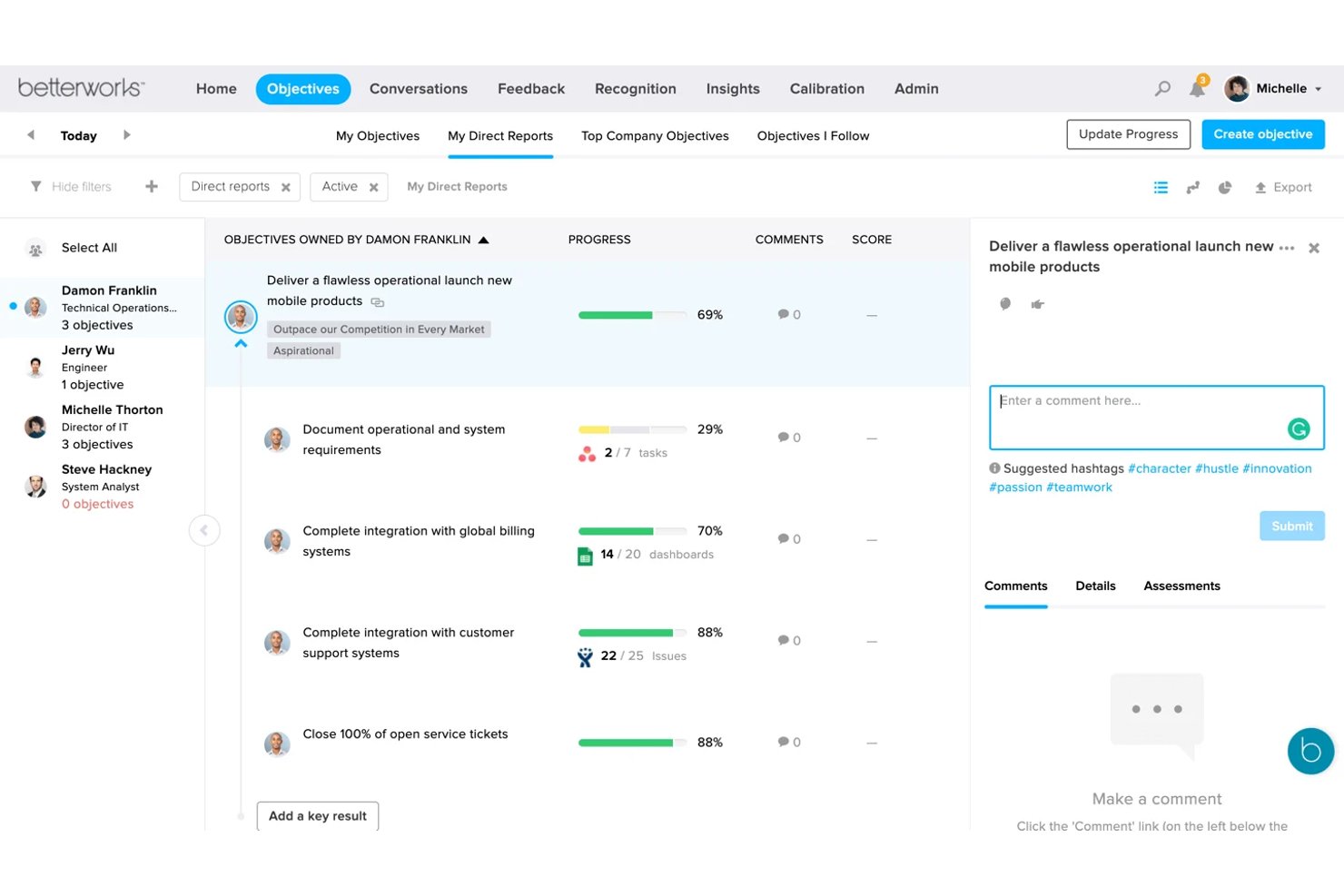
- Connects goals, feedback, and coaching into one continuous performance system.
- Supports enterprise-scale OKR alignment across complex, matrixed organizational structures.
- Embeds performance workflows directly into everyday collaboration and productivity tools.
- Mobile functionality lacks the depth available in the desktop experience.
- Initial admin setup involves a noticeable learning curve for new users.
- Some HCM integrations require additional API or iPaaS configuration.
Leapsome
- Combines HRIS, performance, learning, and engagement tools in one platform.
- Built-in learning management supports employee development without additional software.
- AI-powered workflows help automate feedback, analytics, and administrative tasks efficiently.
- Reporting flexibility may not satisfy highly data-driven enterprise analytics teams.
- Some customization limitations exist for advanced OKR and messaging workflows.
- Feature breadth can feel overwhelming for smaller or simpler organizations.
Best Use Cases for Betterworks and Leapsome
Betterworks
- Enterprise Organizations If your company has hundreds or thousands of employees, Betterworks is built for that level of scale. Its plans and feature set are designed specifically for mid-market (500+ employees) and enterprise organizations (thousands of employees) managing large workforces.
- Technology and SaaS companies If you run a fast-moving technology or SaaS organization, Betterworks helps keep teams aligned around shifting business priorities. Its OKR structure and continuous feedback workflows work especially well in performance-driven environments.
- Financial & Professional Services If your organization depends on clear accountability, structured evaluations, and measurable performance outcomes, Betterworks provides strong visibility into goals, coaching, and calibration processes.
- Manufacturing & Telecommunications If you operate across multiple business units, locations, or reporting structures, Betterworks helps standardize performance management across complex operational environments.
- Healthcare Organizations If you need consistent performance conversations and workforce visibility across large healthcare teams, Betterworks offers centralized performance management with enterprise-level oversight and reporting.
- Businesses Already Using an HRIS If you already rely on an HRIS for employee records, Betterworks works well as a dedicated performance enablement layer. You can add continuous goals, feedback, and talent intelligence without replacing your existing HR system.
Leapsome
- Tech and SaaS Companies Leapsome helps fast-growing tech teams connect performance, goals, engagement, and development in one platform.
- Growing Mid-Market Organizations If your company is scaling quickly, Leapsome helps centralize HR processes and employee data efficiently.
- HR Teams Consolidating Multiple Tools Leapsome is a strong fit if you want to reduce HR tech stack sprawl. You can combine HRIS functionality, reviews, surveys, goals, learning, compensation, and workflows inside a single connected platform.
- Remote and Distributed Teams Leapsome keeps remote employees aligned through feedback, goals, engagement surveys, and structured meetings.
- Organizations Focused on Employee Development Leapsome supports continuous learning with competency frameworks, development tracking, and integrated learning paths.
- Organizations Building Manager Accountability Leapsome gives managers structured tools for coaching, feedback, and recurring performance conversations.
Who Should Use Betterworks, and Who Should Use Leapsome?
Betterworks is best suited for mid-sized and enterprise organizations that need structured performance management, advanced calibration workflows, and enterprise-scale goal alignment. I think it works especially well for companies with established HR infrastructure that want deeper talent intelligence, succession planning, and governance controls layered on top of their existing HRIS. If your organization prioritizes strategic performance enablement across large or complex teams, Betterworks is likely the stronger fit.
Leapsome is a better choice if you want a more flexible all-in-one people platform that combines HRIS, performance management, engagement, learning, and workflows in one connected system. I’d recommend it for startups, growing companies, and modern HR teams that value faster implementation, broader native integrations, and a more approachable day-to-day user experience. It’s especially appealing if you want to consolidate multiple HR and talent tools into a single modular platform.
Differences Between Betterworks and Leapsome
| Betterworks | Leapsome | |
|---|---|---|
| AI Capabilities | Uses AI for talent intelligence, performance summaries, skills inference, and workforce readiness insights. | Uses AI agents and copilots for coaching, workflows, analytics, surveys, meetings, and HR support tasks. |
| Analytics & Insights | Emphasizes enterprise performance analytics, calibration visibility, and talent intelligence insights. | Focuses on interconnected people analytics across HR, engagement, learning, and performance data. |
| HRIS Functionality | Works primarily as a performance layer on top of an existing HRIS. | Includes built-in HRIS capabilities like employee records, payroll prep, and absence management. |
| Learning Management | Integrates with external learning platforms rather than replacing them. | Includes a built-in learning management system with SCORM, xAPI, and LinkedIn Learning support. |
| Visit BetterworksOpens new window | Read Leapsome ReviewOpens new window | |
| Platform Focus | Primarily focused on performance enablement and talent intelligence. | Combines HRIS, talent management, learning, workflows, and analytics in one platform. |
| Talent Planning | Offers advanced calibration, succession planning, and talent mobility tools for enterprise talent reviews. | Provides calibration and compensation tools, but with less enterprise-heavy talent planning depth. |
| Visit BetterworksOpens new window | Read Leapsome ReviewOpens new window |
Similarities Between Betterworks and Leapsome
| 1:1 Meetings & Conversations | Both Betterworks and Leapsome support structured 1:1 meetings, agendas, shared notes, and manager-employee check-ins. |
|---|---|
| Continuous Feedback | Both solutions offer continuous feedback, peer recognition, manager coaching, and real-time performance conversations. |
| Engagement Surveys | Both platforms include engagement surveys, employee sentiment tracking, and analytics to help HR teams monitor workforce engagement. |
| Goal & OKR Tracking | Each platform includes goal and OKR management tools that help align employees, teams, and company objectives with measurable progress tracking. |
| Performance Reviews | Both platforms support customizable performance reviews, review cycles, templates, calibration workflows, and structured employee evaluations. |
| Visit BetterworksOpens new window Read Leapsome ReviewOpens new window | |