


Reseña de OfficeSpace: Ventajas, Desventajas, Características y Precios


OfficeSpace is a workplace and office space management platform that helps teams organize, book, and optimize their workplaces. It’s a great fit for HR and workplace managers in hybrid offices, corporate environments, and fast-growing teams juggling space, seating, and collaboration needs. With OfficeSpace, you get a clear, easy way to manage your workspace so your people can focus on doing great work together.
In this review, you’ll get a full look at OfficeSpace’s features, pros and cons, pricing, and best and worst use cases. If you’re looking to create a more efficient, flexible, and people-first workplace, this guide is for you.
OfficeSpace Evaluation Summary
- Pricing upon request
- Free demo available
Por qué confiar en nuestras reseñas de software
Nuestro equipo lleva probando y evaluando software desde 2012. Como expertos en RR. HH., sabemos lo difícil —y lo importante— que es elegir el software adecuado.
Para esta guía, evaluamos las herramientas mediante pruebas prácticas e investigación independiente, puntuando las herramientas según nuestros criterios de selección. También nos basamos en la experiencia de líderes de opinión del sector y de profesionales de RR. HH. en activo.
Nuestras reseñas reflejan nuestro criterio editorial humano, no un discurso de ventas.
Revisores expertos:
OfficeSpace Overview
OfficeSpace is a solid contender in the office management space — it shines at helping hybrid and mid-sized to large workplaces bring order to their seating, bookings, and space planning. It beats many rivals in usability, support, and polished visual tools, though it can feel tricky when setups get very complex or when you need deep customization. Overall, it’s best suited for organizations that want an out-of-the-box, scalable solution rather than building everything themselves.
pros
-
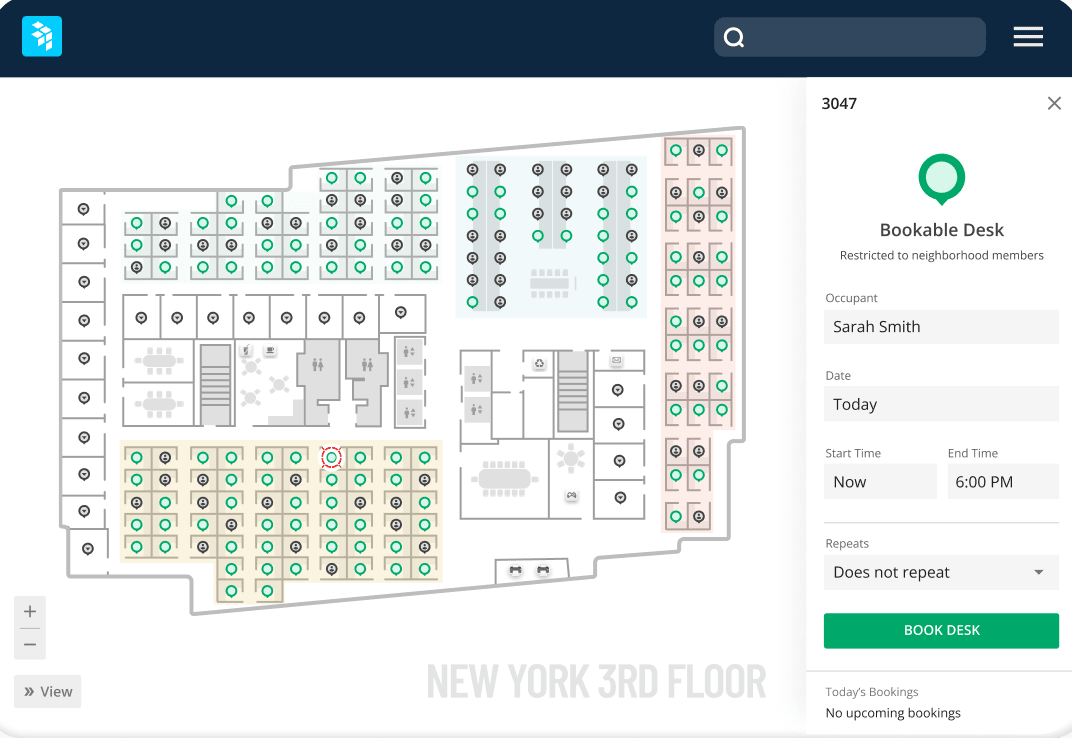
You get clear, visual floor plans and maps so your team can see where desks and rooms are.
-
Wayfinding features help staff and visitors find rooms, desks, or people easily.
-
Scenario planning and move management let you test layout options before committing.
cons
-
The mobile app can feel limited compared to the desktop version.
-
May offer more features than necessary for super small business needs
-
You can’t always customize dashboards or workflows for very niche needs.
-

Justworks
Visit WebsiteThis rating combines scores from multiple user review sites to reflect overall customer sentiment about the product.4.6 -
Small Improvements
Visit WebsiteThis rating combines scores from multiple user review sites to reflect overall customer sentiment about the product.4.3 -
HiBob
Visit WebsiteThis rating combines scores from multiple user review sites to reflect overall customer sentiment about the product.4.5





Cómo probamos y puntuamos nuestras herramientas
Hemos pasado años construyendo, refinando y mejorando nuestro sistema de pruebas y puntuación de software. La rúbrica está diseñada para capturar los matices de la selección de software y lo que hace que una herramienta sea efectiva, centrándose en los aspectos críticos del proceso de toma de decisiones. A continuación, puedes ver exactamente cómo funcionan nuestras pruebas y puntuaciones a través de siete criterios. Esto nos permite ofrecer una evaluación imparcial del software basada en la funcionalidad principal, características destacadas, facilidad de uso, incorporación, soporte al cliente, integraciones, reseñas de clientes y relación calidad-precio.
Funcionalidad principal (25% de la puntuación final)
El punto de partida de nuestra evaluación siempre es la funcionalidad principal de la herramienta. ¿Tiene las funciones básicas que se espera encontrar? ¿Alguna de esas funciones básicas está restringida a planes de precio superiores? En esencia, esperamos que una herramienta se compare favorablemente con las capacidades básicas de sus competidores.
Características destacadas (25% de la puntuación final)
Luego, evaluamos características poco comunes que van más allá de la funcionalidad principal que normalmente se encuentra en herramientas de su tipo. Una puntuación alta refleja funciones especializadas o únicas que hacen que el producto sea más rápido, eficiente o que ofrezca un valor adicional al usuario. También evaluamos lo fácil que es integrar con otras herramientas comúnmente usadas en el entorno tecnológico para ampliar la funcionalidad y utilidad del software. Las herramientas que ofrecen muchas integraciones nativas, conexiones de terceros y acceso a API para construir integraciones personalizadas obtienen las mejores puntuaciones.
Facilidad de uso (10% de la puntuación final)
Consideramos qué tan rápido y fácil es ejecutar las tareas definidas en la funcionalidad principal utilizando la herramienta. El software que obtiene una puntuación alta está bien diseñado, es intuitivo, ofrece aplicaciones móviles, proporciona plantillas y hace que tareas relativamente complejas parezcan simples.
Incorporación (10% de la puntuación final)
Sabemos lo importante que es la rápida adopción del equipo para una nueva plataforma, por eso evaluamos qué tan fácil es aprender y usar una herramienta con una capacitación mínima. Evaluamos cuán rápido un miembro del equipo puede configurarse y comenzar a usar la herramienta sin experiencia. Las soluciones con mejores puntuaciones requieren poco o ningún soporte.
Soporte al cliente (10% de la puntuación final)
Revisamos cuán rápido y fácil es obtener ayuda mediante teléfono, chat en vivo o base de conocimientos. Las herramientas y empresas que ofrecen soporte en tiempo real obtienen las mejores puntuaciones, mientras que los chatbots obtienen las peores.
Reseñas de clientes (10% de la puntuación final)
Además de nuestras propias pruebas y evaluaciones, consideramos el puntaje neto de promotores de clientes presentes y pasados. Revisamos su probabilidad, dada la opción, de elegir nuevamente la herramienta por su funcionalidad principal. El software con una puntuación alta refleja un alto puntaje neto de promotores por parte de clientes actuales o anteriores.
Relación calidad-precio (10% de la puntuación final)
Por último, considerando todos los demás criterios, revisamos el precio promedio de los planes de entrada frente a las funciones principales y valoramos el resto de los criterios de evaluación. El software que ofrece más por menos tendrá una mejor puntuación.
Core Features
Wayfinding
OfficeSpace offers indoor navigation to assist employees and visitors in finding their way around the office. This feature is accessible through a directory, where users can locate various 'Space Types' that can be assigned custom colours for easy identification on the floor plan. This function is particularly useful in large or complex buildings.
Space Management
OfficeSpace allows companies to manage their office space and facilities. It provides tools for space allocation, move management, desk booking, and more.
Desk and Meeting Room Booking
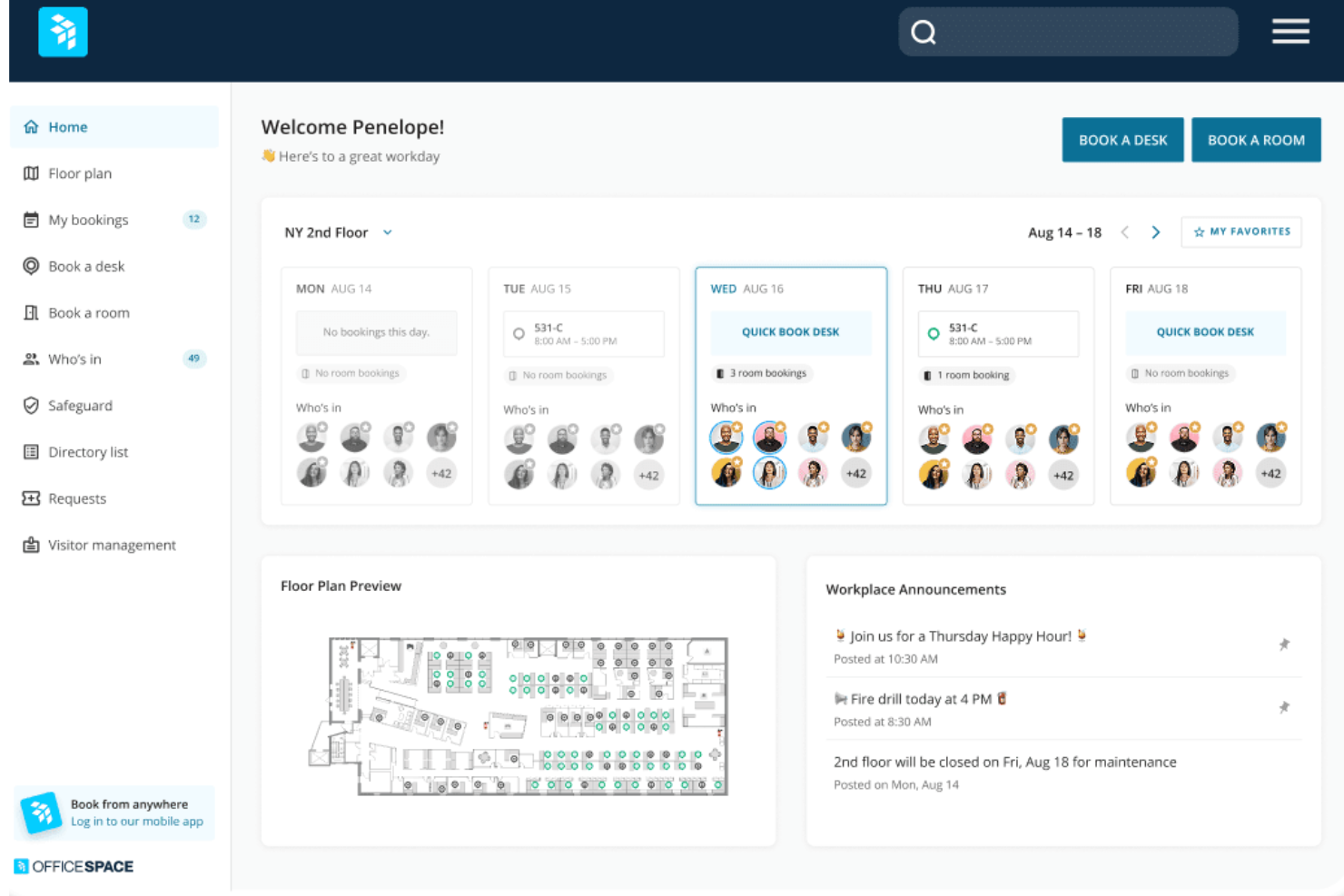
Employees can easily reserve desks or workspaces through OfficeSpace. The software shows real-time desk and room availability, so those “hot spots” are easily bookable for rotating meetings or scoring the best window seat. You can even see who is in the office that day, so you can swing by their desk.
Visitor Management
OfficeSpace enables contactless visitor check-in and screening. It prints visitor badges, notifies hosts when guests arrive, and is able to track and log visitors. OfficeSpace also allows you to easily book desks for guests and coworkers.
Maintenance Management
Companies can manage work orders and maintenance requests with OfficeSpace. It allows these tasks to be assigned to team members.
Reporting and Analytics
You can access easy-to-read reports on occupancy, bookings, and space trends. It gives you the data you need to make smarter real estate decisions.
Ease of Use
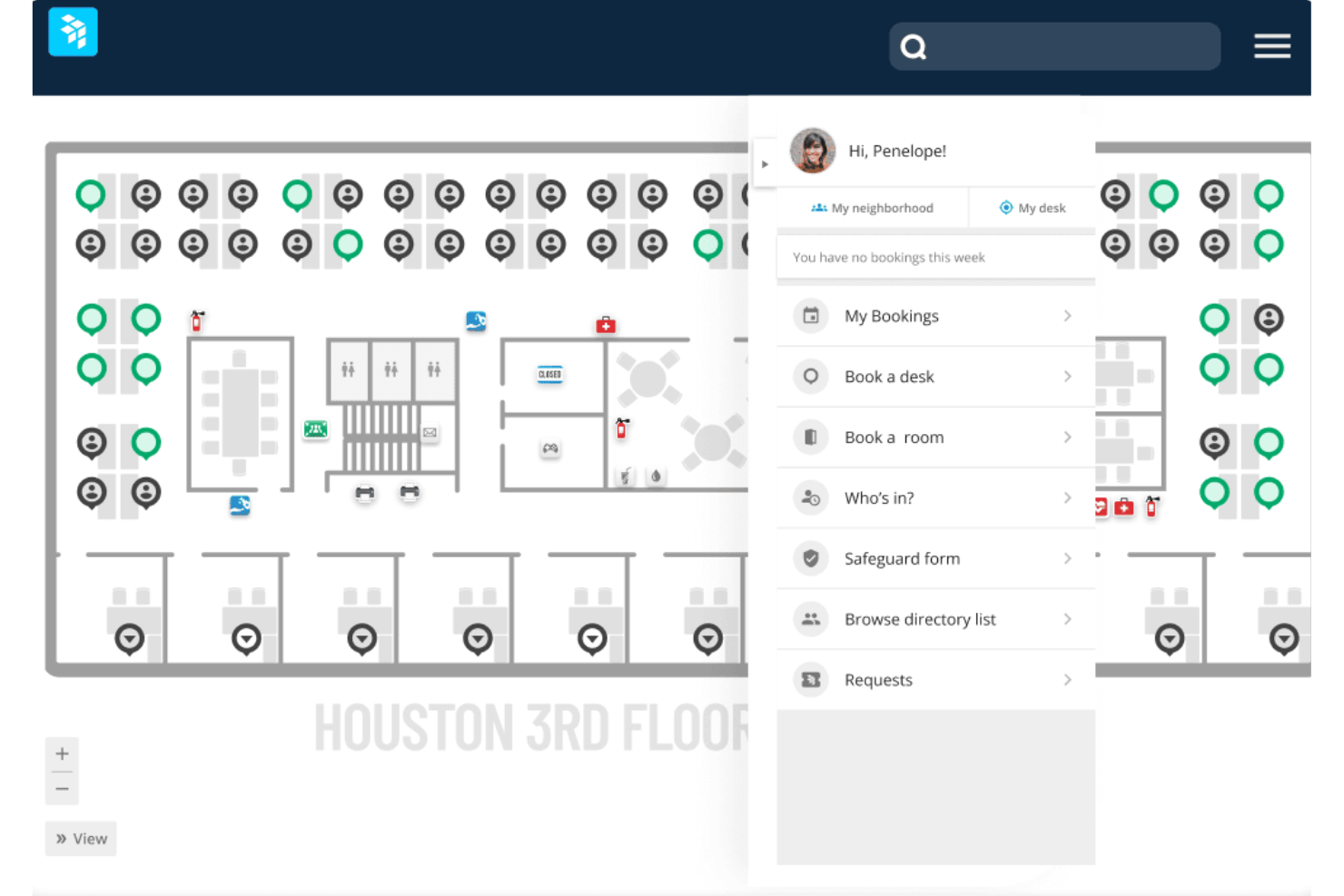
I find OfficeSpace has an intuitive interface and is relatively easy to use compared to some other office management systems. Core functions like desk booking, visitor check-in, and space allocation are straightforward for end users and administrators. The mobile app also provides a simple way for employees to access key features.
New Product Updates from OfficeSpace

OfficeSpace Adds Work Order Status and Cost Reports
OfficeSpace adds Work Order Status and Work Order Cost reports under the Reports menu. The new reports give facilities and operations teams built-in visibility into maintenance activity and spending for easier performance tracking. Highlights include:
- Work Order Status Report: Provides visibility into maintenance activity and work order status.
- Work Order Cost Report: Helps teams review maintenance costs directly within OfficeSpace.
- Built-In Reporting: Reduces reliance on manual spreadsheets for work order analysis.
Visit OfficeSpace’s official site for more details.
 for more details.
OfficeSpace Adds a Three-Level Space Types Hierarchy
OfficeSpace replaces its flat space type structure with a three-level hierarchy of Function → Category → Space Type. The new taxonomy helps organizations standardize space classification while supporting more consistent reporting, visualization, and space management. Highlights include:
- Three-Level Space Hierarchy: Organize spaces using standardized Functions with customizable Categories and Space Types.
- Improved Space Classification: Classify office, collaboration, amenity, technical, and other space types using a structured taxonomy.
- Enhanced Reporting: Analyze and filter workplace data by Function and Category across Insights Hub and other reporting tools.
- Floor Plan Visualization: Color floor plans by Function or Space Type for clearer space allocation and utilization insights.
Visit OfficeSpace's official site for more details.

OfficeSpace Adds Early Booking Access for Desk Reservations
OfficeSpace adds Early Booking Access for bookable desks, enabling admins to configure advance booking windows for different employee groups. The feature helps organizations prioritize desk reservations while keeping desks available for broader employee access as booking windows open. Highlights include:
- Group-Based Booking Windows: Set different advance booking windows for employee groups based on existing restrictions and custom employee fields.
- Multiple Restriction Tiers: Apply up to 10 booking tiers per desk, with the longest booking window automatically applied when employees belong to multiple groups.
- Bulk Configuration: Update Early Booking Access settings across multiple desks using the bulk editor.
Visit OfficeSpace's official site for more details.****
OfficeSpace Specs
- Access Management
- API
- Appointment Scheduling
- Batch Permissions & Access
- Calendar Management
- Chat
- Click-to-Dial
- Contact Management
- Custom Data Forms
- Custom Reports
- Customer Management
- Dashboard
- Dashboards
- Data Export
- Data Import
- Data Visualization
- Email Integration
- External Integrations
- Forecasting
- Google Apps Integration
- Lead Management
- Map Visualization
- Marketing Automation
- Mobile App
- Multi-User
- Notifications
- Resource Management
- Scheduling
- Self-service Portal
- Workflow Management
Alternatives to OfficeSpace




OfficeSpace FAQs
How quickly can your team get up and running with OfficeSpace?
Is there a mobile app for OfficeSpace?
Can OfficeSpace handle hybrid work schedules?
How secure is OfficeSpace for sensitive workplace data?
Does OfficeSpace support global or multi-location teams?
How does OfficeSpace’s AI help your team?
What kind of support does OfficeSpace provide after implementation?
¿Qué sigue?
Para mantenerte al día con las últimas novedades en gestión de personas, suscríbete a nuestro boletín para líderes y gerentes. Recibirás información y recursos personalizados para líderes y profesionales de Recursos Humanos directamente en tu bandeja de entrada.