
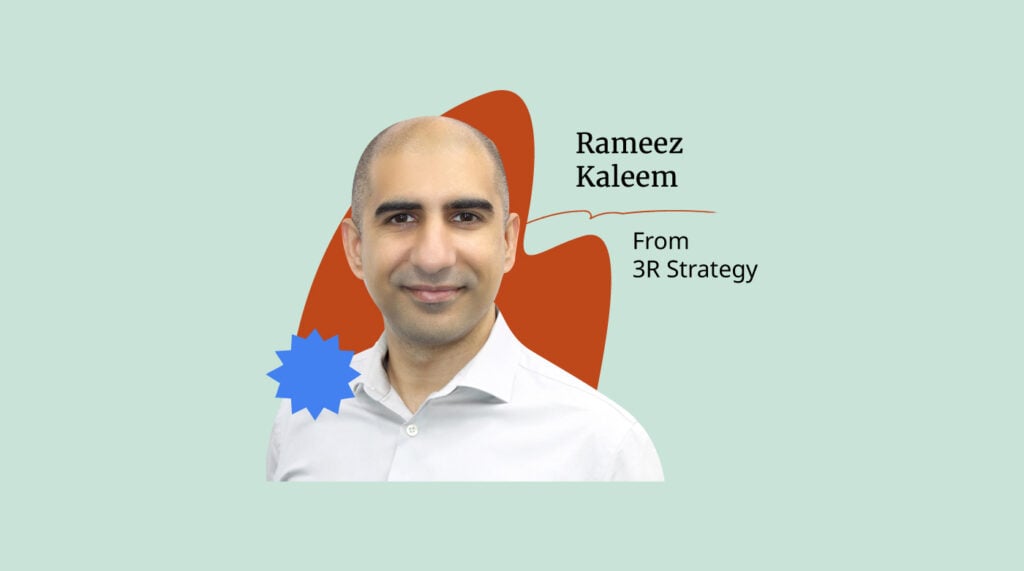
In this episode, host Becca Banyard is joined by Rameez Kaleem—Founder and Director at 3R Strategy—to talk about how pay transparency can help build a culture of trust in the workplace.
Interview Highlights
- Rameez’s background [1:12]
- How organizations pay and reward their employees. He has worked in this field for over 20 years.
- Used to work in consultancy and then worked in-house.
- Around 6 years ago, he quit his job and set up 3R Strategy because he wanted to have a different approach to how we look at pay.
- What is pay transparency? [2:05]
- Transparency in general is around just being honest and telling the truth and giving people context.
- Pay transparency is about giving employees context around how we make pay decisions and why we manage pay the way we do.
- Sometimes there is a misconception about pay transparency - people are thinking about publishing everyone's salary and disclosing that information. But that isn't what transparency is about. It's about giving people context and being honest with them.
- Rameez likes to think of pay transparency almost like a journey and a scale .
- It starts off with, “what do we pay people?”
- It's really being clear about what people get paid.
- How can pay transparency help build trust between employees and employers? [4:28]
- The deciding factor for most people when they're applying for a new job is what they're going to get paid.
- If we want to build trust with our employees, honesty and transparency needs to start right from the start. And that's where we need to demonstrate the pay range.
- A recent survey by Adobe found that 85% of upcoming and recent grads would probably not apply for a job if it didn't have the salary range next to it.
- Why do many organizations not publish their pay range when they're posting a job? [5:42]
- The reason why Rameez wrote his book “A Case of the Mondays” is to try and encourage people to disclose this information and be honest about it.
- Some of the reasons why organizations and leaders are nervous to do this is because they're worried what people will think when they see these ranges.
- Often what happens in organizations is, they hire people and they just get the annual pay increase, which might be 3%, 4% as part of their annual pay review process.
- But when people are moving jobs, they're able to demand higher salaries.
- There’s a trend in a lot of organizations where they’re hiring people on higher salaries than what they pay their people who are loyal to them.
- As an employee, it's the opposite effect. You're loyal to a company and you end up getting paid a lower salary than new employees. And so that's why some companies are nervous about publishing their pay range.
- The other reason can be that sometimes line managers are given budgets and what they're trying to do is make sure that they can maximize those budgets.
- When you go for an interview, they'll say, “what is your current salary?” Or “what is your salary expectation?”
- Those questions are dangerous and that's why a lot of states in the US are banning this question, introducing pay transparency laws.
Being perceived to be fair is more important. And if we don't have the money to make those pay adjustments, the least that we can do is be honest with our people.
Rameez Kaleem
- How can pay transparency impact an organization's everyday practices? [10:47]
- We can't just look at pay in isolation.
- That’s why Rameez always talks about building trust through pay transparency.
- It's not like if nothing else in the organization is working, then people are just going to trust us because we're transparent with pay. These things all need to work together. But if we're transparent about pay, it links to all of these things.
- If we talk about recruitment, if we have that pay transparency, we can be honest with our candidates.
- There's a lot of research that talks about how the number of applications that you get when you're recruiting significantly increases when you publish a salary range.
- The research tells us that the perception of fairness is more than what we pay people.
- When you get career progression, you will inevitably get a pay rise with it. So there's a clear link between pay progression and career progression.
- How do you get 'pay for performance' right? [13:31]
- Step 1: Identify all the roles in our organization.
- What are the different jobs and roles in our organization, and what are the level of skills, responsibility, complexity required to carry out these roles?
- We then have to figure out what our salary range is for each of those roles.
- Step 2: We need to have very clear definitions around individuals that sit within each of those roles.
- What tends to happen in a lot of organizations is that we give everyone the same increase. And there's no clear progression really apart from the standard 2%. And then we end up with recruitment salaries being so much higher than our existing employees.
- What we need is a clear set of definitions that are consistently used by all managers and communicated to all employees so they understand what's required from them.
- Step 1: Identify all the roles in our organization.
- What are the key steps to implementing pay transparency in an organization? [15:54]
- Look at the roles. It's defining the framework that they should have in their organization.
- For example, in an organization with a hundred employees, you can have a framework that is six bands or six levels, or you can have another framework that is nine bands or levels.
- If you want more flexibility in how you want to manage pay for your people, then you might prefer the six broader bands. If you want narrower pay ranges with more internal equity salaries closer together, you might want a larger number of 9 or 10 bands.
- The next step when we start to think about people is to start to link to things like our organizational culture and what are the behaviors that we need from our people that results in exceptional contribution.
- For example, we want to create a culture in our organization that is all around teamwork and collaboration. So what we want to do is try to think about when it comes to teamwork and collaboration, what are the behaviors that lead to exceptional contribution?
- Look at the roles. It's defining the framework that they should have in their organization.
- What are some common challenges or drawbacks that an organization may face when improving pay transparency? [18:32]
- When people are looking to leave or threatening to leave for more money, it's a bad idea to try and keep them by counter offering or getting them to stay. It only should be done in exceptional circumstances if we need that person to deliver a particular project.
- Based on the research, we might get somebody to stay but typically it tends to be just short term.
- You might make that person happy by offering them extra pay, but we might be making another 10 people unhappy because if they find out, they might think “are we not valued? Why are we not getting paid anything extra?”
- What is the number one thing that keeps employees happy in the workplace? [20:52]
- Having a good relationship with colleagues
- What people want is to work in an environment where they get along with their colleagues, they're not stressed, they can joke around and enjoy the company of their colleagues. It's related to a concept of belonging.
- Having a good relationship with colleagues
Yes, pay attracts us to an organization, but it's not something that motivates us on a day-to-day basis. What motivates people, makes them happy, is the relationship that they have with their colleagues.
Rameez Kaleem
- What is the one thing you need to be a successful leader? [22:17]
- Patience and self-awareness
- Having a clear purpose
- Start with the 'why'
- When Rameez talks about pay transparency, he always talks about starting with the why of pay.
Meet Our Guest
Rameez Kaleem is the founder and managing director at 3R Strategy, an independent reward consultancy dedicated to helping organisations build a culture of trust through pay transparency.
Rameez graduated in economics from University College London and began his career in consultancy, initially working in global mobility and then as a reward consultant at Willis Towers Watson. He worked in several in-house reward roles before quitting the corporate world to set up 3R Strategy to support organisations on their journey towards pay transparency. 3R Strategy supports organisations with pay and reward strategy, job evaluation and architecture, pay structure design, and equal pay.
With over twenty years in pay and reward, Rameez consults extensively on these topics, speaking regularly at HR forums and on podcasts. His new book, A Case of the Mondays is a deep dive into how pay transparency can transform the culture of an organisation and how to implement it within any setting.
Pay transparency is about giving employees context around how we make pay decisions and why we manage pay the way we do.
Rameez Kaleem
Related Links:
- Join the People Managing People Community
- Subscribe to the newsletter to get our latest articles and podcasts
- Connect with Rameez on LinkedIn
- Check out Rameez’s book: A Case of the Mondays
- Check out 3R Strategy
Related articles and podcasts:
Read The Transcript:
We’re trying out transcribing our podcasts using a software program. Please forgive any typos as the bot isn’t correct 100% of the time.
Becca Banyard: The Sunday Scaries. You’ve likely heard that term thrown around quite a bit in recent years, and it’s no surprise why. A recent survey found that four out of five people don’t sleep well on Sunday nights because they’re worried about going to work on Monday morning.
My guest today believes that this anxiety and unhappiness around work is the result of a lack of trust and transparency in the workplace. And that one of the best ways any company can help engender a culture of trust is by being transparent about pay.
Welcome to the People Managing People podcast. We’re on a mission to build a better world of work and to help you create happy, healthy, and productive workplaces. I’m your host, Becca Banyard.
Today I’m joined by Rameez Kaleem, founder and director at 3R Strategy, who’s gonna be chatting with me about how pay transparency can help build a culture of trust in the workplace. Stay tuned to learn best practices around pay transparency, why companies choose not to list salary ranges and jobs, and why they should and how to do performance-based pay the right way.
Hi, Rameez! Welcome to the show. Thank you so much for being here today.
Rameez Kaleem: Hi, Becca!
Becca Banyard: Before we dive in, I just wanted to get to know you a little bit more. Why don’t you just share a bit about yourself and what you do at 3R Strategy?
Rameez Kaleem: Sure. So, my background is pay and rewards. So it’s looking at how organizations pay and reward their employees.
And I have worked in this field for over 20 years. I used to work in consultancy and then I worked in-house. And around six years ago, I quit my job and I set up 3R Strategy because I just felt that I wanted to have a different approach to how we look at pay. And then, it’s, there’s a lot of focus on just the amount that we pay, but I wanted the focus to really be around transparency and giving our employees context around these decisions.
So, yeah, so I founded the company and then now there’s a team of us. So it’s a lot nicer working with a team than, being on my own.
Becca Banyard: Well, that’s amazing. And you recently released a book, “A Case of the Mondays: How to Build a Culture of Trust Through Pay Transparency”. So I’d love to dive in to that topic with you and let’s get started with just a simple question.
What is pay transparency?
Rameez Kaleem: So I think transparency in general is around just being honest and telling the truth and giving people context. So when we talk about pay transparency, it’s giving employees context around how we make pay decisions and why we manage pay the way we do. And that’s what’s really people are looking for is you know, that honesty and transparency.
And sometimes there is a misconception or when we talk about pay trans, sometimes when I mention pay transparency, people are thinking about, Oh, does that mean we have to publish everyone’s salary and, disclose that information? But that really isn’t what transparency is about. And we shouldn’t really think about it in those binary terms.
It’s about giving people context and being honest with them.
Becca Banyard: Amazing. So what does that context look like in an organization?
Rameez Kaleem: Like I said, we don’t want to think about it in binary terms. So I like to think of pay transparency almost like a it’s a journey and it’s a scale. So it starts off with, what do we pay people?
So everyone knows what they get paid, but do they know about the benefits that are available to them? What is their total package? So it’s really being clear about what people get paid. Then the journey really starts with why and why do we pay people the way we do? And this is all around our pay strategy and our pay philosophy.
So what are the principles that underpin how we manage pay for our people? Do we want to be market driven? What is our market? Do we want to be market median, upper, lower quartile? And then, I was thinking about what do we want to communicate to our employees? So in the same way that we have a set of values that define the culture of our organization, we should have a set of pay principles that define, this is our approach to pay and this is how we want to pay our employees.
So that really is the start of the journey. And then once we have clarity over the why, then we go into, okay, how do we do this practically in our organization? And the how it comes from all the policies and the processes that we put together around pay and pay progression so on.
Becca Banyard: Amazing. Thanks for explaining that a little bit more. So I wanna dive in a little bit to the area of building trust for a moment here. So you mentioned that in your book, and I’m curious how pay transparency can help build trust between employees and employers?
Rameez Kaleem: If we think about, the deciding factor for most people when they’re applying for a new job is what they’re gonna get paid.
So in some ways that’s potentially the start of a relationship between the employee and their employer. And if we want to build trust with our employees, I think that honesty and transparency needs to start right from the start. And that’s where I think we need to demonstrate that yes, we have a pay range.
This is the pay range that we want to provide for this role. And I think if we look at a lot of the candidates in the market, particularly generations and employees, there was a recent survey which found that 85% of generations said employees would probably not apply for a job if it didn’t have the salary range next to it.
So we know that this is what people are looking for and I think starting off our relationship in that way through honesty and transparency really helps to build that trust right from the start.
Becca Banyard: I’m curious why a lot of organizations don’t publish their pay range when they’re posting a job?
Rameez Kaleem: So we do speak to some organizations that are reluctant to do this. And part of our mission is trying to encourage people, and that’s why I wrote the book, is to try and encourage people to disclose this information and be honest about it. I think some of the reasons why organizations and leaders are nervous to do this is because they’re worried what people will think when they see these ranges.
Often what happens in organizations is, we hire people and they just get the annual pay increase, which might be 3%, 4% as part of their annual pay review process. But when people are moving jobs, often they, they’re able to demand higher salaries.
People can often be, good at negotiating salaries when they’re applying for jobs. So you do see a trend in a lot of organizations where we’re hiring people on higher salaries than what we pay our people who are loyal to us. In some ways, you can think about businesses that operate in this way.
So if you are a loyal customer with a business or a brand, then you end up being a higher rate than a new customer that they’re acquiring. Right?
Becca Banyard: Yeah. I had this experience recently.
Rameez Kaleem: Exactly, and I think as an employee, it’s the opposite effect. You’re loyal to a company and you end up getting paid a lower salary than new employees.
And so that’s why some companies are nervous. They’re thinking, “Our employees are going to see that we’re recruiting on a pay range that is higher, so they’re gonna be annoyed at this”. The other reason can be sometimes line managers are given budgets and what they’re trying to do is to make sure that they can maximize those budgets.
So what is the minimum amount that we can pay somebody to get them to work for us in our company? And so that’s why you have a lot of organizations asking this question. They won’t advertise the pay range. And when you go for an interview, they’ll say, what is your current salary? Or what is your salary expectation?
So if you are, let’s say you were planning a pay range of $40k to $50k and you’re interviewing someone and they say, I’m currently on $30k. The line manager’s gonna think, let me give them a slight increase. I’ll offer them $33k so that they’ll be happy with this and come and join us. So that’s unfair because if you are discriminated against in your job, so women, people of color or with those with disabilities are particularly impacted.
So if you’re discriminated against in your job, all we’re doing is we’re transferring that inequity from one organization to the next organization. And so that’s why I think those sort of questions are really dangerous and that’s why you’re seeing a lot of states in the US that are banning this question, introducing pay transparency laws.
But I think those are just some of the reasons to why organizations are reluctant to publish the salary range.
Becca Banyard: Right. How can organizations start publishing or posting their pay ranges while mitigating the fallout from loyal employees who perhaps will see the higher pay range and ask for more? What can an organization do in this situation?
Rameez Kaleem: Well, I think there, there needs to be work done to try and bridge the gap between what we pay our loyal employees and what we are willing to pay for new recruits. So there needs to be a lot of work done and that’s why I think, pay transparency isn’t something that can happen overnight. There’s a lot of work that needs to go into this.
We really need to think about how we communicate. So, there’s obviously backlash around how employees might react. There’s also a real legal implication because if there are big differences between existing employees and new hires, that in most countries there’s some sort of an equal pay law.
So in the UK is the Equality Act of 2010, which goes through a number of factors that need to be addressed to make sure there is equal pay for equal work. So there’s a legal implication and then there’s a backlash from an employee. So I think we need to do some work before we get to that place.
That’s one thing. But I would also say, this is studied by a company called PayScale, which is a US company. And they found in the study that there were employees that were paid below the market rate, and their job satisfaction rate was 42%. But when the leaders sat down with them, explained to them why this was the case, without making any changes to their salary, their job satisfaction rates went up to 80%.
So even knowing that they were paid below the market, just being treated like adults, being honest, being transparent, their job satisfaction rates went up. So we understand there’s a lot of nervousness. But I think ultimately, and this is what research tells us as well, what a lot of people want is to be treated fairly.
And the research tells us that the perception of fairness is actually more important than what we pay people. So being perceived to be fair is more important. And if we don’t have the money to make those pay adjustments, the lease that we can do is just be honest with our people.
Becca Banyard: That’s really interesting.
So I’m curious how pay transparency then can impact an organization’s everyday practices. So things like performance management, pay benchmarking, recruitment, career progression, that kind of thing. How can becoming more transparent around pay impact these different practices?
Rameez Kaleem: We can’t just look at pay in isolation.
So I always talk about building trust through pay transparency. But it’s not like if nothing else in the organization is working, then people are just gonna trust us because we’re transparent with pay. These things all need to work together. But if we’re transparent about pay, it links to all of these things that you talked about.
So if we talk about recruitment, if we have that pay transparency, we can be honest with our candidates. So there’s a lot of research that talks about how the number of applications that you get when you’re recruiting significantly increases when you publish a salary range. And then when we’re recruiting, if there’s a range of let’s say $40k to $50k, how do we know who we should offer a salary of $40k, $45k or $50k?
And often, again, this can be down to who is better at negotiating, and this is where bias has come in as well. And so if we’re transparent about pay, we can help our recruitment teams to say, look, these are the qualities we’re looking for people who are at the entry level of this pay range. And this is what we expect from people at the top end of the pay range.
So when you are interviewing people, these are some of the things to look out for. When it comes to performance management, you have a lot of organizations that say, we want to pay for performance. So if somebody’s performing well, we want to pay them more. And again, like I was saying earlier, the, the research tells us that the perception of fairness is more than what we pay people.
And if you look at a lot of the research, the leaders in organizations in HR are saying that they feel their performance management process isn’t working well. And so if we feel a process isn’t working well, then why would we want to link a process that isn’t working to pay? Yeah, so I think pay then links with performance management, links with recruitment and career development is another thing.
We know that when you get career progression, you will inevitably get a pay rise with it. So there’s a clear link between pay progression and career progression. And what a lot of employees are looking for is, if I am loyal, and I stay with my organization, how is my pay going to progress if I progress in my career?
So I think that’s the clarity that we can provide to people as well, so that they’re not feeling like, I need to leave my job because recruitment salaries are always going to be higher than existing salaries.
Becca Banyard: That’s so interesting. So when it comes to pay progression with career progression, what are some ways that organizations can do this better?
Rameez Kaleem: I always see this as two steps. So step one in the process is identifying all the roles in our organization. So what are the different jobs and roles in our organization, and what are the level of skills, responsibility, complexity required to carry out these roles? So for example, you have an analyst, a senior analyst, a manager.
So those are different levels of jobs with increasing complexity knowledge and skill that lead to progression. So that’s step one. And we need to really have clear guidance definitions to say, this is what it means to be a graduate role. This is what it means to be an analyst or a senior analyst role. That’s step one.
Now, for each of those roles, we then have to figure out what is our salary range. So if you’re a graduate, it might be $20k to $30k. If you’re an analyst, it might be $28k to $38k, those sort of ranges. And then step two is we now need to have very clear definitions around individuals that sit within each of those roles.
And what do we expect from those individuals in terms of their behaviors and their contribution to us as an organization. That will establish whether they should be sitting at $28k, $33k or $38k. I think that’s the process that organizations need to really come up with to say, this is how we evaluate roles, and this is how we look at individuals who are in the role.
Because what tends to happen in a lot of organizations is that we either give everyone the same increase. And there’s no clear progression really apart from the standard 2%. And then we end up with recruitment salaries being so much higher than our existing employees. Although alternative is we leave it to the line manager and they say, my gut feeling is this person is doing well. Or my gut feeling is, and one person’s gut feeling is different to somebody else’s gut feeling.
And what we need is a clear set of definitions that are consistently used by all managers and communicated to all employees so they understand what’s required from them.
Becca Banyard: So if an organization wants to implement these definitions, what’s the first place they should start?
Rameez Kaleem: So the first place to start is that step one is to looking at the roles.
So it’s defining the sort of framework that they should have in their organization. So this is, for example, we might say, in an organization with a hundred employees that you know you can have a framework that is these six bands or six levels, or you can have another framework that is nine bands or levels, which then goes back to our pay philosophy.
So the different number of bands sue different types of organizations. So if you want more flexibility in how you want to manage pay for your people, then you might prefer the six broader bands. If you want narrower pay ranges with more internal equity salaries closer together, you might want a larger number of 9 or 10 bands.
So that’s the first step. Then it’s about developing clear definitions to say, this is, if we go with six bands, this is what it means to be at band 1, 2, 3, and 4. And so I think that’s the first step. The next step when we start to think about people, this is where we need to now start to link to things like our organizational culture and what are the behaviors that we need from our people that results in exceptional contribution.
So let’s say for example, we want to create a culture in our organization that is all around teamwork and collaboration. And that’s one of our values. So what we want to do is trying to think about, okay, when it comes to teamwork and collaboration, what are the behaviors that lead to exceptional contribution?
And so going back to, looking at the top end of the range or the entry point of the range, it might be that at the top end of the range, somebody is coaching and mentoring people within the team. They’re guiding them through their knowledge and expertise. They’re sharing that knowledge and expertise more widely across the organization, and that’s demonstrating their teamwork and collaboration.
And I think that’s what we need to do is really think about what is the type of culture that we want to build in our organization? What are the behaviors that we value? And differentiating those behaviors from our exceptional contributors to somebody who might be new to a role in and just focus on their own development and establishing themselves in the role.
So I think step one, it’s all about the role, the skills that we need for roles. And step two is about the individual and what are the behaviors and contributions that we’re looking for from our people.
Becca Banyard: I have another question. You had talked about how, you know, salaries will be often higher when you leave a company and join a new one, and you were talking about fairness as well.
And so what can a company do in a situation when an employee is saying that they’re gonna leave to go get a higher salary at another job? Do they have to stick to their boundary and their fairness and say, okay, goodbye? Or are there other ways that they can help meet that employee’s salary needs and keep them in their company?
Rameez Kaleem: I think that’s a really good question. So, because I think it’s something that a lot of organizations face. And I think when people are looking to leave or threatening to leave for more money, I usually think it’s a bad idea to try and keep them by counter offering or getting them to stay. I think it really only should be done in exceptional circumstances if we need that person to deliver a particular project.
Because if you look at the research, we might get somebody to stay, but typically it tends to be just short term. Because usually when, the issue is less about money and it’s about other things as well. And it’s, the money is there to try and compensate for, a bad relationship they have with their line manager or maybe they’re stressed in their job.
So I think we need to think about that issue to say is this, do we really need to do this? And then the second point, I think, is around that point you mentioned around internal equity. So yes, you might make that person happy by offering them an extra $10k, but we might be making another 10 people unhappy because they’re, if they find out, they’re thinking, are we not valued?
Why are we not getting paid anything extra? So we do see that often in organizations and sometimes, managers are always shortsighted and they’re thinking short-term, I need to deliver my objectives to deliver those objectives over the next six months. I need this person in my team, but not thinking about the long-term impact that can have on the rest of the team from an equal pay perspective.
Becca Banyard: So we are almost at time for today, but I just have a couple more questions that I’ve been asking all my guests. I’d love for you to weigh in on them. So the first one is, what do you think is the number one thing that keeps employees happy in the workplace?
Rameez Kaleem: So I, I think the number one thing is around having a good relationship with colleagues.
So we probably spend more time at work than anywhere else. And what people want is to work in an environment where, they get along with their colleagues, they’re not stressed, they can joke around and enjoy the company of their colleagues. And I think it’s related to a concept, this concept of belonging, which I dunno if you know of Brené Brown.
She talks about this quite a lot. And so Brené Brown’s definition of belonging is it’s the innate human desire to be part of something that’s bigger than us, but still having the courage to stand alone and be authentic. So that’s her definition, and I think that’s what a lot of people are looking for.
And that comes with having a good relationship with our colleagues, feeling that you, this is a place where we belong. Because, ultimately, yes, pay attracts us to an organization, but it’s not something that motivates us on a day-to-day basis. It can be demotivating if we don’t get a pay right. But what motivates people, makes them happy is the relationship that they have with their colleagues and that they’re here not just to do a job, but they’re here because they want to help and support other people and enjoy their company.
Becca Banyard: Amazing. And then the last question is, what is the one thing that you personally need to be a successful leader?
Rameez Kaleem: I think there are lots of things like patience and self-awareness. But if I was to pick one thing it would be around, having a clear purpose. And again, mentioned someone else. I dunno if Simon Sinek, who always talked about, starting with why.
It’s something that, I’ve always really used in business as well. So, when I talk about pay transparency, I always talk about starting with the why of pay. Why do we manage pay the way we do? And I think that’s probably the most important aspect is, having a clear sense of purpose and defining that purpose because, you know, that also what ultimately inspires the rest of the team as well.
Becca Banyard: Amazing. So good. Well, Rameez, thank you so much for joining us today. It’s been such a pleasure chatting with you and such an interesting conversation. If people want to connect with you or keep in touch with all that you’re doing, where can they find you?
Rameez Kaleem: So, people can find me on LinkedIn, Rameez Kaleem, or they can find my book A Case of the Mondays”, which is available on Amazon as well. So, but yeah, I think LinkedIn is probably the best way to connect with me.
Becca Banyard: Amazing. We’ll be sure to put all of those links in our show notes as well as your website, 3Rstrategy.com.
And for everybody tuning in, thanks so much for listening. If you like this episode, please leave us a review and subscribe to get notified every time we release a new episode. And if you wanna stay in touch with all things HR and leadership, head over to peoplemanagingpeople.com/subscribe to join our newsletter community.
And until next time, thanks for listening.