

Uma entidade empregadora oficial (EOR) é um serviço que emprega legalmente a sua equipa no estrangeiro, tratando do processamento salarial, da conformidade e da documentação de recursos humanos, para que possa contratar em qualquer lugar sem precisar de ter a sua própria entidade jurídica internacional.
Se está a expandir-se para outros países, a procurar formas de simplificar a contratação de talentos internacionais ou a ter dificuldades em acompanhar a evolução das leis laborais, encontrar o EOR certo dá-lhe clareza e controlo. Este guia apresenta os principais fornecedores de EOR para pequenas empresas, para o ajudar a decidir qual corresponde melhor às suas necessidades de contratação, orçamento e ambições internacionais.
Porque pode confiar nas nossas recomendações de software
6,700+
Reviews
20
Industry experts
16+
Evaluation factors
14
Years reviewing software
A nossa equipa testa e analisa software desde 2012. Como especialistas em RH, sabemos o quão difícil — e importante — é escolher o software certo.
Para este guia, avaliámos as ferramentas através de testes práticos e pesquisa independente, pontuando-as de acordo com os nossos critérios de seleção. Recorremos também a contributos de líderes de opinião do setor e de especialistas em RH no ativo.
As nossas análises refletem o juízo da nossa equipa editorial, e não um discurso de vendas.
Revisores especialistas:
- Phil GrayCOO
 Kim BehnkeHR Tech Editor & Analyst
 Josh BarkerPeople Ops Manager

Tabela comparativa de EOR para pequenas empresas
A tabela abaixo compara os detalhes de preços das minhas principais opções de EOR para pequenas empresas.
Score legend (out of 5)
- Excellent4.5–5
- Good4–4.4
- Average3–3.9
- Below average2–2.9
- Poor1–1.9
Sorted by: Default
| Tool | Starting Price | Website | |||||||
|---|---|---|---|---|---|---|---|---|---|
Best for flat-rate pricing across countries | 3.8 out of 5 | 5 | 2 | 4 | 4 | 4 | 4 | $399/employee/month Free consultation available | Website |
Best with human-led support over automation | 3.7 out of 5 | 5 | 3 | 4 | 3 | 4 | 3 | $349/user/month Free demo available | Website |
Best for direct-entity EOR across 160+ countries | 4.0 out of 5 | 5 | 4 | 5 | 4 | 4 | 2 | $599/user/month Free demo available | Website |
Best for instant hire with localized contracts | 3.7 out of 5 | 4 | 2 | 4 | 4 | 4 | 4 | $199/user/month Free demo available | Website |
Best for hiring with built-in recruiting support | 3.8 out of 5 | 5 | 3 | 4 | 3 | 4 | 4 | $199/employee/month Free demo available | Book Demo |
Best for pre-hire employment cost modeling | 3.7 out of 5 | 5 | 3 | 4 | 4 | 4 | 2 | $399/per employee/month Free demo available | Website |
Best for analyst-recognized global compliance coverage | 3.8 out of 5 | 5 | 3 | 5 | 4 | 4 | 2 | $599/user/month Free demo available | Website |
Best for contractual termination liability coverage | 3.7 out of 5 | 5 | 3 | 5 | 4 | 4 | 1 | $29/user/month Free demo available | Website |
Best for converting contractors to full-time hires | 3.8 out of 5 | 4 | 3 | 4 | 4 | 4 | 4 | $699/user/month Free plan + 30-day free trial + free demo available | Website |
Best for non-HR founders hiring abroad on a budget | 4.0 out of 5 | 5 | 3 | 4 | 3 | 4 | 5 | $199/user/month Free plan + demo available | Website |


Avaliações de EOR para pequenas empresas
Apresentamos abaixo os meus resumos detalhados dos EOR para pequenas empresas que entraram na minha seleção. As minhas avaliações oferecem uma análise detalhada das funcionalidades, dos melhores casos de utilização e dos preços de cada plataforma, para o ajudar a encontrar a melhor opção para si.
 Best for flat-rate pricing across countries
- Free consultation available
- From $399/employee/month
Visit WebsiteCustomer Rating:4.7/5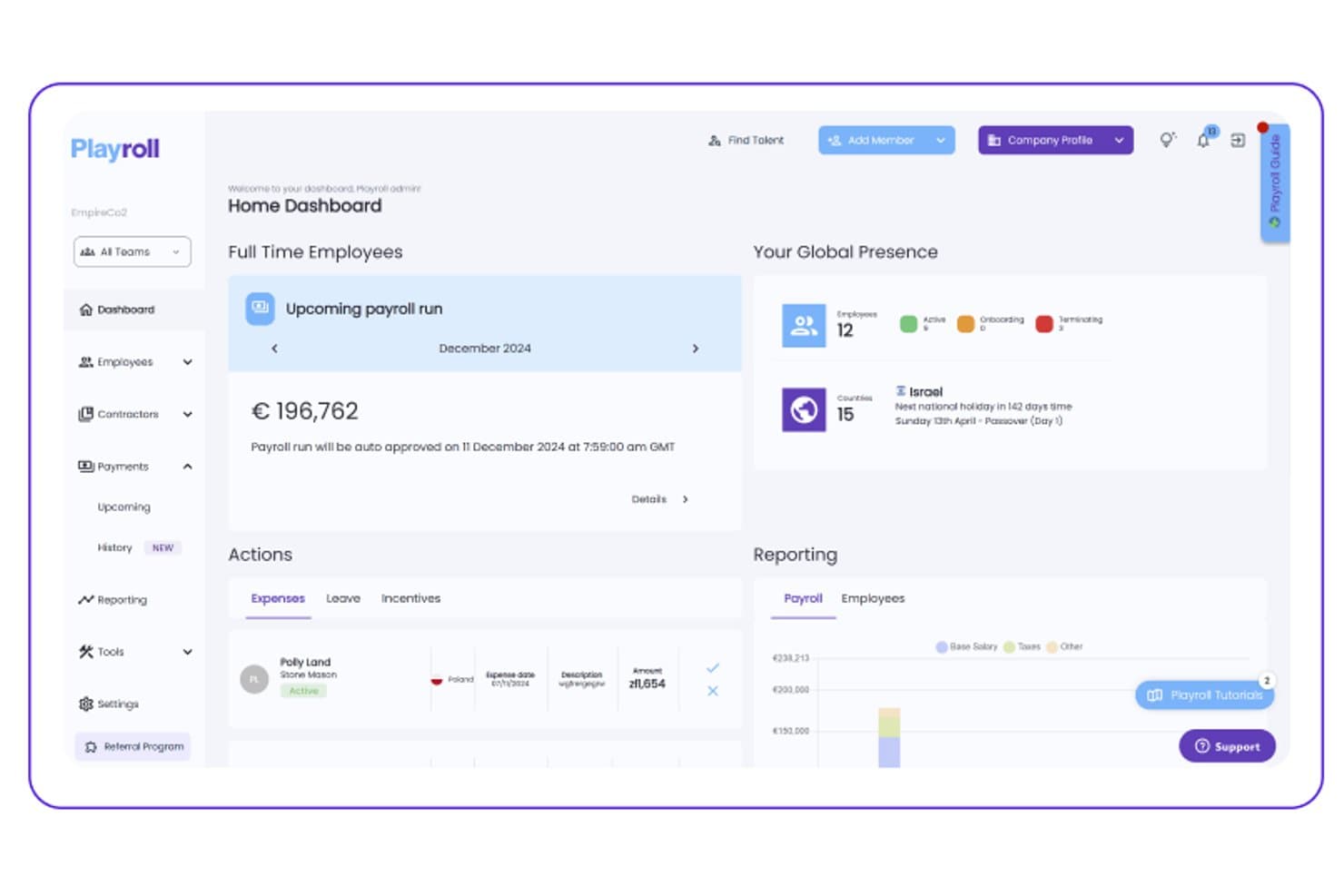
Playroll's dashboard centralizes payroll, headcount, and global presence for small teams. Playroll is an employer of record platform that handles international hiring, payroll, benefits administration, and compliance across multiple countries from a single dashboard.
Who Is Playroll Best For?
Playroll is a strong fit for small businesses hiring across multiple countries that want predictable, flat-rate costs without surprise fees.
Why I Picked Playroll
Playroll earns its spot on my shortlist because its flat-rate pricing model removes one of the biggest headaches in global hiring: unpredictable costs. I love that you pay the same rate regardless of which country you're hiring in, so scaling from one country to five doesn't balloon your budget unexpectedly. Playroll also consolidates payroll, benefits, and compliance into a single dashboard, which is exactly what a lean HR team needs when managing employees across borders.
Playroll Key Features
- Multi-currency payroll processing: Run payroll in local currencies for employees across different countries from a single dashboard.
- Locally compliant employment contracts: Playroll generates contracts that meet in-country legal requirements, including notice periods and statutory benefits.
- Employee self-service portal: Employees can access payslips, request time off, and update personal details without going through HR.
- Built-in expense management: Teams can submit and approve expense claims directly within the platform, keeping reimbursements tied to payroll cycles.
Playroll Integrations
Playroll documents native HRIS integrations with platforms including BambooHR and HiBob, alongside an Open API for custom connections.
Pros and Cons
Pros:
- Expense claims support payroll workflows
- Employee self-service reduces administrative requests
- Locally compliant employment contracts
Cons:
- Benefits administration varies by location
- Limited public detail on country coverage
Learn more about Playroll: Best with human-led support over automation
- Free demo available
- From $349/user/month
Visit WebsiteCustomer Rating:4.9/5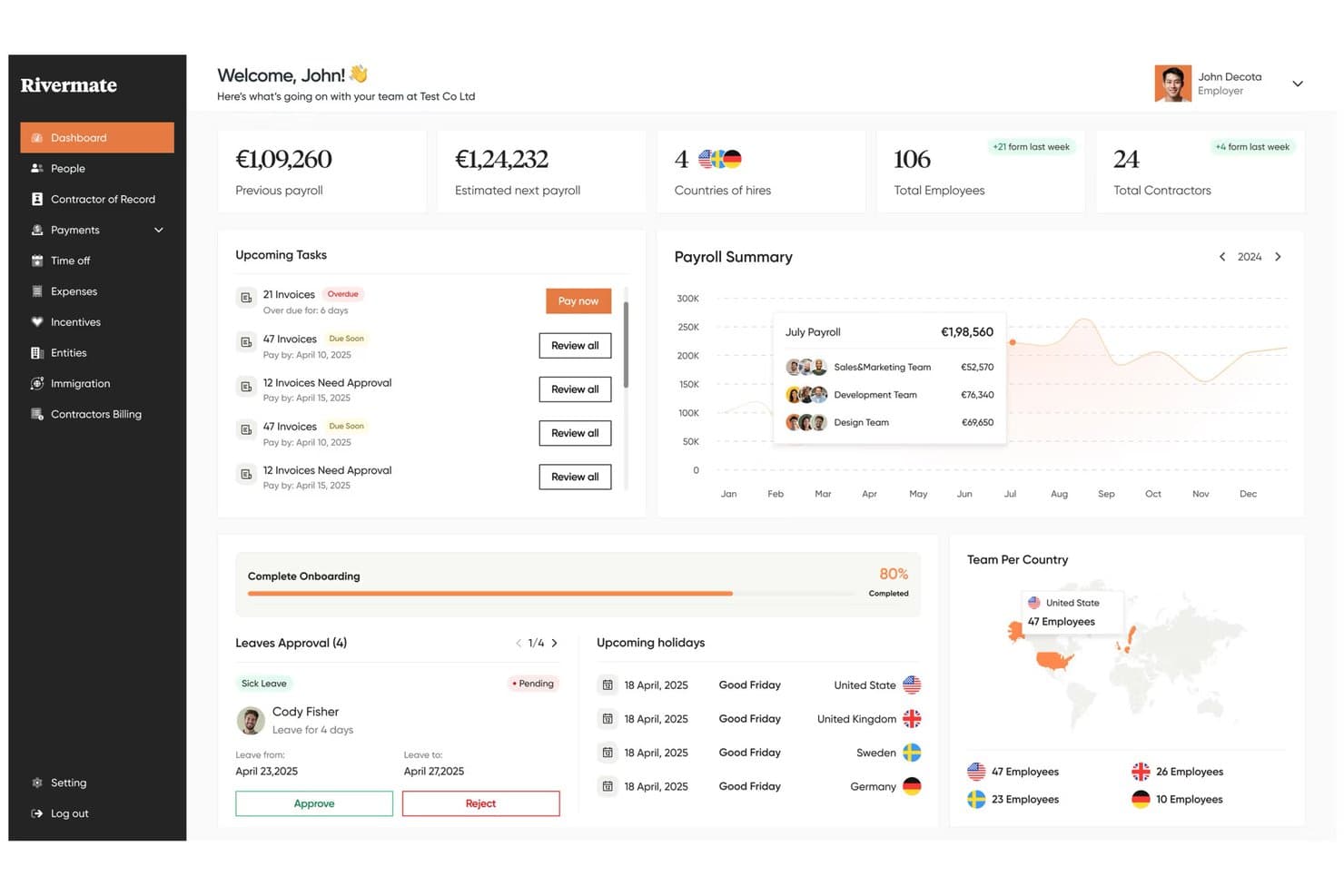
Rivermate centralizes payroll, headcount, and tasks for small business teams. Rivermate is an employer of record service that handles international hiring, payroll, compliance, and benefits administration across multiple countries through a team of local HR and legal experts.
Who Is Rivermate Best For?
Rivermate is a strong fit for small businesses that want a real person handling their international HR questions—not a chatbot or automated workflow.
Why I Picked Rivermate
I've included Rivermate in my top picks because it replaces the chatbot-first experience most EOR platforms default to with actual human experts. When you're hiring your first employee in, say, Brazil or the Philippines, you get a dedicated account manager who knows local labor law, not a knowledge base article. I particularly like that its in-house legal and HR specialists handle contract drafting and compliance checks directly, so nothing gets lost in an automated workflow.
Rivermate Key Features
- Multi-country payroll processing: Rivermate runs payroll in local currencies across 150+ countries, handling calculations, tax filings, and disbursements each pay cycle.
- Locally compliant employment contracts: Rivermate generates employment agreements that reflect in-country legal requirements, including notice periods, severance terms, and mandatory clauses.
- Benefits administration: Rivermate manages statutory and supplemental employee benefits by country, including health coverage, pension contributions, and paid leave entitlements.
- Intellectual property and equipment management: Rivermate supports IP assignment agreements and coordinates equipment provisioning for new international hires.
Rivermate Integrations
Native integrations are not currently listed.
Pros and Cons
Pros:
- Handles payroll and benefits across countries
- Local legal experts review employment contracts
- Human-led support for complex HR questions
Cons:
- Benefit availability varies by destination country
- Less automation than chatbot-first EOR platforms
Learn more about Rivermate: Best for direct-entity EOR across 160+ countries
- Free demo available
- From $599/user/month
Visit WebsiteCustomer Rating:4.6/5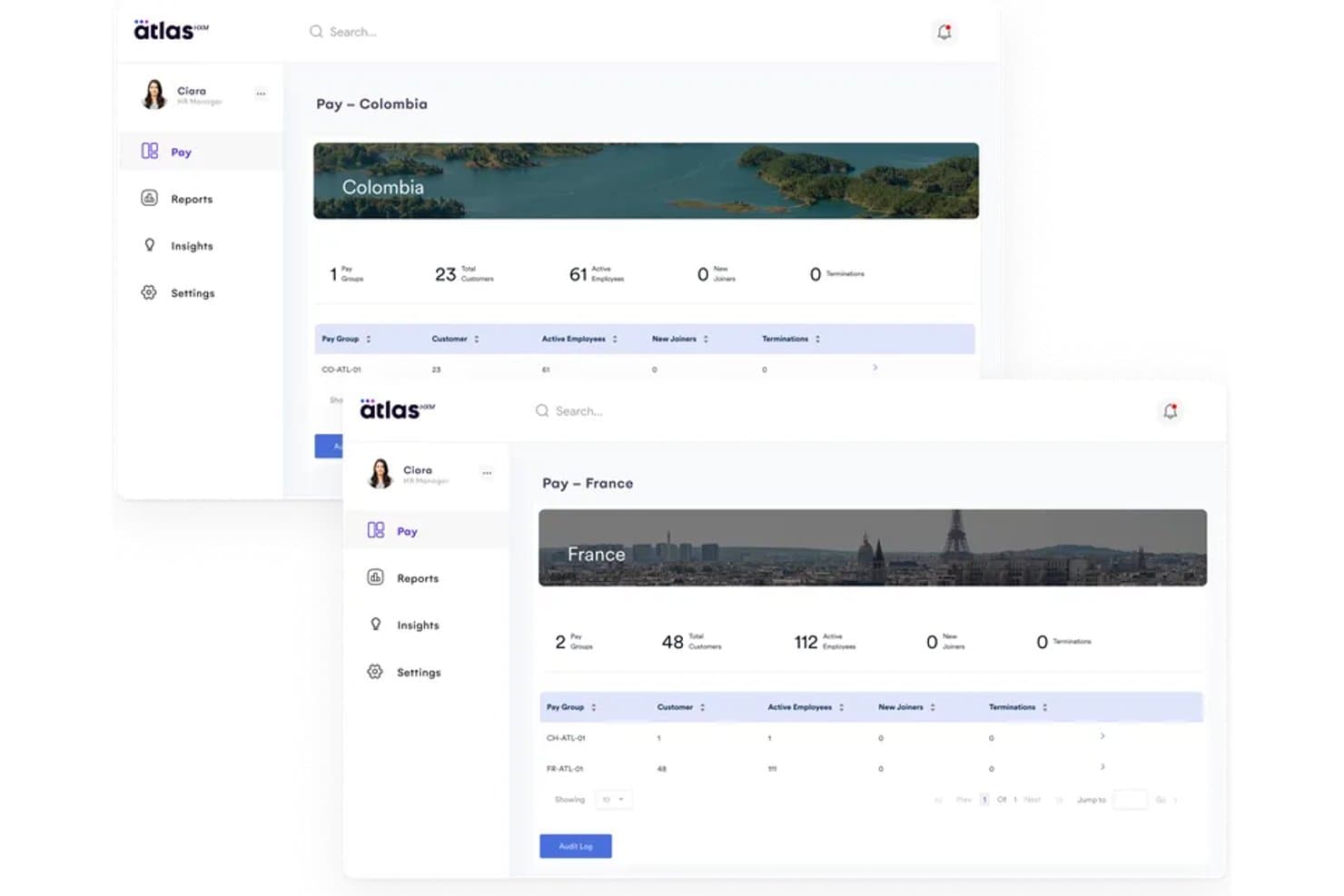
Atlas HXM manages payroll data across multiple countries for small businesses. Atlas HXM is an employer of record platform that manages international hiring, payroll, benefits administration, and compliance through its own legal entities in 160+ countries.
Who Is Atlas HXM Best For?
Atlas HXM is a strong fit for businesses hiring across multiple countries that need a true direct-entity EOR rather than a partner-dependent network.
Why I Picked Atlas HXM
Atlas HXM earns its spot on my shortlist because it operates through its own legal entities in 160+ countries, meaning there's no third-party partner network handling your hires. I love that this direct-entity model gives small businesses real accountability: one contract, one point of contact, and no gaps between what's promised and what's delivered. Its in-house compliance infrastructure also covers local labor law updates automatically, which matters when you're hiring in unfamiliar markets without a dedicated legal team.
Atlas HXM Key Features
- Automated onboarding workflows: Atlas HXM guides new international hires through country-specific onboarding steps, document collection, and contract signing in one platform.
- Benefits administration: You can manage locally competitive benefits packages for employees in each country, including health insurance, retirement plans, and statutory entitlements.
- Integrated global payroll: The platform processes multi-currency payroll across all supported countries, handling deductions, taxes, and disbursements in a single run.
- Immigration and visa support: Atlas HXM provides in-house assistance for work permits and visa applications, helping you relocate or hire talent across borders without a separate immigration vendor.
Atlas HXM Integrations
Atlas HXM supports native integrations with Workday, BambooHR, and Sage, as well as an open API via Atlas Connect.
Pros and Cons
Pros:
- Integrated multi-currency global payroll
- In-house immigration and visa support
- Direct entities across 160+ countries
Cons:
- Best suited to international hiring needs
- Visa sponsorship comes at an additional cost
Learn more about Atlas HXM: Best for instant hire with localized contracts
- Free demo available
- From $199/user/month
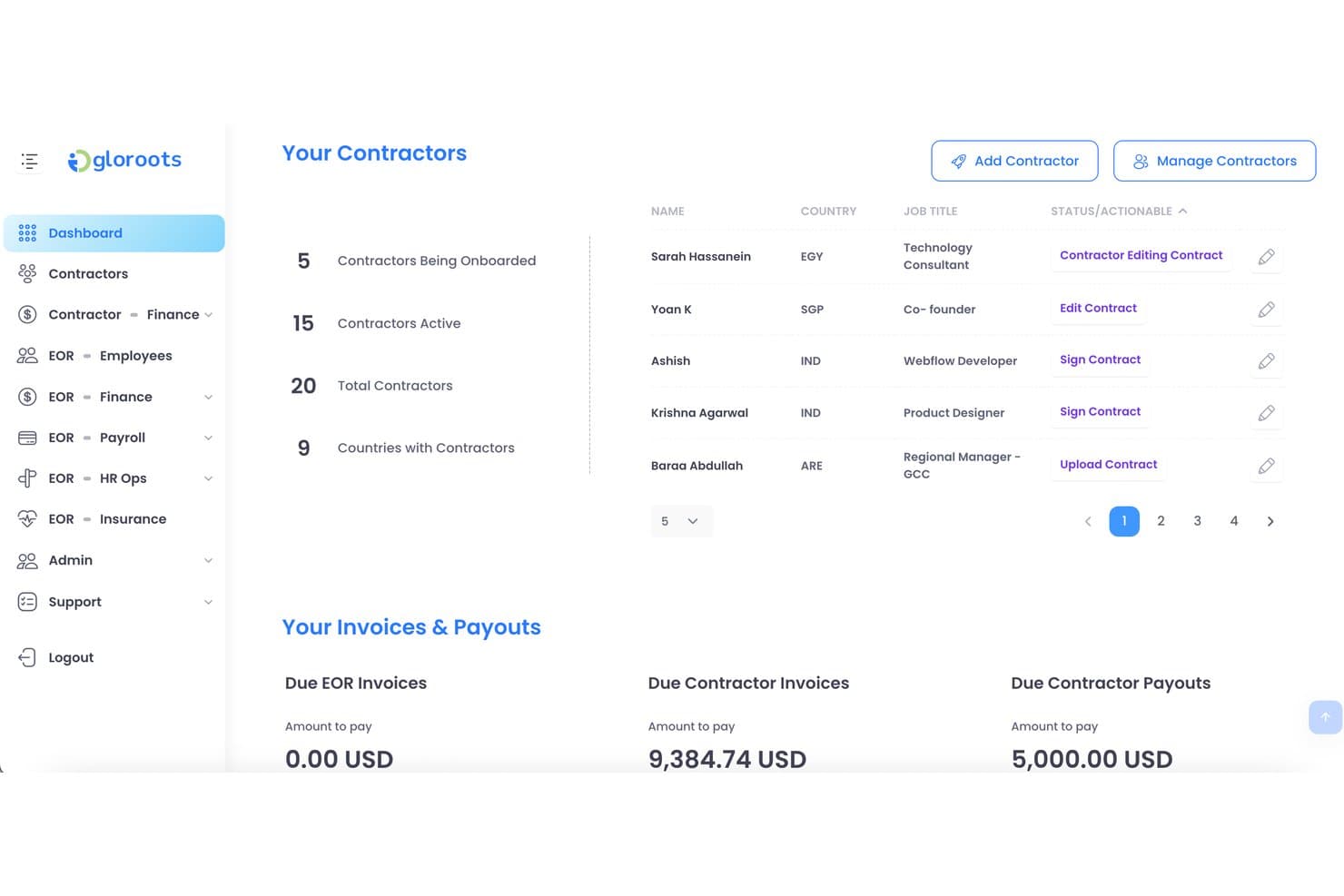
Gloroots lets small businesses manage contractors across multiple countries. Gloroots is an employer of record platform that covers global hiring, localized employment contracts, payroll processing, and compliance management across multiple countries.
Who Is Gloroots Best For?
Gloroots is a strong fit for small businesses that need to hire international employees quickly without getting bogged down in contract drafting or local compliance research.
Why I Picked Gloroots
I picked Gloroots as one of the best because it lets small businesses move from "we need someone in Brazil" to a signed, locally compliant contract in a matter of days. I love that it auto-generates localized employment agreements tailored to each country's labor laws, so you're not scrambling through legal docs or hiring local counsel just to get started. Its built-in compliance checks flag jurisdiction-specific requirements before you hire, which is exactly the kind of safety net a lean HR team needs.
Gloroots Key Features
- Multi-country payroll processing: Run payroll across multiple countries from a single dashboard, with automatic currency conversion and local payment disbursement.
- Employee benefits administration: Manage country-specific statutory and supplemental benefits for international hires directly within the platform.
- Expense management: Employees can submit expenses through the platform, and managers can review and approve reimbursements in local currencies.
- Contractor management: Onboard, pay, and manage international contractors alongside full-time employees under one unified system.
Gloroots Integrations
Native integrations are not clearly documented.
Pros and Cons
Pros:
- Contractors and employees share one platform
- Payroll supports multiple currencies
- Localized contracts accelerate international hiring
Cons:
- Country-specific coverage requires careful verification
- Pricing may challenge very small teams
Learn more about Gloroots: Best for hiring with built-in recruiting support
- Free demo available
- From $199/employee/month
Customer Rating:5/5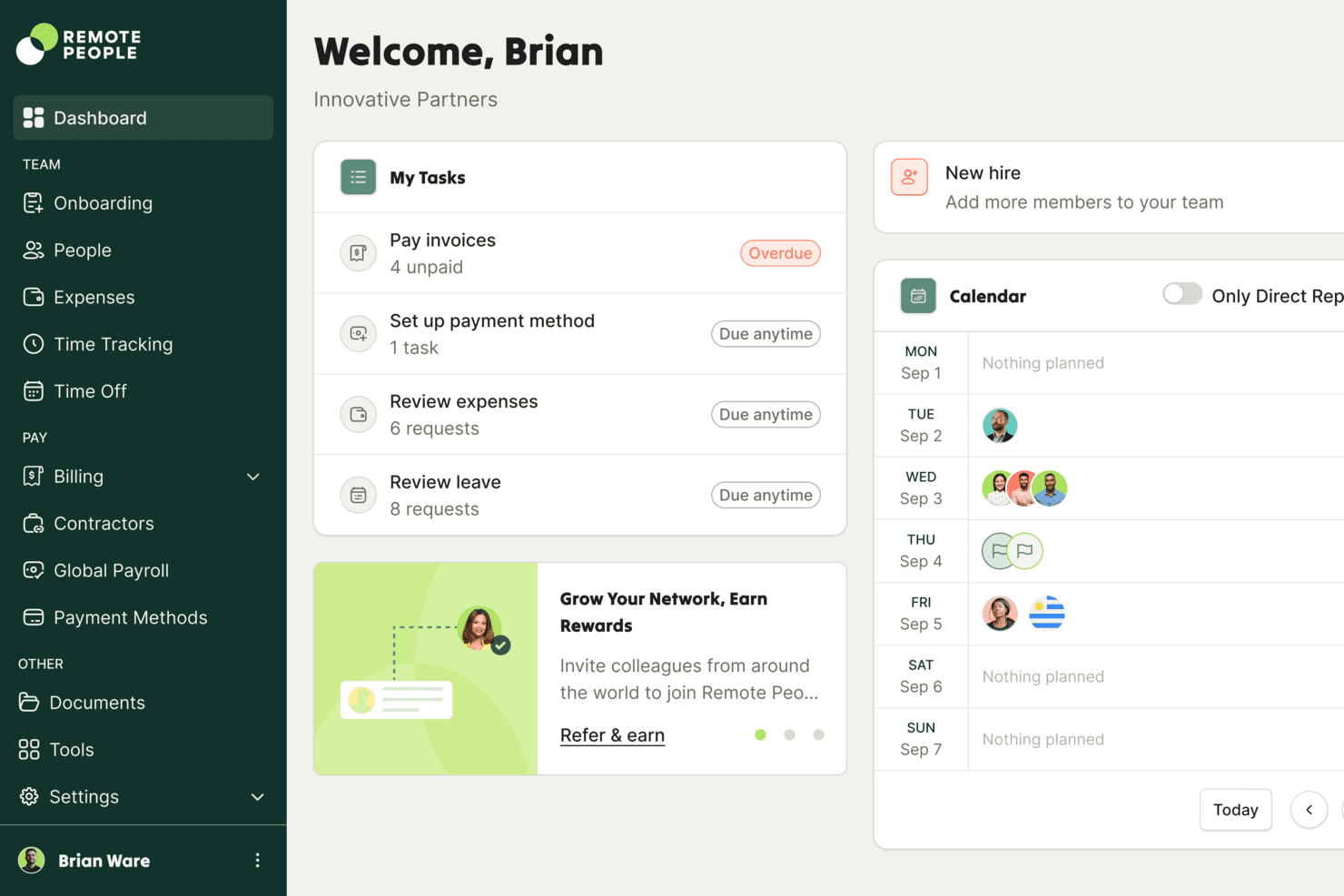
Remote People provides access to task management, billing, and team scheduling in one dashboard. RemotePeople is an employer of record platform that pairs global hiring infrastructure with in-house recruiting services, covering international payroll, compliance, contractor management, and talent sourcing.
Who Is RemotePeople Best For?
RemotePeople is a strong fit for small businesses that need help finding and hiring international talent, not just managing them after the fact.
Why I Picked RemotePeople
I've included RemotePeople in my top picks because it's one of the few EOR platforms that combines talent sourcing with employer of record infrastructure, so you're not just managing hires, you're actually making them. I love that their in-house recruiting team can identify and vet international candidates on your behalf, which is a real advantage when your small business doesn't have a dedicated recruiter. Their contractor management and global payroll tools then take over once someone's onboarded, keeping compliance intact across borders.
RemotePeople Key Features
- Multi-currency payroll processing: Employees and contractors are paid in their local currencies, with automatic currency conversion handled through the platform.
- Benefits administration: RemotePeople manages locally compliant benefits packages for international employees, including health coverage and statutory entitlements.
- Guided employee onboarding: New hires move through a structured onboarding workflow that collects documentation and confirms compliance requirements by country.
- Dedicated account management: Each client is assigned a dedicated account manager who provides direct support for HR queries and cross-border hiring decisions.
RemotePeople Integrations
RemotePeople supports native integrations with Workday, SAP SuccessFactors, BambooHR, HiBob, NetSuite, QuickBooks, Paylocity, Factorial, Lattice, JumpCloud, TriNet, and UKG Pro. It also provides developer APIs with OAuth 2.0 authentication for custom integrations.
Pros and Cons
Pros:
- Local benefits support international employee compliance
- Dedicated account managers guide cross-border hiring
- In-house recruiting supports international talent sourcing
Cons:
- Country-specific service coverage requires verification
- Recruiting support may not suit self-directed teams
Learn more about RemotePeople: 6Best for pre-hire employment cost modeling
Pebl
- Free demo available
- From $399/per employee/month
Visit WebsiteCustomer Rating:4.6/5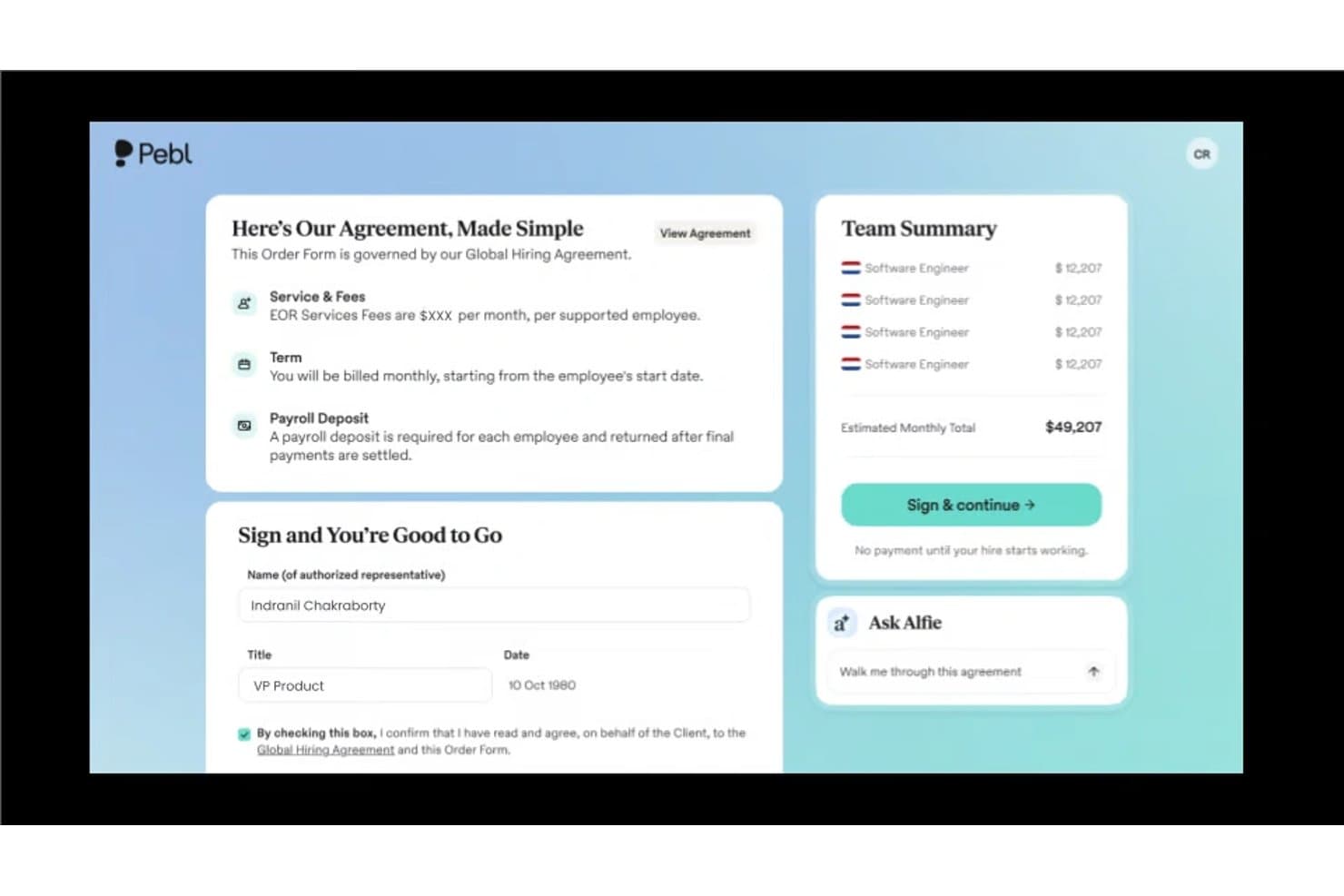
Pebl simplifies EOR contract signing with a clear order summary. Pebl is an employer of record platform that combines international hiring, payroll processing, and pre-hire employment cost modeling to help small businesses compliantly engage workers across borders.
Who Is Pebl Best For?
Pebl is a strong fit for small business owners who want to model the full cost of hiring internationally before making a commitment.
Why I Picked Pebl
Pebl earns its spot on my shortlist because of its pre-hire cost modeling, which lets you see the full employment cost of a hire before you commit. I love that it breaks down employer taxes, benefits, and local compliance costs by country so there are no surprises after onboarding. For small businesses hiring internationally on tight margins, that kind of upfront visibility is genuinely useful.
Pebl Key Features
- AI assistant (Alfie): An built-in AI tool that answers questions about compensation, onboarding, compliance, and workforce insights directly within the platform.
- Locally compliant contract generation: Automatically creates employment contracts in 25+ languages that meet local legal requirements, so you can onboard new hires in days.
- Global benefits administration: Offers country-specific employee benefits through Pebl-owned entities, with Pebl handling the compliance and admin on your behalf.
- HR and payroll integrations: Connects with your existing recruiting, HR, and payroll tools so you can manage your global workforce without switching between systems.
Pebl Integrations
Pebl offers native integrations with Ashby, ADP Workforce Now, Oracle, Namely, Gusto, and more.
Pros and Cons
Pros:
- Country-specific benefits administration reduces compliance workload
- Locally compliant contracts support faster onboarding
- Pre-hire modeling clarifies total employment costs
Cons:
- AI guidance still requires HR review
- Benefits availability varies across employee locations
Learn more about Pebl: 7Best for analyst-recognized global compliance coverage
G-P
- Free demo available
- From $599/user/month
Visit WebsiteCustomer Rating:4.5/5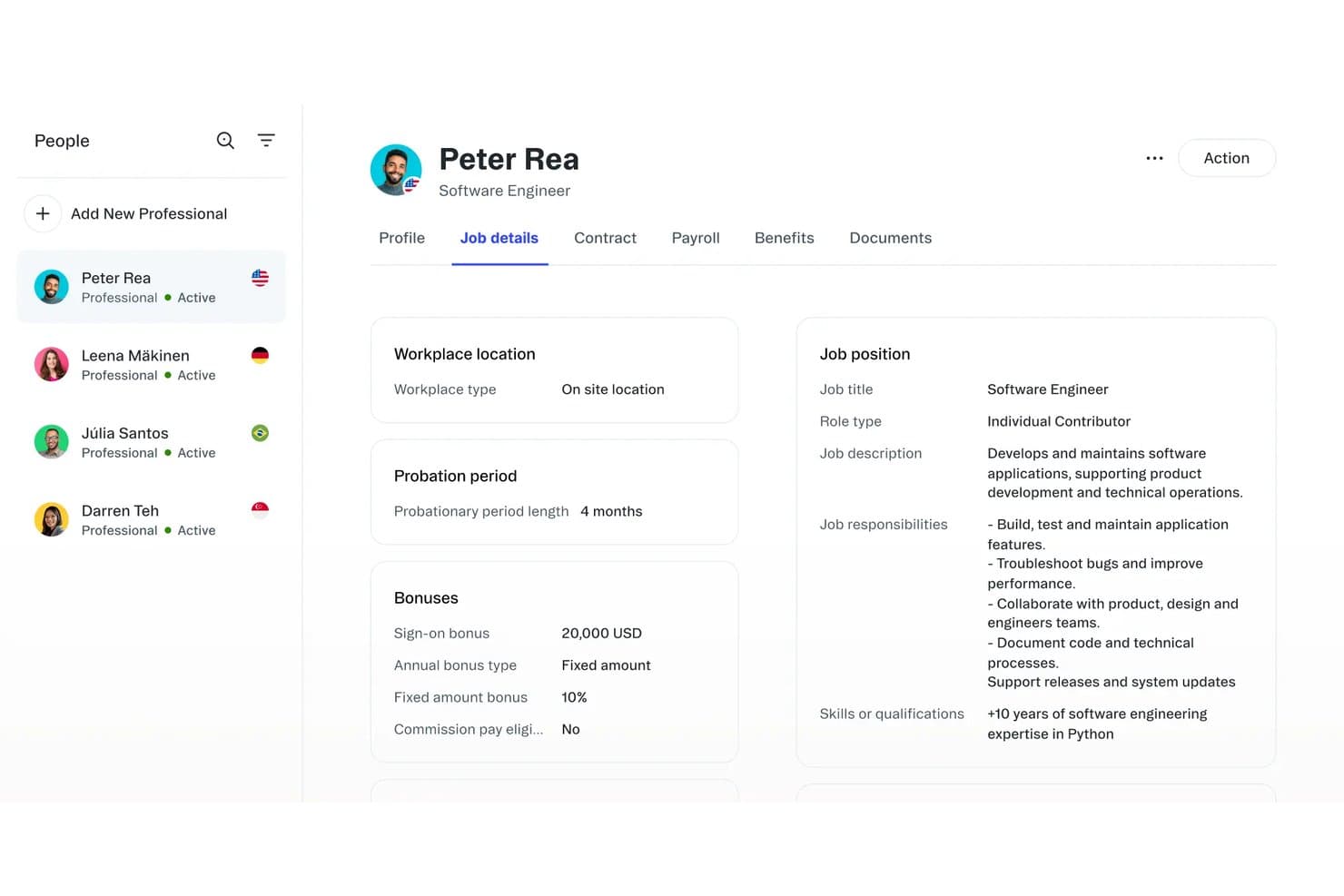
G-P centralizes employee job details, bonuses, and responsibilities in one place. G-P is an employer of record platform that handles international hiring, payroll, benefits administration, and compliance across 180+ countries.
Who Is G-P Best For?
G-P is a strong fit for small businesses that need to hire internationally and want the confidence of a platform independently validated for compliance rigor across global markets.
Why I Picked G-P
G-P earns its spot on my shortlist because its compliance infrastructure has been independently validated by analysts, which matters when you're a small business hiring across borders without a dedicated legal team. I particularly like its Country Insights tool, which surfaces local labor laws, mandatory benefits, and termination rules by market before you commit to a hire. G-P also maintains its own locally incorporated entities in 180+ countries, so your hires aren't routed through third-party partners where compliance gaps tend to appear.
G-P Key Features
- Guided employee onboarding: A built-in onboarding workflow walks you through collecting employee documents, signing contracts, and setting up payroll in a single flow.
- Global benefits administration: G-P manages locally compliant benefits packages, including health insurance and statutory contributions, for employees across covered markets.
- Integrated payroll processing: The platform runs in-country payroll, handles currency conversion, and delivers payslips directly to employees without requiring a separate payroll tool.
- HRIS integrations: G-P connects with common HR systems so your employee records, org data, and headcount stay in sync across your existing tech stack.
G-P Integrations
G-P lists integrations with ADP Workforce Now, Paylocity, BambooHR, HiBob, Personio, SAP SuccessFactors, UKG Pro, UKG Ready, Workday, and Microsoft Entra ID. Its API supports custom integrations.
Pros and Cons
Pros:
- Country Insights clarifies local hiring requirements
- Locally incorporated entities across 180+ countries
- Analyst-recognized global compliance coverage
Cons:
- Global scope can exceed simple hiring needs
- Premium fit for larger hiring budgets
Learn more about G-P: Best for contractual termination liability coverage
- Free demo available
- From $29/user/month
Visit WebsiteCustomer Rating:4.4/5
Papaya Global tracks employer costs across countries and cost centers. Papaya Global is an employer of record and global payroll platform that handles international hiring, contractor management, and workforce payments across multiple countries.
Who Is Papaya Global Best For?
Papaya Global is a strong fit for small businesses hiring internationally that need clear protection when ending contractor or employment relationships.
Why I Picked Papaya Global
Papaya Global earns its spot on my shortlist because of how seriously it handles contractual termination liability, which is one of the trickiest parts of international employment for small businesses. I particularly like its built-in workforce compliance insurance, which covers legal costs and liabilities that arise when ending worker relationships in complex jurisdictions. Its automated offboarding workflows also generate country-specific documentation to keep terminations legally sound from day one.
Papaya Global Key Features
- Multi-currency payroll processing: Run payroll in local currencies across 160+ countries from a single dashboard.
- Worker classification tool: Identifies whether a worker should be classified as an employee or contractor based on local labor laws.
- Consolidated billing: Combines all global workforce costs into a single monthly invoice to simplify financial tracking.
- Benefits administration: Manages locally compliant benefits packages, including statutory and supplemental options, for employees in each country.
Papaya Global Integrations
Documented integrations include BambooHR, SAP SuccessFactors, Namely, Eqip, and OneData. Papaya Global also supports SFTP file imports and custom API development for connecting other HR systems.
Pros and Cons
Pros:
- Multi-currency payroll supports international hiring
- Country-specific offboarding documents support compliant exits
- Contractual termination liability coverage
Cons:
- Global compliance still needs local review
- Smaller teams may need implementation support
Learn more about Papaya Global: Best for converting contractors to full-time hires
- Free plan + 30-day free trial + free demo available
- From $699/user/month
Visit WebsiteCustomer Rating:4.4/5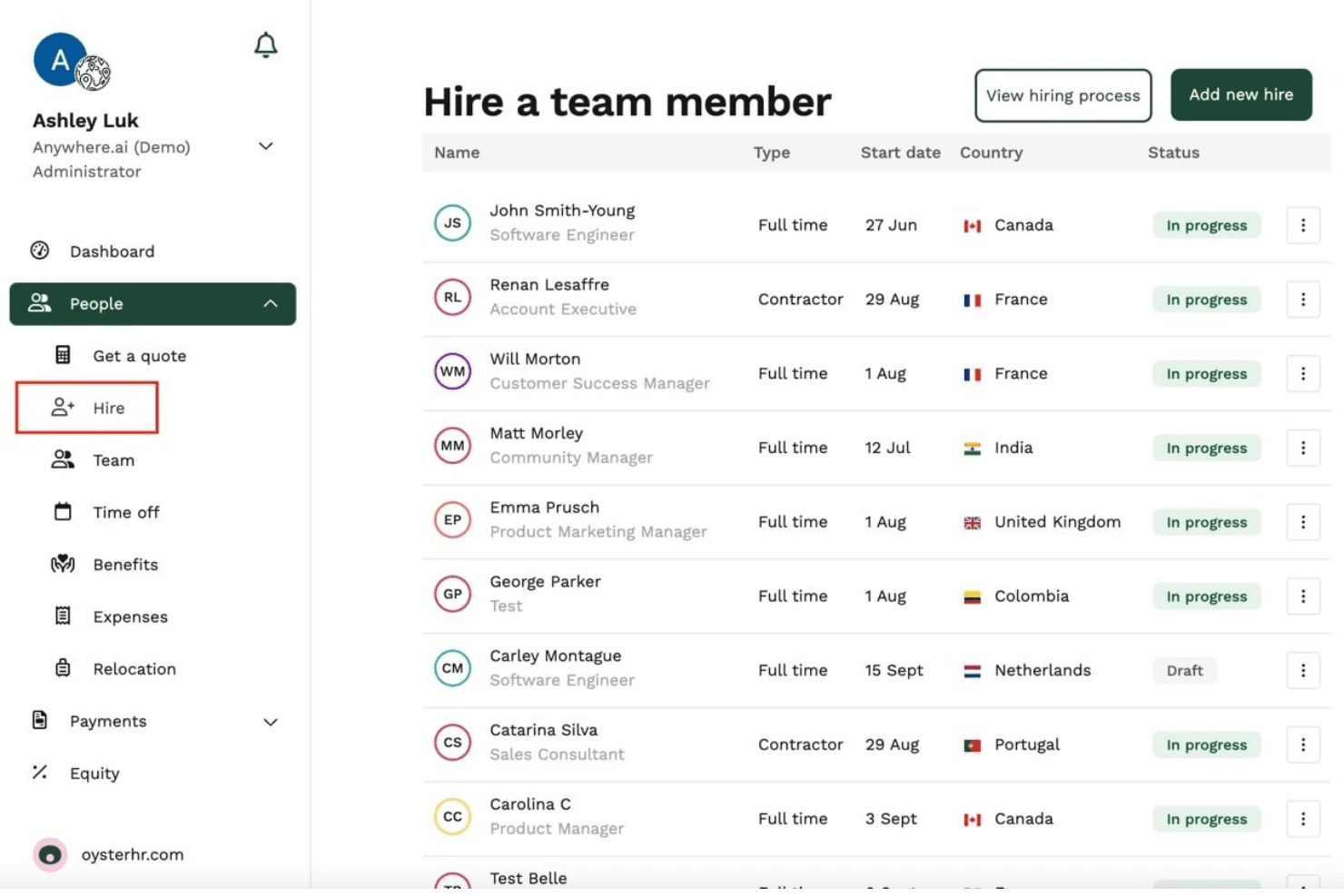
Oyster HR lets users track and manage global new hires in one place. Oyster HR is an employer of record platform that handles global hiring, payroll, benefits administration, and contractor-to-employee conversions across multiple countries.
Who Is Oyster HR Best For?
Oyster HR is a strong fit for small businesses that regularly work with contractors and want a clear path to converting them into full-time employees.
Why I Picked Oyster HR
Oyster HR earns its spot on my shortlist because of how well it handles the contractor-to-employee conversion process, which is a real sticking point for small businesses that rely heavily on freelance or contract talent. I love that it includes built-in compliance checks and local employment contract generation, so when you're ready to bring a contractor on full-time in another country, you're not scrambling to figure out local labor law. Its guided onboarding flow also makes the transition feel structured rather than chaotic.
Oyster HR Key Features
- Global payroll processing: Run payroll across multiple countries in local currencies, with automatic tax calculations and statutory deductions handled for each region.
- Benefits administration: Access and manage locally compliant benefits packages for full-time employees in each country where you hire.
- Employment contract generation: Generate locally compliant employment contracts based on the country and role, pulled from Oyster HR's built-in legal templates.
- Contractor management: Invite, manage, and pay contractors through the same platform you use for full-time employees, keeping your entire workforce in one place.
Oyster HR Integrations
Oyster HR offers integrations with TeamTailor, Workable, Factorial, Lucca, Humaans, ADP Workforce Now, Concur, Carta, and Slack, plus an API for custom workflows. It connects to 5,000+ apps via Zapier.
Pros and Cons
Pros:
- Supports multi-country payroll and benefits
- Generates locally compliant employment contracts
- Simplifies contractor-to-employee conversions
Cons:
- May feel excessive for one-off hires
- Limited trial access for evaluation
 Best for non-HR founders hiring abroad on a budget
- Free plan + demo available
- From $199/user/month
Visit WebsiteCustomer Rating:4.5/5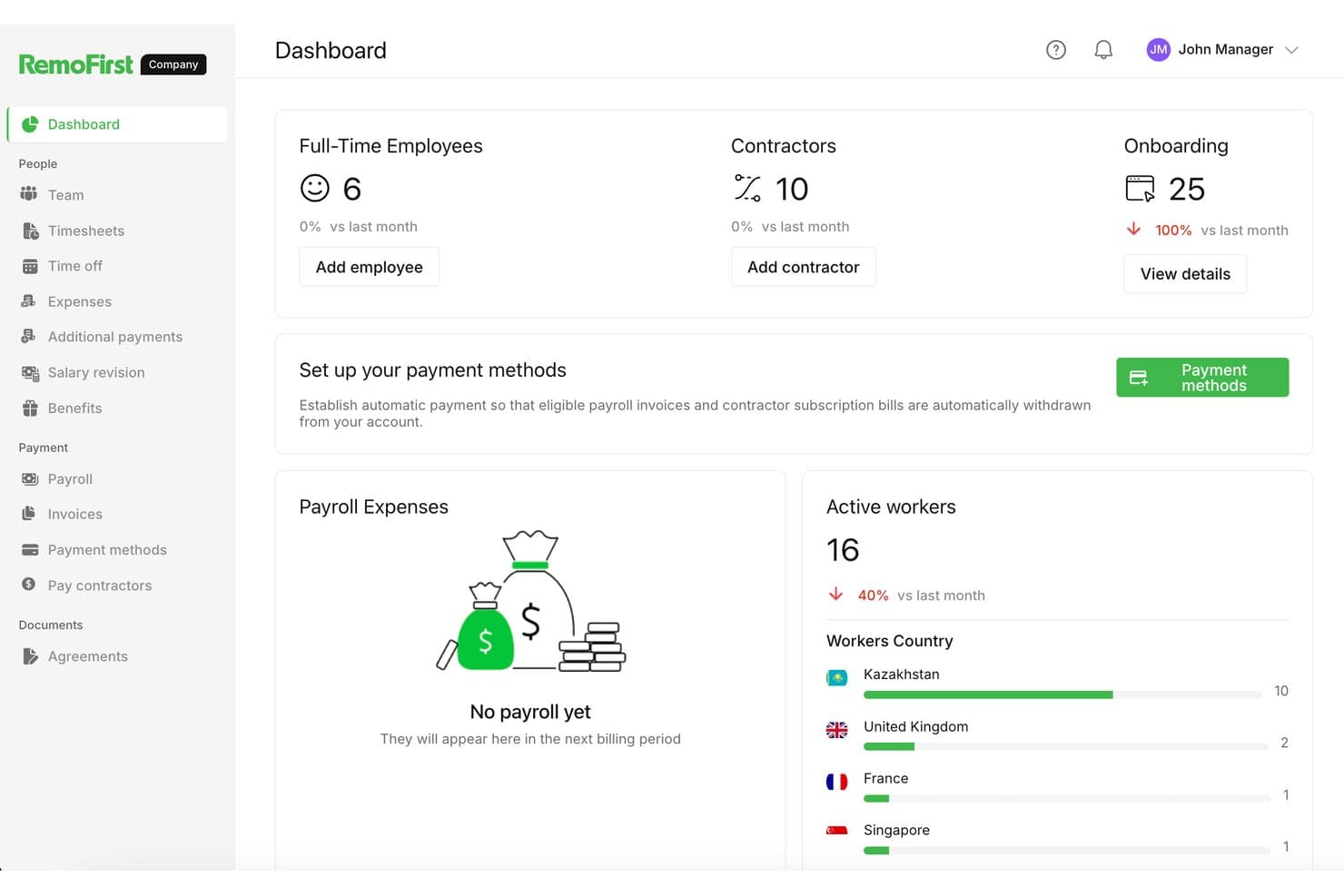
RemoFirst's dashboard gives small businesses a clear workforce overview. RemoFirst is an employer of record platform built for lean teams that handles global hiring, payroll, and compliance across 180+ countries without requiring dedicated HR infrastructure.
Who Is RemoFirst Best For?
RemoFirst is a strong fit for early-stage founders and small teams that need to hire internationally without a dedicated HR function.
Why I Picked RemoFirst
RemoFirst earns its spot on my shortlist because it's built for founders who are figuring out global hiring without an HR team behind them. I particularly like its contract-to-hire workflow, which lets you bring on international contractors and convert them to full-time employees in the same platform without starting over. Its built-in equipment provisioning also means you can ship a laptop to a new hire in another country without coordinating a separate vendor.
RemoFirst Key Features
- Global payroll management: Run payroll for employees across 180+ countries in local currencies from a single dashboard.
- Compliance documentation handling: RemoFirst generates and manages locally compliant employment contracts for each country where you hire.
- Contractor management: Onboard and pay international contractors alongside full-time employees within the same platform.
- Benefits administration: Access and manage locally appropriate benefits packages for employees in each country without sourcing them yourself.
RemoFirst Integrations
RemoFirst offers native integrations with Workday, BambooHR, GoCardless, and ADP Workforce Now. These connect HR data and payroll funding for small-business teams.
Pros and Cons
Pros:
- Includes equipment provisioning for new hires
- Handles hiring across 180-plus countries
- Supports contractor-to-employee conversions
Cons:
- May lack advanced HR capabilities
- Benefits choices vary by country
Outras ferramentas de EOR para pequenas empresas
Eis algumas ferramentas de EOR adicionais para pequenas empresas que não entraram na minha seleção, mas que vale a pena conhecer:
- 11Payoneer Workforce ManagementBest for converting contractors to employees at scale
- 12RemoteBest for unlimited indemnity on global hires
- 13RipplingBest for all-in-one HR and global hiring growth
- 14Deel HireBest for one-platform global hiring at scale
- 15MultiplierBest for hiring globally with a built-in HRIS
- 16JustworksBest for U.S. teams with limited international hiring
- 17WorkMotionBest for compliance-first European EOR hiring
- 18TarmackBest for startup hiring without local entity setup
My Selection Criteria for EOR for Small Businesses
Employer of record tools exist to let you legally employ workers abroad without opening local entities, so I judge them on how well they carry that whole job. These tools all do one business function. I check the shared basics first, then compare how they differ, and only the tools that hold up make my list.
Must-Haves (50% of the score)
A tool has to show it meets this before I consider it at all, and strengths elsewhere don't make up for missing it. How fully a tool meets this requirement also counts toward its score.
- Local Legal Employer: I check that the vendor, or a partner entity it arranges, becomes the worker's formal employer in their country, so your business needs no entity of its own.
Core Capabilities (20%)
Passing the must-haves only gets a tool considered; here I score how well it actually runs the daily work of employing someone abroad. I score each capability from 0 (not offered) to 5 (excels).
- Local Payroll and Tax: I look at how deeply a tool handles recurring pay, such as local currency payment or employer contributions. I give extra credit for visible checks and reviews before each payroll runs.
- Contracts and Onboarding: I evaluate how well a tool supplies country-specific agreements and worker setup, including notice terms, probation rules, or electronic signature. The best add guided country checklists with documented timelines.
- Statutory Benefits Administration: I look at how well a tool handles legally required benefits and enrolls workers in them, whether that's statutory insurance or paid leave.
- Offboarding and Termination: I evaluate how a tool guides you through ending employment lawfully, including final pay, severance, or termination documents.
- Ongoing Employment Changes: I check how a tool processes mid-employment requests with local compliance applied, such as salary adjustments or contract amendments.
- Records and Self-Service: I look at how well central records and portal access work for admins and workers, such as payslip access or leave tracking.
Key Features (7%)
The features a tool offers decide how far you can hire and how well it fits alongside the software you already run.
- Country Coverage: I look at how many countries a tool serves and whether core services stay consistent across them, including whether it discloses owned or partner entities.
- Integrations and Data Exchange: I evaluate how well a tool connects to your stack, whether that's an HRIS or accounting software, and whether it states what data moves.
Standout Features (5%)
When hiring abroad gets complicated, a few extra services separate the strongest tools from the rest.
- Immigration and Mobility Support: I give more credit when a tool handles hands-on help with work authorization, such as visas or relocation.
- Compliance Monitoring: I look at how proactively a tool alerts you to law changes, and whether guidance links to your countries or specific employees.
Use Cases (10%)
A tool can have strong core features and still miss the specific jobs small businesses face when hiring abroad, so I check these separately.
- Pre-Hire Cost Estimates: When you're about to make an offer, I look at whether you can see the full cost of a hire in that country, through a calculator or quoted breakdown.
- Multi-Country Team Management: I check whether one account lets you manage employees in several countries, with consolidated invoices and itemized charges.
- Contractor-to-Employee Conversion: I look at whether you can move an existing contractor into employment without starting over, including local contract setup.
Beyond Features (8%)
Since an employer of record handles pay and legal duties for your people, I look at what employing someone really costs and how reliably you get answers.
- Total Cost Transparency: I evaluate how fully a tool discloses costs beyond its service fee, such as deposits, exchange-rate method, or offboarding charges.
- Local Support and Resolution: I look at how clearly a tool explains how you get help with country-specific questions, including stated hours, escalation path, and local HR or legal expertise.
Como escolher um EOR para uma pequena empresa
É fácil perder-se em listas extensas de funcionalidades e estruturas de preços complexas. Para o ajudar a manter-se focado enquanto analisa o seu processo específico de seleção de software, apresentamos uma lista de verificação dos fatores a ter em conta:
| Fator | O que deve considerar |
| Escalabilidade | A plataforma consegue acompanhar o crescimento em diferentes países e equipas de várias dimensões? Informe-se sobre o suporte à expansão para várias regiões e à adição de colaboradores à medida que cresce. |
| Integrações | O EOR liga-se aos seus sistemas de processamento salarial, de gestão de recursos humanos ou de contabilidade? Avalie a facilidade de sincronização de dados entre os sistemas existentes e a ferramenta de EOR. |
| Personalização | O sistema permite adaptar os fluxos de trabalho às suas políticas e localizações específicas? Verifique se pode criar fluxos de aprovação personalizados ou adaptar contratos. |
| Facilidade de utilização | As suas equipas de recursos humanos e operações conseguem aprender rapidamente a utilizar a interface? Procure painéis intuitivos e funções de utilizador claras para minimizar as necessidades de formação. |
| Implementação e integração inicial | O que é necessário para começar a operar nos países pretendidos? Pergunte que suporte à integração inicial está incluído, qual é o tempo habitual até à primeira contratação e quais são os passos para a migração de dados. |
| Custo | Como funciona o preço para os seus planos de contratação previstos? Esteja atento a taxas adicionais, valores mínimos ou diferenças de preço por país que possam afetar o orçamento. |
| Medidas de segurança | Que proteções existem para os dados sensíveis dos seus colaboradores? Confirme a conformidade com normas de privacidade de dados, como o RGPD, e a preparação para auditorias. |
| Disponibilidade do suporte | O fornecedor oferece suporte internacional e cobertura nas suas regiões? Considere os tempos de resposta, os idiomas suportados e o acesso a conhecimentos especializados locais em recursos humanos e matéria jurídica. |
O que são os serviços de entidade empregadora oficial?
Os serviços de entidade empregadora oficial são prestadores de serviços externos que empregam legalmente trabalhadores em nome da sua empresa, gerindo as responsabilidades de processamento salarial, recursos humanos e gestão de pessoas em diferentes países.
Um parceiro EOR ajuda as pequenas empresas a aceder a talento global e a construir uma força de trabalho global sem estabelecer entidades próprias, reduzindo as responsabilidades associadas à legislação laboral local. Esta abordagem apoia a gestão da força de trabalho em regiões da UE e noutras partes do mundo, ajudando simultaneamente a evitar riscos de classificação incorreta ao contratar prestadores de serviços independentes ou trabalhadores a tempo inteiro.
Funcionalidades das ferramentas EOR para pequenas empresas
Ao selecionar um EOR para uma pequena empresa, tenha em atenção as seguintes funcionalidades essenciais:
- Processamento global de salários: Automatiza os cálculos salariais, distribui pagamentos em moedas locais e deduz impostos e contribuições sociais de acordo com cada região.
- Gestão da conformidade local: Acompanha e aplica a legislação laboral específica de cada país, os requisitos fiscais e as necessidades documentais para reduzir os riscos das pequenas empresas que contratam no estrangeiro.
- Geração de contratos de trabalho: Cria contratos de trabalho conformes que refletem as normas jurídicas locais, os idiomas e as informações estatutárias obrigatórias.
- Administração de benefícios: Disponibiliza e gere os benefícios exigidos localmente, como cuidados de saúde, pensões e férias, respeitando as normas de cada país.
- Fluxos de trabalho de integração: Digitaliza e simplifica a recolha de documentos, a orientação dos trabalhadores e a formação de novos contratados em várias jurisdições.
- Controlo de ausências e licenças: Acompanha os feriados legais, os dias de férias e os diferentes tipos de licença exigidos pela legislação local, com cálculos automáticos da acumulação.
- Gestão de despesas e reembolsos: Permite que os trabalhadores submetam pedidos de reembolso de despesas e que os gestores os aprovem ou rejeitem, com os pagamentos processados através do processamento salarial.
- Salvaguardas de segurança e privacidade dos dados: Protege os dados sensíveis dos trabalhadores e da folha salarial através de protocolos de segurança e cumpre regulamentos como o RGPD.
- Integração com sistemas de RH e financeiros: Liga-se diretamente a sistemas de informação de recursos humanos, ferramentas de contabilidade e fluxos de trabalho para garantir uma transferência de dados fluida e reduzir a introdução manual de dados.
- Painel de apoio a vários países: Disponibiliza um único painel para acompanhar trabalhadores, salários, conformidade e documentos em todos os países onde contrata.
Benefícios dos EOR para pequenas empresas
A implementação de um EOR para uma pequena empresa proporciona vários benefícios para a sua equipa e para a sua empresa. Eis alguns dos benefícios que pode esperar:
- Contratação internacional simplificada: Pode contratar rapidamente trabalhadores em novos países sem estabelecer entidades jurídicas, graças às funcionalidades de processamento salarial, contratos e administração de RH em conformidade.
- Redução dos riscos de não conformidade: O apoio integrado em matéria jurídica e fiscal ajuda a evitar penalizações e multas relacionadas com os regulamentos aplicáveis ao emprego internacional.
- Integração mais rápida dos trabalhadores: Os fluxos de trabalho de integração simplificados e os modelos prontos a utilizar aceleram o processo de integração de novos contratados em várias regiões.
- Administração centralizada de RH: Gira os salários, os benefícios, as ausências e os dados laborais das equipas globais num único painel unificado.
- Processamento salarial rigoroso e atempado: O processamento salarial automatizado garante que os trabalhadores são pagos corretamente e a tempo, nas respetivas moedas locais.
- Eficiência de custos: As plataformas EOR reduzem a sobrecarga administrativa e os custos da expansão global ao consolidarem as ferramentas de RH e de conformidade numa única plataforma.
- Acesso a benefícios locais: Os seus trabalhadores têm acesso a benefícios competitivos e conformes com a legislação do país, geridos e administrados pelo fornecedor EOR.
Custos e preços dos EOR para pequenas empresas
A seleção de um EOR para uma pequena empresa exige uma compreensão dos vários modelos e planos de preços disponíveis. Os custos variam consoante as funcionalidades, a dimensão da equipa, os complementos e outros fatores. A tabela abaixo resume os planos comuns, os respetivos preços médios e as funcionalidades normalmente incluídas nas soluções EOR de pequena escala:
Tabela de comparação de planos de EOR para pequenas empresas
| Tipo de plano | Preço médio | Funcionalidades comuns |
| Plano gratuito | $0 | Orientação básica sobre conformidade, apoio limitado à folha de pagamentos, recursos de integração autónoma e apoio ao cliente exclusivamente por e-mail. |
| Plano pessoal | $150–$250/empregado/mês | Processamento de salários, geração de contratos, fluxos de integração, integrações limitadas e gestão básica da conformidade. |
| Plano empresarial | $250–$400/empregado/mês | Serviços completos de processamento de salários, benefícios localizados, conformidade com as políticas, integrações, painel de administração e apoio em vários países. |
| Plano empresarial de grande dimensão | $400+/empregado/mês | Gestor de conta dedicado, análise avançada de RH, integrações personalizadas, administração global de benefícios e apoio 24 horas por dia, 7 dias por semana. |
Perguntas frequentes sobre EOR para pequenas empresas
Aqui ficam algumas respostas a perguntas comuns sobre EOR para pequenas empresas:
Como é que um EOR ajuda as pequenas empresas a expandirem-se internacionalmente?
Um EOR atua como empregador legal em cada país onde pretende contratar, tratando da folha de pagamentos, da conformidade e da documentação de RH. Isto permite que a sua pequena empresa integre talento em novas localizações muito mais rapidamente e sem criar uma entidade legal local.
Posso utilizar um EOR para contratar empregados a tempo inteiro e prestadores de serviços?
Sim, a maioria dos prestadores de serviços apoia tanto empregados a tempo inteiro como prestadores de serviços. Prestam serviços de gestão da força de trabalho relacionados com contratos, processamento de salários e retenção de impostos, assegurando também a conformidade local para o regime de que a sua empresa necessita.
Qual é a duração habitual dos contratos com prestadores de EOR?
A maioria dos contratos de EOR funciona numa base mensal, com flexibilidade para adicionar ou remover empregados conforme necessário. Verifique sempre as condições de cancelamento do prestador, uma vez que alguns podem ter requisitos mínimos ou períodos de pré-aviso.
Quais são as principais preocupações de conformidade ao contratar globalmente através de um EOR?
Ao contratar internacionalmente, é necessário cumprir a legislação laboral local, as obrigações fiscais e as normas relativas a benefícios. Um EOR trata destes pormenores de conformidade para que possa evitar multas dispendiosas, mas deve ainda assim analisar os requisitos fundamentais de cada mercado-alvo.
Com que rapidez posso integrar um novo empregado através de um EOR?
Normalmente, pode integrar um novo empregado no prazo de alguns dias, dependendo do país e da documentação necessária. A rapidez é uma das principais vantagens, mas algumas regiões podem exigir mais tempo de processamento — pergunte ao seu prestador quais são os prazos de integração locais.
Existem taxas ocultas ou custos adicionais a ter em conta?
Sim, alguns serviços de empregador legal podem cobrar um valor adicional por serviços como alterações aos contratos, processos de saída ou relatórios adicionais. Analise sempre os documentos de preços e peça ao gestor da sua conta EOR uma lista dos custos padrão e opcionais.
Como é que um EOR trata a transferência de PI após a cessação do contrato?
Para as pequenas empresas, um empregador legal (EOR) estabelece normalmente a titularidade da propriedade intelectual (PI) no início da relação laboral, de modo a evitar problemas posteriormente. Os contratos de trabalho indicam claramente que qualquer trabalho criado no âmbito das funções do empregado pertence à empresa ou é cedido à mesma. Após a cessação do contrato, o EOR ajuda a formalizar e reforçar esses direitos, incluindo o tratamento da documentação necessária e a garantia de que todos os materiais relacionados com o trabalho são devolvidos.