
10 beste plattformer for psykisk helse på arbeidsplassen i 2026

Beste plattformer for psykisk helse på arbeidsplassen


Plattformer for psykisk helse på arbeidsplassen er digitale verktøy og tjenester som er utviklet for å støtte ansattes trivsel, psykiske helse og emosjonelle motstandskraft. Hvis du leter etter velprøvde måter å håndtere stress, utbrenthet eller engasjement i teamet ditt på, gir disse plattformene enkel tilgang til rådgivning, coaching, mindfulness og ressurser for atferdshelse.
Ettersom arbeidsgivere møter stadig høyere forventninger om å prioritere psykisk helse, kan det å vite hvilke plattformer som tilbyr praktisk, evidensbasert støtte, utgjøre en stor forskjell for å beholde ansatte, produktivitet og etterlevelse. Denne listen hjelper deg med å sammenligne pålitelige alternativer for å finne den løsningen som passer best til organisasjonens unike behov.
Why Trust Our Software Recommendations
Our team has been testing and reviewing software since 2012. As HR experts ourselves, we know how difficult—and important—it is to choose the right software.
For this guide, we evaluated tools using hands-on testing and independent research, scoring tools using our selection criteria. We also draw on insights from industry thought leaders and practicing HR experts.
Our reviews reflect our human editorial judgment, not a sales pitch.
Expert reviewers:
Sammenligningstabell: Plattformer for psykisk helse på arbeidsplassen
Denne sammenligningstabellen oppsummerer prisopplysningene for mine utvalgte plattformer for psykisk helse på arbeidsplassen.
| Tool | Best For | Trial Info | Price | ||
|---|---|---|---|---|---|
| 1 | Best for mindfulness tools for companies | Free demo available | Pricing upon request | Website | |
| 2 | Best for personalized coaching for workplace growth | Free demo available | Pricing upon request | Website | |
| 3 | Best for self-guided programs to build mental resilience | Free demo available | Pricing upon request | Website | |
| 4 | Best for stress management resources | Free demo available | Pricing upon request | Website | |
| 5 | Best for on-demand therapy sessions | Free demo available | Pricing upon request | Website | |
| 6 | Best for direct access to mental health providers | Free demo available | Pricing upon request | Website | |
| 7 | Best for combining digital and in-person care options | Free demo available | Pricing upon request | Website | |
| 8 | Best for personalized care pathways | Free demo available | Pricing upon request | Website | |
| 9 | Best for proactive well-being support | Free demo available | Pricing upon request | Website | |
| 10 | Best for clinical expertise in complex mental health needs | Free demo available | Pricing upon request | Website |
Omtaler av de beste plattformene for psykisk helse på arbeidsplassen
Nedenfor finner du mine detaljerte sammendrag av de beste plattformene for psykisk helse på arbeidsplassen som kom med på kortlisten min. Omtalene mine gir en detaljert oversikt over funksjonene, de beste bruksområdene og prisene for hver plattform, slik at du kan finne den som passer best for deg.
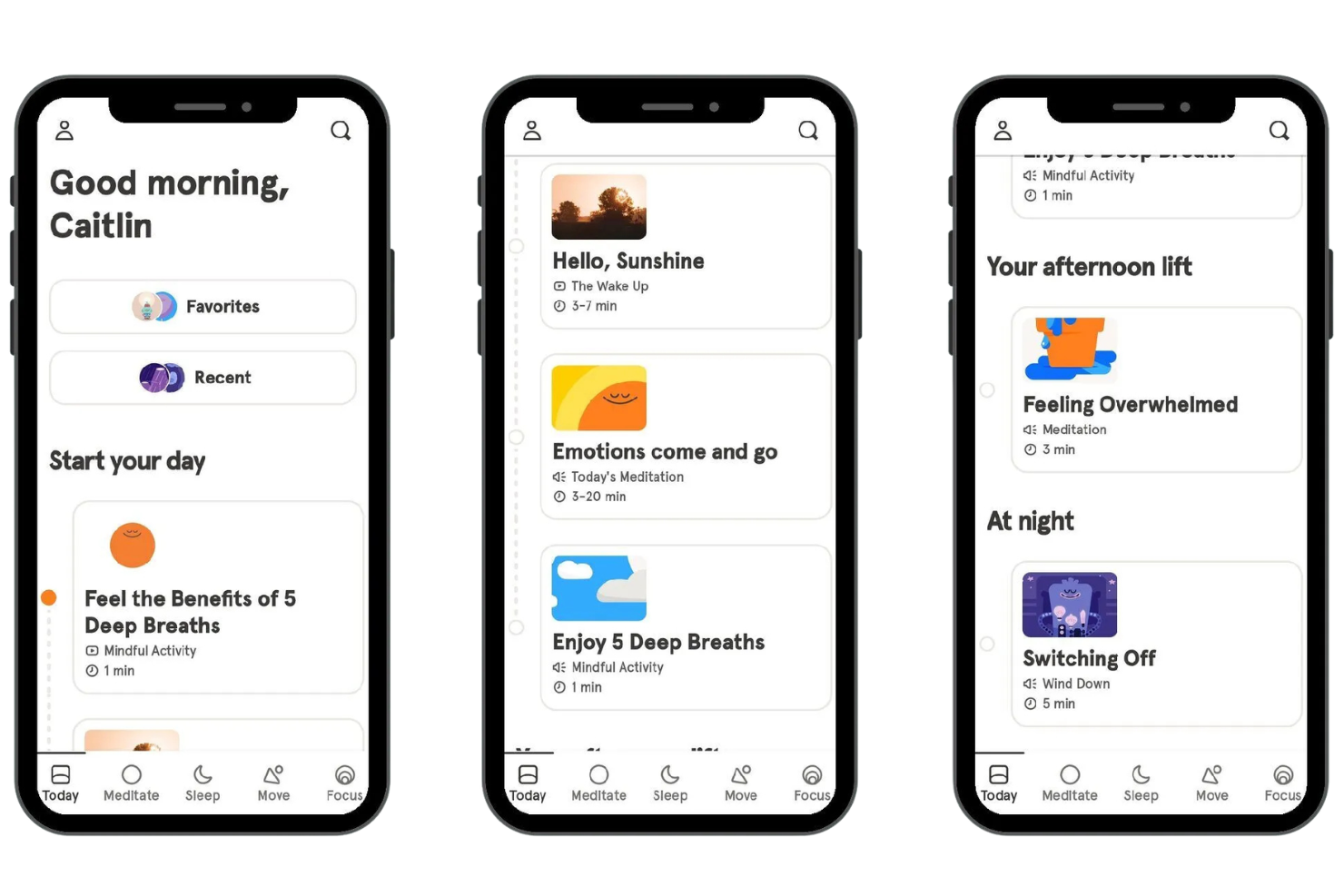
Built around a mindfulness-first approach to mental wellness, Headspace for Work gives employees access to guided meditations, sleep content, mental health coaching, therapy, and psychiatry in one app.
Who Is Headspace Best For?
Headspace for Work is a natural fit for HR teams at enterprise companies that want to go beyond an EAP and offer employees a daily mental wellness habit.
Why I Picked Headspace
Headspace earns its spot on my shortlist because no other workplace mental health platform has built mindfulness as deeply into the product. I love that it includes focus music, mindful movement sessions, and dedicated resilience programs alongside its meditation library.
There's also manager-specific content, which lets team leads model healthy habits and run group sessions directly through the app.
Headspace Key Features
- On-demand therapy and psychiatry: Employees can book sessions with licensed therapists or psychiatrists directly through the app.
- Ebb AI companion: A clinically-informed AI chat tool that gives employees a private, judgment-free space to process stress between sessions.
- Sleep content library: Dedicated sleepcasts, wind-down exercises, and sleep meditations help employees address rest-related issues.
- Admin reporting dashboard: HR teams can track workforce-level engagement and utilization data without accessing individual member activity.
Headspace Integrations
Headspace integrates with Microsoft Viva Insights (via Microsoft Teams) and supports SSO through Okta, Azure, Personify Health, and Cigna Healthcare.
A Castlight Health integration is also available for health plan data exchange, but a public API for custom integrations is not clearly documented.
Pros and Cons
Pros:
- Clinically validated mindfulness content
- Covers therapy, coaching, and psychiatry
- Large library of guided meditations and sleepcasts
Cons:
- Psychiatry services are US only
- Text-based coaching may feel impersonal

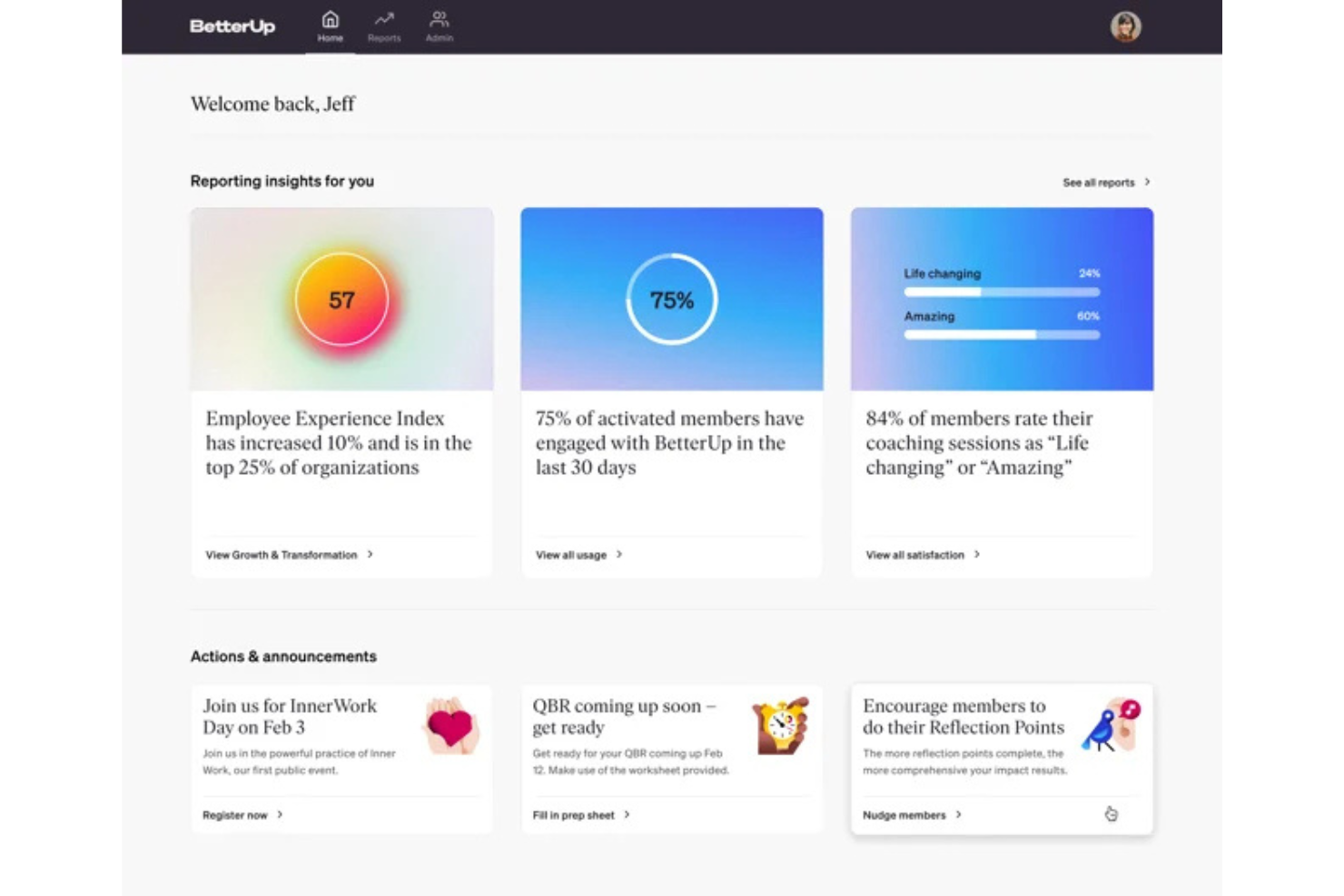
BetterUp is a workforce coaching and development platform that pairs employees at every level with personalized one-on-one coaching, AI-guided support, and performance intelligence to build leadership, resilience, and professional growth.
Who Is BetterUp Best For?
BetterUp is a strong fit for mid-to-large enterprises that want to extend coaching beyond the C-suite to managers and individual contributors across the organization.
Why I Picked BetterUp
I've included BetterUp in my top picks because its coaching model is one of the most structured I've seen for scaling personalized growth across an entire workforce. I like that it doesn't just target executives: BetterUp Lead, Manage, Grow, and Ready each deliver coaching to a different layer of the organization, from senior leaders down to individual contributors.
The always-on AI coaching meets employees in the moment, inside the apps they already use, while live sessions with human coaches handle deeper behavioral development.
BetterUp Key Features
- Whole Person Model assessment: A proprietary measurement tool that captures mental fitness, social connection, and purpose to baseline and track employee wellbeing.
- 100+ AI coaching experiences: Role-play simulations, feedback practice, and core values exercises available 24/7 in text and voice-to-voice formats across 200+ languages.
- Human + AI coaching sync: Automated session transcriptions, shared context between AI and human coaches, and post-session insights for continuity between coaching touchpoints.
- Performance analytics dashboard: Real-time organizational data that tracks behavior change, strategic alignment, and workforce health signals at scale.
BetterUp Integrations
BetterUp offers native integrations with Microsoft Teams, Slack, Workday, SAP SuccessFactors, Salesforce, Microsoft Viva, and Degreed, and also supports any HCM system that can connect through SFTP. An API is available for custom integrations.
Pros and Cons
Pros:
- Tracks wellbeing alongside performance metrics
- Blends AI and human coaching touchpoints
- Coaches vetted with advanced credentials
Cons:
- Limited value for smaller organizations
- High cost limits budget flexibility

Unmind is a workplace mental health platform built around self-guided programs, AI-powered support, therapy and coaching access, manager tools, and clinical assessment capabilities.
Who Is Unmind Best For?
Unmind is well-suited to HR and people teams in large organizations that want to offer always-on mental health support without relying solely on manager referrals or in-person programs.
Why I Picked Unmind
Unmind earns its spot on my shortlist because of how deliberately it's built around self-directed mental resilience. I love that the content library spans six focus areas, from "Overcome," which tackles anxiety, financial stress, and major life changes, to "Grow," which covers resilience series and self-awareness work.
Courses are available in 90+ languages, and two-minute "Shorts" mean employees can engage on their own schedule, without any HR nudge required.
Unmind Key Features
- Therapy and coaching access: Connect employees to a global network of 90,000+ qualified therapists and coaches, matched to their needs and location.
- 24/7 global helpline: Immediate, human-staffed support available around the clock, regardless of time zone or geography.
- Rapid response critical incident coverage: Expert-led care deployed when employees experience serious or unexpected events at work.
- Practitioner matching: Smart technology pairs employees with the right therapist or coach based on their specific situation and preferences.
Unmind Integrations
Unmind integrates with Sage, ADP, Rippling, Deel, Gusto, Keka, Lano, PayPal, OnPay, and more.
Pros and Cons
Pros:
- Manager training is included alongside employee tools
- Built-in wellbeing assessments track employee trends
- Clinician-built content across 60+ languages
Cons:
- Limited text-based reading resources available
- Offline content access is unavailable
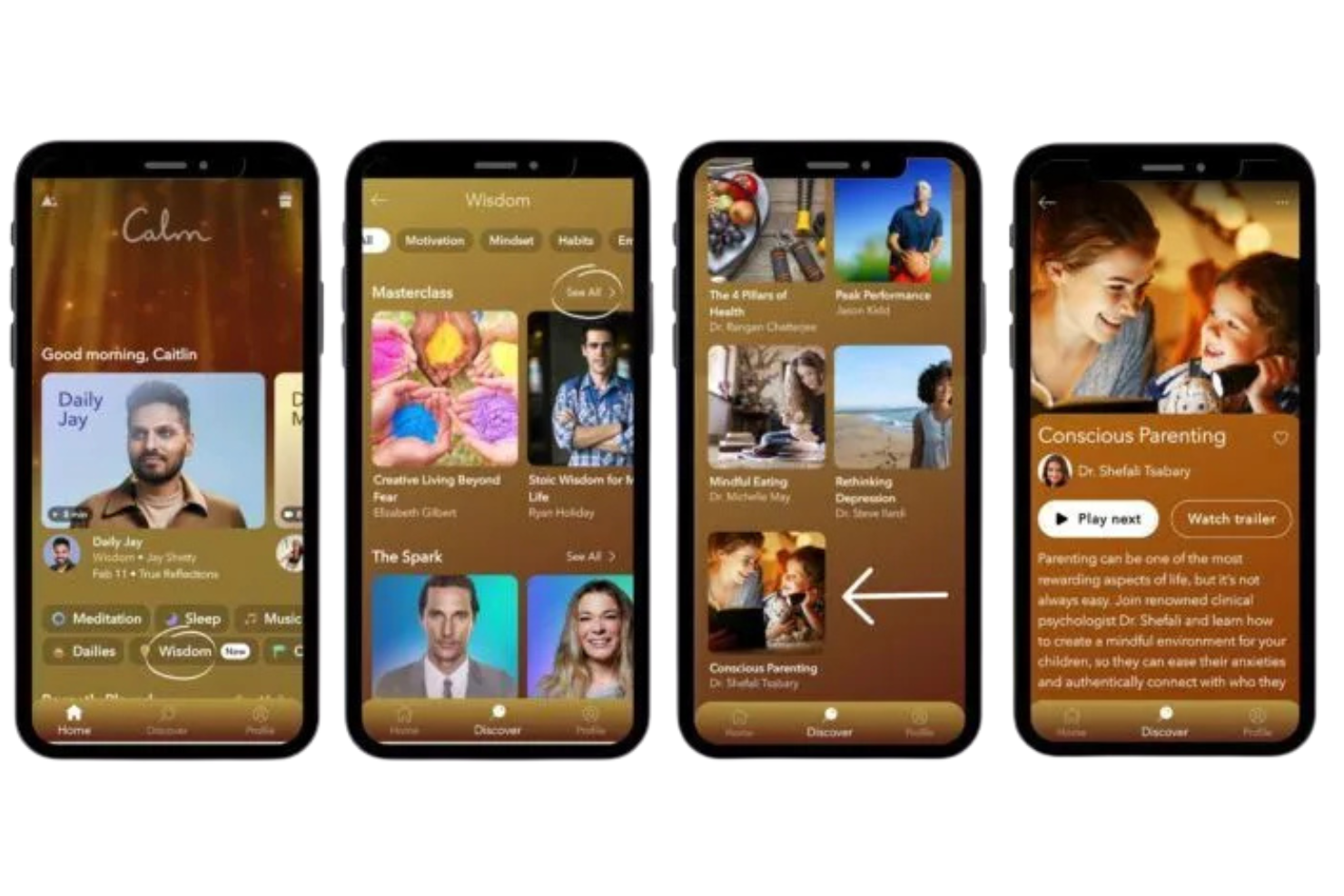
Built on Calm's consumer app foundation, Calm Health is a workplace mental health platform offering guided meditations, sleep programs, and clinical mental health screenings for employee populations.
Who Is Calm Health Best For?
Calm Health is well-suited for HR and benefits teams in high-stress industries like healthcare, finance, and tech that prioritize mental wellness as a core employee benefit.
Why I Picked Calm Health
Calm Health earns its spot on my shortlist because its stress management content library is genuinely one of the most developed I've seen. I use the guided breathing exercises and Daily Calm sessions to address acute stress in real time, not just as background wellness content.
The sleep-specific programs also stand out, since poor sleep and workplace stress are closely linked, and most platforms don't treat them together.
Calm Health Key Features
- Admin reporting dashboard: Lets HR teams track aggregate employee engagement and usage data across the platform without accessing individual employee information.
- Manager-specific resources: Provides people managers with dedicated content and tools for leading teams through stress and organizational change.
- Focus music and soundscapes: Offers curated audio tracks designed to support concentration during deep work or high-pressure work periods.
- Mindful movement content: Includes guided stretching and light movement sessions that employees can access during or between work hours.
Calm Health Integrations
Calm Health offers a small set of integrations with workplace tools, including Zoom Meetings and Microsoft Teams. It also integrates with Amazon Kindle and supports Partner SSO.
Pros and Cons
Pros:
- Includes validated mental health screening tools
- Sleep and meditation content is extensive
- Strong brand recognition boosts employee adoption
Cons:
- No live therapy or counseling sessions
- Lacks direct 1:1 human coaching
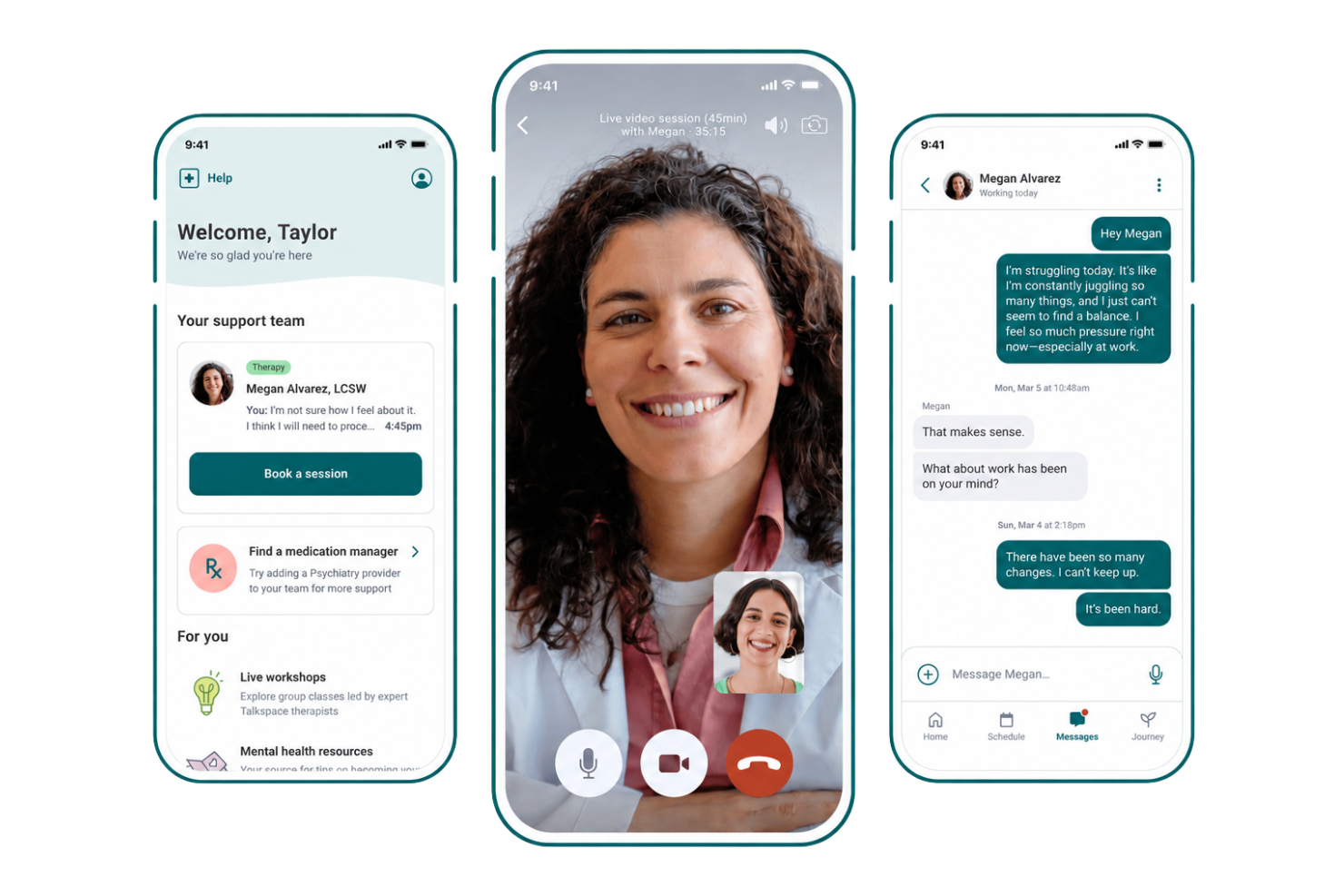
Talkspace for Employers is a workplace mental health platform that gives employees access to licensed therapists, psychiatric care, and self-guided wellness programs through live video, asynchronous messaging, and a dedicated app.
Who Is Talkspace Best For?
Talkspace is a strong fit for HR teams at mid-to-large employers looking to offer clinical mental health support as part of a broader benefits package.
Why I Picked Talkspace
Talkspace earns its spot on my shortlist because it covers the full clinical spectrum in a single platform: self-guided wellness, licensed therapy, and psychiatry with prescribing. What I particularly like is that therapy starts within days through asynchronous text, audio, and video messaging, so employees don't have to wait weeks for a first appointment.
The Talkspace Go app also adds 70+ clinician-created programs and live therapist-led classes for employees who aren't ready for one-on-one sessions.
Talkspace Key Features
- Talkspace Engage portal: An employer-facing dashboard that provides workforce mental health metrics and marketing support to help HR teams track program performance.
- Therapist matching: Talkspace pairs employees with licensed therapists based on their individual needs and preferences before the first session begins.
- Teen dependent support: Employees' teen dependents get access to one-on-one therapy and Teenspace Community, a therapist-moderated virtual peer support space.
- Psychiatric care with prescribing: Employees connect with a licensed medical provider via live video within two weeks for diagnosis, treatment planning, and medication management.
Talkspace Integrations
Talkspace doesn't offer traditional software integrations. Instead, it connects with employer benefits ecosystems through partnerships with Deel, Espresa, ThrivePass, Wellbeing at Work, FitOn Health, and Wheel.
Pros and Cons
Pros:
- Covers therapy, psychiatry, and teen dependents
- Asynchronous messaging keeps support between sessions
- Therapy sessions available within days of signup
Cons:
- Response delays happen between text messages
- Sessions are limited to 30 minutes only
Best for direct access to mental health providers

Lyra Health is a workplace mental health platform that gives employees direct access to therapy, coaching, psychiatry, and specialty care through a network of vetted providers across in-person and virtual settings.
Who Is Lyra Health Best For?
Lyra Health is a strong fit for large, distributed employers who need to offer employees immediate, direct access to licensed mental health providers without waitlists or referral bottlenecks.
Why I Picked Lyra Health
I've included Lyra Health in my top picks because of how directly and quickly it connects employees to licensed providers. With 30,000+ providers and 100% connected calendars, employees can see real-time availability and book appointments, averaging less than a day to their first session.
I also like the intelligent matching feature, which routes each member to the right provider from the very first appointment, not after several trial sessions. The network spans 200+ countries and 65+ languages, so distributed teams get the same level of access regardless of location.
Lyra Health Key Features
- Manager coaching: A dedicated coaching program that gives managers practical tools and structured sessions to support their teams and manage their own risk of burnout.
- Clinical assessments: Clinically validated assessments that providers use to track member progress, guide treatment decisions, and support needs like leave-of-absence evaluations.
- Specialty care navigation: Clinically trained care navigators who guide members with complex needs, including addiction and suicidality, through treatment transitions and step-up or step-down care.
- Lyra AI: An AI layer built into the platform that automates admin tasks for providers, personalizes the member experience, and delivers automated insights to HR leaders.
Lyra Health Integrations
Lyra Health offers native integrations with Carrum Health, Cleo, Hinge Health, Posterity Health, Virta, Wellthy, Workday, Solera, Anthem, MetLife, 9amHealth, and more. An API is available for custom integrations.
Pros and Cons
Pros:
- Tracks clinical outcomes with validated assessments
- Includes specialized care for children and teens
- Covers therapy, coaching, and psychiatry together
Cons:
- Session caps vary by employer
- Only available through employer-sponsored benefits

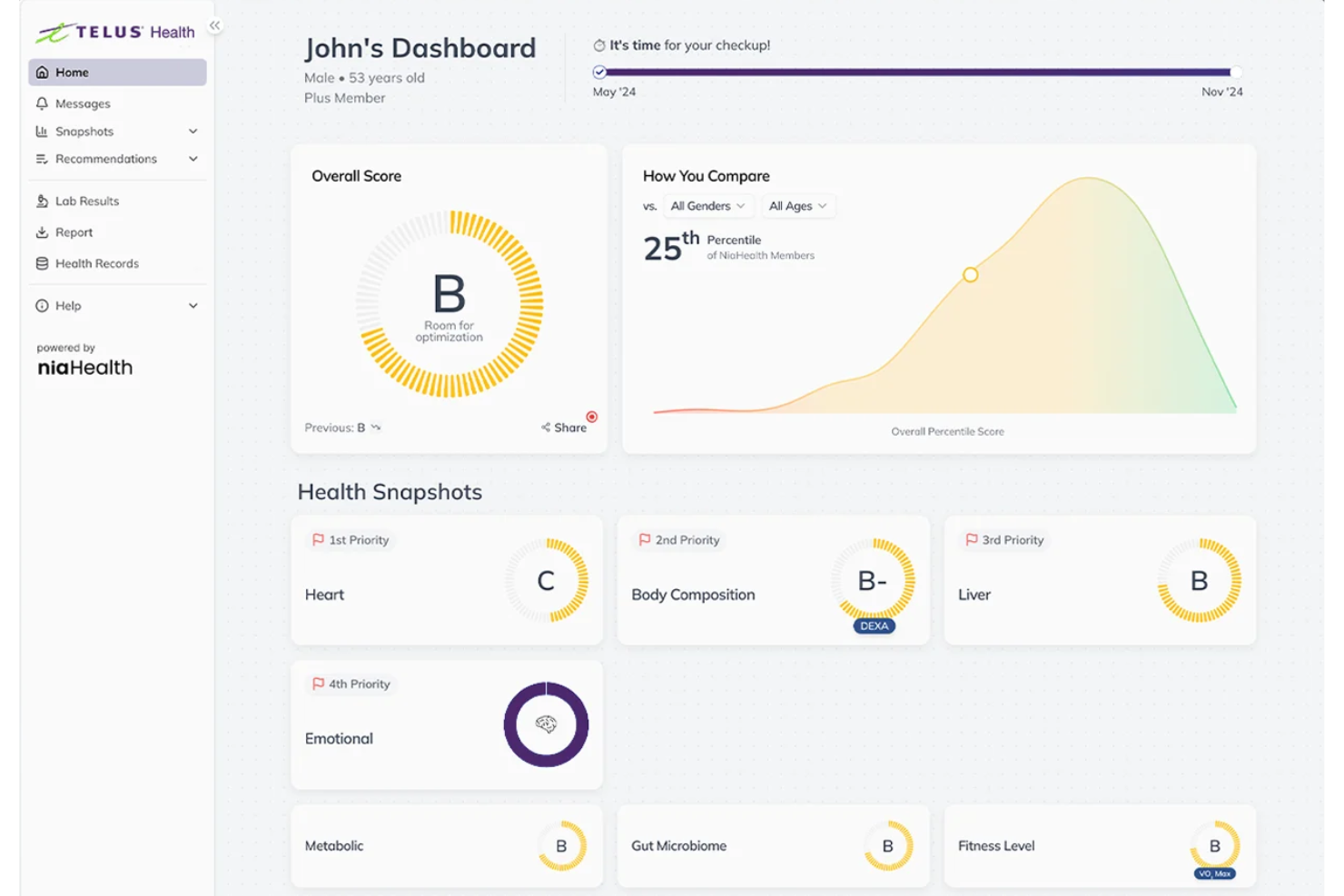
TELUS Health is a workplace mental health and total wellbeing platform that combines EAP services, virtual and in-person counseling, mental health coaching, and physical and financial health programs into a single employer-facing solution.
Who Is TELUS Health Best For?
TELUS Health is a strong fit for enterprise employers across Canada and globally who need a single platform covering clinical, digital, and in-person care without managing multiple vendors.
Why I Picked TELUS Health
TELUS Health earns its spot on my shortlist because of how genuinely it bridges virtual and in-person care, not just as a talking point but as a built-in delivery model. Employees can move between digital counseling sessions and on-site or clinic-based care without switching platforms or providers.
I also like the Total Mental Health program, which offers unlimited counseling sessions through a network of diverse counselors, a feature you rarely see in competing EAP-style products.
TELUS Health Key Features
- Absence management: A dedicated program that supports employees returning to work after illness or injury, while giving employers tools to track and reduce absenteeism costs.
- TELUS Health Care Centres: A network of physical clinics across Canada where employees can access preventive and proactive in-person care.
- Financial health programs: Employer-sponsored financial planning seminars and resources delivered to employees as part of the broader wellbeing package.
- Consulting services: A data-driven advisory service where TELUS Health consultants analyze workforce health trends and help employers design tailored benefits strategies.
TELUS Health Integrations
TELUS Health integrates with Stripe, Ezotech, Tali Al, and Scribeberry.
Pros and Cons
Pros:
- Includes legal, financial, and family services
- Network of over 180,000 qualified providers
- Available in 40+ languages across 200+ territories
Cons:
- Mobile app is difficult to navigate
- Appointment availability can be limited

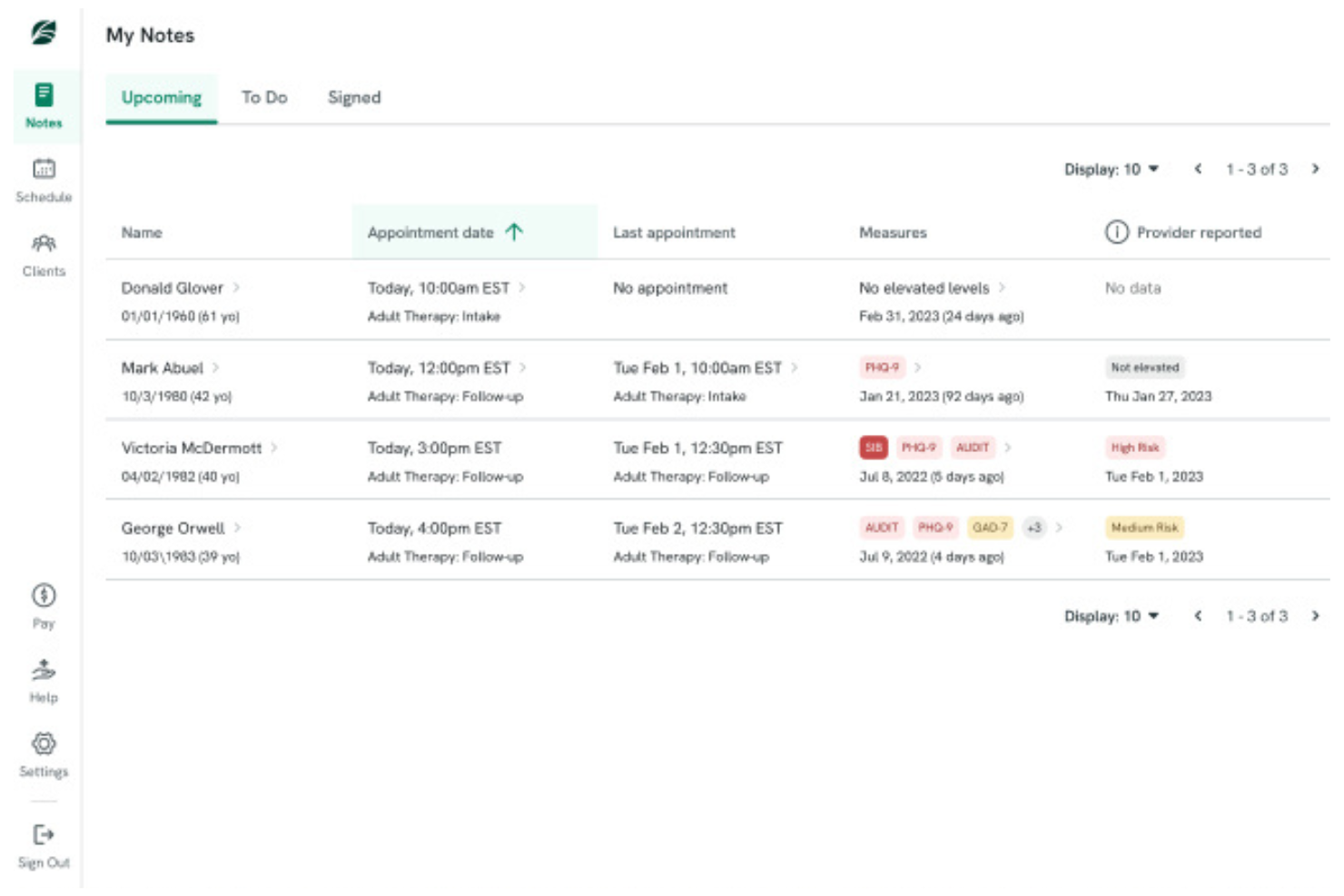
Spring Health is a workplace mental health platform that connects employees to therapy, psychiatric medication management, and coaching through a precision-matching approach that routes each person to the right level of care.
Who Is Spring Health Best For?
Spring Health is a strong fit for mid-size to enterprise employers who want a clinically structured mental health benefit that goes beyond basic EAP offerings.
Why I Picked Spring Health
Spring Health earns its spot on my shortlist because of how it handles the matching problem that most mental health benefits get wrong. Instead of giving employees a provider directory and wishing them luck, Spring Health uses a precision-matching model that routes each person to the right type of care based on a clinical assessment.
I also like that the platform covers a wide spectrum, from therapy and psychiatric medication management to coaching and on-demand tools, so one employee with anxiety and another managing ADHD aren't funneled into the same experience.
Spring Health Key Features
- Manager mental health training: Structured training resources that help managers recognize signs of burnout or distress and respond appropriately.
- HR analytics dashboard: A reporting dashboard that gives HR teams visibility into program utilization and workforce mental health trends.
- Dedicated care navigation: Assigned care navigators who guide employees through their care plan and help them stay engaged with treatment.
- Self-care content library: A collection of digital exercises, meditations, and mental health tools employees can access between or instead of sessions.
Spring Health Integrations
Spring Health integrates with Workday Wellness, empowering employers with AI-driven recommendations to improve benefit offerings and benefits administration.
Pros and Cons
Pros:
- Peer-reviewed ROI evidence backs clinical outcomes
- Mental health support extends to family members
- Appointments available in less than a day
Cons:
- Out-of-pocket costs apply after free sessions
- In-person care options are limited

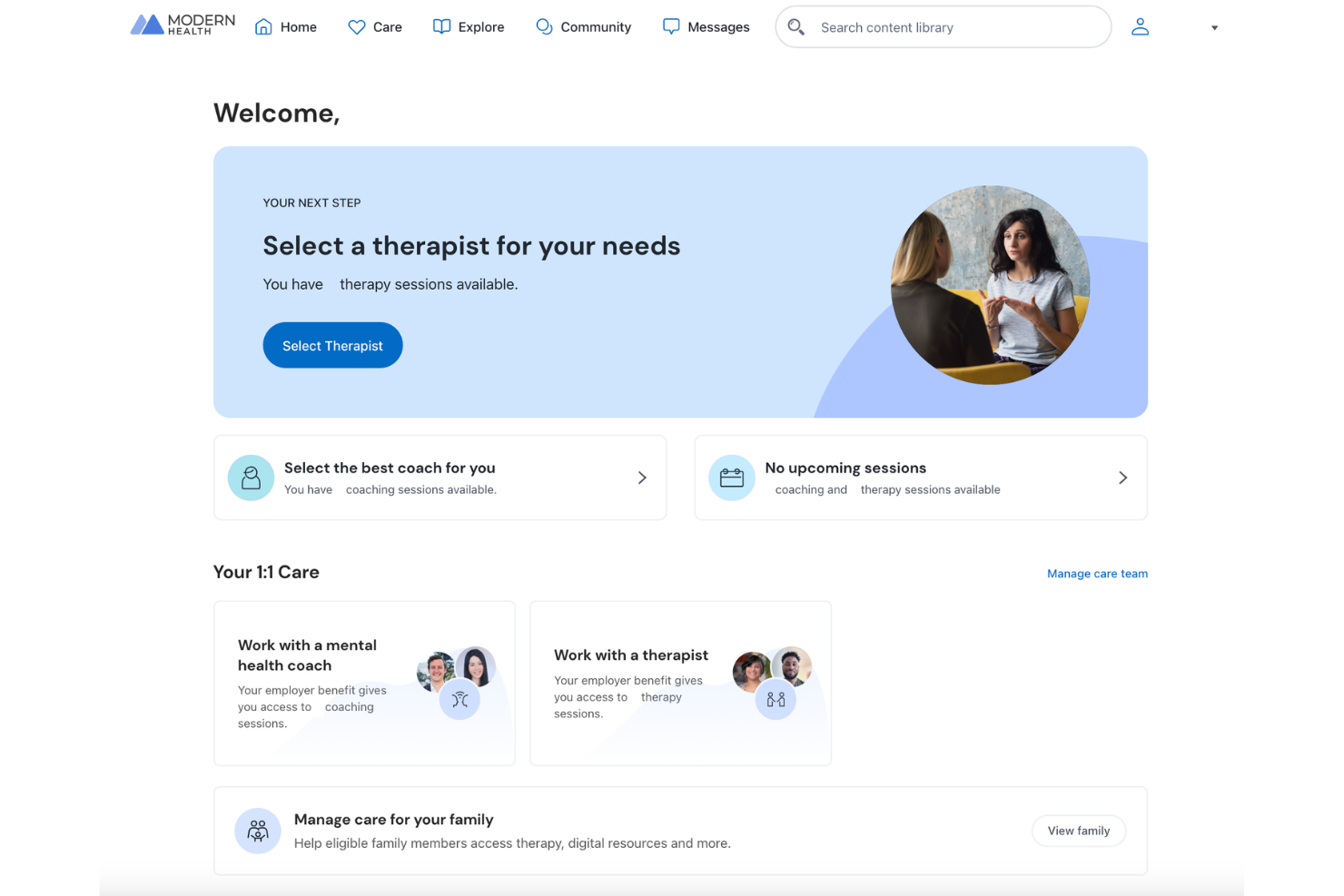
Modern Health is a workplace mental health platform that combines therapy, coaching, psychiatry, and digital programs with an employer admin layer for tracking engagement and deploying resources across an organization.
Who Is Modern Health Best For?
Modern Health is a strong fit for HR teams at mid-to-large employers who want to offer structured, proactive mental health programs across a distributed workforce.
Why I Picked Modern Health
I picked Modern Health as one of the best because of how deliberately it's built around getting ahead of mental health issues, not just responding to them. The Pathways feature is what sets it apart: structured four-session programs pairing employees with dedicated Pathway Specialists on specific topics like burnout, imposter syndrome, and parenting stress.
Employees can access these without a clinical diagnosis or a crisis moment, which makes it a genuinely low-barrier entry point. I also like that each Pathway includes built-in assessments to track progress from the very first session.
Modern Health Key Features
- Circles: Peer support groups facilitated by licensed clinicians, organized around shared topics like stress, grief, and transitions.
- Modern Health Central: A unified admin dashboard giving HR teams real-time, anonymized data on engagement, utilization, and workforce well-being scores by department or location.
- Benefits navigation: A feature inside the Modern Health app that lets employees view the company's other well-being benefits alongside their mental health resources.
- Global coverage: Localized care access across multiple regions, so distributed teams get support without separate vendors or re-enrollment.
Modern Health Integrations
Native integrations are not publicly listed.
Pros and Cons
Pros:
- Provider network spans 80+ languages globally
- Tracks clinical outcomes with validated assessments
- Covers therapy, coaching, and self-guided care
Cons:
- Psychiatry services are not covered
- Only available through employer-sponsored benefits


Magellan Healthcare is a behavioral health and EAP platform that covers mental health, substance use, and complex condition management through a clinically specialized network of care providers.
Who Is Magellan Healthcare Best For?
Magellan Healthcare is a strong fit for employers in high-stress industries like healthcare, public safety, and defense, where complex behavioral health needs are common.
Why I Picked Magellan Healthcare
Magellan Healthcare earns its spot on my shortlist because of its clinical depth, which goes well beyond what a standard EAP offers. I like the 3-tiered care management approach, which moves employees from proactive screening through outpatient and inpatient services, including residential treatment and inpatient detox, when needed.
The provider network spans psychiatrists, psychologists, and clinical social workers, so complex cases get matched to genuinely specialized clinicians rather than general counselors.
Based on the research from the Magellan Healthcare EAP page and other sources, I have enough verified feature information to write the key features section.
Magellan Healthcare Key Features
- Critical incident response: An expert team provides 24/7 support for traumatic workplace events.
- Digital CBT modules: Self-guided digital cognitive behavioral therapy modules for insomnia, chronic pain, substance use disorder, anxiety, and depression.
- Manager consultation line: Unlimited 24/7 manager consultations supported by a Manager's Program Guide and leadership training.
- Live webinar training catalog: Monthly employee and quarterly manager live webinars, plus a training catalog with 60+ courses developed by an in-house team.
Magellan Healthcare Integrations
Native integrations are not publicly listed.
Pros and Cons
Pros:
- Covers federal and military populations
- 24/7 live chat with clinical specialists
- Dedicated substance use and crisis services
Cons:
- Provider directory search is clunky
- No public-facing self-service portal customization
Andre plattformer for psykisk helse på arbeidsplassen
Her er noen flere plattformer for psykisk helse på arbeidsplassen som ikke kom med på kortlisten min, men som likevel er verdt å se nærmere på:
- ComPsych
For comprehensive global employee assistance
- AbleTo
For structured virtual care for measurable outcomes
- Headversity
For upskilling tools for resilience training
- Meditopia
For multilingual content for global teams
- Thrive Global
For science-backed behavior change programs
- Moka.care
For flexible care choices
- Oliva Health
For personalized therapy matched by company culture
- Nilo Health
For expert-led sessions for well-being
- Spill
For Slack integration for mental health support
- Siffi
For mental health check-ins with fast implementation


How I Evaluate Workplace Mental Health Platforms
When HR teams look beyond a basic EAP for real clinical care, I split my evaluation into two layers: the baseline every platform must meet and the factors that separate one from another.
Core Functionality (Table Stakes For This List)
When I'm selecting tools for my list, I rank each one on a scale from 0 (does not offer the functionality) to 5 (excels in this area) for each core functionality listed below. Then, I calculate the tool's total score into a percentage. Each tool needs to achieve a minimum total score of 65% to be considered for inclusion.
- Licensed Clinical Care Access: I check whether the platform connects employees directly with licensed therapists or psychiatrists, and whether it supports multiple session formats like video, chat, and phone.
- Self-Guided Wellbeing Content: The content library should go beyond generic articles and include structured programs like CBT exercises, sleep courses, and mindfulness tracks employees can use on their own time.
- Confidentiality & HIPAA Compliance: I look for HIPAA compliance at a minimum, along with anonymized reporting that ensures employers only see aggregate data and never individual employee activity.
- Aggregate Analytics & Reporting: HR teams need dashboards that show utilization rates, engagement trends, and wellbeing scores so they can report program value to leadership during budget reviews.
- Crisis & Risk Support: I evaluate whether the platform offers 24/7 crisis pathways, since an employee in acute distress at midnight needs immediate triage, not a callback during business hours.
- Benefits & HRIS Integration: Platforms should connect with the HRIS and SSO tools your team already uses so employee eligibility stays current without manual file uploads every pay cycle.
Once I have a list of tools that meet the criteria, I consider what sets each platform apart.
Differentiating Factors (What Sets Vendors Apart)
Here's how I compare and contrast different vendors:
Standout Features
Family and dependent coverage is a big differentiator. When employees can extend therapy access to a spouse or teenage child, utilization tends to climb and the benefit feels more meaningful. I also evaluate provider diversity—whether the network includes therapists matched by language, cultural background, or LGBTQ+ identity, which matters for DEI leads supporting a varied workforce. Manager training modules round out my evaluation, since a people leader who can spot burnout early and guide someone toward care creates a real first line of support before clinical intervention.
Beyond Features
Clinical quality matters here. I look for vendors that measure outcomes with validated tools like the PHQ-9 and GAD-7, and ideally publish peer-reviewed research backing their approach. Pricing structure is another key factor. Whether a vendor charges per employee per month or by utilization changes the math based on your workforce size and expected adoption. Implementation support also counts—I check whether vendors offer launch campaigns and engagement toolkits. Even the best platform falls flat if employees don't know it exists.
Slik velger du plattformer for psykisk helse på arbeidsplassen
Det er lett å gå seg vill i lange funksjonslister og kompliserte prismodeller. For å hjelpe deg med å holde fokus mens du går gjennom den unike prosessen med å velge programvare, har vi laget en sjekkliste over faktorer du bør ha i tankene:
| Faktor | Hva du bør vurdere |
|---|---|
| Skalerbarhet | Kan løsningen vokse sammen med teamet ditt? Se etter fleksible lisensordninger, begrensninger på antall brukere og mulighet for tilpasning til nye kontorsteder eller oppkjøp. |
| Integrasjoner | Kan den kobles til HRIS-systemet, intranettet eller kommunikasjonsverktøyene dine? Prioriter plattformer med dokumenterte integrasjonsmuligheter for HR og personalgoder. |
| Tilpasningsmuligheter | Kan arbeidsflyter, rapportering eller strategier for engasjement tilpasses behovene til arbeidsstyrken eller lokale personvernregler? |
| Brukervennlighet | Kommer ansatte og administratorer faktisk til å bruke den? Be om en demonstrasjon, og test introduksjonen, timeplanleggingen og navigeringen i dashbordet. |
| Implementering og introduksjon | Hvordan er leverandørens prosess fra oppstart til lansering? Be om tydelige tidsplaner, opplæringsmateriell, støtte ved kundelansering og referanseprosjekter. |
| Kostnad | Finnes det skjulte kostnader utover brukerlisenser? Avklar totalkostnader, oppstartsgebyrer og minste bindingstid før du signerer. |
| Sikkerhetstiltak | Oppfyller plattformen interne, juridiske og bransjespesifikke standarder for datasikkerhet? Bekreft sertifiseringer som HIPAA, SOC 2 eller GDPR. |
| Tilgjengelighet av brukerstøtte | Er direkte brukerstøtte, ressurser i hjelpesenteret og lokal dekning tilstrekkelig for teamets arbeidstider og støttebehov? |
Hva er plattformer for psykisk helse på arbeidsplassen?
Plattformer for psykisk helse på arbeidsplassen er digitale verktøy som hjelper organisasjoner med å støtte de ansattes psykiske velvære gjennom profesjonell rådgivning, selvstyrte ressurser og fremdriftssporing. Disse løsningene gir HR-team en sikker og sentralisert måte å tilby støtte for psykisk helse på, fremme en sunnere arbeidskultur og håndtere behov knyttet til psykisk helse proaktivt og konfidensielt.
Funksjoner
Når du velger plattformer for psykisk helse på arbeidsplassen, bør du se etter følgende viktige funksjoner:
- Tilgang til virtuell rådgivning: Koble ansatte med autoriserte fagpersoner innen psykisk helse via sikre alternativer for video, telefon eller chat, slik at de får konfidensiell støtte.
- Selvstyrte ressurser: Tilby stressmestring, mindfulnessøvelser og pedagogisk innhold som ansatte kan bruke i sitt eget tempo.
- Konfidensielle kartlegginger: Tilby anonyme kartlegginger av psykisk helse som hjelper ansatte med å forstå behovene sine og finne relevante ressurser.
- Verktøy for fremdriftsoppfølging: La HR-team følge aggregerte bruksdata og trender for engasjement, samtidig som enkeltpersoners personvern ivaretas.
- Støtte ved krisehåndtering: Sørg for at ansatte har tilgang til rask hjelp eller veiledning i akutte situasjoner knyttet til psykisk helse.
- Ressurser for ledere: Utstyr ledere med verktøykasser, opplæring og praktiske råd for å støtte teamets velvære og gjenkjenne tegn på belastning.
- Tilpasset rapportering: Generer tilpassede, aggregerte rapporter om bruk, effekt og engasjement for å informere HR-strategier og rapportering til ledelsen.
- Flerspråklig støtte: Legg til rette for globale eller mangfoldige team ved å tilby ressurser, rådgivning og kommunikasjon på flere språk.
Vanlige AI-funksjoner i plattformer for psykisk helse på arbeidsplassen
I tillegg til standardfunksjonene i plattformer for psykisk helse på arbeidsplassen som er nevnt ovenfor, tar mange av disse løsningene i bruk AI med funksjoner som:
- AI-drevet risikokartlegging: Analyser engasjementsmønstre og ansattes svar for å identifisere tidlige tegn på utfordringer knyttet til psykisk helse, slik at proaktiv oppfølging eller anbefalinger om støtte kan settes i gang.
- Samtalebaserte chatboter: Tilby AI-drevet støtte i sanntid som veileder ansatte til relevante ressurser, svarer på spørsmål om psykisk helse og gir grunnleggende mestringsteknikker, tilgjengelig hele døgnet.
- Personlige innholdsanbefalinger: Tilby selvhjelpsartikler, øvelser eller videoer som er tilpasset den enkelte ansattes behov og atferd, ved hjelp av AI-baserte anbefalinger.
- Sentimentanalyse: Bruk AI til å tolke skriftlige tilbakemeldinger eller undersøkelsesdata, oppdage endringer i de ansattes holdninger og avdekke trender på tvers av organisasjonen.
- Smarte triageringsmotorer: Koble ansatte med spesialister eller riktige behandlingsforløp basert på kartleggingsdata og observerte interaksjoner, slik at støtten blir mer relevant og effektiv.
Fordeler
Implementering av plattformer for psykisk helse på arbeidsplassen gir flere fordeler for teamet og virksomheten din. Her er noen av fordelene du kan se frem til:
- Bedre velvære blant de ansatte: Ansatte får tilgang til terapi, selvstyrte ressurser og kartlegginger som direkte støtter deres psykiske helse.
- Tidlig identifisering av utfordringer: Konfidensielle kartlegginger og rapporteringsverktøy hjelper HR-team med å oppdage utfordringer knyttet til psykisk helse før de eskalerer.
- Økt engasjement og produktivitet: Enkel tilgang til støtte og innhold om egenomsorg kan redusere fravær og øke den generelle prestasjonen på arbeidsplassen.
- Konfidensiell støtte og personvern: Sikre rådgivningssamtaler og anonyme kartlegginger sørger for at ansatte føler seg trygge når de ber om hjelp.
- Styrkede ledere og mellomledere: Verktøykasser og opplæringsmateriell for ledere gir praktisk veiledning i hvordan de kan støtte teamets velvære.
- Skalerbar støtte for mangfoldige team: Flerspråklige ressurser og fleksible arbeidsflyter gjør det enklere å møte behovene til globale eller fjernarbeidende arbeidsstyrker.
- Handlingsrettet innsikt for HR: Aggregert rapportering og fremdriftssporing gir HR-ansatte dataene de trenger for å forbedre strategier og dokumentere programmets effekt.
Kostnader og priser
Valg av plattformer for psykisk helse på arbeidsplassen krever en forståelse av de ulike prismodellene og planene som er tilgjengelige. Kostnadene varierer basert på funksjoner, teamstørrelse, tillegg og mer. Tabellen nedenfor oppsummerer vanlige planer, gjennomsnittsprisene deres og typiske funksjoner som er inkludert i plattformer for psykisk helse på arbeidsplassen:
Sammenligningstabell for planer for plattformer for psykisk helse på arbeidsplassen
| Plantype | Gjennomsnittspris | Vanlige funksjoner |
|---|---|---|
| Gratisplan | $0 | Grunnleggende selvstyrte ressurser, begrensede vurderinger, begrenset fellesskapsstøtte og tilgang til vanlige spørsmål. |
| Personlig plan | $5-$15/bruker/måned | Utvidet selvstyrt innhold, konfidensielle vurderinger, timebestilling og standardstøtte via e-post. |
| Bedriftsplan | $20-$40/bruker/måned | Virtuelle rådgivningstimer, HR-dashbord, gruppeverksteder, brukssporing og administratorkontroller. |
| Foretaksplan | $40-$80/bruker/måned | Avansert rapportering, flerspråklig støtte, personlige omsorgsforløp, tilpassede integrasjoner og prioritert støtte. |
Vanlige spørsmål om plattformer for psykisk helse på arbeidsplassen
Her er noen svar på vanlige spørsmål om plattformer for psykisk helse på arbeidsplassen:
Hvordan skiller plattformer for psykisk helse på arbeidsplassen seg fra tradisjonelle hjelpetjenester for ansatte?
Plattformer for psykisk helse på arbeidsplassen gir digital tilgang til ressurser, rådgivning og selvstyrt innhold når som helst, i motsetning til tradisjonelle hjelpetjenester for ansatte, som i stor grad kan være basert på henvisninger per telefon eller avtalte møter.
Kan fjernarbeidende eller internasjonale ansatte bruke plattformer for psykisk helse på arbeidsplassen?
Ja, de fleste plattformene støtter globale team med ressurser på flere språk, virtuell rådgivning og verktøy som er tilgjengelige overalt med internettilkobling.
Hvilken introduksjon eller opplæring kreves for HR-team?
De fleste leverandører tilbyr introduksjon, administratoropplæring og ressurser som hjelper HR-team med å lansere plattformen, informere ansatte og bruke rapporteringsverktøy effektivt.
Hvordan håndterer plattformene nødsituasjoner eller kriser?
Disse løsningene omfatter vanligvis funksjoner for krisestøtte i sanntid, for eksempel døgnåpne hjelpelinjer eller direkte lenker til akutt hjelp, slik at ansatte får tilgang til bistand når de trenger det mest.
Tilbyr plattformer for psykisk helse på arbeidsplassen støtte til ledere og andre ansvarlige?
Ja, mange plattformer omfatter opplæringsmoduler, verktøysett og ekspertråd som hjelper ledere med å gjenkjenne tegn på belastning og fremme psykisk velvære i teamene sine.