What Is Payroll Service? (And 4 Reasons Why You Need It)


Payroll services take one of HR’s most error-prone responsibilities off your plate. That matters because payroll mistakes have immediate consequences, from late payments and misfiled taxes to compliance issues that can quickly erode employee trust.
I’ve seen manual processes create exactly those problems. This guide explains what to look for in a payroll service, which capabilities matter most, and how to compare providers based on your needs. Whether you’ve reached that awkward stage in your growth where you have too many employees for one person to manage payroll on their own, or you don’t yet have a formal in-house payroll department.
What is a Payroll Service?
A payroll service is a software platform or third-party provider that manages the process of paying employees and handling payroll taxes. It typically calculates wages, withholds taxes and deductions, issues payments, generates pay stubs, and files required payroll taxes.

The real value is less about “automating payroll” and more about reducing the number of things your team has to remember, calculate, check, and file correctly every pay cycle. A good payroll service gives you a repeatable process for getting people paid accurately and on time while keeping the tax and compliance work from becoming a recurring HR fire drill.
Payroll services can handle a range of tasks, including:
- Tax filing with the IRS, CRA, or local governing body
- Tax payment
- Worker’s compensation
- Employee benefits planning
- Bookkeeping
- Employment tax forms
- Running payroll reports
- Year-end payroll reporting
- Employee attendance and time
- Direct deposits (bi-weekly payroll or however your company chooses)
- Additional human resources functions
Examples of Payroll Services
Here are a few visual examples to help you get a feel for what real payroll service dashboards and tools actually look like:


Types of Payroll Service Providers
Payroll service providers, including PEO companies, cater to a wide variety of needs. Some specialize in small businesses while others focus on enterprise. Some are primarily payroll companies, while others also have bookkeepers and accountants on staff.
Generally speaking, we can divide providers into two main categories:
Full-Service Payroll Providers
As the name suggests, full-service payroll providers (PSPs) handle payroll processing from start to finish. You provide essential business and employee details, and they take care of calculating wages, tax deductions, compliance, and direct deposits. Many full-service providers also offer HR support, benefits administration, and tax filing to ease the burden of managing payroll in-house.
DIY Payroll Providers
With a DIY payroll provider, you’re required to perform some of the administrative tasks and the provider conducts the additional tasks of your choosing.
With a DIY payroll provider, you retain more control over certain payroll tasks while outsourcing only the specific services you need.
Example: You may choose to track employee hours and attendance internally, while the provider manages paycheck distribution, payroll calculations and tax deductions, and paycheck distribution. This option requires more administrative involvement but can be more budget-friendly for businesses comfortable handling some payroll processes in-house.
One of the biggest factors in choosing between full-service and DIY payroll providers is cost. A full-service approach comes with a higher price tag but reduces administrative workload and compliance risks. Meanwhile, a DIY payroll model is often more affordable but requires internal payroll expertise to avoid errors.
How Do Payroll Services Work?
At the heart of payroll services is the automation of payroll processing, which includes calculating employee wages, withholding taxes, and ensuring compliance with various labor laws.
When a company uses payroll services, they begin by inputting employee information into the system. This data includes details such as hours worked, pay rates, tax withholding preferences from a W4 form, and any additional deductions or benefits they opt into.
Once the employee data is entered, the payroll service automatically calculates gross pay, deductions, social security, Medicare, and any other relevant contributions.
An essential feature of payroll services is their ability to ensure that the correct amount of taxes is withheld from each paycheck and that these funds are deposited with the appropriate government agencies. This includes federal, state, and local taxes, as well as any required unemployment insurance contributions.
Payroll services also generate important reports and records for both employers and employees. These reports include pay stubs, tax forms such as W-2s or 1099s, and summaries of all payroll activities.
Top Payroll Services to Consider
Here's my shortlist of the best payroll services solutions:
Clicks on the links below may earn a commission, which supports our independent testing and review of software and services. Learn more about how we stay transparent.


How Much Do Payroll Services Cost?
The cost of payroll solutions can vary widely depending on the size of your business, the complexity of your payroll needs, and the specific features you require. Here's a quick overview of the typical costs associated with payroll services:
Pricing Models
| Pricing Model | Description | Average Cost |
|---|---|---|
| Per Employee Per Month | Charges based on the number of employees processed monthly | $4 - $12 per employee/month |
| Flat Monthly Fee | Fixed rate regardless of the number of employees | $20 - $150 per month |
| Per Payroll Run | Charges each time payroll is processed | $25 - $200 per payroll run |
Additional Costs
| Service | Description | Additional Cost |
|---|---|---|
| Setup Fees | Initial setup and configuration | $50 - $200 one-time |
| Year-End Tax Forms | Preparation and distribution of W-2s and 1099s | $4 - $10 per form |
| Direct Deposit Fees | Charges for enabling direct deposit for employees | $1.50 - $5 per employee/month |
| Tax Filing Services | Handling federal, state, and local tax filings | Included or $10 - $25 per filing |
| HR Integration | Integration with HR software for additional features | $50 - $150 per month |
Example Cost Scenarios
| Business Size | Monthly Payroll Runs | Employees | Estimated Monthly Cost |
|---|---|---|---|
| Small Business | 2 | 10 | $60 - $140 |
| Medium Business | 2 | 50 | $300 - $600 |
| Large Business | 4 | 200 | $1,000 - $2,500 |
Factors Affecting Cost
- Number of Employees: More employees generally increase the cost.
- Frequency of Payroll Runs: More frequent payroll processing leads to higher costs.
- Additional Features: Services like direct deposit, payroll tax filing, and HR integration can add to the overall cost.
- Customization Needs: Tailored solutions may incur extra charges.
- Location of employees: Distributed workforces may increase the cost due to a higher number of regulations and laws that increase the compliance burden.
Who Uses Payroll Services?
Use this list to see if payroll services fit your team or business needs:
- HR departments: Handle recurring payroll, deductions, and compliance for growing workforces.
- Accounting teams: Oversee tax calculations, payroll reporting, and integration with finance systems.
- Small business owners: Manage pay cycles, tax filings, and reporting without dedicated HR or finance staff.
- Global companies: Pay staff across regions and manage evolving country-specific payroll regulations.
- Nonprofit organizations: Stay compliant with grant requirements and ensure timely, accurate payments to full-time and part-time staff.
How Can a Payroll Service Benefit Your Organization?
If you’ve conducted all your payroll tasks in-house up until now, you may be wondering why you need a payroll service provider. Let’s take a look at a few of the pros of outsourcing your payroll.
| Benefits | Risks |
|---|---|
| Fewer payroll errors | Data security vulnerabilities |
| Automated tax calculations and filings | Loss of internal expertise |
| Reduced admin workload for HR and finance | Service disruptions or outages |
| Consistent, timely employee payments | Integration issues with existing systems |
| Improved compliance with payroll regulations | Ongoing service costs |
| Audit-ready payroll records | Potential for compliance gaps if provider lags on updates |
| Scalable as headcount and business needs evolve | Over-reliance on vendor support and processes |
Payroll services help your business operate with fewer payroll errors, stronger compliance, and less time spent on manual admin, all of which drive efficiency and lower risk. While these services often involve ongoing costs and require trusting a third party, the long-term impact often outweighs the expense and security considerations for most teams.
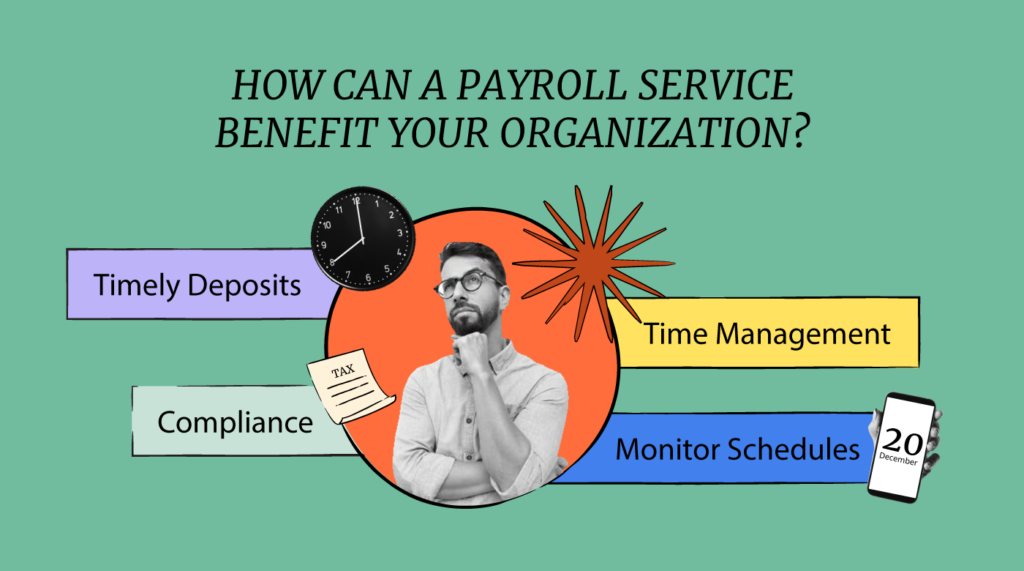
1. Timely Deposits
Outsourcing payroll mitigates errors and ensures that employees are paid on time, every time.
If you’re dealing with hourly and salary, full-time and part-time employees, payroll for independent contractors, and multiple schedules, rates, and pay periods, payroll can quickly become complicated and confusing.
2. Compliance
Payroll service providers will calculate and deduct employment tax from every paycheck. Not only does this take the time-consuming task of tax compliance off your hands, it also ensures that your employees aren’t confronted with any unexpected income tax bills at year end.
The complexity in payroll isn’t the calculation, it’s the compliance. If your data isn’t clean, it doesn’t matter how expensive the system is.

Payroll services often handle tax compliance for you, covering data synchronization and security measures. But if you're looking for more control over this aspect, consider using advanced payroll software that offers detailed tax filing features.
3. Time Management
Often within small businesses, the payroll function falls to the human resources team.
Once you outsource to an online payroll service company, you can offload a variety of tasks, consolidate others into a central software application, and dramatically simplify the process of payroll overall. This way, more time can be spent on the tasks that pertain directly to your job description.
While you may be able to easily handle doing payroll for one employee, as you grow as a company you may consider outsourcing the best method for payroll management.
4. Monitor Schedules
The majority of payroll service companies offer self-service options that allow employees to directly input hours and submit paid time-off (PTO) requests.
In placing the responsibility for reporting in the hands of the employees, you eliminate bottlenecks and increase the accuracy of time management records. With scheduling data now in a central location, it’s easy for you to monitor hours and track attendance.
What is the Difference Between Payroll Service and Payroll Software?
Working with a payroll service provider allows you to outsource your payroll to a third party, freeing up your time to focus on other tasks.
Payroll software is typically more budget-friendly than hiring a payroll service, but it can be tricky to manage without an accounting background.
Using HR payroll software means you will still have to execute payroll functions yourself, but with the assistance of a software tool. You may have to manually input payroll data like insurance premiums, retirement plan deductions, social security, and other wage garnishments.
Small business owners will still find payroll software to be helpful, since the software will calculate payments and generate checks on your behalf. But working with software alone will not free up the time and energy that a payroll service provider can.
A payroll service takes payroll off your plate, allowing time for other business priorities. On the other hand, payroll software puts you in control, requiring manual input and calculations but offering greater oversight of the process.
For more, take a read of our article payroll software vs payroll services.
Payroll Services Case Studies
See how real teams transformed their payroll processes by switching from manual tasks to payroll services—these case studies illustrate what changed for their HR, finance, and overall employee experience.Case Studies Insert Section
Case Study: Hunger Thirst Group and Paychex
Hunger Thirst Group, a seven-location restaurant group based in St. Petersburg, FL, turned to Paychex after a failed payroll rollout with a previous provider caused employees to walk out before the first paycheck was issued. Paychex onboarded the entire HTG staff within five days and extended their support to include tip reporting, E-Verify, 401(k) setup, and benefits administration.
Here are the results of Hunger Thirst Group's implementation of payroll services:
- $120,000 in annual savings: Switching to Paychex cut payroll costs significantly compared to what HTG had been paying its previous out-of-state PEO.
- Payroll processing time cut from 3 days to 8 hours: Each pay period now takes a fraction of the time it previously required, freeing up finance and operations staff.
- Full staff onboarding in 5 days: After a critical payroll failure with a prior provider, Paychex completed a full onboarding in less than a week, preventing further employee turnover.
- Improved benefits competitiveness: With access to retirement plans and better benefits administration, HTG gained an edge in attracting and retaining restaurant talent.
- Compliance gaps closed: E-Verify setup, compliance support, and employee handbook corrections were all addressed during the initial implementation.
Case Study: Momentus Technologies and Paylocity
Momentus Technologies, a venue and event management software company with employees across 10 countries on four continents, replaced a fragmented combination of ADP Streamline and country-specific spreadsheets with Paylocity's unified platform. The switch eliminated a two-week international payroll lead time and gave HR leadership a single source of truth for people data across all regions.
Here are the results of Momentus Technologies' implementation of payroll services:
- 90% reduction in HR workload: Paperless, automated onboarding and centralized data management drastically cut the manual tasks previously handled across multiple disconnected systems.
- International payroll delays eliminated: The previous two-week lead time for international payroll—which could stretch raises and bonuses out by up to six weeks—was resolved through direct Paylocity integrations with local payroll partners.
- Scalable global coverage: The platform now supports compliant payroll in 50+ countries, with local regulatory experts in each region managing tax and labor law changes.
- Unified people data: Leadership gained instant access to consolidated HR metrics—from payroll to performance—enabling more informed workforce decisions linked to company financials.
- Improved compliance across 10 countries: Country-specific regulatory monitoring, previously managed manually, is now handled by Paylocity's in-region subject-matter experts.
How to Choose the Best Payroll Service
Choosing a payroll service provider can be a challenge. There are a variety of factors to consider as you weigh up your options.
Creating a comprehensive payroll services RFP can help structure your evaluation process. The best choice depends on your business size, budget, and payroll complexity.
Need full HR and compliance support? A PEO might be the right fit. Prefer to keep HR in-house while outsourcing payroll processing? A PSP could be ideal.
Questions to ask when choosing payroll service
- What’s your budget?
- How many employees do you have?
- What additional services (on top of payroll) would you like to see?
- Consider your existing technology stack. What are the essential integrations for your payroll?
- How much customer support do you need, such as a dedicated customer success manager?
Characteristics and assets
- A simple user interface that’s easy to navigate
- Training materials to simplify onboarding for new hires
- Integrations with other relevant tools your team is currently using
- Cost effective solutions with excellent value for the money
Key features
- Direct deposit payments
- Payroll scheduling
- Self-service portal
- Tax compliance
- Tax filing
- Payroll reporting
Find the Right Partner Today
Working with a payroll partner or PEO can help scale your small business by streamlining your payroll process and freeing up valuable time.
To stay informed about all the latest human resources trends and insights, don’t forget to subscribe to our newsletter.