

10 Best AI Employee Engagement Tools Reviewed in 2026

10 Best AI Employee Engagement Tools Shortlist


The best AI employee engagement tools help you measure sentiment, gather feedback, and boost motivation—so you can create a workplace where people feel heard and supported.
Without the right tools, engagement initiatives often rely on guesswork or outdated surveys, leading to blind spots and missed opportunities to improve culture and retention. AI-powered platforms give you real-time insights into employee needs, automate feedback collection, and even recommend tailored actions for managers.
Drawing on years of experience reviewing HR and AI-driven solutions, I’ve evaluated the top engagement tools that are smart, scalable, and designed to help organizations connect with their people in meaningful ways. In this guide, you’ll find platforms that improve engagement, reduce turnover, and strengthen your employee experience strategy.
Why Trust Our Software Recommendations
Our team has been testing and reviewing software since 2012. As HR experts ourselves, we know how difficult—and important—it is to choose the right software.
For this guide, we evaluated tools using hands-on testing and independent research, scoring tools using our selection criteria. We also draw on insights from industry thought leaders and practicing HR experts.
Our reviews reflect our human editorial judgment, not a sales pitch.
Expert reviewers:
AI Employee Engagement Tools Comparison Table
This comparison table summarizes pricing details for my top AI employee engagement tool selections:
| Tool | Best For | Trial Info | Price | ||
|---|---|---|---|---|---|
| 1 | Best with AI-driven leadership insights | Free demo available | Pricing upon request | Website | |
| 2 | Best for AI-driven engagement in global teams | Free demo available | From $599/user/month | Website | |
| 3 | Best for small teams | Free plan available | From $5/user/month | Website | |
| 4 | Best with customizable integrations via open API | Free demo available | From $8/user/month | Website | |
| 5 | Best for engagement metrics | 14-day free trial + free demo available | From $2/user/month | Website | |
| 6 | Best for anonymous feedback with GDPR hosting | Free plan + free trial + free demo available | From $4/user/month (billed annually) | Website | |
| 7 | Best for peer-to-peer recognition | Free demo available | Pricing upon request | Website | |
| 8 | Best for internal communication | Free demo available | Pricing upon request | Website | |
| 9 | Best for data analytics | Free demo available | Pricing upon request | Website | |
| 10 | Best for AI-powered analytics and feedback | Free demo available | From $4,999/year | Website |


Best AI Employee Engagement Tool Reviews
Below are my detailed summaries of the best AI employee engagement tools that made it onto my shortlist. My reviews offer a detailed look at the key features, pros & cons, integrations, and ideal use cases of each tool to help you find the best one for you.

Best with AI-driven leadership insights
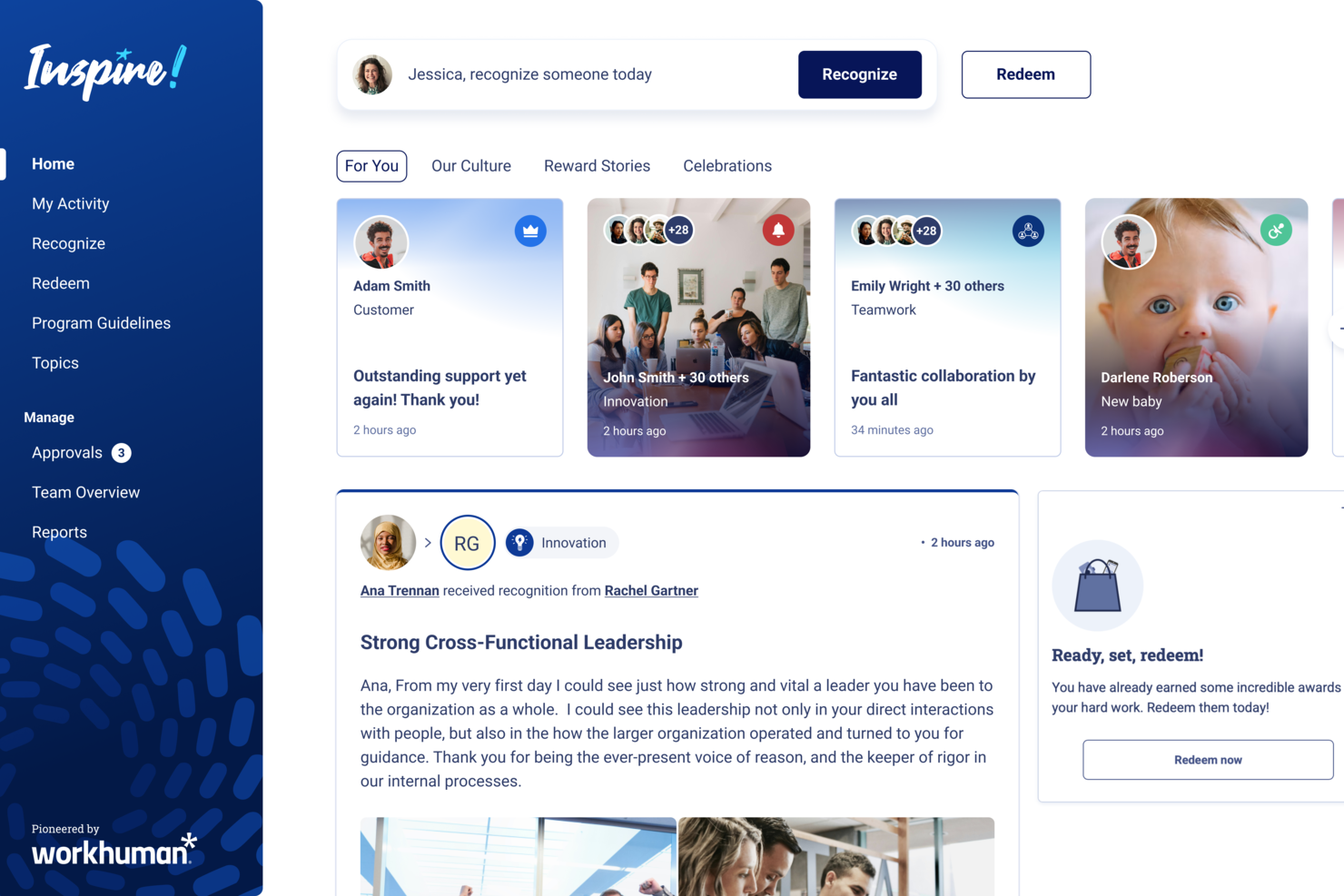
Workhuman offers an AI-powered platform designed to help organizations build a culture of recognition and engagement. It’s a strong choice for HR teams and business leaders looking to boost employee morale and gather actionable insights from real-time feedback. The platform stands out for its focus on personalized recognition and data-driven decision-making in the workplace.
Who Is Workhuman Best For?
Workhuman is a good fit for HR teams and business leaders in mid-sized to large organizations seeking to drive employee engagement and recognition through AI-powered insights.
Why I Picked Workhuman
I chose Workhuman for this list because its AI-driven leadership insights set it apart in the ai engagement tools space. The platform uses AI to analyze recognition and feedback data, surfacing actionable insights that help leaders understand team dynamics and identify engagement trends. I appreciate how Workhuman translates this data into practical recommendations for leadership development and culture improvement. These capabilities make it especially valuable for organizations that want to empower leaders with data-backed guidance.
Workhuman Key Features
Some other features of Workhuman that stand out for teams looking at ai engagement tools include:
- Personalized recognition feeds: Employees receive a tailored stream of recognition moments, making achievements visible across the organization.
- Real-time feedback tools: Users can give and receive feedback instantly, supporting ongoing performance conversations.
- Social recognition platform: The system enables peer-to-peer recognition, allowing colleagues to celebrate each other's contributions.
- HRIS integration capabilities: Workhuman connects with popular HRIS platforms to sync employee data and streamline workflows.
Workhuman Integrations
Integrations include Workday, UKG, Oracle, SAP SuccessFactors, ADP, Microsoft Teams, Slack, Outlook, Gmail, and Zoom.
Pros and Cons
Pros:
- Real-time feedback supports continuous employee growth
- Social recognition tools foster peer engagement
- AI-driven insights identify emerging leaders quickly
Cons:
- Analytics dashboards can feel overwhelming to new users
- Limited customization for recognition program design
Deel HR
Best for AI-driven engagement in global teams

Deel Engage is an AI-driven employee engagement tool that helps you retain and develop your people through performance management, feedback, and growth opportunities.
Why I picked Deel: I picked Deel Engage because it uses built-in AI to make engagement and performance management more efficient and personalized. The AI helps you draft career paths, generate detailed training courses, and even suggest development plans—all in minutes. This focus on automation and AI frees your HR team from repetitive setup work so they can spend more time on coaching and culture-building. Deel Engage also links performance data with compensation and learning, helping you identify top performers and offer targeted growth opportunities.
Standout features & integrations:
Features include 360° feedback reviews that eliminate bias and ensure fair performance appraisals. You can also connect OKRs and goal tracking to development plans so every team member’s progress aligns with company objectives.
Integrations include QuickBooks, BambooHR, NetSuite, Gusto, ADP Workforce Now, SAP SuccessFactors, Slack, Google Workspace, Hubstaff, Time Doctor, Ravio, and PinPoint.
Pros and Cons
Pros:
- Supports 360° and custom feedback processes
- Connects engagement to pay and growth
- AI speeds up HR development tasks
Cons:
- May feel complex for smaller teams
- AI suggestions may need fine-tuning
New Product Updates from Deel HR

Deel Expands Stablecoin Wallet to 80+ Countries
Deel expands its Stablecoin Wallet to 80+ countries with dollar-backed balances and optional rewards. This gives eligible contractors more ways to hold and manage earnings inside Deel. For more information, visit Deel’s official site.
 .
.
Bonusly
Best for small teams

Bonusly is an employee recognition and rewards platform that enhances workplace culture by facilitating peer-to-peer recognition and performance management. It serves organizations across industries like tech, finance, healthcare, and hospitality, offering recognition, team support tools, and a customizable rewards catalog.
Why I picked Bonusly: Bonusly excels in providing small teams with straightforward recognition solutions. It allows employees to give each other video-based recognitions, which makes it engaging and personal.
The platform offers tools for managers to gain insights into team performance and engagement. Small teams benefit from its easy-to-use interface and customizable rewards options.
Standout features & integrations:
Features include a customizable rewards catalog, video-based recognitions, and automated milestone celebrations. You can set up real-time feedback tools to support team growth. Bonusly's AI-powered insights help track and improve employee engagement.
Integrations include Slack, Microsoft Teams, BambooHR, Workday, ADP, Namely, Rippling, Zenefits, Gusto, and Google Workspace.
Pros and Cons
Pros:
- AI-powered insights for managers
- Real-time feedback tools
- Engaging video recognition
Cons:
- Occasional delays in reward processing
- Basic analytics features
Best with customizable integrations via open API
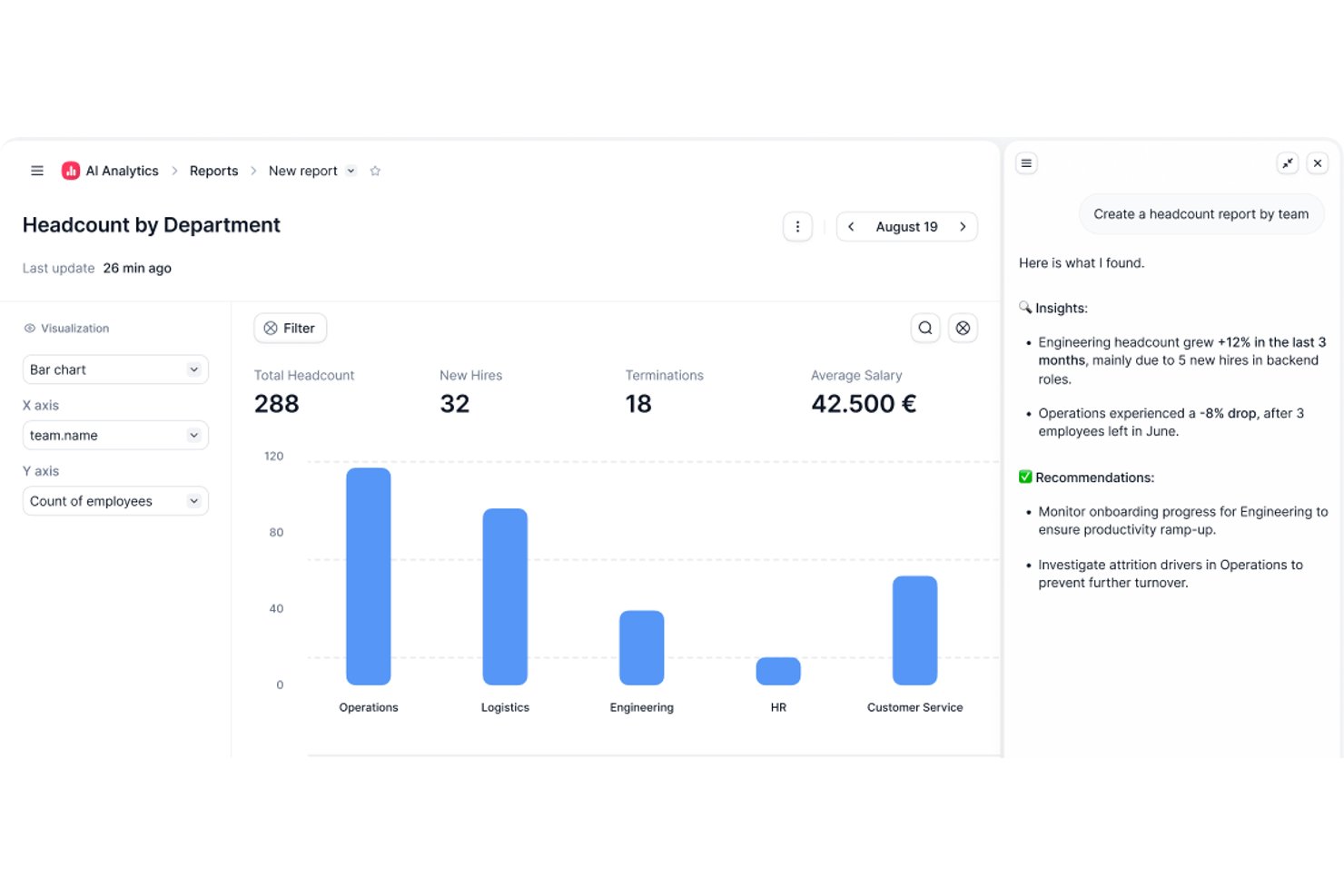
Factorial is an HR and employee engagement platform that offers AI-powered surveys, feedback tools, analytics, and workflow automation for companies looking to manage and boost engagement across their teams.
Who Is Factorial Best For?
HR teams in growing small to midsize companies that want to centralize engagement, automation, and people operations.
Why I Picked Factorial
I picked Factorial as one of the best because its open API lets my team build custom apps, connect engagement data with other HR systems, and automate people workflows across our tool stack. This flexibility covers unique process needs.
Factorial Key Features
- AI-powered engagement surveys: Collect anonymous employee feedback using smart, customizable survey templates.
- Performance review cycles: Set up and automate regular 360-degree feedback and evaluation processes.
- Absence and leave management: Track, approve, and report on time-off requests in a centralized dashboard.
- HR analytics reporting: Generate visual reports on engagement, turnover, and other workforce trends.
Factorial Integrations
Factorial offers over 40 native integrations, including Slack, Microsoft Teams, Google Workspace, BambooHR, Zapier, Personio, TravelPerk, and more. An API is available for building custom integrations.
Pros and Cons
Pros:
- Centralized platform for engagement and performance
- Customizable automation for HR workflows
- AI-driven surveys and sentiment analysis
Cons:
- Some region-specific HR features unavailable
- Limited advanced reporting customization
Best for engagement metrics

ThriveSparrow is an Employee Success Platform designed to support organizations in building high-performing teams by enhancing employee engagement. It serves HR professionals and managers focused on improving team alignment and satisfaction through goal-setting, performance reviews, and engagement surveys.
Why I picked ThriveSparrow: ThriveSparrow uses AI to transform engagement tracking into meaningful actions that drive team success. With tools like Employee Net Promoter Score (eNPS) and pulse surveys, the platform collects real-time feedback and applies AI insights to uncover sentiment patterns.
Standout features & integrations:
Features include OKR tracking for aligning team goals, automated employee rewards systems, and AI-powered sentiment analysis. You can utilize multilingual surveys to cater to a diverse workforce. ThriveSparrow also offers action plans to address feedback and drive improvements.
Integrations include Slack, Microsoft Teams, BambooHR, Workday, ADP, Google Workspace, Salesforce, LinkedIn, Zoom, and Zapier.
Pros and Cons
Pros:
- Actionable engagement metrics
- Real-time OKR tracking
- Automated reward systems
Cons:
- Occasional performance issues
- Requires initial setup time
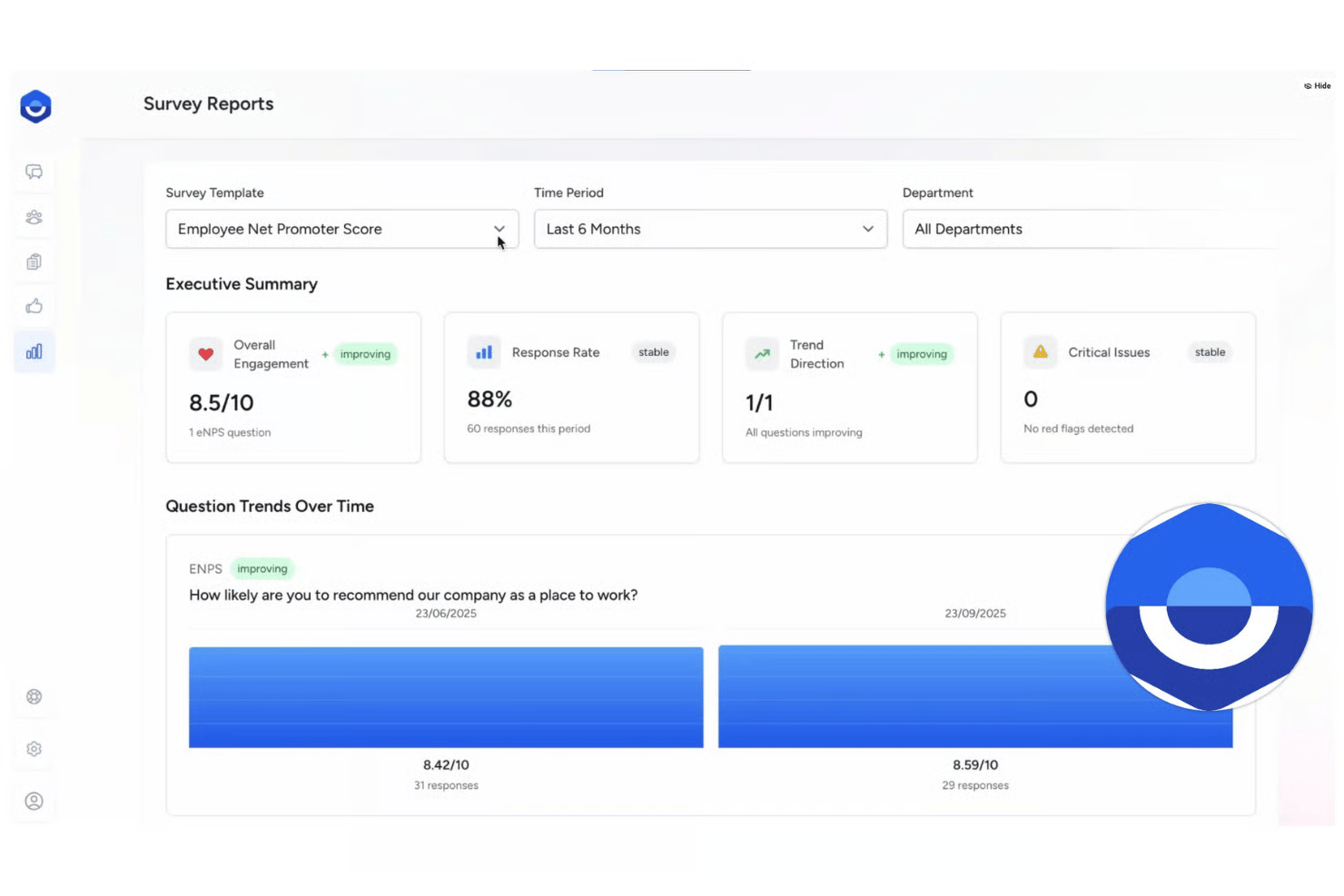
FeedbackPulse is an anonymous employee feedback tool that covers pulse surveys, eNPS, 360° reviews, and performance cycles, with AI-generated summaries and EU-based GDPR hosting built in.
Who Is FeedbackPulse Best For?
FeedbackPulse is a strong fit for small teams in Europe that need anonymous employee feedback with built-in GDPR compliance and simple, no-fuss setup.
Why I Picked FeedbackPulse
I've included FeedbackPulse in my top picks because it's one of the few tools that treats anonymity as a structural guarantee rather than a setting. Its 3-response minimum is hardcoded and admin-proof, so employees in small European teams can respond honestly without worrying their manager will identify them. Survey data is hosted on EU servers (Hetzner, Nuremberg), which makes GDPR compliance concrete rather than contractual. AI summaries then surface sentiment and key findings from those survey responses, giving you a readable signal without needing to dig through raw data.
FeedbackPulse Key Features
- Pulse survey templates: Ready-made surveys cover Weekly Pulse Check, eNPS, 30-Day Onboarding, Exit Interview, and Annual Engagement, so you can launch without building from scratch.
- 360° performance reviews: Peer, manager, and self-review cycles run on monthly, quarterly, semi-annual, or annual schedules with no manual setup required each cycle.
- eNPS benchmarking: Pro and Max plans include eNPS score tracking with benchmarks, giving you a reference point for how your scores compare.
- Multi-language support: Surveys are available in 8 languages, so teams across different regions can respond in their preferred language.
FeedbackPulse Integrations
FeedbackPulse offer native integrations with Slack and Microsoft Teams, available on the Max plan. Enterprise customers can also request custom integrations.
Pros and Cons
Pros:
- Automated surveys simplify recurring feedback collection
- GDPR-compliant EU hosting supports privacy-conscious teams
- Anonymity safeguards resist administrator override
Cons:
- Three-response minimum limits small-team visibility
- AI summaries lack predictive engagement insights
Kudos
Best for peer-to-peer recognition

Kudos is a platform designed to foster employee engagement through recognition, feedback, and values-based communication. It’s built for organizations that want to improve workplace culture by giving their teams tools to acknowledge and appreciate one another’s efforts.
Why I picked Kudos: Kudos uses AI to deepen engagement by transforming recognition into a powerful cultural driver. Its AI-powered insights show leaders how peer-to-peer appreciation connects to company values, morale, and performance, helping to foster a recognition-first culture that motivates employees and strengthens connections across teams.
Standout features & integrations:
Features Kudos offers AI-driven analytics that uncover trends in recognition, highlighting which values and behaviors are most celebrated and where gaps may exist. Peer-to-peer appreciation is amplified through points-based rewards, badges, and personal messages, while AI ensures recognition programs remain aligned with cultural priorities. Customizable recognition workflows allow organizations to create tailored, values-based engagement strategies.
Integrations include Slack, Microsoft Teams, Google Workspace, BambooHR, Workday, ADP, Salesforce, LinkedIn, Zoom, Okta, and SAP SuccessFactors.
Pros and Cons
Pros:
- Offers recognition without requiring rewards
- Encourages consistent peer feedback
- Ties recognition to company values
Cons:
- Reporting options can feel limited
- Admin setup takes extra time

Haiilo
Best for internal communication

Haiilo is an internal communication platform designed to enhance employee engagement and collaboration within organizations. It is built for communication and HR teams in mid-sized to large companies, supporting engagement, interaction, and internal visibility through analytics.
Why I picked Haiilo: Haiilo leverages AI to make employee communications smarter and more impactful. Its AI-powered content creation tools help you craft engaging messages that resonate across teams, while intelligent recommendations ensure the right content reaches the right audience.
Standout features & integrations:
Features include intuitive, AI-assisted content creation and distribution tools, helping you generate compelling posts, newsletters, and campaigns in less time. Its AI-driven analytics track engagement in depth, identifying what works best and suggesting improvements. Employee advocacy is also boosted by AI, enabling teams to amplify your brand’s message with data-backed insights.
Integrations include SharePoint, Office 365, Microsoft Teams, Slack, Workplace by Facebook, Yammer, Google Workspace, LinkedIn, Twitter, and Instagram.
Pros and Cons
Pros:
- Employee advocacy features
- Supports multimedia formats
- Intuitive content creation tool
Cons:
- Occasional technical glitches
- Requires training for full use
Best for data analytics

Culture Amp is an employee engagement platform designed for HR professionals and managers to gather insights and drive workplace improvements. Its main user base includes large organizations focused on boosting employee satisfaction and performance through surveys, feedback analysis, and actionable insights.
Why I picked Culture Amp: Culture Amp uses AI to transform employee feedback into actionable insights that directly enhance engagement and performance. Its AI-driven survey tools go beyond simple data collection by helping you uncover hidden trends and sentiment patterns. The platform enables HR and leaders to make confident, evidence-based decisions that foster stronger engagement, improve workplace culture, and support continuous growth.
Standout features & integrations:
Features include AI-powered surveys and analytics that personalize the feedback experience and highlight the areas with the greatest impact on employee engagement. Its intelligent reporting identifies themes, predicts potential challenges, and recommends next steps. With a library of best-practice templates, benchmarking against industry data, and real-time feedback analysis, Culture Amp combines human-centered design with AI precision to help organizations build thriving, engaged teams.
Integrations include Slack, Microsoft Teams, Workday, ADP, BambooHR, Okta, Google Workspace, SAP SuccessFactors, Namely, and LinkedIn.
Pros and Cons
Pros:
- Benchmarking data available
- Real-time feedback access
- Customizable survey options
Cons:
- Needs regular updates for accuracy
- Requires data analysis skills

Workleap
Best for AI-powered analytics and feedback
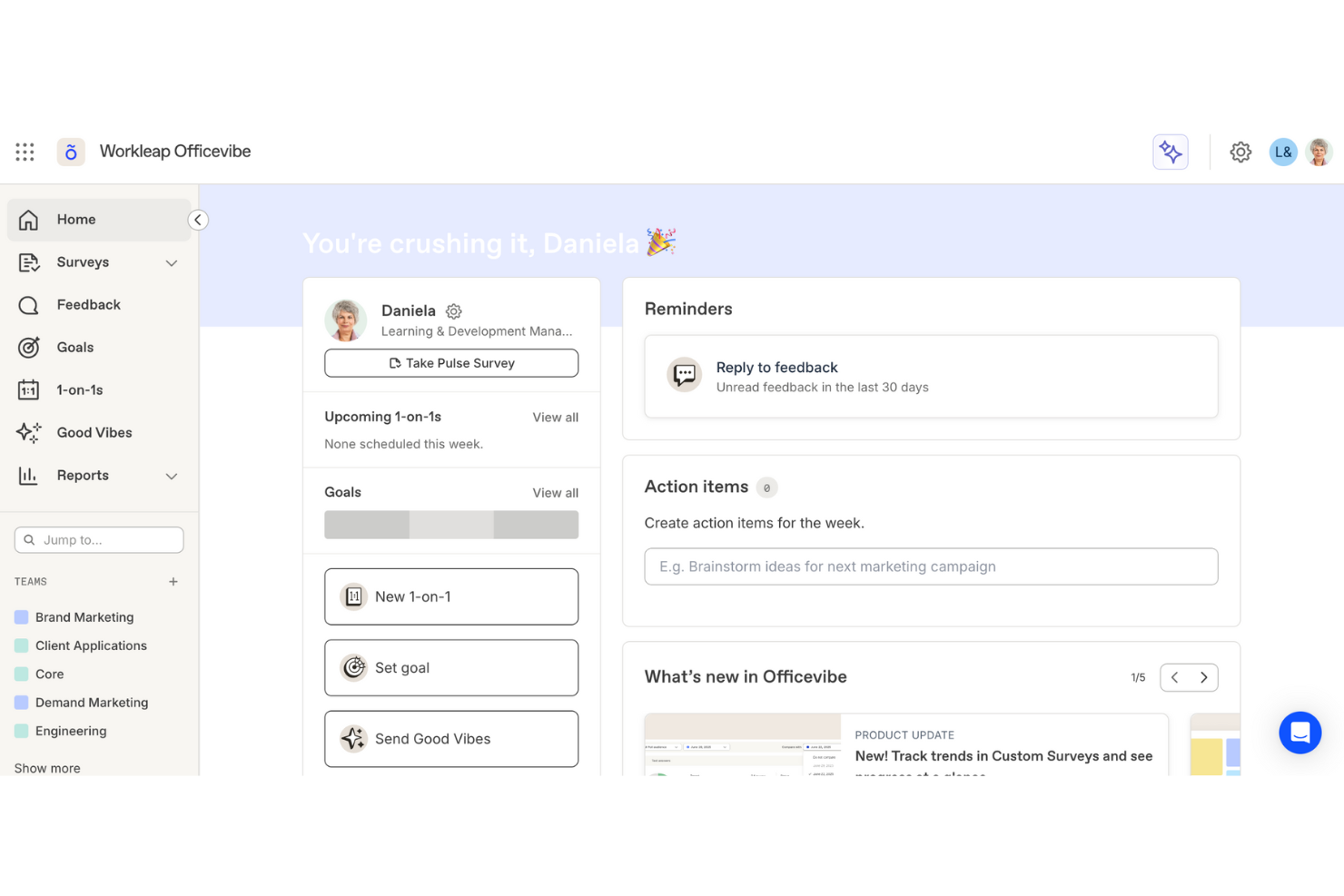
Among AI employee engagement tools, Workleap offers a practical platform for teams that want to improve communication and employee feedback. It’s well-suited for HR teams and managers who need an easier way to track engagement and gather input from employees. With a simple interface that supports open responses and regular check-ins, Workleap helps teams understand workplace concerns and improve day-to-day collaboration.
Why I Picked Workleap
I picked Workleap because its AI-powered engagement tools help managers interpret survey results and identify follow-up actions based on team data. The platform identifies themes from open-ended responses and generates action plans tied to engagement trends, helping managers respond more consistently to employee feedback.
Workleap Key Features
In addition to AI-powered analytics and feedback, Workleap offers:
- Pulse Surveys: These quick, frequent surveys allow you to gauge employee sentiment regularly and make timely adjustments.
- Structured Conversations: This feature facilitates ongoing dialogue between managers and employees, supporting continuous feedback and growth.
- Growth-Oriented Templates: Designed to support employee development, these templates help structure discussions on career progression and skill development.
- Real-Time Analytics: Provides immediate insights into team dynamics, enabling you to respond swiftly to any emerging issues.
- AI-powered recommendations: Analyze engagement data and suggest follow-up actions based on team feedback trends.
Workleap Integrations
Integrations include Slack, Microsoft Teams, HRIS platforms (e.g., BambooHR, ADP), SSO tools (e.g., Okta, Google Workspace), and calendar apps (e.g., Google Calendar, Outlook).
Pros and Cons
Pros:
- Real-time insights help teams track engagement and collaboration
- Recognition features support employee appreciation and team culture
- Communication tools improve employee feedback and team engagement
Cons:
- Reporting tools lack depth for detailed data analysis
- Integration issues affect calendar syncing and HR system connections
Other AI Employee Engagement Tools
Here are some additional AI employee engagement tools options that didn’t make it onto my shortlist, but are still worth checking out:
- Lattice AI
For goal tracking
- WorkTango
For employee feedback
- Awardco
For budget-friendly rewards
- Leapsome
For performance reviews
- AdvantageClub.ai
For rewards programs
- Sogolytics
For survey customization
- Eletive
For real-time insights
- Deel Payroll
For managing remote teams
- Firstup
For employee communication apps
- People Insight
For UK compliance


How I Evaluate AI Engagement Tools
Every tool on this list needs to deliver AI that actually moves the needle—like helping you spot disengagement before it turns into turnover, not just pinning a chatbot onto a basic survey. I split my evaluation into core functionality a tool must have to qualify and differentiating factors that separate good options from great ones.
Core Functionality (Table Stakes For This List)
When I'm selecting tools for my list, I rank each one on a scale from 0 (does not offer the functionality) to 5 (excels in this area) for each core functionality listed below. Then, I calculate the tool's total score into a percentage. Each tool needs to achieve a minimum total score of 65% to be considered for inclusion.
- AI-Powered Sentiment Analysis: I check whether the tool uses NLP to surface themes and emotions from open-text responses, not just positive/negative labels on closed-ended survey answers.
- Automated Pulse Surveys: The tool should handle survey scheduling and question logic with AI, like adapting follow-up questions based on a prior response about workload.
- Predictive Engagement Analytics: I look for ML models that flag attrition risk or burnout at the individual or team level before managers see it in resignation letters.
- AI-Generated Action Plans: Each tool should translate engagement data into specific next steps for managers, such as suggested 1:1 talking points after a team's scores drop.
- Personalized Employee Touchpoints: I evaluate whether AI tailors nudges, recognition, or development prompts per employee rather than blasting the same message to everyone.
- Engagement Reporting Dashboards: Dashboards should let HR leaders slice engagement data by team, tenure, or location and include AI-written summaries that explain what the numbers mean.
Once I have a list of tools that meet the criteria, I consider what sets each platform apart.
Differentiating Factors (What Sets Vendors Apart)
Here's how I compare and contrast different vendors:
Standout Features
Manager enablement copilots stand out because they close the gap between insight and action—tools that generate 1:1 agendas or coaching nudges based on a team's latest scores give frontline managers something they can use right away. I also look for DEIB insight detection, where AI surfaces equity gaps in sentiment across demographic groups that manual analysis would miss. Continuous listening channels matter too, especially when a platform pulls feedback from Slack, Teams, and email into one unified view instead of relying solely on scheduled surveys.
Beyond Features
Data privacy and ethical AI practices top my list here—I check whether a vendor offers anonymization thresholds, bias documentation, and compliance with standards like SOC 2 and GDPR, since employees won't share honest feedback without trust. Integration depth matters just as much; a tool that connects natively with your HRIS and lives inside Slack or Teams gets far higher adoption than one that requires a separate login. I also evaluate benchmarking access, because comparing your engagement scores against industry or regional norms gives leadership the context they need to act.
How to Choose AI Employee Engagement Tools
It’s easy to get bogged down in long feature lists and complex pricing structures. To help you stay focused as you work through your unique software selection process, here’s a checklist of factors to keep in mind:
| Factor | What to Consider |
|---|---|
| Scalability | Can the tool grow with your team? Consider user limits and how easily you can add more users or features as your organization expands. |
| Integrations | Does it work with your existing systems? Look for compatibility with HR and communication tools you already use, like Slack or Microsoft Teams. |
| Customizability | Can you tailor the tool to fit your processes? Check if you can customize dashboards, reports, and workflows to meet your specific needs. |
| Ease of use | Is the tool user-friendly? Evaluate the interface and navigation. A steep learning curve can slow down adoption by your team. |
| Implementation and onboarding | How quickly can you get started? Assess the time and resources needed for setup and whether the vendor offers support like training videos or interactive tours. |
| Cost | Does the pricing fit your budget? Compare the cost against the features offered. Look for hidden fees or mandatory upgrades that could affect your budget. |
| Security safeguards | Are your data and privacy protected? Verify compliance with data protection regulations and the availability of encryption and other security measures. |
| Support availability | Will you get help when you need it? Consider the availability of customer support, including hours of operation and the channels offered, such as phone or chat. |
What Are AI Employee Engagement Tools?
AI employee engagement tools are software solutions designed to enhance employee interaction and satisfaction within a company. HR professionals and managers typically use these tools to gather feedback, improve communication, and boost morale. Surveys, feedback collection, and performance tracking help with understanding employee needs and aligning organizational goals. These tools provide value by fostering a more engaged and productive workforce.
Features
Here are the core features any great AI employee engagement tool software should have:
- Employee feedback collection: Gather insights from employees to understand their needs and improve workplace satisfaction.
- Performance tracking: Monitor employee progress and performance to align with company goals and objectives.
- Engagement surveys: Conduct surveys to measure employee engagement levels and identify areas for improvement.
- Goal setting: Facilitate setting and tracking of individual and team goals to ensure alignment with organizational priorities.
- Recognition and rewards: Implement systems to acknowledge and reward employees for their contributions and achievements.
- Real-time analytics: Access immediate data and insights to make informed decisions about employee engagement strategies.
- Customizable dashboards: Tailor dashboards to display relevant data and metrics that meet your specific needs.
- Integration capabilities: Connect with existing HR and communication tools for a smooth workflow.
- Automated reminders: Set up reminders for feedback and surveys to ensure consistent employee participation.
- Benchmarking tools: Compare your organization's performance against industry standards to gauge effectiveness.
Benefits
Implementing AI employee engagement tools provides several benefits for your team and your business. Here are a few you can look forward to:
- Improved communication: Facilitate open dialogue between employees and management with feedback collection and surveys.
- Enhanced productivity: Boost efficiency by aligning performance tracking with organizational goals.
- Increased satisfaction: Foster a positive work environment through recognition and rewards systems.
- Data-driven decisions: Use real-time analytics to make informed choices about engagement strategies.
- Goal alignment: Ensure everyone is on the same page with goal-setting features that track progress.
- Better retention: Keep talent engaged and committed by addressing employee needs and concerns.
- Cost efficiency: Optimize resources by integrating with existing tools and automating routine tasks.
Costs and Pricing
Selecting AI employee engagement tools requires an understanding of the various pricing models and plans available. Costs vary based on features, team size, add-ons, and more. The table below summarizes common plans, their average prices, and typical features included in AI employee engagement tools solutions:
Plan Comparison Table for AI Employee Engagement Tools
| Plan Type | Average Price | Common Features |
|---|---|---|
| Free Plan | $0 | Basic feedback collection, limited surveys, and simple analytics. |
| Personal Plan | $5-$25/user/month | Advanced surveys, basic goal setting, and email support. |
| Business Plan | $25-$50/user/month | Customizable dashboards, performance tracking, and integration capabilities. |
| Enterprise Plan | $50+/user/month | Full customization, dedicated account support, and advanced analytics and reporting. |
FAQs
Here are some answers to common questions about AI employee engagement tools:
How to use AI for employee engagement?
AI can personalize engagement by tailoring insights and recommending learning opportunities. It can help track employee wellness and gamify development goals. Consider using AI to recognize achievements and suggest team-building activities based on individual interests and needs.
What should you not do when using AI tools at work?
Avoid sharing sensitive or confidential information with AI services. Always double-check AI-generated results before using them, as AI can make mistakes. Be aware of potential biases in AI systems and ensure AI tools comply with your organization’s privacy policies.
What are the key security concerns when using AI tools in the workplace?
Security risks include data exposure and compliance violations from unauthorized AI tools. It’s crucial to implement AI-specific governance and risk management. Ensure employees use only approved AI tools and monitor their usage to protect sensitive information.
How can AI improve employee engagement surveys?
AI can automate feedback analysis, providing deeper insights and suggesting tailored action plans. It helps in real-time sentiment analysis and can enhance the accuracy of survey results. AI can also identify trends and areas needing attention, making surveys more effective.
What are the benefits of using AI-driven feedback?
AI-driven feedback tools offer personalized and timely responses. They can improve performance management by providing data-driven insights. AI helps in identifying employee needs and preferences, leading to better engagement and satisfaction in the workplace.
How do AI tools support remote team management?
AI tools facilitate communication and collaboration among remote teams. They can automate routine tasks and provide insights into team performance. AI helps in tracking productivity and engagement, ensuring remote teams remain connected and aligned with organizational goals.