


Culture Amp Review: Employee Engagement Software for 2026



Culture Amp Employee Engagement Software Review for 2025
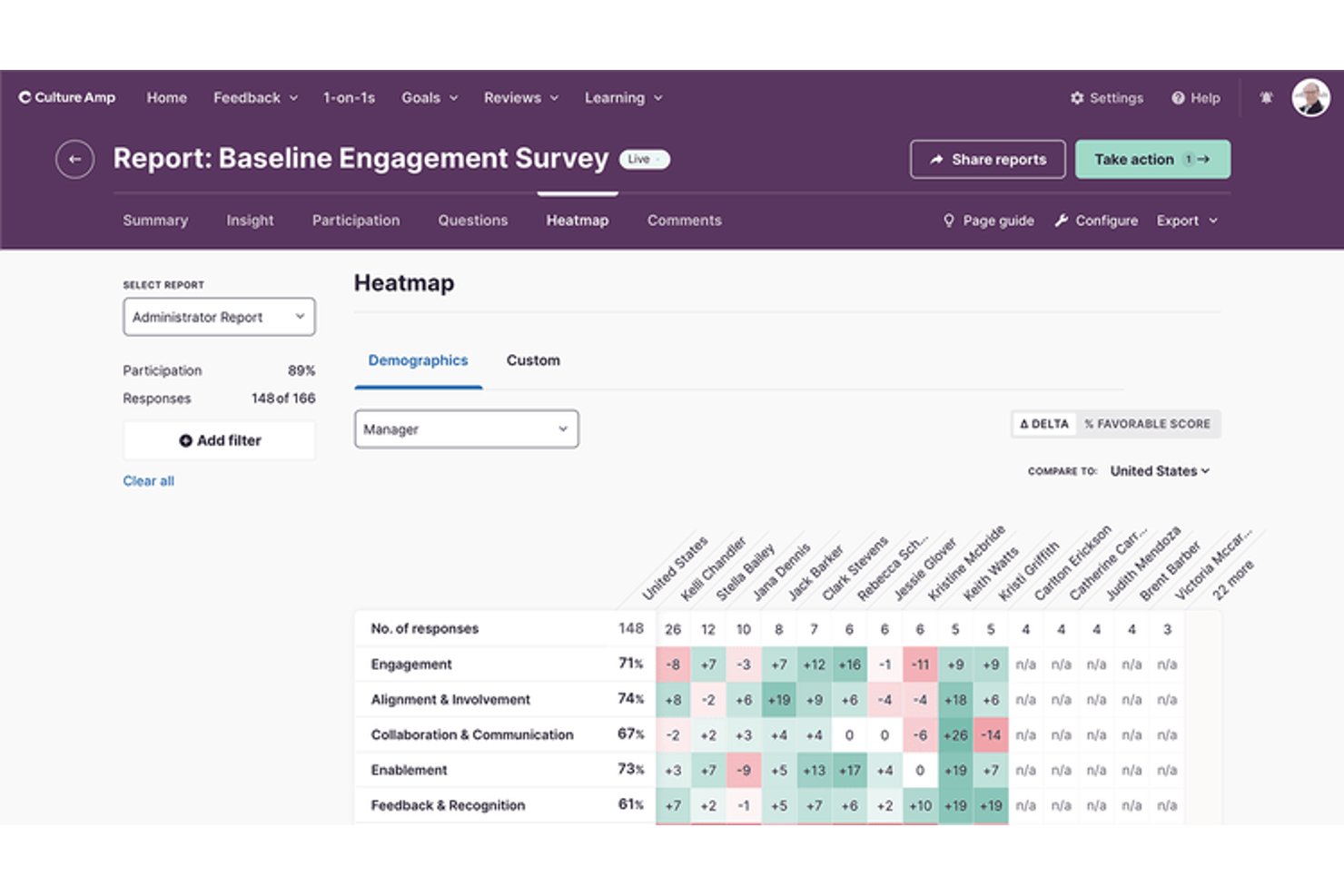
Culture Amp is an employee engagement software built for HR teams that need to run engagement surveys, analyze people data, and connect insights to meaningful action. If you're weighing it against Lattice, Culture Amp goes deeper on survey science and people analytics, making it the stronger pick when data-driven decision-making is the priority over a more evenly split engagement and performance management toolset.
Culture Amp Evaluation Summary
- Pricing upon request
- Free demo available
Why Trust Our Software Recommendations
Our team has been testing and reviewing software since 2012. As HR experts ourselves, we know how difficult—and important—it is to choose the right software.
For this guide, we evaluated tools using hands-on testing and independent research, scoring tools using our selection criteria. We also draw on insights from industry thought leaders and practicing HR experts.
Our reviews reflect our human editorial judgment, not a sales pitch.
Expert reviewers:
Culture Amp Overview
In my experience, Culture Amp is a top pick for HR teams who want intuitive employee engagement software with strong analytics, easy onboarding, and responsive support. Its survey templates and feedback tools are more actionable than most, and the interface is clean and approachable. Pricing is mid-range, but you get robust reporting and integrations that justify the cost for midsize to large organizations. While customization options are somewhat limited compared to some competitors, I think Culture Amp is best for companies prioritizing quick adoption and data-driven decision-making over deep workflow tailoring.
pros
-
Science-backed engagement surveys provide highly actionable employee sentiment insights.
-
Strong benchmarking data helps you compare culture against industry standards.
-
Flexible performance review workflows support multiple evaluation and feedback styles.
cons
-
Limited OKR management compared to more performance-focused enterprise competitors.
-
Some analytics features can feel overwhelming for first-time administrators initially.
-
Some advanced customization options may feel restrictive for complex organizational needs.
-

Justworks
Visit WebsiteThis rating combines scores from multiple user review sites to reflect overall customer sentiment about the product.4.6 -
Small Improvements
Visit WebsiteThis rating combines scores from multiple user review sites to reflect overall customer sentiment about the product.4.3 -
HiBob
Visit WebsiteThis rating combines scores from multiple user review sites to reflect overall customer sentiment about the product.4.5


How We Test & Score Our Tools
We’ve spent years building, refining, and improving our software testing and scoring system. The rubric is designed to capture the nuances of software selection and what makes a tool effective, focusing on critical aspects of the decision-making process.
Below, you can see exactly how our testing and scoring works across seven criteria. It allows us to provide an unbiased evaluation of the software based on core functionality, standout features, ease of use, onboarding, customer support, integrations, customer reviews, and value for money.
Core Functionality (25% of final score)
The starting point of our evaluation is always the core functionality of the tool. Does it have the basic features and functions that a user would expect to see? Are any of those core features locked to higher-tiered pricing plans? At its core, we expect a tool to stand up against the baseline capabilities of its competitors.
Standout Features (25% of final score)
Next, we evaluate uncommon standout features that go above and beyond the core functionality typically found in tools of its kind. A high score reflects specialized or unique features that make the product faster, more efficient, or offer additional value to the user.
We also evaluate how easy it is to integrate with other tools typically found in the tech stack to expand the functionality and utility of the software. Tools offering plentiful native integrations, 3rd party connections, and API access to build custom integrations score best.
Ease of Use (10% of final score)
We consider how quick and easy it is to execute the tasks defined in the core functionality using the tool. High scoring software is well designed, intuitive to use, offers mobile apps, provides templates, and makes relatively complex tasks seem simple.
Onboarding (10% of final score)
We know how important rapid team adoption is for a new platform, so we evaluate how easy it is to learn and use a tool with minimal training. We evaluate how quickly a team member can get set up and start using the tool with no experience. High scoring solutions indicate little or no support is required.
Customer Support (10% of final score)
We review how quick and easy it is to get unstuck and find help by phone, live chat, or knowledge base. Tools and companies that provide real-time support score best, while chatbots score worst.
Customer Reviews (10% of final score)
Beyond our own testing and evaluation, we consider the net promoter score from current and past customers. We review their likelihood, given the option, to choose the tool again for the core functionality. A high scoring software reflects a high net promoter score from current or past customers.
Value for Money (10% of final score)
Lastly, in consideration of all the other criteria, we review the average price of entry level plans against the core features and consider the value of the other evaluation criteria. Software that delivers more, for less, will score higher.
Culture Amp Specs
- 360 Degree Feedback
- API
- Application Tracking
- Attendance Tracking
- Budgeting
- Calendar Management
- Dashboard
- Data Export
- Data Import
- Data Visualization
- Employee Database
- Employee Engagement
- Employee Incentive Management
- Employee Onboarding
- External Integrations
- Feedback Management
- Forecasting
- Multi-User
- Notifications
- Onboarding
- Scheduling
- Timesheets
- Vacation & Absence Calendar
Alternatives to Culture Amp


Culture Amp Frequently Asked Questions
How does Culture Amp handle data security and compliance?
Culture Amp takes data security seriously, adhering to global standards like GDPR to protect your team's information. They use encryption to safeguard data both in transit and at rest. Regular audits and security assessments ensure compliance with industry regulations. You can trust that your data is managed with the highest security protocols, giving you peace of mind.
Can Culture Amp support remote teams effectively?
Yes, Culture Amp offers features that cater to remote teams, such as digital surveys and real-time feedback tools. These capabilities help you engage your team regardless of location, ensuring everyone feels connected and heard. The platform's insights enable you to address remote work challenges efficiently.
Is Culture Amp customizable to fit my organization's needs?
Culture Amp provides some customization options, such as tailoring surveys to align with your company culture and goals. While it may not offer extensive customization like some other platforms, the available options are generally sufficient for most HR teams to gather relevant insights.
How does Culture Amp help improve employee engagement?
Culture Amp uses surveys and analytics to identify areas for improvement in your workplace culture. By providing actionable insights, it empowers you to implement changes that boost engagement. Regular feedback loops keep you informed of your team's needs and progress.
What kind of training and resources are available for new users?
Culture Amp offers a range of resources, including tutorials, webinars, and a dedicated support team to help you get started. These resources ensure you understand the platform's functionalities and can use them to their full potential, enhancing your onboarding experience.
How often does Culture Amp update its features?
Culture Amp regularly updates its platform to introduce new features and improvements based on user feedback. This ensures you benefit from the latest tools and technologies to enhance your employee engagement strategies. Staying current with updates helps you keep your workplace culture dynamic and responsive.
Does Culture Amp offer multi-language support?
Yes, Culture Amp supports multiple languages, allowing you to engage with a diverse workforce. This feature ensures your surveys and communications reach all team members effectively, fostering inclusivity and comprehensive feedback collection.
How can Culture Amp assist with performance reviews?
Culture Amp's performance review tools help you align individual goals with team objectives. You can conduct structured reviews that provide valuable insights into employee development, allowing you to make informed decisions about promotions and training needs. This functionality supports a culture of continuous growth and improvement. I couldn't find specific information on Culture Amp's company overview and history. Please note that the content below is hypothetical and based on general knowledge of similar companies.
Culture Amp Company Overview & History
Culture Amp is headquartered in Melbourne, Australia, and employs a diverse team dedicated to improving workplace culture. Known for its innovative approach, Culture Amp collaborates with various industries to enhance employee engagement. Companies like Airbnb and Slack use its platform to cultivate positive work environments, showcasing its effectiveness. While specific financial details are private, Culture Amp's reputation as a leader in employee engagement software speaks volumes about its success.
Culture Amp Major Milestones
2009: Culture Amp was founded to revolutionize employee engagement.
2011: Released its first employee feedback platform.
2016: Secured major funding to expand its global reach.
2020: Recognized for its outstanding workplace culture initiatives.
2022: Expanded its client base to include top tech companies.
What's Next?
To remain up to date on all the latest in people management, subscribe to our newsletter for leaders and managers. You'll receive insights and offerings tailored to leaders and HR professionals straight to your inbox.