

De 10 beste EOR-tjenestene for teknologistartups i 2026

EOR for teknologistartups – kortliste


Hvorfor du kan stole på våre programvareanbefalinger
Teamet vårt har testet og anmeldt programvare siden 2012. Vi er selv HR-eksperter, så vi vet hvor vanskelig og hvor viktig det er å velge riktig programvare.
I denne guiden har vi vurdert verktøyene gjennom praktisk testing og uavhengig research og gitt dem poeng ut fra våre utvelgelseskriterier. Vi bygger også på innsikt fra ledende eksperter i bransjen og erfarne HR-eksperter.
Anmeldelsene våre bygger på vår egen redaksjonelle vurdering. De er ikke et salgsargument.
Ekspertanmeldere:
Sammenligningstabell for EOR for teknologistartups
Denne sammenligningstabellen oppsummerer prisdetaljene for mine beste utvalgte EOR-løsninger for teknologistartups:
| Tool | Best For | Trial Info | Price | ||
|---|---|---|---|---|---|
| 1 | Best for scaling global tech teams | Free demo available | From $599/user/month | Website | |
| 2 | Best for enterprise-grade global compliance at scale | Free demo available | From $599/user/month | Website | |
| 3 | Best for fast global hiring without local entities | Free demo available | From $599/employee/month | Website | |
| 4 | Best for indemnification-backed hiring | Not available | From $399/user/month | Website | |
| 5 | Best for managing equity and ESOPs | Free demo available | From $459/user/month | Website | |
| 6 | Best for global employee onboarding | Free demo available | From $499/user/month | Website | |
| 7 | Best for direct-entity compliance at scale | Free demo available | From $599/user//month | Website | |
| 8 | Best for customized onboarding workflows | Free demo available | From $199/user/month | Website | |
| 9 | Best for unified global HR and payroll automation | Free demo available | Pricing upon request | Website | |
| 10 | Best for IP protection during investor due diligence | Free demo available | From $699/user/month | Website |


Anmeldelser av EOR for teknologistartups
Nedenfor finner du mine detaljerte sammendrag av EOR-løsningene for teknologistartups som kom med på kortlisten min. Anmeldelsene mine gir en detaljert gjennomgang av funksjonene, de beste bruksområdene og prisene for hver plattform, slik at du kan finne den som passer best for deg.

Best for scaling global tech teams
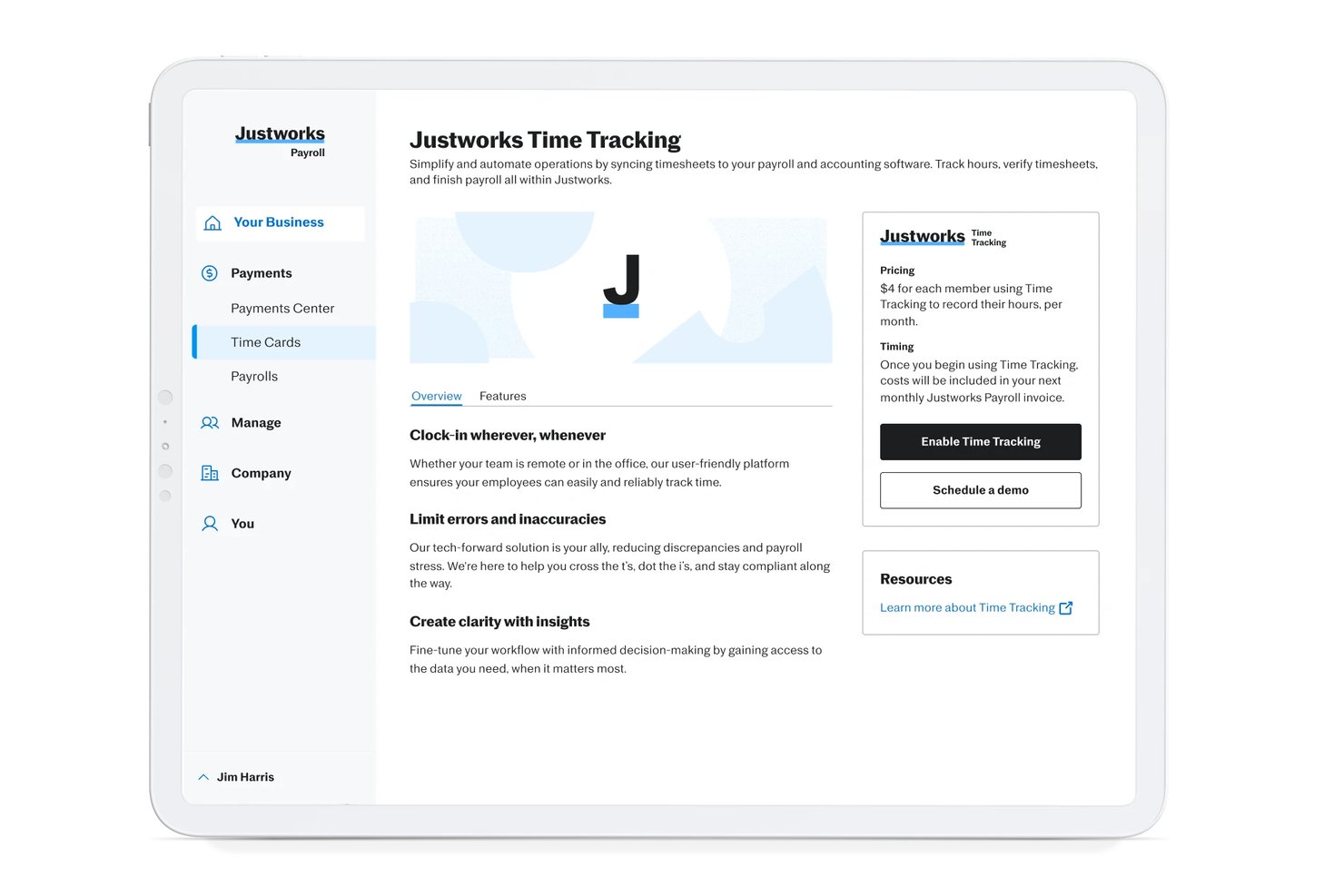
Justworks is an employer of record (EOR) platform designed for tech startups that need bundled payroll, HR management, and benefits administration during global expansion.
Who Is Justworks Best For?
Growing tech startups looking to manage payroll, benefits, and HR compliance as they expand across multiple regions.
Why I Picked Justworks
I picked Justworks as one of the best because it combines payroll, HR, and benefits in a single package. I’m able to manage health insurance, payroll processing, and compliance all in one system when hiring for tech startups.
Justworks Key Features
- EOR international hiring: Lets you hire and pay employees in multiple countries using a single platform.
- Integrated time tracking: Tracks employee hours and syncs directly with payroll for accurate payments.
- On-demand HR support: Provides access to HR experts for compliance and policy questions.
- Automated tax filings: Calculates and files federal, state, and local payroll taxes automatically.
Justworks Integrations
Native integrations are not clearly documented. The platform provides an API for custom integrations.
Pros and Cons
Pros:
- Compliance support for multi-region hiring
- Responsive, highly rated customer support
- Bundled payroll and benefits administration
Cons:
- Few native third-party software integrations
- Limited advanced HR analytics capabilities

G-P
Best for enterprise-grade global compliance at scale
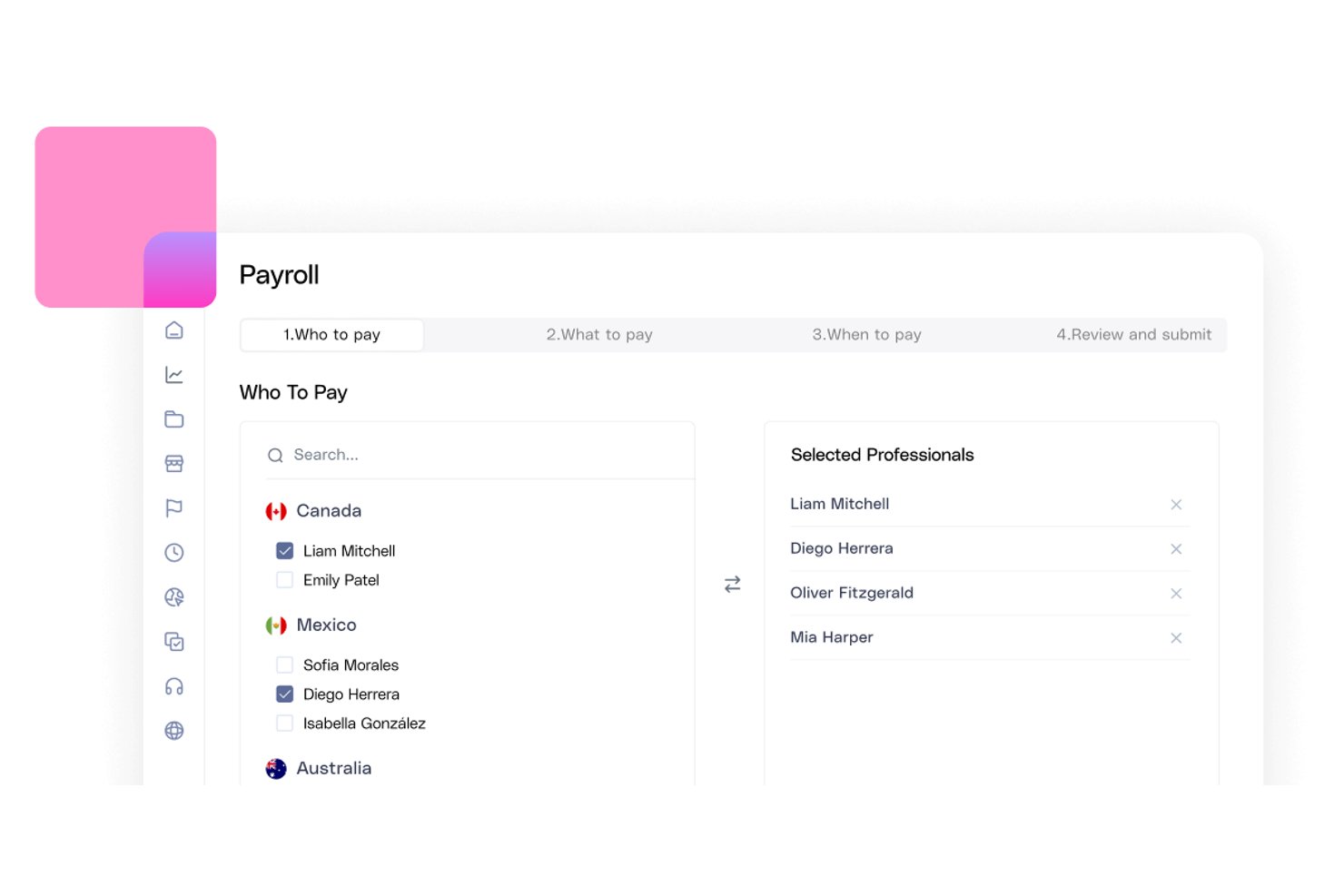
G-P is an employer of record platform built on a global network of 100+ wholly owned legal entities, offering compliant hiring, automated payroll, benefits administration, and contractor management across 180+ countries.
Who Is G-P Best For?
G-P is a strong fit for scaling startups and growth-stage tech companies that need airtight compliance across multiple countries without building local legal entities.
Why I Picked G-P
G-P earns its spot on my shortlist because it's the only EOR built on 100+ wholly owned legal entities across 180+ countries, meaning your employment contracts, payroll, and terminations never route through a third-party partner. I especially like the Global Compliance Engine, which auto-generates locally compliant contracts in roughly eight minutes, and G-P Gia™, an AI agent trained on 100,000+ vetted legal articles that flags regulatory changes before they become your problem. For scale-up tech teams hiring across Germany, Japan, and Brazil simultaneously, that compliance depth is genuinely hard to replicate.
G-P Key Features
- Bulk onboarding: Onboard multiple employees across countries simultaneously, reducing HR task volume by over 40% with 25% fewer required data fields.
- G-P Contractor™: Manage contractors in 190+ countries with AI-powered misclassification checks in 40+ countries and instant payments via Wise in 50+ currencies.
- HCM integrations: Connect G-P directly to Workday, BambooHR, HiBob, Personio, and SAP SuccessFactors through native out-of-the-box integrations.
- Equity payroll management: Handle cross-border payroll for equity events and stock option administration as an add-on to the core EOR platform.
G-P Integrations
G-P offers native integrations with BambooHR, HiBob, Personio, Workday, Google Workspace, Microsoft Entra ID, and Okta, plus an open API for custom integrations.
Pros and Cons
Pros:
- Dedicated customer success with deep HR expertise
- Globally compliant contracts generated in minutes
- Coverage in 180+ countries with owned entities
Cons:
- Requires sales contact for transparent pricing
- Real-world onboarding is slower than peers
Best for fast global hiring without local entities
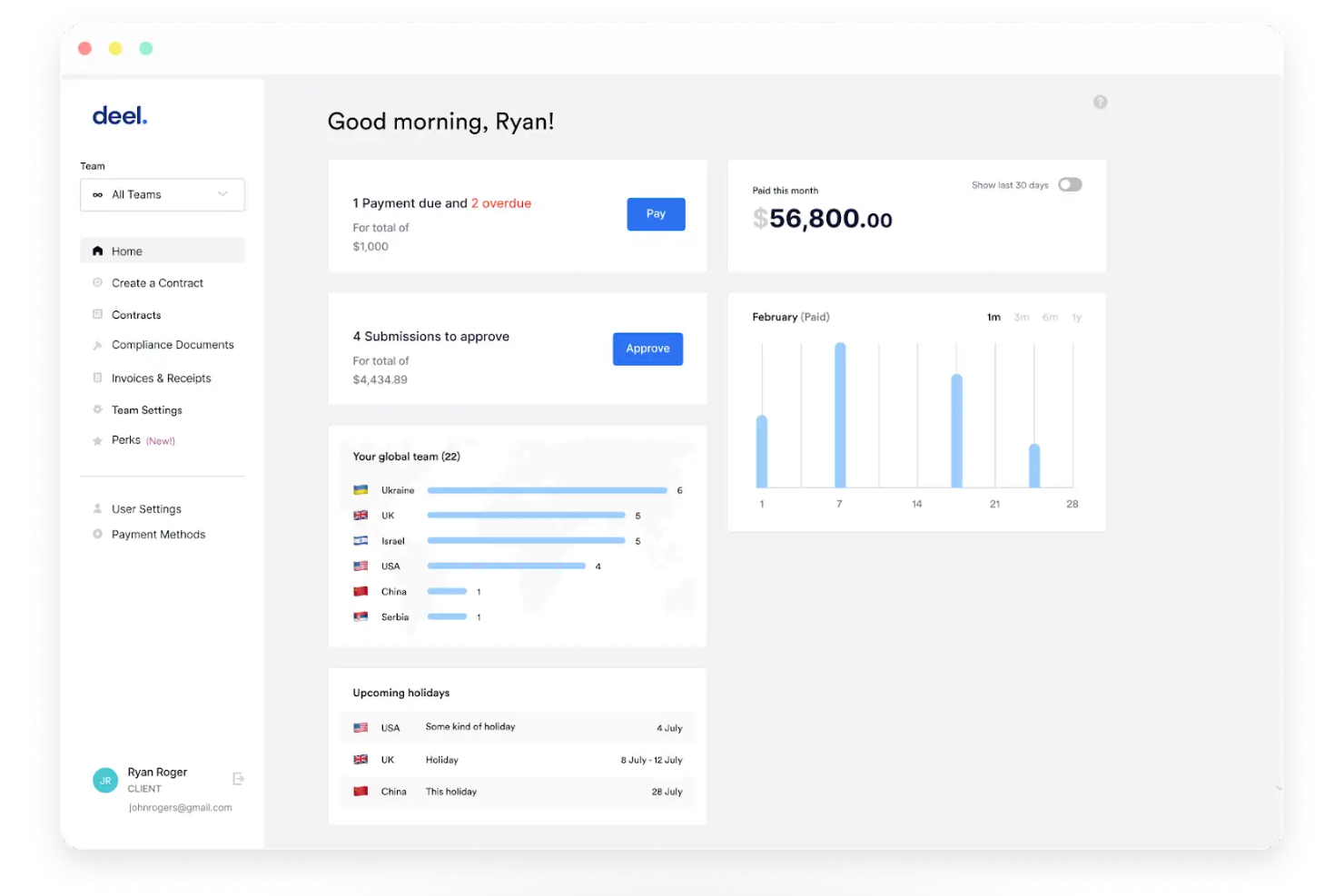
Deel is a strong fit for early-stage and scaling tech startups that need to hire international employees quickly while staying compliant, without opening local subsidiaries.
Who Is Deel Hire Best For?
Deel Hire is a strong fit for early-stage and scaling tech startups that need to hire international talent without setting up local legal entities.
Why I Picked Deel Hire
I picked Deel because of how quickly startups can move from candidate selection to compliant onboarding. Once you input a hire’s details, the platform generates a localized employment agreement and sets up payroll within the same workflow. For tech startups competing for global talent, reducing administrative lag can make a real difference in closing offers. Deel also handles compliance across 150+ countries, removing the need to establish local legal entities during early expansion.
Deel Hire Key Features
- Localized contract generation: Create employment agreements aligned with country-specific labor laws.
- Worker classification assessment: Evaluate employee vs. contractor status to reduce misclassification risk.
- Multi-country payroll: Run payroll in local currencies across Deel’s global infrastructure.
- Equity guidance support: Manage global equity considerations for distributed teams.
- Offboarding management: Handle terminations and severance in line with local regulations.
Deel Hire Integrations
Integrations include Greenhouse, BambooHR, Workday, HiBob, Ashby, Expensify, NetSuite, and QuickBooks. Zapier connectivity and API access are available for custom integrations.
Pros and Cons
Pros:
- Integrated payroll and compliance management
- Strong global coverage for startup expansion
- Fast contract generation and onboarding workflows
Cons:
- Customer support experience can vary by region
- Pricing may be high for very early-stage startups

Best for indemnification-backed hiring
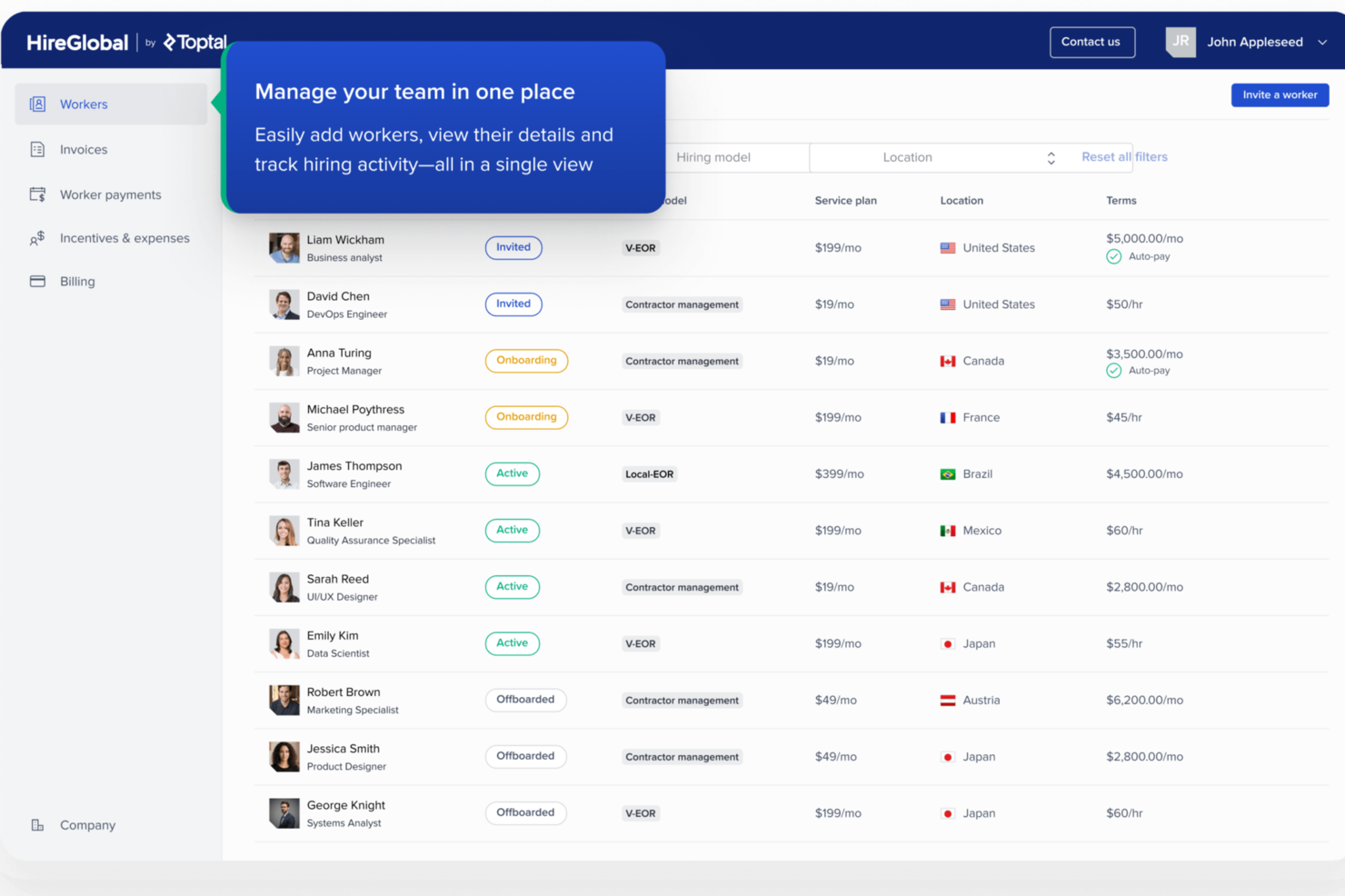
HireGlobal is Toptal's employer of record platform for hiring, onboarding, and paying employees and contractors across 180+ countries, with a virtual EOR model, built-in HRIS, and multi-currency payroll support.
Who Is HireGlobal Best For?
HireGlobal is a strong fit for early-stage and scaling tech startups that need to hire international talent quickly without setting up legal entities abroad.
Why I Picked HireGlobal
I've included HireGlobal in my top picks because its built-in HRIS consolidates onboarding, contracts, payroll, and compliance into one platform, which means your HR team isn't bouncing between disconnected tools to manage a global workforce. Rather than relying on a patchwork of separate systems, HireGlobal's centralized dashboard lets you track worker status, manage documents, and approve payments all in one place. I also like that it surfaces consolidated invoicing across your entire workforce, so finance and HR are always working from the same data without manual reconciliation.
HireGlobal Key Features
- Virtual EOR model: Hire full-time employees in 180+ countries without setting up a local legal entity, backed by $1M indemnification per worker.
- Multi-currency payroll: Pay workers across 50+ currencies from a single platform, with payments processed in local currency.
- Contractor management: Onboard and pay contractors under an Agent of Record model alongside full-time EOR employees.
- Background check services: Run pre-employment background checks directly within the platform before finalizing a new hire.
HireGlobal Integrations
Native integrations are not clearly documented for HireGlobal. The platform does integrate with TopTracker, Toptal's time tracking tool, for end-to-end time tracking, invoice approval, and contractor payments. API and Zapier support are not clearly available at this time.
Pros and Cons
Pros:
- Lower EOR pricing than competitors
- $1M indemnification per worker included
- Backed by Toptal's 12+ years of infrastructure
Cons:
- Newer EOR with fewer user reviews
- Limited third-party native integrations available

Best for managing equity and ESOPs
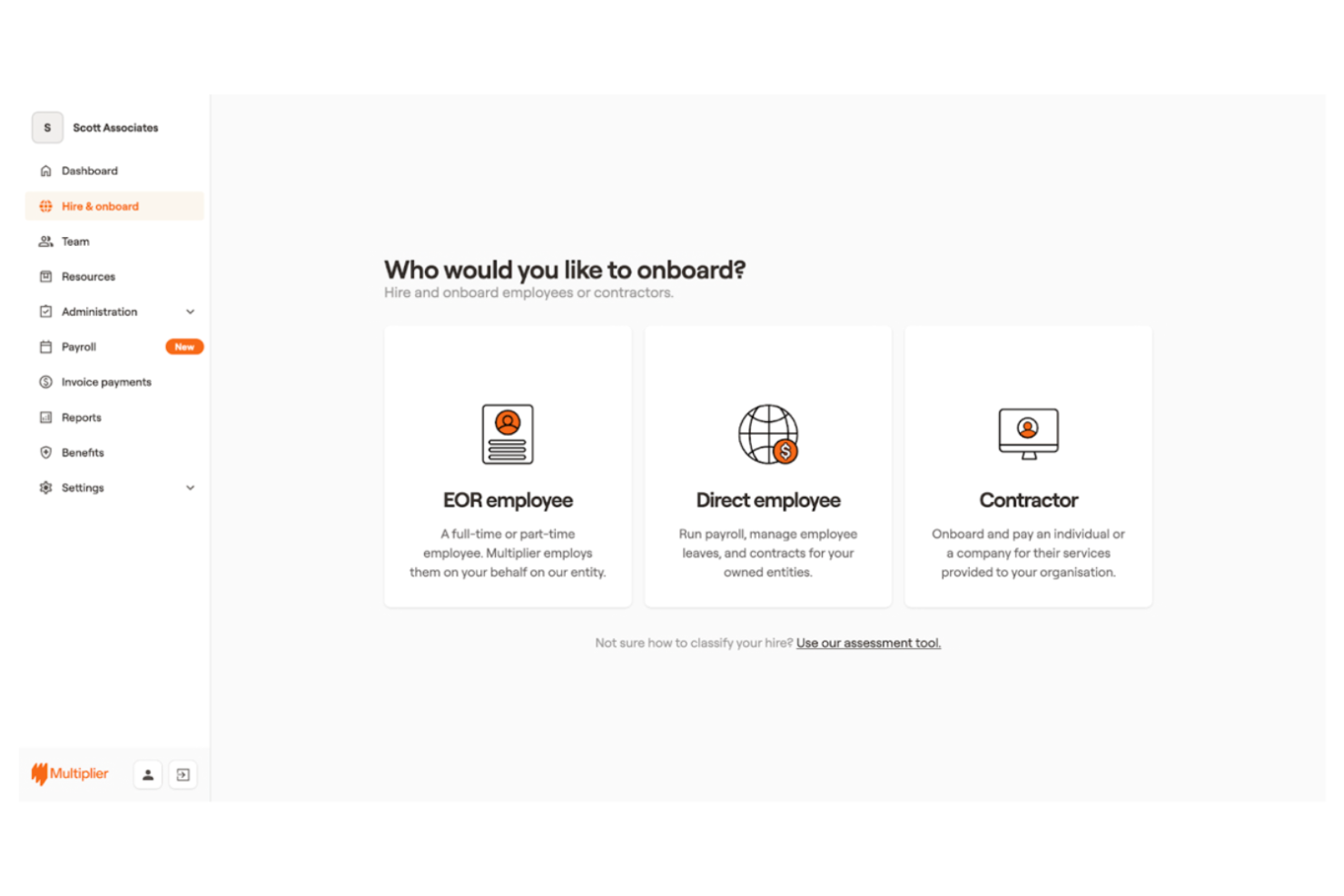
Multiplier is an employer of record platform designed for tech startups to handle global hiring, payroll, compliance, and contractor management with tools built for complex equity and workforce needs.
Who Is Multiplier Best For?
Multiplier suits startups and scale-ups in the tech industry that need to manage employee equity and ESOPs across multiple countries.
Why I Picked Multiplier
I picked Multiplier as one of the best because it gives my team dedicated modules for managing equity and ESOPs alongside standard EOR processes. We use the built-in tools to issue, track, and administer stock options for international hires without legal gaps. I also rely on its automated compliance for global equity distribution to avoid missteps in different markets.
Multiplier Key Features
- Multi-country payroll: Run payroll across over 150 countries within a unified dashboard.
- Automated tax compliance: Handles tax calculations, filings, and required deductions in each supported country.
- Localized employment contracts: Generate compliant, country-specific employment agreements in minutes.
- Expense management: Lets you approve and manage team member expenses in one place.
Multiplier Integrations
Integrations include HiBob, BambooHR, Workday, Deel, and more.
Pros and Cons
Pros:
- Payroll processing in over 150 countries
- Automated tax compliance for multiple countries
- Localized contracts for niche tech markets
Cons:
- Lacks advanced analytics or dashboards
- No out-of-the-box reporting for equity plans

Best for global employee onboarding
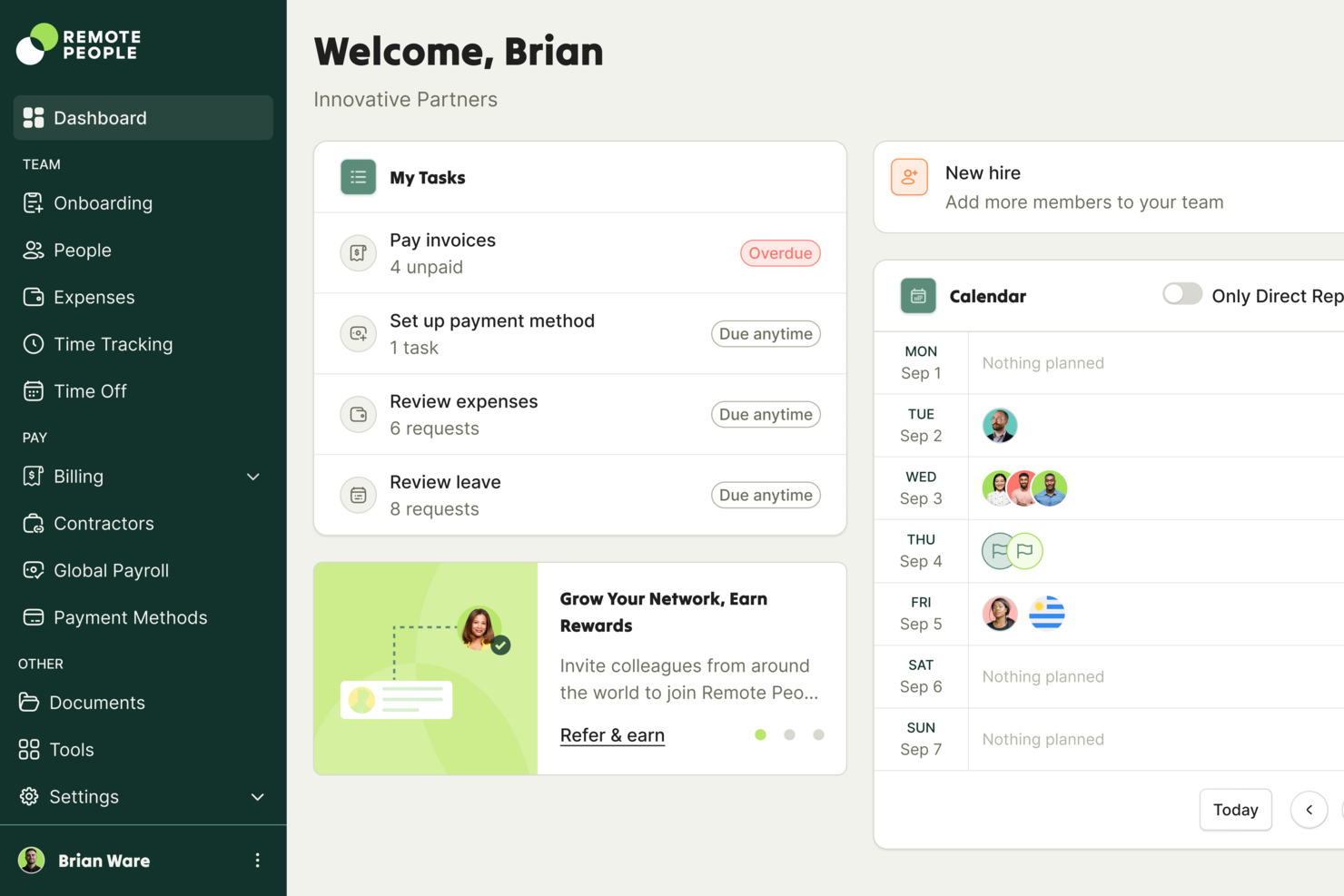
RemotePeople is an employer of record (EOR) platform for tech startups that supports global hiring, payroll, benefits administration, and compliance management across multiple countries.
Who Is RemotePeople Best For?
RemotePeople is a strong fit for early-stage and scaling tech startups that need to hire internationally without setting up local legal entities.
Why I Picked RemotePeople
I've included RemotePeople in my top picks because it delivers on something most EOR platforms promise but rarely execute: getting new hires actually working in 48 hours. When a tech startup locks in a critical engineering hire in Germany or Singapore, waiting weeks for contracts and payroll setup isn't an option. RemotePeople handles local contracts and onboarding within 24 to 48 hours, backed by owned entities and in-country HR specialists rather than third-party partners. I also like that the recruit-and-hire option pairs in-house recruiters with the EOR layer, so you can go from candidate selection to a fully onboarded employee without switching tools or vendors.
RemotePeople Key Features
- Global payroll management: Run payroll across multiple countries from a single dashboard, with taxes, deductions, and statutory filings handled per jurisdiction each pay cycle.
- Contractor management: Generate locally compliant contracts, collect tax documents (W-8, W-9, and local equivalents), and pay contractors in 120+ currencies through local payment rails.
- Visa and relocation support: Handle work permits, visa applications, embassy scheduling, and housing support end to end across 80+ countries.
- Background checks: Run employee background screening across 150+ countries, built directly into the hiring workflow.
RemotePeople Integrations
Native integrations are not clearly documented. RemotePeople provides an API for custom integrations.
Pros and Cons
Pros:
- Supports GDPR-ready employee data management
- Multilingual legal document generation automated
- Onboarding workflow reduces hiring setup times
Cons:
- Some roles require manual compliance review
- Fewer self-service features for employees
Best for direct-entity compliance at scale
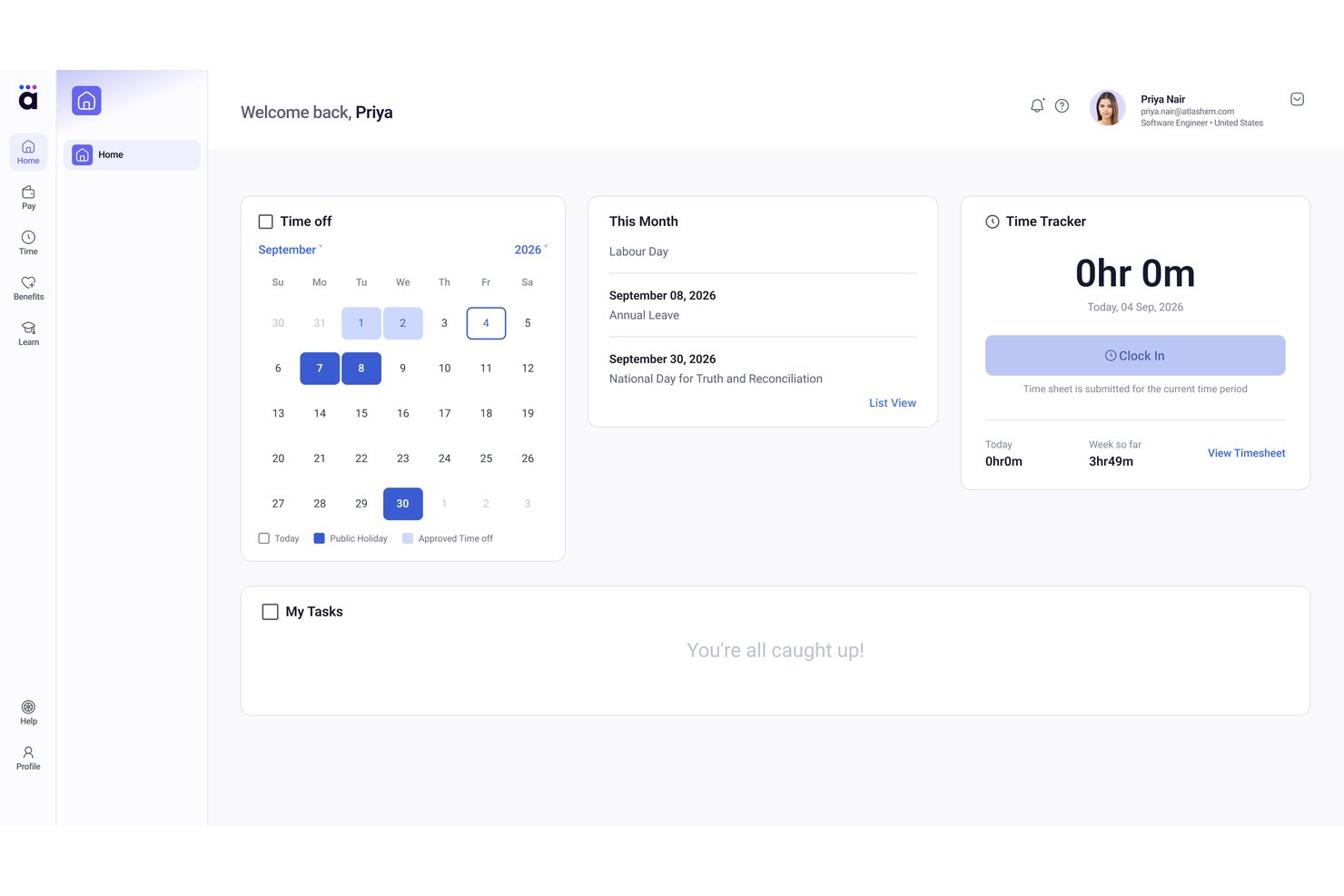
Atlas HXM is an employer of record platform that manages international hiring, local entity compliance, payroll, and contractor management across 160+ countries through its own legal entities.
Who Is Atlas HXM Best For?
Atlas HXM suits scaling tech companies that need to hire across multiple countries without relying on third-party entities for compliance.
Why I Picked Atlas HXM
Atlas HXM earns its spot on my shortlist because it operates through its own legal entities in 160+ countries, meaning there's no third-party intermediary handling compliance on your behalf. For a tech startup scaling across multiple markets fast, that matters: Atlas directly employs your hires, so local labor law adherence, payroll, and benefits aren't outsourced to a partner network. I particularly like its built-in entity infrastructure for managing multi-country hiring from a single platform without the legal exposure that comes with patchwork EOR arrangements.
Atlas HXM Key Features
- Contractor management: A built-in module for onboarding, paying, and managing independent contractors alongside full-time employees across 160+ countries.
- Global payroll processing: Atlas runs payroll in local currencies with built-in tax calculations and statutory deductions handled through its own entities.
- Benefits administration: Country-specific benefits packages are configured and administered directly within the platform to meet local statutory requirements.
- Employee self-service portal: Employees can access pay stubs, documents, and personal information through a dedicated portal without going through HR.
Atlas HXM Integrations
Atlas HXM offers Atlas Connect, a RESTful API for custom integrations with your HR and business systems. Specific native integrations are not clearly documented.
Pros and Cons
Pros:
- Employees access payslips and documents independently
- Covers 160+ countries under one provider
- Direct entities reduce partner handoffs
Cons:
- Premium costs can strain startup budgets
- Some reviewers report payroll and paperwork delays


Gloroots is a global employer of record platform for tech startups that centralizes onboarding, employee management, local payroll, contractor payments, and compliance monitoring across international teams.
Who Is Gloroots Best For?
HR teams at early-stage tech companies that need flexible onboarding for a globally distributed workforce.
Why I Picked Gloroots
I picked Gloroots as one of the best for tech startups because I can design country-specific onboarding workflows and automate document collection for each new hire. My team is able to personalize onboarding steps, set role-based assignment tasks, and manage cross-border compliance from a single dashboard.
I also like having employee self-service onboarding so remote hires can get started without bottlenecks.
Gloroots Key Features
- Real-time compliance monitoring: Tracks employment law changes across supported countries.
- Global payroll processing: Handles multi-currency payroll and statutory deductions automatically.
- Contractor management tools: Manages onboarding, document storage, and payments for international contractors.
- Document e-signature: Supports digital contract signing and secure storage for HR files.
Gloroots Integrations
Native integrations are not publicly documented.
Pros and Cons
Pros:
- Direct cryptocurrency options for contractor payments
- Built-in employee misclassification risk calculator
- Integrated talent sourcing and recruitment assistance
Cons:
- No support for US domestic payroll
- Missing public per-country rate card

Rippling
Best for unified global HR and payroll automation
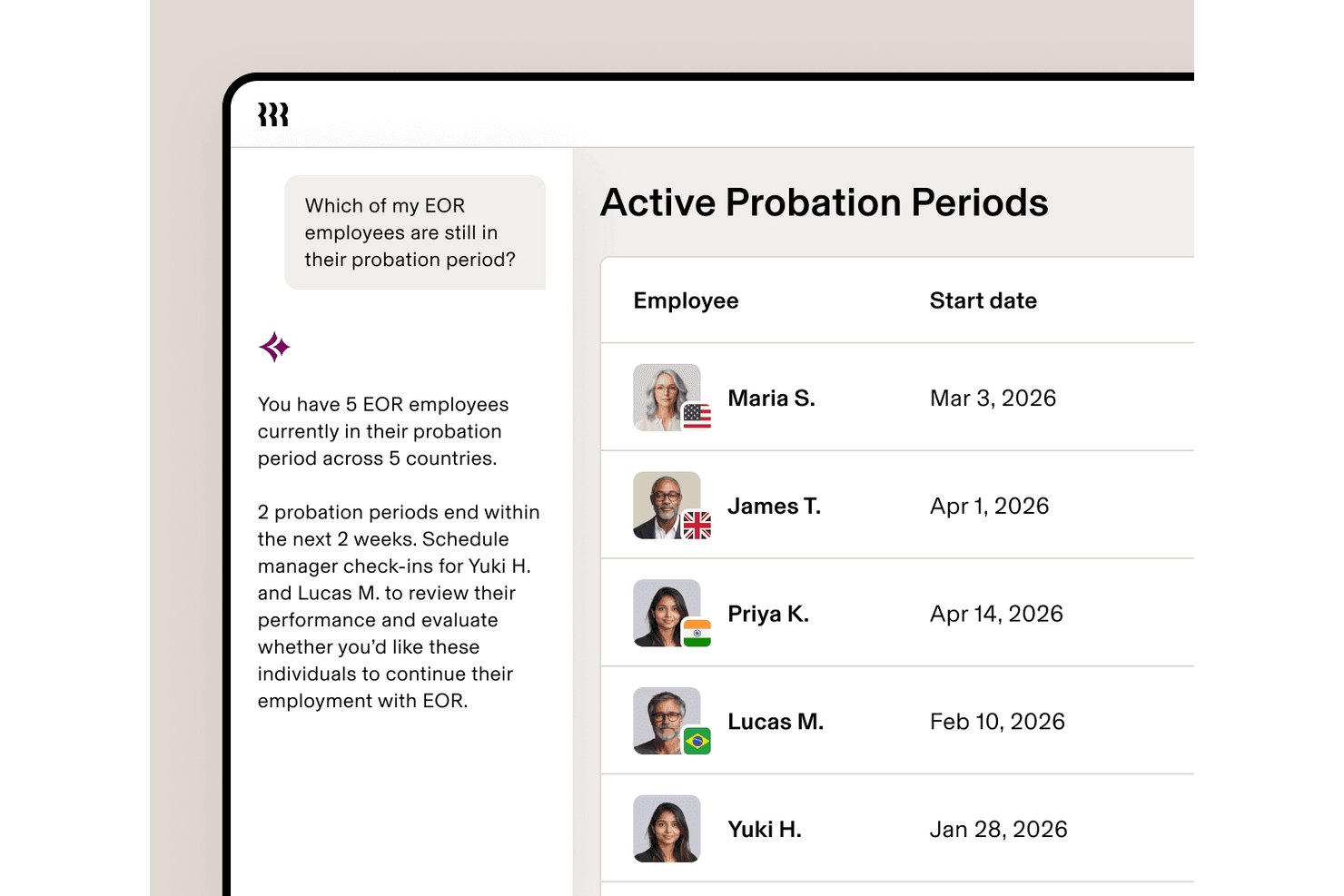
Rippling is a workforce management platform that combines EOR services, global payroll, HRIS, and IT provisioning across 80+ countries in a single connected system.
Who Is Rippling Best For?
Rippling fits scaling tech startups (roughly 20–500 employees) that need HR, IT, and global payroll managed in one place as they expand internationally.
Why I Picked Rippling
I picked Rippling as one of the best because no other EOR platform natively handles IT provisioning alongside hiring. When I add a new engineer in Brazil, Rippling ships and configures their laptop with MDM enrollment from the same onboarding workflow that sets up payroll, benefits, and app access. I also like the entity conversion feature: if my startup later establishes a local entity, Rippling migrates EOR employees to direct hires without re-onboarding them from scratch.
Rippling Key Features
- Automated local contract generation: Instantly creates country-specific, compliant employment agreements with built-in data privacy protections.
- Global benefits administration: Provides health, retirement, and PTO administration tailored to each country’s laws and practices.
- Integrated multi-currency payroll: Calculates, files, and remits taxes and salaries in 50+ currencies and 185+ countries from a single workflow.
- Contractor management tools: Supports payments, compliance checks, and conversions from contractor to full-time international employee.
Rippling Integrations
Rippling offers native integrations with QuickBooks, Xero, GitHub, Slack, Google Workspace, Azure Active Directory, Okta, Jira, Salesforce, and Zoom. An API is available for custom integrations.
Pros and Cons
Pros:
- Native MDM handles global device management too
- Fast automated onboarding across multiple countries
- Unified HR, IT, and payroll in one platform
Cons:
- Support quality varies by country and region
- EOR coverage relies on third-party partners
New Product Updates from Rippling

Rippling Expands Automated Compliance With AI Workflows
Rippling expands Automated Compliance with multi-framework support, AI workflows, an audit portal, and trust centers. These updates help GRC teams manage compliance work and audits. For more information, visit Rippling’s official site.

Remote
Best for IP protection during investor due diligence
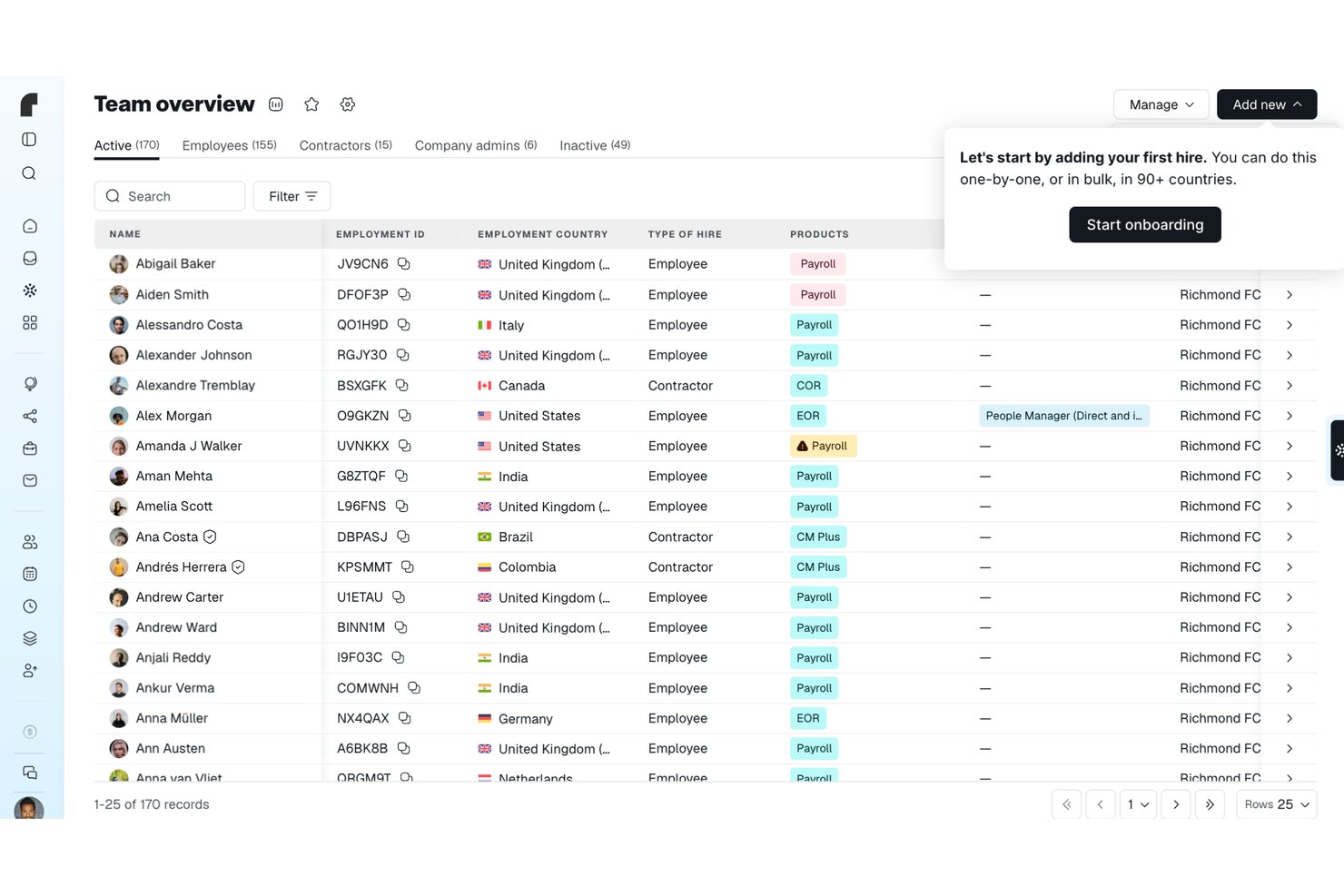
Remote is an employer of record and contractor management provider that covers international hiring, global payroll, and IP ownership assignment across countries.
Who Is Remote Best For?
Remote is a strong fit for tech startups preparing for funding rounds that need airtight IP assignment across international hires.
Why I Picked Remote
I've included Remote in my top picks because its IP ownership assignment capabilities are genuinely built for startups approaching a funding round. Remote automatically assigns intellectual property rights to the employing entity at the point of hire, which means investor due diligence doesn't uncover gaps in IP ownership across your international team. I also like that this works alongside its employer of record and contractor management products, so you're covering both employees and freelancers in one place.
Remote Key Features
- Stock option management: Remote supports equity and stock option grants for international employees, helping startups extend consistent compensation packages across borders.
- Localized employment contracts: Remote generates compliant, country-specific employment contracts that reflect local labor laws at the point of hire.
- Multi-currency payroll: Remote processes payroll in local currencies across multiple countries, removing the need for manual currency conversions or third-party transfers.
- Benefits administration: Remote provides access to locally relevant benefits packages for international hires, covering health, pension, and statutory entitlements by country.
Remote Integrations
Remote lists integrations with BambooHR, Carta, Greenhouse, QuickBooks, Xero, Slack, and Workday. It also offers an API for custom connections and Zapier.
Pros and Cons
Pros:
- Localized contracts support compliant expansion
- EOR and contractor hiring under one provider
- Automatic IP assignment supports investor diligence
Cons:
- Urgent support escalation can be slow
- Users report high overall costs
Andre EOR-løsninger for teknologistartups
Her er noen flere EOR-løsninger for teknologistartups som ikke kom med på kortlisten min, men som likevel er verdt å se nærmere på:
- Oyster HR
For hiring globally with built-in equity support
- Native Teams
With dedicated employee expense cards
- Mercans
For analyst-recognized payroll accuracy
- RemoFirst
For affordable per-employee rates
- Safeguard Global
For deep local market intelligence
- Payoneer Workforce Management
For Payoneer-backed cross-border pay
- Playroll
For predictable per-hire monthly pricing
- WorkMotion
For European market expansion
- Pebl
For contractor-to-EOR conversion at funding time
- Teamed
For contractor misclassification protection
- Papaya
For global equity and payroll in one view


How I Evaluate EOR for Tech Startups
I split my evaluation into three parts, weighting core functionality most: legally employ hires abroad and manage local labor and tax rules. Then I look for standout features such as equity support and contractor-to-EOR conversion. Finally, I consider beyond-feature factors like responsive support, onboarding help, and transparent pricing as hiring scales.
Core Functionality (Table Stakes For This List)
When I'm selecting tools for my list, I score each one on a scale from 0 (does not offer the functionality) to 5 (excels in this area) for each core functionality listed below. I then convert the total into a percentage to help assess each tool's overall fit, with extra weight on any functionalities I’ve deemed essential.
- Legal Employment (Essential): I check whether the provider employs workers on your behalf in each hiring country and clearly assumes employer responsibilities.
- Local Compliance (Essential): I look for country-specific labor, tax, and statutory guidance that supports compliant hiring as your team expands.
- Global Payroll: I assess whether payroll runs across countries in local currencies, with clear processes for resolving pay discrepancies.
- Local Benefits: I consider how the provider sources and administers benefits that fit local expectations, such as health coverage and retirement plans.
- Onboarding Workflows: I look for self-service steps that help a new international engineering hire complete paperwork and get ready to work promptly.
- Employment Contracts: I evaluate whether contracts reflect local requirements and can be generated and managed for hires in different countries.
Once I have a list of tools that meet the criteria, I consider what sets each platform apart.
Differentiating Factors (What Sets Vendors Apart)
Here's how I compare and contrast different vendors:
Standout Features
I evaluate how each platform handles equity and stock option administration across jurisdictions, since startups competing for engineers often lean on equity when cash is tight. Contractor-to-EOR conversion matters just as much—I check whether a provider can move an existing contractor to full-time status without gaps in work or compliance. I also look at API and HRIS integrations, particularly with tools like Slack and Jira that most engineering teams already use daily.
Beyond Features
I look for flat per-employee pricing so early-stage teams can forecast headcount costs without surprises from hidden contract-amendment or termination fees. Termination guidance matters just as much—providers that calculate severance and map notice-period rules help you avoid costly missteps during layoffs or restructuring. I also check whether the platform holds SOC 2 or ISO 27001 certification, since clean audit trails and compliance records come up fast during investor due diligence.
Slik velger du EOR for teknologistartups
Det er lett å gå seg vill i lange funksjonslister og kompliserte prisstrukturer. For å hjelpe deg med å holde fokus mens du arbeider deg gjennom den unike prosessen med å velge programvare, får du her en sjekkliste over faktorer du bør ha i tankene:
| Faktor | Hva du bør vurdere |
|---|---|
| Skalerbarhet | Vil EOR-løsningen støtte vekstplanene dine, fra en håndfull til hundrevis av globale ansettelser, uten kraftige prisøkninger? |
| Integrasjoner | Hvilke HR-, lønns- og regnskapsverktøy kobler den seg til? Se etter innebygd støtte for systemene du allerede bruker. |
| Tilpasningsmuligheter | Kan du tilpasse arbeidsflyter, godkjenningsprosesser og rapportering slik at de passer teamets struktur og behov for etterlevelse? |
| Brukervennlighet | Er grensesnittet tydelig og tilgjengelig for personer uten spesialisert HR- eller juridisk kompetanse? |
| Implementering og innfasing | Hvor raskt kan du komme i gang? Se etter tydelig støtte ved migrering, dedikert hjelp med innfasing og eventuelle skjulte trinn. |
| Kostnad | Hva er de totale månedlige/årlige kostnadene, inkludert oppsett, løpende kostnader og avgifter per ansatt? Gå gjennom vilkårene for variable kostnader. |
| Sikkerhetstiltak | Tilbyr leverandøren støtte for GDPR, kryptering og regelmessige sikkerhetsrevisjoner for å holde sensitive HR- og lønnsdata trygge? |
| Krav til etterlevelse | Vil plattformen holde tritt med utviklingen innen arbeidsrettslige regler på stedene der du ønsker å ansette – særlig for fjernarbeidende eller grensekryssende team? |
Hva er EOR for teknologistartups?
EOR-løsninger for teknologistartups fungerer som den juridiske arbeidsgiveren for det fjernarbeidende eller distribuerte teamet ditt og håndterer lønn, fordeler, skatter og etterlevelse på dine vegne.
Disse løsningene lar deg ansette raskt i nye regioner uten å opprette lokale virksomheter, samtidig som de reduserer risikoen og den administrative byrden når du skalerer opp startupen din.
Funksjoner
Når du velger EOR for teknologistartups, bør du se etter følgende viktige funksjoner:
- Global lønnshåndtering: Håndterer all lønnsbehandling for ansatte i forskjellige land, inkludert skatter, fradrag og valutaomregning.
- Administrasjon av ansattgoder: Administrerer tilgang til helseforsikring, pensjonsordninger og andre goder, og sørger for lokal etterlevelse og konkurransedyktige tilbud.
- Etterlevelse av arbeidsavtaler: Utarbeider og vedlikeholder arbeidsavtaler som er i samsvar med lovkravene og oppdateringene i hvert enkelt land.
- Støtte ved onboarding og offboarding: Veileder nyansatte og ansatte som slutter, gjennom alle relevante HR-trinn, all dokumentasjon og lovpålagte krav.
- HR- og dokumenthåndtering: Sentraliserer personalopplysninger, avtaler, onboarding-dokumenter og dokumentasjon for etterlevelse i et sikkert digitalt miljø.
- Registrering av fridager og permisjoner: Registrerer ferie, sykefravær og lovpålagte permisjoner i henhold til arbeidslovgivningen i hver region.
- Skattetrekk i flere land: Beregner og innbetaler arbeidsgiveravgift og andre lønnsskatter til lokale myndigheter på vegne av både selskapet og de ansatte.
- Begrensning av juridisk risiko: Overvåker regelverksendringer og oppdaterer interne prosesser for å hjelpe oppstartsbedriften med å unngå bøter eller rettstvister.
- Selvbetjeningsportal for ansatte: Lar ansatte få tilgang til lønnsslipper, informasjon om ansattgoder og skattedokumenter samt administrere personopplysninger direkte.
- Støtte ved overgang fra oppdragstaker til ansatt: Forenkler overgangen for frilansere eller oppdragstakere som ønsker å bli heltidsansatte, med praksis som er i samsvar med regelverket.
Fordeler
Implementering av EOR for teknologistartups gir flere fordeler for teamet og virksomheten din. Her er noen av fordelene du kan se frem til:
- Raskere markedsekspansjon: Ansett medarbeidere i nye land uten forsinkelsen ved å etablere lokale selskaper, takket være infrastruktur for ansettelser og lønn som er i samsvar med regelverket.
- Redusert risiko og bedre etterlevelse: Hold deg oppdatert på lokale arbeidslover, skattekrav og ansattes rettigheter, og minimer den juridiske eksponeringen etter hvert som virksomheten vokser.
- Forenklet HR-drift: Sentraliser lønn, ansattgoder og dokumenthåndtering, slik at det lille HR-teamet ditt kan fokusere på talentutvikling.
- Tiltrekning av de beste talentene: Tilby konkurransedyktige ansattgoder og en profesjonelt administrert ansettelsesopplevelse som appellerer til kvalifiserte kandidater over hele verden.
- Besparelser på administrasjon: Reduser driftskostnadene ved å la EOR-leverandøren håndtere skatter, avtaler og lønn i stedet for å bygge en global HR-avdeling internt.
- Større fleksibilitet ved endringer i arbeidsstyrken: Gjør det enkelt å konvertere oppdragstakere til ansatte eller ansette på tvers av ulike regioner etter hvert som ansettelsesbehovene endrer seg.
- Enhetlig medarbeideropplevelse: Lever standardisert onboarding, tilgang til ansattgoder og lønnsbehandling for alle teammedlemmer – uavhengig av hvor de befinner seg.
Kostnader og priser
Valg av EOR for teknologistartups krever en forståelse av de ulike prismodellene og planene som er tilgjengelige. Kostnadene varierer basert på funksjoner, teamstørrelse, tilleggstjenester og mer. Tabellen nedenfor oppsummerer vanlige planer, gjennomsnittsprisene deres og typiske funksjoner som inngår i EOR-løsninger for teknologistartups:
Sammenligningstabell for EOR for teknologistartups
| Plantype | Gjennomsnittspris | Vanlige funksjoner |
|---|---|---|
| Gratisplan | $0 | Begrensede HR-ressurser, grunnleggende veiledninger for etterlevelse og brukerstøtte via e-post. |
| Personlig plan | $200-$400/ansatt/mnd | Lønnsbehandling, grunnleggende etterlevelse av avtaler, dokumentlagring og enkle brukerstøttealternativer. |
| Bedriftsplan | $400-$600/ansatt/mnd | Regionale ansattgodspakker, onboarding-tjenester, registrering av permisjoner, lokal skattehjelp og kundestøtte i sanntid. |
| Plan for store virksomheter | $600-$900/ansatt/mnd | Lønnsbehandling i flere land, avansert overvåking av etterlevelse, tilpassede ansattgoder, dedikerte kundeansvarlige og API-tilgang. |
Vanlige spørsmål om EOR for teknologistartups
Her er noen svar på vanlige spørsmål om EOR for teknologistartups:
Hvordan håndterer en EOR overføring av IP ved arbeidsforholdets slutt?
En EOR håndterer overføring av IP for teknologistartups ved å inkludere overdragelse av IP i arbeidsavtalen fra første dag. Dette sikrer at all kode, produktfunksjonalitet eller teknisk arbeid som utvikles av den ansatte, juridisk eies av startupen din, noen ganger gjennom en overdragelse fra EOR-en. Derfor er det vanligvis ikke nødvendig med en separat overføring av IP når arbeidsforholdet avsluttes.
Når arbeidsforholdet avsluttes, kan EOR-en bistå med ytterligere dokumentasjon dersom det kreves i enkelte land, og sørger for at all kode, alle påloggingsopplysninger og selskapets eiendeler leveres tilbake. Dette er særlig viktig for startups, der det er avgjørende å beskytte proprietær teknologi og IP knyttet til produkter på tvers av ulike jurisdiksjoner.
Kan EOR hjelpe teknologistartupen min med å ansette medarbeidere i flere land?
Ja, EOR-tjenester gjør det mulig for startupen din å ansette globalt talent i land der dere ikke har en egen juridisk enhet. EOR-en fungerer som juridisk arbeidsgiver og håndterer internasjonale ansettelser og arbeidstillatelser, slik at du kan fokusere på global ekspansjon og på å bygge det distribuerte teamet ditt gjennom en spesialisert EOR-plattform.
Hvor lang tid tar det å ta imot en ny medarbeider gjennom en EOR?
De fleste EOR-tjenesteleverandører kan ta imot medarbeidere raskt, og sørger ofte for at de er klare til å arbeide fra første dag. Hvor lang tid det tar å få tilgang til talent, avhenger av skattereglene i landet og hvor raskt bakgrunnssjekker fullføres og dokumenter verifiseres av det juridiske teamet.
Hva er forskjellen mellom EOR- og PEO-tjenester?
En EOR-løsning fungerer som juridisk arbeidsgiver for den globale arbeidsstyrken din og håndterer alt fra kontrakter til etablering av juridiske enheter, mens en PEO vanligvis krever at du har en lokal juridisk enhet. For startups er riktig EOR en banebrytende løsning fordi den gir global dekning uten behov for kompleks infrastruktur, og gjør det kostnadseffektivt å administrere fjernarbeid.
Håndteres medarbeiderfordeler gjennom EOR-en eller selskapet mitt?
Medarbeiderfordeler håndteres av EOR-en, som bruker sin lokale ekspertise til å sikre full overholdelse av regionale lover. EOR-en tilbyr åpen prising på forhånd uten skjulte gebyrer og tar seg av registrering og administrasjon på dine vegne, slik at du enkelt får tilgang til internasjonalt talent.
Hvilke risikoer reduserer bruk av en EOR for startups?
Bruk av en EOR med dokumenterte resultater reduserer i stor grad risikoen knyttet til problemer med etterlevelse, lønnsoppgaver og feilklassifisering. Ved å håndtere kompleksiteten i lokale arbeidsmarkeder sørger EOR-en for at startupen din unngår juridisk eksponering samtidig som teamet skaleres på tvers av ulike jurisdiksjoner.