

10 Best Rippling Competitors of 2026

10 Best Rippling Competitors Shortlist


Rippling is a comprehensive platform that integrates HR, payroll, IT, and finance management, offering businesses a unified system to manage employee data, automate payroll, and streamline HR tasks.
While it's a well-known and worthwhile solution, it might not necessarily be the best for your specific needs.
In this article, I’ll walk you through my recommendations for the best Rippling competitors to manage your core HR functions within one system.
What is Rippling?
Rippling offers an all-in-one platform that integrates human resource management, financial and payroll software, and IT operations into one system.
It’s designed primarily for small and medium-sized businesses seeking to streamline their internal processes.
Rippling offers three distinct products—an HR Cloud, IT Cloud, and Finance Cloud— that cover a multitude of functions including recruiting, payroll, benefits administration, performance management, time and attendance, compliance, scheduling, and IT device management, among others.
Rippling’s appeal lies in the ability to centralize numerous administrative tasks into a single, cohesive system, helping businesses manage employee data and systems efficiently while ensuring compliance and improving overall operational workflows.
Why Use A Rippling Alternative?
Even though Rippling does have a lot to offer, there are several reasons why you might want to consider a Rippling competitor, including:
1. Can get expensive as you scale
Rippling starts off affordably, but costs rise quickly as you add modules (like IT, Finance, or Global Payroll).
If you're budget-conscious, it may end up being pricier than expected, however some users report being able to negotiate discounts for the first year.
2. Steep learning curve for admins
Because it’s highly customizable and covers a lot beyond HR, it can feel overwhelming for first-time users. You’ll likely need time (or support) to fully optimize it.
3. Not ideal for complex global entities (yet)
Rippling supports international hiring, but larger companies with complex legal structures or heavy compliance needs may find limitations. It’s still maturing compared to legacy enterprise tools.
4. Service and support can vary
Some users report delays or inconsistent help from customer support, especially during implementation as there's no support number, just a live chat. There If white-glove onboarding is a must, this could be a sticking point.
5. Still building out certain features
While Rippling moves fast, some features—like in-depth performance management, native LMS, or workforce planning—are lighter than dedicated tools. You might need add-ons or integrations.
With the above in mind, lets get into some Rippling alternative reviews!
Why Trust Our Software Reviews
Our team has been testing and reviewing software since 2012. As HR experts ourselves, we know how difficult—and important—it is to choose the right software.
For this guide, we evaluated tools using hands-on testing and independent research, scoring tools using our selection criteria. We also draw on insights from industry thought leaders and practicing HR experts.
Our reviews reflect our human editorial judgment, not a sales pitch.
Expert reviewers:
Rippling Competitors Pricing Comparison Table
This comparison table highlights pricing details for my top Rippling competitors to help you compare your options.
| Tool | Best For | Trial Info | Price | ||
|---|---|---|---|---|---|
| 1 | Best for direct employee HR data access | Not available | Pricing upon request | Website | |
| 2 | Best for global payroll and compliance | Free demo available | From $599/employee/month | Website | |
| 3 | Best for unified global workforce management | Free demo available | From $599/employee/month | Website | |
| 4 | Best for global recruitment solutions | Free demo available | From $199/employee/month | Website | |
| 5 | Best for customizable compensation planning | Free demo available | Pricing upon request | Website | |
| 6 | Best for benefits management and administration | Not available | From $599/employee/month | Website | |
| 7 | Best for unified reporting dashboards | Free demo available | From $459/user/month (billed annually) | Website | |
| 8 | Best for indemnification-backed hiring | Free demo available | From $399/employee/month | Website | |
| 9 | Best for global compliance handling | Free demo available | From $99/employee/month | Website | |
| 10 | Best for HR and IT management in Europe | Free demo available | From $8/user/month | Website |


Best Rippling Competitor Reviews
Below are in-depth summaries of my recommendations for the best Rippling competitors. I’ll cover their features, pros and cons, and best use cases to help you find the best fit for your needs.

Paycom
Best for direct employee HR data access
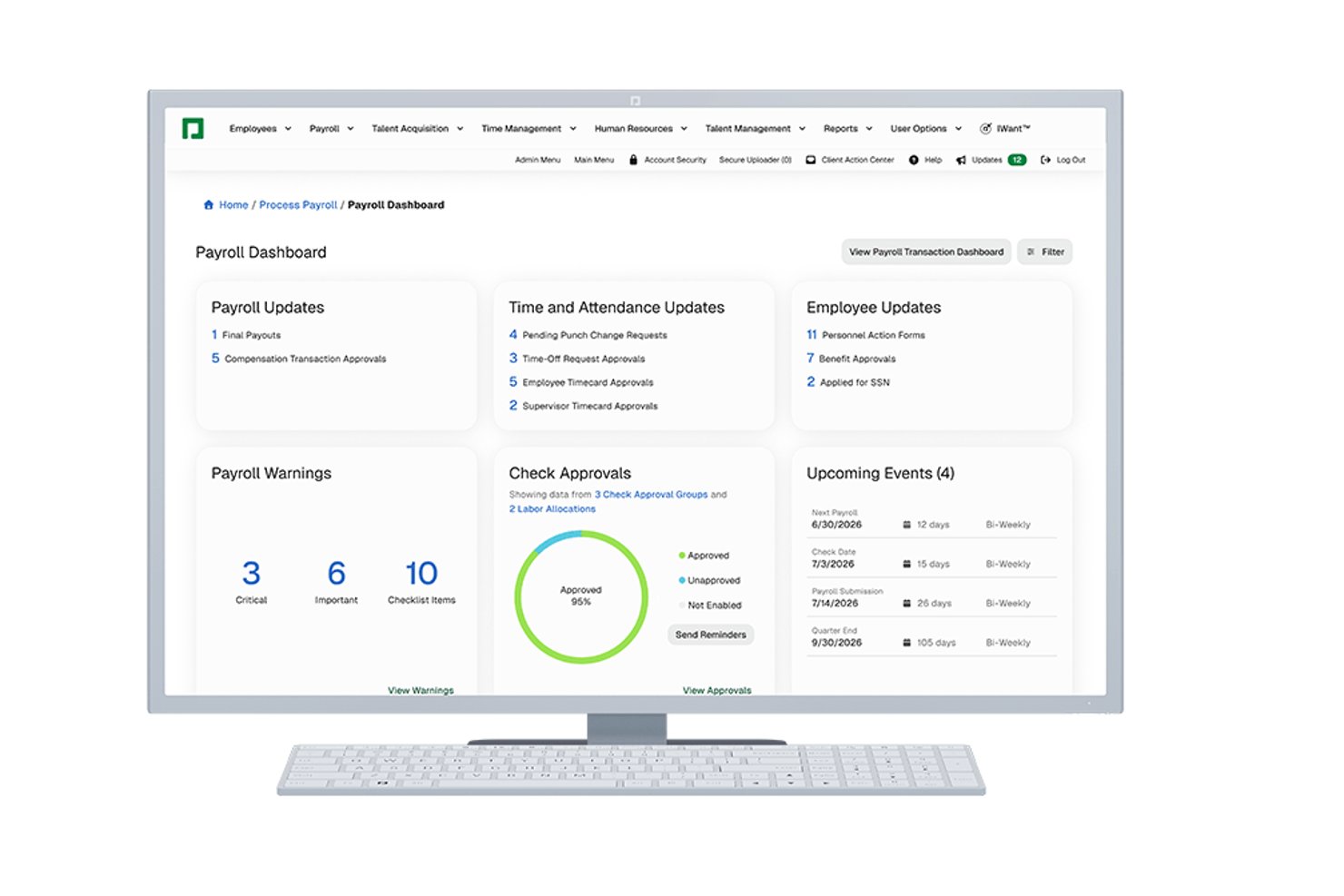
Paycom is a single-database HCM platform built for mid-sized to enterprise organizations that want to consolidate payroll, HR, benefits, and time management without stitching together multiple systems.
Who Is Paycom Best For?
Paycom is a strong fit for U.S.-based HR teams that want employees to own their own data entry, reducing administrative back-and-forth across payroll and HR workflows.
Why Paycom Is a Good Best Rippling Competitors
I've included Paycom in my top picks because of how it puts HR data directly in employees' hands. Beti, Paycom's employee-driven payroll tool, lets employees find and fix their own payroll errors before submission, which cuts processing time and reduces back-and-forth with HR. I also appreciate Employee Self-Service®, which lets employees update their own records, request time off, and manage benefits without routing every change through an HR admin.
Paycom Key Features
- Single-database HR platform: All HR, payroll, and benefits data live in one unified system for consistent records and fewer manual updates.
- Compensation budgeting tools: Create and manage detailed compensation plans, including budgeting, approvals, and analytics for salary adjustments.
- Learning management system: Assign, track, and report on employee training assignments and completion directly within the core platform.
- ACA and benefits compliance: Built-in compliance tools that handle Affordable Care Act reporting and benefits eligibility tracking.
Paycom Integrations
Native integrations are not clearly documented. Paycom provides an API for custom integrations.
Pros and Cons
Pros:
- Beti catches payroll errors before processing
- Single database eliminates duplicate data entry
- Employees self-manage their own payroll data
Cons:
- Reporting customization requires significant setup time
- Limited global payroll support outside the U.S.
Best for global payroll and compliance

Deel helps global companies hire, pay, and manage talent across borders with built-in compliance and localized support.
Why It's A Good Rippling Alternative
I picked Deel because it lets you run compliant international payroll without relying on manual processes or third-party intermediaries. You can hire full-time employees through its employer of record (EOR) network, which handles local contracts, taxes, and benefits so your team can enter new markets quickly and safely.
I also like that it centralizes contractor payments in hundreds of currencies with automated invoicing and tax documents, reducing admin for finance teams. Deel’s built-in HRIS gives you a place to manage onboarding, documents, and performance for both employees and contractors. For companies scaling globally, this mix of compliance support and payroll automation makes international operations much easier to manage.
Deel Key Features
Here are some key features worth highlighting:
- Localized employment contracts: Country-specific agreements reviewed by local legal experts.
- Automated global payroll: Consolidates payroll, taxes, and statutory contributions across multiple countries.
- Equity management: Supports granting and administering equity to international employees.
- Immigration support: Provides visa sponsorship and relocation assistance for cross-border hires.
Deel Integrations
Integrations include QuickBooks, Xero, NetSuite, BambooHR, Greenhouse, Lever, Workday, SAP SuccessFactors, ADP, and Oracle.
Pros and Cons
Pros:
- Multi-currency payments simplify global contractor management
- Strong local compliance guidance across many countries
- Dedicated customer support
Cons:
- Payroll reporting customization can feel limited
- No free trial available
G-P
Best for unified global workforce management
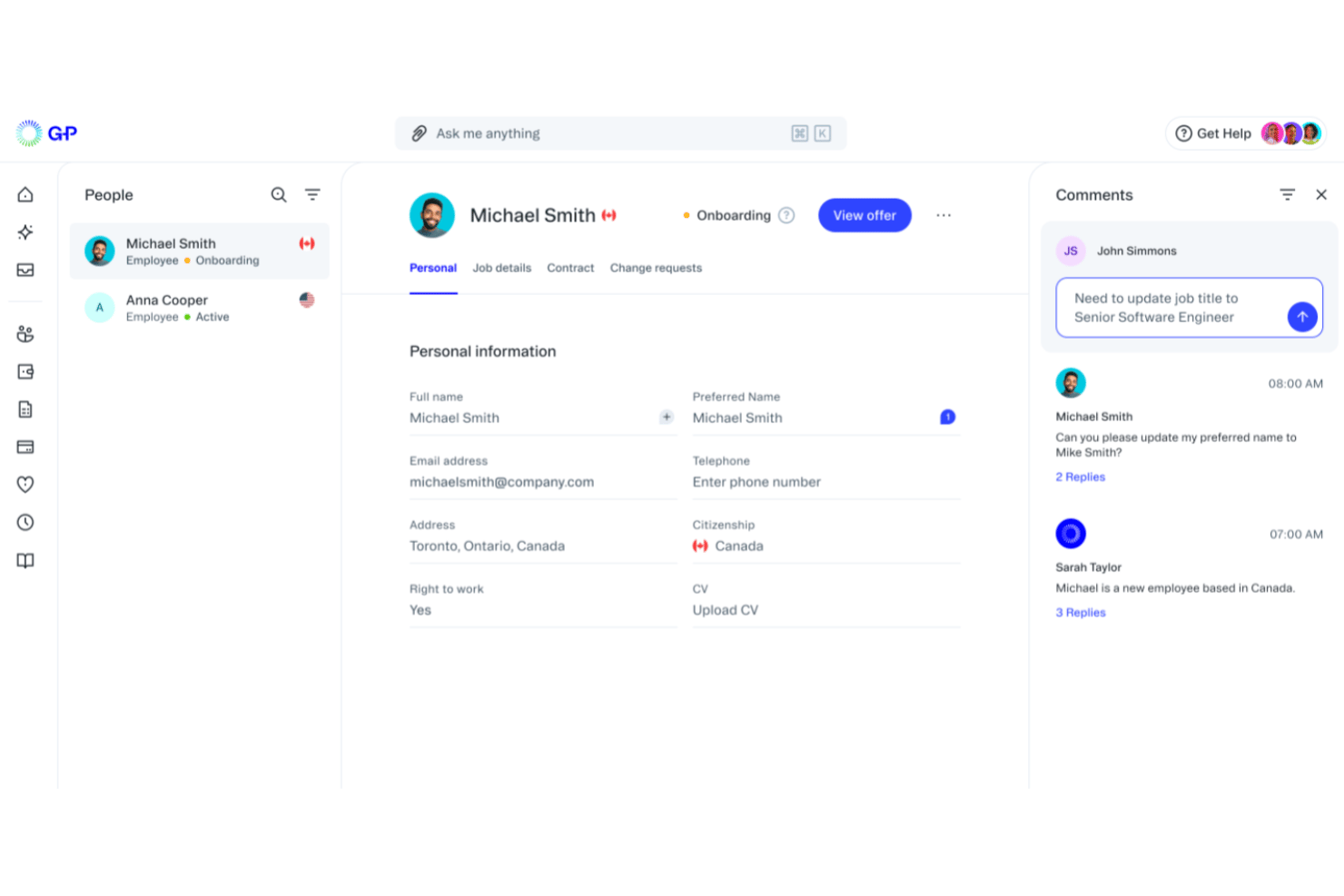
G-P is an employer of record platform that helps HR teams hire, pay, and stay compliant in 180+ countries—no local legal entities needed.
Who Is G-P Best For?
G-P suits mid-market and enterprise HR teams managing international expansion or overseeing employees across multiple countries simultaneously.
Why G-P Is a Good Best Rippling Competitors
I picked G-P as one of the best because its Global Compliance Engine automatically validates every employment action, from contracts to payroll, against local labor laws across 180+ countries in real time. I especially like the AI-guided onboarding, which handles right-to-work verification and cuts time-to-onboard by 87%. That level of built-in compliance depth is something Rippling's global module doesn't replicate natively.
G-P Key Features
- Global payroll engine: Process payroll in 150+ currencies with local tax compliance rules built in for each country.
- Localized benefits administration: Allocate and manage region-specific benefits packages for employees in 180+ countries.
- Bulk contractor onboarding: Generate and issue contracts, plus pay contractors in 190+ countries, all from one dashboard.
- API and HRIS integrations: Connect with systems like Workday, BambooHR, HiBob, and others to centralize data across your HR stack.
G-P Integrations
G-P offers native integrations with Workday, BambooHR, HiBob, Personio, SAP SuccessFactors, UKG, TriNet, ADP, Paylocity, Okta, Microsoft Entra ID, and Google Workspace. An open API is available for custom integrations.
Pros and Cons
Pros:
- AI-guided onboarding reduces time-to-hire significantly
- Built-in local compliance across all markets
- Covers EOR hiring in 180+ countries
Cons:
- Limited native HR tools beyond global employment
- Not suited for single-country domestic teams

Best for global recruitment solutions
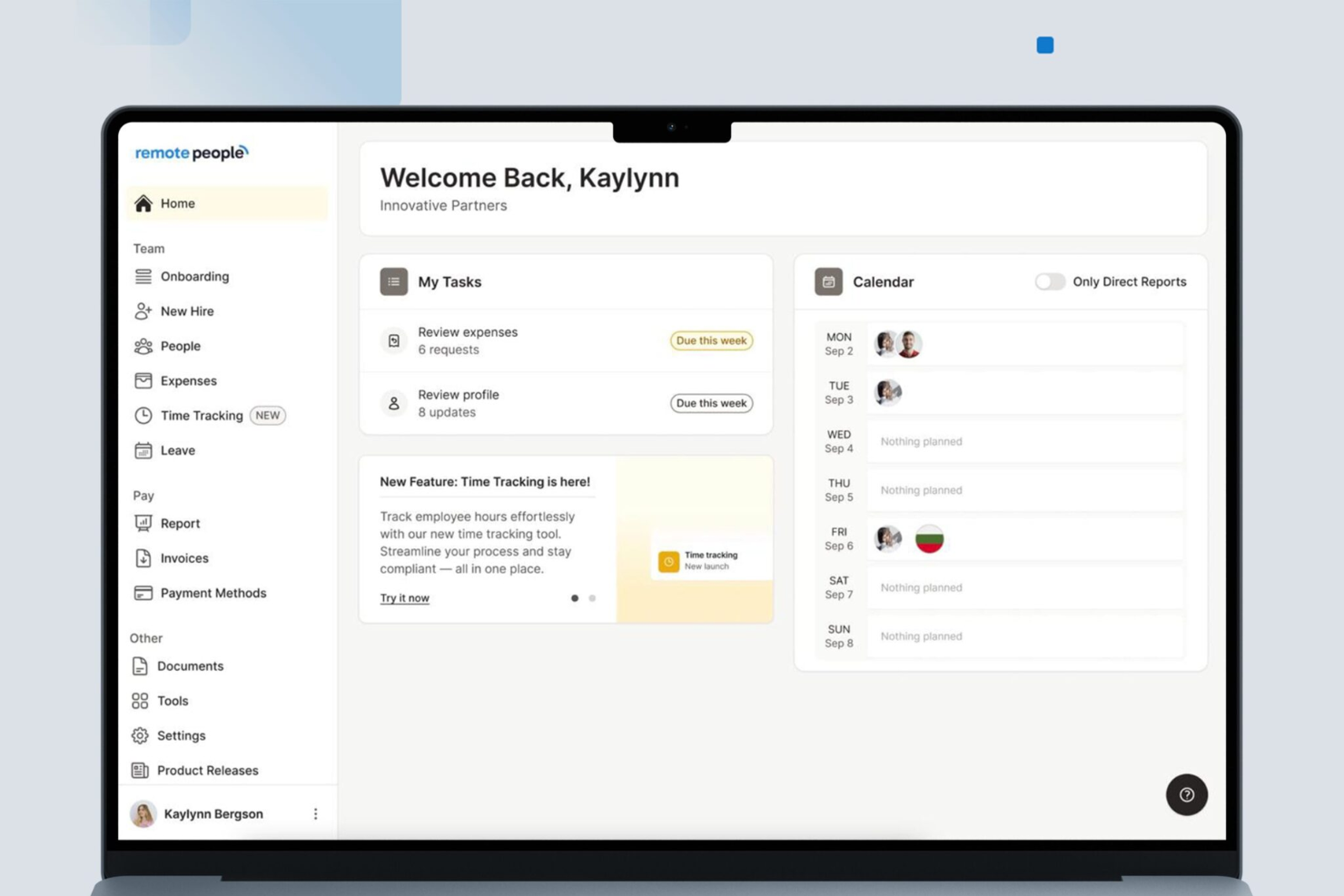
RemotePeople is a platform that helps businesses hire and manage remote talent across more than 150 countries. It's designed to support companies in expanding their global workforce by offering a range of recruitment and payroll services.
Why it's a good Rippling competitor: One of the reasons I picked RemotePeople as a competitor to Rippling is its global recruitment capabilities. It provides access to a vast pool of vetted candidates, ensuring businesses can find the right talent for various roles, including executive positions. This feature is crucial for companies looking to diversify their workforce with skilled professionals from around the world.
Another key feature is the employer of record (EOR) services, which allows businesses to hire employees in countries where they don't have a legal entity. This service ensures compliance with local labor laws, making it easier for companies to manage payroll and benefits for their international employees. The ability to legally hire and manage employees in multiple countries is a significant advantage for businesses aiming to expand globally.
Standout features & integrations:
Features include a streamlined hiring process that delivers a shortlist of vetted candidates within five days, making recruitment quick and efficient. The platform also offers contractor management services, allowing businesses to hire and pay international contractors with ease. Additionally, RemotePeople provides background checks, giving companies peace of mind when bringing new employees on board. These features work together to support a comprehensive approach to global workforce management.
Integrations are not presently listed by RemotePeople.
Pros and Cons
Pros:
- Candidate placement guarantee
- Dedicated client support contact
- Wide recruitment network
Cons:
- No publicly listed integrations
- Some services available only in certain regions
HiBob
Best for customizable compensation planning
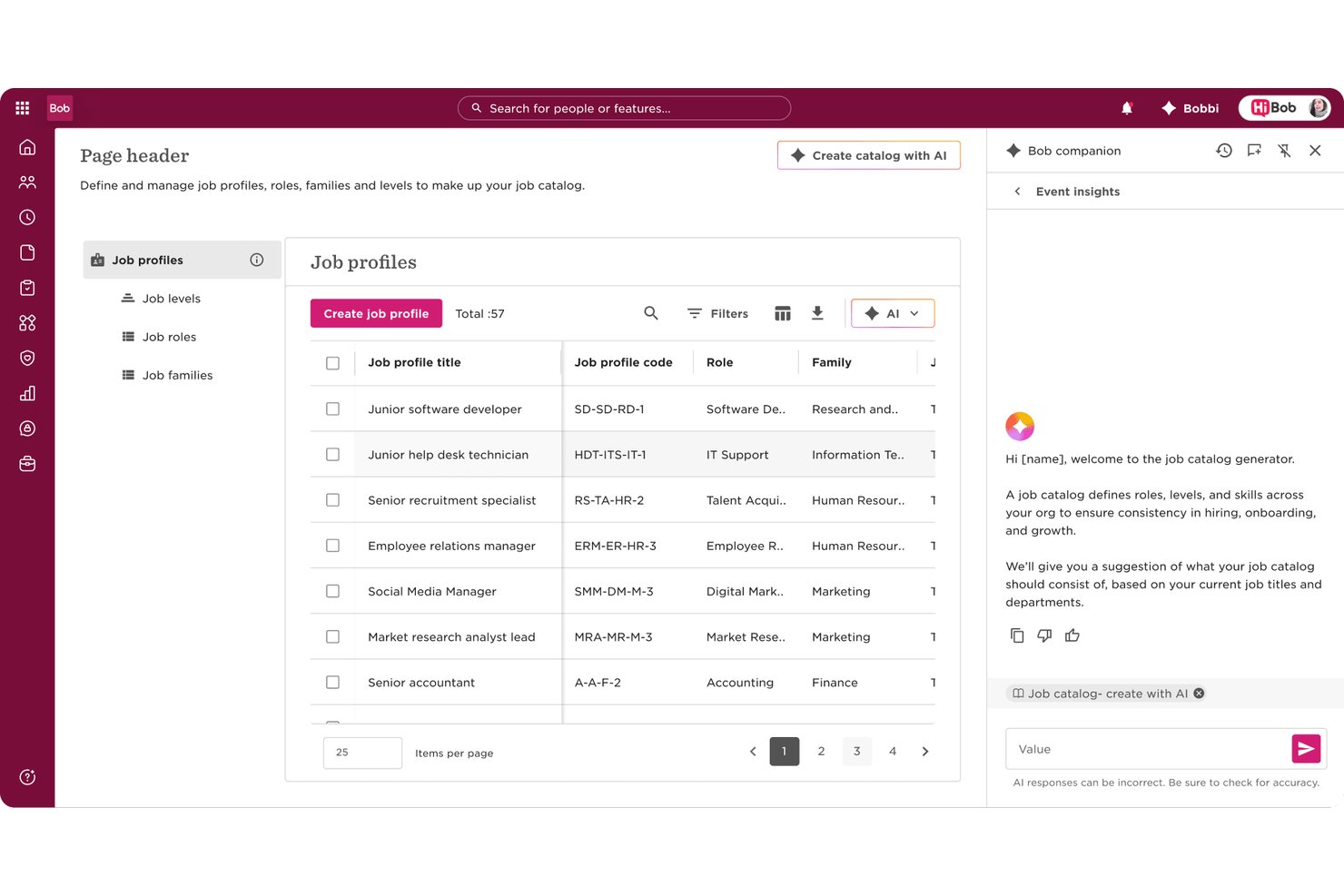
HiBob's Bob platform is a people-centred HRIS built for mid-sized, multinational teams that need to manage the full employee lifecycle—from onboarding and performance to compensation and workforce planning—without stitching together separate systems.
Who Is HiBob Best For?
HiBob is a strong fit for growing companies between 100 and 5,000 employees that operate across multiple countries and need a single HR platform to keep up with them.
Why HiBob Is a Best Rippling Competitor
I picked HiBob as one of the best because its compensation planning tools go well beyond a basic salary review. I appreciate how you can build fully configurable comp cycles with custom pay bands, then validate those decisions against Mercer benchmarking data without leaving the platform. That combination of a structured review workflow and real market data baked directly into the process is something I rarely see in mid-market HRIS tools.
HiBob Key Features
- Employee database: Store and manage detailed employee records with customizable fields and document management.
- Automated onboarding workflows: Configure multi-step onboarding journeys with e-signatures, task assignments, and automated alerts.
- Time and attendance tracking: Monitor leave balances, PTO requests, and working hours with a built-in approval process.
- Open API and integration marketplace: Connect HiBob to major productivity, payroll, and IT systems through a broad selection of pre-built integrations and APIs.
HiBob Integrations
HiBob offers native integrations with Slack, Microsoft 365, Google Workspace, Greenhouse, Okta, DocuSign, Xero, BambooHR, and Workable. An open API is available for custom integrations.
Pros and Cons
Pros:
- People analytics dashboards built into the core
- Highly configurable employee lifecycle workflows
- Strong multi-country workforce visibility tools
Cons:
- Reporting customization can feel limited
- No native payroll in most countries
Best for benefits management and administration
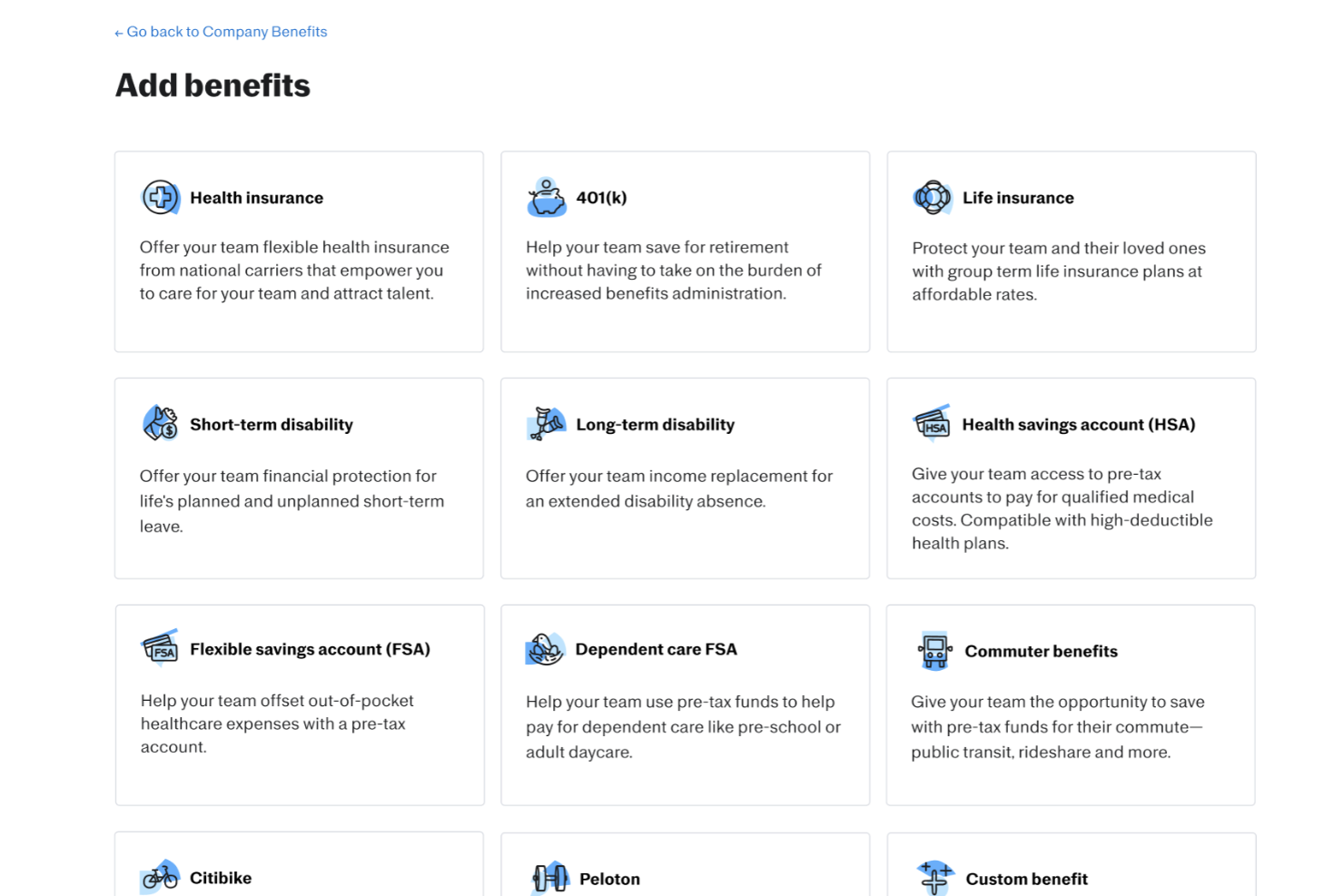
Justworks serves as an alternative to Rippling for businesses that need payroll and HR support in one system. It stands out for benefits management and administration, helping companies handle employee health plans and related programs alongside payroll and compliance. This structure supports organizations that prefer a centralized approach to workforce operations.
Why I Picked Justworks
I picked Justworks as a Rippling competitor for its benefits management and administration, which allows businesses to manage health insurance, retirement plans, and other employee programs within the same system as payroll. Compared to Rippling’s broader IT and HR focus, Justworks places stronger emphasis on structured benefits support alongside payroll and compliance. This setup helps small businesses keep benefits enrollment, contributions, and payroll records organized in one platform.
Justworks Key Features
In addition to benefits management and administration, Justworks offers:
- Time Tracking: Allows you to manage employee hours and attendance seamlessly.
- Employee Onboarding: Streamlines the process of bringing new hires into your organization with digital onboarding tools.
- Compliance Support: Helps you stay compliant with labor laws and regulations, reducing the risk of legal issues.
- Reporting and Analytics: Provides insights into various HR metrics, allowing you to make informed decisions.
Justworks Integrations
Integrations include QuickBooks, Xero, NetSuite, Sage Intacct, Electric AI, allwhere, JazzHR, Brex, Culture Amp, and Leapsome.
Pros and Cons
Pros:
- Automated payroll tax filings
- Clear employee dashboard for benefits and pay information
- Straightforward onboarding workflow for new hires
Cons:
- Reporting tools offer limited in-depth business insights
- Fewer advanced HR features than larger enterprise platforms
Best for unified reporting dashboards

Multiplier is a good fit for companies hiring internationally who want one place to manage payroll, compliance, and workforce costs across multiple countries. If you’re expanding into new markets and need clearer visibility into what you’re spending, its unified reporting dashboards help you monitor payroll, taxes, and headcount without juggling multiple vendors.
Why It's A Good Rippling Alternative
I picked Multiplier because it gives your team a single global payroll system where you can track costs, payments, and compliance requirements across 100+ countries. You can see country-level payroll totals, deductions, and employer contributions in one dashboard, which makes reporting much easier for finance teams.
I also like that Multiplier handles local taxes and filings for each region, so you don’t need separate in-country partners to stay compliant. Its ability to run payroll in local currencies—and consolidate all results into one view—helps you compare workforce costs across markets. For teams building globally, this clarity is a major advantage over tools that spread payroll features across multiple modules.
Multiplier Key Features
Here are some key features worth highlighting:
- Global Cost Visibility: Consolidated dashboards show payroll totals, contributions, and employer costs across regions.
- Country-Specific Payroll Processing: Local tax rules, deductions, and filings managed automatically for 100+ countries.
- Multi-Currency Payments: Supports payments in 120+ currencies with real-time exchange-rate calculations.
- Compliance Support: Access to in-country legal and tax specialists to help resolve region-specific questions.
Multiplier Integrations
Integrations include Workday, BambooHR, Personio, HiBob, Zoho People, Okta, Xero, and QuickBooks.
Pros and Cons
Pros:
- Fast onboarding for global employees via guided workflows
- Automates local tax calculations and statutory contributions
- Unified dashboard improves visibility into global payroll spending
Cons:
- Fewer native integrations than broader HR suites
- Limited contract-customization options for specific markets

Best for indemnification-backed hiring
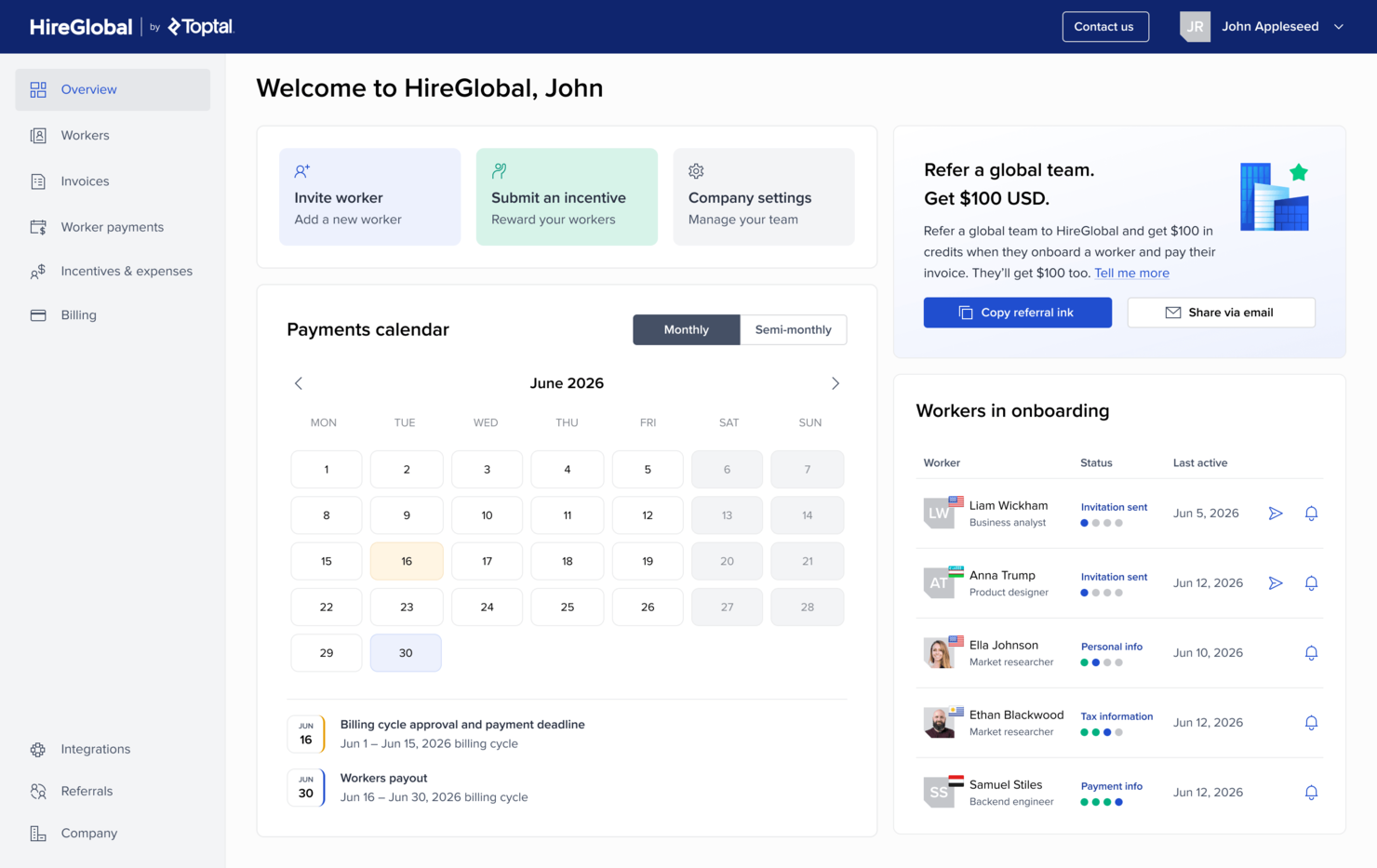
HireGlobal is a global hiring and payroll platform for businesses that need to onboard, pay, and compliantly manage international contractors and remote employees across 180+ countries without setting up local entities.
Who Is HireGlobal Best For?
HireGlobal is a strong fit for growing companies that need to hire and pay international talent quickly, without the overhead of managing multi-country compliance in-house.
Why HireGlobal Is a Good Rippling Competitor
I picked HireGlobal as a competitor to Rippling because it combines global employment services with access to Toptal's network of pre-vetted professionals. Every candidate has already passed Toptal's multi-stage vetting process, covering technical skills, communication, and professionalism. It also pairs talent access with Agent of Record and Virtual EOR services, making it a good option for businesses that want to hire and engage global workers through a single provider.
HireGlobal Key Features
- Global payroll processing: Run payroll for contractors and employees across 180+ countries in local currencies from a single dashboard.
- Background screening: Request and manage candidate background checks directly within the HireGlobal platform during onboarding.
- Misclassification indemnification: HireGlobal provides up to $1M in coverage to protect your business against worker misclassification liability.
- Consolidated invoicing: Receive a single invoice across all international workers, regardless of country or contract type.
HireGlobal Integrations
HireGlobal integrates with TopTracker, Toptal's time tracking tool, for time tracking, invoice approval, and payment processing. Native integrations beyond TopTracker are not clearly documented, and public documentation does not list Zapier or API support.
Pros and Cons
Pros:
- $1M compliance indemnification per worker
- EOR coverage through multiple local partners
- Backed by 40+ in-house lawyers
Cons:
- No mobile worker tracking application
- Relatively new platform with fewer reviews
Best for global compliance handling

Native Teams is built for companies that need affordable, compliant hiring across multiple countries without opening local entities. It’s a strong fit for small and mid-sized teams that want to employ or pay workers abroad while keeping global payroll, taxes, and benefits legally sound.
Why I Picked Native Teams
I picked Native Teams because it focuses heavily on compliance, giving your team the legal coverage needed to hire in 95+ countries. You get EOR services that manage compliant contracts, payroll taxes, and statutory contributions, reducing the risk of misclassification or local law violations.
I also like that it pairs compliance with practical tools—such as localized benefits and multi-currency wallets—so employees receive country-appropriate perks while your finance team handles payments accurately.
Lastly, its visa and relocation support adds another compliance layer for cross-border mobility.
Native Teams Key Features
Here are some key features worth highlighting:
- Visa & Relocation Assistance: Supports compliant relocation by managing visa requirements and documentation.
- Contractor Payment Tools: Ensures freelancers are paid correctly and within local legal frameworks.
- Localized Benefits Administration: Offers country-specific insurance and perks that meet statutory standards.
- Tax Optimization Tools: Helps calculate salaries and taxes based on each region’s legal requirements.
Native Teams Integrations
Integrations include Slack, QuickBooks, Xero, Deel Payroll Sync (limited regions), Google Calendar, Microsoft Outlook, Wise, Revolut Business, and Payoneer.
Pros and Cons
Pros:
- Regional benefit requirements in many countries
- Compliant employment contracts and documentation
- Payroll calculators for compliant salary planning
Cons:
- Covers fewer countries than some competitors
- May not offer advanced HR tools beyond essential employment features
Factorial
Best for HR and IT management in Europe
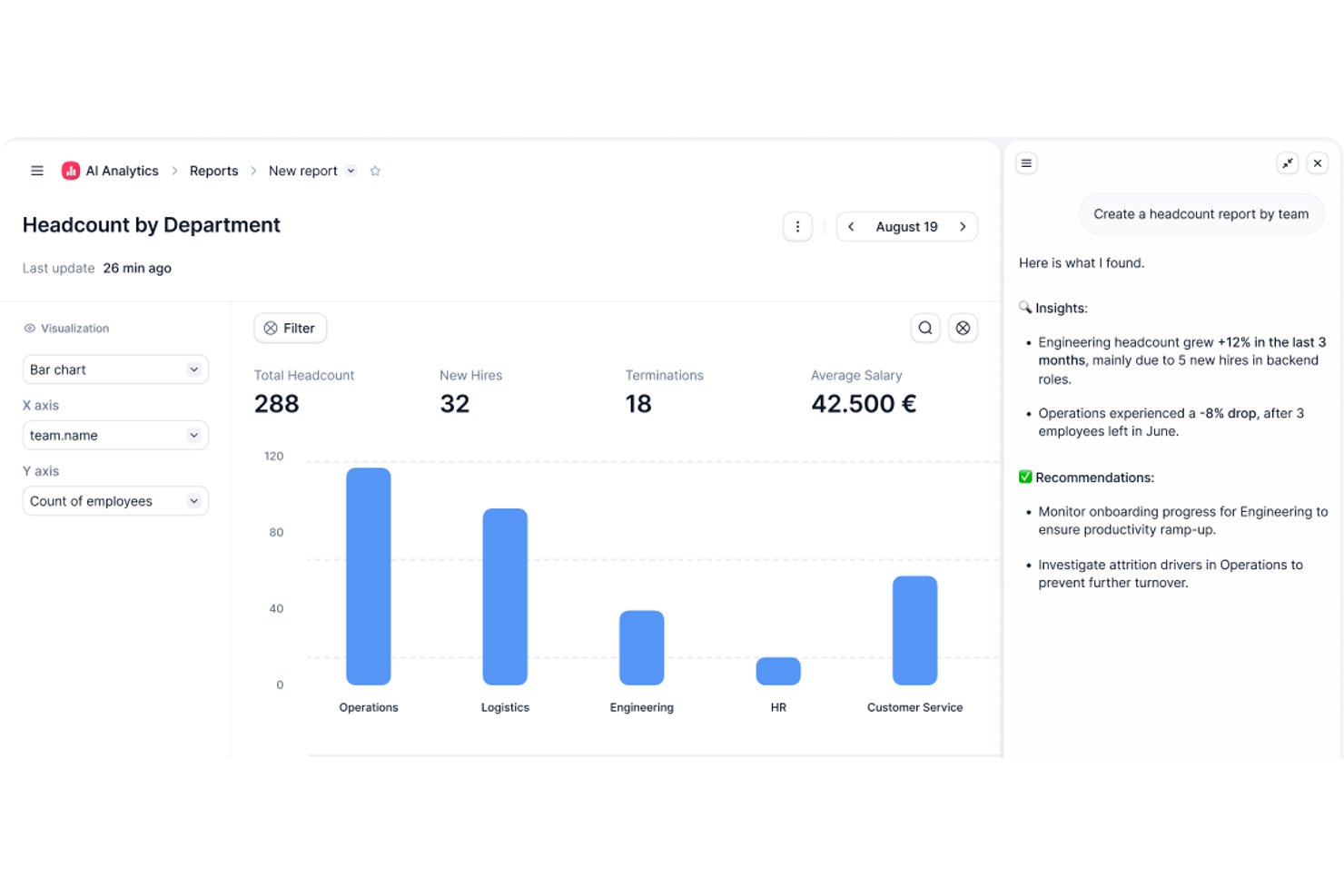
Factorial is an all-in-one HR software designed for organizations that want to manage everything from employee data and time off to onboarding and digital document storage in a single platform. It’s ideal for midsize and larger teams seeking easy integration with IT workflows.
Who Is Factorial Best For?
HR and IT teams at midsize or larger European organizations that want unified employee data, onboarding, and compliance in one platform.
Why Factorial Is a Good Rippling Competitor
I picked Factorial as one of the best because it can handle HR data, time off, onboarding, and compliance for European organizations in one platform. I like having unified employee records and document storage in the same space as IT management workflows, which helps us stay organized and compliant as we grow.
Factorial Key Features
- Customizable approval workflows: Set up multi-step approvals for time off, expenses, and other HR requests.
- Employee self-service portal: Let employees update personal data, submit requests, and view documents on their own.
- Automated payroll management: Sync payroll data and automate calculations to handle monthly payouts with less manual work.
- Integrated digital signature: Sign and store contracts or policies securely with built-in e-signature functionality.
Factorial Integrations
Factorial offers native integrations with Slack, Microsoft Teams, Google Workspace, SAP, Personio, and Okta. It also provides an API for custom integrations.
Pros and Cons
Pros:
- European compliance focus with localized data controls
- Digital signatures built into employee onboarding
- Approval workflows tailored for complex HR processes
Cons:
- Customization options limited for advanced workflows
- Reports of slow customer support responses
Other Rippling Competitors
If you’d like a few more options to consider, here are several other worthwhile Rippling competitors that are also worth checking out:
| Factor | What to Consider |
|---|---|
| Business Objectives | Identify your primary goals—e.g., automating HR processes, improving compliance, or scaling globally. Choose a solution that directly supports those objectives. |
| Core HR Features | Ensure the system includes essentials like employee records, time tracking, benefits administration, and compliance management. |
| Payroll and Benefits Management | Look for accurate, automated payroll with multi-country support (if needed), plus seamless benefits enrollment and management tools. |
| Talent Management | Consider whether the platform includes recruiting, onboarding, performance reviews, and learning management features to support employee growth. |
| Integration and Compatibility | Verify it integrates smoothly with your accounting software, collaboration tools (like Slack or Teams), and other HR platforms you use. |
| Ease of Use | Evaluate the user interface and employee experience. A clean, intuitive design reduces onboarding time and HR workload. |
| Scalability | Make sure the platform can grow with your company—supporting additional employees, locations, and compliance requirements as you expand. |
| Customization and Flexibility | Check if you can tailor workflows, reports, and user permissions to your organization’s structure and policies. |
| Support and Training | Compare customer service options—such as 24/7 chat, phone support, and onboarding assistance—and ask about training resources. |
| Compliance and Security | Confirm the system complies with relevant labor laws and data protection standards (e.g., GDPR, SOC 2, HIPAA). |
| Analytics and Reporting | Look for built-in dashboards that track workforce trends, payroll costs, and turnover rates for better decision-making. |
| Costs and Pricing Model | Understand how pricing scales with users and features. Watch for add-on fees for integrations or implementation. |
| Reputation and Reliability | Read user reviews, case studies, and third-party ratings (like G2 or Capterra) to assess product reliability and vendor trustworthiness. |
- Paylocity
For core HR with employee engagement
- Gusto
For automated payroll and tax filing
- TriNet
For U.S. businesses with up to 500 employees
- RemoFirst
For budget-conscious teams
- Pebl
For AI-powered EOR tools
- RUN Powered by ADP®
For small businesses
- CXC Global
For integrating human expertise
- TimeTrex
For detailed job costing and expense tracking
- WorkBright
For mobile-first onboarding
- GoCo
For an easy-to-use interface with responsive customer support
- Borderless AI
For automated contract generation
- UKG Ready
For AI-powered workforce management
- Atlas HXM
For global compliance management
- Omnipresent
For adherence to employment laws
- Sage HR
Modular HR software solution for small businesses
- ADP
For comprehensive payroll and HR services
- SAP SuccessFactors
For AI-enabled talent management
- Oracle Cloud HCM
For AI-embedded HR processes
- Zoho People Plus
For customizable workflows
- Paychex
For all-in-one payroll and HR solutions
- Remunance
EOR in India
- Remote
For flexible employee and contractor management
- BambooHR®
User-friendly HR software for SMBs
- Papaya Global
For multi-currency payments
- Oyster HR
For specialized local support
- Wisemonk
For India hiring compliance
- TopSource
For compliance-focused global hiring
- Namely
For mid-sized companies needing HR and payroll
- Workday
For a skills-based people strategy
- Keka HR
For employee experience and engagement


Related HR Software Reviews
If you still haven't found what you're looking for here, check out these other related tools that we've tested and evaluated:
- HR Software
- Payroll Software
- Recruiting Software
- Employer of Record Services
- Applicant Tracking Systems
- Workforce Management Software
How I Evaluate Rippling Competitors
I split my evaluation into two layers: the baseline HR and payroll capabilities a platform must cover, and the differentiators—like global coverage or pricing model—that separate the best fits.
Core Functionality (Table Stakes For This List)
When I'm selecting tools for my list, I rank each one on a scale from 0 (does not offer the functionality) to 5 (excels in this area) for each core functionality listed below. Then, I calculate the tool's total score into a percentage. Each tool needs to achieve a minimum total score of 75% to be considered for inclusion.
- Core HRIS & Employee Records: I check whether the platform serves as a true system of record—org charts, custom fields, headcount reporting, and multi-entity support.
- Payroll Processing: Each tool's payroll scope matters, from single-country runs with automated tax filing to multi-country payroll with local compliance built in.
- Benefits Administration: I look for carrier connectivity, open enrollment workflows, and plan setup—not just a place to log benefit elections manually.
- Onboarding & Offboarding Workflows: I evaluate how much of the new hire flow is automated, like offer letters, e-signatures, document collection, and task sequencing.
- Time & Attendance Tracking: PTO requests, clock-in options, approval chains, and scheduling all factor in, especially for teams managing hourly and salaried workers.
- Integrations & Workflow Automation: I look at the breadth of native connectors to tools like accounting platforms, ATS products, and productivity apps, plus API access.
Once I have a list of tools that meet this criteria, I consider what sets each platform apart.
Differentiating Factors (What Sets Vendors Apart)
Here's how I compare and contrast different vendors:
Standout Features
Global EOR capabilities matter when your team is hiring across borders without setting up local entities. I also evaluate whether a platform ties IT provisioning—like app access and device management—directly to HR events, since that's a gap many buyers are trying to close. Built-in talent management tools like performance reviews and compensation planning can eliminate the need for a separate platform entirely.
Beyond Features
Pricing transparency is a big differentiator—some vendors bundle modules while others charge per add-on, which changes total cost as you scale headcount. I also evaluate implementation support, especially how a platform handles data migration from a legacy HRIS or payroll system. Compliance coverage matters too. I look at whether the vendor actively maintains jurisdiction-specific tax and labor law updates or leaves that responsibility to your team.
Features of Rippling Alternatives
When selecting rippling alternatives, keep an eye out for the following key features:
- Payroll management: Make sure you can run payroll automatically, calculate taxes, and handle deductions with ease. It's best when the system guides you through pay runs so mistakes are less likely—even if you’re not a payroll expert.
- Benefits administration: Look for a solution that helps you set up and manage employee benefits, like health insurance and retirement plans. The best tools ensure employees can enroll easily while keeping you compliant with regulations.
- Time tracking: Choose software that lets employees clock in and out digitally, tracks hours worked, and streamlines timesheet approval. This removes manual tracking headaches (and the classic “who forgot to log their hours again?” chase).
- HR management: The system should make it simple to onboard new hires, handle employee records, and manage essential HR documentation all in one place. Bonus points if it keeps you updated on upcoming reviews or certifications.
- Expense tracking: Find a platform where employees can submit expenses, upload receipts, and get approvals quickly. It makes reimbursement painless and helps you avoid losing track of who spent what.
- Reporting and analytics: Go for a service that turns your payroll and HR data into easy-to-read reports. These insights can help you spot trends, plan budgets, and keep leadership happy with clear data.
- Integrations: The right choice should connect smoothly with your accounting platforms, time tracking tools, or other business apps. That way, you won’t need to juggle data between different systems.
- Self-service portals: Give employees their own dashboards so they can review pay stubs, update contact details, and request time off without extra emails or paperwork.
- Compliance support: With labor laws always changing, it helps to have software that stays on top of regulations for you. The best options send reminders or update documents automatically to keep you in the clear.
Common Rippling Alternatives AI Features
Beyond the standard rippling alternatives features listed above, many of these solutions are incorporating AI with features like:
- Automated document processing: AI speeds up tasks like reading resumes, sorting contracts, and extracting key details from documents—making admin work much faster (and giving you back your sanity).
- Predictive analytics: These tools use AI to forecast turnover risks, payroll spikes, or future hiring needs, so you can plan ahead with confidence instead of reacting to surprises.
- Smart chatbot support: Employees can get instant answers to HR or payroll questions thanks to AI-powered chatbots, cutting down on back-and-forth emails for everyone.
- Intelligent anomaly detection: AI scans for things that look off in payroll, benefits, or timesheets—flagging issues so you can fix them before they become costly mistakes.
- Personalized onboarding workflows: AI adapts onboarding steps for each new hire, making the process smoother and more relevant (and making newbies feel less nervous on their first day).
How To Choose A Rippling Alternative
When choosing an alternative to Rippling HCM, it’s important to evaluate how each option aligns with your business needs, technology setup, and growth plans. Use the table below to guide your comparison and decision-making process.
| Factor | What to Consider |
|---|---|
| Business Objectives | Identify your primary goals—e.g., automating HR processes, improving compliance, or scaling globally. Choose a solution that directly supports those objectives. |
| Core HR Features | Ensure the system includes essentials like employee records, time tracking, benefits administration, and compliance management. |
| Payroll and Benefits Management | Look for accurate, automated payroll with multi-country support (if needed), plus seamless benefits enrollment and management tools. |
| Talent Management | Consider whether the platform includes recruiting, onboarding, performance reviews, and learning management features to support employee growth. |
| Integration and Compatibility | Verify it integrates smoothly with your accounting software, collaboration tools (like Slack or Teams), and other HR platforms you use. |
| Ease of Use | Evaluate the user interface and employee experience. A clean, intuitive design reduces onboarding time and HR workload. |
| Scalability | Make sure the platform can grow with your company—supporting additional employees, locations, and compliance requirements as you expand. |
| Customization and Flexibility | Check if you can tailor workflows, reports, and user permissions to your organization’s structure and policies. |
| Support and Training | Compare customer service options—such as 24/7 chat, phone support, and onboarding assistance—and ask about training resources. |
| Compliance and Security | Confirm the system complies with relevant labor laws and data protection standards (e.g., GDPR, SOC 2, HIPAA). |
| Analytics and Reporting | Look for built-in dashboards that track workforce trends, payroll costs, and turnover rates for better decision-making. |
| Costs and Pricing Model | Understand how pricing scales with users and features. Watch for add-on fees for integrations or implementation. |
| Reputation and Reliability | Read user reviews, case studies, and third-party ratings (like G2 or Capterra) to assess product reliability and vendor trustworthiness. |