

AI compensation planning software uses AI and pay data to support compensation reviews, equity analysis, and pay decisions. You’ll need a tool that fits your review process, keeps recommendations explainable, and gives HR control over final decisions. My nearly two decades in operations, including financial forecasting and HRIS use, inform this comparison of tools for pay reviews, incentives, and workforce-cost planning. AI capabilities vary, so I’ll help you compare what each platform offers and choose one that fits your team.
Why Trust Our Software Recommendations
6,700+
Reviews
20
Industry experts
16+
Evaluation factors
14
Years
Our team has been testing and reviewing software since 2012. As HR experts ourselves, we know how difficult—and important—it is to choose the right software.
For this guide, we evaluated tools using hands-on testing and independent research, scoring tools using our selection criteria. We also draw on insights from industry thought leaders and practicing HR experts.
Our reviews reflect our human editorial judgment, not a sales pitch.
Expert reviewers:
- Phil GrayCOO
 Kim BehnkeHR Tech Editor & Analyst
 Josh BarkerPeople Ops Manager

Comparison Table: AI Compensation Planning Software
Compare pricing and specs, side by side, for the AI compensation planning software that made it onto my shortlist.
Score legend (out of 5)
- Excellent4.5–5
- Good4–4.4
- Average3–3.9
- Below average2–2.9
- Poor1–1.9
Sorted by: Default
| Tool | Starting Price | Website | |||||||
|---|---|---|---|---|---|---|---|---|---|
Best for multi-level compensation budgeting | 3.0 out of 5 | 2 | 1 | 3 | 3 | 5 | 4 | Pricing upon request Free demo available | Website |
Best for auditable AI-guided pay decisions | 3.5 out of 5 | 2 | 4 | 3 | 4 | 4 | 4 | Pricing upon request Free demo available | Website |
Best for modeling complex incentive programs | 3.3 out of 5 | 3 | 4 | 3 | 4 | 3 | 3 | Pricing upon request Free demo available | Website |
Best for budget-aware pay equity remediation | 3.0 out of 5 | 4 | 2 | 2 | 4 | 3 | 3 | Pricing upon request Free demo available | Website |
Best for flight-risk-aware pay reviews | 3.2 out of 5 | 2 | 2 | 3 | 4 | 4 | 4 | Pricing upon request Free demo available | Website |
Best for custom, explainable pay guidance | 3.3 out of 5 | 2 | 4 | 4 | 3 | 3 | 4 | Pricing upon request Free demo available | Website |
Best for market-informed merit planning | 2.7 out of 5 | 3 | 2 | 1 | 2 | 4 | 4 | Pricing upon request Free demo available | Website |
Best for connecting pay and workforce plans | 3.3 out of 5 | 2 | 3 | 4 | 3 | 4 | 4 | Pricing upon request Free demo available | Website |
Best for modeling workforce cost trade-offs | 2.7 out of 5 | 2 | 2 | 2 | 2 | 4 | 4 | Pricing upon request Free demo available | Website |
Best for AI that can change planning settings | 3.7 out of 5 | 2 | 4 | 4 | 4 | 4 | 4 | $15,000/year Free demo available | Book Demo |


AI Compensation Planning Software Reviews
Below are my reviews of the best AI compensation planning software on my shortlist. Each overview covers features, pay equity tools, and review workflows to help you find the right platform for your team.
 Best for multi-level compensation budgeting
- Free demo available
- Pricing upon request
Visit WebsiteCustomer Rating:4.6/5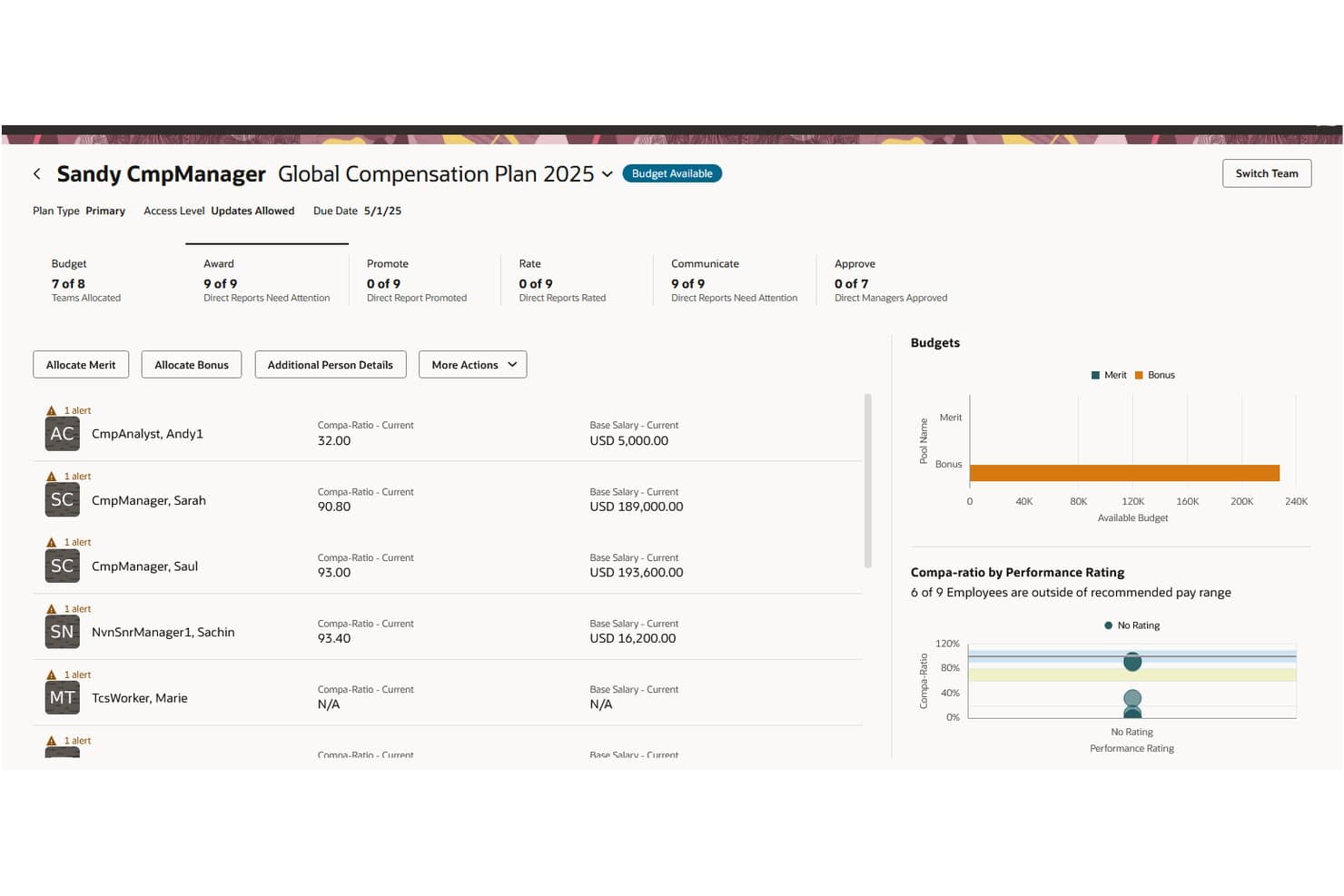
Oracle HCM lets managers review team compensation plans and budgets. Oracle Compensation is a compensation planning tool within Oracle Fusion Cloud HCM that supports budget modeling, merit and bonus allocations, approval workflows, and total compensation statements.
Who Is Oracle Best For?
Oracle Compensation is best for enterprise HR and compensation teams using Oracle Fusion Cloud HCM that need multi-level compensation planning, manager-level budgeting, and approval hierarchies.
Why I Picked Oracle
I picked Oracle Compensation for its individual compensation plans, which let employees submit allowance claims with supporting document uploads and approval workflows. This is separate from its workforce compensation planning features, where managers can review and adjust allocations at different approval levels before submitting them. I also like that Oracle supports manager-level budgeting across organizational hierarchies.
Oracle Key Features
- Budget pool modeling: Configure up to five budget pools for compensation components such as merit increases, bonuses, and stock awards.
- Total compensation statements: Generate employee statements covering earnings, equity awards, benefits, and other compensation components.
- Pay-for-performance planning: Incorporate employee performance measures into compensation targets, budgeting, and allocation approvals.
- AI-assisted compensation insights: Ask Compensation Advisor questions about employee pay, market composites, and compensation percentiles.
Oracle Integrations
Oracle Compensation connects with Oracle Performance Management and Oracle Succession Planning within Oracle Fusion Cloud HCM. Oracle also provides REST APIs for custom integrations.
Pros and Cons
Pros:
- Merit and bonus planning supports review cycles
- Linked budget pools track manager allocations
- Employee-claimed allowances include approval workflows
Cons:
- Market surveys require customer-managed imports
- Custom worksheet approval routes are unsupported
Learn more about Oracle: Best for auditable AI-guided pay decisions
- Free demo available
- Pricing upon request
Visit WebsiteCustomer Rating:4.7/5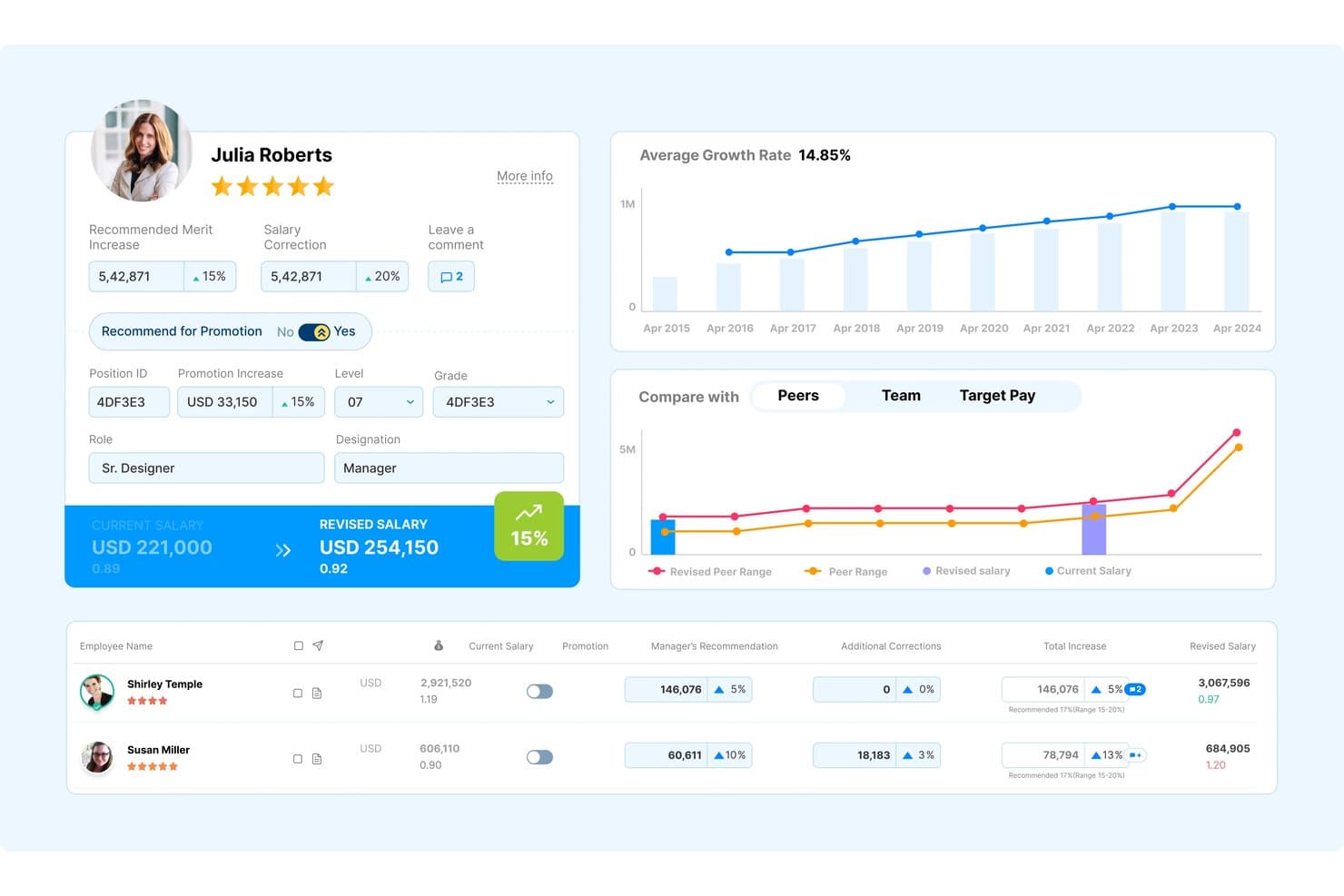
Compport helps managers review and adjust employee salaries with peer benchmarking. Compport is an AI-native compensation management platform that supports merit and bonus planning, pay equity analysis, long-term incentive modeling, total rewards statements, and sales incentive planning.
Who Is Compport Best For?
Compport is best for compensation, total rewards, and HR teams at mid-sized and large organizations managing salary reviews, incentive plans, pay equity analysis, and compensation approvals.
Why I Picked Compport
I picked Compport for its AI-guided compensation recommendations with built-in audit trails and human approval controls. CompportIQ records the user, timestamp, and basis behind each recommendation, while requiring an authorized person to approve changes to compensation records. Its six AI agents, including Pay Equity and Comp Planner, support compensation analysis and planning. The Pay Equity agent can also identify proposed salary increases that may create or widen pay gaps before approvals close.
Compport Key Features
- Bonus plan scenario simulation: Build and compare variable pay scenarios with budget and impact analyses before implementing a plan.
- Long-term incentive modeling: Configure LTI plans by grade, tenure, and location, set performance-based vesting multipliers, and simulate potential equity value.
- Total rewards statements: Combine salary, bonuses, equity, and benefits into personalized employee statements with historical rewards data and configurable content.
- HR analytics with 200+ reports: Access prebuilt compensation reports with interactive drill-downs covering pay parity, salary growth, performance ratings, and budget usage.
Compport Integrations
Compport offers native integrations with Workday, SAP SuccessFactors, Oracle HCM, ADP, and UKG. It also provides an API for custom integrations.
Pros and Cons
Pros:
- Configurable cycles cover salary and incentive reviews
- Mid-cycle equity checks flag widening pay gaps
- AI recommendations carry approval and audit trails
Cons:
- AI-generated pay changes require human approval
- Market benchmarking requires licensed external data
Learn more about Compport: Best for modeling complex incentive programs
- Free demo available
- Pricing upon request
Visit WebsiteCustomer Rating:4.4/5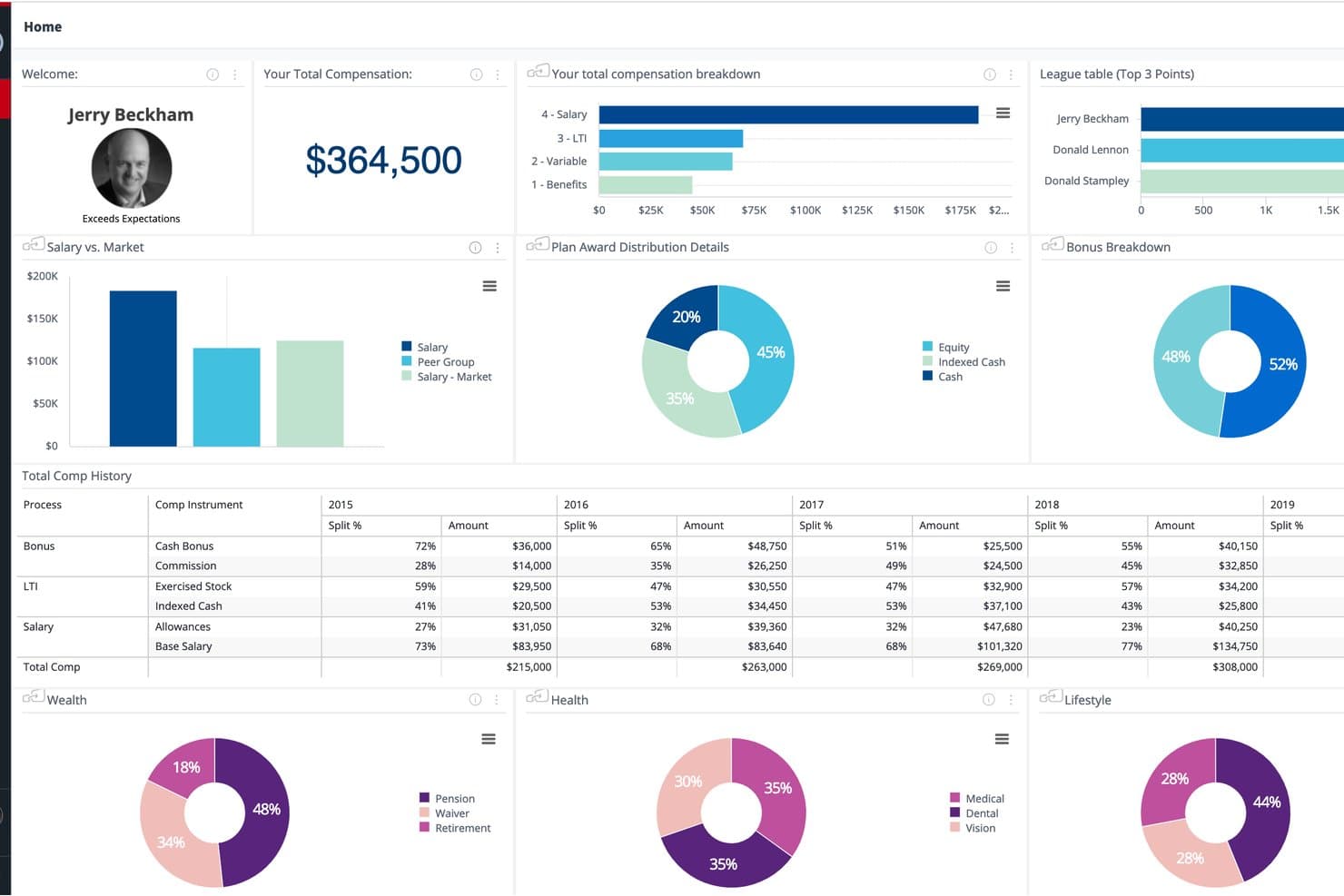
beqom gives employees a full view of total compensation and history. beqom is an AI-powered compensation management platform for global enterprises, offering salary planning, short- and long-term incentive management, sales compensation, pay equity analysis, and pay transparency tools.
Who Is beqom Best For?
beqom is best for compensation and benefits teams at large, global enterprises managing salary reviews, bonuses, sales commissions, and long-term incentive programs across multiple business units and countries.
Why I Picked beqom
I picked beqom for its support of complex compensation and incentive programs across global organizations. Its long-term incentive management tools let compensation teams configure equity- and cash-based awards, model different performance outcomes, and forecast program costs, vesting schedules, and accruals. I also like its no-code configuration tools, which let HR teams manage compensation plan rules and workflows without custom development.
beqom Key Features
- Pay equity gap analysis: Analyze compensation differences across employee groups and generate individual pay adjustment recommendations.
- Compensation rounds workspace: Configure compensation review cycles with validation rules, approval routing, and decision histories.
- AI pay predictions: Apply machine-learning models to generate pay recommendations for hiring, merit increases, and promotions.
- Global pay transparency tools: Support employee pay information requests, compensation reporting, and reward communication.
beqom Integrations
beqom lists integrations with Workday, SAP SuccessFactors, Oracle, ADP, UKG, and Dayforce. The platform also supports connectivity with HR, payroll, finance, and equity systems, though integration methods and setup requirements may vary.
Pros and Cons
Pros:
- Pay equity recommendations include human oversight
- LTI simulations model dilution and vesting
- Configurable workflows handle varied incentive rules
Cons:
- Benchmark data sources and refresh cadence undisclosed
- BYOM requires customer-supplied prediction models
Learn more about beqom: Best for budget-aware pay equity remediation
- Free demo available
- Pricing upon request
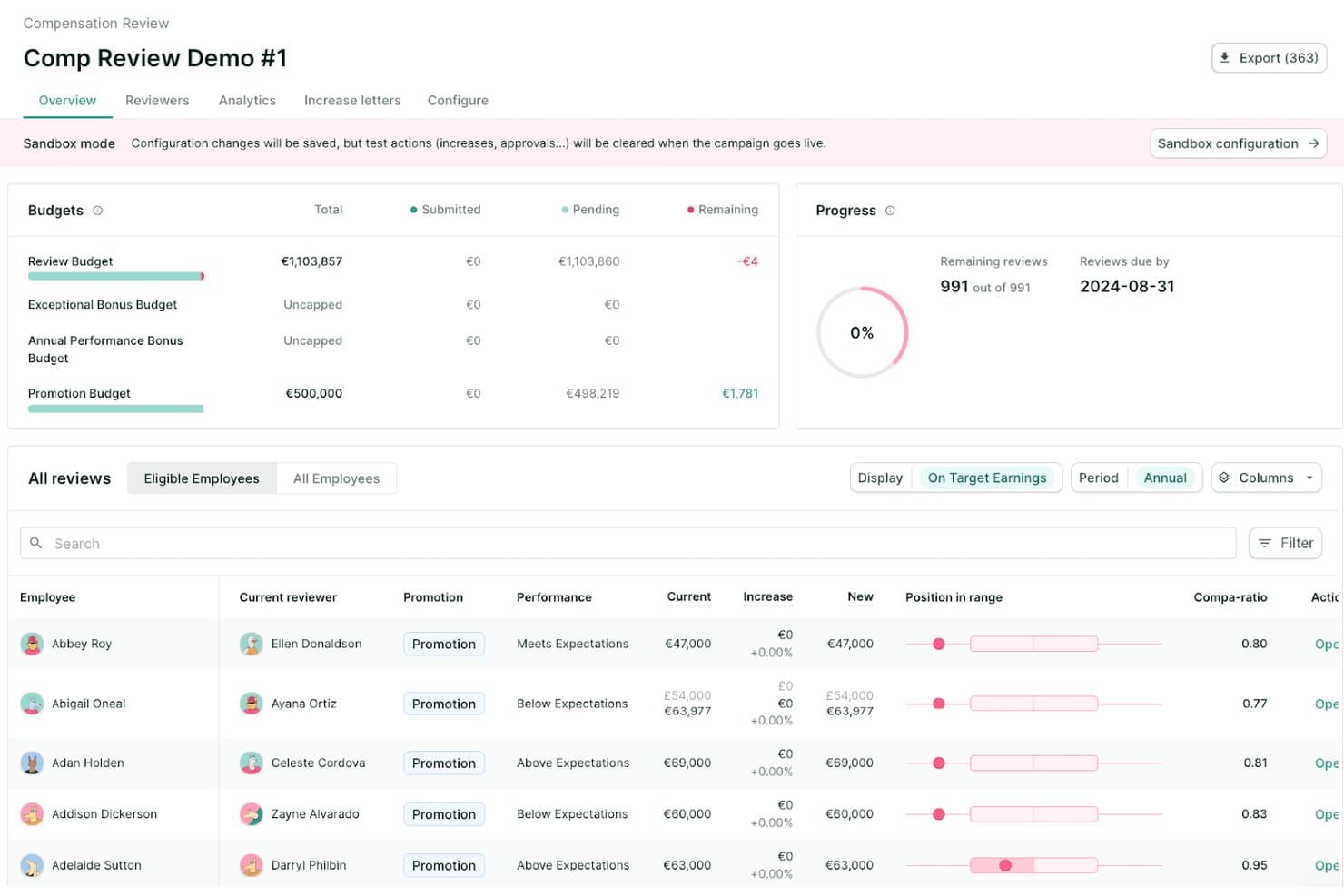
Figures tracks compensation review budgets, progress, and employee increases. Figures is a compensation management platform offering salary benchmarking, salary band management, pay equity analysis, and collaborative compensation review workflows.
Who Is Figures Best For?
Figures is best for compensation managers, total rewards teams, and HR leaders at European companies managing salary structures, pay equity analysis, and EU pay transparency requirements.
Why I Picked Figures
I picked Figures for its pay equity analysis and budget-based remediation planning. Its pay equity tools identify raw pay gaps above 5% by worker category and support correction scenarios aligned with compensation budgets. Figures also offers automated remediation review campaigns and real-time monitoring of how salary decisions affect pay equity.
Figures Key Features
- FiguresAI benchmark predictions: Uses XGBoost machine learning to estimate compensation ranges by job, location, and level.
- Salary band management: Create and manage salary bands using market benchmarks, employee positioning indicators, and change history.
- Compensation review campaigns: Configure annual and off-cycle salary reviews with approval workflows, multiple budgets, and live budget tracking.
- Pay equity analysis: Identify pay gaps by worker category and simulate salary adjustments against compensation budgets.
Figures Integrations
Figures lists 30+ HRIS integrations, including Workday, HiBob, and BambooHR, along with Ledgy for equity data. It also supports Google Workspace sign-in.
Pros and Cons
Pros:
- Benchmarks include data quality indicators
- Annual and off-cycle reviews include approvals
- Pay-gap remediation scenarios align with budgets
Cons:
- Benchmark predictions depend on data coverage
- Advanced pay equity analysis requires add-on
Learn more about Figures: Best for flight-risk-aware pay reviews
- Free demo available
- Pricing upon request
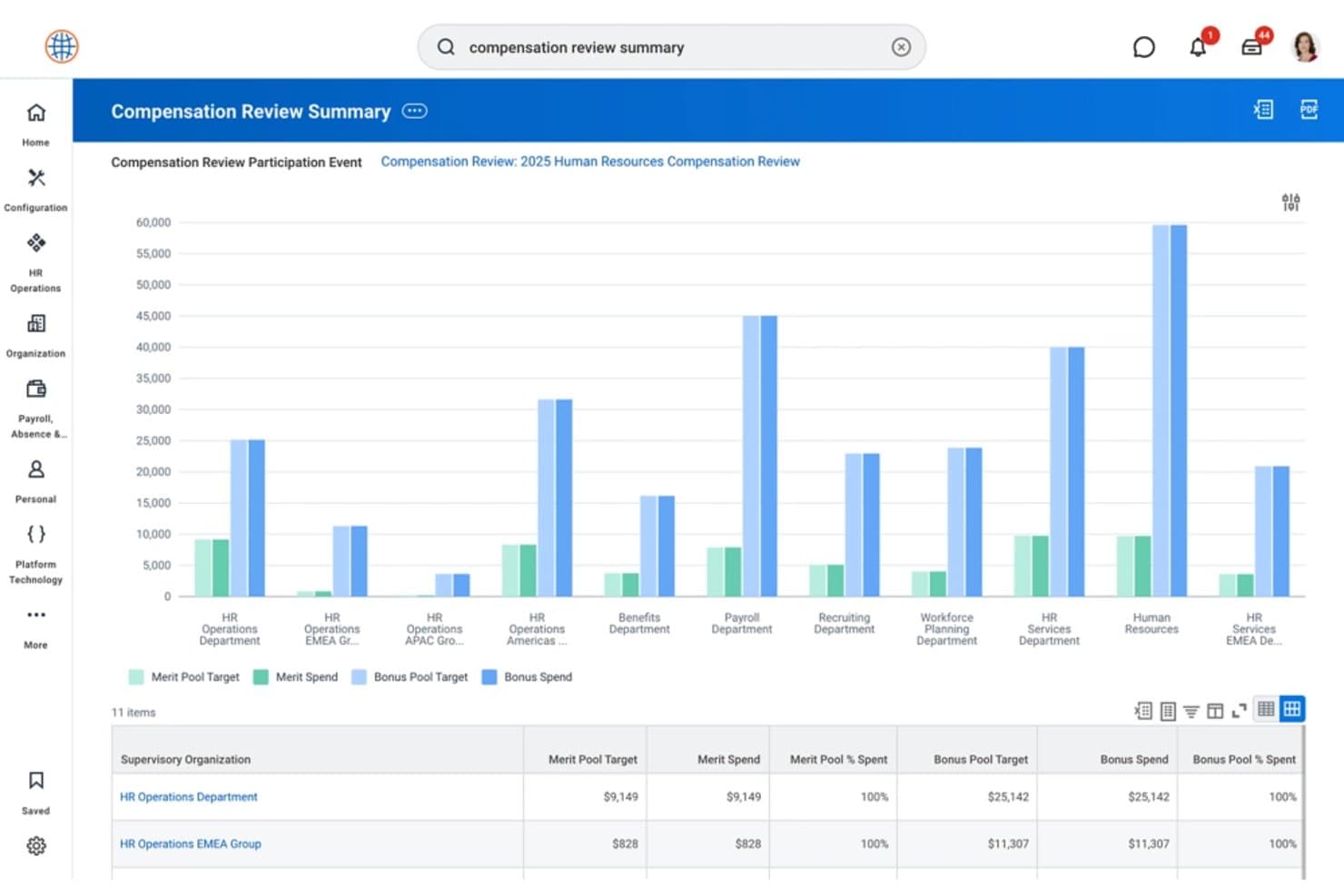
Workday displays merit and bonus pool spending by department. Workday Compensation is an AI-assisted compensation management tool within Workday HCM that supports pay reviews, budget planning, pay equity analysis, and market benchmarking.
Who Is Workday Compensation Best For?
Workday Compensation is best suited for HR and compensation teams at mid-sized and large organizations using Workday HCM to manage pay reviews, compensation budgets, and pay equity analysis.
Why I Picked Workday Compensation
I picked Workday Compensation because it combines compensation planning with AI-assisted retention insights and pay equity analysis. Workday provides flight-risk information to inform compensation decisions, while its Pay Equity Discovery Board helps HR teams examine pay differences across demographic groups, including gender, ethnicity, and age. Managers can also review performance, skills, and budget information when planning merit increases and bonus awards.
Workday Compensation Key Features
- Compensation review workflow: Configure annual, semiannual, quarterly, and off-cycle compensation reviews with planner roles, approval steps, and organizational hierarchies.
- What-if modeling: Simulate compensation changes and evaluate potential budget impacts before finalizing award pools.
- Skills-informed pay decisions: Review employee skills and performance information alongside proposed merit increases and bonus awards.
- Personalized total rewards statements: Configure employee statements covering compensation, benefits, and other reward components.
Workday Compensation Integrations
Workday Compensation integrates with Compa through the Workday Marketplace's Real-time Employee Benchmarks app, providing market compensation data within Workday workflows. Workday also supports public web services for compensation matrices, survey data, benchmark configuration, and job matching.
Pros and Cons
Pros:
- Supports multiple external compensation surveys
- Real-time budget tracking across award pools
- Flight-risk flags add review context
Cons:
- External survey benchmarks require data configuration
- Compensation matrix limits require custom validations
Learn more about Workday Compensation: Best for custom, explainable pay guidance
- Free demo available
- Pricing upon request
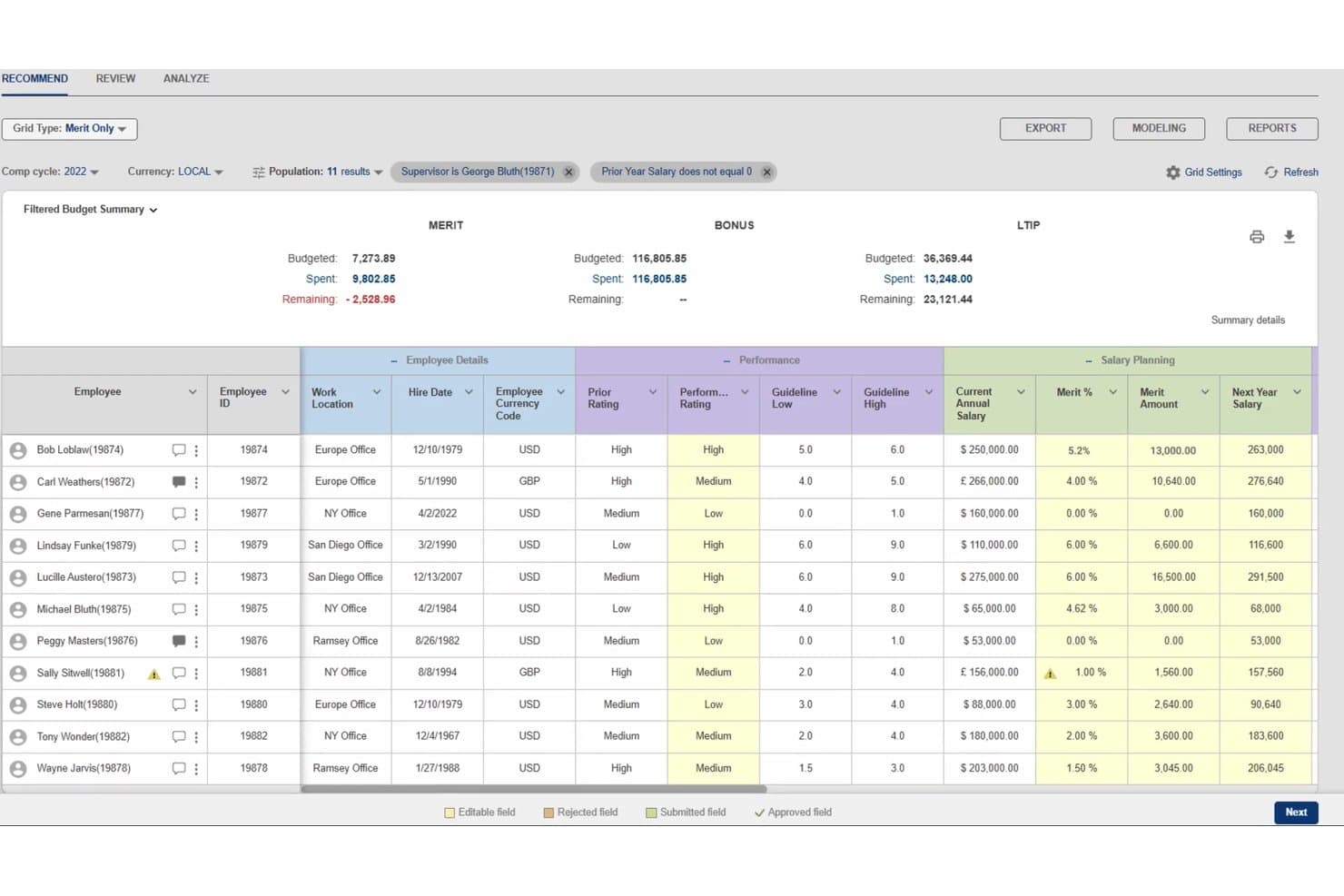
Decusoft Compose lets users manage merit, bonus, and LTIP salary planning. Decusoft Compose is an AI-powered compensation planning platform that supports salary, merit, bonus, equity, and incentive program management alongside configurable approval workflows, pay equity reporting, and scenario modeling.
Who Is Decusoft Compose Best For?
Compose is best for compensation managers, total rewards teams, and HR and finance leaders at mid-sized and large organizations managing multiple compensation programs across regions and currencies.
Why I Picked Decusoft Compose
I picked Decusoft Compose for its AI-based compensation recommendations and configurable prediction models. Teams can factor performance, tenure, location, cost of living, and market benchmarks into compensation scenarios before finalizing pay decisions. I also like that Compose supports audit records for compensation decisions and approval workflows, giving compensation teams a record of how pay changes were reviewed.
Decusoft Compose Key Features
- Multi-program compensation planning: Configure salary, merit, bonus, equity, commission, deferred compensation, and long-term incentive programs.
- Pay equity reporting: Analyze compensation patterns, salary progression, and pay equity metrics across employee groups and organizational levels.
- Configurable approval workflows: Route compensation recommendations through multiple management levels with customizable approval screens and email notifications.
- Scenario modeling and forecasting: Compare potential compensation adjustments, merit allocations, and budget outcomes using configurable predictive models.
Decusoft Compose Integrations
Decusoft Compose integrates with Workday, ADP, UKG, SAP, and Oracle HCM through APIs or secure file exchange. It also supports API-based connections with other systems.
Pros and Cons
Pros:
- Role-based access with customizable permissions
- Configurable planning for complex pay programs
- Explainable AI recommendations using configurable factors
Cons:
- Some requirements need custom feature development
- Large commission uploads may delay calculations
Learn more about Decusoft Compose: 7Best for market-informed merit planning
Pave
- Free demo available
- Pricing upon request
Visit WebsiteCustomer Rating:4.7/5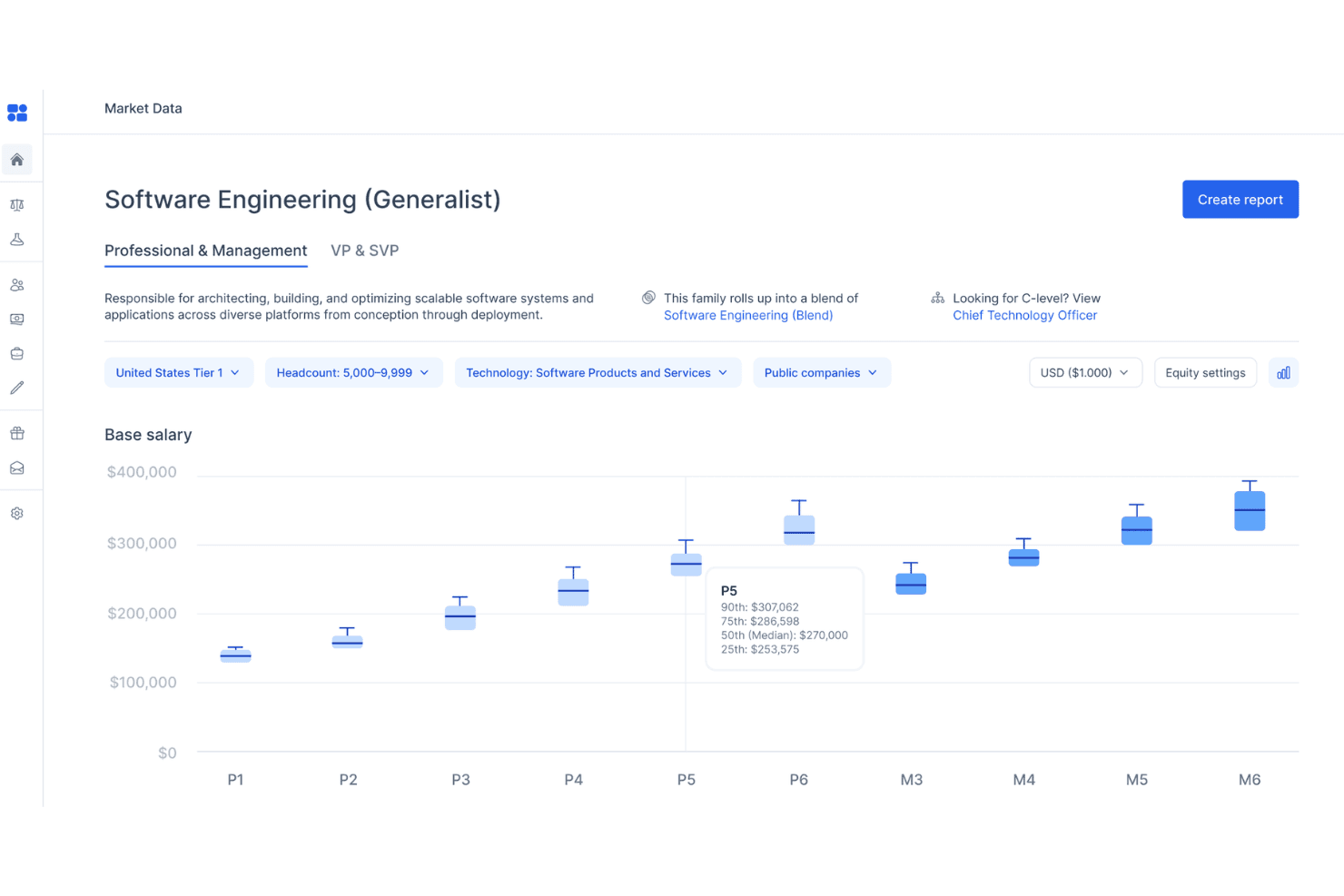
Pave provides software engineering salary ranges by level and percentile. Pave is a compensation planning platform that combines market benchmarking with merit cycle workflows, configurable budgets, approval chains, and compensation analytics.
Who Is Pave Best For?
Pave is best for compensation managers and HR teams managing structured merit cycles that involve market benchmarking, salary and equity adjustments, budget allocations, and approval workflows.
Why I Picked Pave
I picked Pave because it combines market compensation benchmarks with configurable merit cycle planning. Its top-down and bottom-up budgeting options support cash and equity allocations, while budget monitoring provides information on spending throughout the cycle. I also considered its Smart Flags, which identify compensation outliers, manager compression, and equity vesting drops based on configurable rules.
Pave Key Features
- Smart Flags: Configure rule-based indicators for compensation outliers, manager compression, and equity vesting drops, with soft or hard stops for flagged decisions.
- Cycle access permissions: Restrict compensation planning cycles to selected roles, including executive or department-specific reviews.
- AI employee summaries: Generate employee summaries covering tenure, performance, compensation band positioning, equity vesting, and proposed adjustments.
- Cycle insights: Monitor budget consumption, approval progress, compensation increases, and pay band adherence during and after planning cycles.
Pave Integrations
Pave lists integrations with Workday, ADP, BambooHR, Rippling, Greenhouse, Culture Amp, Carta, and Pulley. It also provides a REST API with read-only access to compensation planning data for custom integrations.
Pros and Cons
Pros:
- Approval chains track submissions and cycle progress
- Top-down and bottom-up cash, equity budgets
- Location-filtered compensation market benchmarks
Cons:
- Advanced formulas require Handlebars knowledge
- API supports read-only access to planning data
Learn more about Pave: Best for connecting pay and workforce plans
- Free demo available
- Pricing upon request
Visit WebsiteCustomer Rating:4.5/5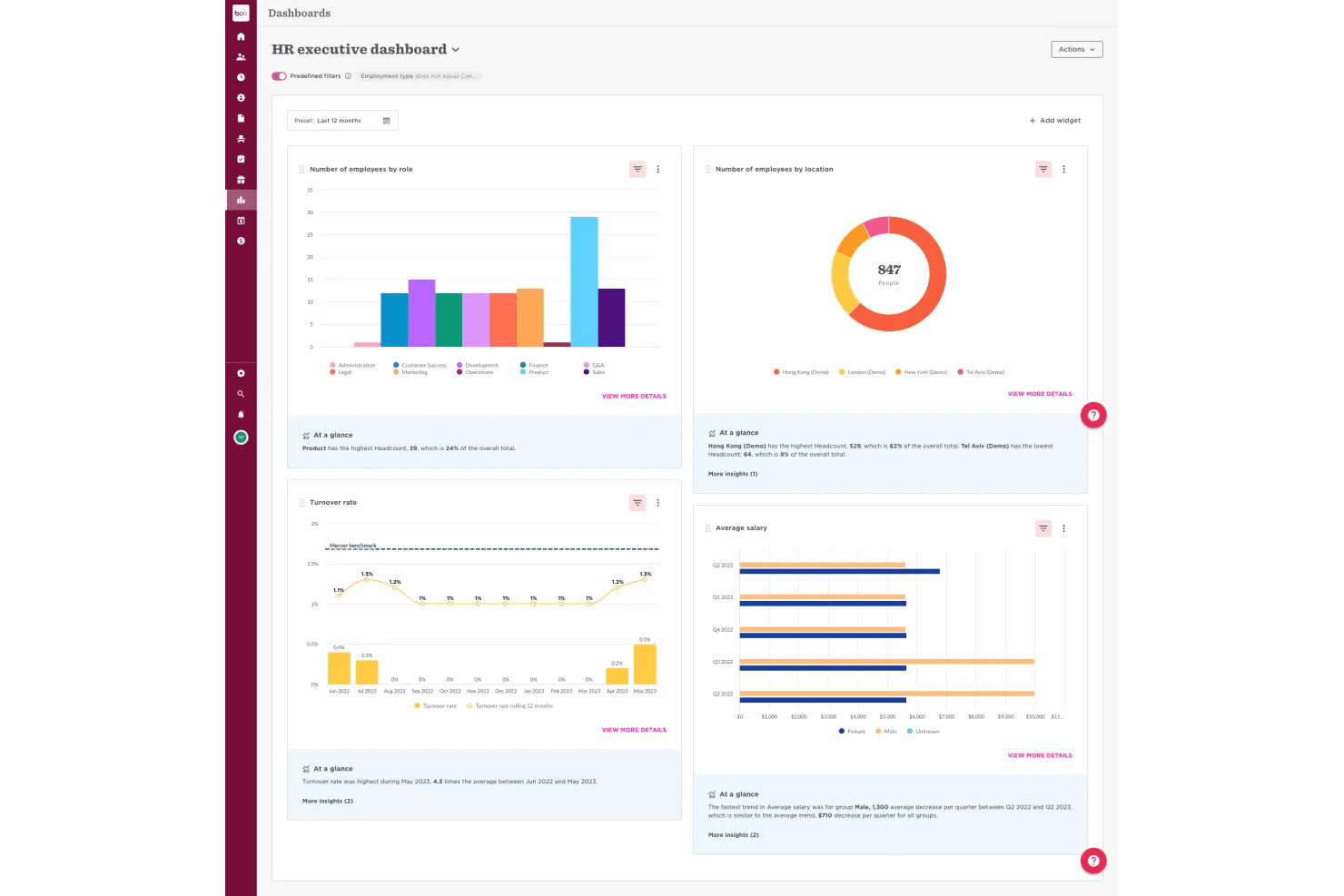
HiBob provides HR leaders with an executive analytics dashboard. HiBob is an AI-powered human capital management (HCM) platform with a compensation planning module that supports salary bands, compensation cycles, budget controls, pay equity analysis, and scenario modeling.
Who Is HiBob Best For?
HiBob is best for HR, People Operations, and Finance teams at mid-market and enterprise organizations managing compensation cycles, salary structures, and workforce planning.
Why I Picked HiBob
I picked HiBob because its compensation module connects salary planning with workforce planning and Finance-approved budget controls. Managers can review proposed increases against budget limits, while real-time alerts identify potential overruns during compensation cycles. HiBob also includes an AI-powered pay equity analyzer that identifies gaps by role, level, gender, and location, allowing HR teams to review potential discrepancies before compensation decisions are finalized.
HiBob Key Features
- Global compensation cycles: Manage compensation reviews across currencies and locations with configurable workflows and role-specific salary bands.
- Multi-level approval workflows: Route compensation proposals based on role level, budget impact, location, and organizational hierarchy.
- Compensation analytics: Monitor budget utilization, pay equity metrics, cycle progress, and manager compensation decisions.
- Job Catalog: Define job roles, levels, and pay bands to support compensation planning and salary structures.
HiBob Integrations
HiBob Marketplace integrations include ADP Workforce Now (US), Google Workspace, Okta, OneLogin, Slack, and Zalaris Payroll. HiBob also offers a public API and webhooks for custom integrations, with OAuth-based connectivity available to approved Marketplace partners.
Pros and Cons
Pros:
- Explainable AI considers performance, benchmarks, and budgets
- Multi-currency cycles pair budgets with scenarios
- Real-time budget guardrails flag manager overruns
Cons:
- OAuth integrations require approved partner status
- Mercer benchmarking requires separate package purchase
 Best for modeling workforce cost trade-offs
- Free demo available
- Pricing upon request
Visit WebsiteCustomer Rating:4.8/5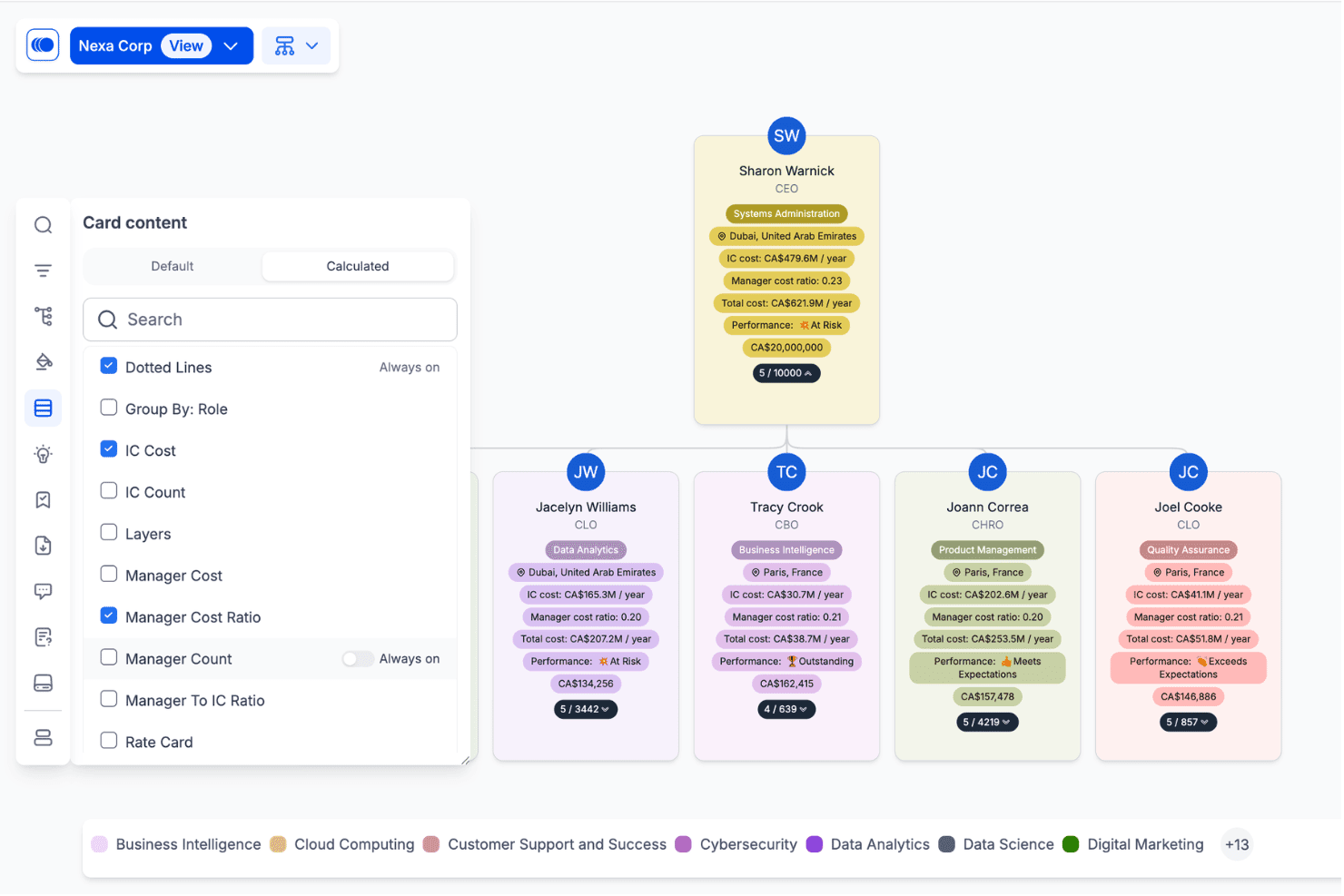
Agentnoon lets users customize org chart card content and view cost metrics. Agentnoon, now part of Dayforce Strategic Workforce Planning, is a workforce planning platform that supports headcount forecasting, organizational scenario modeling, and workforce cost analysis using employee data and AI-assisted planning tools.
Who Is Agentnoon Best For?
Agentnoon is best for HR and finance leaders who need to model workforce scenarios, evaluate organizational structures, and compare headcount costs when planning workforce changes.
Why I Picked Agentnoon
I picked Agentnoon because it supports workforce scenario planning across headcount, organizational structure, and labor costs. Now part of Dayforce, it lets HR and finance teams compare proposed workforce changes, review cost implications, and create presentation materials for stakeholder discussions. Its natural-language planning capabilities also support organizational scenario exploration without requiring users to start with a predefined report.
Agentnoon Key Features
- Workforce scenario modeling: Create full-organization, department-level, or new-team scenarios to evaluate proposed changes to positions, reporting structures, and salaries.
- Headcount and cost forecasting: Review projected workforce costs and headcount changes across monthly, quarterly, or annual planning periods.
- Organizational structure analysis: Analyze reporting layers, spans of control, headcount distribution, and workforce costs using configurable charts.
- Workforce planning presentations: Create slide packs from workforce charts, customize presentation content, and export reports to PowerPoint.
Agentnoon Integrations
Agentnoon, now part of Dayforce, supports workforce data imports from HRIS platforms such as Workday, BambooHR, and ADP through CSV uploads or configured integrations. SFTP and REST API options are also documented for workforce data synchronization. Integration availability and refresh schedules depend on configuration.
Pros and Cons
Pros:
- Explores skills and costs through plain-language questions
- Visualizes organizational structures and headcount variance
- Compares workforce cost scenarios before headcount decisions
Cons:
- Manual imports require administrator refreshes
- Scenario changes require separate HRIS updates
Learn more about Agentnoon: 10Best for AI that can change planning settings
Aeqium
- Free demo available
- From $15,000/year
Visit WebsiteCustomer Rating:4.6/5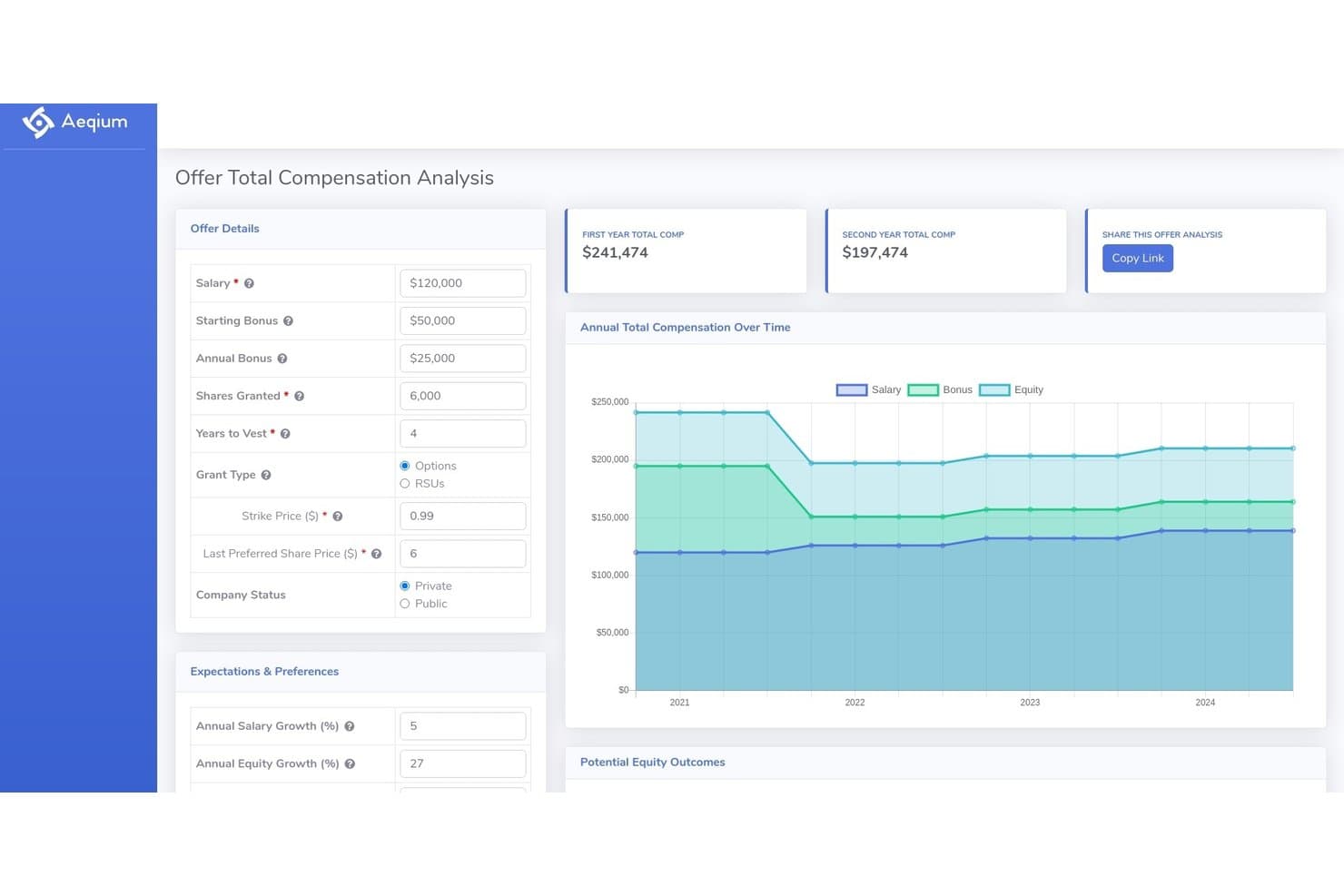
Aeqium lets users analyze total compensation offers with equity and bonus breakdowns. Aeqium is an AI-powered compensation planning platform for managing merit, bonus, and equity cycles. It includes configurable approval workflows, budget scenario modeling, and compensation analytics.
Who Is Aeqium Best For?
Aeqium is best for total rewards and compensation teams that manage merit, bonus, and equity planning cycles and need to configure eligibility rules, approval workflows, and budget allocations without IT support.
Why I Picked Aeqium
I picked Aeqium for its AI-assisted compensation configuration and reporting capabilities. Aeqium Assist applies changes to cycle settings, including eligibility rules and approval workflows, based on plain-language instructions. Aeqium Analyst lets compensation teams query current and historical compensation data and generate reports identifying patterns, outliers, and recommendations without manually building spreadsheets.
Aeqium Key Features
- Pay equity analysis: Analyze compensation gaps across employee groups using regression-based reporting and demographic breakdowns, available as an add-on.
- Compensation statements: Generate personalized compensation statements for employees at the end of a review cycle.
- Interactive offer letters: Present salary, equity, and benefits information with an equity offer simulator for comparing grant scenarios.
- Budget guardrails: Configure budget limits and approval rules for manager compensation recommendations during planning cycles.
Aeqium Integrations
Aeqium lists native integrations with BambooHR, Workday, Rippling, ADP Workforce Now, SAP, Xero, and TriNet HR Plus. It also supports CSV uploads and custom integrations through API or SFTP connections.
Pros and Cons
Pros:
- Configurable approval chains support complex workflows
- Budget scenarios update in real time
- AI can directly change cycle settings
Cons:
- Draft band publishing cannot be undone
- Market benchmarks require separately licensed survey data
Learn more about Aeqium:
Other AI Compensation Planning Software
Here are a few additional options that didn’t make my shortlist but are still worth checking out:
- 11Deel ServicesBest for gated manager access to pay bands
- 12AnaplanBest for forecasting deferred bonus payouts
- 13SAPBest for SAP Employee Central pay planning
- 14LatticeBest for linking performance reviews to pay
- 15WorkleapBest for showing employees total rewards
- 16SyndioBest for EU pay transparency compliance
- 17HRSoftBest for pay planning across org hierarchies
- 18PequityBest for linking market data to pay cycles
- 19Salary.comBest for in-platform survey participation
- 20PayfactorsBest for year-round manager pay decisions
How I Evaluate AI Compensation Planning Software
To make this list, a tool’s AI needs to handle compensation work, like recommending pay and flagging equity gaps. From there, I evaluate three things. Core functionality carries the most weight, like allocating budgets and managing approvals. Then I look at standout features, like manager talking points, and beyond-feature factors, like the credibility of market data.
Core Functionality (Table Stakes For This List)
When I'm selecting tools for my list, I score each one on a scale from 0 (does not offer the functionality) to 5 (excels in this area) for each core functionality listed below. I then convert the total into a percentage to help assess each tool's overall fit, with extra weight on any functionalities I’ve deemed essential.
- AI Pay Recommendations (Essential): I look for recommendations informed by factors such as role, performance, and market data, with enough explanation for HR to review them.
- Compensation Budgeting (Essential): I assess whether managers can allocate merit, bonus, and equity budgets within limits and track their teams’ proposed changes.
- Pay Equity Analysis: I check whether teams can identify disparities across employee groups and review potential corrections before a compensation cycle closes.
- Market Benchmarking: I consider the roles and markets covered, how current the data is, and whether comparisons help HR assess pay bands.
- Approval Workflows: I look for configurable review steps, role-based access, status tracking, and records of manager and HR decisions.
- Scenario Modeling: I assess whether HR can compare budget scenarios by changing assumptions and reviewing projected costs across teams.
Once I have a list of tools that meet the criteria, I consider what sets each platform apart.
Differentiating Factors (What Sets Vendors Apart)
Here's how I compare and contrast different vendors:
Standout Features
Manager enablement tools matter a lot here. I look for guided talking points and simulation features that help managers explain pay decisions with confidence—especially during merit cycles when employees ask, "Why this number?" Platforms like beqom and Aeqium approach this differently, so I check how actionable the guidance actually is. I also evaluate equity and long-term incentive modeling, since many organizations need to present RSUs or stock options alongside cash comp in a single view. HRIS and payroll sync rounds this out: bi-directional, real-time data flow prevents the spreadsheet reconciliation that derails tight review timelines.
Beyond Features
I evaluate how each vendor sources and refreshes market data. Platforms pulling from verified third-party surveys on a quarterly cadence give compensation teams stronger footing when defending recommendations to leadership than those relying on crowdsourced inputs. Data privacy governance matters just as much—I check for SOC 2 or ISO 27001 certifications and whether role-based access controls limit salary visibility by hierarchy. I also look at integration depth, since native HRIS and payroll connectors cut manual reconciliation during tight review cycles.
How to Choose AI Compensation Planning Software
Choose a platform by testing whether its pay decisions are explainable, its data is traceable, and its controls fit your compensation process.
| If Your Priority Is | Look For |
|---|---|
| If Your Priority IsExplaining pay recommendations | Look ForA sample rationale that identifies decision factors and records overrides |
| If Your Priority IsReviewing pay equity | Look ForA documented method for identifying gaps and assessing proposed corrections |
| If Your Priority IsKeeping managers within budget | Look ForClear rules for allocating and tracking each team’s compensation pool |
| If Your Priority IsDefending market comparisons | Look ForBenchmark documentation with data sources, job matches, and refresh dates |
How to Vet Your Shortlist
- Trace a recommendation: Request one anonymized example and have an HR reviewer match its stated rationale to the inputs and decision record.
- Check benchmark evidence: Ask for the methodology document and latest refresh date, then compare its job matches with three roles your team hires or reviews.
- Test budget controls: Use a trial task with a fictional team and fixed pool; change two proposed awards and confirm the resulting allocation against your rules.
- Choose your guidance model: Use your written compensation policy as the decision filter—favor configurable rules when exceptions matter most, or more prescriptive guidance when consistent recommendations across managers matter more.
What Is AI Compensation Planning Software?
AI compensation planning software uses artificial intelligence and pay data to support pay reviews, budget allocation, and pay equity analysis. HR teams can use it to assess recommendations, model compensation costs, and manage approvals. Human reviewers should check recommendations and retain control over final pay decisions.
Features
Here are the main features I look for in AI compensation planning software:
- AI pay recommendations: The system suggests pay changes based on factors such as role, performance, and market data. HR should be able to review the reasoning and adjust recommendations before decisions are finalized.
- Budget allocation and tracking: HR sets compensation pools and managers propose merit, bonus, or equity awards within those limits. The software tracks proposed changes against each team’s available budget.
- Pay equity analysis: The tool compares compensation across employee groups to identify potential pay disparities. HR can review the findings and consider adjustments before a compensation cycle closes.
- Market benchmarking: Compensation teams compare employee pay with market data for relevant roles and locations. Clear job matches, data sources, and refresh dates help HR assess whether comparisons fit.
- Approval workflows: Configurable review steps route proposed pay changes to the right managers and HR reviewers. Role-based access, status tracking, and decision records help teams manage approvals.
- Scenario modeling: HR adjusts assumptions, such as budget limits or award levels, to compare projected compensation costs across different planning scenarios.
- Manager guidance: The platform can provide talking points or guidance to help managers explain pay decisions. HR can check that the material reflects the organization’s compensation policies.
- HRIS and payroll integrations: Data connections transfer employee and compensation records between systems. Integration capabilities, including bidirectional syncing and refresh frequency, vary by provider.
Benefits
Here are a few common benefits you can expect from AI compensation planning software:
- Greater oversight of AI recommendations: HR teams can review the factors behind suggested pay changes and adjust proposals before final approval.
- Better control over compensation budgets: Budget comparisons help HR and finance teams identify proposed allocations that exceed established spending limits.
- Opportunities for earlier pay equity reviews: Compensation analysis helps HR identify potential disparities and consider adjustments during the planning cycle.
- More context for compensation decisions: Market comparisons provide external pay references that HR can assess alongside internal salary structures.
- Greater accountability in approval processes: Recorded decisions and approval histories help teams identify who reviewed, modified, or authorized compensation changes.
- Improved visibility into projected costs: Scenario comparisons help HR and finance teams assess the financial implications of different compensation plans before finalizing budgets.
- More structured pay discussions: Manager guidance provides reference points for explaining compensation decisions according to established company policies.
Pricing
Pricing varies by features, employee count, and contract terms. Most vendors provide pricing upon request, so treat published starting prices as reference points rather than standard per-user rates.
Plan Comparison Table for AI Compensation Planning Software
| Pricing Type | Typical Price | Common Features |
|---|---|---|
| Pricing TypeCustom Compensation Planning | Typical PricePricing upon request | Common FeaturesCompensation budgeting, pay recommendations, approval workflows, and pay equity analysis. |
| Pricing TypeCustom Workforce Planning | Typical PricePricing upon request | Common FeaturesScenario modeling, headcount forecasting, organizational analysis, and workforce cost planning. |
| Pricing TypePublished Annual Subscription | Typical PriceFrom $15,000/year (Aeqium) | Common FeaturesBudget scenario modeling, compensation analytics, and configurable approval workflows. |
FAQs
Some answers to common questions about AI compensation planning software:
Does AI compensation planning software make final pay decisions?
No. AI compensation planning software should support recommendations and analysis, while authorized people make final pay decisions. Before launch, define who can recommend, review, approve, and override each change. Ask vendors whether the system records the inputs, rationale, reviewer, and any override. During a cycle, HR should review exceptions and confirm recommendations fit documented pay policies, budgets, and applicable requirements. Treat an AI score as a prompt for review, not a substitute for judgment or employee-specific context.
How should HR validate AI pay recommendations?
Validate recommendations before managers see them by testing representative roles, locations, performance levels, and compensation histories. Check whether the system uses the right employee data and whether its rationale matches your pay policy. Ask HR and compensation reviewers to inspect unusual results, compare patterns across employee groups, and record overrides. Then run a small pilot and review manager changes, approval outcomes, and employee questions before expanding. Repeat checks after data changes or model updates; one initial review won’t tell you whether results stay suitable.
Can managers see only their team’s pay data?
Often, yes, but the exact access controls depend on the product and your configuration. Ask the vendor to show how permissions restrict employee-level salary details, team views, and approval actions. Test with separate manager, HR, and executive accounts using sample records before opening a live cycle. Check whether access follows reporting lines and whether HR can audit permission changes. Don’t assume a manager dashboard hides every sensitive field; verify what users can export, download, or see in notifications.
What data should we prepare before implementation?
Prepare employee records, job levels, current salaries, compensation ranges, budgets, and reporting relationships. Performance ratings and market benchmarks may also be required, depending on the software and compensation process. Before importing data, review missing job codes, duplicate records, inconsistent currencies, and outdated reporting structures. Ask vendors which fields are mandatory, how employee data is updated, and whether corrections are supported during active compensation cycles.