

10 Best Employers of Record in Pakistan in 2026

10 Best Employers of Record in Pakistan Shortlist


An employer of record in Pakistan legally employs workers on your behalf and manages local payroll and employment administration. The right provider depends on where your team will work, the province-level compliance support you need, and whether you plan to convert contractors or hire in other countries.
This shortlist compares providers by their Pakistan services, operating models, and local HR support to help you choose a fit for your hiring plans.
Comparison Table: Employers of Record in Pakistan
Compare pricing and specs side by side for the employers of record in Pakistan that made it onto my shortlist:
| Tool | Best For | Trial Info | Price | ||
|---|---|---|---|---|---|
| 1 | Best for hiring across Pakistan's provinces | Free demo available | From $319/user/month | Website | |
| 2 | Best for contractor-to-employee conversion in Pakistan | Free demo available | From $599/user//month | Website | |
| 3 | Best for hiring in Pakistan without a local entity | Free demo available | From $199/user/month | Website | |
| 4 | Best for owned-entity hiring across Pakistan | Free demo available | From $299/user/month | Website | |
| 5 | Best for multi-country scale beyond Pakistan | Free demo available | From $699/user/month | Website | |
| 6 | Best for province-level Pakistan compliance | Free demo available | From $199/user/month | Website | |
| 7 | Best for province-by-province Pakistani hiring | Free demo available | From $99/user/month | Website | |
| 8 | Best for hiring in Pakistan via owned entity | Free demo available | From $699/user/month | Website | |
| 9 | Best for multi-province Pakistani workforce compliance | Free demo available | From $459/user/month | Website | |
| 10 | Best for Baker McKenzie-vetted Pakistan compliance | Free demo available | From $399/user/month | Website |

Employers of Record in Pakistan Reviews
Below are my detailed summaries of the best employers of record in Pakistan that made it onto my shortlist. My reviews cover each provider’s compliance support, payroll services, and local HR expertise to help you find the right fit.

Best for hiring across Pakistan's provinces
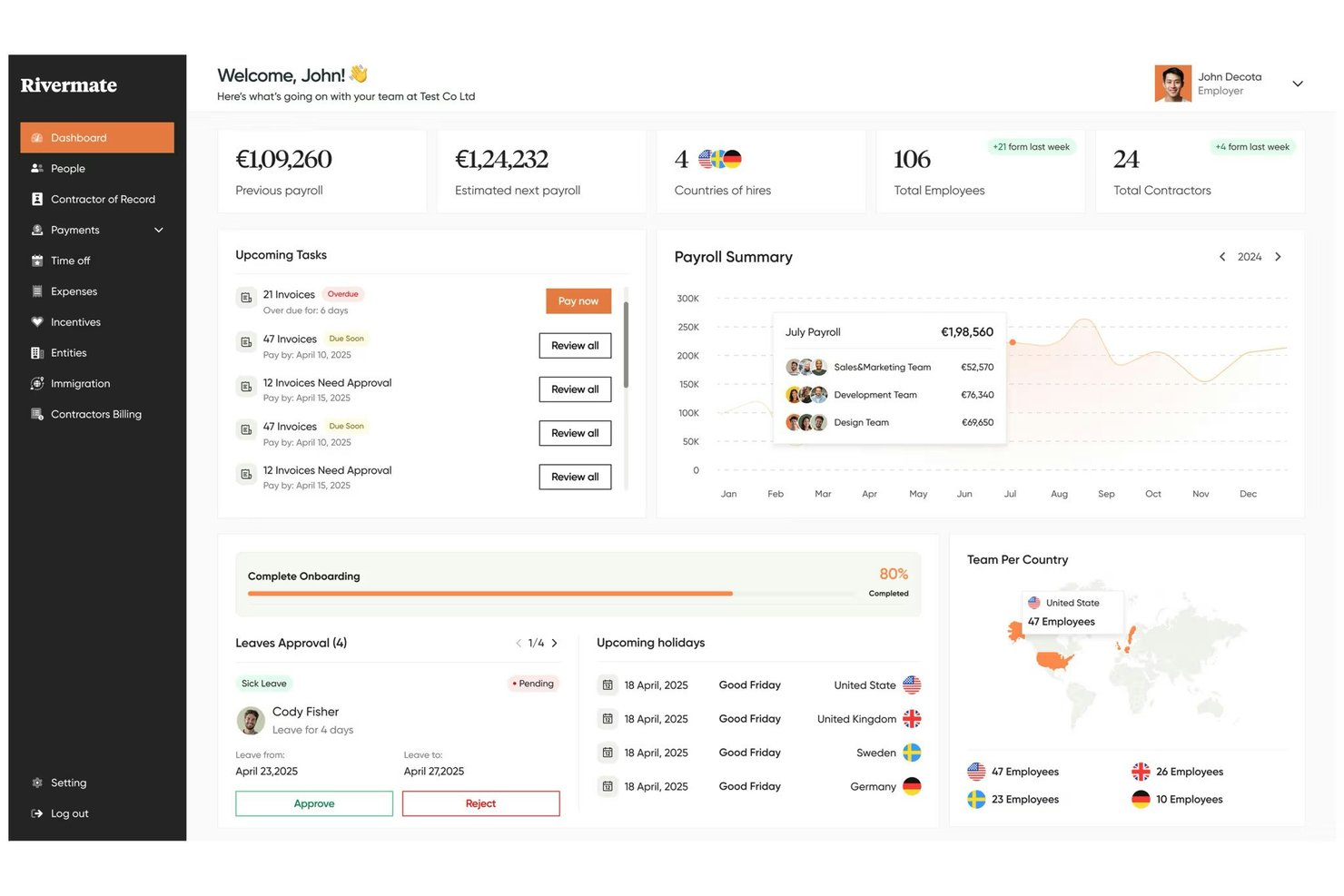
Rivermate is an employer of record platform that covers 180+ countries and handles Pakistani payroll in PKR, statutory benefits like EOBI and provincial social security, bilingual employment contracts, and work permit support.
Who Is Rivermate Best For?
Rivermate is a strong fit for globally expanding companies that need to hire across multiple Pakistani provinces without navigating the country's fragmented, region-specific labor regulations.
Why I Picked Rivermate
I've included Rivermate in my top picks because it's one of the few EOR platforms that explicitly handles Pakistan's fragmented provincial labor landscape, covering distinct minimum wages, social security schemes, and leave rules across Punjab, Sindh, KPK, and Balochistan. I particularly like that it generates bilingual English/Urdu employment contracts tailored to each province and processes EOBI contributions alongside provincial social security automatically. If your team is hiring in multiple Pakistani provinces at once, that built-in provincial compliance coverage is genuinely hard to replicate manually.
Rivermate Key Features
- Provincial minimum wage tracking: Rivermate applies the correct minimum wage for each province, covering distinct rates across Punjab, Sindh, KPK, and Balochistan.
- Salary cost calculator: An employment cost simulator breaks down total monthly PKR payroll costs, including taxes and statutory contributions, before you commit.
- End-to-end work permit management: Rivermate handles Pakistani work visa applications, eligibility checks, renewals, and dependent visas for foreign national hires.
- Dedicated account manager: Every client gets a named account manager reachable via Slack, WhatsApp, email, or phone for day-to-day support.
Rivermate Integrations
Rivermate doesn't have any clearly documented native integrations. Its Pakistan content mentions HRIS, payroll, Slack, and ATS connectivity without naming specific vendors.
Pros and Cons
Pros:
- Handles PKR payroll and statutory contributions
- Reviewers praise responsive human account managers
- Tracks province-specific wage and leave rules
Cons:
- Some reviewers mention salary errors or delays
- Reviewers report limited payroll reporting visibility

Best for contractor-to-employee conversion in Pakistan
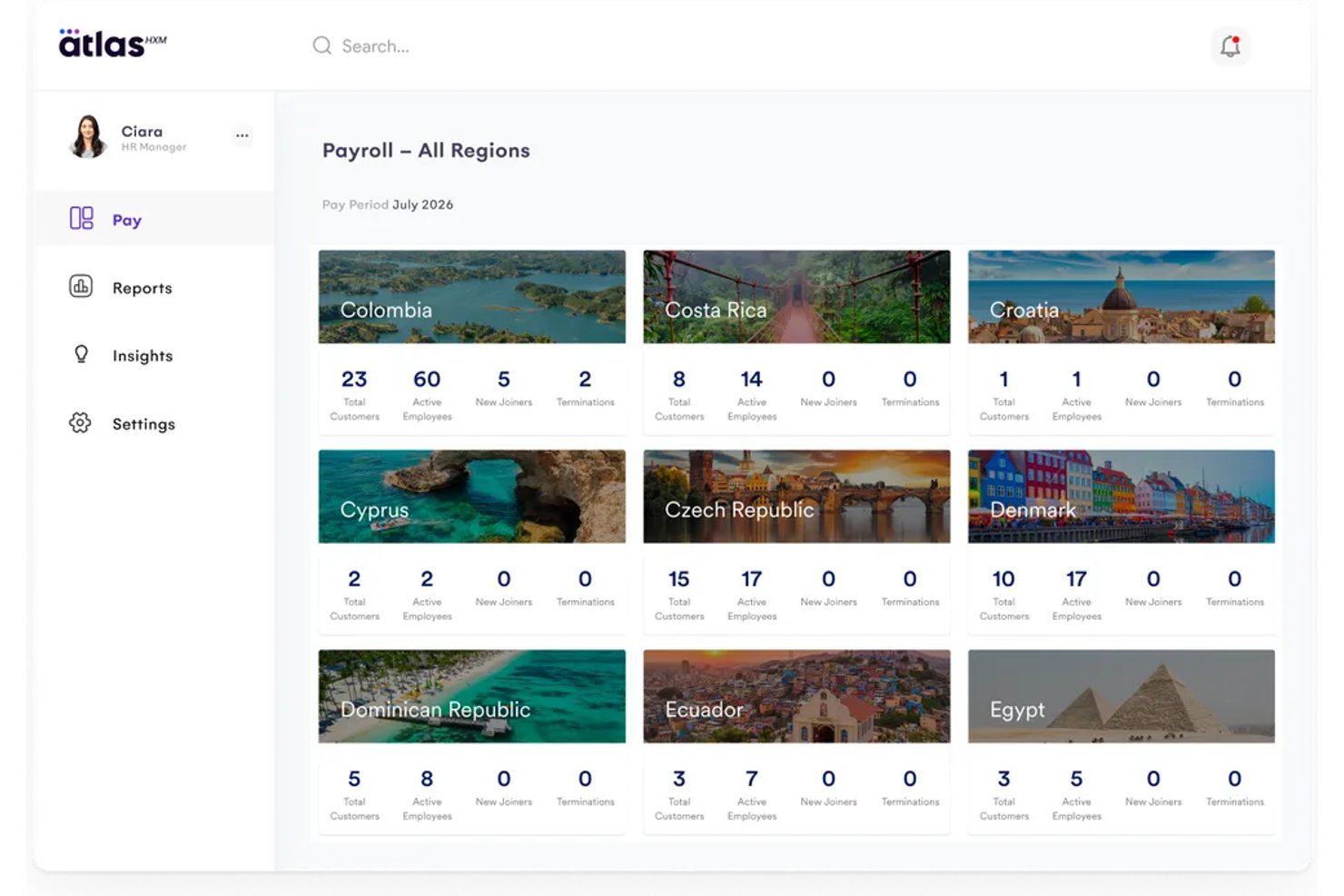
Atlas HXM is an employer of record platform that employs workers in Pakistan through its own direct legal entity, handling payroll in PKR, provincial labor law compliance, statutory contributions, and contractor-to-employee conversion across all four provinces and the Islamabad Capital Territory.
Who Is Atlas HXM Best For?
Atlas HXM is a strong fit for global expansion teams that need to bring Pakistan-based contractors onto compliant employment contracts without setting up a local entity.
Why I Picked Atlas HXM
I've included Atlas HXM in my top picks because its Agent of Record product makes contractor-to-employee conversion a structured process, not an afterthought. It includes a misclassification assessment with up to $100k in classification protection per contractor, and the $99 assessment fee gets credited toward the subscription if the worker converts to an EOR employee. Atlas also owns its legal entity in Pakistan directly, covering provincial labor law differences across Punjab, Sindh, KPK, Balochistan, and the Islamabad Capital Territory in a single engagement.
Atlas HXM Key Features
- Provincial payroll compliance: Payroll runs in PKR with automated income tax withholding, EOBI contributions, and provincial social security deductions across all four provinces and ICT.
- Dedicated HR consultant: Each account gets a named HR consultant backed by in-region experts and 24-hour human support in 15+ languages.
- Anomaly detection in payroll: The payroll engine flags irregularities before processing, with full audit trails and a 2–5 day pre-payday funding window.
- Multi-country centralized reporting: A single dashboard covers headcount, payroll, and compliance data across 160+ countries, with cost comparisons by country.
Atlas HXM Integrations
Atlas HXM lists integrations with Workday, BambooHR, Sage, Ashby, Paycor, UKG, and Dayforce, plus SSO through Okta, Microsoft, and Google Workspace. API access supports custom integrations.
Pros and Cons
Pros:
- Contractor conversion includes classification protection
- Provincial compliance mapping covers five jurisdictions
- Direct-owned Pakistan entity supports accountability
Cons:
- Some reviewers report payroll timing issues
- Gratuity and provident fund remain unconfirmed

Gloroots
Best for hiring in Pakistan without a local entity
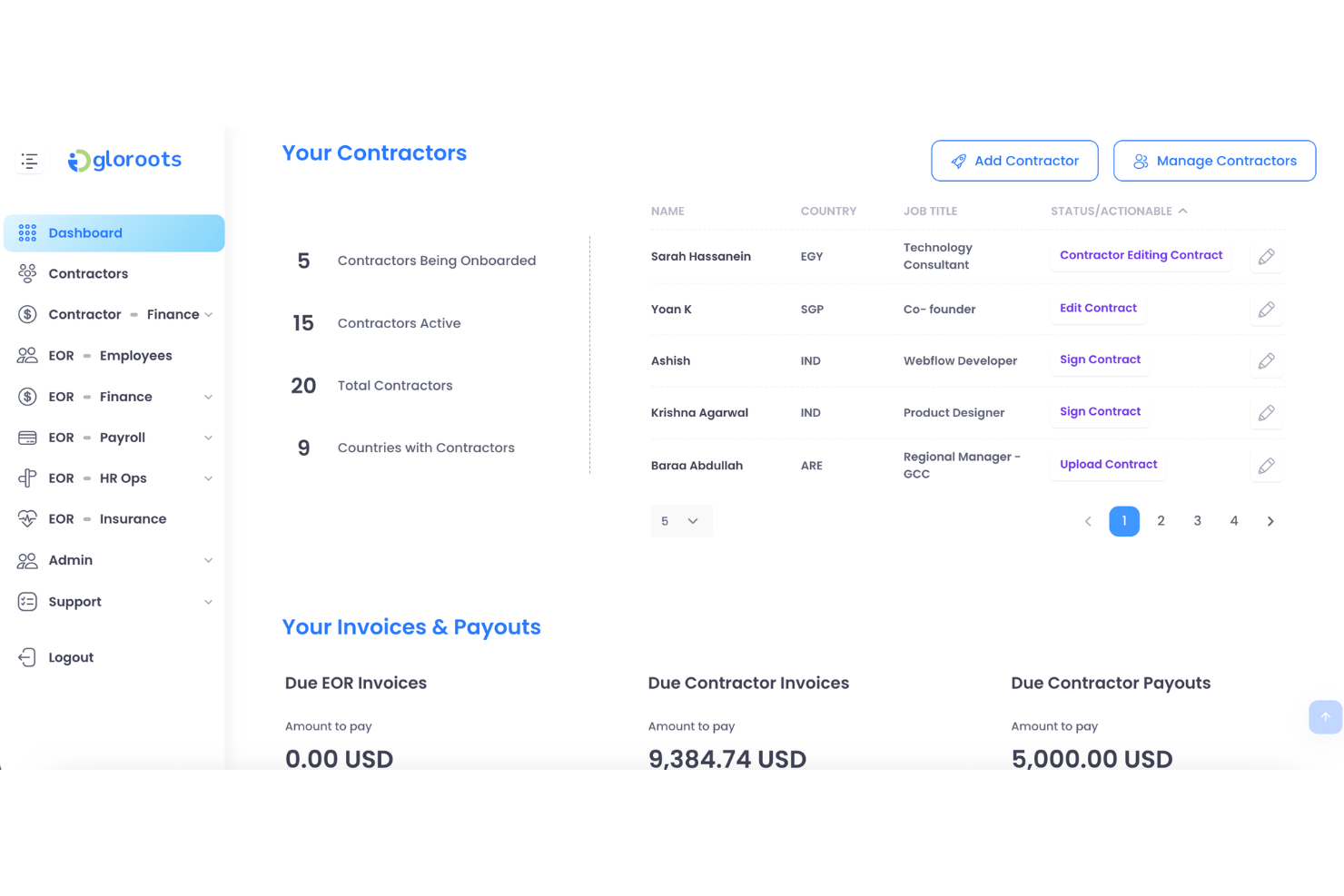
Gloroots is an employer of record platform with its own registered legal entity in Pakistan that handles local payroll in PKR, FBR tax withholding, statutory contributions, compliant contract drafting, and contractor-to-employee conversion.
Who Is Gloroots Best For?
Gloroots suits startups and small teams that want to hire in Pakistan quickly, without the cost or time of setting up a local entity.
Why I Picked Gloroots
I picked Gloroots as one of the best because it operates through its own registered legal entity in Pakistan rather than relying on a partner network, which matters when your payroll runs through FBR tax withholding and four separate provincial social security bodies (PESSI, SESSI, KPESSI, and BESSI). I especially like its contractor-to-employee conversion workflow, which handles backdated statutory enrollment and payroll from the conversion date, a real advantage if you've been working with Pakistani contractors and need to bring them onto compliant employment contracts fast. Onboarding typically wraps up in three to five days.
Gloroots Key Features
- Provincial social security enrollment: Gloroots registers employees with all four provincial social security bodies—PESSI, SESSI, KPESSI, and BESSI—depending on where they're based.
- Multi-currency payroll funding: Clients can fund payroll in USD or crypto, which Gloroots converts to PKR for employee payments.
- Misclassification risk checker: A free tool that flags contractor misclassification risk before you convert workers to employees.
- Electronically signed, localized contracts: Contracts include IP and invention-rights clauses and are stored centrally for audit access.
Gloroots Integrations
Native integrations are not clearly documented. Gloroots offers an enterprise-grade API for custom integrations, but no verified native connectors are listed.
Pros and Cons
Pros:
- Responsive support praised by G2 reviewers
- Converts contractors with backdated statutory enrollment
- Handles Pakistan’s provincial social security enrollment
Cons:
- Conflicting published leave and employer cost figures
- Cannot sponsor Pakistan work visas
Mercans
Best for owned-entity hiring across Pakistan
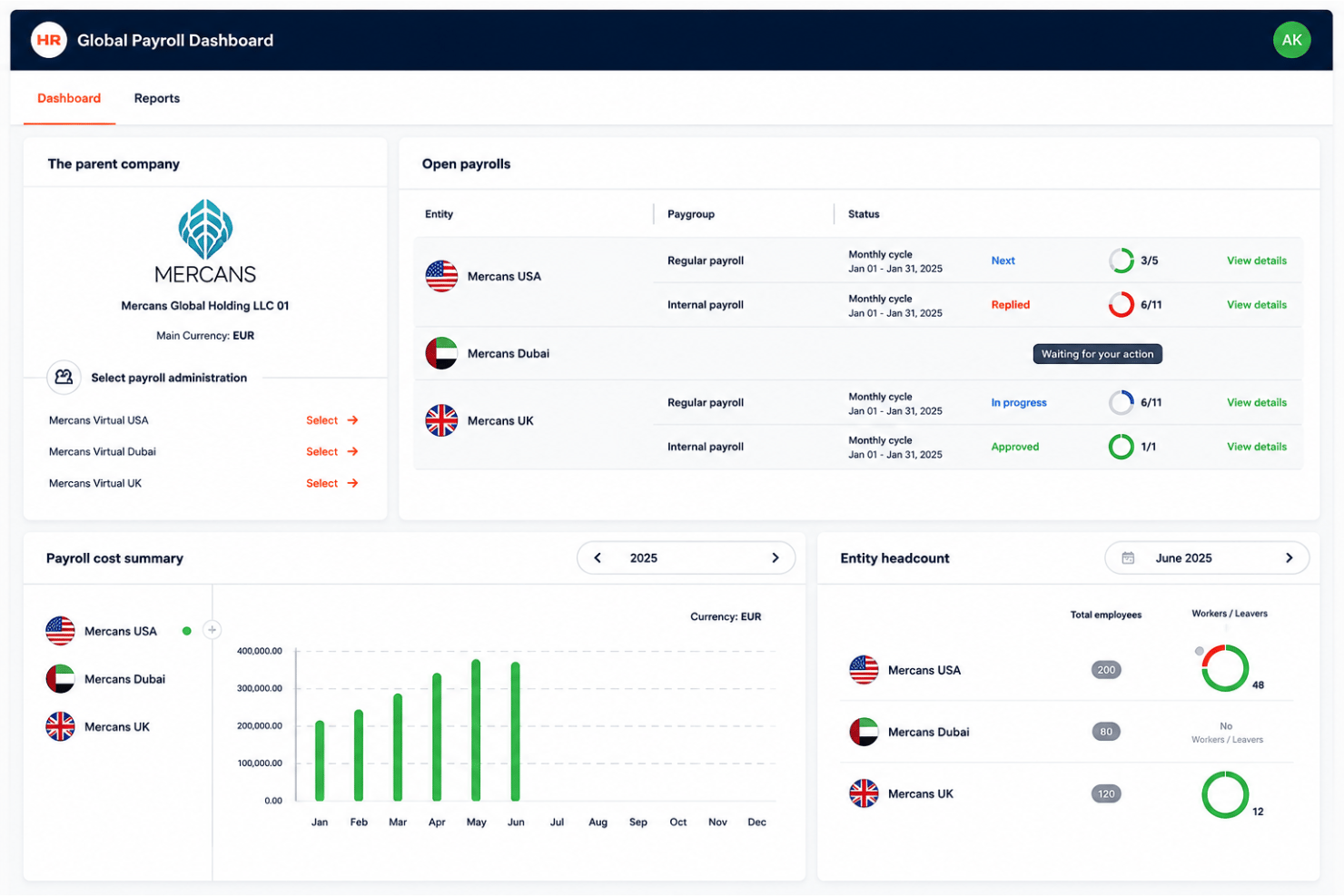
Mercans is an employer of record platform with its own legal entity in Pakistan that handles local payroll, statutory benefits, contract management, and work permit support across 160+ countries through its proprietary HR Blizz system.
Who Is Mercans Best For?
Mercans is a strong fit for global expansion teams that want direct legal entity employment in Pakistan without relying on third-party aggregators.
Why I Picked Mercans
Mercans earns its spot on my shortlist because it owns a legal entity in Pakistan directly, which means your workers are employed through Mercans itself rather than a third-party provider. I find that distinction meaningful: when a termination dispute arises under the Standing Orders Ordinance 1968, there's no aggregator in the middle muddying liability. I also like that the platform covers Pakistan-specific details like provincial social security variations, gratuity calculations, and 2026 FBR tax slab withholding all within HR Blizz.
Mercans Key Features
- Multi-currency payroll processing: HR Blizz runs payroll in 103 currencies, with funds held by your organization until two days before the pay cycle runs.
- HCM system integrations: Pre-built, two-way connectors link HR Blizz to Workday, Oracle Cloud HCM, BambooHR, UKG Pro, and other HCM or ERP platforms.
- Dedicated account manager: A single point of contact handles HR and payroll advisory, replacing the need to coordinate across multiple service teams.
- Visa and work permit administration: Mercans manages expatriate visa applications, work permit documentation, and Board of Investment filings for foreign nationals working in Pakistan.
Mercans Integrations
Mercans offers documented integrations with Workday and Oracle Cloud HCM for HR and payroll data exchange. HR Blizz also supports APIs for custom integrations.
Pros and Cons
Pros:
- Dedicated account managers handle HR queries
- Reviewers praise local labor-law knowledge
- Mercans employs directly through its Pakistan entity
Cons:
- Sparse reviews limit independent validation
- Conflicting EOBI and social security rates

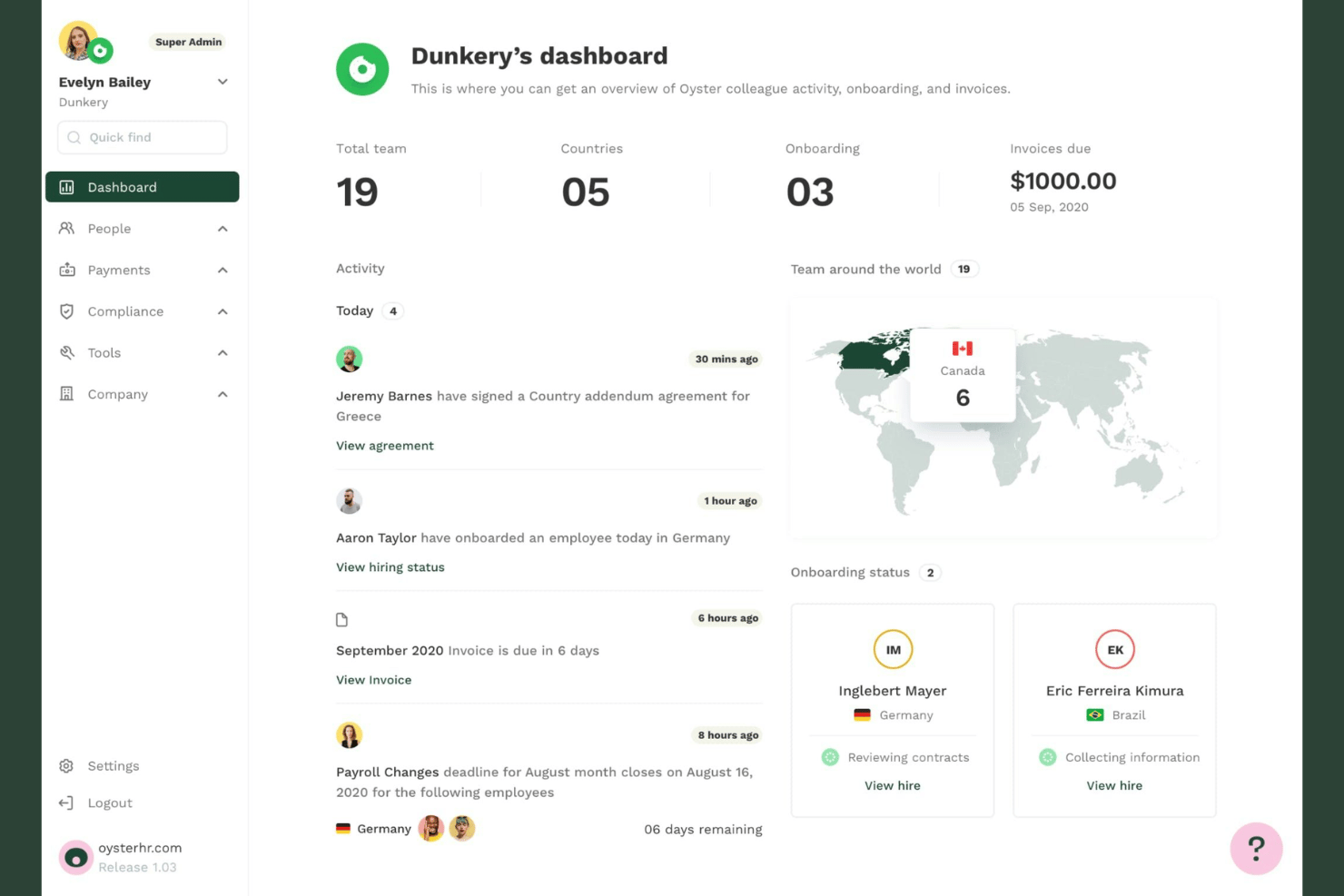
Oyster is a global employer of record platform that handles employment contracts, payroll processing, statutory benefits, and compliance across 120+ countries, including Pakistan.
Who Is Oyster Best For?
Oyster is a strong fit for global expansion teams that are hiring in Pakistan as part of a broader, multi-country workforce strategy.
Why I Picked Oyster
I've included Oyster in my top picks because it's the only platform where I can pair Pakistan EOR with active hiring in 120+ other countries, all without switching tools. If your Pakistan hire is one piece of a broader global headcount push, Oyster's multi-country contract management and salary benchmarking across 130+ countries handle the full picture. I also like that Oyster maps provincial labor code variations for Pakistan, covering EOBI, provincial social security, and Workers' Welfare Fund differences across regions.
Oyster Key Features
- Contract quality scoring: Oyster benchmarks your Pakistan employment contracts against local legal standards and flags terms that fall outside acceptable ranges.
- Contractor conversion tooling: A built-in misclassification risk analyzer and guided three-step conversion process helps you move Pakistan contractors to compliant employee status.
- Multi-currency payroll funding: Fund Pakistan payroll in USD, EUR, GBP, or CAD, with automatic PKR conversion and payslip generation included.
- HRIS and ATS integrations: Oyster connects with HiBob, BambooHR, Greenhouse, Ashby, and others, keeping Pakistan employee data in sync across your existing HR stack.
Oyster Integrations
Oyster offers native integrations with HiBob, BambooHR, Personio, Greenhouse, Ashby, Workable, Xero, QuickBooks, SAP Concur, and Carta. It also provides an API for custom integrations and supports Zapier.
Pros and Cons
Pros:
- Fast onboarding receives positive user feedback
- Localized contract review and legal guidance
- Pakistan-specific labor rules and payroll support
Cons:
- Users report support delays and payroll visibility gaps
- Pakistan entity-versus-partner model remains unclear

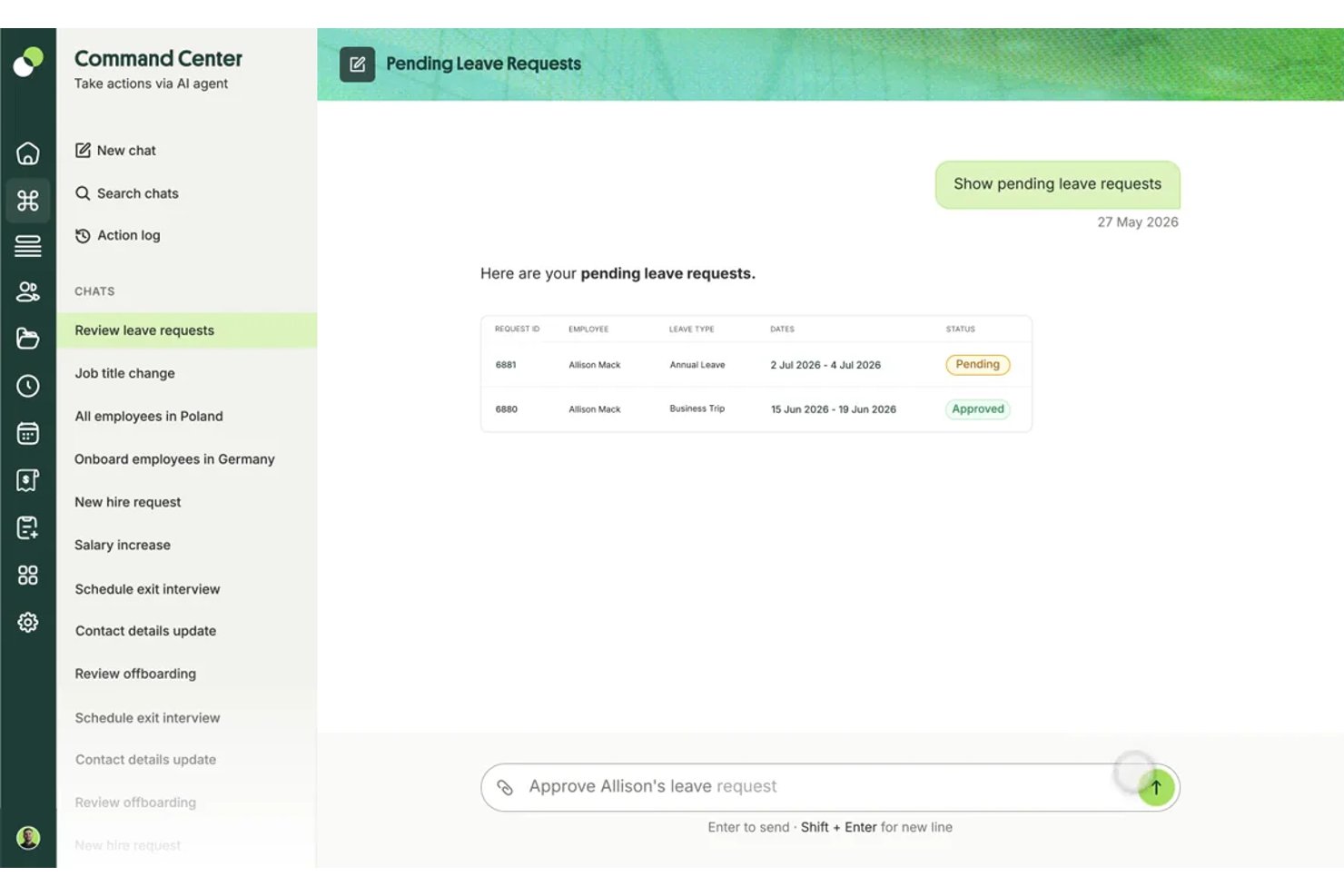
Remote People is an employer of record platform covering 150+ countries that handles Pakistani payroll, statutory contributions (EOBI, ESSI, WWF), labor law compliance across all four provinces, contract drafting, and visa sponsorship for foreign nationals.
Who Is Remote People Best For?
Remote People works well for companies hiring across multiple Pakistani provinces, where navigating different ESSI rates, minimum wages, and maternity leave rules requires granular, location-specific compliance support.
Why I Picked Remote People
I've included Remote People in my top picks because its province-level compliance coverage is the most granular I've seen for Pakistan specifically. It breaks out ESSI rates by province (6% in Punjab, KP, and Balochistan versus 7% in Sindh), maps maternity leave entitlements across ICT, Sindh, Punjab, KP, and Balochistan separately, and tracks minimum wage differences between PKR 40,000 and PKR 37,000 in Balochistan. If you're hiring across multiple provinces, that detail keeps you from applying a one-size-fits-all policy that puts you offside with local law.
Remote People Key Features
- BOI work visa sponsorship: Remote People manages Board of Investment visa applications for foreign nationals, covering Categories A and B and SEZ fast-track visas, with an assigned immigration manager per case.
- FBR income tax withholding: Payroll processing includes automatic withholding under current FBR tax slabs, including the surcharge on high earners, so your Pakistani workers are tax-compliant from day one.
- Bilingual contract drafting: Employment contracts are drafted in either Urdu or English, as permanent or fixed-term agreements, under the Standing Orders Ordinance 1968, typically within 2–3 days of onboarding.
- AI Command Center: An AI-assisted HR tool lets you submit people requests in plain language, with human specialists reviewing changes and every action logged to an audit trail.
Remote People Integrations
Remote People offers integrations with QuickBooks, Xero, BambooHR, ADP Workforce, 7shifts, Google Workspace, Okta, Gusto, Paycom, and Square Payroll. It doesn’t have an open API, and integration depth is limited.
Pros and Cons
Pros:
- Urdu and English contract drafting
- EOBI, ESSI, and FBR withholding
- Province-level compliance detail
Cons:
- Payroll documentation delays reported
- Pakistan entity ownership remains unclear

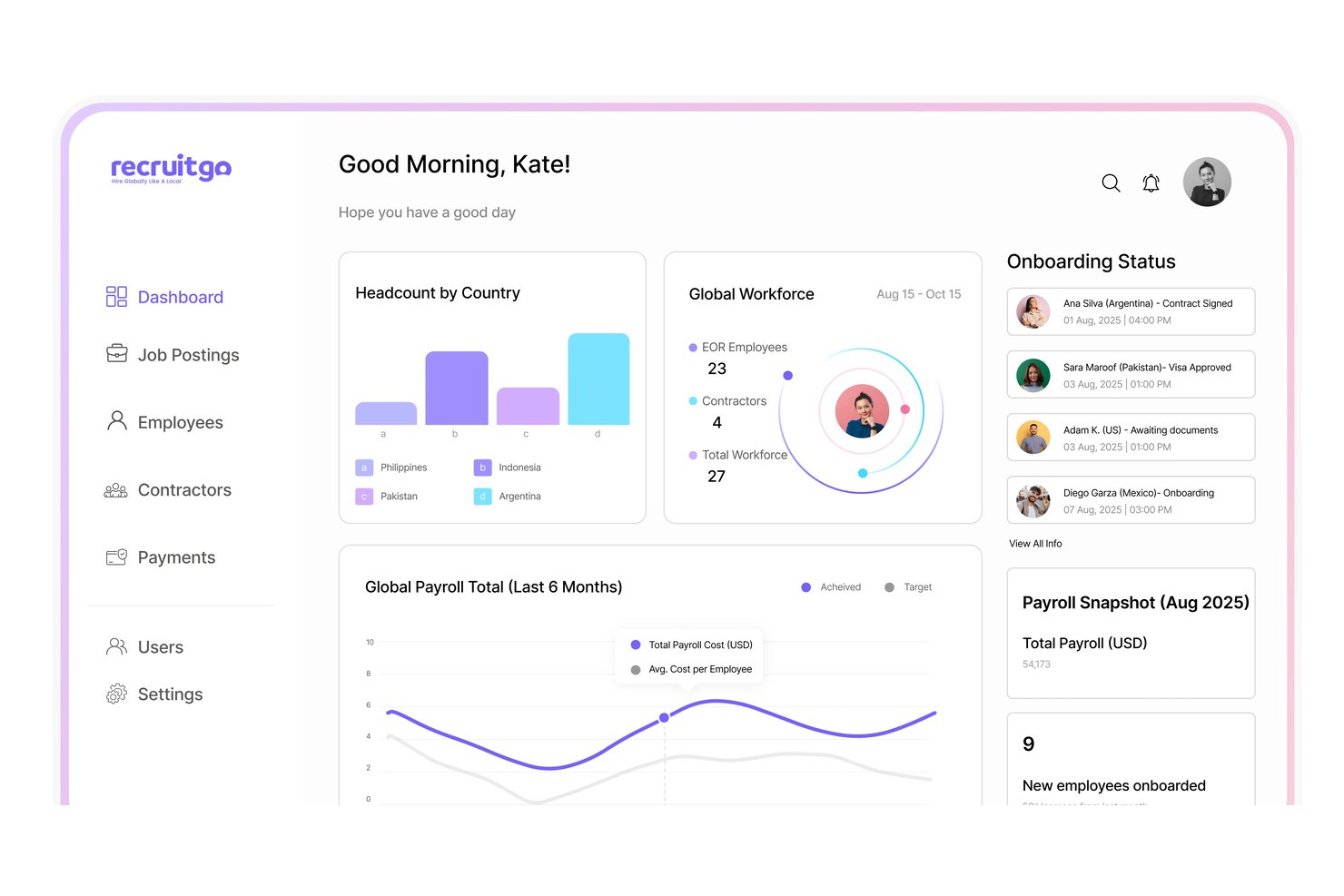
RecruitGo is an employer of record platform covering Pakistan and 40+ countries, handling local payroll in PKR, statutory benefits, labor law compliance, and contract drafting across all four provinces.
Who Is RecruitGo Best For?
RecruitGo is a strong fit for companies hiring across multiple Pakistani provinces who need compliance mapped to each region's distinct labor laws.
Why I Picked RecruitGo
I picked RecruitGo as one of the best because its provincial labor law mapping is genuinely detailed in a way I haven't seen elsewhere: it breaks down minimum wages, social security bodies, sick leave entitlements, and gratuity rules across Punjab, Sindh, KPK, Balochistan, and Islamabad Capital Territory. That matters when you're onboarding someone in Karachi versus Lahore, since the rules aren't the same. I also like that contractor-to-employee conversion is built into the workflow, with a misclassification risk assessment before onboarding begins.
RecruitGo Key Features
- PKR payroll dashboard: A client-facing dashboard displays payslips, cost breakdowns, and multi-country payroll reports in one place, with a dedicated payroll manager assigned to your account.
- Contractor-to-employee conversion: RecruitGo runs a misclassification risk assessment before onboarding and completes the conversion to compliant employment in 5–10 business days.
- Statutory contributions management: RecruitGo calculates and administers EOBI, provincial social security (PESSI, SESSI, PESCI, BESSI), and gratuity accruals on your behalf each pay cycle.
- FBR tax withholding and ATL registration: Income tax is withheld monthly under current FBR slabs, and RecruitGo handles Active Taxpayer List registration and annual tax reconciliation for each employee.
RecruitGo Integrations
RecruitGo integrates with AanyaHR and Talenta to import employee details, and Xero to retrieve invoice data.
Pros and Cons
Pros:
- Contractor conversion includes risk assessment
- Province-specific labor law mapping
- Responsive local payroll support
Cons:
- Visa assistance appears advisory only
- Pakistan entity ownership remains unclear

Remote
Best for hiring in Pakistan via owned entity
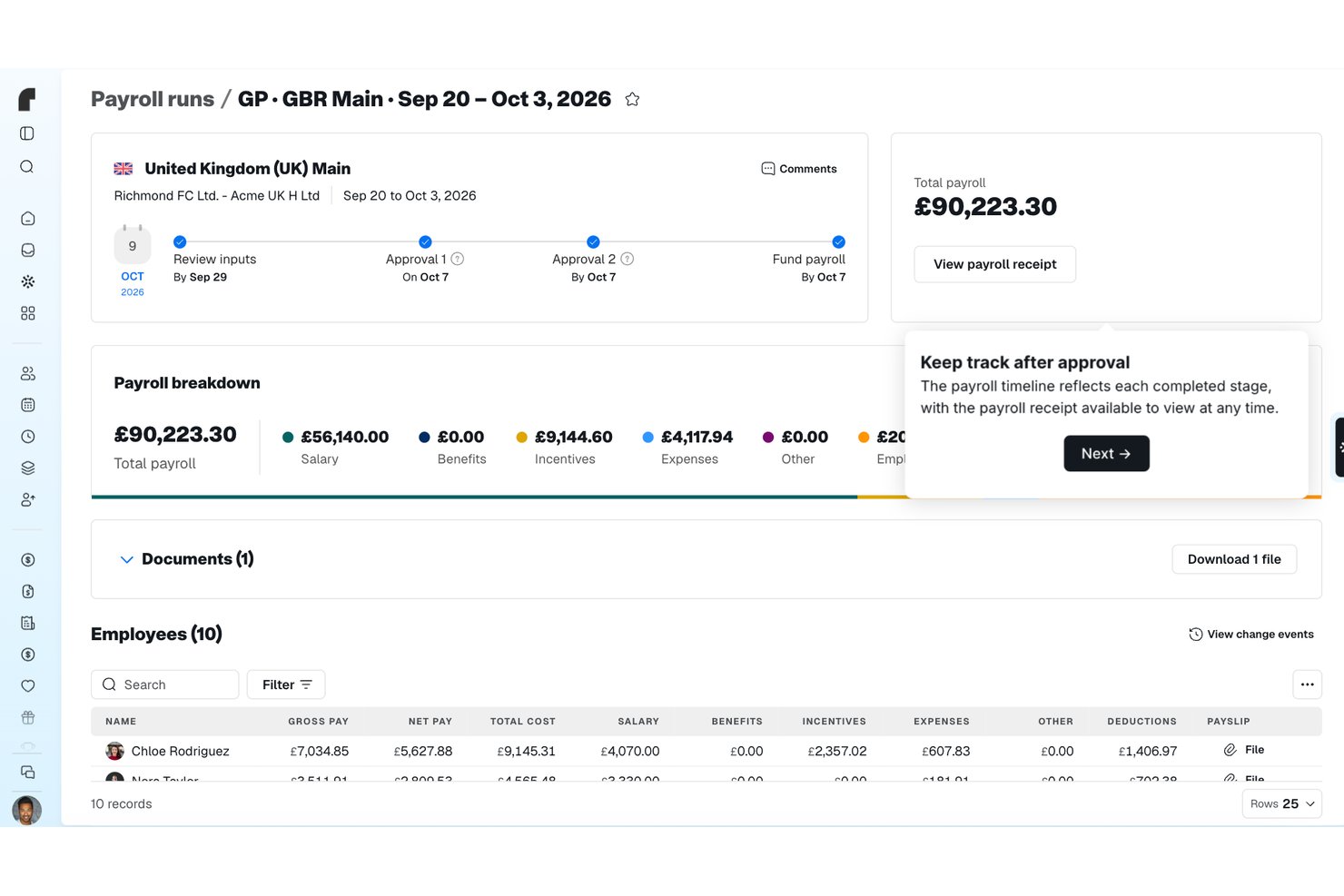
Remote is a payroll and employment provider that lets you hire workers in Pakistan without a local entity, handling contracts, payroll in PKR, and local compliance through its own legal entity on the ground.
Who Is Remote Best For?
Remote is a strong fit for companies hiring their first employee in Pakistan and wanting direct legal accountability through an owned local entity.
Why I Picked Remote
Remote earns its spot on my shortlist because it owns its legal entity in Pakistan outright, with no third-party intermediaries handling compliance or payroll on its behalf. That direct accountability matters when you're hiring your first employee in Karachi or Lahore and need to know exactly who's responsible if something goes wrong. I also like that Remote auto-generates Pakistan-specific employment contracts and manages the full contractor-to-employee conversion process, including right-to-work checks and statutory benefit enrollment, without you needing to raise a support ticket.
Remote Key Features
- Compliance Watchtower: Tracks legal changes across 90+ countries so your Pakistan employment contracts and policies stay current without manual monitoring.
- Unlimited indemnity coverage: Remote assumes full legal liability as the employer of record, with no caps on compliance-related claims.
- Contractor misclassification risk calculator: A built-in tool that assesses classification risk for your Pakistan-based contractors before you decide whether to convert them.
- Split salary payments: Pakistani employees can divide their PKR salary across multiple bank accounts directly through the Remote platform.
Remote Integrations
Remote lists 20 integrations, including BambooHR, Workday, HiBob, Personio, Okta, Greenhouse, QuickBooks, Xero, NetSuite, and Zapier. These connect HR, payroll, accounting, identity, and recruiting workflows for Pakistan-based employees.
Pros and Cons
Pros:
- Reviewers praise onboarding and responsive support
- Contractor conversion preserves employee account continuity
- Owned Pakistani entity avoids third-party employer handoffs
Cons:
- Users report billing and termination handling complaints
- Pakistan page omits EOBI and provincial contributions

Best for multi-province Pakistani workforce compliance
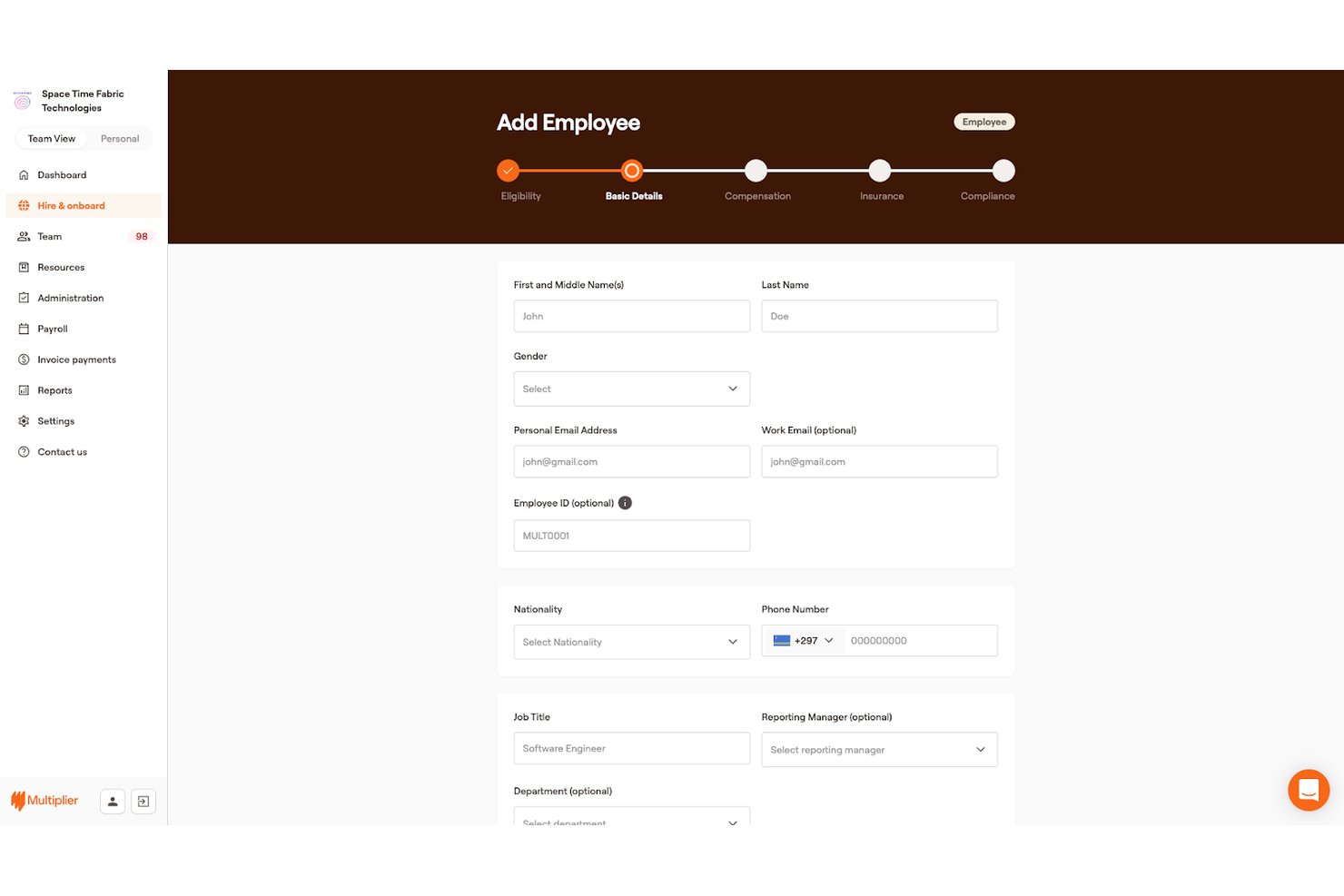
Multiplier is a global employer of record platform with a wholly-owned entity in Pakistan that handles local payroll in PKR, statutory benefits administration, multi-province labor law compliance, and contract generation.
Who Is Multiplier Best For?
Multiplier is a strong fit for global expansion teams and HR managers who need to hire across multiple Pakistani provinces without setting up a local entity.
Why I Picked Multiplier
I've included Multiplier in my top picks because it tracks labor law differences across all four Pakistani provinces, covering distinct minimum wage rates, maternity leave durations, and social security schemes like PESSI in Punjab and SESSI in Sindh. That level of provincial granularity is genuinely rare. I also like that Multiplier's payroll engine automates EOBI and PESSI/SESSI contributions separately, so filings reflect the correct provincial rules rather than a one-size-fits-all federal approach.
Multiplier Key Features
- Onboarding speed: Multiplier onboards employees in Pakistan in as little as 24–72 hours, compared to the 2–3 months it typically takes to set up a local entity.
- Multi-currency billing: Clients can be invoiced in USD, SGD, AUD, EUR, or GBP while employees receive pay in PKR at mid-market exchange rates.
- Contract generation in English and Urdu: Multiplier auto-generates localized employment contracts covering probation, leave, working hours, and notice periods in either language.
- Integrated immigration support: The platform includes work permit applications and dependent visa assistance across 140+ countries, including Pakistan.
Multiplier Integrations
Multiplier integrates with Workday, HiBob, BambooHR, and Personio. HRIS integrations and API access for custom connections are available on the Growth plan.
Pros and Cons
Pros:
- Reviews praise responsive support and quick onboarding
- Own entity carries local employer obligations
- Tracks distinct labor rules across provinces
Cons:
- Foreign-worker sponsorship details remain unclear
- Reviews report invoice errors and processing delays

Pebl
Best for Baker McKenzie-vetted Pakistan compliance
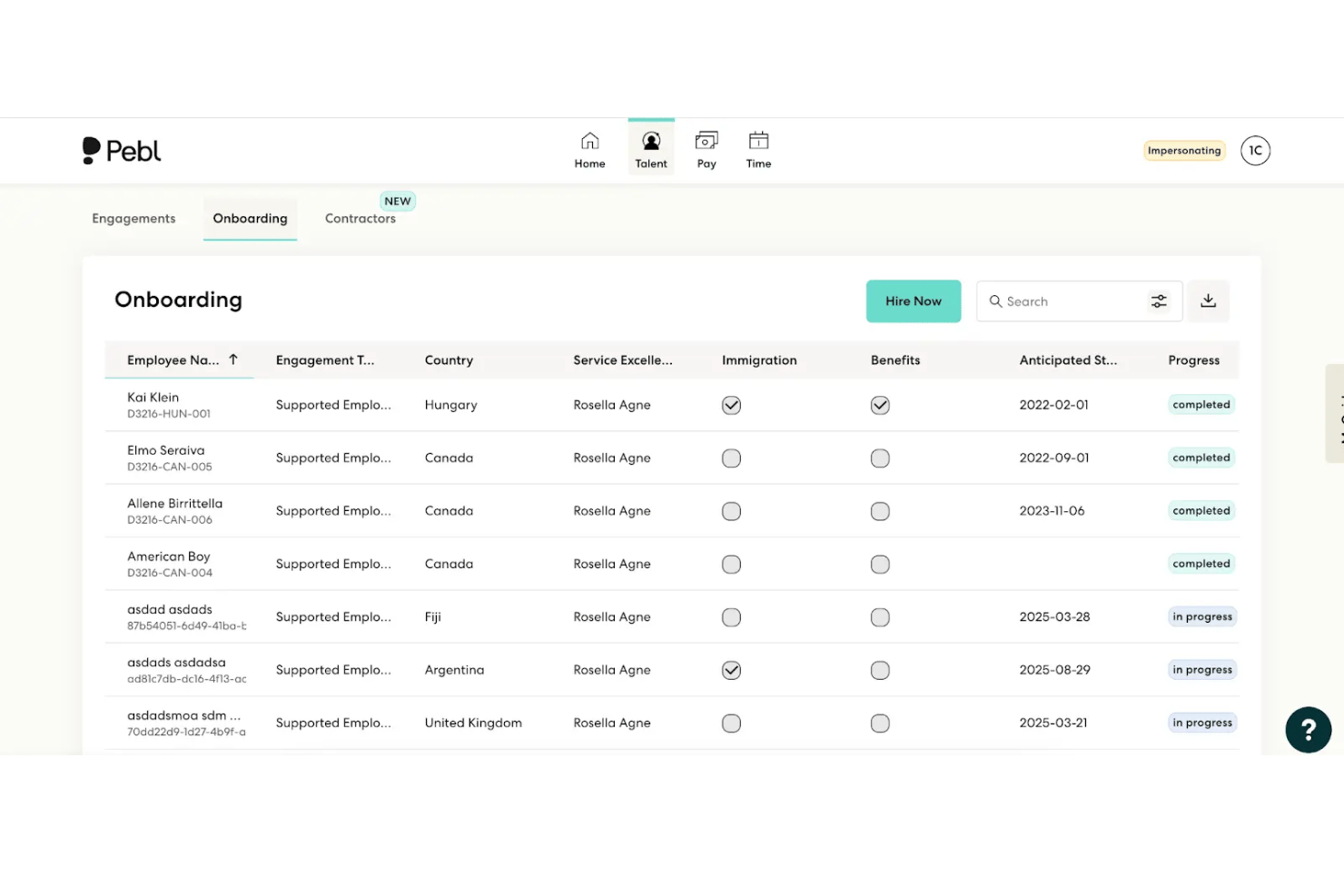
Pebl is an employer of record platform that handles entity-free hiring in Pakistan, covering local payroll in PKR, statutory benefits administration, labor law compliance, and work visa support across 185+ countries.
Who Is Pebl Best For?
Pebl is a strong fit for global expansion leads and HR teams that need Pakistan hiring backed by Baker McKenzie-vetted legal guidance across payroll, benefits, and labor law compliance.
Why I Picked Pebl
I've included Pebl in my top picks because its Pakistan compliance content is vetted by Baker McKenzie, which gives it a legal credibility layer I haven't seen matched elsewhere in this category. In practice, that means my team can rely on its documented guidance covering provincial payroll variations, EOBI and ESSI filings, and statutory benefits like gratuity and the profit bonus, knowing a top-tier law firm has reviewed it. Pebl's in-house immigration team also handles the full Pakistan Employment Visa process, including BOI applications and Ministry of Interior security clearance.
Pebl Key Features
- PKR payroll with multi-authority filing: Pebl processes salaries in Pakistani rupees and handles withholding, EOBI, and provincial social security filings across federal and provincial tax authorities.
- Employment Visa sponsorship: Pebl's in-house immigration team manages the full Pakistan Employment Visa process, including BOI applications and Ministry of Interior security clearance.
- 250+ HR and finance integrations: Connect Pebl to tools like BambooHR, HiBob, ADP Workforce Now, Greenhouse, NetSuite, and QuickBooks via native integrations or API access.
- AI compliance assistant: Alfie, Pebl's built-in AI assistant, answers compliance questions on-demand and is backed by human success managers for escalations.
Pebl Integrations
Pebl offers 250+ documented integrations, including BambooHR, HiBob, Greenhouse, ADP Workforce Now, NetSuite, QuickBooks, and SAP Concur. API access is included for custom connections.
Pros and Cons
Pros:
- In-house team manages visa sponsorship
- PKR payroll covers provincial filings
- Baker McKenzie-vetted Pakistan compliance
Cons:
- Reviewers report delays in complex cases
- Pakistan entity ownership remains undisclosed
Other Employers of Record in Pakistan
Here are a few additional options that didn’t make my shortlist but are still worth checking out:
- Payoneer Workforce Management
For Payoneer-backed PKR payroll at scale
- TopSource
For dedicated local HR expert access
- Rippling
For converting Pakistani contractors to employees
- Papaya Global
For multi-country payroll with unified reporting
- Borderless AI
For flat-rate Pakistan hiring at scale
- INS Global
For market entry without a local entity
- WorkMotion
For province-by-province Pakistan compliance
- Tarmack
For multi-country expansion starting in Pakistan
- Playroll
For transparent flat-rate Pakistan hiring
- Cadana
For fintech-backed PKR payroll at scale


How I Evaluate Employer of Record Pakistan
I split my evaluation into three parts. First—and most important—core functionality: the provider must legally employ workers in Pakistan and keep contracts and terminations compliant with local labor law. Then I look at standout features like provincial labor law mapping. Finally, I consider cost transparency and local HR advisory access.
Core Functionality (Table Stakes for This List)
When I'm selecting tools for my list, I score each one on a scale from 0 (does not offer the functionality) to 5 (excels in this area) for each core functionality listed below. I then convert the total into a percentage to help assess each tool's overall fit, with extra weight on any functionalities I've deemed essential.
- Local Entity Employment (Essential): I check whether the provider holds a owned entity in Pakistan or relies on third-party partners, and how much compliance oversight they maintain over that structure.
- Pakistani Labor Law Compliance (Essential): I look for providers that tailor contracts, termination procedures, and leave policies to Pakistan's provincial labor regulations rather than offering generic templates.
- Local Payroll Processing: Accurate PKR salary disbursement with correct statutory deductions like income tax and EOBI matters here. I evaluate how automated the payroll cycle is and whether clients get real-time visibility into calculations.
- Statutory Benefits Administration: Providers like Mercans and Remote People handle social security, provident fund, and gratuity differently. I look at which mandatory benefits each provider actively administers versus simply advising on.
- Contract Drafting and Management: I evaluate whether generated employment contracts reflect Pakistani legal requirements out of the box or need heavy customization from your team before they're usable.
- Visa and Work Permit Support: For teams placing foreign nationals in Pakistan, I consider how much of the work permit process the provider manages end-to-end versus handing paperwork back to the client.
Once I have a list of tools that meet the criteria, I consider what sets each platform apart.
Differentiating Factors (What Sets Vendors Apart)
Here's how I compare and contrast different vendors:
Standout Features
Provincial labor law mapping is the first thing I check. Pakistan's labor codes differ across Punjab, Sindh, KPK, and Balochistan, so I look at whether a provider tracks leave entitlements, termination rules, and social security obligations per province or just applies a single national template. Contractor-to-EOR conversion also matters—I evaluate how smoothly a provider can transition an existing contractor into a compliant employee without gaps in pay or coverage. Providers like Atlas HXM and Remote each handle this differently, and the workflow details affect how fast your team can move. Finally, I consider local HR advisory access, since having an in-country expert available for questions about cultural norms or regulatory gray areas saves HR teams from costly missteps during onboarding or offboarding.
Beyond Features
I evaluate how clearly each provider itemizes Pakistan's statutory costs—EOBI contributions, gratuity, and provincial social security—since vague "all-in" pricing makes it hard to forecast your true employer burden. Onboarding speed matters too; in a competitive talent market, a provider that takes weeks to generate compliant contracts can cost you a top candidate. I also check whether liability for misclassification or compliance gaps sits with the EOR or shifts back to you, because that distinction shapes your long-term legal exposure as you scale headcount across provinces.
How to Choose an Employer of Record in Pakistan
Choose an EOR by testing how its employment model handles the worker’s province, statutory costs, and your planned hiring changes.
| If Your Priority Is… | Look For… |
|---|---|
| Province-specific compliance | Written guidance for the worker’s province on leave and termination requirements |
| Clear employer-cost forecasts | A sample breakdown separating salary, EOBI, provincial social security, and gratuity |
| Moving a contractor to employment | A transition plan showing contract, payroll, and coverage start dates |
| Hiring foreign nationals | Written confirmation of which work-permit tasks the provider handles |
How to Vet Your Shortlist
- Test provincial guidance: Request a sample employment contract and leave policy for the province where your first hire will work; compare their terms with your requirements.
- Reconcile statutory costs: Ask for one sample monthly payroll calculation showing salary, income tax, EOBI, provincial social security, and any gratuity accrual as separate lines.
- Check transition timing: For a planned contractor conversion, request a dated onboarding checklist that identifies when the new employment contract and payroll take effect.
- Put responsibility in writing: Request the agreement clause describing who handles payroll corrections and compliance issues, and review it before signing.
- Choose your operating model: If direct local oversight matters most, weigh an owned entity against a partner-based model; use the contract’s responsibility clause to decide how much oversight you need.
What Are Employers of Record in Pakistan?
An employer of record in Pakistan is a third-party organization that legally employs workers on behalf of another company. It typically manages employment contracts, payroll, tax withholding, and local employment administration, while your company directs the employee’s day-to-day work.
Features
Here are the main features I look for in an employer of record in Pakistan:
- Local legal employment: The provider employs your workers through its own Pakistani entity or a local partner. Confirm which model it uses and who remains responsible for employment obligations.
- Pakistan labor law compliance: The provider adapts employment terms and processes to applicable national and provincial rules. This includes guidance on contracts, leave, and termination.
- PKR payroll and tax withholding: The provider calculates salaries in Pakistani rupees, applies required income tax withholding, and arranges salary payments. Payroll records help you review deductions and pay dates.
- Statutory benefits administration: The provider manages applicable contributions and benefits, such as EOBI, provincial social security, provident fund, or gratuity. Ask which items it administers and which it only advises on.
- Employment contract management: The provider prepares and maintains employment agreements that reflect local requirements and agreed terms. You can review details such as pay, role, and leave before onboarding.
- Leave and termination administration: The provider records leave and supports compliant offboarding based on the worker’s circumstances and location. Clear processes help your team manage final pay and required notices.
- Work permit support: For foreign nationals, the provider explains which work-permit steps it handles and which require your involvement. Confirm responsibilities and timelines before making an offer.
- Contractor-to-employee conversion: The provider coordinates the move from contractor status to formal employment, including contract and payroll start dates. A dated transition plan helps prevent gaps in pay or coverage.
Benefits
In my experience, Pakistan EOR services can offer several practical benefits:
- Local employment: An EOR can employ workers through its Pakistani entity or a local partner, so your business can hire without establishing its own entity.
- Provincial compliance: Locally tailored contracts, leave policies, and termination processes can help your team account for applicable provincial labor rules.
- PKR payroll: Payroll processing can calculate salaries in Pakistani rupees, with income tax withholding and payment records for review.
- Statutory benefits administration: EORs can manage applicable EOBI, provincial social security, provident fund, or gratuity obligations, depending on the provider and worker’s circumstances.
- Local HR guidance: Access to in-country HR expertise can help your team address questions about local practices and employment requirements.
- Contractor transitions: A planned contractor-to-employee process can coordinate contract, payroll, and coverage start dates to reduce gaps during the change.
- Work permit support: For foreign hires, an EOR can clarify which permit steps it handles and what your team needs to complete.
Costs and Pricing
EOR fees in Pakistan vary by provider, team size, and service scope. Most providers charge per employee, and the ranges below are indicative monthly service fees, not standardized plan prices. They exclude salary and employer statutory costs; a free plan for employing workers isn’t typical.
Plan Comparison Table for Employer of Record in Pakistan
| Plan Type | Average Price | Common Features |
|---|---|---|
| Free EOR Service | Not typically available | Free plans do not generally include legal employment, payroll processing, or local compliance services. |
| Lower-Cost EOR | $200–$400 per employee/month | Employment contract setup, PKR payroll, and basic HR support. |
| Standard EOR | $400–$800 per employee/month | Contract and payroll management, statutory benefits administration, and leave and termination support. |
| Enterprise EOR | Custom pricing | Multi-country payroll coordination, tailored compliance support, and dedicated HR advisory. |
FAQs
Here are answers to common questions about employer of record services in Pakistan.
Does an EOR replace the need to set up a Pakistani entity?
Usually, yes. An EOR can employ workers in Pakistan without your company first establishing a local entity. The EOR becomes the formal employer and handles agreed employment administration, while your team directs day-to-day work. This arrangement doesn’t automatically cover every activity your business may conduct in Pakistan. For example, local sales, licensing, tax registration, or other operations could create separate requirements. Before signing, confirm the EOR’s entity or partner model and ask local counsel whether your wider business plans require a Pakistani registration.
Do employment requirements differ across Pakistan’s provinces?
Yes. Pakistan’s labor requirements can vary by province and employment circumstances, so don’t assume one contract or policy works everywhere. The relevant rules can depend on where the employee works and the type of employment. Ask the EOR to confirm in writing which provincial rules it applies to the worker’s contract, leave, social security, and termination process. If you hire in Lahore and Karachi, request separate explanations for each location. That gives HR a clearer basis for checking obligations before onboarding or approving a transfer.
Which statutory costs should I ask an EOR to include in a quote?
Ask the EOR to identify each applicable cost rather than assume every contribution applies to every hire. EOBI, provincial social security, provident fund, and gratuity can appear in a Pakistan employment cost discussion, but eligibility and treatment may differ. Request a sample payroll breakdown showing gross salary, income tax withholding, each applicable employer contribution, any benefit accrual, and the EOR fee separately. Have the provider identify items it administers versus merely advises on. Compare vendors using the same assumptions before budgeting.
Can an EOR hire foreign nationals in Pakistan?
Yes, some EORs support employment of foreign nationals in Pakistan, but confirm the provider’s scope before making an offer. Ask what it handles: permit or visa filings, document guidance, and coordination with authorities. Get responsibilities, expected timing, and any fees in writing. Also verify that the worker can obtain and maintain the required authorization for the role and location. Don’t treat an employment contract as permission to work; confirm authorization separately before setting a start date.