

10 beste lønnssystemer for flere land i 2026

Kortliste over de beste lønnssystemene for flere land


Lønnssystemer for flere land lar deg administrere lønn og etterlevelse for ansatte og oppdragstakere i mer enn ett land fra én enkelt plattform. Hvis du bygger opp team på tvers av landegrenser, er dette den eneste måten å holde utbetalingene nøyaktige på, følge med på skatteregler og arbeide effektivt – uansett hvor medarbeiderne dine befinner seg.
I denne veiledningen finner du de beste lønnssystemene for flere land for 2026, vurdert ut fra global dekning, etterlevelse, integrasjoner og driftsmodeller, slik at du kan finne systemet som passer best til HR-prioriteringene og virksomhetens vekst.
Hvorfor du kan stole på våre programvareanbefalinger
Teamet vårt har testet og anmeldt programvare siden 2012. Vi er selv HR-eksperter, så vi vet hvor vanskelig og hvor viktig det er å velge riktig programvare.
I denne guiden har vi vurdert verktøyene gjennom praktisk testing og uavhengig research og gitt dem poeng ut fra våre utvelgelseskriterier. Vi bygger også på innsikt fra ledende eksperter i bransjen og erfarne HR-eksperter.
Anmeldelsene våre bygger på vår egen redaksjonelle vurdering. De er ikke et salgsargument.
Ekspertanmeldere:
Sammenligningstabell for lønnssystemer for flere land
Sammenlign priser og spesifikasjoner side om side for lønnssystemene for flere land som kom med på kortlisten min.
| Tool | Best For | Trial Info | Price | ||
|---|---|---|---|---|---|
| 1 | Best for contractor-to-employee transitions | Free demo available | From $199/user/month | Website | |
| 2 | Best for Workday-native global payroll at scale | Not available | Pricing upon request | Website | |
| 3 | Best for Workday-native enterprise payroll | Not available | Pricing upon request | Website | |
| 4 | Best for long-tail payroll across 115+ countries | Free demo available | Pricing upon request | Website | |
| 5 | Best for native payroll across 50+ countries | Free demo available | Pricing upon request | Website | |
| 6 | Best for owned-entity payroll across 100+ countries | Free demo available | From $29/user/month | Website | |
| 7 | Best for enterprise payroll on a single data model | Free demo available | Pricing upon request | Website | |
| 8 | Best for in-house payroll across 170+ countries | Free demo available | Pricing upon request | Website | |
| 9 | Best for enterprise HR and payroll on one data model | Free demo available | Pricing upon request | Website | |
| 10 | Best for consolidating existing in-country providers | Free demo available | Pricing upon request | Website |

Anmeldelser av de beste lønnssystemene for flere land
Nedenfor finner du mine detaljerte sammendrag av de beste lønnssystemene for flere land som kom med på kortlisten min. Anmeldelsene mine gir et detaljert innblikk i funksjonene, mulighetene og de beste bruksområdene for hver plattform, slik at du kan finne den som passer best for deg.

Best for contractor-to-employee transitions
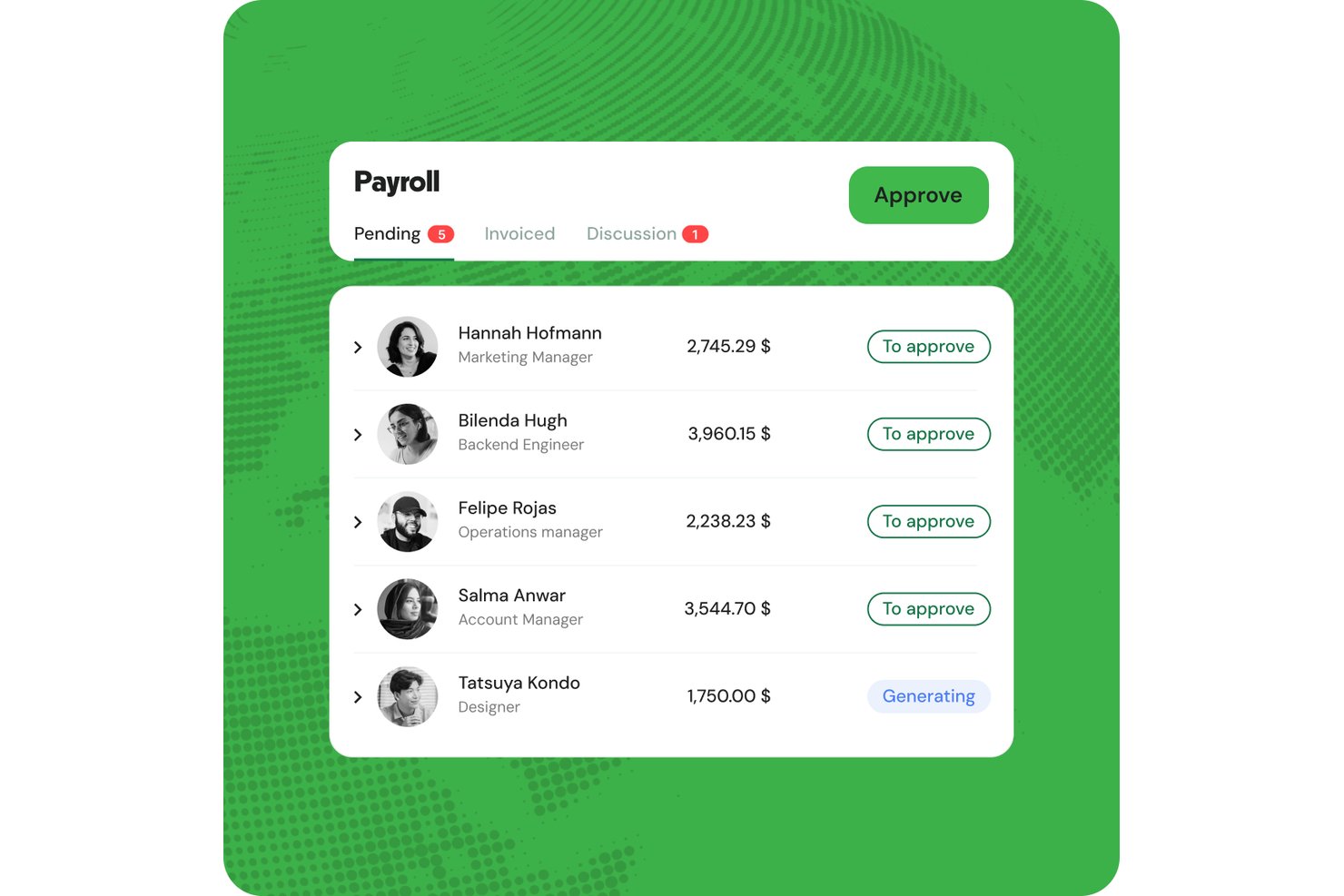
RemoFirst is an employer of record platform that handles international hiring, payroll, tax filings, and employment compliance across 185+ countries without requiring you to set up local entities.
Who Is RemoFirst Best For?
RemoFirst is a strong fit for companies that need to convert international contractors into full-time employees without setting up legal entities abroad.
Why I Picked RemoFirst
I've included RemoFirst in my top picks because it handles something most EOR platforms treat as an afterthought: converting international contractors into full-time employees without requiring you to set up a local legal entity. When a contractor relationship needs to become a permanent hire, RemoFirst generates a localized employment contract and enrolls the worker in payroll and benefits in one motion. It covers 185+ countries, handles tax filings, pension contributions, and local labor compliance through vetted in-country partners.
RemoFirst Key Features
- Consolidated global payroll dashboard: View employee headcount by country, worker classifications, and total payroll spend tracked in a single currency across your global workforce.
- Localized employment contracts: RemoFirst generates country-specific employment agreements that reflect local labor law requirements for each new hire.
- Multi-currency employer invoicing: Receive invoices in your preferred currency from eight options, including USD, EUR, GBP, CAD, AUD, NZD, SGD, and ILS.
- HRIS integrations: Connect RemoFirst with Workday, BambooHR, or ADP Workforce Now to sync employee records and onboarding data with your existing HR systems.
RemoFirst Integrations
RemoFirst lists HRIS integrations with Workday, BambooHR, and ADP Workforce Now. BambooHR transfers data one way into RemoFirst.
Pros and Cons
Pros:
- One dashboard tracks country headcount and spend
- Contractor-to-employee transitions include localized contracts
- On-time local-currency payroll reported by users
Cons:
- Payroll reporting depth remains limited
- Complex compliance cases can stall

CloudPay
Best for Workday-native global payroll at scale
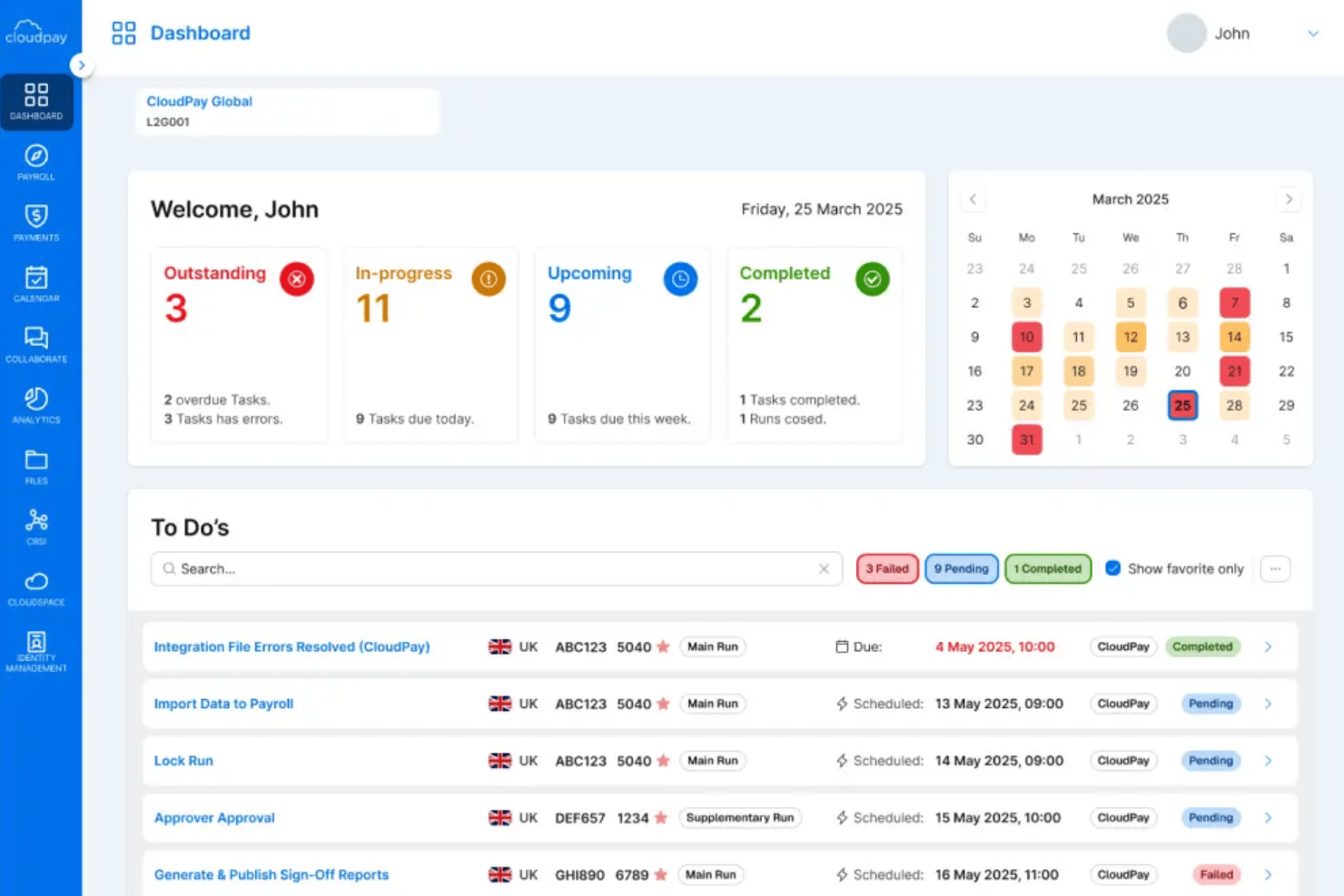
CloudPay is a managed global payroll and payments platform that handles multi-country payroll processing, local currency disbursements, compliance management, and HCM integrations across 130+ countries.
Who Is CloudPay Best For?
CloudPay is a strong fit for enterprise HR and payroll teams running Workday who need managed, multi-country payroll across 130+ countries without building local payroll infrastructure from scratch.
Why I Picked CloudPay
CloudPay earns its spot on my shortlist because its 5-star Workday Global Payroll Connect certification covers all five GPC features across 110+ countries, which I haven't seen matched elsewhere. I love that the CloudPay Navigator platform gives payroll teams a single governed workflow with real-time exception handling, replacing the usual mix of spreadsheets and country-by-country batch runs. Its owned payment rails via Visa Direct also mean employees get paid in local currencies in roughly 30 seconds, not days.
CloudPay Key Features
- Pay-to-card disbursements: Employees receive salary payments to any debit or credit card via Visa Direct in approximately 30 seconds, 24/7, across 110+ currencies.
- Local Payroll Information (LPI) module: Consolidates global pay data into a single reporting layer with cross-country currency conversion and entity-level breakdowns.
- Earned wage access via CloudPay NOW: Employees can withdraw a portion of already-earned pay instantly through the CloudPay app, with employer-configurable withdrawal limits and no credit checks required.
- SAP SuccessFactors pre-configured connector: Automates employee and organizational data transfers from SAP SuccessFactors into CloudPay, with country-specific validation controls applied at the point of transfer.
CloudPay Integrations
CloudPay offers certified Workday integrations, a pre-configured SAP SuccessFactors connector, and bi-directional Oracle HCM Cloud integration. It also supports native HiBob and UKG Pro integrations, plus API access for custom connections.
Pros and Cons
Pros:
- Embedded earned wage access for employees
- Real-time exceptions and global payroll dashboard
- Instant pay-to-card in 110+ currencies
Cons:
- Hybrid in-house and partner country support
- No native HR or talent modules

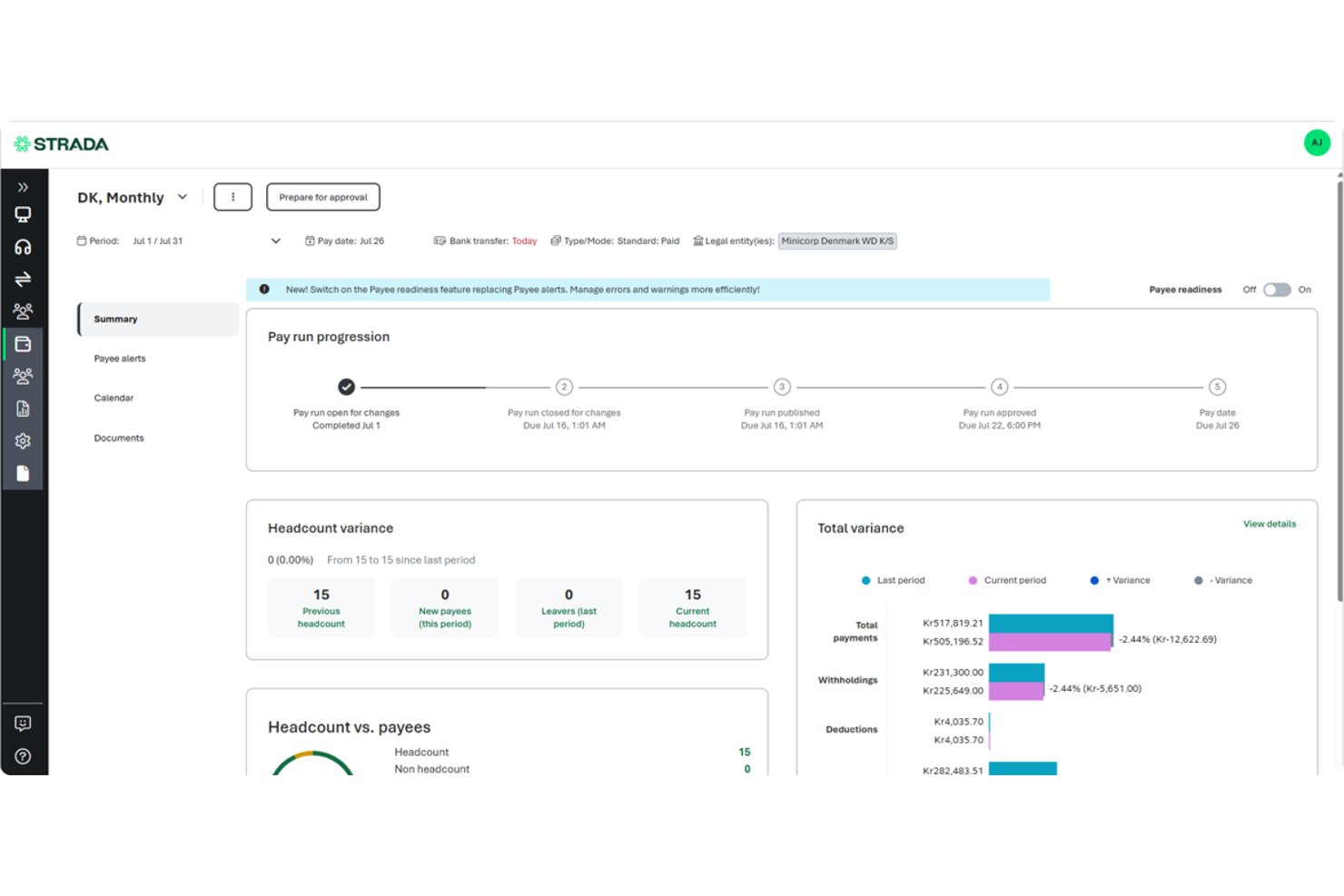
Strada is an enterprise multi-country payroll platform that combines a native global payroll engine, AI-powered anomaly detection, compliance management, and deep bidirectional integrations with Workday, SAP SuccessFactors, and Oracle HCM.
Who Is Strada Best For?
Strada is a strong fit for enterprise HR and payroll teams at organizations with 1,000+ employees that already run Workday, SAP SuccessFactors, or Oracle HCM and need multi-country payroll managed within that same ecosystem.
Why I Picked Strada
Strada earns its spot on my shortlist because of how deeply it embeds into Workday as a native payroll engine, not just a connected third-party. I'm particularly impressed by "Workday Payroll by Strada," a co-sold SKU available directly through the Workday marketplace that lets HR teams run global payroll without ever leaving their Workday tenant. Strada's continuous calculation engine and AI-powered anomaly detection also mean payroll errors get caught before they hit the payslip, which matters when you're processing pay across dozens of countries simultaneously.
Strada Key Features
- Defensive queries: Cross-engine checks that proactively enforce accuracy and consistency across multiple payroll engines before pay runs finalize.
- Data quality dashboard: Flags incoming payroll data issues by source, country, and timeframe so your team can catch problems before they enter the pay cycle.
- AI-powered case management: Auto-classifies payroll exceptions and routes escalations without manual triage.
- Compliance suite: Handles garnishment administration, overpayment recovery, severance workflows, and business travel tax tracking across supported countries.
Strada Integrations
Strada offers native, bidirectional integrations with Workday, SAP SuccessFactors, and Oracle, including Workday Payroll by Strada. It also provides a Workday Marketplace connector and a REST API library for custom connections.
Pros and Cons
Pros:
- Unified workflow for 180+ countries
- AI anomaly detection for payroll accuracy
- Native Workday payroll experience for enterprises
Cons:
- Dependent on partner network for most countries
- No EOR or contractor management features

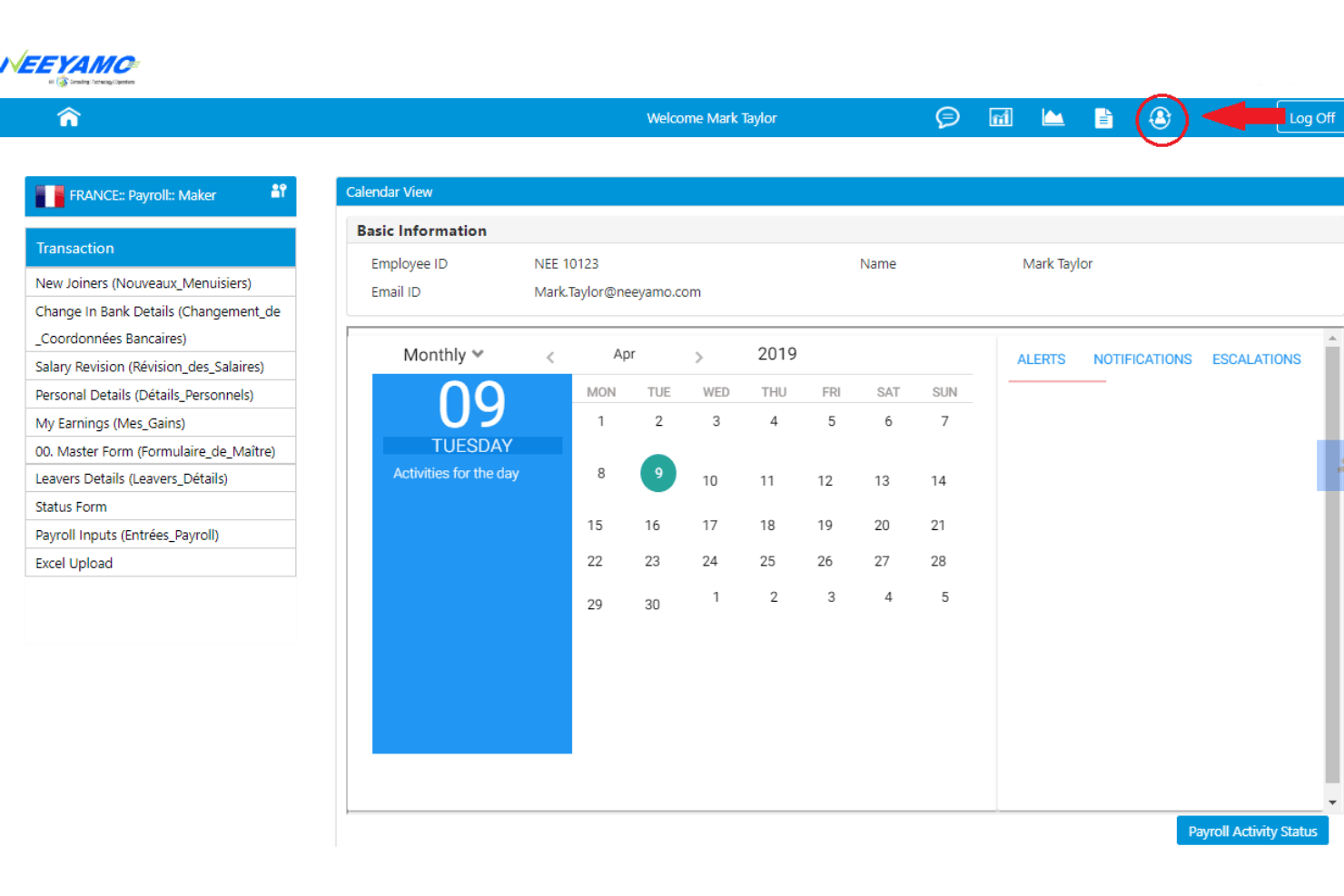
Neeyamo is a multi-country payroll platform built around a proprietary gross-to-net engine that natively processes payroll in 115 countries, with centralized reporting, an AI assistant (ARIA), and built-in employer of record services across 150+ countries.
Who Is Neeyamo Best For?
Neeyamo is a strong fit for large multinationals managing payroll in dozens of lower-headcount countries where local complexity is high but standard providers fall short.
Why I Picked Neeyamo
I picked Neeyamo as one of the best because its proprietary gross-to-net engine natively processes payroll in 115 countries, which is a rare technical distinction when most providers rely on partners for anything beyond their core markets. I find its long-tail payroll model particularly compelling: it brings low-headcount countries onto the same centralized platform as your major markets, so a company running payroll in Vietnam or Nigeria alongside Germany doesn't need separate local vendors. Neeyamo Payroll I.O. adds a governance layer on top of that, consolidating inputs and outputs across all geographies without replacing existing systems.
Neeyamo Key Features
- ARIA AI assistant: A generative AI agent that detects payroll anomalies, sends proactive compliance alerts, and handles natural-language payroll queries via chat and voice.
- Neeyamo Payroll I.O.: An overlay layer that consolidates, validates, and governs payroll inputs and outputs across existing internal and third-party payroll systems without replacing them.
- Neeyamo Compliance module: Tracks regulatory changes across supported countries and flags non-compliant payroll entries before a pay run is approved.
- GlobalWork EOR: An employer of record service covering 150+ countries, integrated directly into the same platform as core payroll processing.
Neeyamo Integrations
Neeyamo offers native integrations with Workday, SAP SuccessFactors, Oracle HCM Cloud, and HiBob. An Open API supports custom connections with other HRIS, ERP, and accounting systems.
Pros and Cons
Pros:
- Consolidates global payroll with validation layer
- AI assistant detects compliance and payroll anomalies
- Native payroll engine covers 115 countries
Cons:
- Limited direct payout currency selection
- No transparent or self-serve pricing options

Rippling
Best for native payroll across 50+ countries
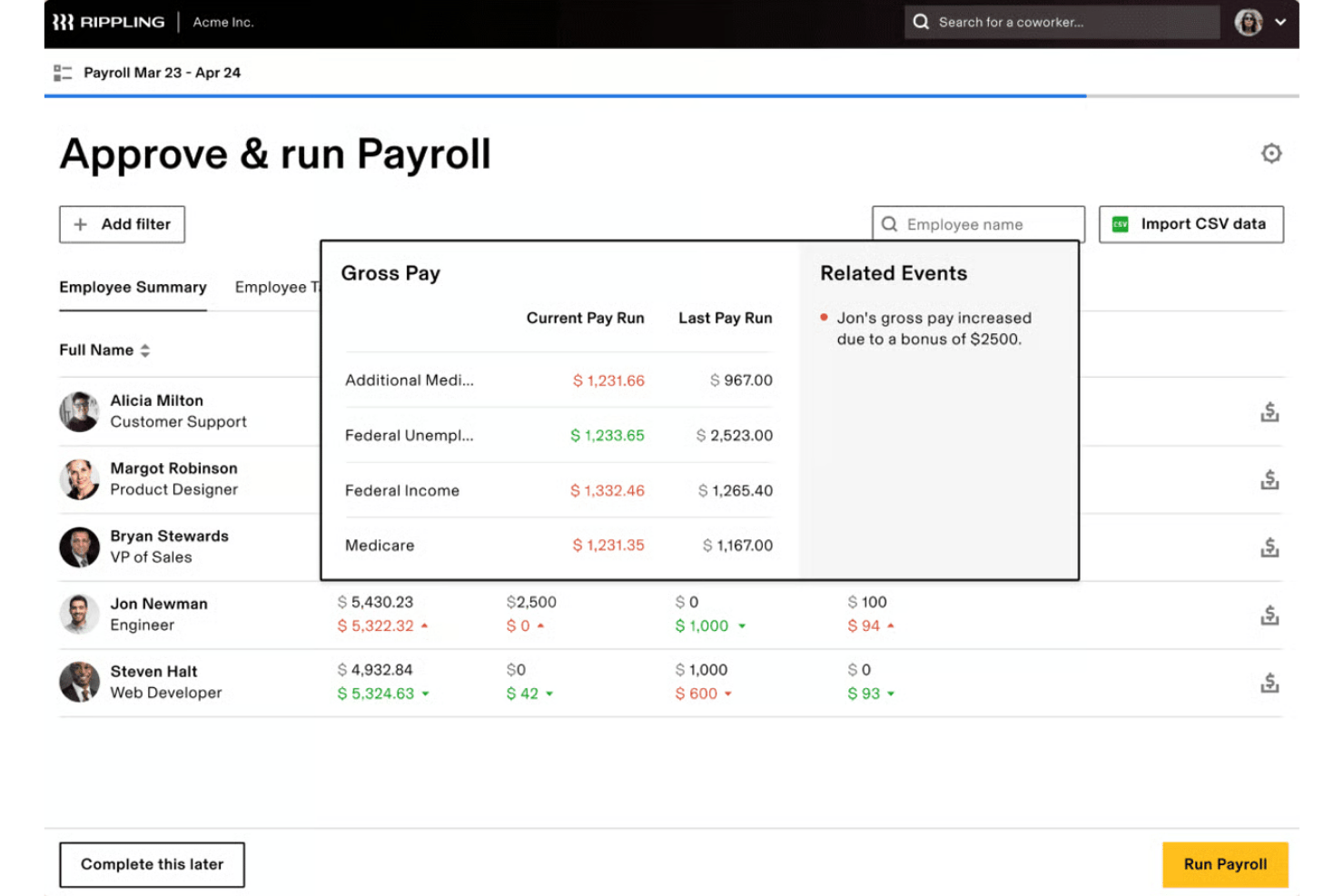
Rippling is a multi-country payroll platform that runs its own native payroll tax engine across 50+ countries, with built-in employer of record, global contractor management, and a unified HRIS on a single employee record.
Who Is Rippling Best For?
Rippling is a strong fit for mid-market and scale-up companies that need to pay full-time employees, EOR hires, and contractors across multiple countries from a single platform.
Why I Picked Rippling
I've included Rippling in my top picks because it runs its own native payroll tax engine across 50+ countries rather than routing calculations through third-party local vendors, which is what most so-called "global" payroll platforms actually do. That distinction matters: Rippling's in-house engine delivers payroll block periods as short as four days and instant gross-to-net previews, while contractors in 185+ countries get paid in local currency within two to four days of approval.
Rippling Key Features
- Employer of Record (EOR) hiring: Hire full-time employees in 80 countries without a local entity, with employment agreements, benefits enrollment, and software provisioning automated at onboarding.
- Global Contractor Hub: Manage contractors across 185+ countries with automated KYC verification, localized agreements, auto-invoice generation, and approval routing workflows.
- AI-generated workforce reports: Generate compensation trend reports, headcount analytics, and total compensation breakdowns across countries and currencies using live platform data.
- Bi-directional accounting sync: Push payroll data directly to QuickBooks, Xero, NetSuite, or Sage Intacct with custom GL mapping and automated journal posting.
Rippling Integrations
Rippling supports 600+ native integrations, including Carta, Jira, HubSpot, Slack, Zoom, Asana, Salesforce, Notion, Zendesk, and Gong. It supports an API for custom integrations.
Pros and Cons
Pros:
- Fast EOR onboarding and payroll processing
- Single dashboard for global pay runs
- Local tax compliance managed in-house across countries
Cons:
- Escalating costs as features are added
- Native payroll engine covers about 50 countries
New Product Updates from Rippling

Rippling Expands Automated Compliance With AI Workflows
Rippling expands Automated Compliance with multi-framework support, AI workflows, an audit portal, and trust centers. These updates help GRC teams manage compliance work and audits. For more information, visit Rippling’s official site.

Best for owned-entity payroll across 100+ countries
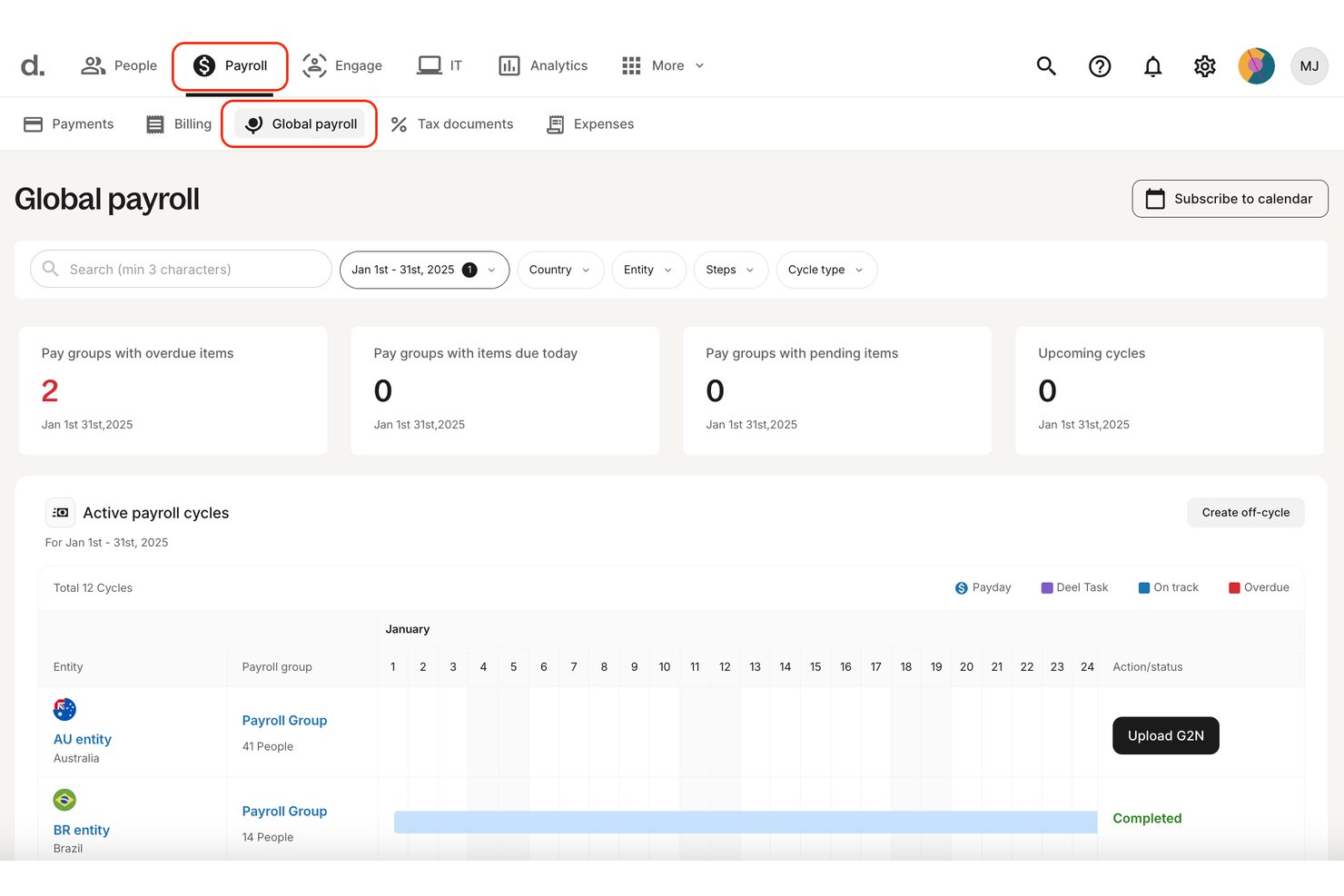
Deel is a multi-country payroll platform that combines global payroll processing, employer of record services, contractor management, and a built-in HRIS—all within a single dashboard covering 150+ countries.
Who Is Deel Payroll Best For?
Deel Payroll is a strong fit for companies running payroll across multiple countries through their own legal entities, particularly those that need to manage a mix of direct employees, EOR workers, and contractors from one platform.
Why I Picked Deel Payroll
I picked Deel Payroll as one of the best because it operates owned legal entities and payroll infrastructure in 100+ countries, which is a meaningful distinction from aggregator-model competitors that rely heavily on third-party in-country partners. In practice, that means my team can run payroll across multiple countries with tighter compliance control and fewer hand-offs. I also like that Deel AI runs pre-payroll anomaly detection before every pay run, flagging missing data or legal risks before approval rather than after.
Deel Payroll Key Features
- Payroll Connect: Consolidates Deel-run payroll and third-party payroll vendors into a single dashboard, giving your team unified visibility across all providers without requiring a full platform switch.
- Multi-currency payments: Disburses payroll in 120+ currencies via owned payment rails, with crypto and USDC payout options available in supported countries.
- Contractor management suite: Handles contractor onboarding, localized contract templates, automated invoicing, and mass payouts across 120+ currencies from the same platform as employee payroll.
- Flexible deployment model: Lets you run payroll self-serve in some countries while handing off others to Deel's in-country experts—configurable on a per-country basis.
Deel Payroll Integrations
Deel Payroll offers integrations with QuickBooks, Xero, BambooHR, Expensify, NetSuite, Sage Intacct, Greenhouse, Workday, SAP, and ADP, among others available through its app store. It also connects with Zapier and provides an API for custom integrations.
Pros and Cons
Pros:
- Mixes EOR, contractor, and payroll in one platform
- AI flags compliance risks before payroll approval
- Owns payroll infrastructure in 100+ countries
Cons:
- HRIS integrations require managed implementation
- EOR pricing frequently cited as expensive
Dayforce
Best for enterprise payroll on a single data model
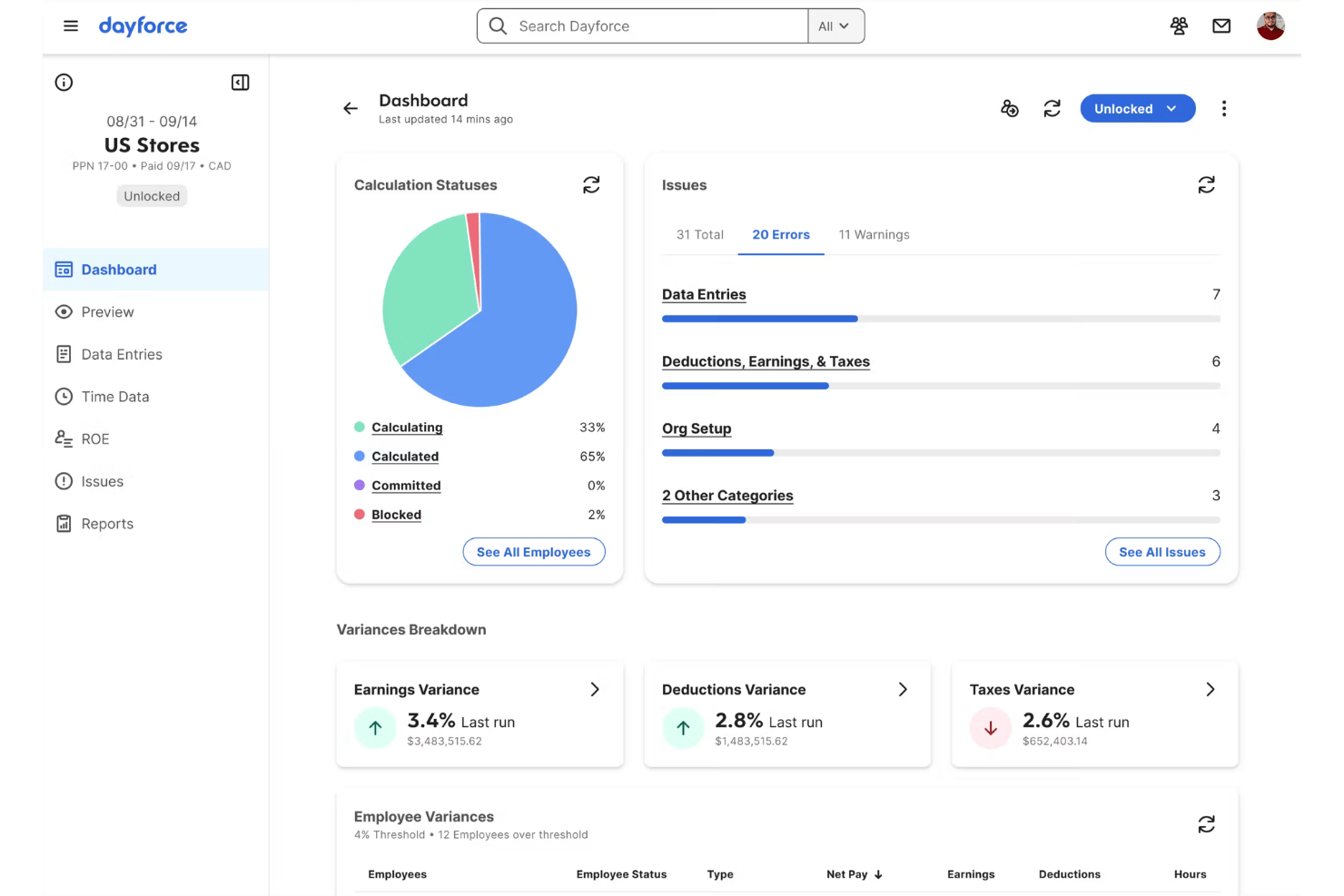
Dayforce is a single-database HCM platform that runs payroll, time, benefits, HR, and talent data on one unified system, with a continuous calculation engine and multi-country payroll coverage across 200+ countries and territories.
Who Is Dayforce Best For?
Dayforce is built for large enterprises that need HR, time, benefits, and payroll running on a single data model across multiple countries.
Why I Picked Dayforce
I picked Dayforce as one of the best because no other platform I've used runs payroll, time, benefits, and HR on a single data model the way it does. Its continuous calculation engine is what genuinely sets it apart: pay and tax figures recalculate in real time as time data flows in, so there's no scramble at period close. I also rely on its 300+ pre-built reports and People Analytics dashboards to track payroll variances and earnings trends across all entities from one place.
Dayforce Key Features
- Payroll audit reports: Pre-submission audit reports scan your pay run and flag compliance issues before you process, reducing the risk of errors reaching employees.
- Managed payroll services: Two-tier outsourced payroll processing (Base and Premium) lets your team offload payroll operations to Dayforce specialists across 150+ countries.
- Dayforce AI Agents: Task-oriented AI automations handle repetitive payroll, time off, and HR workflows while surfacing flagged regulatory changes in real time.
- Integration Studio: A low-code, in-platform environment for building and managing integrations with third-party systems via pre-built connectors, REST APIs, and event-driven webhooks.
Dayforce Integrations
Native integrations are not publicly listed. An API is available for custom integrations.
Pros and Cons
Pros:
- Global reporting with 300+ pre-built reports
- Real-time payroll recalculation as data flows in
- Runs payroll, HR, time, and benefits together
Cons:
- Native payroll engine limited to five countries
- No native employer of record option

iiPay
Best for in-house payroll across 170+ countries
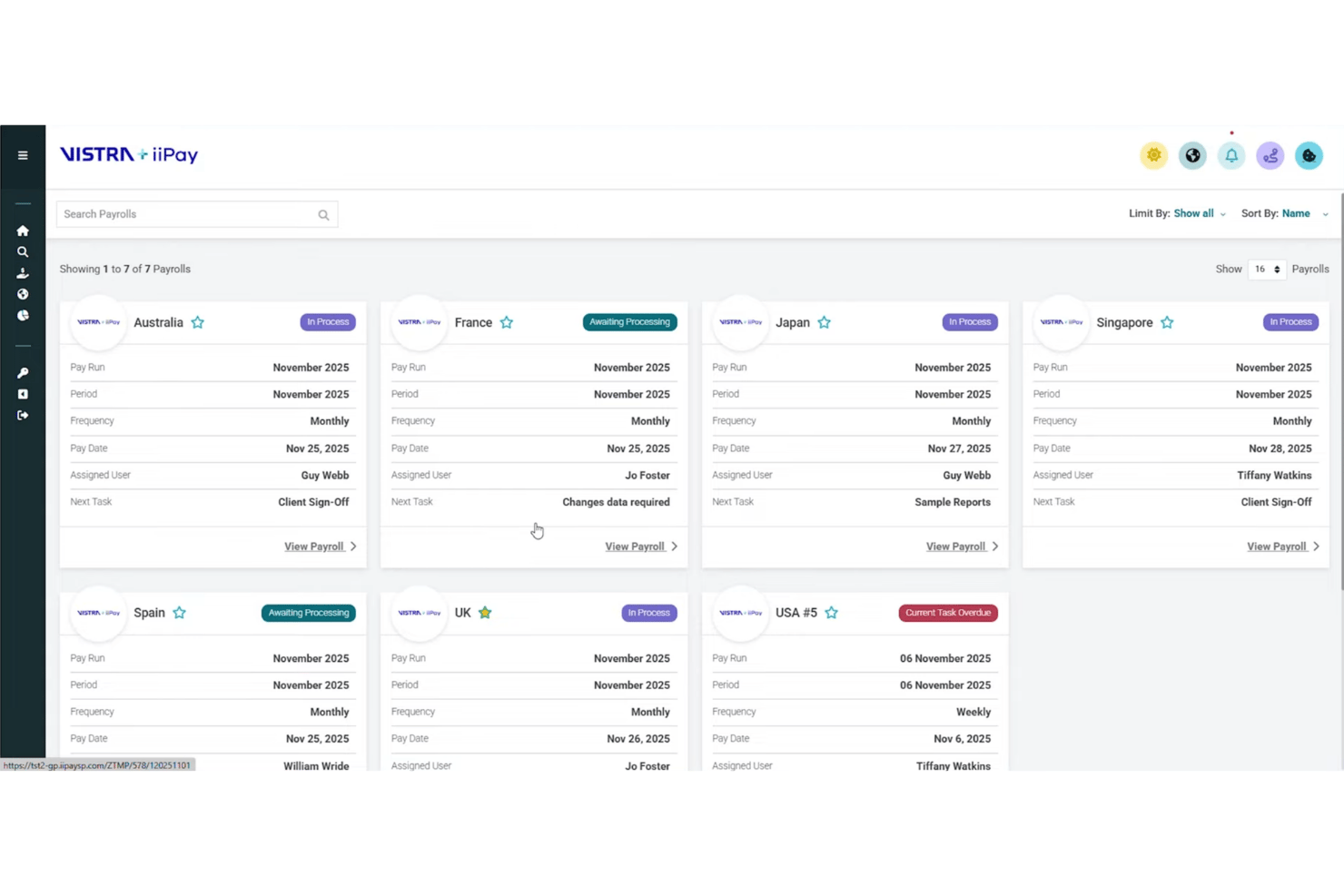
iiPay is a multi-country payroll platform that centralizes pay-run management, statutory compliance, multi-currency payments, and employee self-service across 170+ countries through a predominantly in-house delivery model.
Who Is iiPay Best For?
iiPay is a strong fit for enterprise organizations managing payroll across dozens of countries who need a single, predominantly in-house delivery model rather than a patchwork of local vendors.
Why I Picked iiPay
I picked iiPay as one of the best because its in-house delivery model genuinely sets it apart: 96% of payroll across 170+ countries is processed directly by iiPay's own team of 1,500+ local specialists, not routed through third-party partners. That translates to tighter compliance control and a single point of accountability when statutory filings are due. I especially like the Global Control Centre, which gives you live critical-path monitoring across every jurisdiction so nothing slips through unnoticed.
iiPay Key Features
- Global Employee Portal: A mobile-optimized self-service hub available in 20+ languages, giving employees encrypted access to payslips and payroll documents from any device.
- ContractorPay: A managed contractor payment framework that handles compliant payments across multiple currencies and countries, with built-in spend analytics for blended workforces.
- Single Currency Funding: A treasury feature that consolidates multi-country payroll funding into one currency, reducing foreign exchange complexity across global pay runs.
- Geni AI agent: An AI assistant embedded in both employee self-service and the analytics dashboard, providing 24/7 multi-language query support and proactive anomaly detection.
iiPay Integrations
iiPay integrates with Workday, HiBob, SAP SuccessFactors, and Oracle HCM. REST APIs, SFTP, and flat-file support enable connections with additional HCM, time, finance, ERP, and General Ledger systems.
Pros and Cons
Pros:
- Global Control Centre for live payroll oversight
- AI-driven compliance and payment monitoring
- In-house processing covers 170+ countries
Cons:
- No free trial or self-serve onboarding
- EOR coverage limited versus payroll coverage

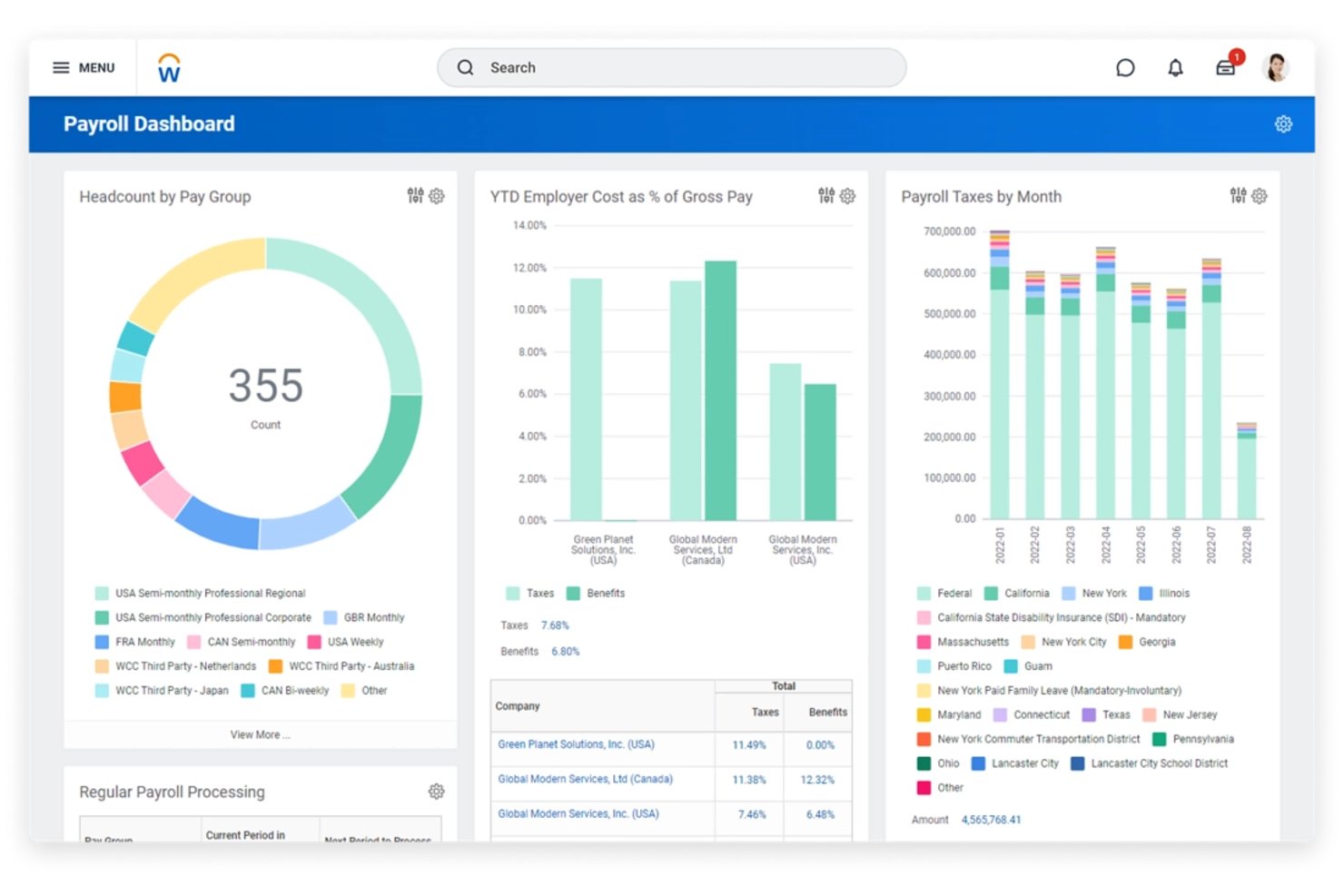
Workday Payroll is an enterprise-grade multi-country payroll solution built natively on the Workday HCM platform, combining in-house payroll processing, a global partner network, centralized pay run management, and AI-powered compliance monitoring across 100+ countries.
Who Is Workday Payroll Best For?
Workday Payroll is a strong fit for large enterprises already running Workday HCM that need to manage payroll across multiple countries from a single platform.
Why I Picked Workday Payroll
Workday Payroll earns its spot on my shortlist because HR and payroll live on the exact same data model, meaning a compensation change in Workday HCM hits the pay run immediately, with no sync, no middleware, and no reconciliation step. I've seen this matter most when managing retroactive pay across multiple countries, since the continuous payroll calculation engine handles backdated changes automatically. The AI Payroll Agent adds another layer I genuinely value: it scans each pay run against your tax policies and org structure, flagging minimum-wage gaps or missing configurations before payday, not after.
Workday Payroll Key Features
- Global Payroll Hub: A centralized interface for tracking pay run status, payroll results, and post-payroll documents across all countries and third-party vendors in one place.
- Global Payroll Connect (GPC) certified partner network: Pre-built, bidirectional REST API integrations with certified providers like ADP, Deel, CloudPay, and Remote covering 100+ countries.
- External Payroll Results (EXPR): Imports pay register data from third-party payroll providers directly into Workday, consolidating multi-vendor payroll outputs into a single record.
- Employee self-service agent: An AI-powered conversational tool that gives employees instant answers about their pay details, deductions, and HR data across all supported countries.
Workday Payroll Integrations
Workday Payroll has native integrations with Workday HCM, Workday Financial Management, and Workday Adaptive Planning, plus GPC-certified integrations with ADP, CloudPay, Deel, Strada, Payslip, and Neeyamo. Bidirectional REST APIs support custom integrations.
Pros and Cons
Pros:
- AI Payroll Agent flags compliance gaps
- Centralized payroll dashboard for 100+ countries
- Native HR and payroll on one platform
Cons:
- Extremely high implementation effort required
- Native payroll only in six countries

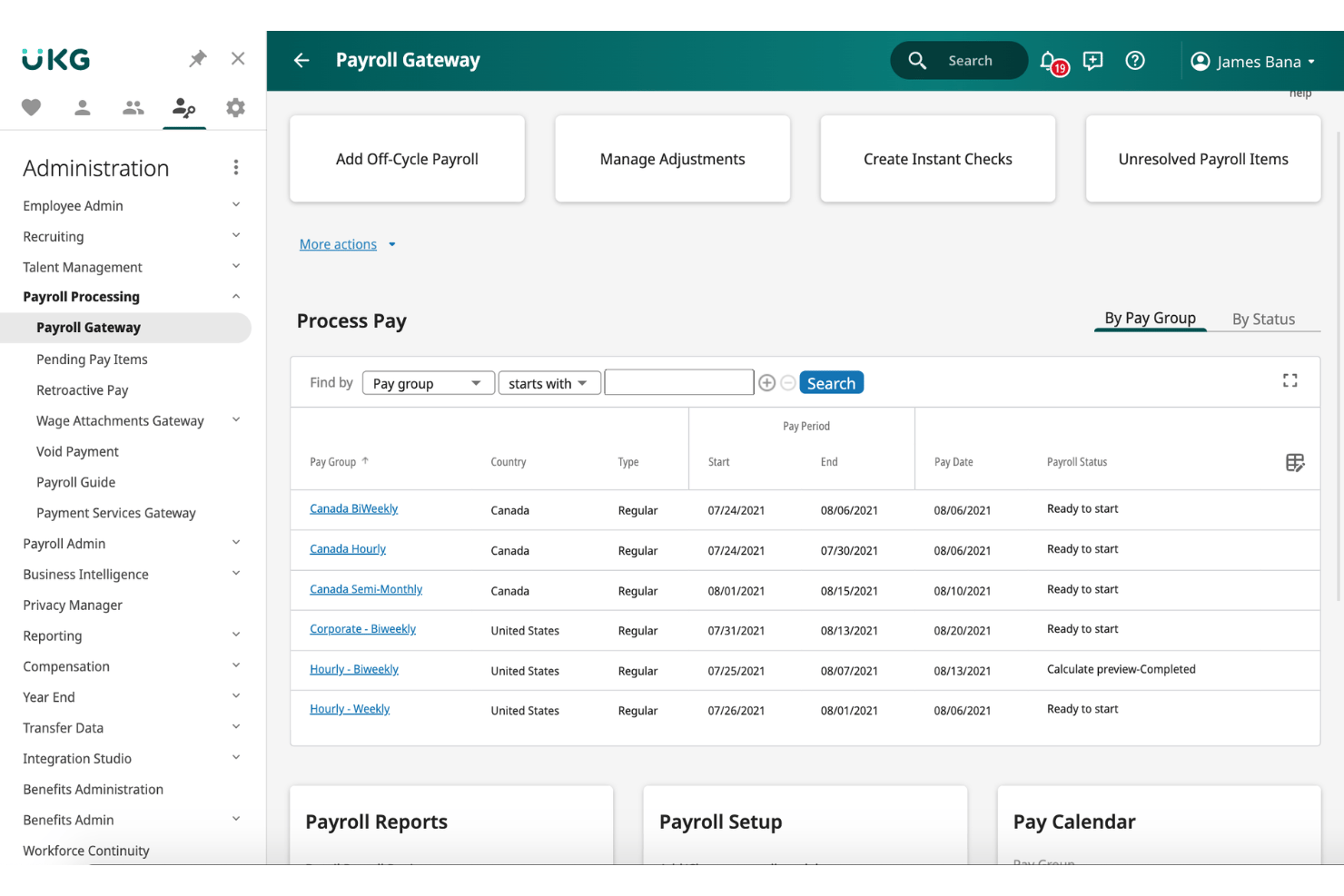
UKG Payroll is a multi-country payroll platform that centralizes payroll data from 160+ countries into a single dashboard, connecting existing in-country providers, managing cross-border payments in 120+ currencies, and automating tax compliance through AI-powered validation.
Who Is UKG Payroll Best For?
UKG Payroll works best for large, established multinationals that already have in-country payroll providers in place and need a single platform to centralize, validate, and report on payroll across 160+ countries without displacing existing local setups.
Why I Picked UKG Payroll
I picked UKG Payroll because it's genuinely built for multinationals that already have in-country providers locked in and don't want to rip them out. UKG One View layers on top of your existing local processors, pulling payroll data from 160+ countries into a single dashboard without forcing a migration. What I find most valuable is the perpetual validation engine, which continuously flags calculation errors before a payroll run is finalized, catching issues that would otherwise surface as costly corrections post-submission.
UKG Payroll Key Features
- One View Payments: Manages cross-border employee payments in 120+ currencies with real-time global payroll funding oversight.
- Bryte AI anomaly detection: Continuously flags payroll calculation errors and compliance risks before a payroll run is approved.
- Employee self-service portal: Gives employees mobile and web access to payslips and tax documents in 20+ languages.
- General ledger export: Automatically posts payroll journal entries to connected ERP and accounting systems.
UKG Payroll Integrations
UKG Payroll has native integrations with UKG Pro and UKG Ready, plus GL export and an open API. Its marketplace includes hundreds of integrations, including Globalization Partners and Flexspring connections to SAP, Oracle, ADP, and Workday.
Pros and Cons
Pros:
- Retains existing local payroll providers
- AI-powered compliance and error detection
- Centralizes payroll across 160+ countries
Cons:
- Business intelligence reporting requires technical training
- No native contractor payment tools
Andre lønnssystemer for flere land
Her er noen flere alternativer for lønnssystemer for flere land som ikke kom med på kortlisten min, men som likevel er verdt å undersøke:
- Pebl
For EOR-backed global payroll compliance
- Papaya Global
For owned-rail payments across 180+ countries
- ADP GlobalView Payroll
For large-scale enterprise payroll compliance
- Ramco Global Payroll
For APAC-heavy enterprise payroll
- Remote
For AI-driven payroll across 100+ countries
- Atlas HXM
For direct-entity EOR payroll in 160+ countries
- Mercans
For single-codebase payroll across 160+ countries
- Lano
For orchestrating existing local payroll providers
- SAP SuccessFactors Employee Central Payroll
For SAP-native multi-country payroll at scale


How I Evaluate Multi-Country Payroll Software
I split my evaluation into baseline criteria every tool must meet and differentiating factors that separate the best from the rest.
Core Functionality (Table Stakes For This List)
When I'm selecting tools for my list, I rank each one on a scale from 0 (does not offer the functionality) to 5 (excels in this area) for each core functionality listed below. I then calculate the tool's total score into a percentage, using 65% as a benchmark to help assess its overall fit for the list.
- Multi-country coverage: I evaluate how many countries a platform supports and whether it processes payroll natively or through in-country partners across major regions.
- Local tax and compliance: Each tool needs to handle country-specific tax calculations, social contributions, and statutory filings with regular regulatory updates built in.
- Multi-currency payments: I look for native multi-currency pay runs with transparent FX rates and local payment rails, not just currency conversion bolted onto a single-currency system.
- Centralized payroll management: The platform should let you run, approve, and track payroll across all countries from one dashboard rather than toggling between separate country-level systems.
- Consolidated global reporting: I check whether the tool can generate cross-country reports with currency normalization, GL mapping, and entity-level breakdowns in a single view.
- HRIS and accounting integrations: Pre-built connectors with major HRIS, ERP, and accounting platforms matter here, along with API access for syncing employee data and posting payroll journals.
Once I have a list of tools that meet the criteria, I consider what sets each platform apart.
Differentiating Factors (What Sets Vendors Apart)
Here's how I compare and contrast different vendors:
Standout Features
I look for platforms with embedded global payment rails—ones that own the money movement rather than routing through third parties—since that directly affects payment speed, FX transparency, and traceability for finance teams. Employer of record capabilities bundled into the payroll platform matter when you're hiring in countries where you don't have an entity. I also evaluate each tool's AI compliance features, checking whether it can flag regulatory changes or auto-detect classification risks before a pay run goes through.
Beyond Features
I evaluate whether a vendor processes payroll through owned entities or in-country partners, since partner-heavy models often introduce inconsistent SLAs and data hand-offs that slow down pay runs. Implementation timelines matter just as much—some platforms go live in days for contractors, while enterprise rollouts with parallel runs can stretch past six months. I also check each vendor's security certifications, data residency options, and whether FX spreads and per-country minimums are transparent or buried in the contract.
Slik velger du et lønnssystem for flere land
Hva bør du fokusere på for å velge en lønnsløsning for flere land som holder teamet ditt i samsvar med regelverket og prosessene dine under kontroll når du vokser på tvers av landegrenser:
| Hvis prioriteten din er ... | Se etter ... |
|---|---|
| Rask oppstart i nye land | Ferdigbygde arbeidsgiver-of-record-funksjoner (EOR) |
| Nøyaktig, landsspesifikk skatterapportering | Regelmessig oppdatert etterlevelsesmotor for det aktuelle landet |
| Innsyn i betalinger i sanntid | Egne betalingskanaler med direkte sporing |
| Minimalt med manuell dataregistrering | Toveis synkroniseringsintegrasjoner med HRIS- eller ERP-systemet ditt |
| Samlet rapportering for ledelsen | Globale rapporter på enhetsnivå med standardiserte valutaer |
Slik vurderer du kortlisten din
- Be om eksempler på lønnsrapporter: Be hver leverandør om anonymiserte filer fra lønnskjøringer på tvers av land og eksportfiler for hovedbok.
- Test åpenheten rundt valutaveksling: Kjør en prøveutbetaling i en sekundær valuta, og sammenlign valutamarginen med markedsrater innen 24 timer.
- Send inn et spørsmål om etterlevelse: Send et lokalt lovpålagt spørsmål til kundestøtten, og følg med på svartid og tydelighet.
- Be om dokumentasjon på integrasjonen: Be om en direktedemonstrasjon av HRIS- eller ERP-integrasjonen som synkroniserer faktiske medarbeiderdata.
- Velg mellom egen enhet og partnermodell: Leverandører med egne enheter reduserer overleveringer og forsinkelser, men partnermodeller kan tilby bedre landdekning hvis dekning er det viktigste for deg.
Hva er et lønnssystem for flere land?
Lønnssystemer for flere land er en digital plattform som lar deg administrere lønn, skatter og etterlevelse for ansatte og oppdragstakere i mer enn ett land fra ett enkelt kontrollpanel. Disse verktøyene håndterer lønnsberegninger, lokale skatteregler og rapportering på tvers av landegrenser, slik at HR-team kan betale folk korrekt samtidig som de holder tritt med ulike lover og krav etter hvert som virksomheten vokser internasjonalt.
Funksjoner
Når du velger et lønnssystem for flere land, bør du se etter følgende viktige funksjoner:
- Dekning i flere land: Støtter lønnskjøring på tvers av flere land, slik at teamet ditt kan håndtere etterlevelse, lønnsberegninger og lønnskjøringer for ansatte og oppdragstakere i ulike jurisdiksjoner.
- Håndtering av lokale skatter og krav: Automatiserer landsspesifikke skatteberegninger, sosiale avgifter og lovpålagte innrapporteringer, med innebygde oppdateringer som gjenspeiler endringer i regelverket, slik at du kan oppfylle alle lokale krav.
- Betalinger i flere valutaer: Lar deg betale ansatte og oppdragstakere i deres lokale valutaer ved hjelp av sanntidskurser og lokal bankinfrastruktur, noe som reduserer manuelle omregninger og uventede valutakostnader.
- Sentralisert lønnskontrollpanel: Gir deg et samlet arbeidsområde for å planlegge, godkjenne og gjennomgå lønnskjøringer i hvert land, slik at du slipper å bytte mellom separate systemer eller regionale plattformer.
- Konsolidert global rapportering: Genererer rapporter som samler lønnsdata fra alle land, standardiserer valutaer og gir oppdelinger på virksomhetsnivå for økonomi-, HR- og ledelsesteam.
- Integrasjoner med HRIS og regnskapssystemer: Kobler seg direkte til ledende HRIS-, ERP- og regnskapssystemer, synkroniserer ansattdata og automatiserer posteringer i hovedboken for å redusere manuell dataregistrering og avstemmingsfeil.
- Funksjoner for registrert arbeidsgiver (EOR): Tilbyr lovlig ansettelse og lønnsbehandling i land der virksomheten din ikke har en lokal enhet, slik at du kan ekspandere uten å etablere en juridisk tilstedeværelse.
- Innebygd global betalingsinfrastruktur: Eier betalingsinfrastrukturen fra ende til ende, noe som gir raskere utbetalinger og sporing av betalinger i sanntid i stedet for å være avhengig av tredjeparts betalingsformidlere.
- Avansert sikkerhet og kontroll over datalagring: Sikrer sensitive lønnsdata med sertifiseringer, tilgangskontroller for brukere og alternativer for lagring av data i bestemte land eller regioner for å støtte personvernkrav.
- Automatiserte varsler om etterlevelse: Overvåker endringer i regelverket og risikofaktorer, og varsler deg før lønnskjøringen dersom det finnes nye lovpålagte krav eller klassifiseringsproblemer i et av landene som dekkes.
Fordeler
Implementering av et lønnssystem for flere land gir flere fordeler for teamet og virksomheten din. Her er noen av fordelene du kan se frem til:
- Sentralisert administrasjon: Administrer lønn, rapportering og godkjenninger for ansatte og oppdragstakere i alle land fra ett enkelt kontrollpanel.
- Nøyaktig etterlevelse: Bruk landsspesifikke skatte-, avgifts- og lovpålagte regler automatisk, med innebygde oppdateringer av regelverket.
- Betalinger i flere valutaer: Betal teamet ditt i deres lokale valutaer ved hjelp av oppdaterte valutakurser og lokale betalingsnettverk, med færre manuelle omregninger og skjulte valutakostnader.
- Global rapportering i sanntid: Generer standardiserte lønnsrapporter på tvers av land og oppdelinger på virksomhetsnivå i én samlet visning.
- Effektivisert dataflyt: Koble lønnssystemet til HRIS-, ERP- og regnskapsplattformene dine for å synkronisere ansattdata og automatisere posteringer i hovedboken.
- Raskere internasjonal oppstart: Ansett og betal arbeidstakere i nye land raskt med innebygde funksjoner for registrert arbeidsgiver (EOR).
- Avansert sikkerhet: Beskytt sensitive lønnsdata gjennom sertifiseringer, tilgangskontroller for brukere og alternativer for lagring av informasjon i påkrevde dataregioner.
Trender
Lønnssystemer for flere land blir stadig mer automatiserte, integrerte og rettet mot etterlevelse etter hvert som selskaper håndterer stadig mer geografisk spredte arbeidsstyrker.
- AI og automatisering av lønn: AI brukes i økende grad til å identifisere avvik i lønnsutbetalinger, validere data, besvare lønnsspørsmål og redusere manuell behandling.
- Overvåking av samsvar i sanntid: Plattformene blir stadig bedre til å spore endringer i lokale skatte-, arbeids- og lønnsbestemmelser på tvers av land.
- Samlet global lønnshåndtering: Virksomheter ønsker i økende grad ett system for lønnsdata, rapportering, betalinger og arbeidsstyring på tvers av flere land.
- Dypere integrasjoner med HR og økonomi: Lønnsplattformer for flere land kobles tettere sammen med HRIS-, ERP-, regnskaps-, tidsregistrerings- og ytelsessystemer.
- Større innsyn i lønn: Samlede oversikter og global lønnsanalyse gjør det enklere å sammenligne lønnskostnader, antall ansatte og forpliktelser på tvers av land.
- Fleksibel støtte for en global arbeidsstyrke: Plattformene støtter i økende grad kombinasjoner av direkte ansatte, oppdragstakere og arbeidstakere ansatt gjennom en arbeidsgiver på vegne av virksomheten (EOR) innenfor samme globale strategi for arbeidsstyrken.
For kjøpere ligger det viktigste skiftet i overgangen fra bare å behandle lønn i flere land til plattformer som tilbyr sentraliserte data, støtte for lokalt regelverk, automatisering og global oversikt over arbeidsstyrken.
Kostnader og priser
Valg av lønnsprogramvare for flere land krever en forståelse av de ulike prismodellene og abonnementene som er tilgjengelige. Kostnadene varierer basert på funksjoner, teamstørrelse, tillegg og mer. Tabellen nedenfor oppsummerer vanlige abonnementer, gjennomsnittsprisene deres og typiske funksjoner som inngår i lønnsløsninger for flere land:
Sammenligningstabell for lønnsløsninger for flere land
| Abonnementstype | Gjennomsnittspris | Vanlige funksjoner |
|---|---|---|
| Gratisabonnement | $0 | Grunnleggende lønnsberegninger for et begrenset antall land, enkel rapportering og grunnleggende verktøy for overholdelse av regelverk. |
| Personlig abonnement | $30–$60/bruker/måned | Lønnskjøringer i flere land, kjerneintegrasjon med HRIS, lokalisert skattehåndtering og viktige rapporteringsfunksjoner. |
| Bedriftsabonnement | $60–$120/bruker/måned | Dekning av flere land, avansert automatisering av regelverksetterlevelse, betalinger i flere valutaer, samlet global rapportering og brukerstøtte. |
| Enterprise-abonnement | $120–$250/bruker/måned | Tilpassede integrasjoner, innebygde globale betalingsløsninger, EOR-alternativer i de enkelte landene, kontroll over datalagring og dedikert kundestøtte. |
Vanlige spørsmål om lønnsprogramvare for flere land
Her er svar på vanlige spørsmål om lønnsprogramvare for flere land:
Dette innholdet er kun ment for generell informasjon og utgjør ikke juridisk rådgivning, skatterådgivning eller annen profesjonell rådgivning. Det er ikke nødvendigvis fullstendig, korrekt eller oppdatert, og lover og praksis kan endres uten varsel og variere mellom jurisdiksjoner. Du bør ikke handle ut fra denne informasjonen uten å innhente råd fra kvalifiserte juridiske eller skattemessige rådgivere i den relevante jurisdiksjonen om dine spesifikke omstendigheter.