

10 Best Volunteer Management Software in 2026

10 Best Volunteer Management Software Shortlist


Volunteer management software helps you organize every part of the volunteer journey—recruitment, onboarding, scheduling, compliance, and impact tracking—all in one place. The right platform connects volunteer data with fundraising, manages onboarding for compliance-heavy roles, and measures real impact across programs, sites, or regions.
I’ve evaluated top solutions that match the complexity and scope most HR professionals face. Here’s what you need to know before choosing tools that support your goals.
Why Trust Our Software Reviews
Our team has been testing and reviewing software since 2012. As HR experts ourselves, we know how difficult—and important—it is to choose the right software.
For this guide, we evaluated tools using hands-on testing and independent research, scoring tools using our selection criteria. We also draw on insights from industry thought leaders and practicing HR experts.
Our reviews reflect our human editorial judgment, not a sales pitch.
Expert reviewers:
Compare the Best Volunteer Management Software
Compare pricing and specs, side by side, for the volunteer management software that made it onto my shortlist.
| Tool | Best For | Trial Info | Price | ||
|---|---|---|---|---|---|
| 1 | Best for linking volunteer and donor data in one CRM | Free demo available | From $119/month (billed annually) | Website | |
| 2 | Best for corporate and nonprofit co-hosted events | Free plan + 14-day free trial available | From $99/month (billed annually) | Website | |
| 3 | Best for SDG-aligned volunteer impact reporting | Free plan + 7-day free trial available | From $20/month (billed annually) | Website | |
| 4 | Best for government and healthcare volunteer programs | Free demo available | Pricing upon request | Website | |
| 5 | Best for volunteer onboarding with a native LMS | Free plan + 30-day free trial available | From $35/seat/month (billed annually) | Website | |
| 6 | Best for converting volunteers to donors | Free plan available | From $100/month | Website | |
| 7 | Best for nonprofits tracking volunteer lifecycles | Free demo available | Pricing upon request | Website | |
| 8 | Best for compliance-heavy volunteer onboarding | Free demo available | From $2,390/year (billed annually) | Website | |
| 9 | Best for hospital and large nonprofit programs | Free demo available | Pricing upon request | Website | |
| 10 | Best for enterprise-scale volunteer programs | Free demo available | Pricing upon request | Website |
Best Volunteer Management Software Reviews
Below are my detailed summaries of the best volunteer management software that made it onto my shortlist. My reviews offer a detailed look at the features, best use cases, and integrations of each platform to help you find the best one for you.
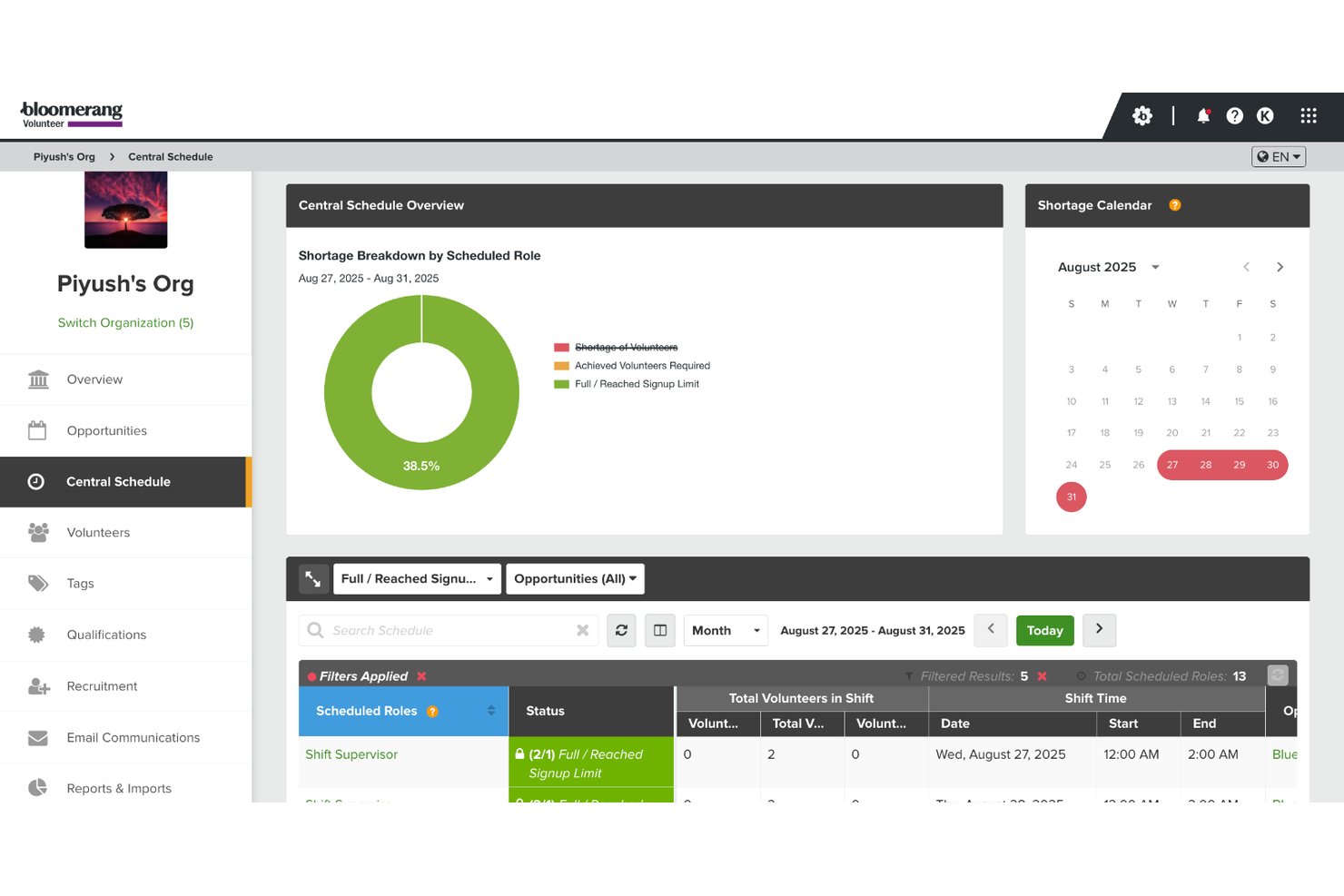
Bloomerang Volunteer is a volunteer management platform for nonprofits that combines scheduling, hours tracking, volunteer communications, background screening, and impact reporting with a built-in CRM link to donor data.
Who Is Bloomerang Volunteer Best For?
Bloomerang Volunteer is a strong fit for nonprofits that manage both volunteers and donors and want to connect that data in a single platform.
Why I Picked Bloomerang Volunteer
I picked Bloomerang Volunteer as one of the best because it's the only volunteer management tool I've used that natively links volunteer activity to donor records in the same CRM. When a volunteer hits a milestone or logs consistent hours, that data lives alongside their giving history, making it easy to identify conversion opportunities. RosterMode then handles AI-driven shift matching so coordinators aren't manually sorting through availability to fill recurring shifts.
Bloomerang Volunteer Key Features
- Digital waivers and e-signatures: Collect signed liability waivers and agreements within the platform, without a third-party tool.
- Verified First background checks: Run criminal, employment, education, driving, drug, and credit screenings on volunteers from inside the platform.
- Milestone recognition and leaderboards: Automatically surface volunteer milestones and display contribution rankings to drive ongoing engagement.
- Multi-channel messaging: Send targeted email, SMS, and push notifications to volunteer segments, with built-in automated shift reminders.
Bloomerang Volunteer Integrations
Bloomerang Volunteer integrates with Bloomerang CRM, Verified First, QuickBooks, Mailchimp, Constant Contact, DonorSearch, and Amilia. It also offers an API and Zapier integration for custom connections.
Pros and Cons
Pros:
- Automates shift matching using AI scheduling
- Offers dedicated volunteer and manager mobile apps
- Links volunteer and donor records natively
Cons:
- No in-app training or LMS features
- No free trial or self-serve version

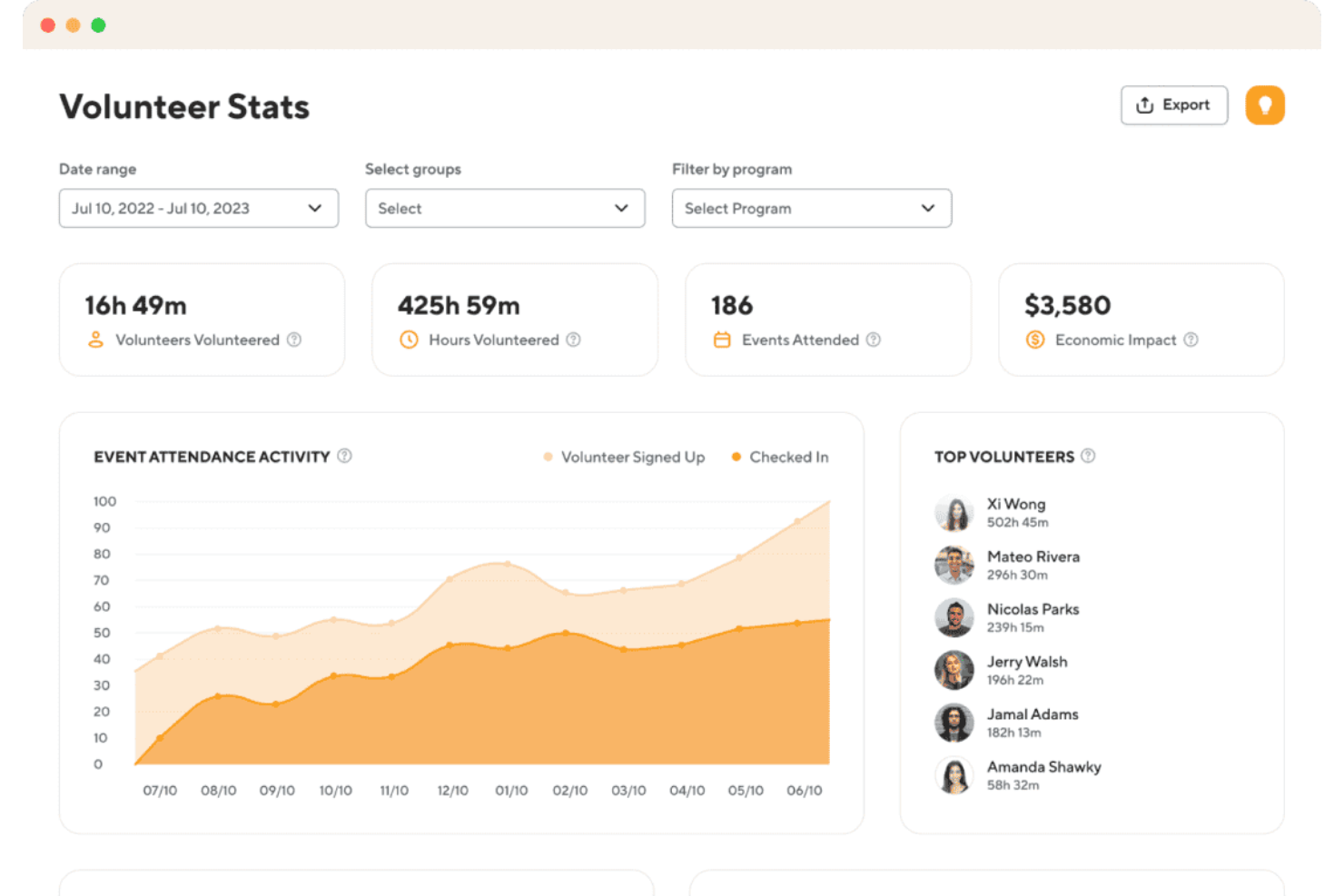
POINT is a volunteer management platform that combines scheduling, hour tracking, volunteer onboarding, automated communications, and impact reporting with a dual-sided model for both nonprofits and corporate volunteer programs.
Who Is POINT Best For?
POINT is ideal for nonprofits and corporate CSR teams co-hosting volunteer events, offering a single platform to manage both partners.
Why I Picked POINT
I've included POINT in my top picks because its dual-sided model is genuinely built for co-hosted events, letting a nonprofit and a corporate partner share a single event, split volunteer management, and generate separate impact reports without duplicating data entry. I love how corporate teams get their own private event feed and company-level reporting through POINT for Work, while the nonprofit retains full scheduling control. Co-hosted events with automatic group-level tracking make it the clearest choice when a company and a nonprofit are running a volunteer day together.
POINT Key Features
- Volunteer self-submission with approval workflow: Volunteers log outside hours via the mobile app or web, and admins receive a notification to approve, edit, or deny each submission.
- Custom application builder: Create volunteer intake forms with tailored questions, document requirements, and a built-in review and approval workflow.
- E-waiver management: Build and store digital waivers with automatic expiration tracking and version control to activate or sunset documents.
- Volunteer discovery network: Increases your reach by connecting with local users who follow causes like yours.
POINT Integrations
POINT integrates with Checkr, Kindful, DonorPerfect, Calendar apps, PayPal, and Venmo. It also supports Okta SSO, social sharing, and website embeds.
Pros and Cons
Pros:
- Mobile app with built-in volunteer discovery
- Co-hosted nonprofit organizations and corporate volunteer events
- Unlimited volunteers and admins on all plans
Cons:
- No recurring schedule bulk tools
- Requires workarounds for deep CRM setups

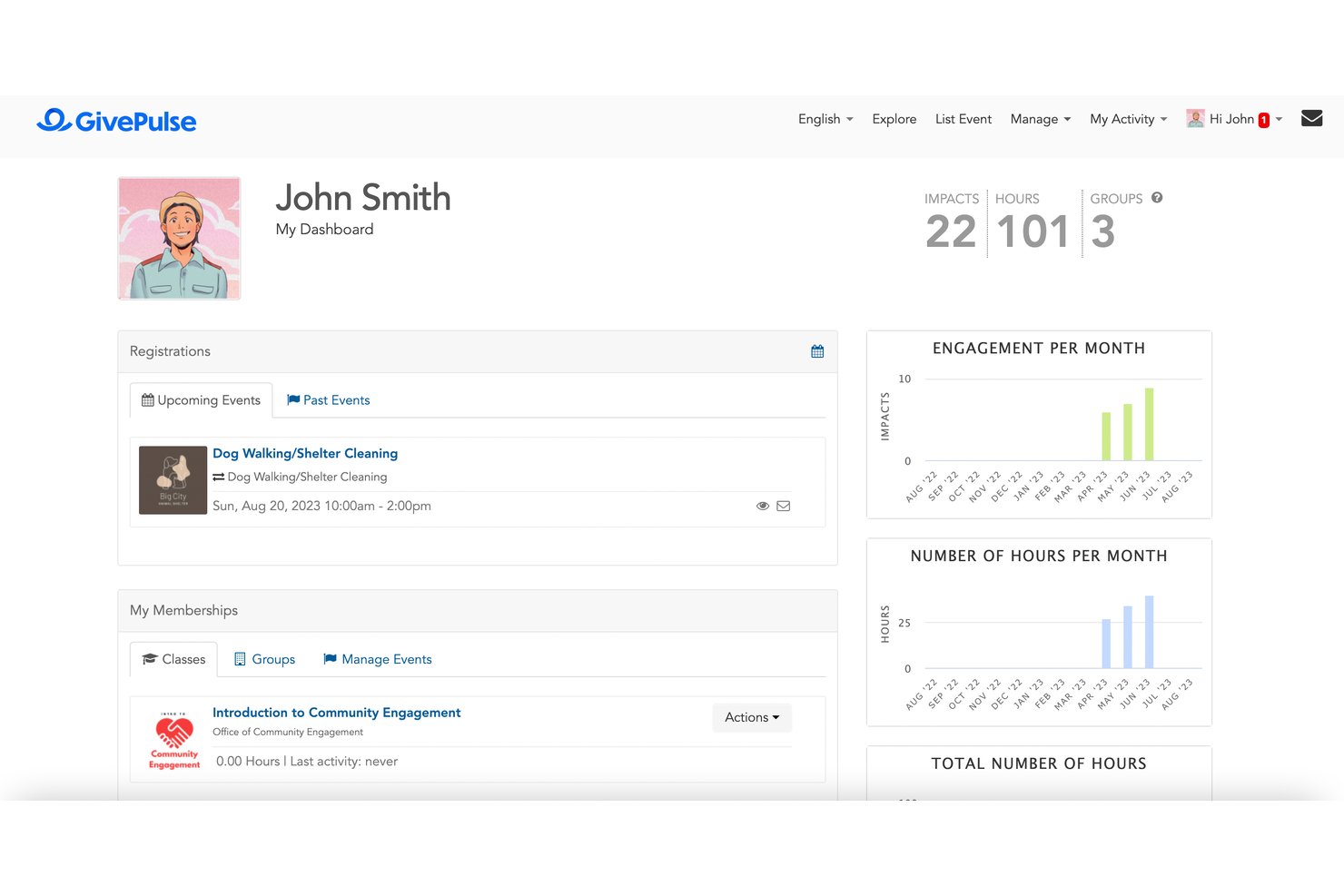
GivePulse is a volunteer management platform that combines volunteer and donor CRM, shift and event scheduling, multi-method hours tracking, and impact reporting with built-in SDG affiliation tagging and economic value calculation.
Who Is GivePulse Best For?
GivePulse is a strong fit for universities, United Ways, and corporate CSR teams that need to document and report volunteer impact against SDG frameworks.
Why I Picked GivePulse
GivePulse earns its spot on my shortlist because of how it handles impact documentation, particularly its built-in SDG affiliation tagging, which lets you tie every volunteer event to a Sustainable Development Goal. I also like that it calculates the economic value of volunteer hours using Independent Sector rates, a figure you can customize per program and pull into grant applications or board reports. The combination of SDG tracking and VIVA-style economic valuation is rare to find natively in a volunteer management platform.
GivePulse Key Features
- Unified volunteer and donor CRM: Store volunteer profiles, service history, donation records, and documents with custom fields and tags.
- Multi-method check-in: Capture hours via mobile clock-in/out, QR code scanning, tablet kiosk mode, or geofencing that auto-verifies on-site arrival within a defined radius.
- Subgroup architecture: Organize volunteers into subgroups by program, department, or location, each with its own admin access.
- Digital waivers and application forms: Collect volunteer applications with configurable fields for skills and certifications.
GivePulse Integrations
GivePulse integrates with Salesforce, Blackbaud, Handshake, HubSpot, and NeonCRM. It also offers a RESTful API and Zapier integration for custom connections.
Pros and Cons
Pros:
- Unified volunteer and donor CRM database
- Multiple mobile, QR, and geofencing check-ins
- Built-in SDG impact and economic value reporting
Cons:
- No native background check integration
- Steep learning curve for non-tech users

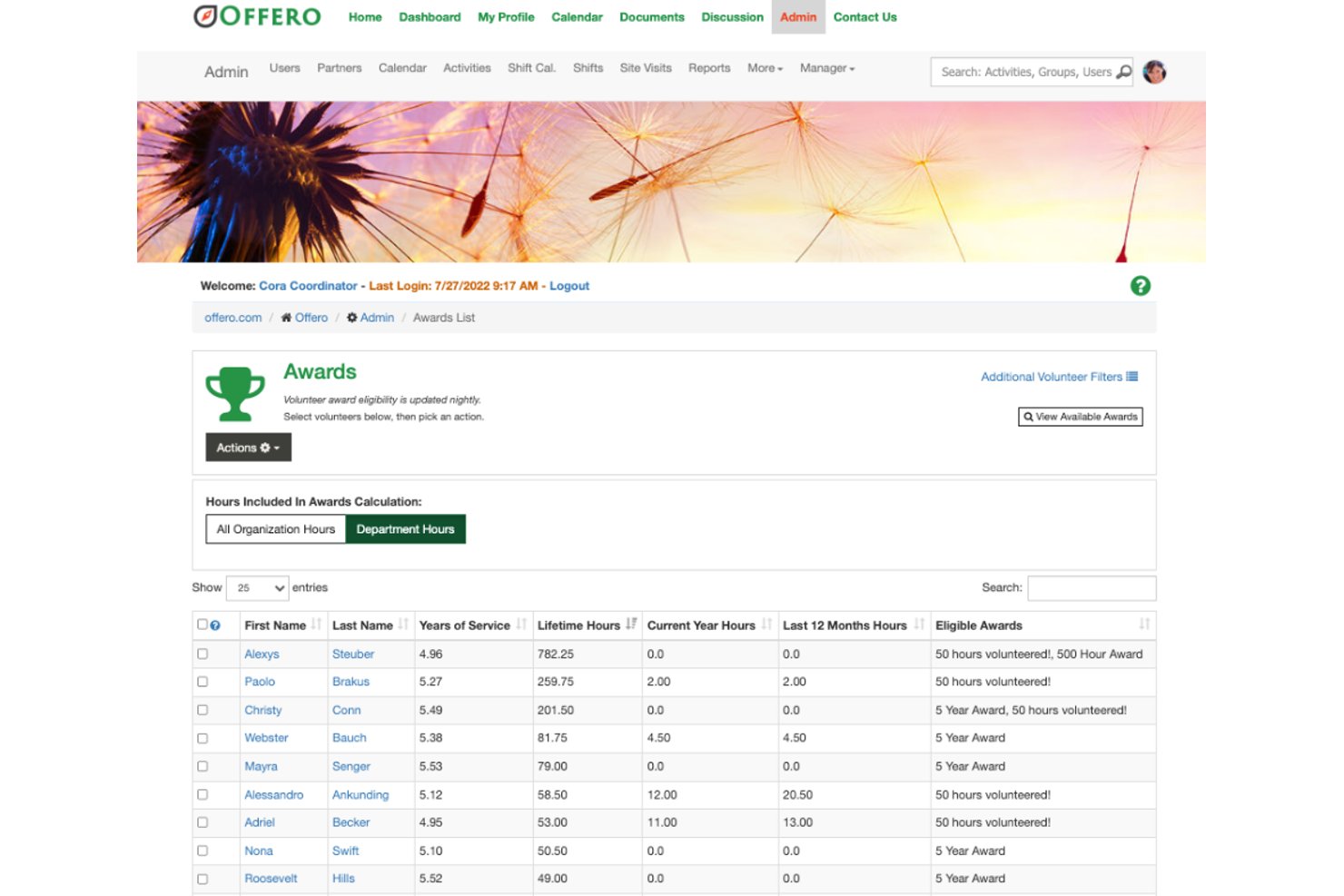
Offero is a volunteer management platform built around compliance-heavy programs, combining volunteer scheduling, a native LMS with qualification gating, background check integrations, hours tracking, and unified event and participant management.
Who Is Offero Best For?
Offero is a strong fit for government agencies and healthcare organizations running multi-site volunteer programs that require compliance infrastructure, credentialing workflows, and qualification-gated scheduling.
Why I Picked Offero
I picked Offero as one of the best because its built-in LMS with qualification gating is something I haven't seen handled this well elsewhere in the category. In government and healthcare settings, that means you can block a volunteer from signing up for a hospital shift until they've completed a specific training course and passed the quiz. Pair that with native background check integrations through Sterling Volunteers and Verified Volunteers, and Offero handles the full credentialing chain in one place.
Offero Key Features
- Unified volunteer and event calendar: Manage public event participant registration and shift scheduling in a shared view.
- Self-reported site visit tracking: Volunteers self-schedule field visits and submit impact reports to log hours, record custom metrics, and submit maintenance requests.
- Automated recognition and awards: Set milestone triggers based on cumulative hours or custom impact measures.
- Configurable volunteer application forms: Build custom intake forms for new volunteer applicants, with automated admin notifications upon submission.
Offero Integrations
Offero integrates with Sterling Volunteers and Verified Volunteers for background checks, plus Usersnap for in-app feedback. An API is also available for custom integrations.
Pros and Cons
Pros:
- Unified calendar for events and shifts
- Built-in LMS for compliance and training
- No per-seat fees for admins or volunteers
Cons:
- Limited custom reporting options
- No dedicated mobile app available
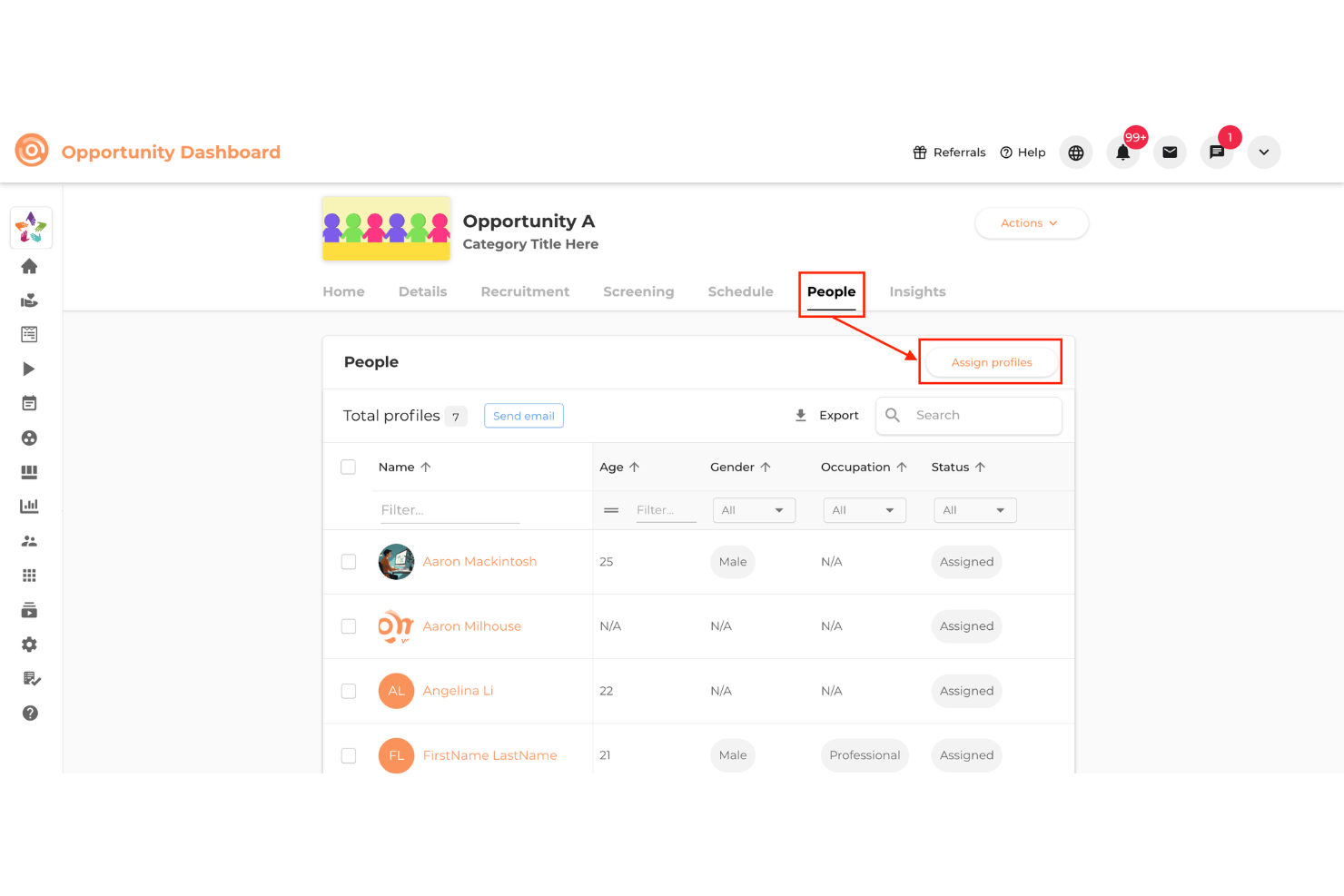
Vome Volunteer is a volunteer management platform offering recruitment, scheduling, tracking, onboarding, LMS, and messaging with single admin-seat pricing and no volunteer limit.
Who Is Vome Volunteer Best For?
Vome Volunteer is a strong fit for nonprofits and volunteer-driven organizations that need to train volunteers at scale through structured, built-in learning pathways.
Why I Picked Vome Volunteer
I've included Vome Volunteer in my top picks because it's the only volunteer management platform I've found with a fully native LMS built in, no third-party tool required. You can build multi-chapter training courses with video, SCORM hosting, and quizzes, then gate volunteer access to shifts until they pass. The certification expiry tracking and auto-renewal rules mean onboarding compliance doesn't fall through the cracks for large or seasonal volunteer programs.
Vome Volunteer Key Features
- GPS proximity check-in: Volunteers check in via QR code, tap, or kiosk, with geo-fencing per site or shift to validate that check-ins happen on location.
- Multi-step onboarding sequences: Build automated flows that combine forms, fillable PDFs, e-signatures, background checks, and training modules.
- Custom awards and achievements: Set rules-based awards triggered by hours logged or shifts completed, with eligibility scoped by tags, sites, or age.
- Impact Formula Builder: Create custom impact calculations using any numeric data or form response to generate economic-value reporting for boards and grant applications.
Vome Volunteer Integrations
Vome Volunteer integrates with Sterling Volunteers, Verified First, and Double the Donation. It also supports REST API access, webhooks, and Zapier.
Pros and Cons
Pros:
- Multiple check-in methods with GPS validation
- Unlimited volunteer profiles on every plan
- All-in-one platform with native LMS
Cons:
- Lack of deep native CRM sync
- Non-intuitive automated workflows

Golden
Best for converting volunteers to donors
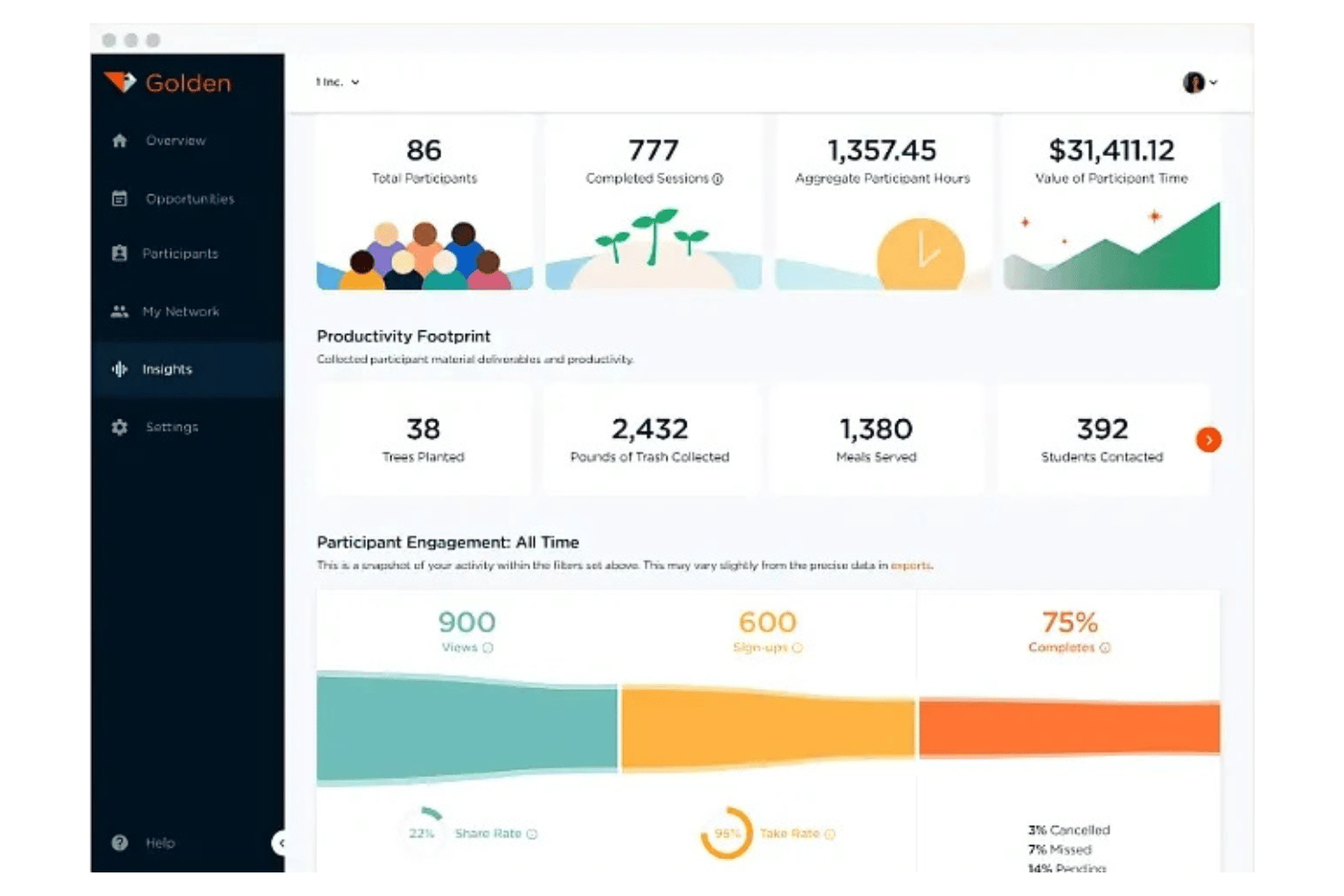
Golden is a volunteer management platform with built-in AI fundraising tools that connects volunteer scheduling, hours tracking, multi-channel communications, and donor conversion in one system.
Who Is Golden Best For?
Golden is a strong fit for nonprofits that want to turn their volunteer base into a donor pipeline using built-in AI fundraising tools.
Why I Picked Golden
Golden earns its spot on my shortlist because of its built-in AI fundraising layer, which no other volunteer management platform I've reviewed offers. It analyzes volunteer engagement signals to identify who's likely to donate, then fires off personalized asks via email, SMS, or push notifications. I also love that the volunteer-facing mobile app keeps volunteers engaged between shifts, which makes the donor conversion pipeline feel natural.
Golden Key Features
- Volunteer self-scheduling: Volunteers can browse open shifts and sign up directly through the mobile app or web portal based on their own availability.
- Kiosk check-in: Volunteers can check in and out at large-scale events without coordinator intervention.
- Omnichannel automated messaging: Build automated workflows that trigger shift reminders, thank-you messages, and milestone alerts.
- Gamification and milestone recognition: Offer digital badges, track achievements, and run leaderboards to encourage volunteer engagement.
Golden Integrations
Golden integrates with Salesforce, Microsoft Dynamics, Blackbaud, Virtuous, and NationBuilder. It also offers an open API for custom integrations and SSO for secure user authentication.
Pros and Cons
Pros:
- Forever free plan supports unlimited volunteers
- Offers award-winning volunteer mobile app
- Converts engaged volunteers into likely donors
Cons:
- Admins and users report frequent app crashes
- Grant-specific reporting capabilities are limited

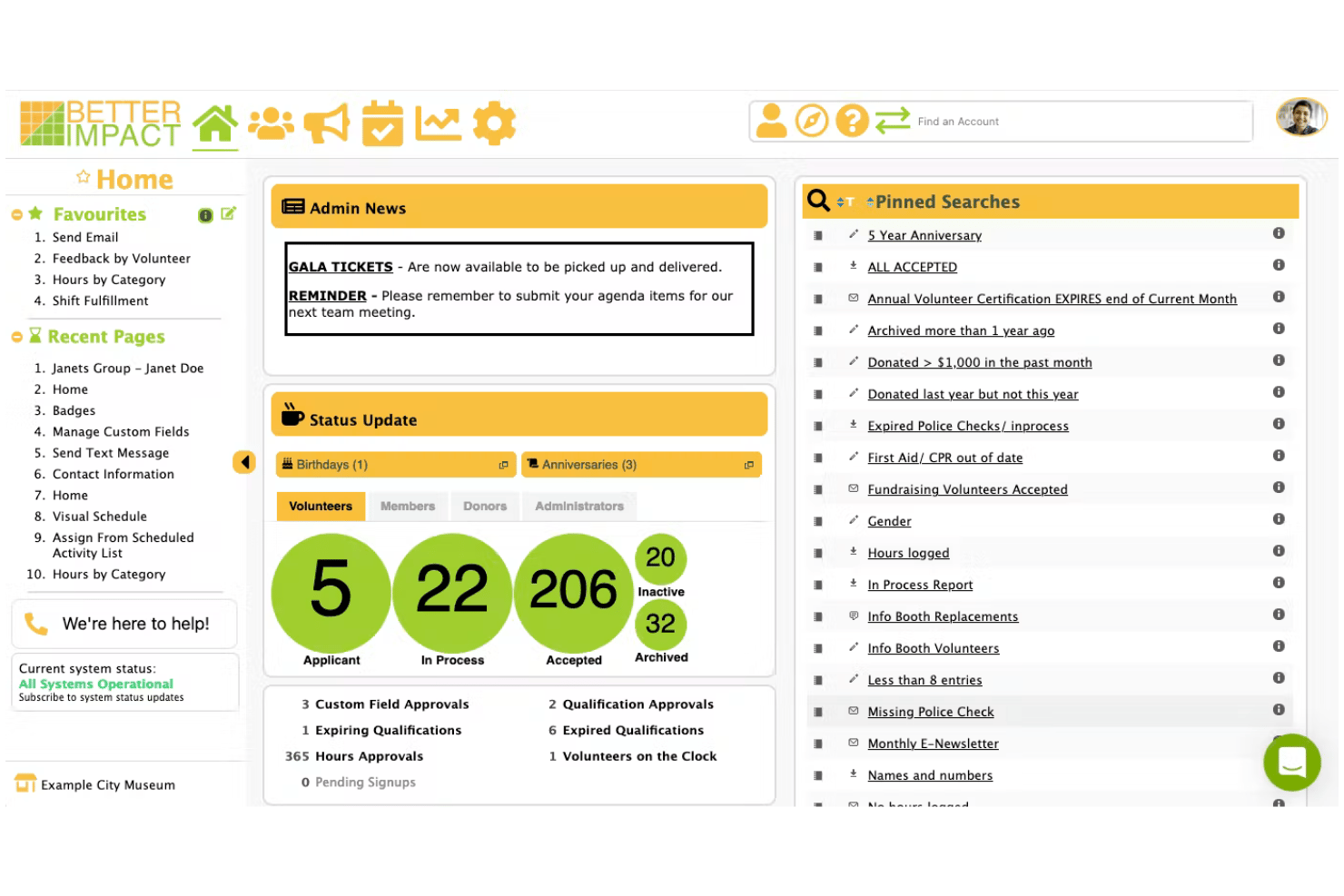
Better Impact is a volunteer management platform that covers the full volunteer lifecycle, including recruitment, onboarding, shift scheduling, hours tracking, communications, training, and impact reporting.
Who Is Better Impact Best For?
Better Impact is a good fit for nonprofits, libraries, healthcare organizations, and government agencies that manage large, ongoing volunteer programs and need a single system to handle the full volunteer journey.
Why I Picked Better Impact
Better Impact earns its spot on my shortlist because it covers the full volunteer lifecycle in one place, from online applications and e-signature waivers to built-in LMS training, shift scheduling, and milestone tracking. I'm particularly impressed by the certification expiry alerts, which automatically flag when a volunteer's credentials are lapsing, and the geolocation check-in via the "My Impact" mobile app, which removes the need for manual sign-in sheets.
Better Impact Key Features
- Built-in LMS: Create multi-step online training courses with text, video, and quiz components to certify volunteers before they begin.
- Volunteer self-service portal: Volunteers can browse opportunities, sign up for shifts, and update their own profiles without admin involvement.
- Mass email and SMS messaging: Send segmented bulk communications to volunteers filtered by attributes like role, location, or program.
- Multi-location reporting: Generate standardized reports across departments or sites to consolidate hours, participation, and demographics data in one view.
Better Impact Integrations
Better Impact integrates with Sterling Volunteers and Verified First for background checks. It also offers SSO and a JSON-based REST API for custom integrations.
Pros and Cons
Pros:
- Geolocation check-in via mobile app
- Built-in LMS for volunteer training modules
- Volunteer milestones tracked with automatic badges
Cons:
- Multi-branch accounts locked to enterprise plans
- No built-in SMS tools

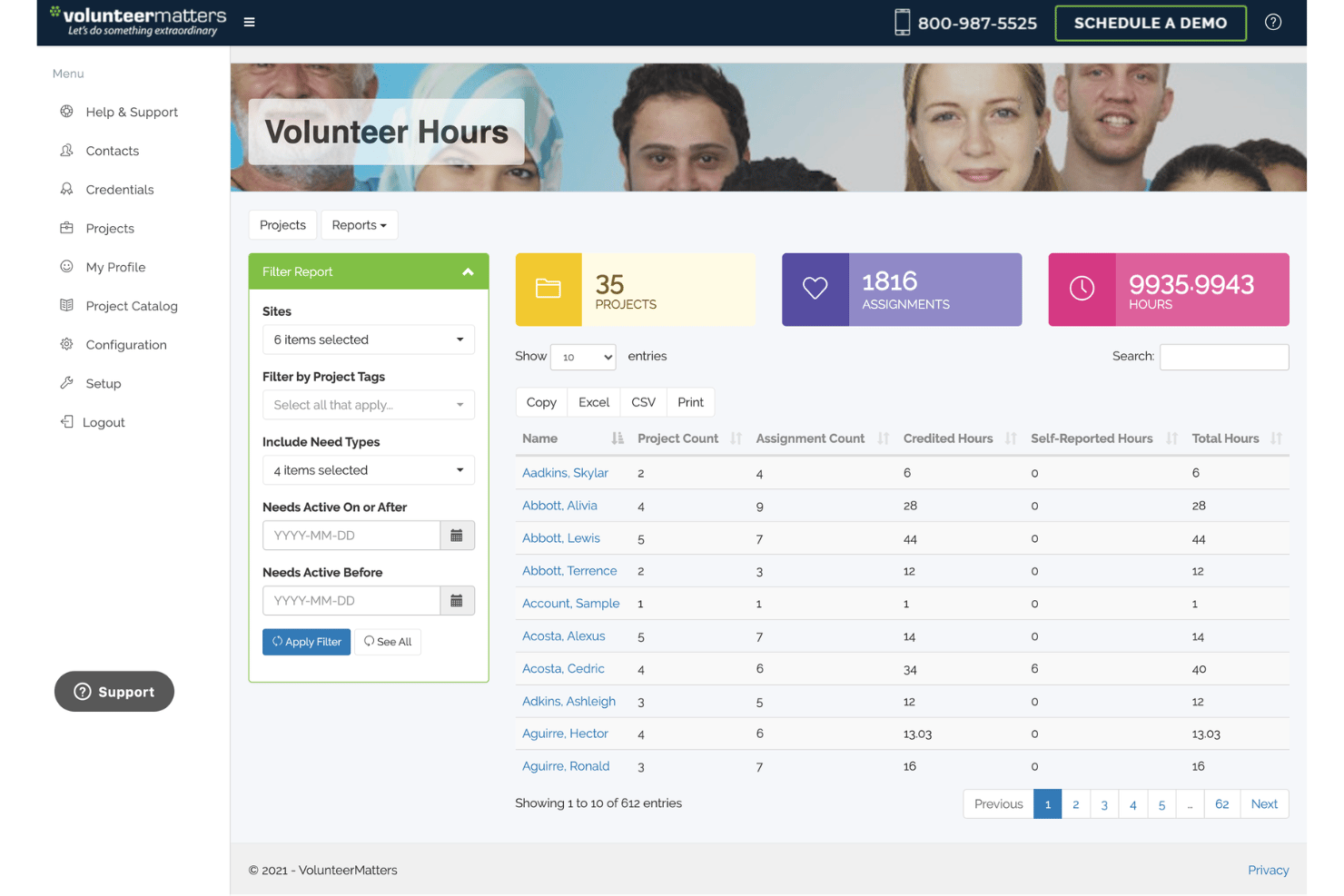
VolunteerMatters is a volunteer management platform that handles end-to-end program operations, including volunteer recruitment, compliance-driven onboarding, shift scheduling, hours tracking, and multi-channel communications.
Who Is VolunteerMatters Best For?
VolunteerMatters is a strong fit for nonprofits and mission-driven organizations that manage large volunteer programs with strict compliance, screening, or credentialing requirements.
Why I Picked VolunteerMatters
VolunteerMatters earns its spot on my shortlist because its onboarding automation goes deeper than any other tool I've seen in this category. I'm impressed by how it chains background checks (via Sterling Volunteers and Intellicorp), e-signature waivers, and role-specific training requirements into a single self-service flow that volunteers complete at their own pace. The FCRA-compliant adjudication automation means my team gets instant alerts the moment a check is flagged, rather than manually chasing results.
VolunteerMatters Key Features
- Credential expiration tracking: Automatically reminds volunteers to renew certifications before expiration, keeping records updated without manual effort.
- Geolocation-verified check-in: Confirms a volunteer's on-site location before logging hours, adding an integrity layer useful for grant reporting and audits.
- Volunteer self-service portal: Volunteers browse shifts, submit hours, complete training, and manage their own profiles via a mobile web portal.
- Post-assignment feedback surveys: Automatically sends surveys to volunteers and compiles responses into organized reports for program evaluation.
VolunteerMatters Integrations
VolunteerMatters integrates with Salesforce, Daxko, TractionRec, and NimbleAMS. It also supports a REST API with webhooks and Zapier for custom integrations.
Pros and Cons
Pros:
- Parental consent features for youth volunteers
- Geolocation check-in for compliance-focused hours tracking
- Onboarding automates background checks and waivers
Cons:
- Interface can be confusing for occasional volunteers
- Reporting customization options are limited

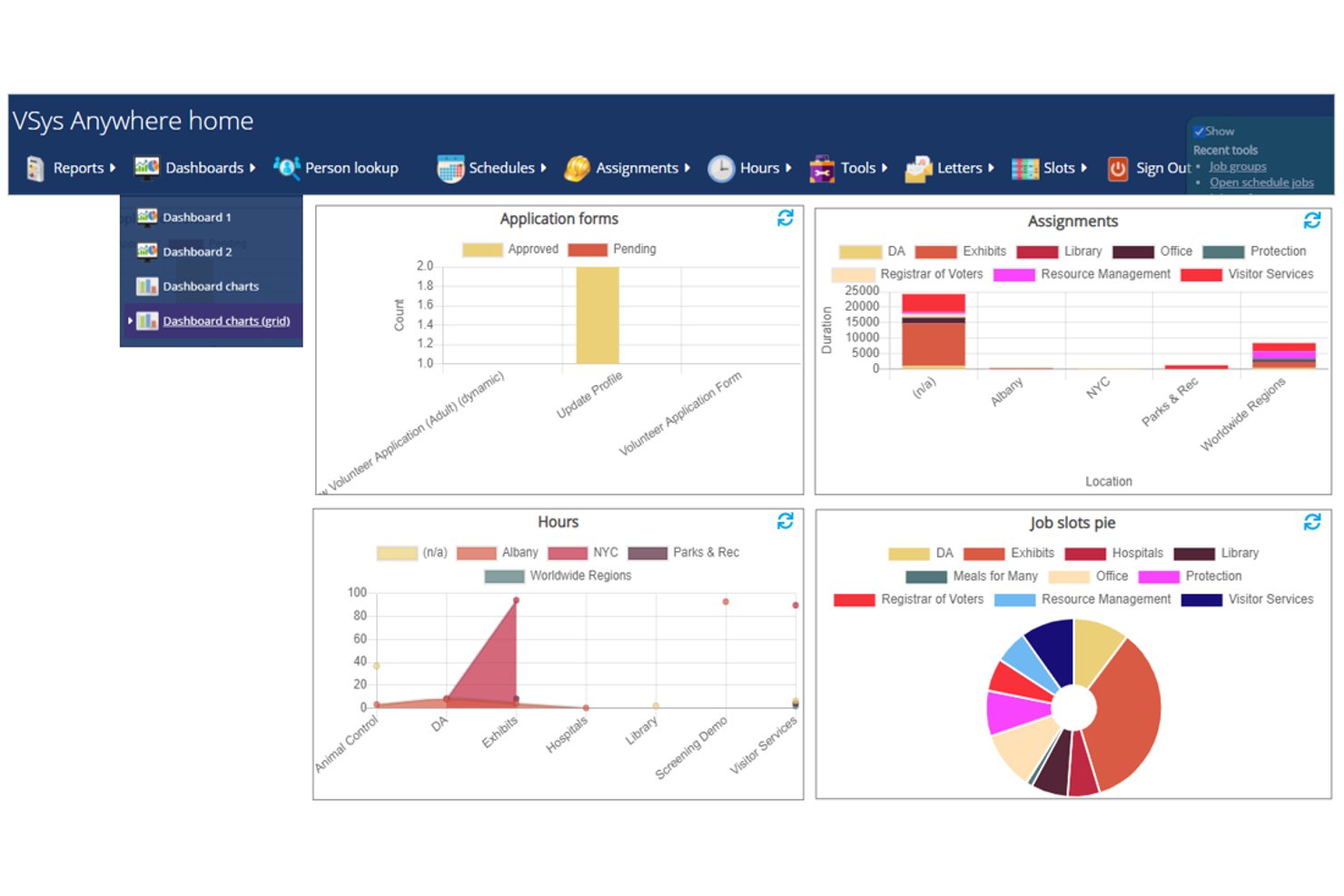
VSys One is a volunteer management platform built around highly configurable volunteer records, multi-channel scheduling, hours tracking, onboarding workflows, and 200+ reporting tools designed for large-scale programs.
Who Is VSys One Best For?
VSys One is a strong fit for healthcare systems and large nonprofits that need enterprise-grade compliance, configurable volunteer information, and audit-ready reporting.
Why I Picked VSys One
I picked VSys One as one of the best because it's purpose-built for the complexity hospital and large nonprofit volunteer programs deal with. The eligibility checklist system supports multiple onboarding paths, so a hospital can route clinical volunteers through HIPAA training and TB screening records separately from gift shop volunteers. I also love built-in Joint Commission audit-ready reporting.
VSys One Key Features
- Bidirectional SMS messaging: Volunteers can text back directly through Twilio or Telnyx integrations, with all messages stored in each volunteer's record.
- VSys Live self-service portal: Volunteers sign up for shifts, log hours, and complete digital forms via a browser-based portal.
- Custom field engine: Create global or project-specific data fields to track specialized credentials, demographics, or custom metrics.
- Role-based admin access control: Restricts system permissions and profile data access by user tier, department, or location to ensure data privacy.
VSys One Integrations
Integrations include Workday, Sterling Volunteers, Enterprise Health Solution, OHM, and Tessitura, with VOXI API and scripted modules enabling custom scheduled data exchanges.
Pros and Cons
Pros:
- Reporting supports healthcare audit requirements
- Unlimited volunteer records at no extra cost
- Highly configurable onboarding and compliance workflows
Cons:
- User interface feels outdated to new admins
- No dedicated mobile app for volunteers

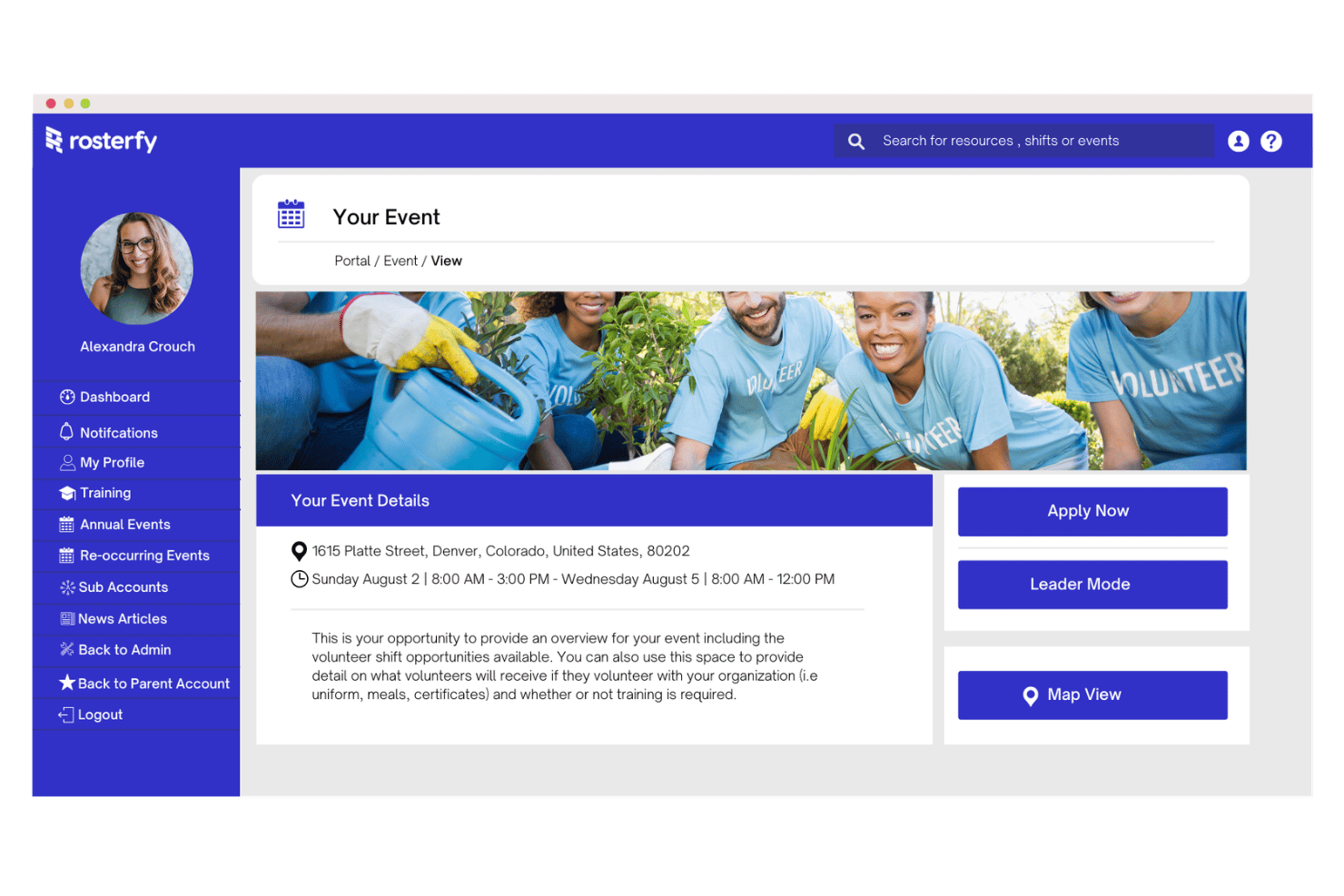
Rosterfy is a volunteer management platform built for large-scale programs, offering end-to-end tools for volunteer recruitment, onboarding, scheduling, hours tracking, communications, and impact reporting.
Who Is Rosterfy Best For?
Rosterfy is built for large nonprofits, sports organizations, and corporate CSR teams managing complex, high-volume volunteer programs across multiple sites or regions.
Why I Picked Rosterfy
I picked Rosterfy as one of the best because it's built specifically for the scale and complexity that enterprise volunteer programs actually deal with. I'm particularly impressed by the native LMS with SCORM support, which auto-assigns training and gates shift access until compliance is confirmed. Pair that with multi-modal check-in options like geofencing and QR codes across concurrent venues, and Rosterfy handles what most platforms can't.
Rosterfy Key Features
- Reward and recognition: Issue e-badges, certificates, gift vouchers, and merchandise rewards with built-in inventory management for physical items.
- Salesforce two-way sync: Connect volunteer activity records directly to Salesforce NPSP and Nonprofit Cloud donor profiles.
- Multi-entity admin access: Manage chapters, regions, or departments under one platform with segmented permissions and cross-entity reporting.
- Volunteer self-service portal: Let volunteers manage their own profiles, update availability, and sign up for shifts without coordinator involvement.
Rosterfy Integrations
Rosterfy lists 50+ integrations, including Salesforce, Blackbaud, Microsoft Dynamics, Microsoft Power BI, Brevo, and Stripe. It also supports custom integrations through its API.
Pros and Cons
Pros:
- Granular permission controls for enterprise oversight
- Built-in LMS with compliance gating features
- Handles multi-site, large-scale volunteer programs
Cons:
- No free tier or self-serve trial
- No admin access via mobile app
Other Volunteer Management Software
Here are some additional volunteer management software options that didn’t make it onto my shortlist, but are still worth checking out:
- Get Connected
For volunteer networks spanning multiple sites
- Access Assemble
For UK charities managing volunteers at scale
- VolunteerLocal
For no-password volunteer sign-up
- Volgistics
For kiosk and portal-based hour tracking
- VolunteerHub
For Blackbaud volunteer sync
- Giveffect
For unifying volunteer tracking with donor CRM
- Civic Champs
For active-volunteer pricing
- Volunteero
For mobile-first self-scheduling
- Salesforce Nonprofit Cloud
For nonprofits already running on Salesforce
- LiveImpact
For nonprofits with group volunteer scheduling


How I Evaluate Volunteer Management Software
I split my evaluation into baseline functionality every tool must cover—scheduling, hour tracking, onboarding—and the differentiators that separate a niche fit from a genuinely scalable volunteer management solution.
Core Functionality (Table Stakes For This List)
When I'm selecting tools for my list, I rank each one on a scale from 0 (does not offer the functionality) to 5 (excels in this area) for each core functionality listed below. I then calculate the tool's total score into a percentage, using 65% as a benchmark to help assess its overall fit for the list.
- Volunteer database: I evaluate how well each tool handles profile customization, including skills tagging, certification tracking, and segmentation filters that let you find the right person for a specialized role fast.
- Shift and event scheduling: Self-service signup, recurring shifts, waitlists, and calendar sync all factor in here—coordinators shouldn't need to manually slot every volunteer into every opening.
- Hours tracking: I look for multiple logging methods like mobile check-in, kiosk mode, or self-reporting paired with an approval workflow, since accurate records matter for grant reporting and compliance.
- Recruitment and onboarding: Background check integrations, waiver collection, and training assignments tell me whether a platform can handle intake for roles in healthcare or government where screening requirements are strict.
- Volunteer communications: Multi-channel messaging with segmentation is what I check for—teams managing hundreds of volunteers need targeted shift reminders and updates across email, SMS, or push notifications.
- Reporting and analytics: Custom dashboards, impact metrics, and scheduled report delivery are the markers I use to gauge whether a tool can satisfy board-level reporting or funder requirements.
Once I have a list of tools that meet the criteria, I consider what sets each platform apart.
Differentiating Factors (What Sets Vendors Apart)
Here's how I compare and contrast different vendors:
Standout Features
I check whether a platform can auto-calculate the economic value of volunteer hours using recognized valuation rates, since that figure shows up constantly in grant applications and board reports. Skills-based matching is another area I evaluate—pairing volunteers to roles by credentials, certification expiry, and proximity saves coordinators from manual sorting, especially during disaster response surges. I also look at how well a tool unifies volunteer activity with donor history, because spotting conversion opportunities depends on having one constituent record, not two disconnected databases.
Beyond Features
Pricing models vary widely—some vendors charge per active volunteer, others per admin seat—so I check how costs behave during seasonal surges like holiday drives or disaster response. Integration depth matters just as much: I look for native connectors to donor CRMs like Salesforce NPSP or Raiser's Edge and background check providers like Checkr, since manual workarounds add real admin load. I also evaluate compliance posture, especially GDPR readiness and role-based permissions, because volunteer programs in healthcare or youth services handle sensitive data that demands audit trails and age-based protections.
How to Choose a Volunteer Management Software
Finding the right volunteer management platform comes down to matching your real operational pain points with key software features:
| If your priority is… | Look for… |
|---|---|
| Tracking volunteer lifecycles | Customizable profiles and lifecycle reporting |
| Heavy compliance and onboarding flows | Integrated background checks and e-sign waivers |
| Large-scale scheduling across sites | Multi-location shift scheduling with permission controls |
| Tying donor and volunteer data together | CRM integration and unified reporting |
| Measuring and reporting impact | Configurable dashboards with exportable analytics |
How to Vet Your Shortlist
- Test onboarding workflows: Run a full intake from signup to documentation on three devices within 72 hours.
- Check background check compliance: Request a list of integrated screening and waiver tools along with their privacy policies.
- Evaluate integration depth: Ask for a live demo connecting to your CRM or HRIS, verifying how data syncs in both directions.
- Assess permissions and audit logs: Request an admin sandbox to review user roles, audit trails, and data export features.
- Tradeoff—feature depth vs. integration flexibility: Decide if your program needs advanced volunteer reporting in one suite or best-in-class integrations with existing HR and CRM systems.
What Is Volunteer Management Software?
Volunteer management software is a digital tool that helps teams with volunteer recruitment, onboarding, shift scheduling, and communications in one place. These platforms enable you to maintain accurate records, improve compliance, and measure program impact. By centralizing volunteer data and processes, you can improve operational efficiency, meet compliance requirements, and deliver tailored experiences to volunteers.
Features of Volunteer Management Software
When selecting volunteer management software, keep an eye out for the following key features:
- Volunteer database: Store, organize, and search volunteer profiles with customizable fields, skills tracking, certifications, and segmentation to quickly match people to specialized roles.
- Shift and event scheduling: Create and manage shifts, events, and recurring schedules with self-service signup, waitlists, calendar syncing, and automated reminders to keep volunteers informed.
- Hours tracking: Record volunteer hours through methods like mobile check-in, kiosk mode, and self-reporting, with options for approval workflows to ensure accurate records for compliance and reporting.
- Recruitment and onboarding: Manage intake with applications, integrated background check partners, e-signature waivers, and track progress through training and document completion—essential for compliance-heavy environments.
- Volunteer communications: Send targeted messages, shift reminders, and updates across channels such as email, SMS, or push notifications, enabling coordinators to keep volunteers engaged and informed.
- Reporting and analytics: Generate, customize, and export reports and dashboards to monitor volunteer activity, measure impact, and share key metrics with stakeholders and funders.
- Integration options: Connect with donor management systems, HRIS, and background check providers to synchronize data, reduce manual entry, and unify constituent records for better insights.
- Permission controls and audit trails: Set user roles with permission levels, track changes and user actions for accountability, and maintain compliance with data privacy policies.
- Document management: Collect, store, and manage important volunteer documents such as waivers, certifications, and training records in one location.
- Multi-location support: Coordinate volunteers and programs across different sites, chapters, or regions, each with tailored access, scheduling, and reporting tools.
Common Volunteer Management Software AI Features
Beyond the standard volunteer management software features listed above, many of these solutions are incorporating AI with features like:
- AI-driven volunteer matching: Uses machine learning to analyze volunteer skills, interests, and availability, then recommends the best-fit roles or events. This helps coordinators quickly fill positions and ensures volunteers are placed where they can contribute most.
- Predictive attendance analytics: Leverages historical participation data and behavioral patterns to forecast which volunteers are likely to attend or miss upcoming shifts. This allows teams to proactively manage no-shows and optimize scheduling.
- Automated communication assistants: Employs natural language processing to draft, personalize, and schedule messages to volunteers across email, SMS, or app notifications. These assistants can answer common questions and send timely reminders without manual intervention.
- Sentiment analysis on volunteer feedback: Analyzes survey responses, emails, and chat logs to detect volunteer satisfaction, engagement, or potential burnout. This gives coordinators early warning signs and helps them address issues before they escalate.
- AI-powered impact reporting: Automatically compiles and interprets volunteer activity data to generate visual reports and narratives that highlight program outcomes. This saves time on manual data analysis and helps teams communicate results to stakeholders.
Benefits of Volunteer Management Software
Implementing volunteer management software provides several benefits for your team and your business. Here are a few you can look forward to:
- Centralized volunteer data: Store, organize, and search all volunteer profiles, skills, and documents in one secure place through customizable databases and document management.
- Efficient scheduling and coordination: Create shifts, events, and recurring schedules with self-service signups, automated reminders, and calendar syncing, reducing manual scheduling work.
- Accurate time tracking: Track volunteer hours using mobile check-in, kiosk modes, or self-reporting with approval workflows to support compliance and grant reporting.
- Unified recruitment and onboarding: Manage applications, background checks, e-sign waivers, and training progress in one platform for a consistent onboarding experience.
- Targeted communications: Send messages, reminders, and updates through segmented email, SMS, or push notifications, keeping volunteers engaged and informed.
- Impact measurement and reporting: Generate custom dashboards and exportable analytics to monitor activity and demonstrate outcomes to stakeholders and funders.
- Integration with other systems: Sync volunteer activity with donor CRMs, HRIS, and background check providers to unify constituent records and reduce manual data entry.
Costs and Pricing of Volunteer Management Software
Selecting volunteer management software requires an understanding of the various pricing models and plans available. Costs vary based on features, team size, add-ons, and more. The table below summarizes common plans, their average prices, and typical features included in volunteer management software:
Plan Comparison Table for Volunteer Management Software
| Plan Type | Average Price | Common Features |
|---|---|---|
| Free Plan | $0–$50/month | Limit on volunteer records, basic event scheduling, mobile check-in, and limited reports. |
| Personal Plan | $25–$100/month | Expanded volunteer database, shift scheduling, hours tracking, onboarding workflows, and email support. |
| Business Plan | $100–$400/month | Multi-location management, donor CRM integration, analytics dashboards, messaging tools, and role management. |
| Enterprise Plan | $400–$2,000/month | Advanced permissions, custom integrations, dedicated support, compliance modules, and audit trails. |
Volunteer Management Software FAQs
Here are some answers to common questions about volunteer management software:
How do you vet the security and compliance features of volunteer management software?
Start by asking vendors for details about data encryption, audit logs, and user permissions. Review their privacy policy and whether they mention frameworks like GDPR, HIPAA, or SOC 2. Run a test of their admin settings to check for role-based access and whether you can generate audit trails. If your program deals with youth or health data, confirm age-based restrictions and data retention controls are in place.
Can volunteer management software integrate with my existing donor CRM?
Yes, most leading platforms offer integrations with popular donor CRMs like Salesforce or Blackbaud. Before you commit, ask for a demo of the integration. Check that volunteer and donor data syncs both ways and that you can report on both activities together. If you use a less common CRM, ask about custom API or middleware options.
What should I look for when onboarding seasonal or surge volunteers?
Look for software that supports batch onboarding, allows mobile sign-up, and handles background checks and e-sign waivers. Make sure the platform can segment these volunteers and schedule them separately from year-round teams. Ask about automated reminders and bulk communication features to easily manage large volunteer groups.
What’s the best way to compare pricing models across volunteer management software vendors?
Request clear quotes for your actual volunteer volume. Confirm what’s included in each tier—some charge by active volunteers, others by seats, or per feature. Ask about costs during peak events and beware of hidden fees for integrations or support. Annual contracts can save money, but only if the software reliably covers your unique needs.