

An employer of record (EOR) in Nigeria legally employs your team, manages local employment administration, and lets you hire without setting up a Nigerian entity.
The best employer of record in Nigeria for your organization should support compliant employment, dependable payroll, and a positive employee experience. Compare these providers by fees, payout options, HR support, integrations, and fit for your team’s size and work arrangements.
Why Trust Our Software Recommendations
6,700+
Reviews
20
Industry experts
16+
Evaluation factors
14
Years
Our team has been testing and reviewing software since 2012. As HR experts ourselves, we know how difficult—and important—it is to choose the right software.
For this guide, we evaluated tools using hands-on testing and independent research, scoring tools using our selection criteria. We also draw on insights from industry thought leaders and practicing HR experts.
Our reviews reflect our human editorial judgment, not a sales pitch.
Expert reviewers:
- Phil GrayCOO
 Kim BehnkeHR Tech Editor & Analyst
 Josh BarkerPeople Ops Manager

Comparison Table: Employers of Record in Nigeria
Compare pricing and specs side by side for the employers of record in Nigeria that made it onto my shortlist.
Score legend (out of 5)
- Excellent4.5–5
- Good4–4.4
- Average3–3.9
- Below average2–2.9
- Poor1–1.9
Sorted by: Default
| Tool | Starting Price | Website | |||||||||
|---|---|---|---|---|---|---|---|---|---|---|---|
Best for recruiting-linked EOR onboarding | Not rated | 4 | 3 | 3 | 4 | 3 | 3 | Not rated | Not rated | $599/employee/month Free demo available | Website |
Best for choosing a global hiring model | Not rated | 2 | 2 | 2 | 2 | 2 | 2 | Not rated | Not rated | $399/user/month Not available | Book Demo |
Best for Nigeria hiring with labor-law guidance | Not rated | 3 | 3 | 3 | 2 | 3 | 3 | Not rated | Not rated | $199/user/month Free demo available | Website |
Best for crypto-funded Nigerian payroll | Not rated | 3 | 3 | 3 | 3 | Not rated | Not rated | 4 | 3 | $199/user/month Free demo available | Website |
Best for analyst-ranked flat-fee Nigeria hiring | Not rated | 3 | 4 | 3 | 3 | Not rated | Not rated | 3 | 3 | $599/employee/month Free demo available | Website |
Best for Nigeria hiring with built-in tax filing | Not rated | 3 | 4 | 3 | 2 | 3 | 4 | Not rated | Not rated | $499/employee/month Free demo available | Website |
Best for transparent pricing on Nigerian hires | Not rated | 4 | 4 | 3 | 3 | Not rated | Not rated | 3 | 4 | $599/per employee/month Free demo available | Website |
Best for dedicated HR and employee support in Nigeria | Not rated | 3 | 4 | 2 | 3 | Not rated | Not rated | 3 | 4 | $399/employee/month Free demo available | Website |
Best for Nigerian payroll with project-site cover | Not rated | 4 | 3 | 3 | 4 | Not rated | Not rated | 3 | 3 | $199/employee/month Not available | Website |
Best for all-in-one HR and payroll in Nigeria | Not rated | 4 | 3 | 3 | 3 | Not rated | Not rated | 2 | 3 | $8/user/month Free trial + free demo available | Website |


Employers of Record in Nigeria Reviews
Below are my summaries of the best employers of record in Nigeria that made it onto my shortlist. My reviews examine each service’s compliance support, payroll, and HR features to help you find the right fit.
 Best for recruiting-linked EOR onboarding
- Free demo available
- From $599/employee/month
Visit WebsiteCustomer Rating:4.9/5
Deel Hire lets users add new hires individually or in bulk from the directory. Deel Hire is a global hiring and employer of record platform that connects recruiting, EOR employment, contractor management, and payroll across 150+ countries, including Nigeria, within a single workflow.
Who Is Deel Hire Best For?
Deel Hire suits companies that want to move from sourcing to EOR employment in Nigeria without switching tools or losing candidate data along the way.
Why I Picked Deel Hire
I've included Deel Hire in my top picks because it's the only tool on this list where recruiting and EOR onboarding in Nigeria share a single workflow. If you source a candidate through Deel's ATS or talent marketplace, that candidate's data moves directly into the EOR contract and onboarding flow, with no re-entry and no tool-switching. I also like that Nigerian payroll, statutory contributions (pension, ITF, NSITF), and benefits like AXA private healthcare are handled within that same platform.
Deel Hire Key Features
- EOR termination workflow: Assigns a local HR expert to manage offboarding, with Deel's Legal Group handling complex cases and final pay processed through the standard payroll cycle.
- Employee self-service portal: Lets Nigerian employees access payslips, tax documents, contracts, leave requests, and benefits-related tasks directly through their Deel account.
- Multi-currency contract options: Supports EOR contracts denominated in USD for Nigerian hires, with a local-currency payment option where legally required.
- Background screening: Automates new-hire background checks for Nigerian employees, with the option to add human-led verification.
Deel Hire Integrations
Deel Hire offers native integrations with Google Workspace and Microsoft Teams for interview scheduling. It also provides REST APIs, webhooks, MCP, CLI, and OpenAPI 3.0.1 support for custom integrations.
Pros and Cons
Pros:
- Local HR and legal review support offboarding
- NGN payroll shows deductions and payslips
- Candidate data carries into EOR onboarding
Cons:
- Reviewers report payout delays and exchange-rate concerns
- Nigerian employing entity remains undisclosed
Learn more about Deel Hire: Best for choosing a global hiring model
- Not available
- From $399/user/month
Visit WebsiteCustomer Rating:4.5/5
HireGlobal streamlines onboarding by guiding users to invite workers and add payment info. HireGlobal is Toptal's employer of record service that lets you hire, onboard, and pay employees across 180+ countries through a network of local providers, without setting up a legal entity.
Who Is HireGlobal Best For?
HireGlobal suits scaling businesses and HR teams that want to manage a global workforce across multiple hiring models without building local entities.
Why I Picked HireGlobal
I picked HireGlobal as one of the best because it's the only option on this list that lets you choose from multiple hiring models, including full EOR, Virtual EOR, and Agent of Record, so you're not locked into one approach when building a Nigerian team. Its provider network spans 180+ countries, and local experts handle contracts, payroll, and compliance on your behalf. I also like that you get a dedicated representative to escalate compliance questions directly, rather than relying on a generic support queue.
HireGlobal Key Features
- Locally compliant employment contracts: HireGlobal generates employment agreements that align with local labor laws in each country where you hire.
- Consolidated global payroll invoicing: All workforce payments across countries are bundled into a single invoice, billed in USD with currency conversion applied at the invoice date.
- Multi-model hiring options: You can choose between full EOR, Virtual EOR, Agent of Record, or contractor management depending on your compliance needs and budget.
- SOC 2-certified data security: HireGlobal holds SOC 2 Type 1, Type 2, and SOC 3 certifications, with AES-256 encryption applied to workforce data in transit and at rest.
HireGlobal Integrations
HireGlobal doesn't have any native integrations documented. Its API availability and named integration options aren't stated.
Pros and Cons
Pros:
- Multiple hiring models offer flexibility
- Users describe support as responsive
- Reviewers praise fast, frictionless payments
Cons:
- Relies on virtual EOR
- Nigerian employing entity remains undisclosed
Learn more about HireGlobal: Best for Nigeria hiring with labor-law guidance
- Free demo available
- From $199/user/month
Visit WebsiteCustomer Rating:4.5/5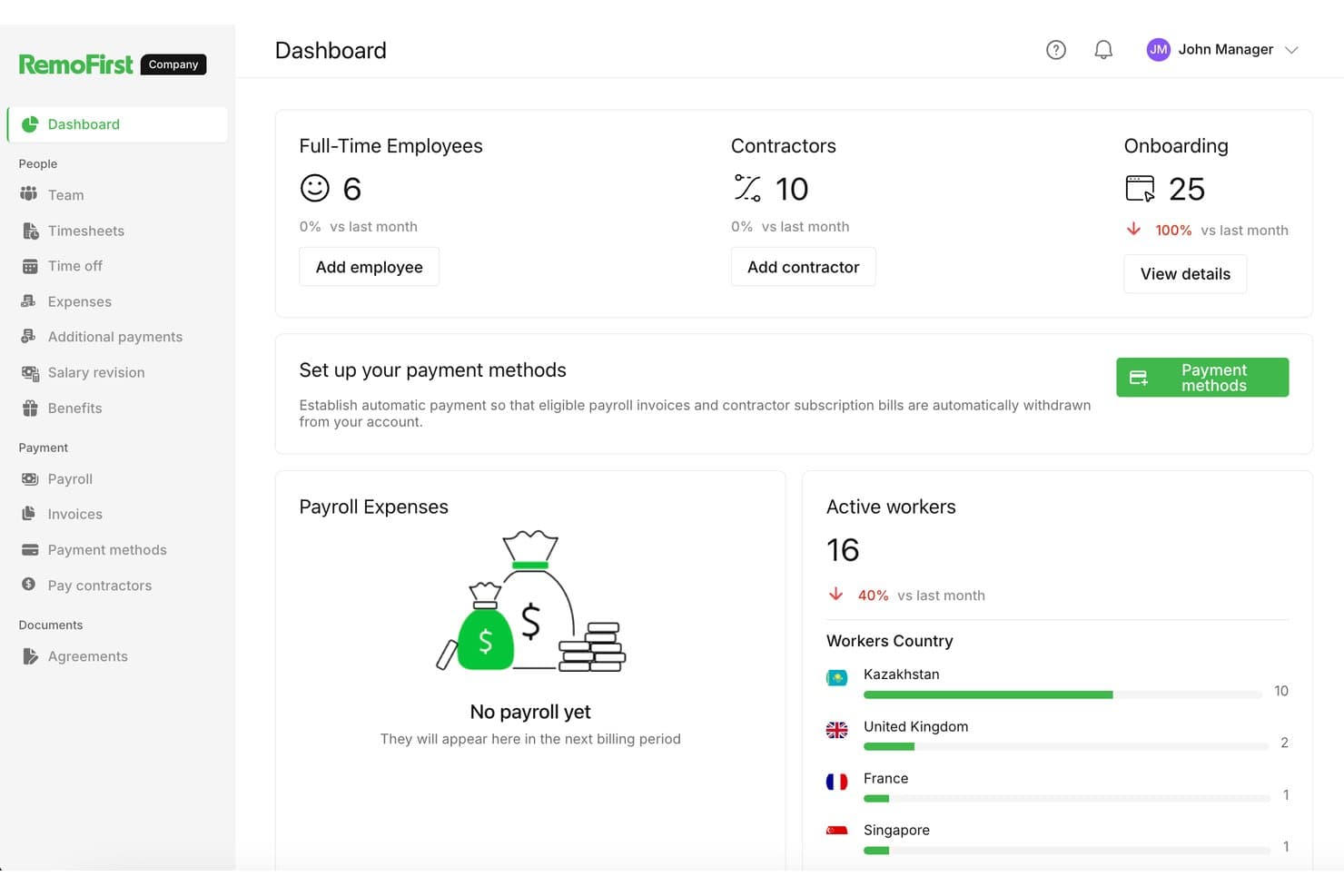
RemoFirst lets users manage global workers from one dashboard. RemoFirst is an employer of record platform that hires and pays full-time employees in Nigeria on your behalf, covering payroll, statutory contributions, locally compliant contracts, and termination guidance without requiring you to set up a local entity.
Who Is RemoFirst Best For?
RemoFirst is a strong fit for startups and small businesses hiring their first Nigerian employee without the budget or bandwidth to establish a local entity.
Why I Picked RemoFirst
I picked RemoFirst as one of the best because it comes with a detailed Nigeria country guide that maps out exactly which statutory contributions apply to your hire, including PAYE, pension (10% employer, 8% employee), NSITF, and ITF obligations. I've found this kind of labor-law transparency genuinely useful when onboarding a first Nigerian employee, since knowing the compliance landscape upfront reduces the risk of costly missteps. RemoFirst also generates locally compliant employment contracts covering indefinite and fixed-term structures, with built-in guidance on probation norms recognized by Nigerian courts.
RemoFirst Key Features
- Partner-based local employment: RemoFirst works with vetted, audited in-country partners to formally employ Nigerian workers on your behalf without requiring a local entity.
- NGN payroll processing: Employees in Nigeria are paid in Nigerian naira (NGN), with client invoicing available in USD, EUR, GBP, CAD, AUD, or SGD.
- Dedicated account management: Every customer, regardless of size or headcount, gets a dedicated account manager plus 24/7 platform support.
- Visa and work permit support: RemoFirst assists with Nigerian Business Visas, Temporary Work Permits, and STR + CERPAC applications, including paperwork, eligibility assessments, and document collection.
RemoFirst Integrations
RemoFirst lists integrations with Workday, BambooHR, GoCardless, and ADP Workforce Now. API availability and the total integration count aren’t documented.
Pros and Cons
Pros:
- Dedicated account manager and 24/7 support
- Locally compliant contract and probation guidance
- Detailed Nigerian statutory contribution guidance
Cons:
- Termination disputes raise cost and communication concerns
- Nigerian partner identity remains undisclosed
 Best for crypto-funded Nigerian payroll
- Free demo available
- From $199/user/month
Visit WebsiteCustomer Rating:4.9/5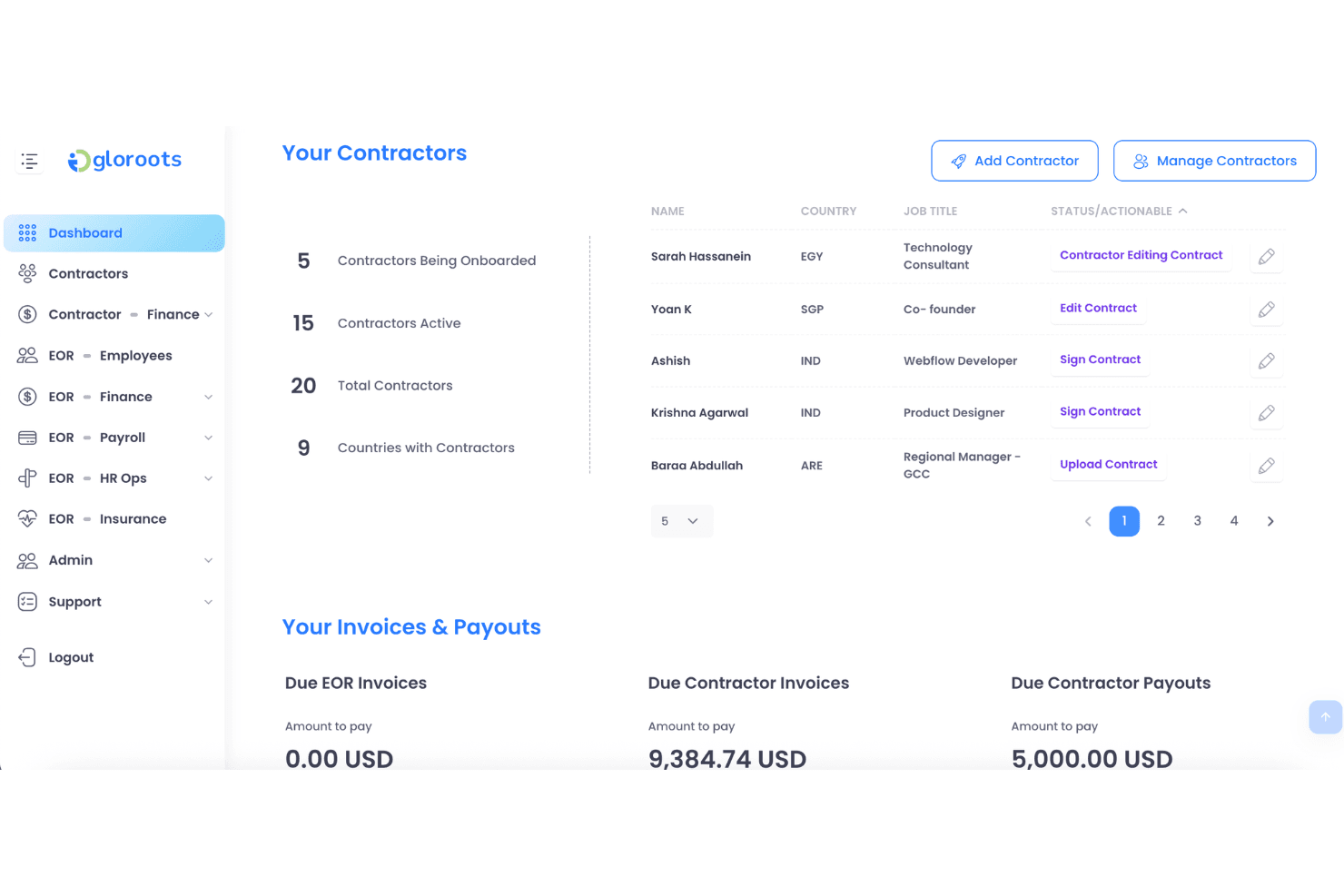
Gloroots lets users manage contractors and track invoices from one dashboard. Gloroots is a global employer of record platform that handles Nigerian payroll, statutory compliance, contract generation, and benefits administration across 150+ countries without requiring you to set up a local entity.
Who Is Gloroots Best For?
Gloroots is a strong fit for startups and lean global teams that want to hire in Nigeria quickly, without entity setup, at a predictable monthly cost.
Why I Picked Gloroots
I've included Gloroots in my top picks because it supports crypto pay-ins for its EOR service, which can be useful for startups managing payroll from digital-asset treasuries. Gloroots also offers Naira payroll, currency conversion, and statutory compliance support for Nigerian employment. I also like that it covers visa and work permit support, including STR visas and CERPAC permits, which is genuinely useful when relocating foreign talent into Nigeria.
Gloroots Key Features
- Employee self-service portal: Employees can manage employment documentation through Gloroots, while payroll records and payslips are accessible through its centralized platform.
- Multi-country coverage: Gloroots supports hiring across 150+ countries from a single platform, so you're not locked into a Nigeria-only tool as your team grows.
- Statutory registration management: Before the first payroll run, Gloroots registers new hires for PAYE, a licensed pension fund administrator, NSITF, and NHIA.
- Free employer cost calculator: A built-in calculator estimates your total employer cost in Nigeria, including statutory contributions like pension, NSITF, and ITF, before you commit to hiring.
Gloroots Integrations
Gloroots lists connections to Workday, SAP SuccessFactors, Oracle, and BambooHR, though native status isn’t clearly documented. Enterprise plans include an API, SSO, and SCIM provisioning for custom connectivity.
Pros and Cons
Pros:
- Crypto pay-ins supported for EOR
- Nigeria-specific statutory filing coverage
- Responsive human support
Cons:
- Few Nigeria-specific independent reviews
- Conflicting statutory compliance thresholds
Learn more about Gloroots:
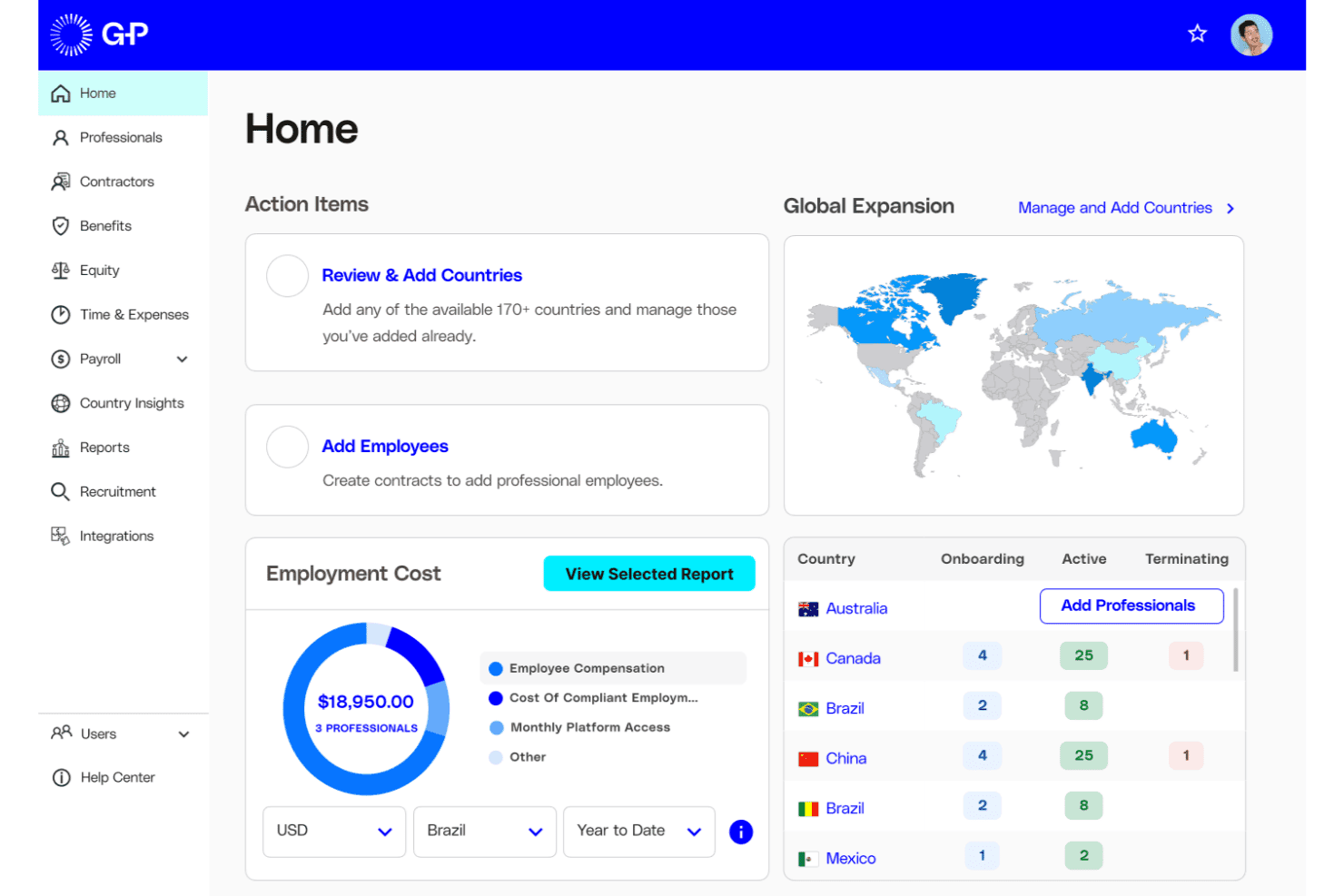
G-P centralizes global workforce management across 170+ countries. G-P is a global employer of record platform that lets you hire workers in Nigeria without setting up a local entity, handling local payroll, statutory contributions, employment contracts, and benefits administration.
Who Is G-P Best For?
G-P is a strong fit for global expansion teams and startup founders who need a recognized, analyst-ranked EOR to hire in Nigeria at a predictable flat monthly fee.
Why I Picked G-P
I picked G-P as one of the best because it's consistently ranked by NelsonHall and Everest Group as an EOR leader, which matters when you need a defensible, credentialed partner for Nigeria hiring. Its Global Compliance Engine generates locally compliant Nigerian contracts automatically, covering statutory requirements like Naira-denominated pay and fixed-term versus indefinite structures. G-P also handles PAYE, pension contributions, NHF, and NSITF directly, so your team isn't tracking those obligations manually.
G-P Key Features
- AI-guided onboarding: G-P walks new Nigerian hires through the onboarding process automatically, including right-to-work checks and contract delivery.
- HCM integrations: Connect G-P directly to platforms like BambooHR, Workday, SAP SuccessFactors, and HiBob to sync employee data across your HR stack.
- Statutory benefits administration: G-P manages mandatory Nigerian benefits including pension contributions, NHF, NSITF, and legally required leave entitlements.
- Role-based access control: Set permissions by user role across your account, so the right people access payroll, contracts, and employee records.
G-P Integrations
G-P offers integrations with BambooHR, HiBob, Personio, SAP SuccessFactors, UKG Pro, UKG Ready, and Workday, plus Google Workspace, Microsoft Entra ID, and Okta. A developer API supports custom integrations.
Pros and Cons
Pros:
- Recognized by NelsonHall and Everest Group
- Reviewers often praise responsive customer support
- Manages Nigerian PAYE, pension, NHF, and NSITF
Cons:
- No Nigerian visa or work-permit support
- Nigeria guidance cites outdated minimum-wage information
Learn more about G-P: Best for Nigeria hiring with built-in tax filing
- Free demo available
- From $499/employee/month

Remote People's Command Center displays employee leave requests. RemotePeople is an employer of record platform that handles entity-free hiring in Nigeria, covering employment contracts, NGN payroll, personal income tax withholding, and statutory contributions including pension, NHIA, NSITF, and ITF.
Who Is RemotePeople Best For?
RemotePeople is a strong fit for HR managers and global expansion teams that need to hire in Nigeria quickly, without the overhead of setting up a local entity.
Why I Picked RemotePeople
RemotePeople earns its spot on my shortlist because it handles Nigeria's statutory tax obligations directly inside the EOR workflow, so there's no separate filing process to manage. I like that it withholds and remits personal income tax by the 21st of the following month, while also administering pension (10%), NHIA (10%), NSITF (1%), and ITF contributions on defined schedules. It also reflects current Nigerian law, noting that NHF contributions are no longer mandatory for private-sector employees following the {{year}} tax reforms.
RemotePeople Key Features
- Labour Act contract generation: Contracts are drafted under the Nigerian Labour Act (Cap L1) in English, with required clauses covering pay, location, hours, leave, and termination.
- Work permit management: RemotePeople collects supporting documents, submits applications to the Nigeria Immigration Service, and tracks the process through to CERPAC issuance.
- Employee self-service portal: Employees access payslips, time-off requests, expense submissions, and employment documents through a dedicated portal.
- Named account manager: Each client is assigned a dedicated account manager, available 24/5 and backed by HR and legal specialists.
RemotePeople Integrations
RemotePeople lists integrations with BambooHR, HiBob HRIS, Personio, ADP Workforce Now, Google Workspace, and Okta, but doesn’t specify whether they’re native or what each connection supports. Its API uses OAuth 2.0 Client Credentials for custom integrations.
Pros and Cons
Pros:
- Reviewers praise guided onboarding and helpful support
- Labour Act contracts specify required employment terms
- Detailed Nigerian tax and contribution schedules
Cons:
- Nigerian employing entity and ownership remain undisclosed
- Some reviewers report delayed or unclear payroll transfers
Learn more about Remote People: Best for transparent pricing on Nigerian hires
- Free demo available
- From $599/per employee/month
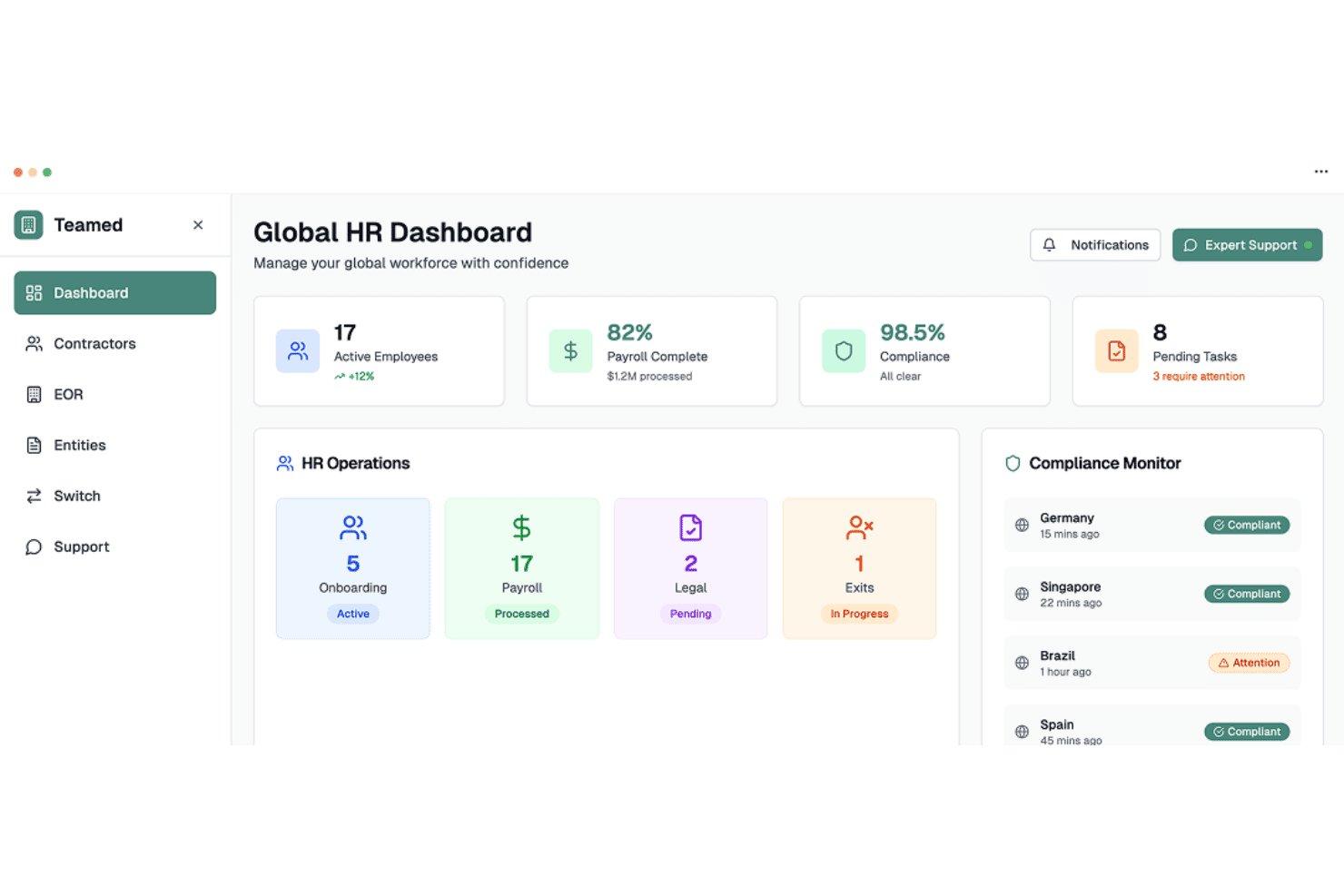
Teamed centralizes global HR operations, payroll, and compliance in one dashboard. Teamed is an employer of record platform that handles legal employment, payroll, tax compliance, and contract generation across 187+ countries, with dedicated country specialists and locally drafted employment contracts for each market.
Who Is Teamed Best For?
Teamed is a good fit for mid-market companies hiring in Nigeria that want flat, predictable pricing with no FX markup and a named local specialist on every account.
Why I Picked Teamed
I picked Teamed as one of the best because its pricing is published, flat, and free of FX markup, which matters when you're paying salaries in naira. You'll see exactly what you're paying: a fixed fee per employee, employer pension contributions at 10% of monthly pay, and statutory deductions passed through at cost. I also like that every account gets a named Nigerian HR and legal specialist, not a ticket queue, so PAYE filings and Labour Act terminations get handled by someone who actually knows Nigerian employment law.
Teamed Key Features
- Lawyer-drafted employment contracts: Local legal specialists prepare contracts aligned with Nigerian employment requirements, with onboarding possible within 24 hours once terms are confirmed.
- Named country specialist: Every account gets access to dedicated HR and legal expertise for Nigerian employment questions, rather than relying solely on automated support.
- Gross-to-net payroll automation: Teamed manages Nigerian payroll calculations, PAYE withholding, pension contributions, and other applicable statutory obligations, with itemized payroll records.
- Contractor-to-EOR-to-entity pathway: Move workers from contractor arrangements to EOR employment and eventually to your own Nigerian entity, with transition support and cost modelling to identify when setting up an entity makes financial sense.
Teamed Integrations
Teamed lists 19 integrations, including Personio, BambooHR, HiBob, Workday, QuickBooks, Xero, Sage, Greenhouse, Okta, and Zapier; only Personio has published sync documentation. There’s no self-serve public API, so confirm availability for your HR or payroll stack during onboarding.
Pros and Cons
Pros:
- G2 reviewers praise responsive human support
- NGN payroll without FX markup
- Named Nigerian HR and legal specialist
Cons:
- Requires a refundable deposit equal to one month's gross salary, plus upfront funding of the first month's employment costs
- G2 reviewers report delayed onboarding contracts
Learn more about Teamed: Best for dedicated HR and employee support in Nigeria
- Free demo available
- From $399/employee/month
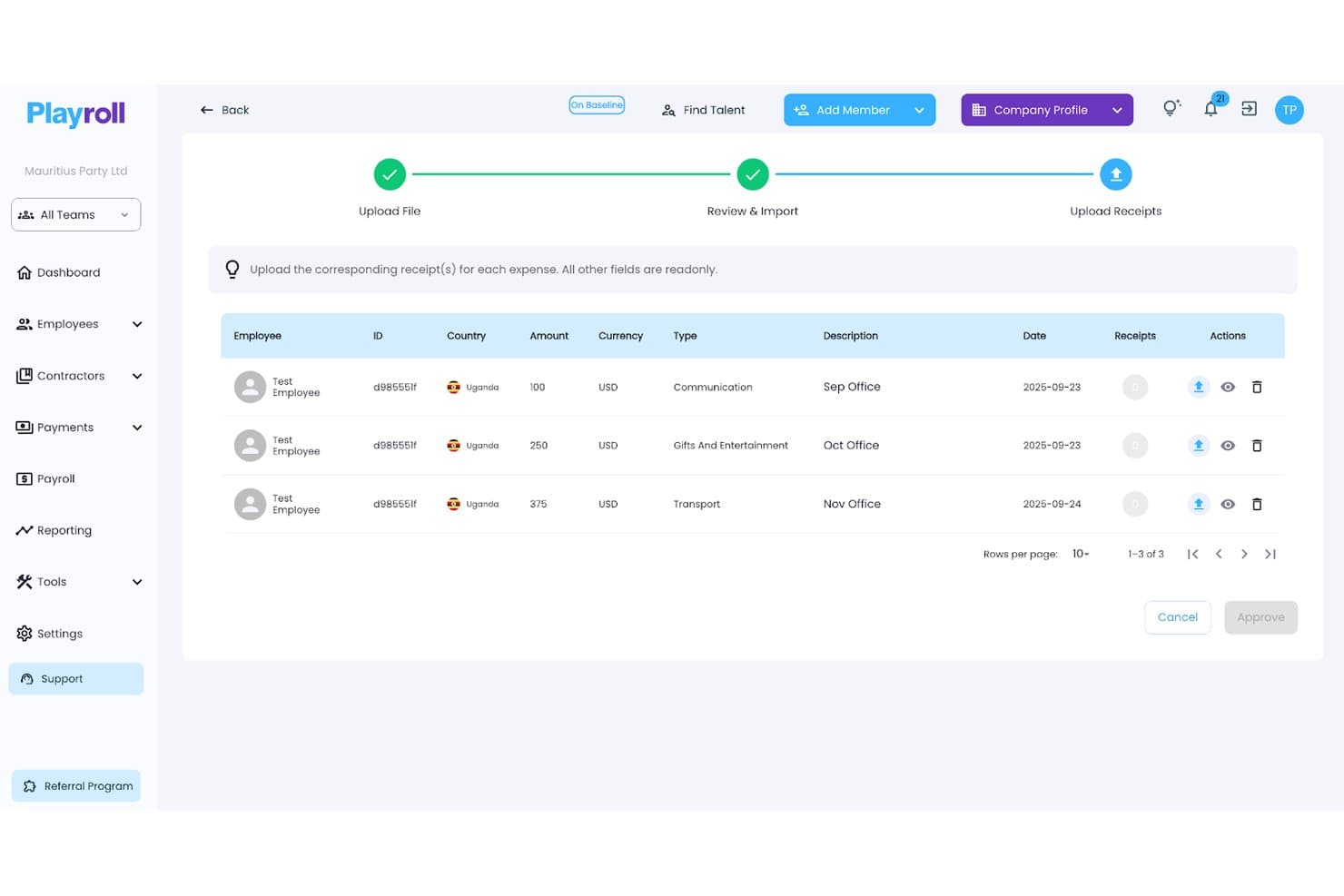
Playroll lets users bulk upload expense receipts with a three-step import flow. Playroll is an employer of record platform covering Nigeria and 180+ countries, handling local employment contracts, PAYE and statutory filings, Naira payroll, and compliance management for pension, NSITF, NHF, and ITF obligations.
Who Is Playroll Best For?
Playroll is a strong fit for HR teams and startup founders hiring their first Nigerian employees who want dedicated, named support contacts alongside compliance handling.
Why I Picked Playroll
I picked Playroll as one of the best because it assigns both a dedicated Customer Success Manager and a dedicated Employee Success Manager to every account, which means your Nigerian hires get a named human contact for HR queries, not a support queue. I love that this dual-support model extends to employees directly, covering payslips, leave requests, and onboarding questions without routing everything through your internal team. Playroll also handles applicable PAYE, pension, NSITF, NHF, and ITF obligations in Nigeria, coordinating filings and remittances according to local requirements.
Playroll Key Features
- Labour Act–aligned contract generation: Playroll drafts employment contracts in English that include required clauses on pay, hours, leave, notice periods, and termination grounds.
- Multi-statutory filing management: Playroll manages applicable PAYE, pension, NSITF, NHF, and ITF registrations, filings, and remittances according to Nigerian requirements.
- Employee self-service portal: Your Nigerian hires can access payslips, documents, time-off requests, and expense submissions directly through the platform.
- Entity setup pathway: Playroll offers a route to transition from EOR to establishing your own in-country legal entity as your Nigeria headcount grows.
Playroll Integrations
Playroll documents integrations with BambooHR, HiBob, Expensify, and Mesh. It also offers an API for custom integrations.
Pros and Cons
Pros:
- Lagos presence supports African expansion
- Nigeria-specific PAYE, pension, and NSITF filings
- Named CSM and ESM support employees directly
Cons:
- Nigeria-specific supplemental benefits remain unclear
- Conflicting Nigerian tax, wage, and onboarding guidance
Learn more about Playroll: Best for Nigerian payroll with project-site cover
- Not available
- From $199/employee/month

Africa Deployments offers compliant HR and payroll across 50+ African countries from $199/month. Africa Deployments is an Africa-focused employer of record service covering 50+ countries, with Nigeria-specific payroll processing, statutory compliance, employment contracts, benefits administration, and termination support.
Who Is Africa Deployments Best For?
Africa Deployments is a good fit for HR teams and global companies hiring in Nigeria that want local payroll, statutory compliance, and employment support from a provider specializing in African markets.
Why I Picked Africa Deployments
I included Africa Deployments because it combines Nigerian employment administration, payroll, statutory compliance, and immigration assistance with broader workforce support across Africa. Its Nigeria EOR service covers employment contracts, benefits, tax withholding, and offboarding, while its additional cross-border payment and invoice settlement services can help companies manage international financial operations.
Africa Deployments Key Features
- Nigerian payroll and tax administration: Processes local payroll, PAYE withholding, pension and NHF contributions, and payslip generation for employees hired through its Nigerian EOR service.
- Payroll compliance support: Coordinates Nigerian tax deductions, statutory remittances, and payroll documentation to help employers meet local reporting obligations.
- Work permit and visa processing: Manages work permit applications, cross-border relocation, and visa documentation for international employees hired in Nigeria.
- Multi-currency invoice settlement: Offers a separate invoice settlement service supporting conversions from African currencies into USD, EUR, GBP, and AUD for international payments.
Africa Deployments Integrations
Africa Deployments does not publicly list named native integrations or a customer-facing API marketplace. Its payroll guidance discusses HRIS connectivity, bank connectors, and APIs, but buyers should confirm the available integration options for their Nigerian EOR arrangement.
Pros and Cons
Pros:
- Expat permit support for field operations
- Cross-border payments and invoice settlement available
- Nigerian payroll includes statutory deduction checks
Cons:
- Few independent reviews verify service quality
- Nigerian entity ownership remains unclear
Learn more about Africa Deployments: 10Best for all-in-one HR and payroll in Nigeria
Rippling
- Free trial + free demo available
- From $8/user/month
Visit WebsiteCustomer Rating:4.9/5
Rippling manages global payroll across multiple countries from one dashboard. Rippling is an all-in-one HR and EOR platform that combines local employment, payroll processing, contract generation, benefits administration, and IT management across 80+ countries, including Nigeria.
Who Is Rippling Best For?
Rippling is a strong fit for global expansion teams that already use—or want—a single platform to manage HR, IT, and payroll across multiple countries.
Why I Picked Rippling
I've included Rippling in my top picks because it's the only platform where HR, payroll, and IT management sit in one place, which matters when you're scaling across multiple countries at once. For Nigeria specifically, Rippling's EOR service manages local payroll and compliance obligations, including PAYE, pension contributions, and NSITF, through its centralized platform. It also generates localized employment agreements during onboarding.
Rippling Key Features
- Global EOR payroll: Manage employee payroll across multiple countries through Rippling's centralized platform, with local payroll processing and tax compliance support for Nigerian EOR employees.
- IT and device management: Provision and deprovision app access and wipe devices as part of employee onboarding and offboarding workflows.
- Workflow automation: Automate HR tasks like benefits enrollment and access permissions using built-in triggers tied to employment events.
- Employee self-service portal: Employees access pay stubs, documents, time off balances, and HR policies through a mobile app and web dashboard.
Rippling Integrations
Native integrations with specific third-party vendors aren’t clearly documented for Rippling’s Nigeria EOR. The service operates within Rippling’s unified HR, payroll, benefits, time tracking, expenses, performance, IT, and spend platform.
Pros and Cons
Pros:
- Reviewers praise onboarding and offboarding automation
- Fast payroll cycles with local-currency payouts
- Unified HR, payroll, and IT management
Cons:
- IT and device management require separately priced products.
- Nigeria hiring guide still displays outdated PAYE tax bands.
Other Employers of Record in Nigeria
Here are a few additional options that didn’t make my shortlist but are still worth checking out:
- 11MultiplierBest for multi-currency Nigerian worker payouts
- 12WorkMotionBest for Nigerian compliance with HRIS sync
- 13PeblBest for Baker McKenzie-backed Nigerian compliance
- 14Papaya GlobalBest for banking-grade Naira payroll at scale
- 15RemoteBest for hiring in Nigeria with USD payout option
- 16Atlas HXMBest for direct-entity EOR across Africa
- 17Safeguard GlobalBest for multi-country African workforce expansion
- 18Payoneer Workforce ManagementBest for SMB hiring in Nigeria via Payoneer
- 19Native TeamsBest for low-cost Nigeria hiring without lock-in
- 20OysterBest for startup teams hiring Nigerian talent fast
Related Reviews
How I Evaluate Employers of Record in Nigeria
I split my evaluation into three parts. First, core functionality—specifically whether a provider can legally employ workers in Nigeria and manage statutory compliance like PAYE, pension, and NSITF contributions; this carries the most weight. Second, I look for standout features like multi-currency payout options. Third, I consider pricing transparency and support responsiveness.
Core Functionality (Table Stakes For This List)
When I'm selecting tools for my list, I score each one on a scale from 0 (does not offer the functionality) to 5 (excels in this area) for each core functionality listed below. I then convert the total into a percentage to help assess each tool's overall fit, with extra weight on any functionalities I've deemed essential.
- Local Legal Employment (Essential): I check whether the provider employs workers through its own Nigerian entity or a disclosed local partner, since this affects accountability and employee security.
- Nigerian Compliance Management (Essential): I evaluate how well each provider handles PAYE, pension (PenCom), NHF, and NSITF contributions and whether it monitors regulatory changes proactively.
- Payroll Processing: Accurate, timely payroll in Naira matters, so I look at each provider's payroll automation, tax deduction handling, and multi-currency payout options.
- Contract Generation: I look for localized, editable employment contracts that reflect Nigerian labor terms rather than generic global templates requiring heavy manual adjustments.
- Benefits Administration: Providers should administer both statutory and supplemental benefits in Nigeria, so I evaluate enrollment workflows and how much is automated vs. manual.
- Termination and Offboarding: I consider whether a provider guides compliant terminations, calculates severance correctly, and helps manage the legal risk involved in ending employment.
Once I have a list of tools that meet the criteria, I consider what sets each platform apart.
Differentiating Factors (What Sets Vendors Apart)
Here's how I compare and contrast different vendors:
Standout Features
Multi-currency payout options matter a lot in Nigeria, where Naira volatility can erode take-home pay. I check whether a provider lets workers receive salary in USD or other currencies alongside Naira. Rapid onboarding timelines are equally important—providers like Multiplier and Remote can get hires employed within days, which beats the weeks you'd spend registering your own entity. I also evaluate whether each provider offers an employee self-service portal with localized payslips, tax documents, and leave requests, since that directly reduces HR admin load across time zones.
Beyond Features
I check whether a provider owns its Nigerian entity or relies on a third-party partner, since owned subsidiaries give you more direct accountability if a compliance issue arises. Pricing structure matters just as much—some providers bundle statutory contributions and FX conversion into one fee, while others charge separately, so I look for clear breakdowns before headcount grows. I also evaluate support responsiveness, because a payroll error in Lagos can't wait for a team in a distant time zone to start their day.
How to Choose an Employer of Record in Nigeria
Choose an EOR by matching its Nigerian employment arrangement to your compliance exposure, pay requirements, and employee terms. Verify the underlying documents and responsibilities before weighing the proposal.
| If your priority is… | Look for… |
|---|---|
| If your priority is…Local accountability | Look for…A named Nigerian employing entity and a clear explanation of its role |
| If your priority is…Statutory deductions | Look for…Written responsibility for PAYE, pension, NHF, and NSITF contributions |
| If your priority is…Predictable take-home pay | Look for…Written details on payout currency, exchange-rate basis, and transfer fees |
| If your priority is…Clear employee terms | Look for…A localized contract and benefits schedule covering statutory and supplemental benefits |
How to Vet Your Shortlist
- Confirm the employer: Request the Nigerian entity’s legal name and registration details, then compare them with the contracting entity in the draft agreement.
- Map statutory duties: Ask for a responsibility matrix and sample payslip showing employee deductions, employer contributions, and payment dates.
- Test a compliance question: File a support ticket about how the provider handles a specific Nigerian payroll scenario, and request a written answer within five business days.
- Review employment terms: Request a draft contract and offboarding clause; check notice, leave, termination calculations, and responsibility for required final payments.
- Choose your tradeoff: Prefer an owned Nigerian entity when direct local accountability matters most; consider a disclosed partner arrangement when its responsibilities and escalation route are acceptable to your team.
What Are Employers of Record in Nigeria?
An employer of record in Nigeria is a third-party organization that legally employs workers on your behalf and manages local employment administration. It can handle payroll, tax deductions, statutory contributions, and employment documents while your team directs the workers’ day-to-day work. This arrangement lets you hire in Nigeria without establishing a local entity, but you should confirm the provider’s legal role and responsibilities in writing.
Features
Here are the main features I look for in an employer of record in Nigeria:
- Local legal employment: The provider employs your team through its own Nigerian entity or a disclosed local partner. Ask for the entity’s legal name and confirm its responsibilities in your agreement.
- Nigerian payroll and statutory deductions: The provider calculates payroll in naira and handles applicable PAYE, pension, NHF, and NSITF obligations. Request a sample payslip and a schedule of payment and remittance dates.
- Localized employment contracts: Contracts should reflect Nigerian employment terms, including compensation, leave, notice, and other applicable conditions. Review a draft before hiring to check that it matches the role and your agreed terms.
- Benefits administration: The provider manages required benefits and any supplemental benefits included in your offer. Clear enrollment steps and a written benefits schedule help you and your employees understand coverage and responsibilities.
- Onboarding support: The service coordinates employment documents, required employee information, and payroll setup before the start date. Defined steps and timelines help your HR team plan each hire.
- Employee self-service: A portal can give employees access to payslips, tax documents, and leave requests. Check which records employees can view and update, and whether the portal supports your team’s needs.
- Termination and offboarding: The provider should explain notice requirements, final pay calculations, and the process for ending employment. Written guidance helps your team handle departures consistently and identify issues that need local advice.
- Compliance updates and support: The provider should explain how it tracks changes to Nigerian employment and payroll requirements and who handles questions. Confirm how to raise an issue and when to expect a written response.
Benefits
Here are a few common benefits of using an employer of record in Nigeria:
- Entity-free hiring: An EOR can employ workers through its Nigerian entity or a disclosed local partner, so your business can hire without establishing its own local entity.
- Local compliance support: Services that manage PAYE, pension, NHF, and NSITF obligations can help your team handle Nigerian payroll requirements.
- Managed payroll: Payroll processing in naira, statutory deductions, and documented payout schedules give your team a clearer process for paying employees.
- Localized employment terms: Nigerian employment contracts and onboarding support help document agreed compensation, leave, and other terms from the start.
- Benefits administration: A provider can coordinate statutory and supplemental benefits, with a written schedule to clarify what employees receive.
- Employee access to records: A self-service portal can give workers access to payslips, tax documents, and leave requests.
- Guided offboarding: Written guidance on notice, final pay, and termination steps helps your team manage employee departures consistently.
Costs and Pricing
Nigeria EOR pricing varies by provider, employee count, hiring country, and included services. Among the providers reviewed, published starting fees range from $199 to $599 per employee per month, while some require custom quotes.
These are EOR service fees, not total employment costs. Employee salaries, statutory employer contributions, benefits, and optional services may be charged separately.
Plan Comparison Table for Employer of Record in Nigeria
Most EOR providers charge a recurring fee per employee rather than offering personal or business software plans. Free demos or consultations may be available, but they don't include employment services. Here's how the main pricing models compare.
| Service Type | Typical Price | Common Features |
|---|---|---|
| Service TypeFree Demo or Consultation | Typical PriceFree | Common FeaturesPlatform walkthrough, Nigeria hiring consultation, and personalized pricing quote. No EOR employment services included. |
| Service TypeStandard EOR Service | Typical PricePublished starting fees of $199–$599/employee/month among reviewed providers | Common FeaturesLocal employment contracts, payroll processing, statutory compliance, benefits administration, and employee support. |
| Service TypeMulti-Country or Enterprise EOR | Typical PriceCustom quote, typically priced per employee/month | Common FeaturesMulti-country payroll administration, centralized reporting, compliance support, and potentially advanced integrations. |
| Service TypeOptional Services and Add-Ons | Typical PriceQuoted separately | Common FeaturesImmigration, recruitment, equipment provisioning, supplemental benefits, and other specialized support. |
FAQs
Here are answers to common questions about employers of record in Nigeria:
Is using an EOR in Nigeria legal?
Yes, companies can use an EOR arrangement in Nigeria, but the provider’s actual role matters. Confirm which Nigerian entity employs the worker and what responsibilities the EOR accepts. Review the employment contract and service agreement together, especially the terms for payroll, statutory contributions, supervision, and termination. Don’t rely on a general promise of local compliance. If your arrangement involves unusual work, regulated activities, or cross-border assignments, ask a Nigerian employment adviser to review it.
How long does it take to onboard an employee through a Nigerian EOR?
There’s no single onboarding timeline; it depends on the provider and the employee’s circumstances. Contract review, identity and payroll information, benefit choices, and any required work authorization can affect the start date. Ask the EOR for a written sequence of steps, named owners, and target dates before confirming a start date. Also check what happens if documents arrive late, and when the first salary will be paid. That helps you set clear expectations with the new hire.
Can a Nigerian EOR hire contractors too?
An EOR arrangement is generally designed for employees, while contractor engagements use a different relationship and documentation. Don’t assume a provider’s contractor service makes a role correctly classified. Ask how it assesses the working arrangement, who prepares the agreement, and who handles tax or reporting obligations. Describe the person’s actual duties, schedule, and level of direction when seeking guidance. If the role resembles employment, get local advice before treating the worker as a contractor.